
Life, 1917-10-04 · page 27 of 44
Life — October 4, 1917 — page 27: what you’re looking at
What you’re looking at
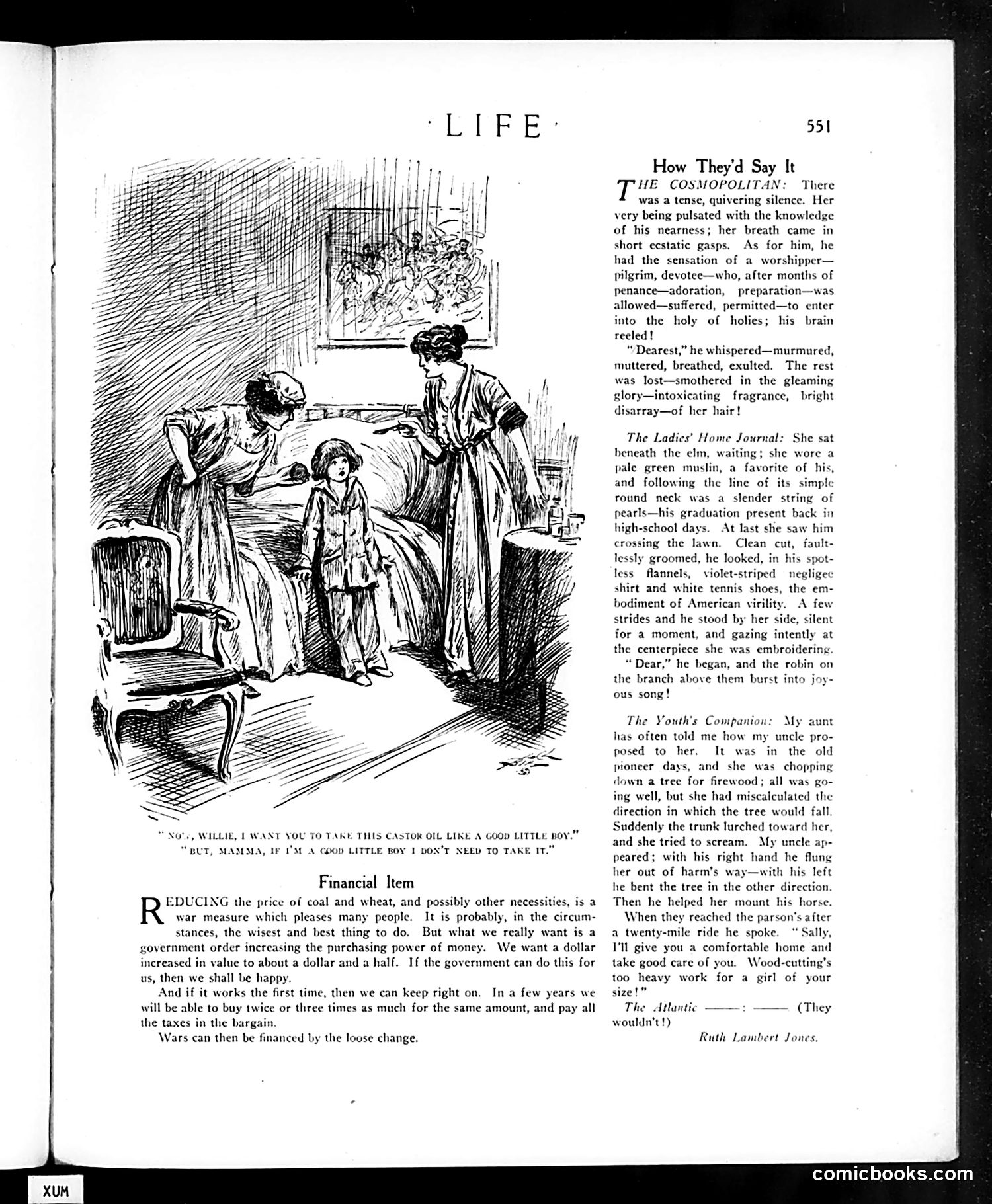
The main cartoon depicts a mother forcing castor oil on a reluctant child named Willie. His protest—"if I'm a good little boy I don't need to take it"—is a humorous logical argument against the unpleasant medicine. The joke relies on childhood reasoning and parental exasperation. Below, "Financial Item" satirizes wartime economic policy, proposing absurdly that the government increase a dollar's value to $1.50, then repeat indefinitely so citizens could "finance wars with loose change"—mocking the contradiction between reducing prices (a war measure) and needing actual purchasing power growth. The "How They'd Say It" section parodies how different 1910s-1920s magazines describe the same romantic moment—from *Cosmopolitan's* breathless, flowery prose to *Ladies' Home Journal's* genteel sentimentality to *Youth's Companion's* practical frontier story. It satirizes each publication's distinct voice and target audience.
📄 Transcribed text from this page (OCR, searchable)
Machine-transcribed from the original scan — historical spelling and the odd misread are preserved.
ee _ -XUM NO's, WILLIE, E WANT YOU TO TAKE THIS CASTOR OIL LIKE A GOOD LITTLE Boy.” “BUT, MAMMA, IF I'M A GOOD LITTLE BOY I DON’T NEED TO TAKE IT.” Financial Item DUCING the price of coal and wheat, and possibly other necessities, is a R war measure which pleases many people. It is probably, in the circum- stances, the wisest and best thing to do. But what we really want is a government order increasing the purchasing power of money. We want a dollar increased in value to about a dollar and a half. If the government can do this for us, then we shall be happy. And if it works the first time, then we can keep right on. In a few years we will be able to buy twice or three times as much for the same amount, and pay all the taxes in the bargain. Wars can then be financed by the loose change. 551 How They'd Say It HE COSMOPOLI : There was a tense, quivering silence. Her very being pulsated with the knowledge of his nearness; her breath came in short ecstatic gasps. As for him, he had the sensation of a worshipper— pilgrim, devotee—who, after months of penance—adoration, preparation—was allowed—suffered, permitted—to enter into the holy of holies; his brain reeled! “ Dearest,” he whispered—murmured, muttered, breathed, exulted. The rest was lost—smothered in the gleaming glory—intoxicating fragrance, bright disarray—of her hair! The Ladies’ Home Journal: She sat beneath the elm, waiting; she wore a pale green muslin, a favorite of his, and following the line of its simple round neck was a slender string of pearls—his graduation present back in high-school days. At last she saw him crossing the lawn. Clean cut, fault- lessly groomed, he looked, in his spot- less flannels, violet-striped negligec shirt and white tennis shoes, the em- bodiment of American virility. A few strides and he stood by her side, silent for a moment, and gazing intently at the centerpiece she was embroidering “Dear,” he began, and the robin on the branch above them burst into joy- ous song! The Youth's Companion: My aunt has often told me how my uncle pro- posed to her. It was in the old pioneer days, and she was chopping down a tree for firewood; all was go- ing well, but she had miscalculated the direction in which the tree would fall. Suddenly the trunk lurched toward her, and she tried to scream. My uncle ap- peared; with his right hand he flung her out of harm's way—with his left he bent the tree in the other direction. Then he helped her mount his horse. When they reached the parson’s after a twenty-mile ride he spoke. “Sally, I'll give you a comfortable home and take good care of you. Wood-cutting’s too heavy work for a girl of your size!” The Atlantie —— wouldn't!) —— (They Ruth Lambert Jones. comicbooks.com