
A complete issue · 42 pages · 1917
Life — April 19, 1917
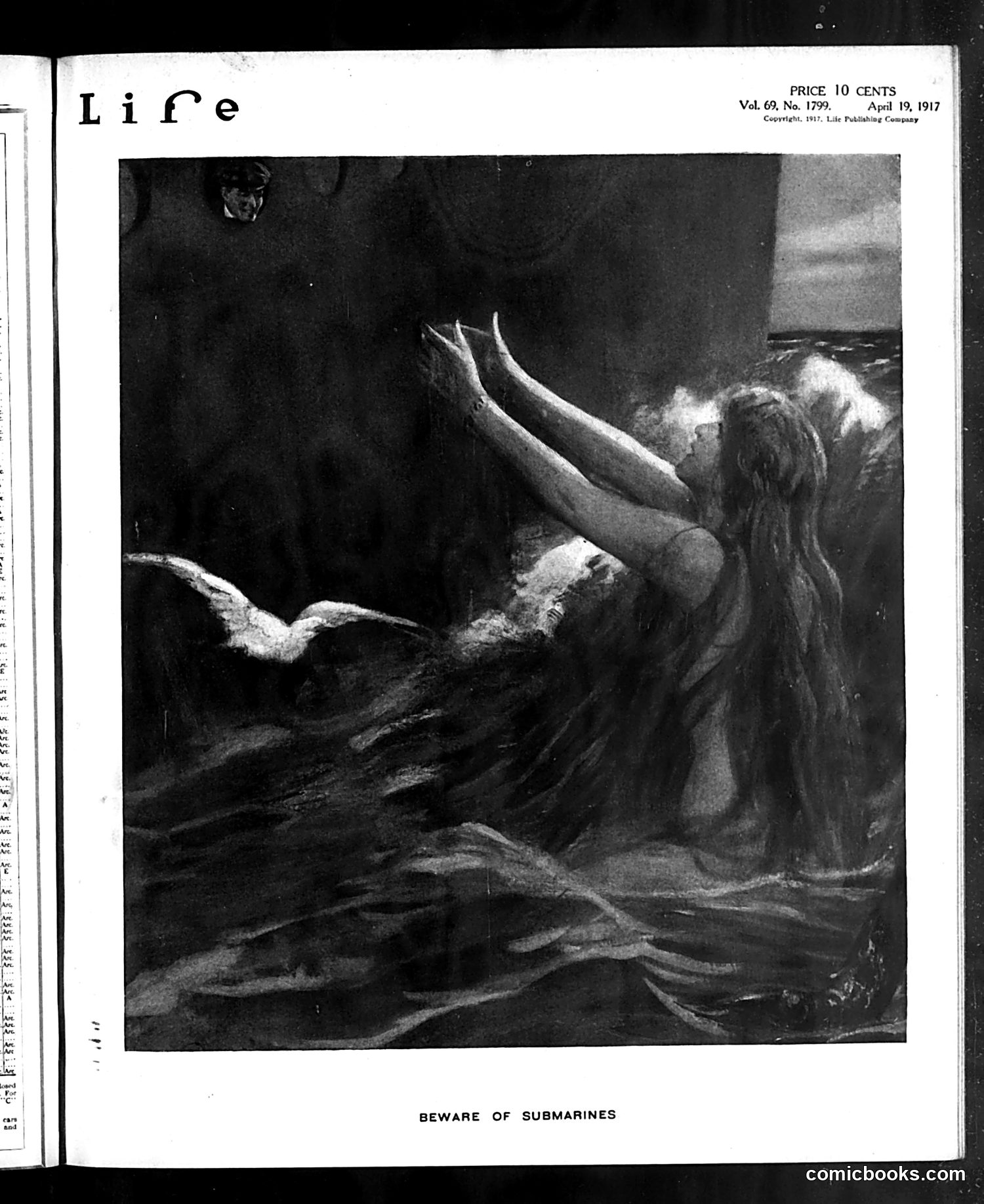
This is a political cartoon from April 19, 1917—just days after the U.S. entered World War I. The image depicts a mermaid or sea creature with long hair being pulled underwater by what appears to be a submarine or tentacled sea monster emerging from dark waters. The cartoon uses the classical "mermaid luring sailors" mythology as a metaphor for German submarine warfare, which had killed American civilians and merchant sailors. By portraying the submarine threat as a dangerous, seductive force pulling victims to their doom, the illustration warns Americans of the deadly U-boat menace that justified U.S. entry into the war. The imagery equates submarine danger with mythological peril—something treacherous and inescapable lurking beneath the surface.
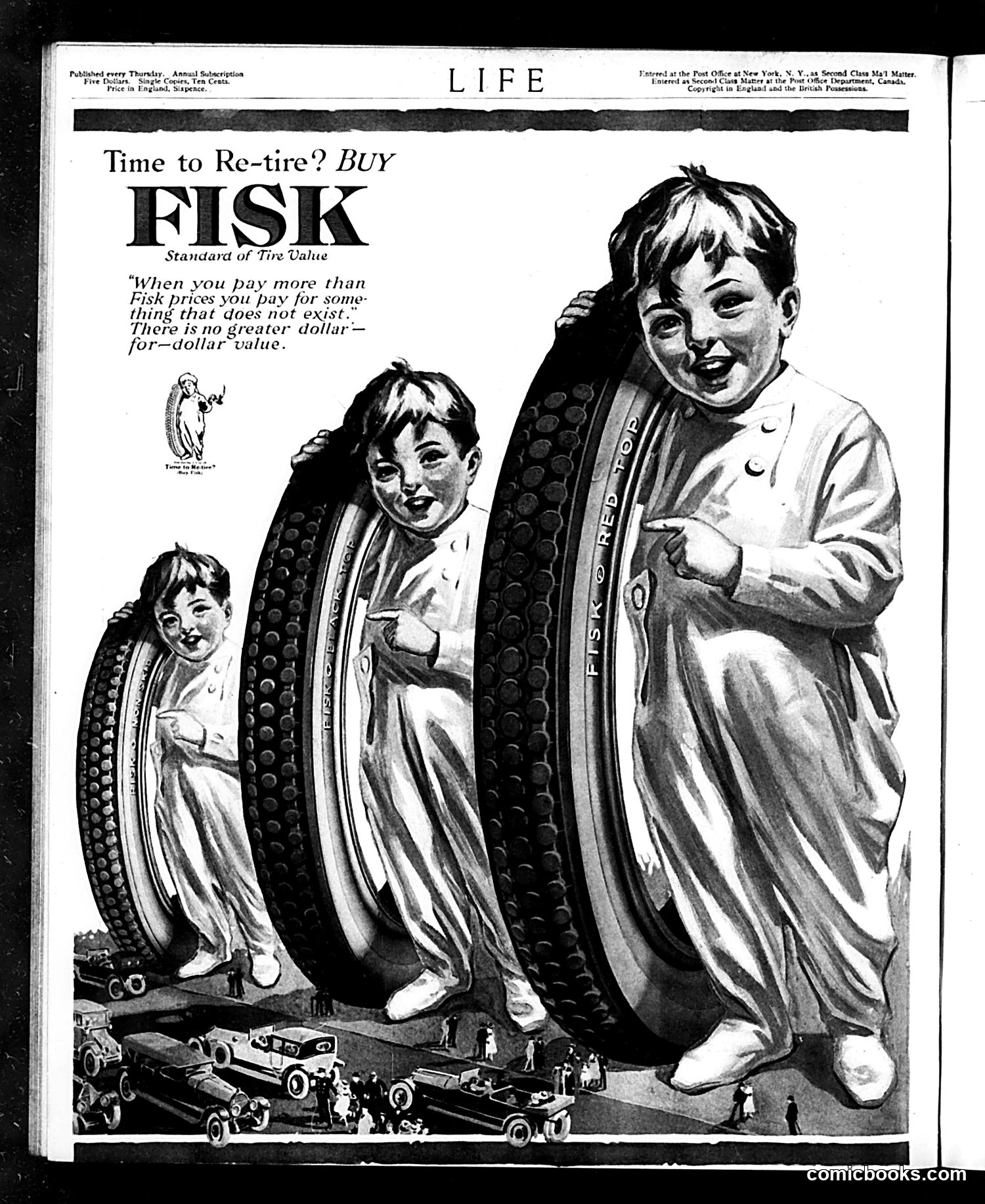
This is a **Fisk Tires advertisement**, not political satire. The image shows three cherubic children of increasing size, each wearing or positioned with a Fisk tire labeled "FISKO RED TOP." Toy cars and figures appear at the bottom. The ad's message plays on the sales pitch: "When you pay more than Fisk prices you pay for a thing that does not exist. There is no greater dollar-for-dollar value." The visual metaphor suggests that Fisk tires offer exceptional durability and growth potential—as children grow, Fisk tires grow with them (or last through multiple generations). The Fisk Rubber Company's mascot, the "Fisk Boy" (the small figure upper left), was their trademark symbol used in early-20th-century advertising to convey reliability and longevity.
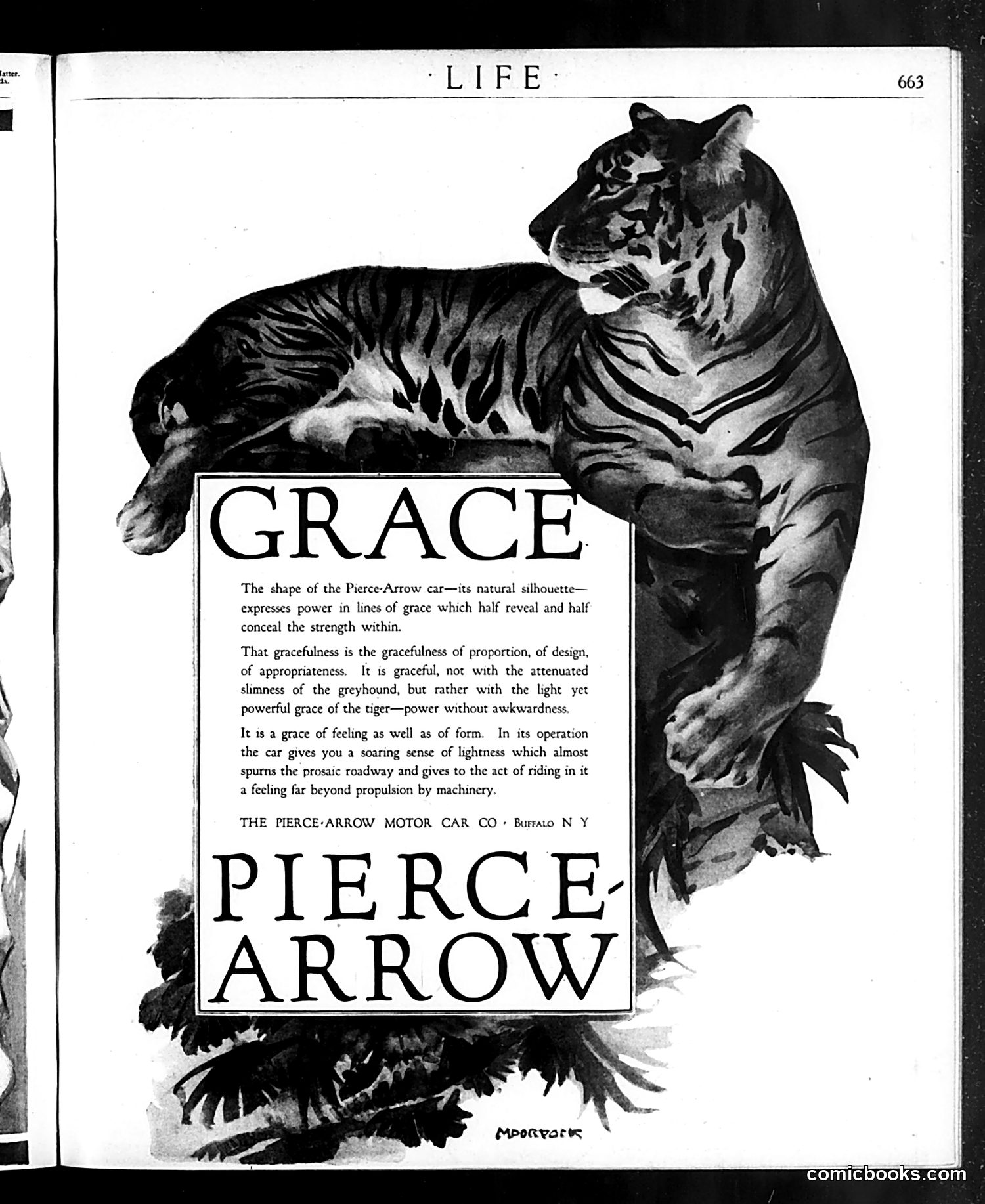
This is **not political satire or comics**, but rather a **luxury automobile advertisement** from *Life* magazine (page 663). The Pierce-Arrow Motor Car Company uses a tiger as a metaphor for their vehicle, emphasizing "grace"—defined as power combined with elegant proportions and effortless performance. The advertisement compares the car's design to the tiger's natural beauty: strength without awkwardness. The text appeals to early 20th-century automotive buyers by suggesting the Pierce-Arrow offers both mechanical superiority and an almost spiritual driving experience—"a feeling far beyond propulsion by machinery." This represents typical high-end advertising strategy: associating a luxury product with natural elegance and refined power rather than mere technical specifications.
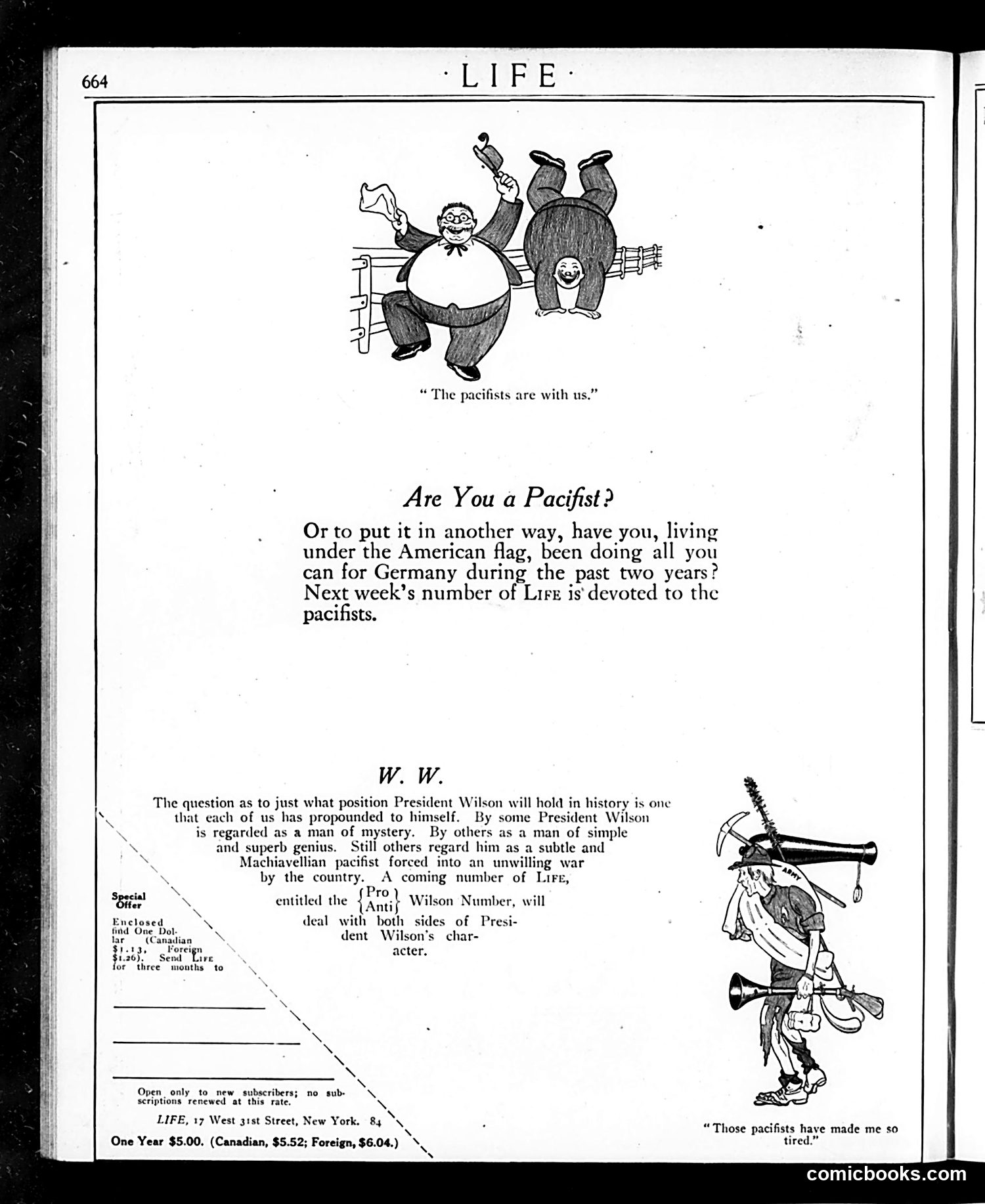
**Top Cartoon:** A rotund figure labeled "The pacifists are with us" depicts a cheerful man alongside what appears to be a German soldier, suggesting ironic alliance between American pacifists and Germany. **"Are You a Pacifist?" Section:** The text provocatively questions whether pacifists living under the American flag have truly supported Germany over the past two years—a wartime accusation linking pacifism to enemy sympathy. This reflects WWI-era hostility toward peace advocates. **"W.W." Section:** Announces a forthcoming "Anti-Wilson Number," suggesting Life will critique President Wilson's character and policies from multiple perspectives. **Right Cartoon:** A weary figure states "Those pacifists have made me so tired," expressing public frustration with pacifist opposition during wartime. **Context:** This reflects early 20th-century American tensions over neutrality versus war participation, when pacifism was often portrayed as unpatriotic or pro-German.
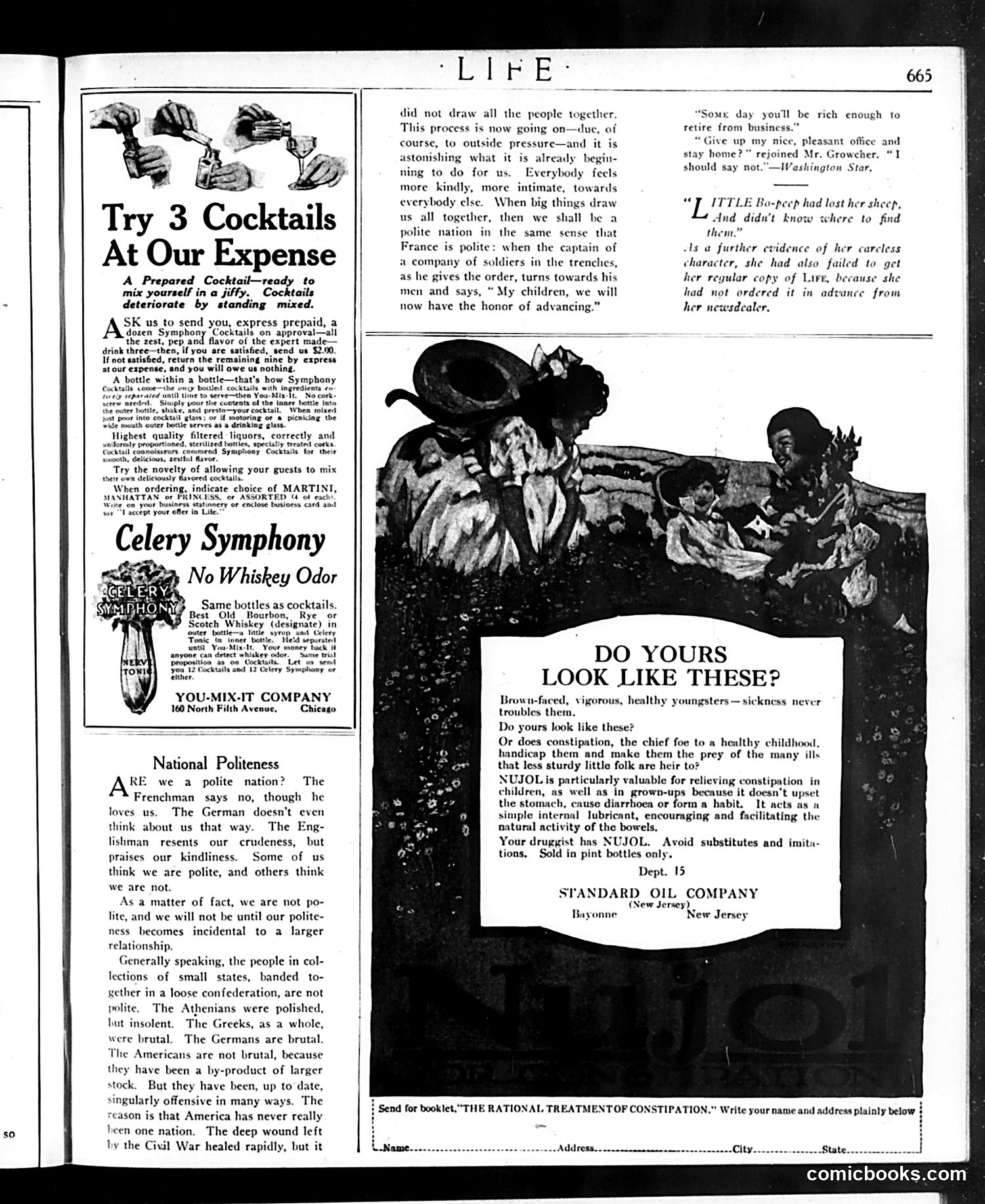
This page is primarily **advertising and editorial content** rather than political satire. The left side features cocktail advertisements ("Try 3 Cocktails At Our Expense") and liquor products (Celery Symphony whiskey). The main editorial piece, "National Politeness," discusses American civility and manners, comparing Americans favorably to other nations historically. It argues Americans are polite despite being "a by-product of larger stock," referencing post-Civil War social development. The right side contains a medical advertisement for **Nujol laxative**, showing an unhealthy child and promoting the product as a constipation remedy "particularly valuable for nursing mothers." The page reflects early 20th-century consumer culture and period medical advertising practices rather than political cartoon satire.
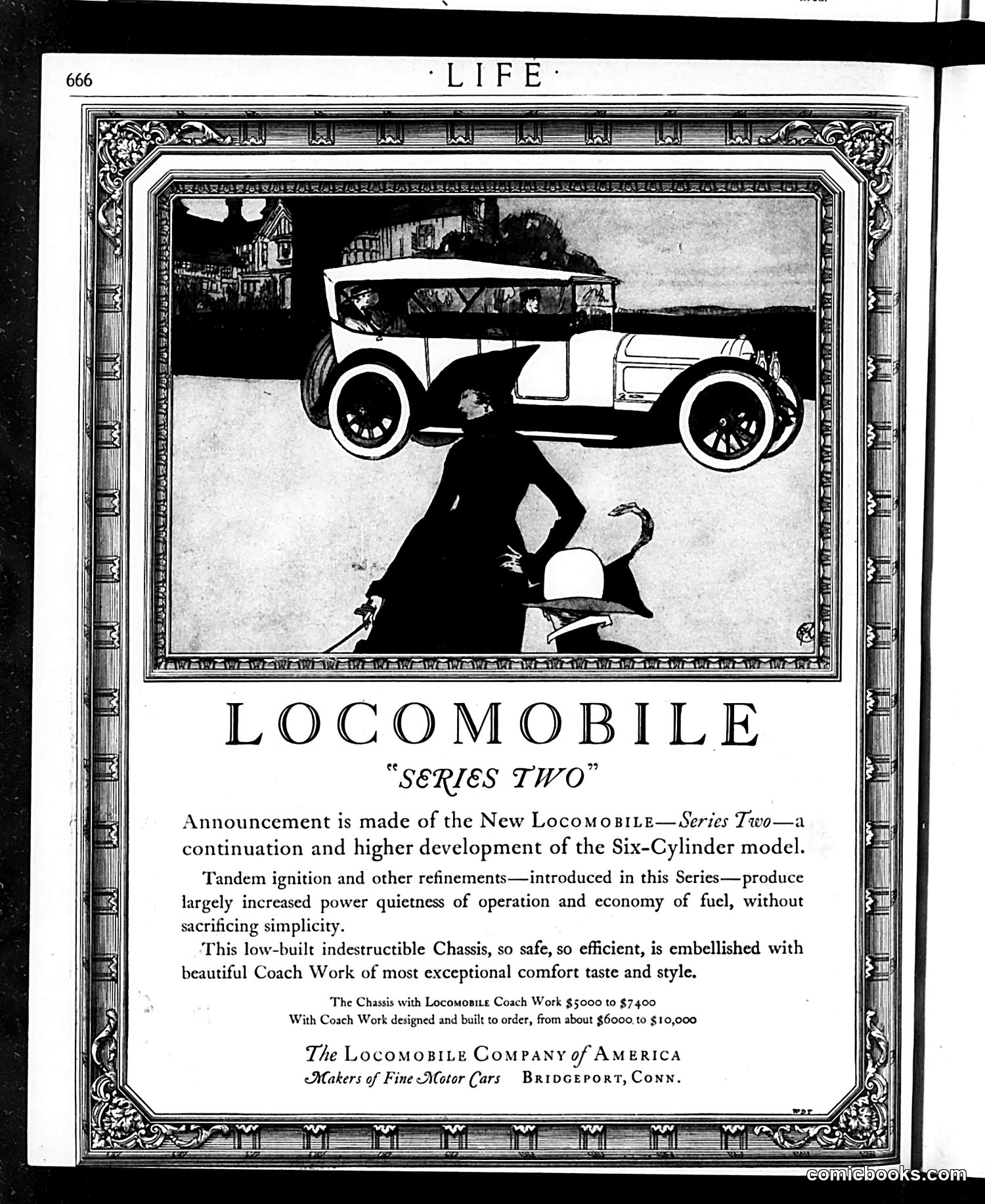
This page is primarily an **advertisement**, not satire or editorial content. It promotes the Locomobile Company's "Series Two" automobile—a six-cylinder car marketed as a refined, powerful vehicle with improved ignition systems and fuel economy. The accompanying illustration shows a stylishly dressed woman in silhouette alongside the car, likely appealing to affluent consumers. The woman's elegant pose and fashionable attire suggest the car's status as a luxury product for the well-to-do. Pricing information indicates this was an expensive vehicle ($5,000-$7,000 for chassis with coach work, equivalent to roughly $175,000-$245,000 today). The advertisement emphasizes engineering refinements rather than satirizing any social or political issue. This represents typical early-1900s automotive marketing targeting wealthy buyers.
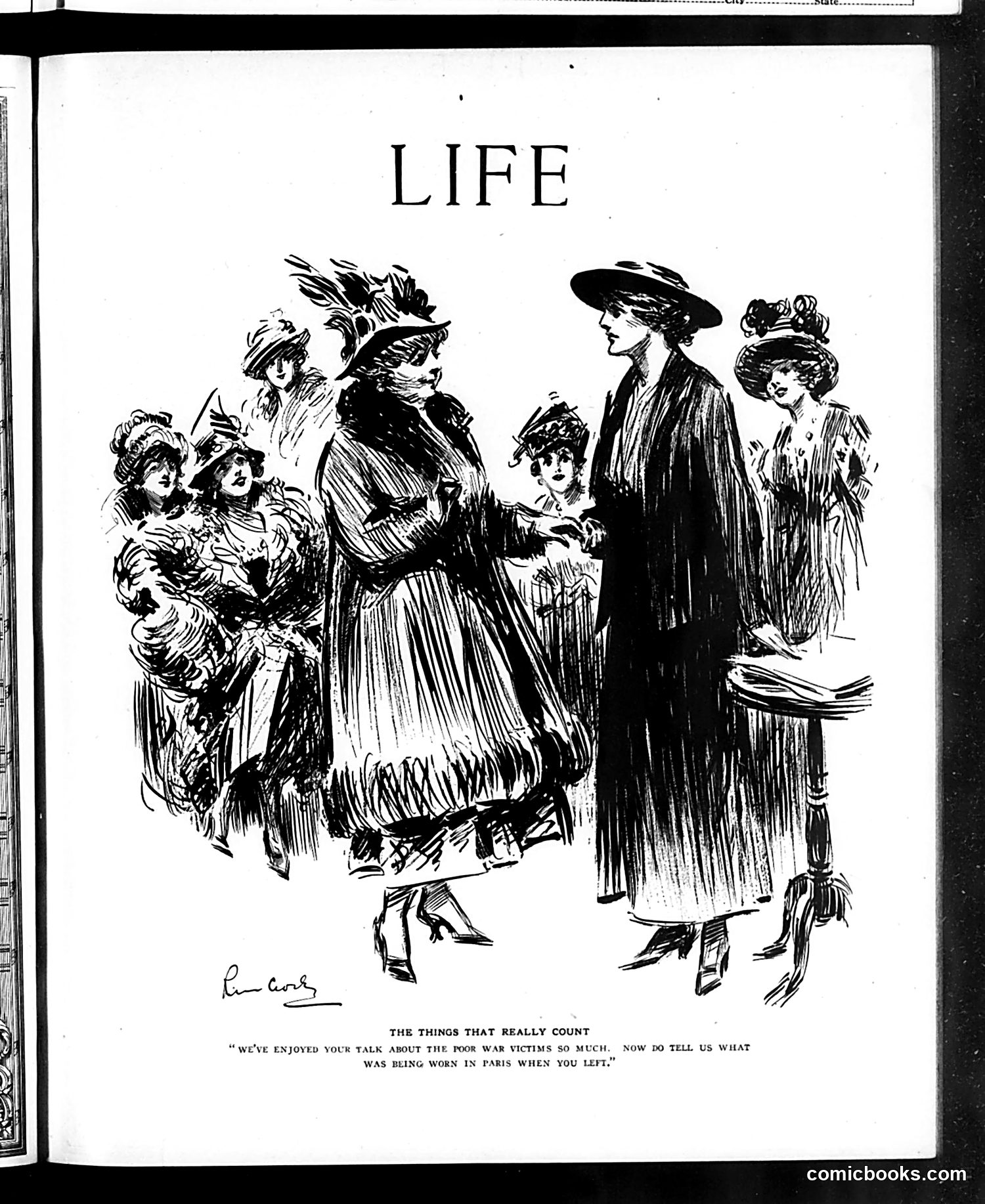
This page is titled "LIFE: THE THINGS THAT REALLY COUNT" and features a satirical sketch by what appears to be Charles Dana Gibson (based on the signature style). The cartoon depicts a social scene where wealthy or fashionable women are gossiping. The caption reads: "WE'VE ENJOYED YOUR TALK ABOUT THE POOR WAR VICTIMS SO MUCH. NOW DO TELL US WHAT WAS BEING WORN IN PARIS WHEN YOU LEFT." The satire targets upper-class hypocrisy and superficiality: society women feign concern about war victims (likely referencing WWI), but their real interest is fashion and Paris couture. The joke exposes how charitable concern is performative—a social conversation topic—while material vanity and luxury are their genuine priorities. The illustration's elegant, detailed rendering of the women's fashionable clothing ironically emphasizes this point.
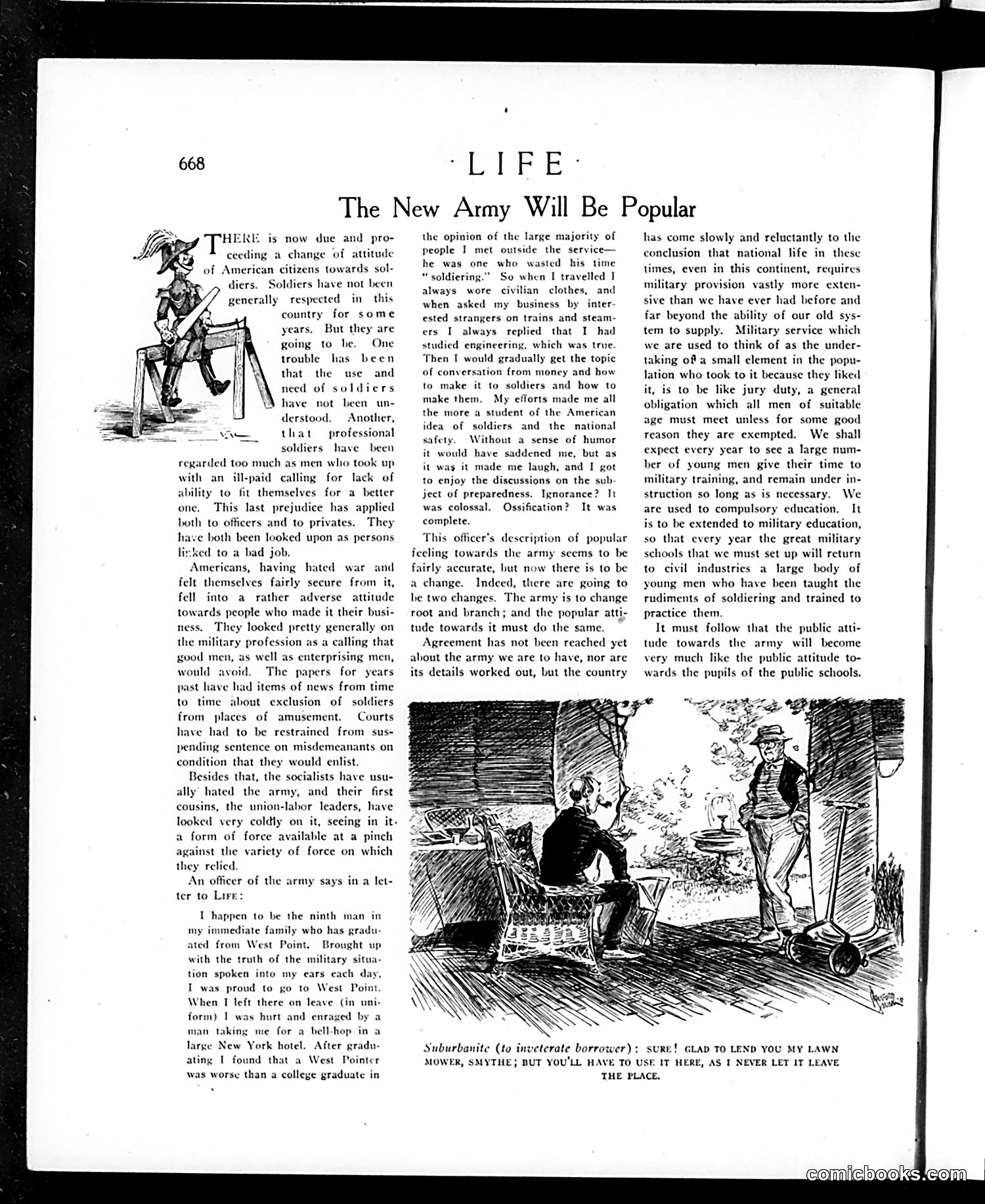
This page discusses changing American attitudes toward the military profession. The article argues that soldiers have historically been regarded poorly by American civilians, viewed as lacking ability or moral character. The author contends this prejudice is changing as the country recognizes military service's necessity. The accompanying cartoon depicts a suburbanite reluctantly lending his lawn mower to a soldier, with the caption emphasizing he'll never let it leave the place—a humorous commentary on American civilian reluctance to share or commit to military needs. The broader point: post-war America must develop greater respect for military service and integrate military training into civilian education to build national strength and prepare young men for potential future conflicts.
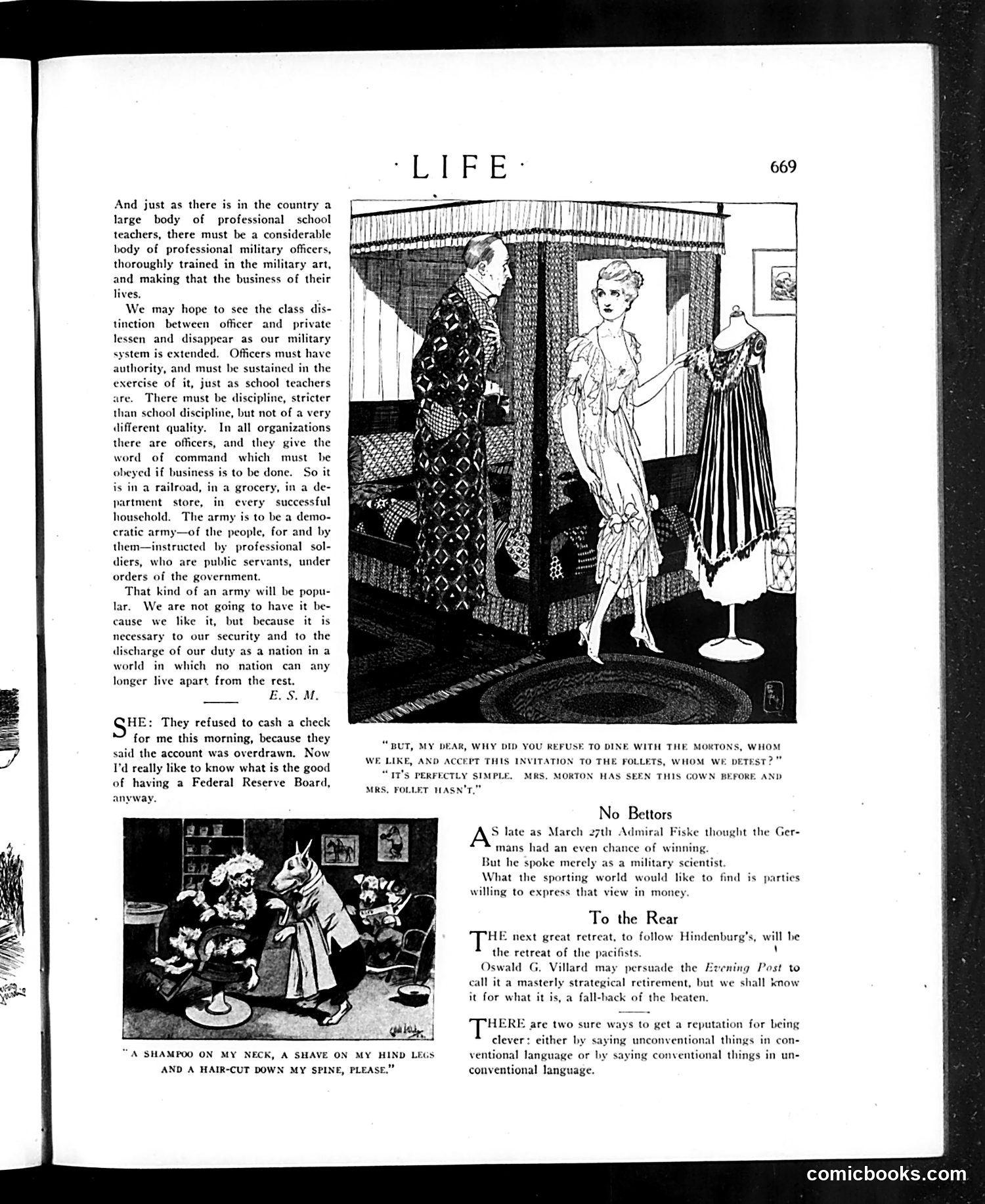
This page contains two satirical cartoons and accompanying text from *Life* magazine (page 669). **Top Cartoon**: Depicts a domestic scene where a woman confronts a man about refusing a dinner invitation from "the Mortons." The caption quotes her asking why he rejected dining with people they like, noting Mrs. Morton has worn a certain gown before and Mrs. Follett hasn't seen it. The satire mocks trivial social anxieties and status-consciousness among the upper-middle class—the concern that wearing the same dress twice among social peers is somehow damaging. **Bottom Cartoon**: Shows a barber shop scene with the caption "A SHAMPOO ON MY NECK, A SHAVE ON MY HIND LEGS AND A HAIR-CUT DOWN MY SPINE, PLEASE." This appears to ridicule exaggerated or absurd grooming requests, likely satirizing pretentious or nonsensical customer behavior. Both pieces target bourgeois social vanity and pretension.
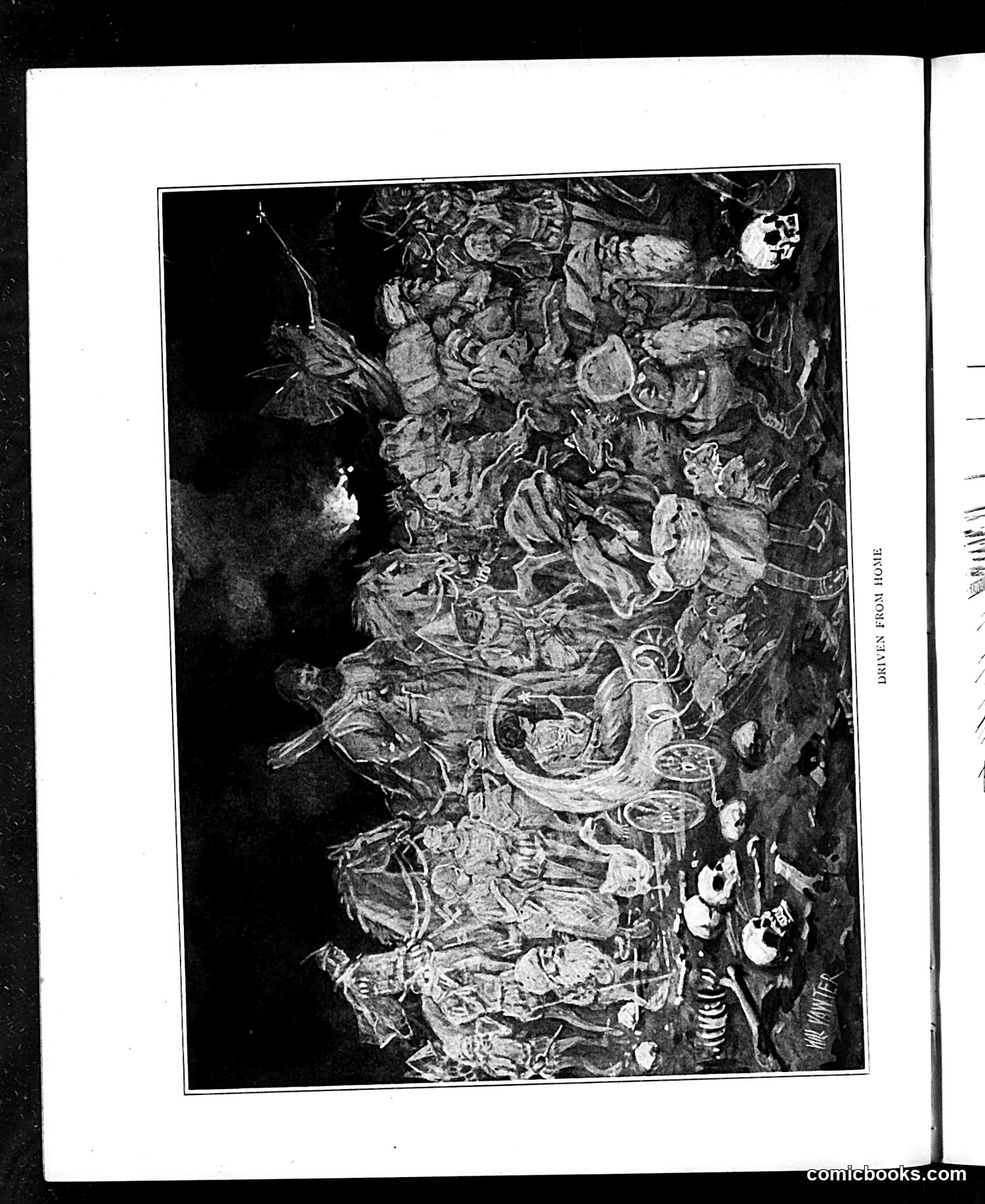
I can see this is a black and white illustration that appears to be rotated 90 degrees, making it difficult to read clearly. The caption on the right margin appears to reference "DRIVEN FROM HOME" though the text is partially obscured. The image itself shows multiple figures in what appears to be a crowded, chaotic scene with elaborate period clothing and details. However, without being able to read the caption text clearly or identify specific individuals with certainty, I cannot reliably explain the cartoon's political or social meaning to a modern reader. To provide accurate analysis as requested, I would need either a clearer image orientation or confirmation of the specific publication date and caption text, which would help identify the historical context and figures being satirized.
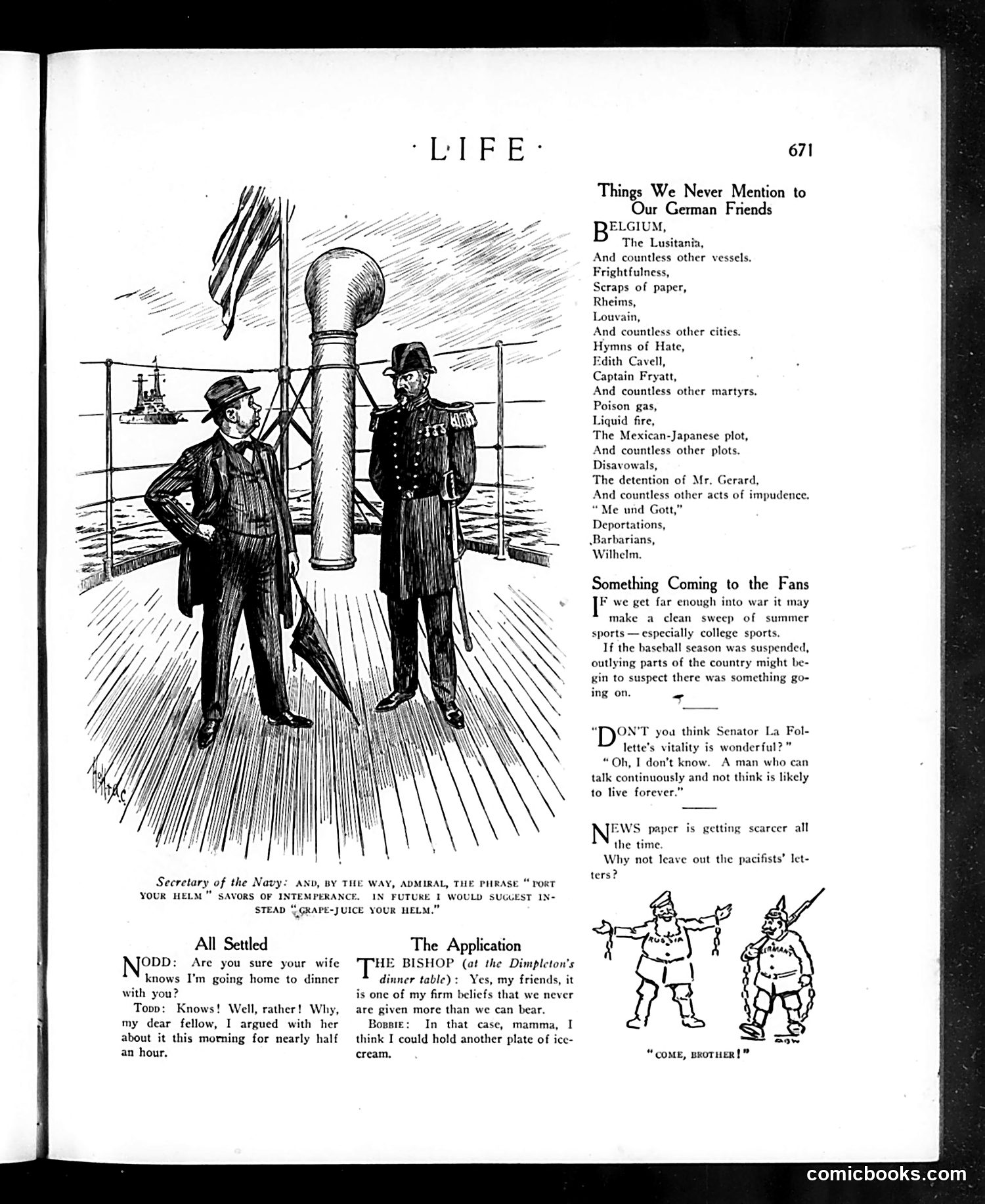
The main illustration depicts two military figures on a ship's deck—one in civilian clothes, one in full naval uniform with medals. The caption quotes the Secretary of the Navy suggesting the civilian should say "Port your helm" instead of using profanity. The right column lists German-related topics Americans supposedly avoid mentioning to German friends during WWI: Belgian atrocities, the Lusitania sinking, poison gas, and various war crimes. This is satirical commentary on diplomatic awkwardness and suppressed wartime grievances. Below are humor pieces: "All Settled" jokes about a domestic dispute, "The Application" features a bishop at dinner, and small cartoon figures labeled "Come, brother!" The overall page satirizes WWI-era tensions, military protocol, and social hypocrisy about discussing uncomfortable historical events.
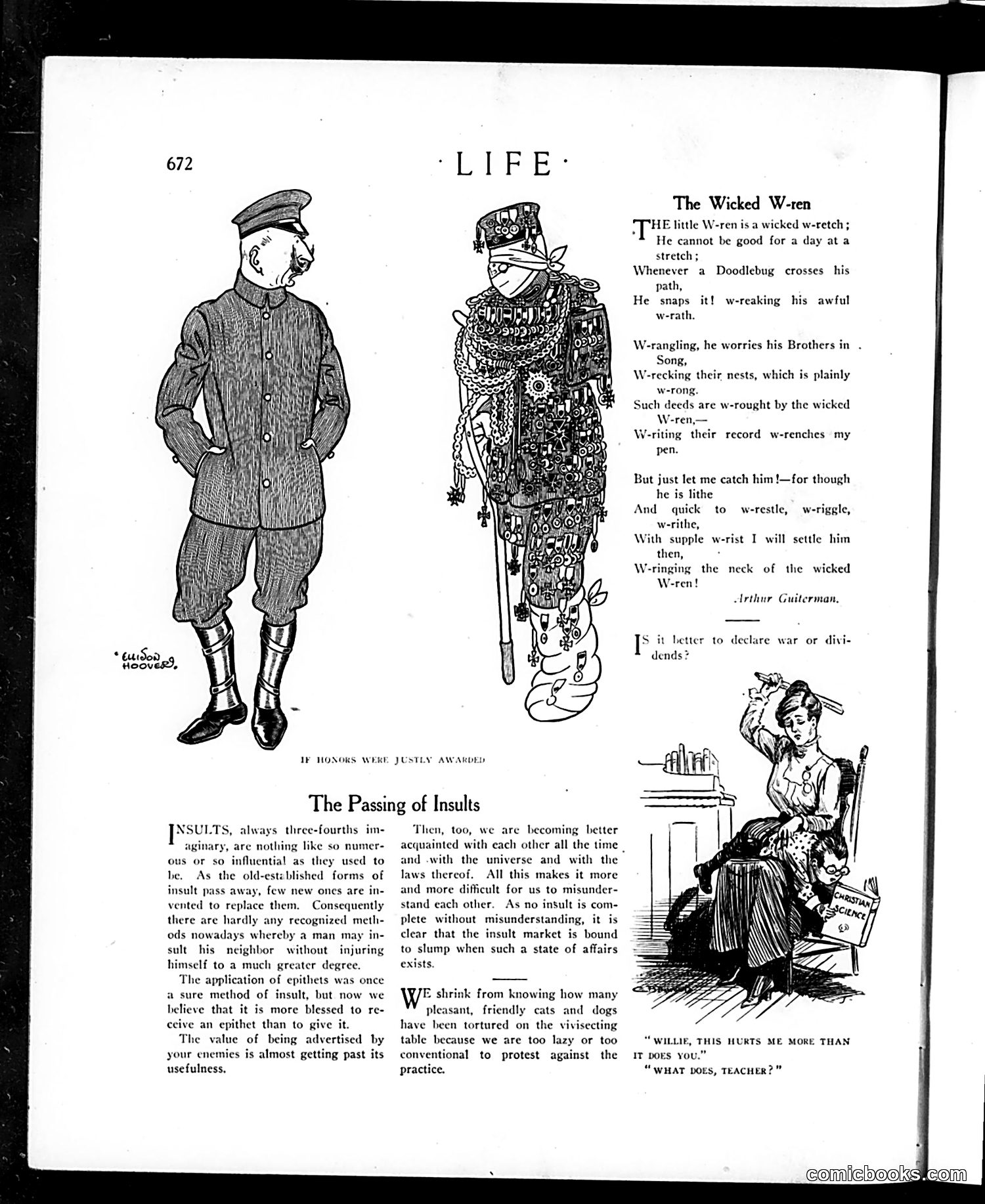
This page contains two satirical pieces. "The Wicked W-ren," a poem by Arthur Guiterman, uses alliteration to mock a small, mischievous bird that wreaks havoc on other birds' nests. The extended "W" sounds suggest childish annoyance, making fun of overwrought complaints about minor nuisances. "The Passing of Insults" critiques how modern civility has eliminated direct confrontation. The author argues that while old-fashioned insults were damaging, contemporary society's "insult market" has become ineffective because people understand each other too well and misunderstandings are rare. The accompanying cartoon shows schoolchildren, suggesting young people experience less impact from verbal attacks than previous generations did.
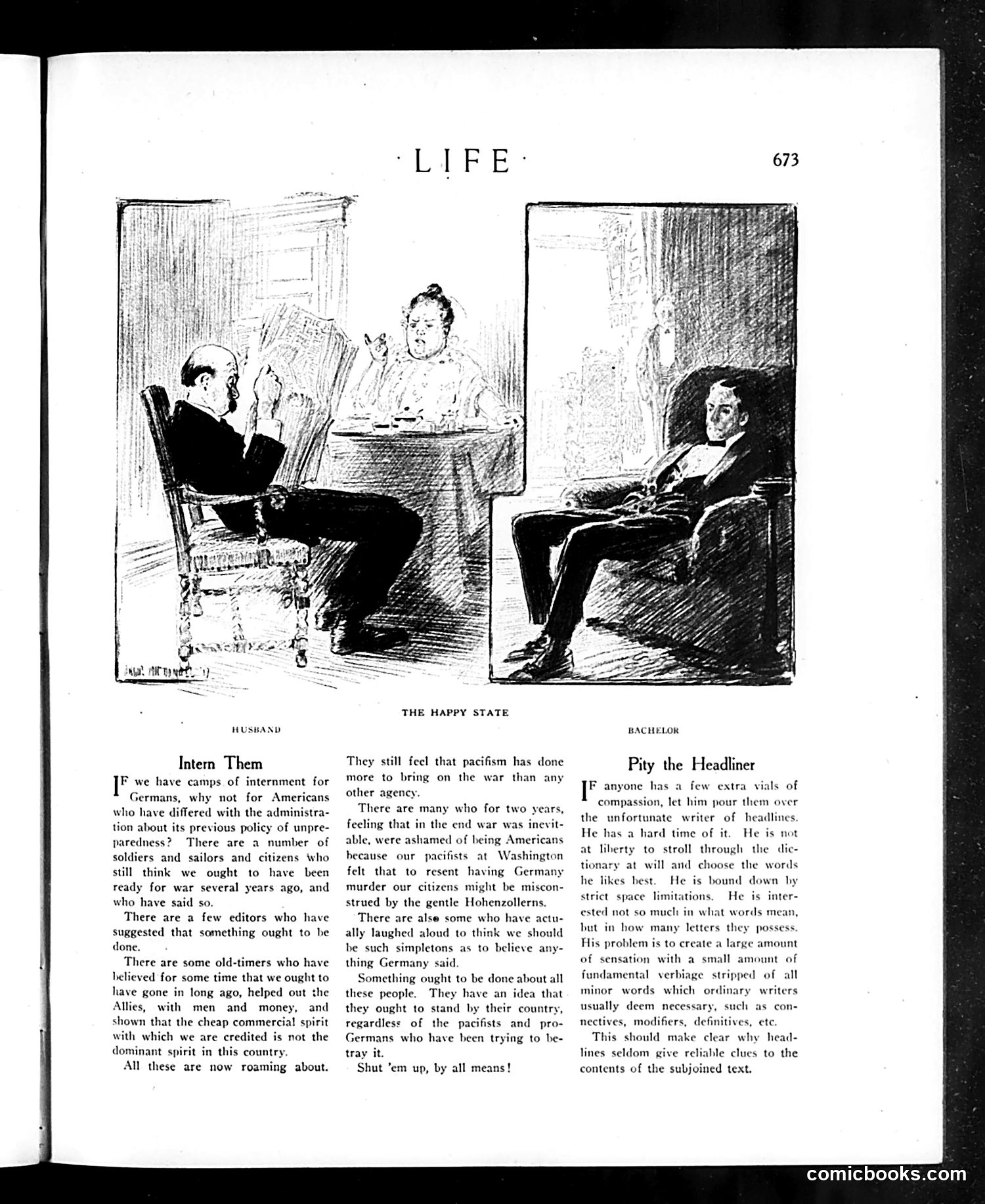
The page presents three opinion pieces from *Life* magazine (a satirical publication). The cartoon titled "THE HAPPY STATE" contrasts a husband (left) and bachelor (right) in separate domestic scenes, satirizing their different life circumstances. The text pieces discuss: 1. **"Intern Them"** — argues Americans who opposed U.S. entry into WWI should face internment, criticizing pacifists and those questioning the war's necessity. 2. **"Pity the Headliner"** — sympathizes with newspaper writers struggling under strict wartime censorship that limits what they can publish, forcing them to use vague language. These pieces reflect WWI-era political tensions: suppression of dissent, censorship of the press, and debates over patriotism versus free speech. The commentary suggests wartime restrictions on civil liberties were controversial even among supporters.
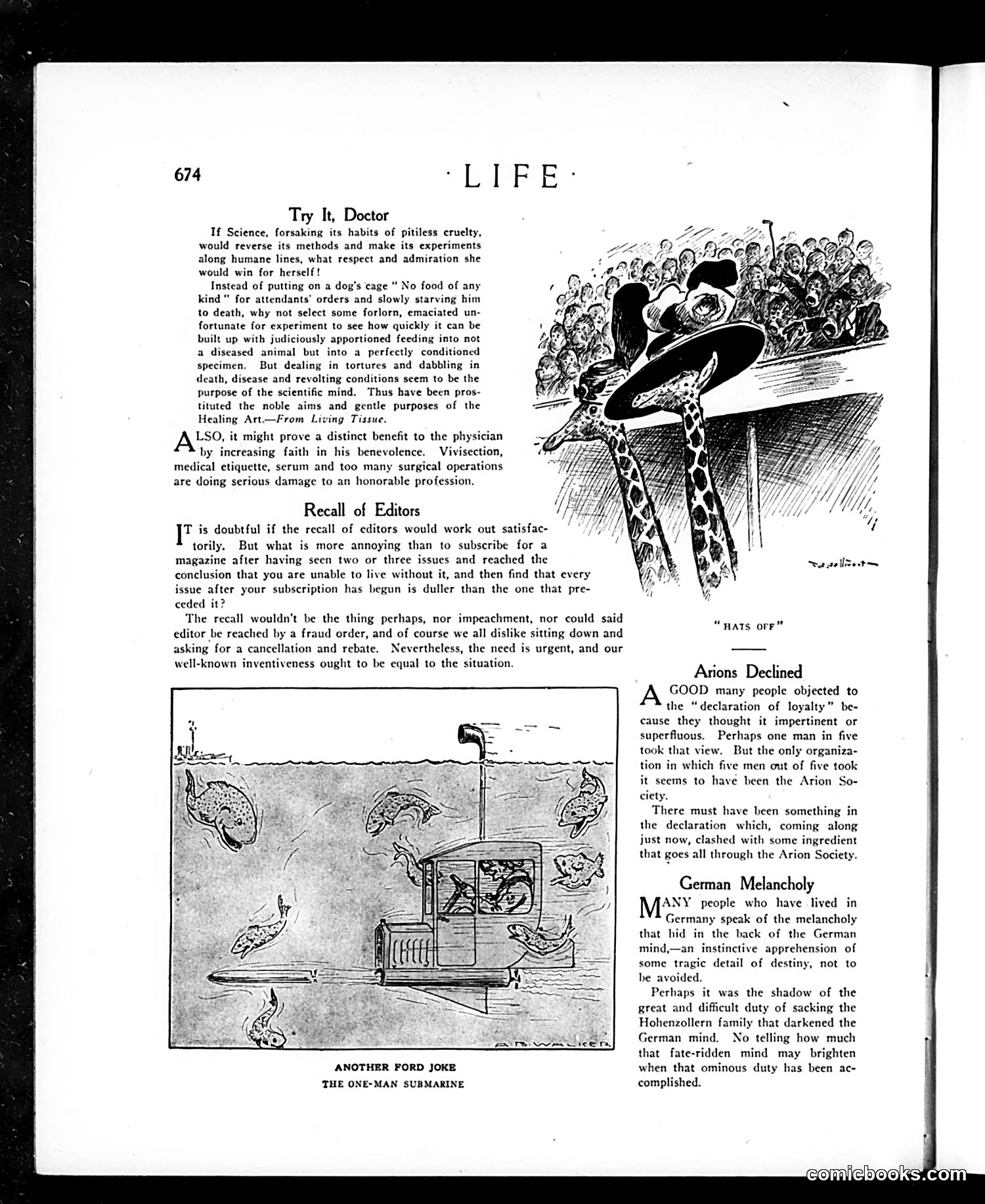
The page contains three distinct pieces: 1. **"Try It, Doctor"** — An editorial criticizing scientists who conduct cruel experiments on animals in the name of medical progress, arguing they should test on condemned humans instead. 2. **"Hats Off"** — A sketch (right) showing a figure tipping their hat to a crowd, likely depicting a public figure or politician being celebrated. 3. **"Another Ford Joke: The One-Man Submarine"** — A cartoon showing a Model T Ford converted into an underwater vessel, mocking Ford automobiles. This type of "Ford joke" was common satirical fodder during the early automotive era. The page also includes brief articles on magazine subscription quality and declining membership in the Arian Society, reflecting social concerns of the period.
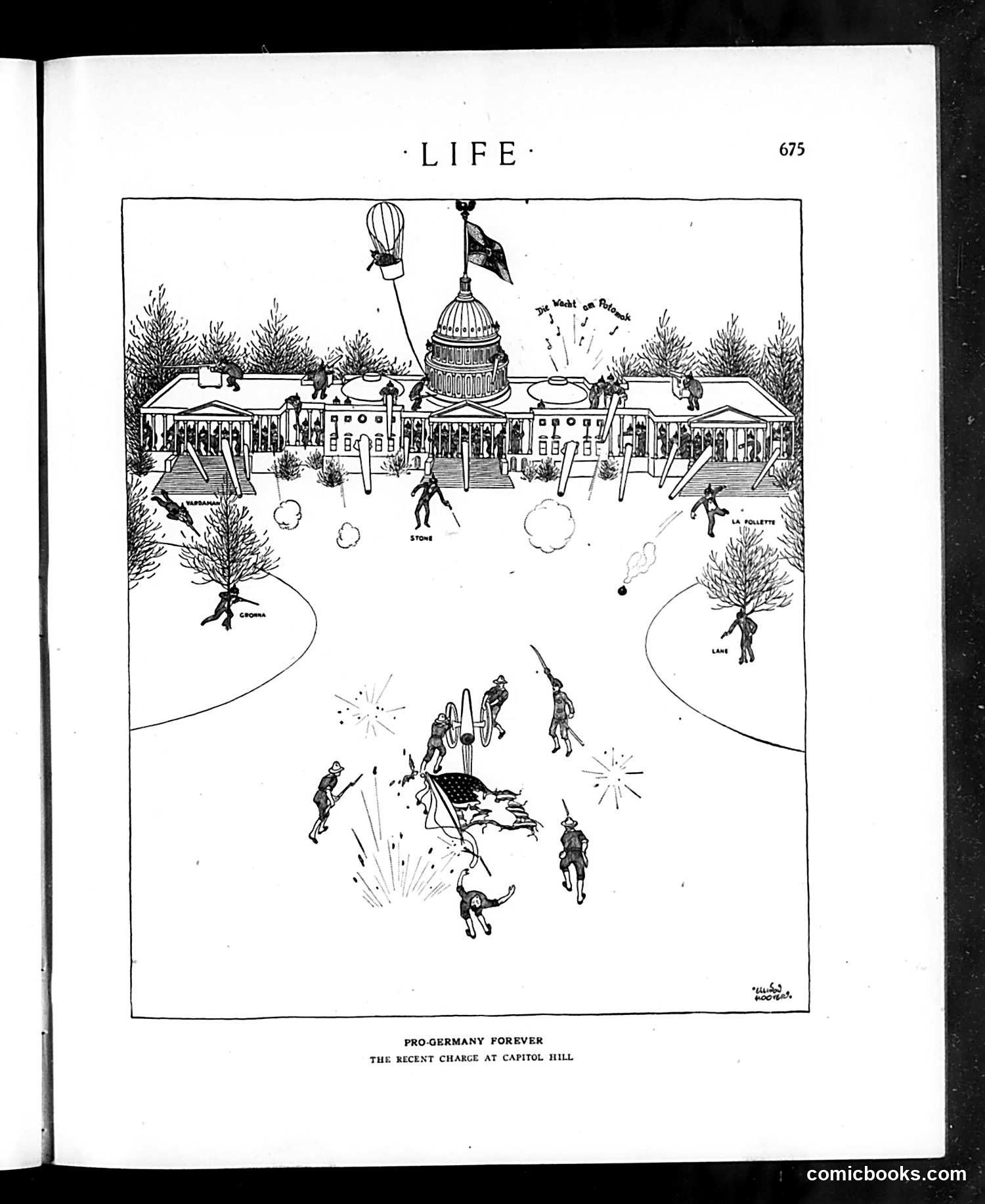
This political cartoon satirizes pro-German activities or sympathies at the U.S. Capitol. The image shows figures charging at the Capitol building with explosives or weapons, while chaos erupts—suggesting violent disruption or sabotage. The title's sardonic phrase "Pro-Germany Forever" appears to mock those advocating for Germany, likely during either World War I or the interwar period. The cartoon depicts pro-German agitation as literally under assault on American democracy itself. The scene references real historical anxieties about German espionage, sabotage networks, and political influence in America during these eras. Life magazine used such cartoons to ridicule and warn against foreign interference in American institutions. The specific "recent charge" referenced remains unclear without additional context about the publication date.
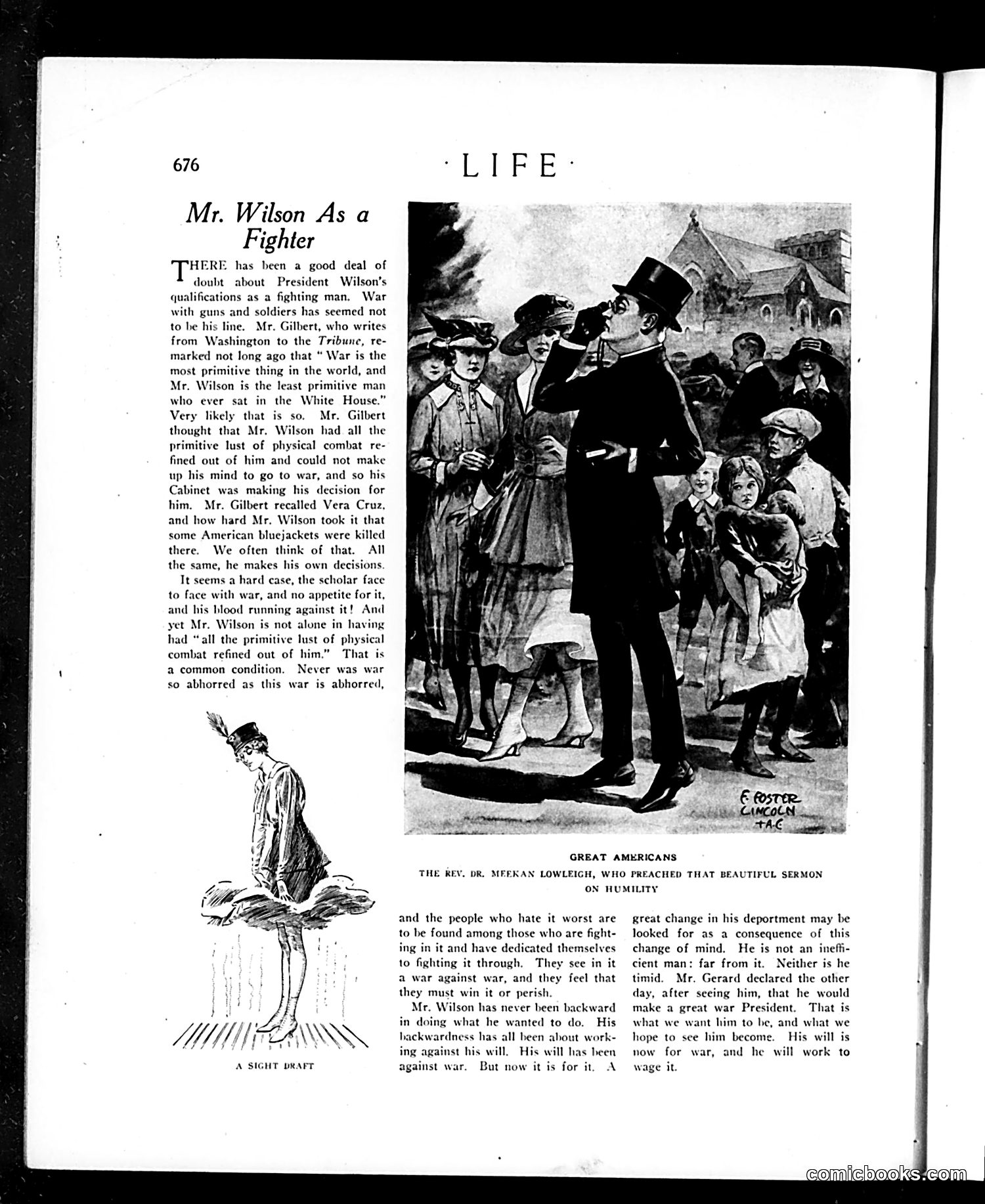
This Life magazine page defends President Wilson's fitness as a wartime leader against recent criticism. The text references columnist Mr. Gilbert's earlier Tribune piece questioning whether Wilson—described as overly intellectual and refined—lacked the primitive aggression necessary for war leadership. The article cites Wilson's reluctance over the Vera Cruz incident as evidence of his unsuitability. However, the author argues Wilson's apparent pacifism reflects principle, not cowardice. Soldiers themselves often hate war most. Crucially, Wilson has now committed his will to war, and once resolved, he will prosecute it effectively—he's neither inefficient nor timid. Ambassador Gerard apparently affirmed Wilson would make an excellent war president. The small cartoon "A Sight Draft" appears to be unrelated satire. The "Great Americans" caption ironically references a sermon on humility (the meaning unclear without context).
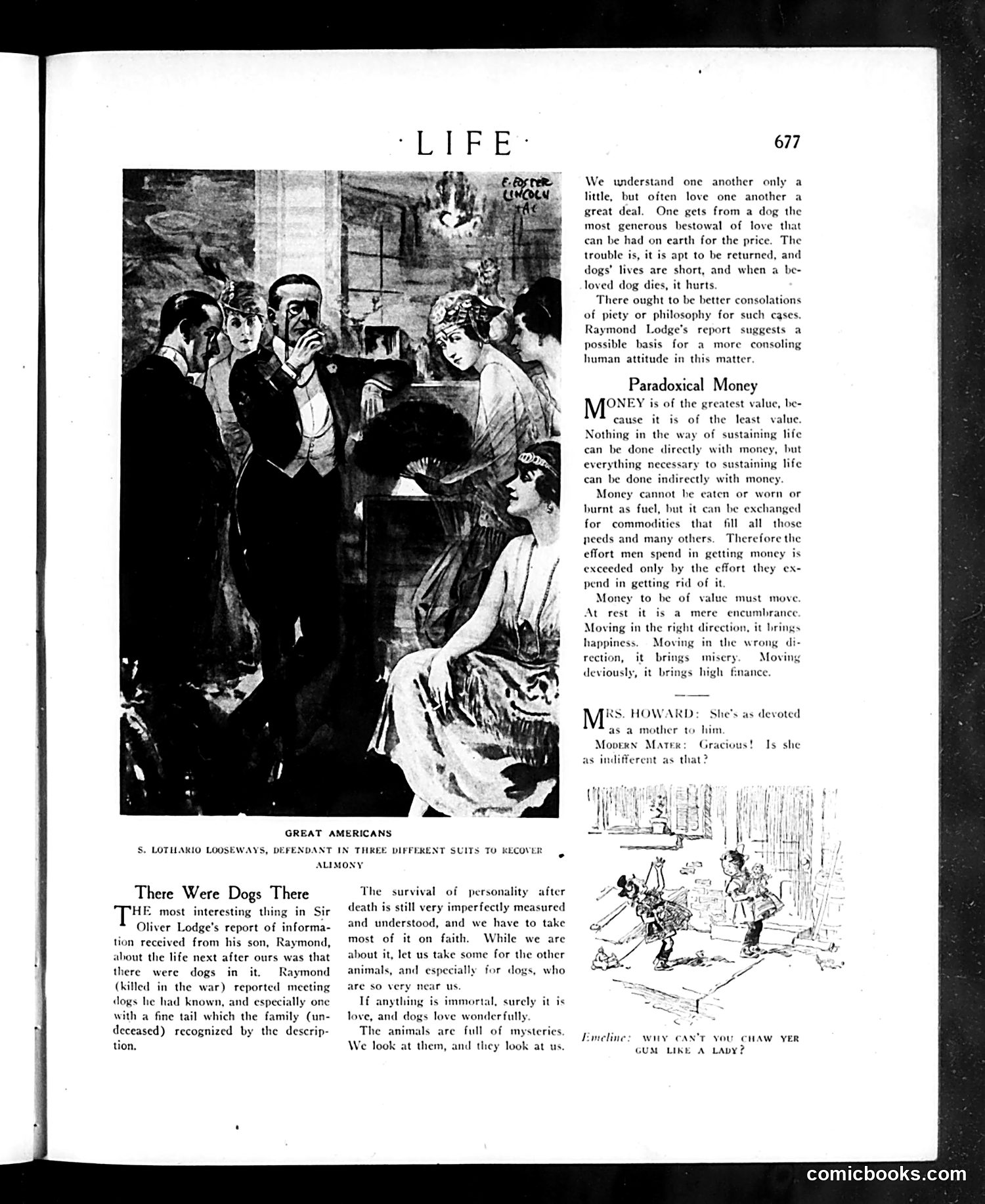
This page contains three satirical pieces: **"Great Americans: S. Lothario Looseways"** — A mock-heroic portrait of a man sued three times for alimony recovery. The satire mocks serial marriage and men evading financial obligations to ex-wives—a contemporary social scandal. **"There Were Dogs There"** — Commentary on spiritualist Sir Oliver Lodge's claims that his dead son Raymond reported seeing dogs in the afterlife. Life uses this to discuss animal immortality and human grief, treating the supernatural claim with gentle skepticism while celebrating dogs' loyalty. **"Paradoxical Money"** — A philosophical piece explaining money's paradox: most valuable because least useful directly; its worth depends on circulation and direction of flow. **Bottom cartoon "Emeline"** — A domestic humor strip showing a woman (likely a wife or girlfriend) exasperated at a man's poor table manners, asking why he can't chew gum "like a lady"—poking fun at masculine crudeness and evolving etiquette standards of the era.
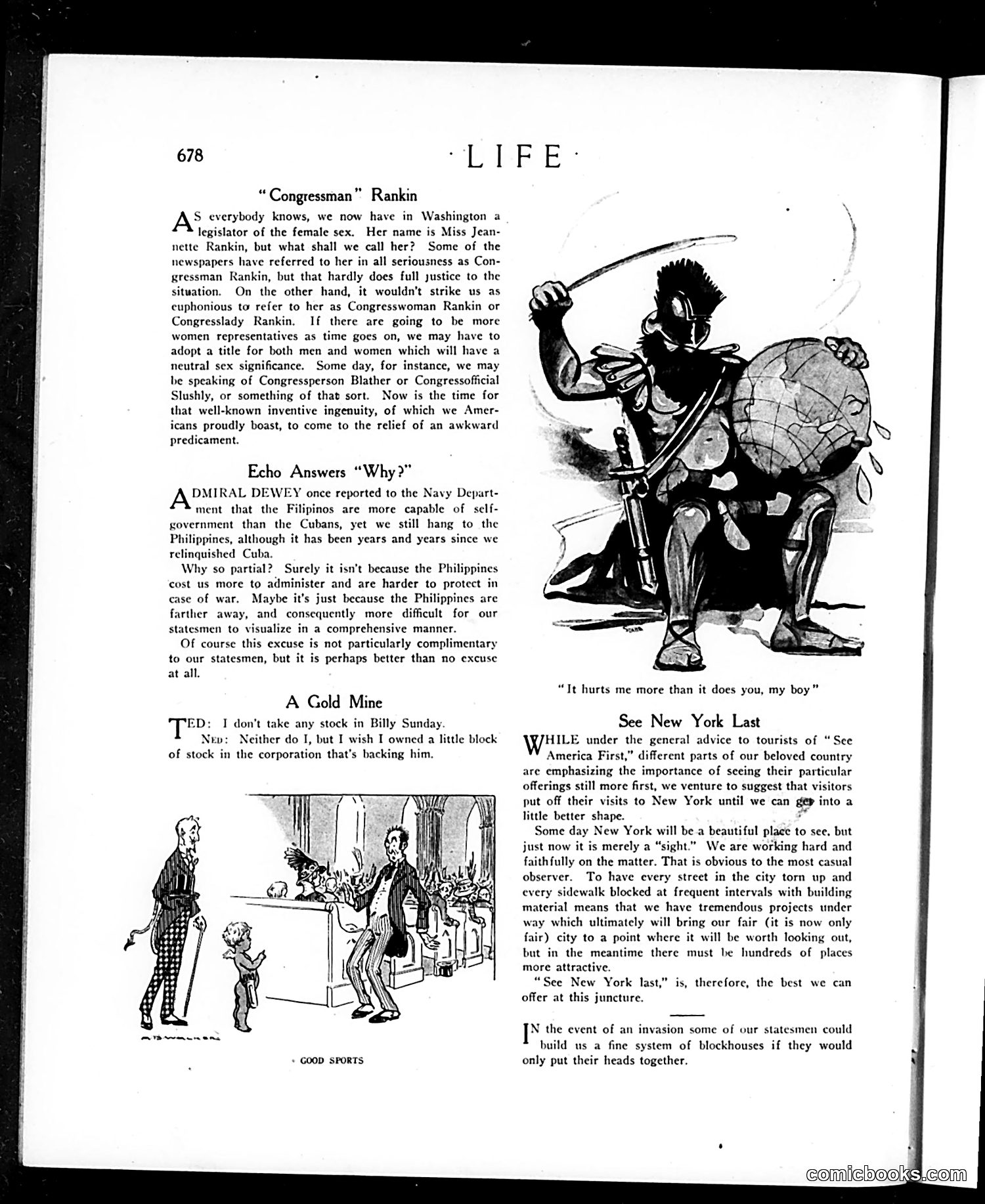
This page contains three satirical pieces: **"Congressman" Rankin**: Addresses Jeannette Rankin, the first female U.S. legislator (elected 1916). The satire mocks the awkwardness of her title—newspapers called her "Congressman," which seems inappropriate. The author proposes inventing gender-neutral terms like "Congressperson" to solve the predicament, humorously suggesting this represents a quintessential American inventive challenge. **Echo Answers "Why?"**: Critiques U.S. imperialism. Admiral Dewey reportedly said Filipinos were more capable of self-government than Cubans, yet America retained the Philippines while relinquishing Cuba. The satire suggests distance—not strategic value—explains this inconsistency, mockingly implying American statesmen simply can't visualize distant territories clearly. **Other items**: A joke about evangelist Billy Sunday, and commentary on New York City's construction chaos, humorously urging tourists to "See New York last." The page exemplifies Life's characteristic political and social satire of the Progressive Era.
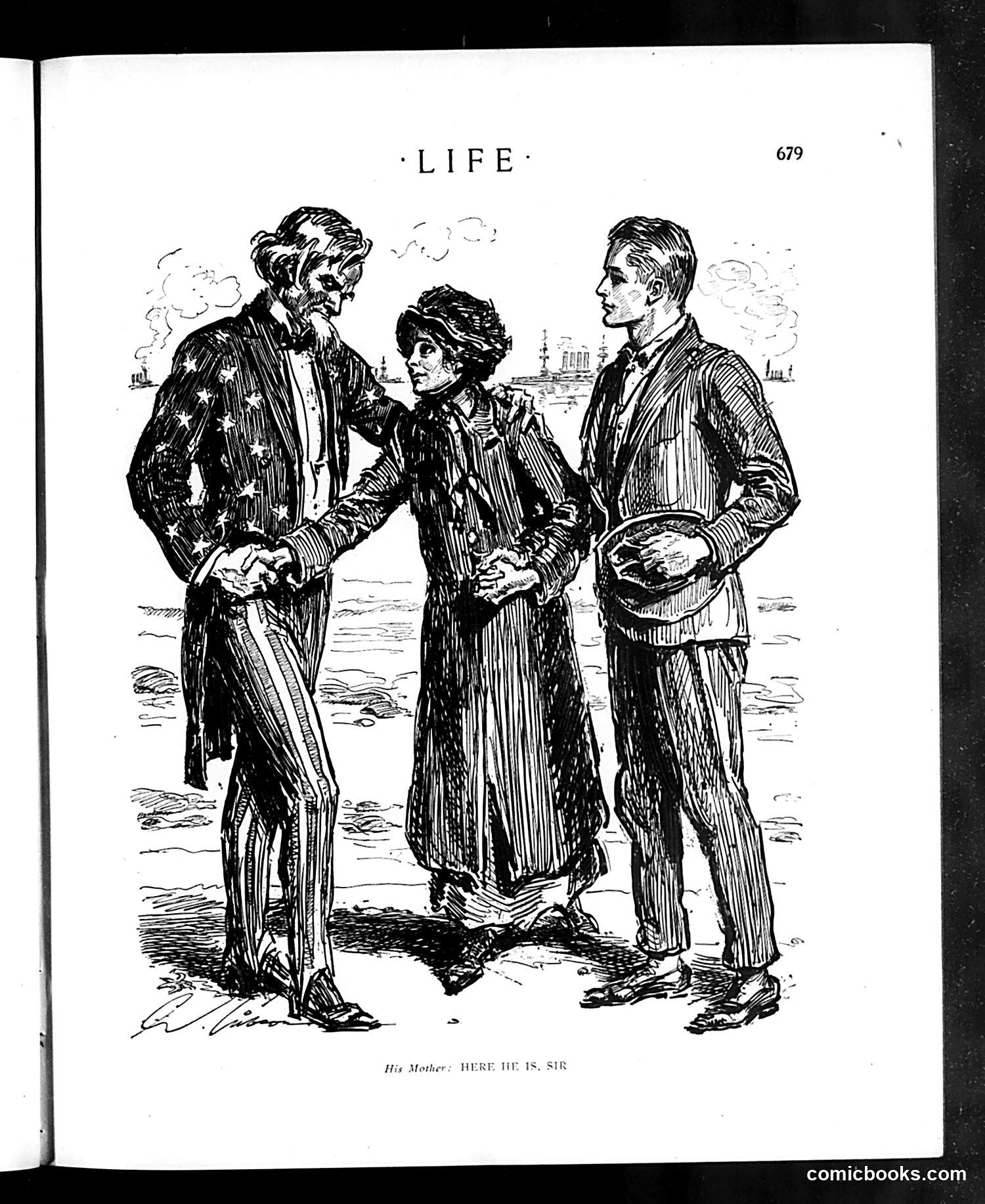
This is a single cartoon captioned "His Mother: HERE HE IS, SIR" showing three figures on a beach or seaside location. Two men in suits flank a woman in the center who appears to be introducing or presenting one of the men to the other. The specific political or social reference is unclear without additional context. The cartoon likely satirizes a social situation—possibly a matchmaking scenario, a business introduction, or a formal presentation of some kind. The formal attire, the woman's central positioning as intermediary, and the caption suggest she is "his mother" introducing her son to someone of importance or authority (addressed as "sir"). Without identifying the specific figures or knowing the publication date, the exact satirical point remains indeterminate.
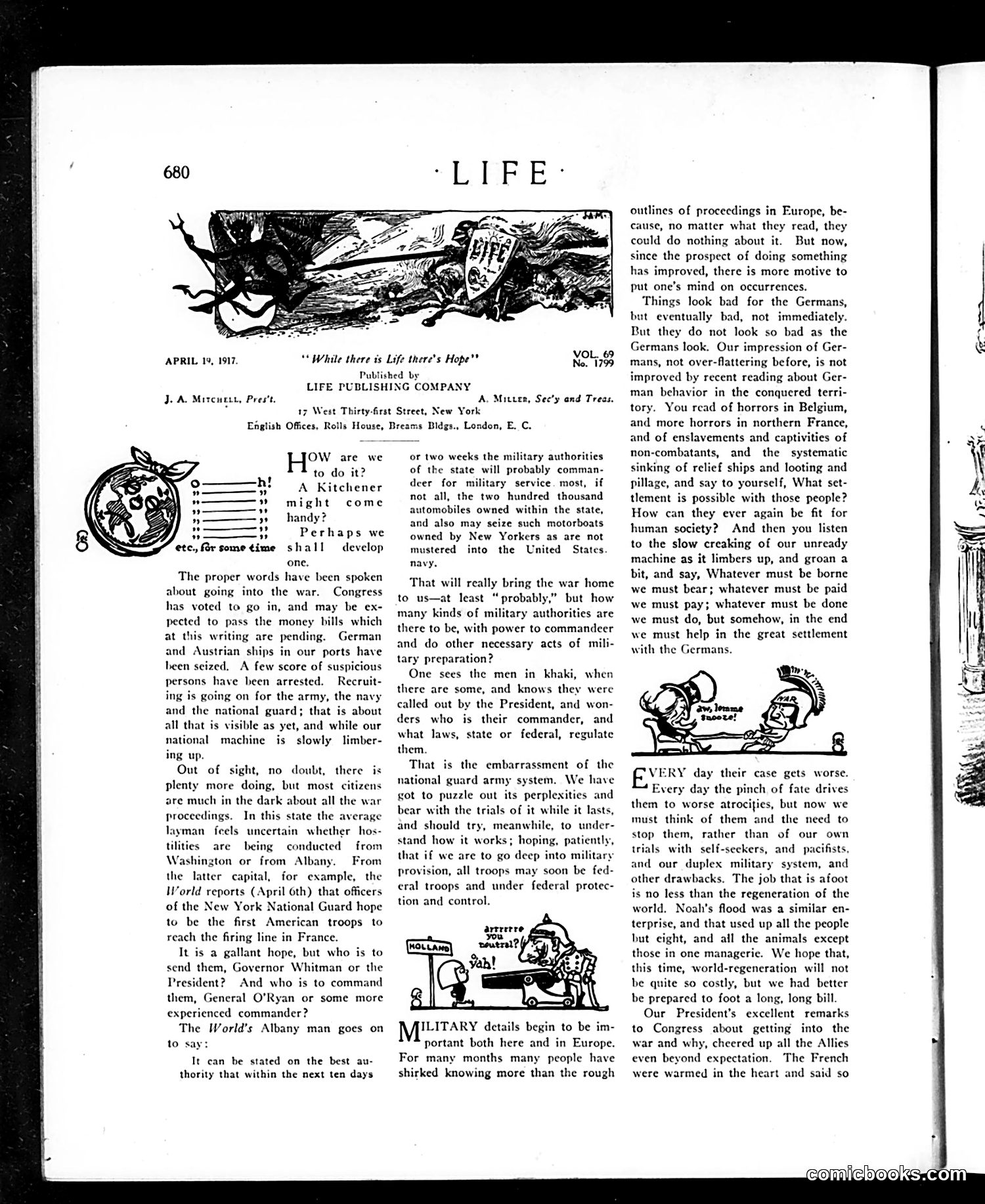
This editorial page addresses America's recent entry into World War I (declared April 6, 1917). The satirical cartoons and text mock the confusion and disorganization of American military mobilization. The main cartoon depicts a figure (likely representing American military/governmental authority) struggling to start a machine—representing the U.S. war effort. The caption "While there is Life there's Hope" is ironic commentary on America's unpreparedness. The article criticizes the chaotic command structure: unclear whether New York's Governor Whitman or President Wilson controls state troops, and whether General O'Ryan or an "experienced commander" leads them. The text mocks the National Guard system's ambiguities and the threat to commandeer private automobiles and motorboats. The editorial also expresses moral outrage at German behavior in occupied Belgium and France—"horrors," "enslavements," and "looting"—questioning how peace could ever be made with such a nation. Overall, the page satirizes American governmental confusion while validating the moral necessity of war against Germany.
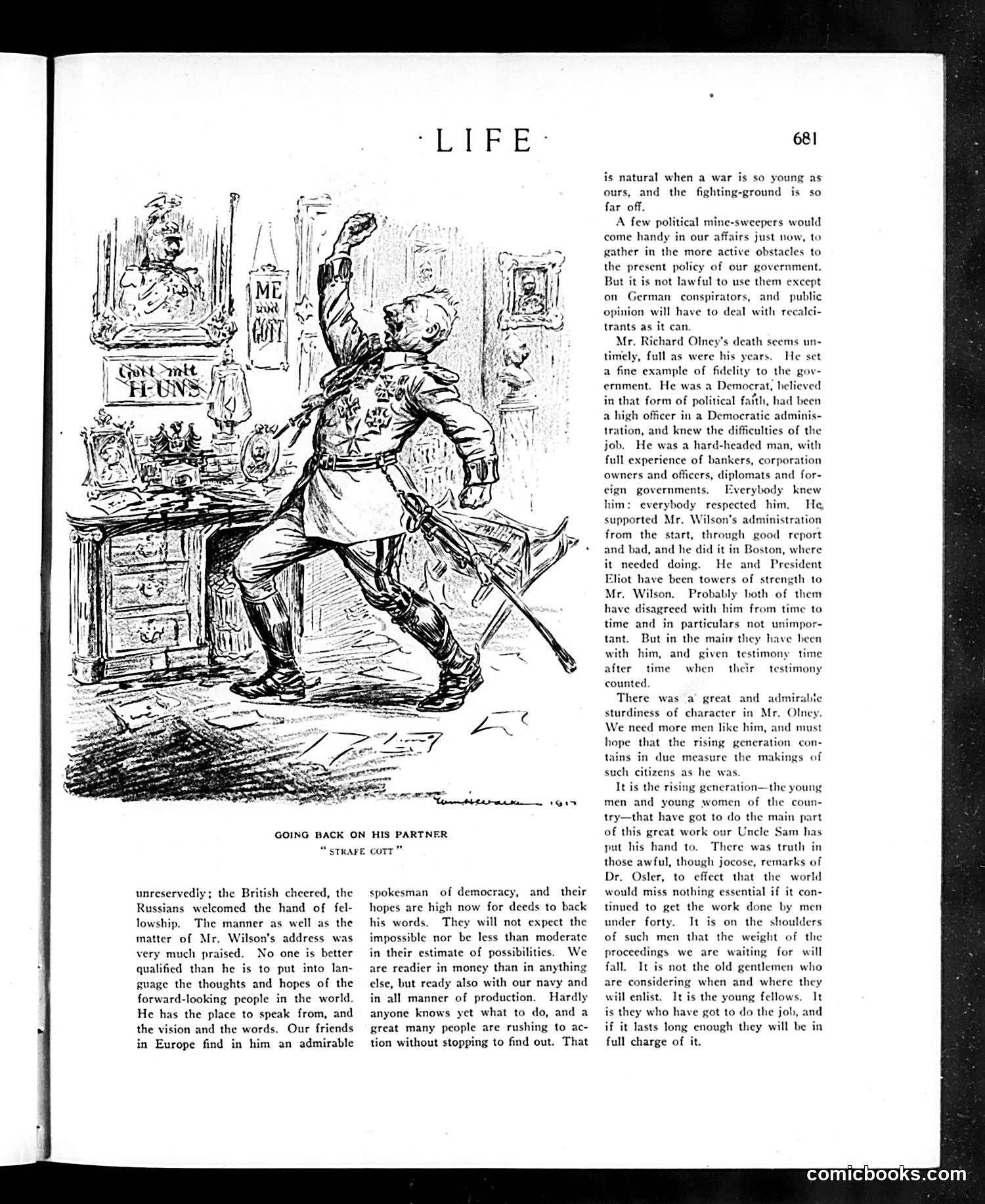
This cartoon satirizes perceived inconsistency in Wilson administration war policy. The figure labeled "Strafe Cott" (likely satirizing "Strafecott" or German strafing tactics) appears to represent Germany or German military strategy. The cartoon's title suggests an ally—possibly Britain or another Allied power—is abandoning partnership with this figure. The accompanying text discusses President Wilson's recent address praising Allied cooperation and American democratic values. However, the article critiques the gap between inspiring rhetoric and concrete action: "They will not expect the impossible nor be less than moderate in their estimate of possibilities." The satire targets the tension between Wilson's eloquent pro-democracy statements (which impressed Europeans) and the practical difficulties of translating those ideals into military/political strategy. The cartoon implies the administration may be inconsistently applying its stated principles. The text also eulogizes Richard Olney, a Democratic official who loyally supported Wilson despite disagreements, contrasting principled consistency with the wavering "strafe cott" partnership depicted.
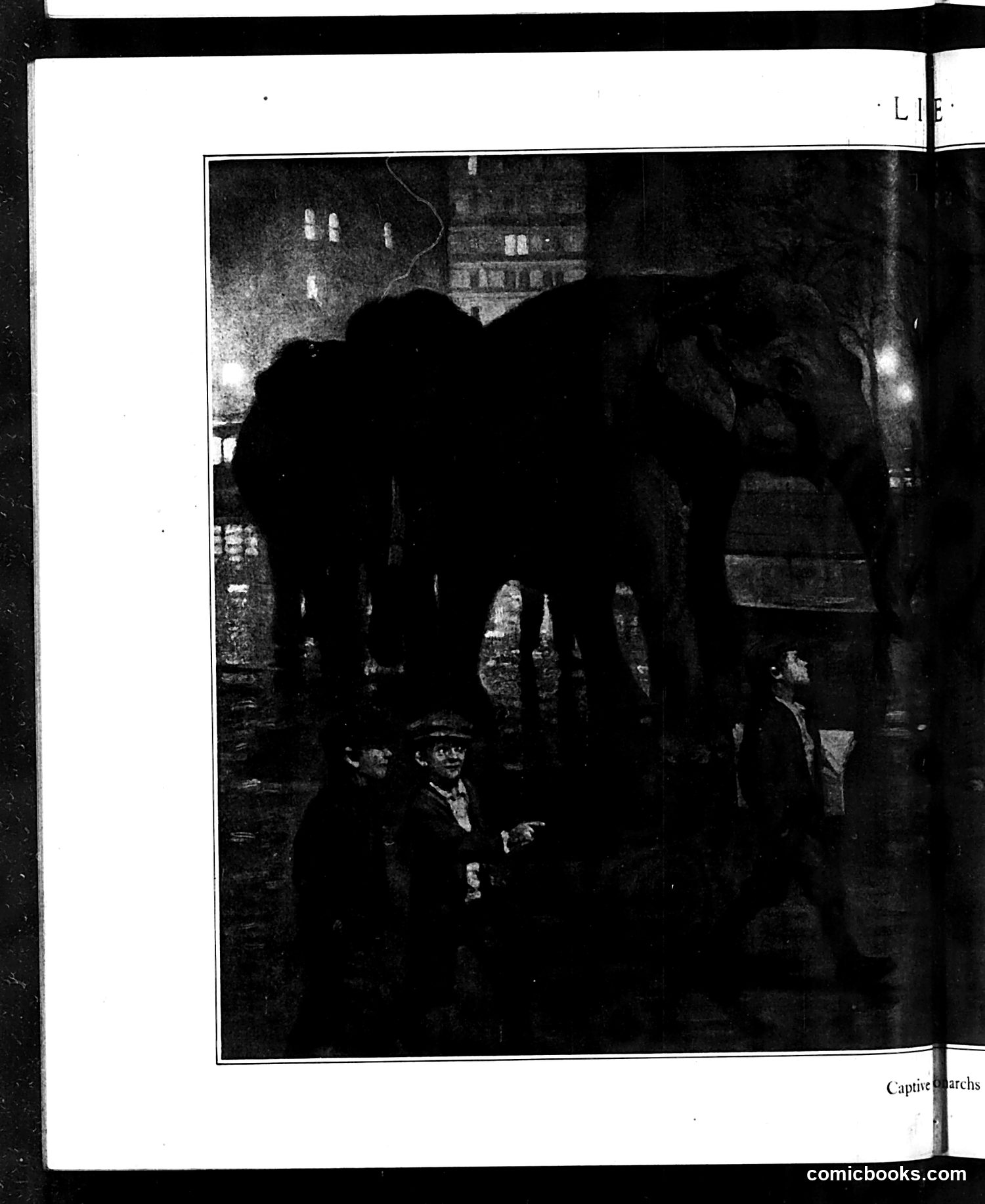
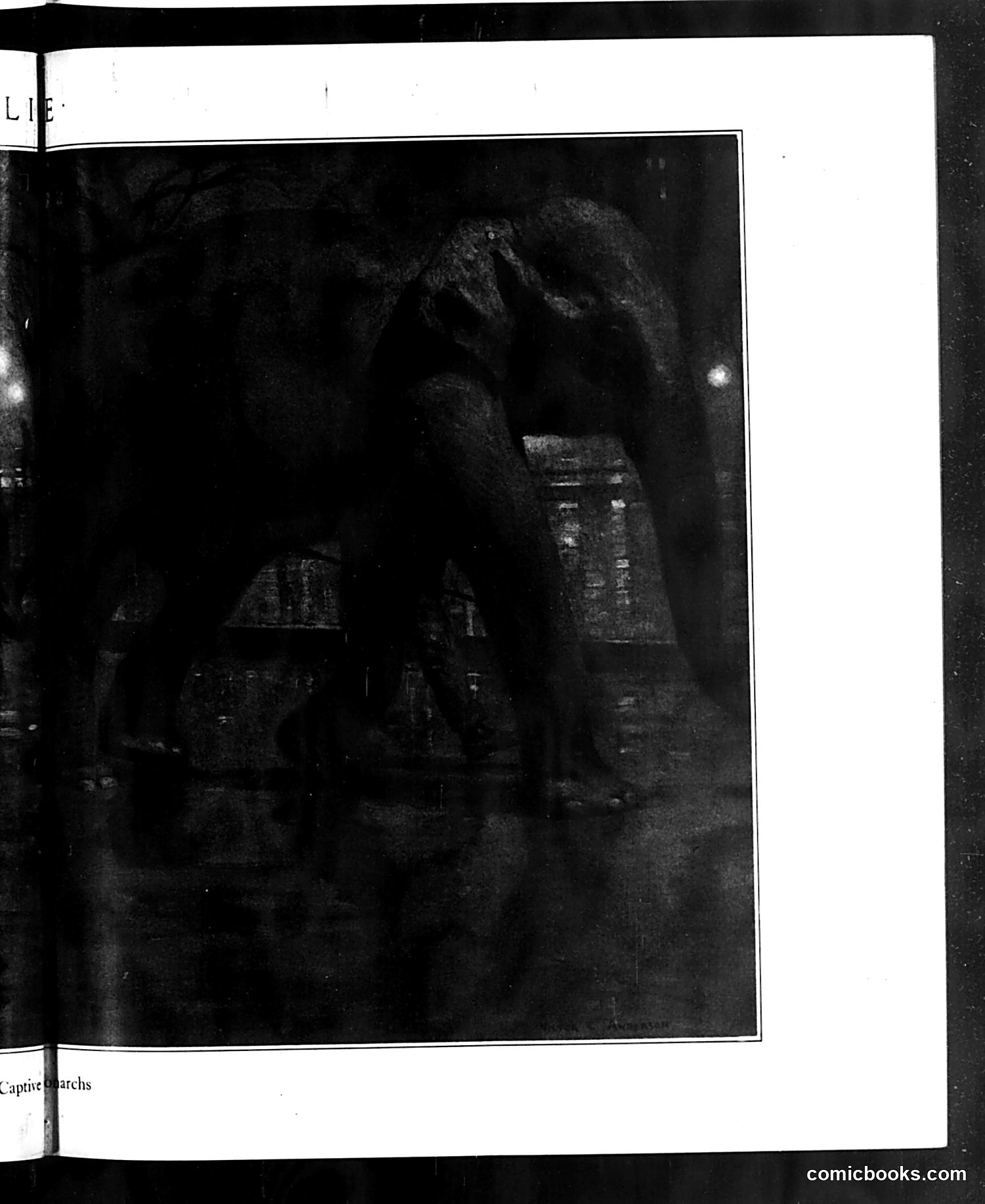
This is a dark, heavily silhouetted photograph labeled "Captive Archs" (possibly "Captive Arches"). The image shows several figures in shadow against a nighttime urban backdrop with illuminated building windows visible behind them. The silhouetting makes identification difficult, but the composition suggests a scene of confinement or captivity—figures appear trapped or enclosed within architectural spaces. Without clearer visibility of faces or additional context text, the specific political or social satire intended remains unclear. The dramatic contrast and nighttime setting suggest commentary on urban conditions, imprisonment, or loss of freedom, but the precise target of the satire cannot be determined from this image alone.
I can see this is a page from *Life* magazine, but the image quality is too poor for me to make out specific details of any cartoon or illustration with confidence. The page appears to contain a dark photograph or illustration with some architectural elements visible, but I cannot reliably identify specific figures, caricatures, or political references. The OCR text provides only a website attribution ("comicbooks.com") with no actual article text or caption that would clarify the content's meaning or historical context. Without clearer visibility of the image details or accompanying text, I cannot accurately explain what satire or social commentary this page contains for a modern reader.
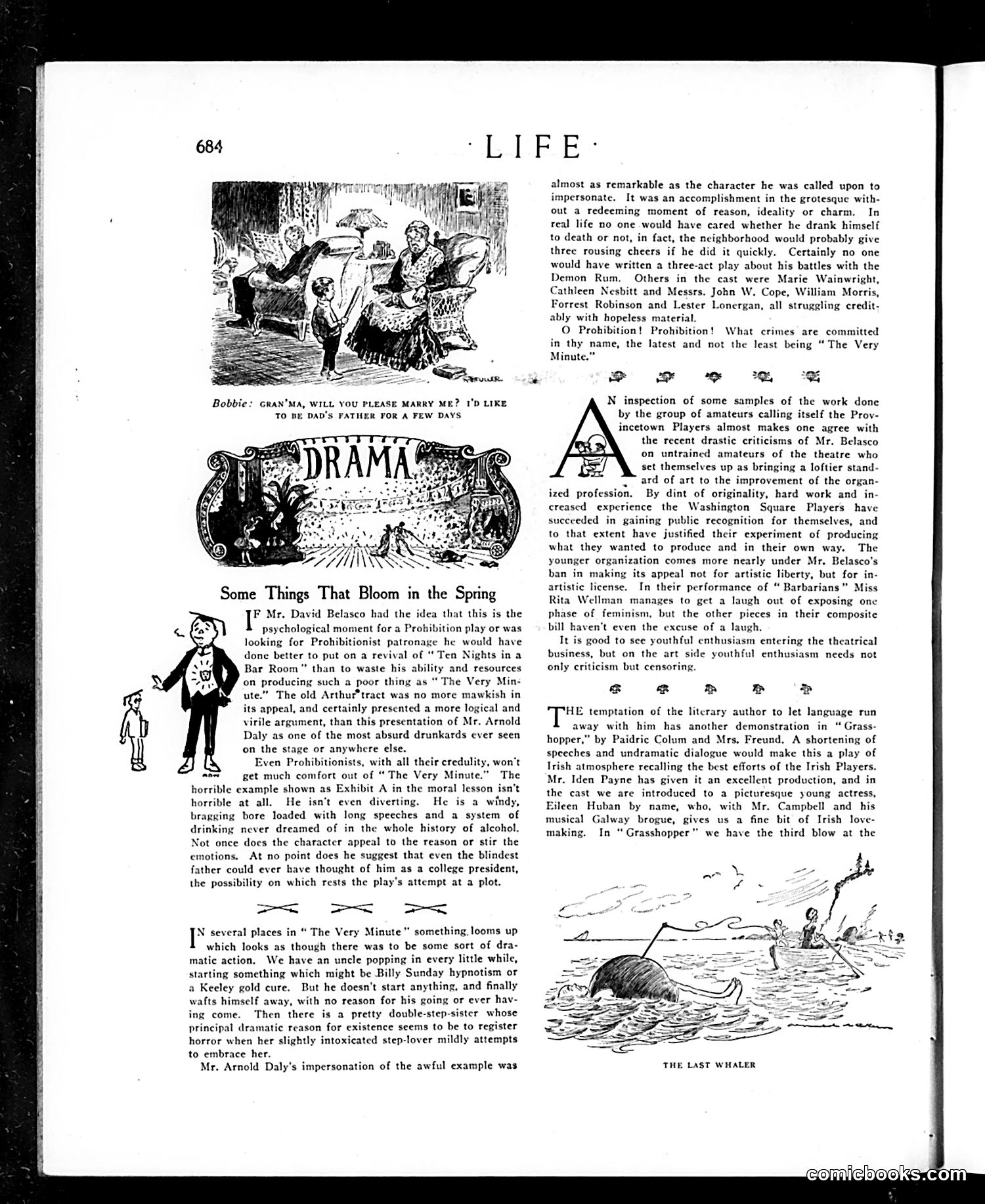
This page critiques David Belasco's theatrical production "The Very Minute," a Prohibition-themed play starring actor Arnold Daly. The reviewer savagely mocks the play as heavy-handed propaganda disguised as drama. **The Satire:** The critic argues the play fails even at promoting Prohibition—its ostensible goal. Daly's drunken character is unconvincing and unlikeable (a "windy, bragging bore"), not a cautionary tale. The reviewer suggests Belasco would've been better off reviving the 19th-century temperance melodrama "Ten Nights in a Bar Room," which at least had genuine emotional appeal. **Secondary Critique:** The page also attacks the Provincetown Players, an amateur theater group, for sacrificing artistic merit for self-righteous messaging. The reviewer distinguishes between the Washington Square Players (who earned credibility through quality work) and the Provincetown Players (who claim artistic license while producing propaganda). **Context:** This reflects 1920s debates over Prohibition's cultural impact and tensions between commercial theater and experimental drama.
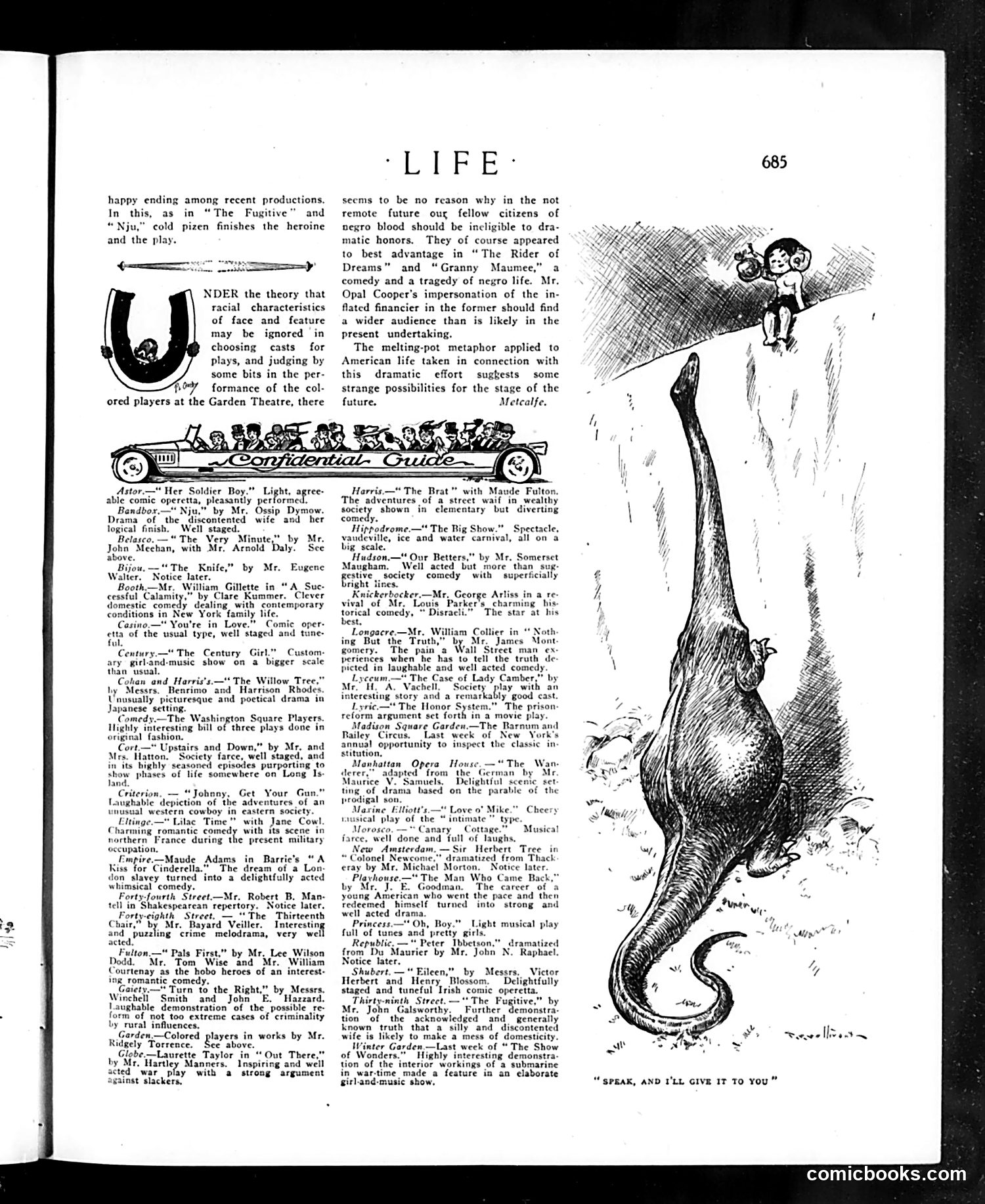
This page reviews Broadway theater productions, with particular focus on a significant cultural moment: Black actors performing at the Garden Theatre in works by Ridgely Torrence ("The Rider of Dreams" and "Granny Maumee"). The critic (Metcalfe) argues that these performances demonstrate Black actors deserve equal consideration for dramatic roles regardless of "racial characteristics." He praises Opal Cooper's performance as a financier, suggesting such casting should expand beyond segregated productions. The "melting-pot metaphor" reference connects theater integration to broader American assimilation debates. The accompanying cartoon (bottom right) appears to be unrelated theatrical illustration, captioned "Speak, and I'll Give It to You." This review reflects early 20th-century theatrical integration efforts and the contemporary racial debates surrounding who could perform which roles on stage—a progressive stance for the era, though framed in period-appropriate language that treats this as surprising or noteworthy.
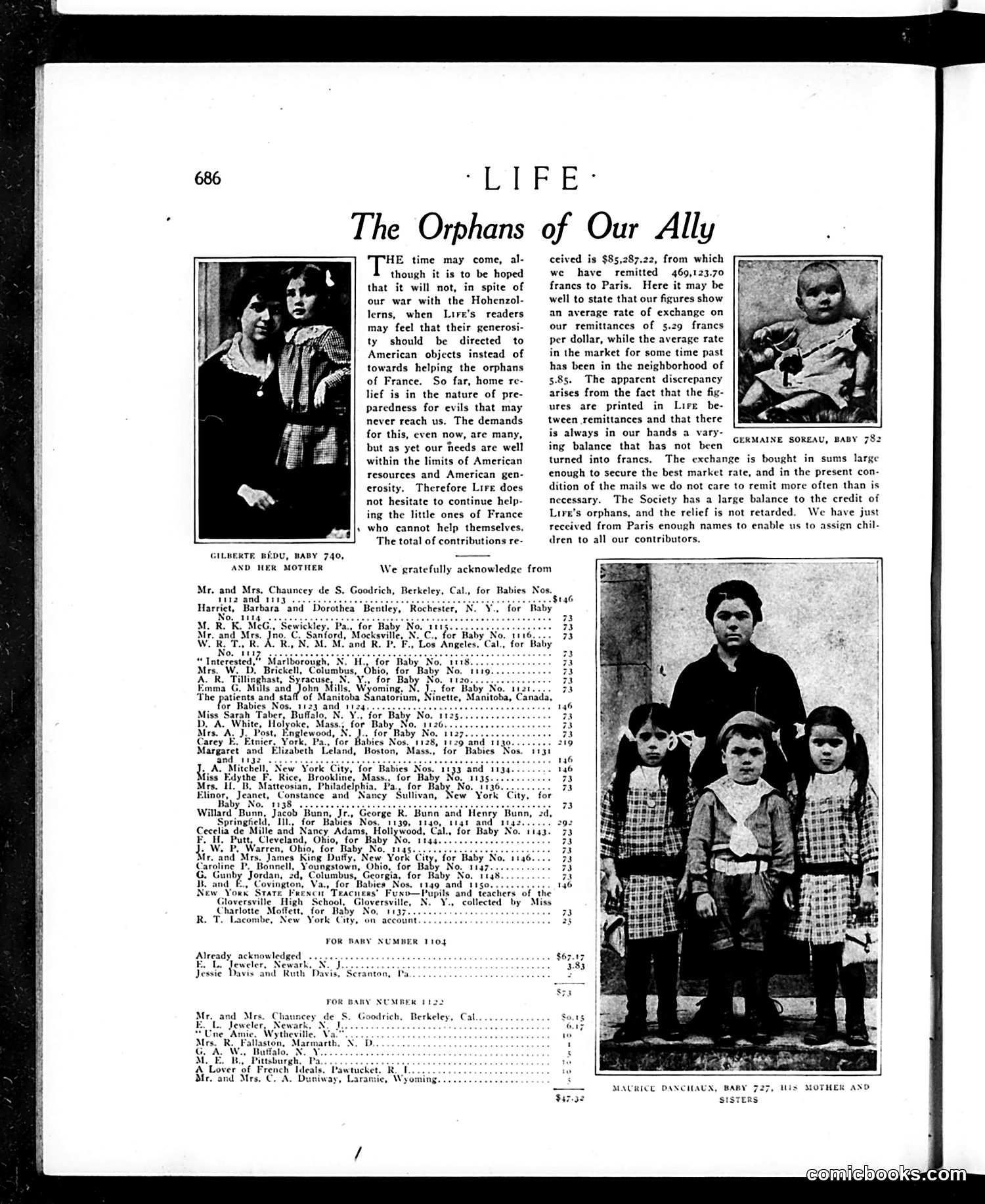
This page documents Life magazine's charitable fundraising campaign for French war orphans during World War I. The photographs show actual French children being supported—identified by name and number (Baby 740, Baby 782, etc.)—whose care is funded by American donors listed below. The editorial text addresses a patriotic concern: readers might ask why Americans should help French orphans when American resources could address domestic needs. Life's argument: American relief capacity remains sufficient for both foreign and home aid, and France is "our ally" in the war against Germany (the "Hohenzollerns"). The detailed donor list and financial accounting ($85,287.22 collected, 469,123.70 francs remitted to Paris) demonstrates transparency and legitimacy—crucial for convincing skeptical donors during wartime. This reflects early-20th-century American philanthropic culture and WWI-era transatlantic solidarity.
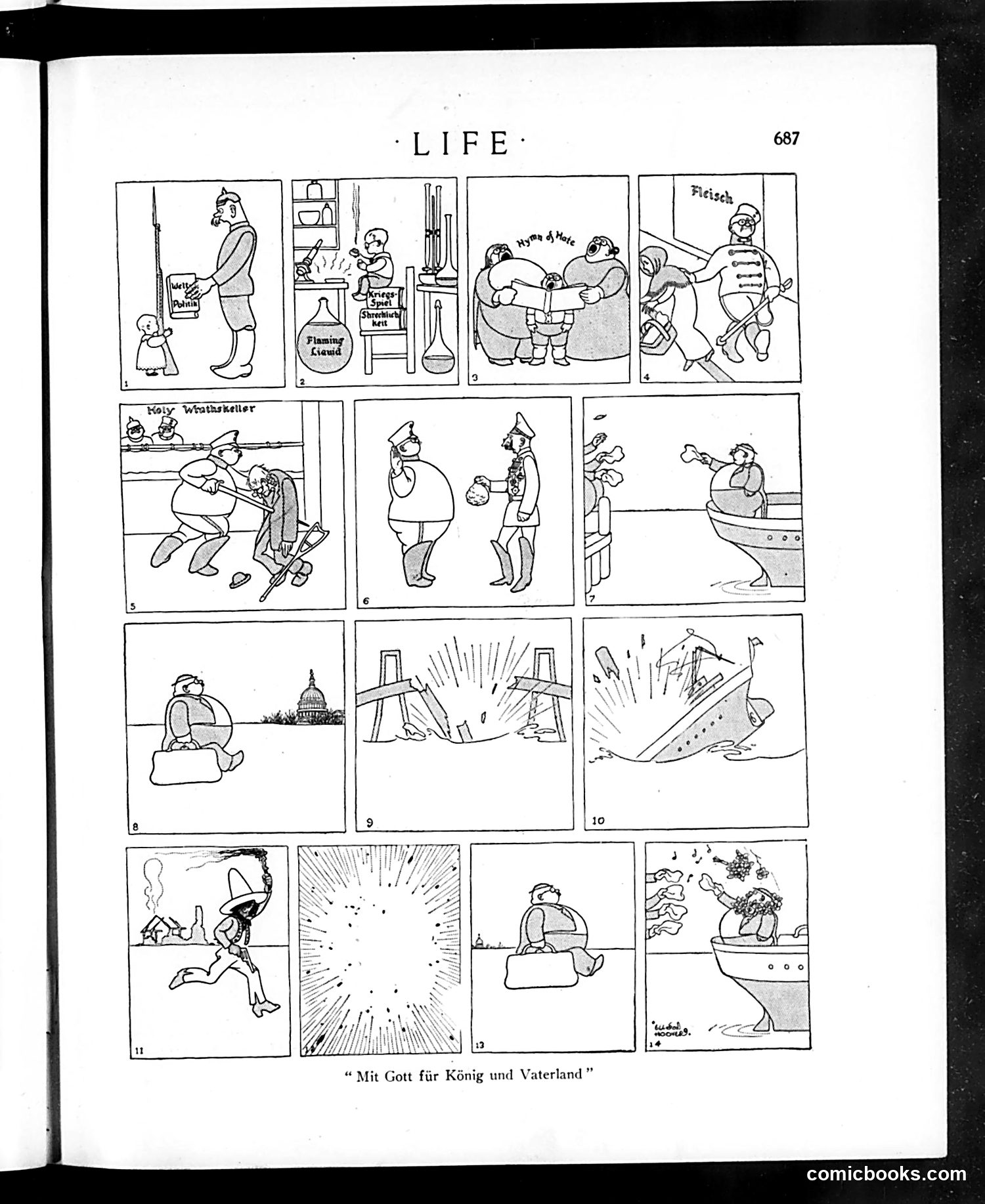
This is a German-language comic strip with the caption "Mit Gott für König und Vaterland" ("With God for King and Fatherland"), a patriotic German motto. The sequential narrative appears to depict a man's escalating misfortunes: he begins with domestic life, progresses through increasingly chaotic situations involving water and ships, and culminates in what appears to be catastrophic destruction. The strip likely satirizes German militarism or nationalism of the early 20th century by showing how patriotic fervor leads to absurd, escalating consequences. The protagonist's journey from ordinary citizen to disaster victim suggests ironic commentary on blind obedience to patriotic slogans. Without a visible date or publication context, the specific historical event referenced remains unclear, though the German motto and cartoon style suggest pre-WWI or WWI-era satire.
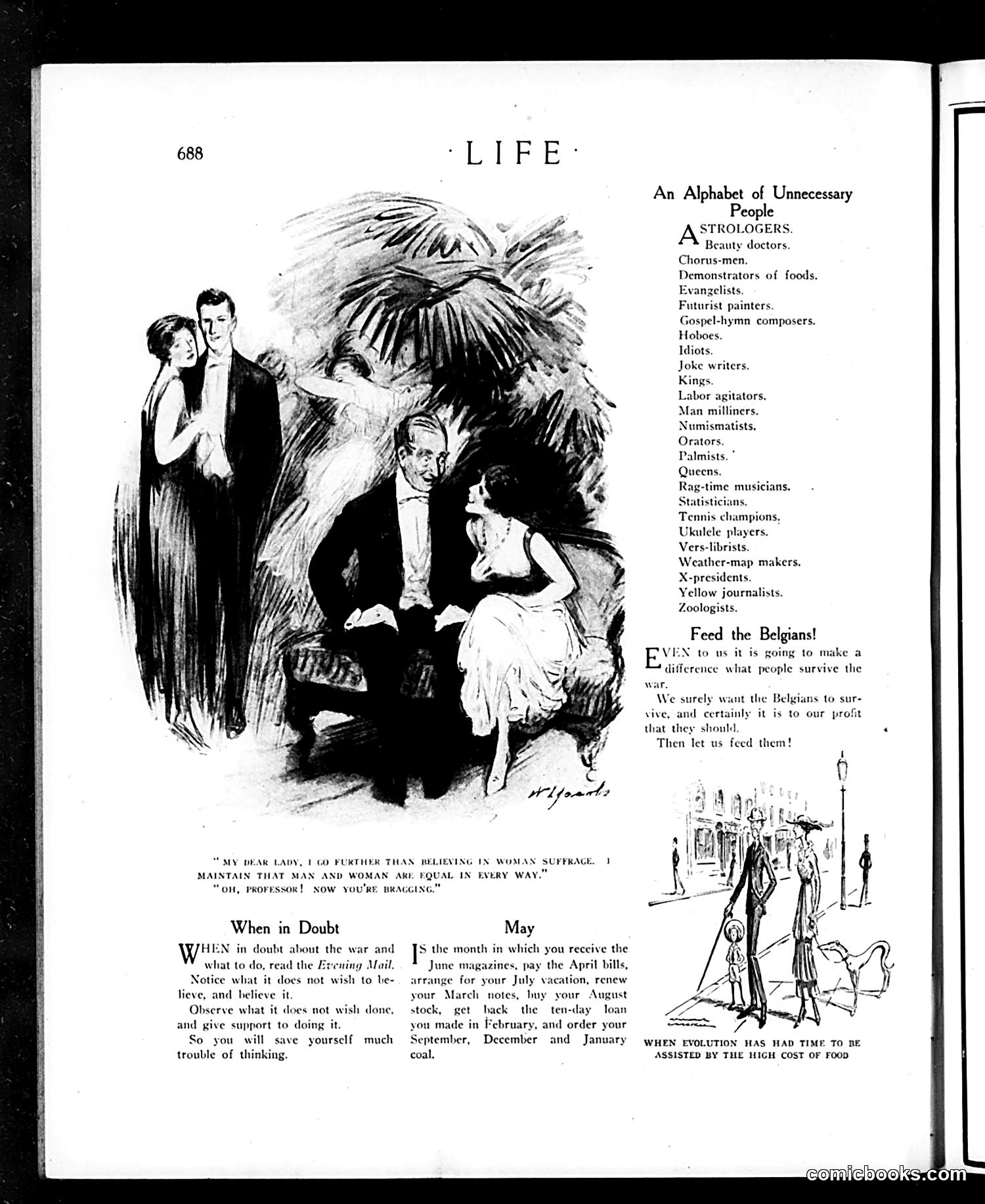
This page contains WWI-era American satire (likely 1914-1918). **The Professor cartoon** mocks female suffragists: a professor pontificates about gender equality while a woman sarcastically congratulates him, implying his beliefs are self-serving hypocrisy rather than genuine principle. **"When in Doubt"** sardonically advises readers to invert the Evening Mail's editorial positions—trust the opposite of what it publishes. This critiques the newspaper's perceived unreliability or bias. **"An Alphabet of Unnecessary People"** is a cutting list of societal occupations deemed worthless: astrologers, chorus-men, evangelists, palmists, etc. It reflects wartime frustration with perceived frivolity and waste. **"Feed the Belgians!"** addresses Belgium's desperate food shortage during German occupation. The final cartoon darkly suggests that high food costs will accomplish what evolution couldn't—implying mass starvation. This bitter satire condemns American reluctance to aid Belgian relief efforts. All pieces reflect American wartime cynicism and social criticism.
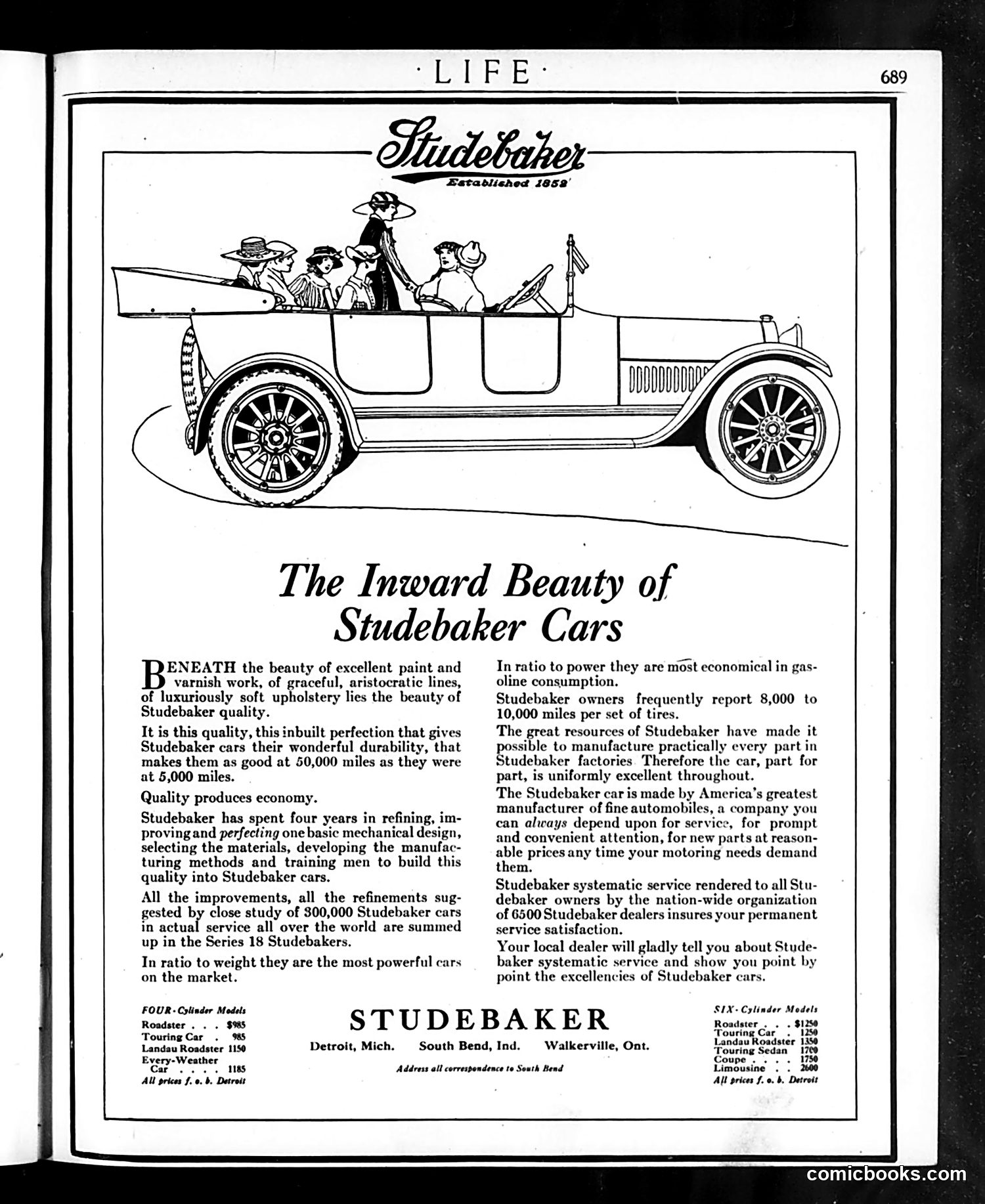
This is not a political cartoon but a **full-page automobile advertisement** for Studebaker cars, published in *Life* magazine (established 1852). The illustration depicts a vintage open-air touring car from approximately the 1910s-1920s, filled with well-dressed passengers wearing hats. The ad emphasizes "inward beauty"—quality engineering beneath attractive surfaces—claiming Studebaker's cars maintain performance at 50,000 miles as well as at 5,000. Key marketing claims include durability, fuel economy, tire longevity (8,000-10,000 miles per set), and nationwide dealer service (6,500 dealers). The ad highlights that Studebaker manufactures parts in-house for consistency. **For modern readers:** This represents early automotive advertising emphasizing reliability and service networks—concepts still used today, though the specific product claims and pricing ($985-$2,600) are historically dated. The formal illustration style and earnest copy typify early-20th-century corporate messaging.
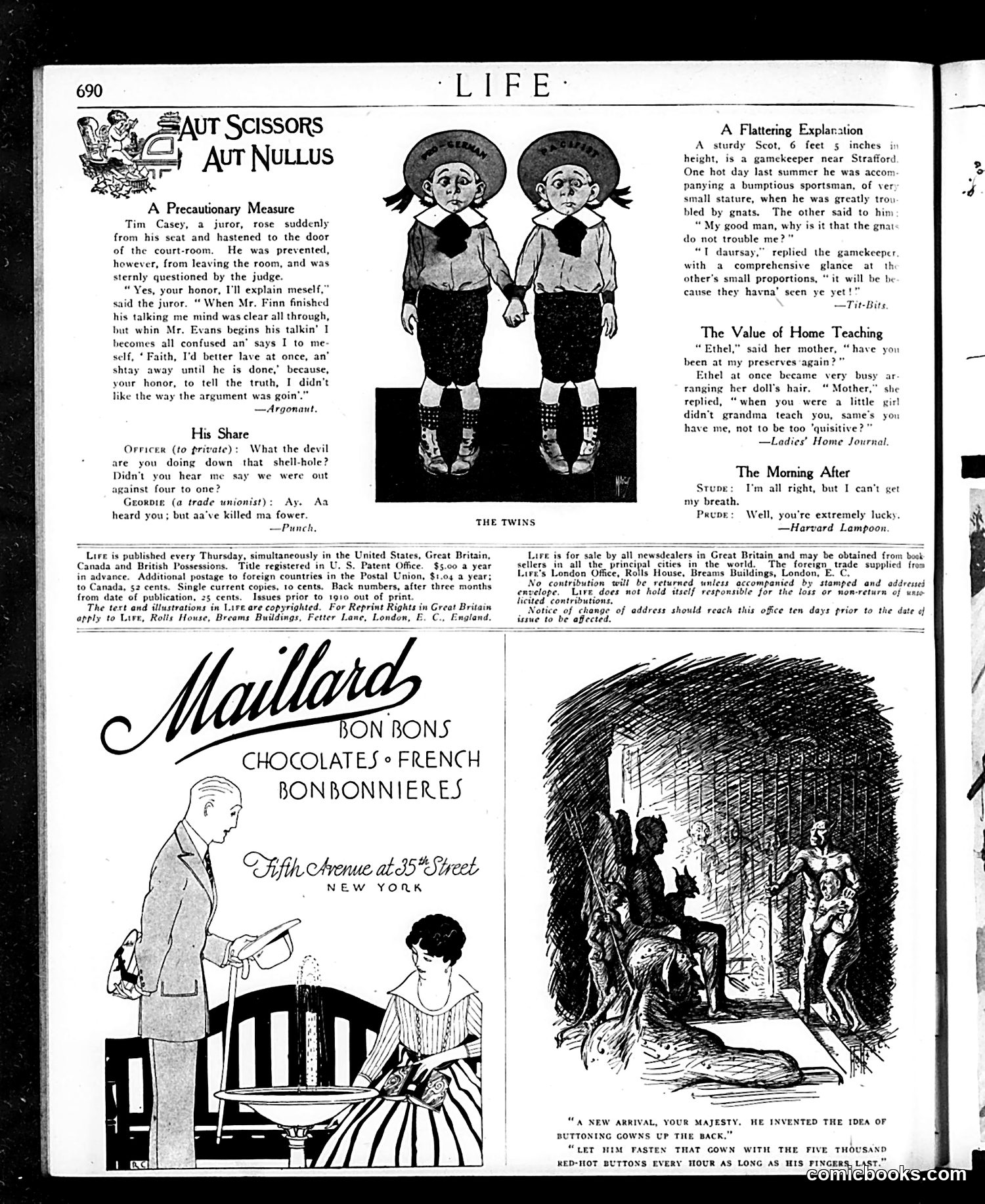
This page from *Life* magazine (undated but early 20th century based on styling) contains several short humorous anecdotes and illustrations typical of the publication's satirical format. **"A Precautionary Measure"** mocks jury deliberation: a juror tries to flee when opposing counsel begins arguing, claiming the first lawyer's argument was clear but the second confuses him—so he'd rather leave than hear contradictory testimony. **"His Share"** is a WWI-era joke about class consciousness: a soldier in a shell-hole during combat claims he's fulfilled his duty by killing "his four" enemies (matching the 4-to-1 odds), a reference to trade-union attitudes about "fair share" of work. The remaining sketches are light domestic humor about children and courtship, typical of *Life*'s gentle satire. The Mailland chocolates advertisement and illustration about a royal invention (buttoning gowns up the back) occupy the lower portion, representing the magazine's advertising revenue model.
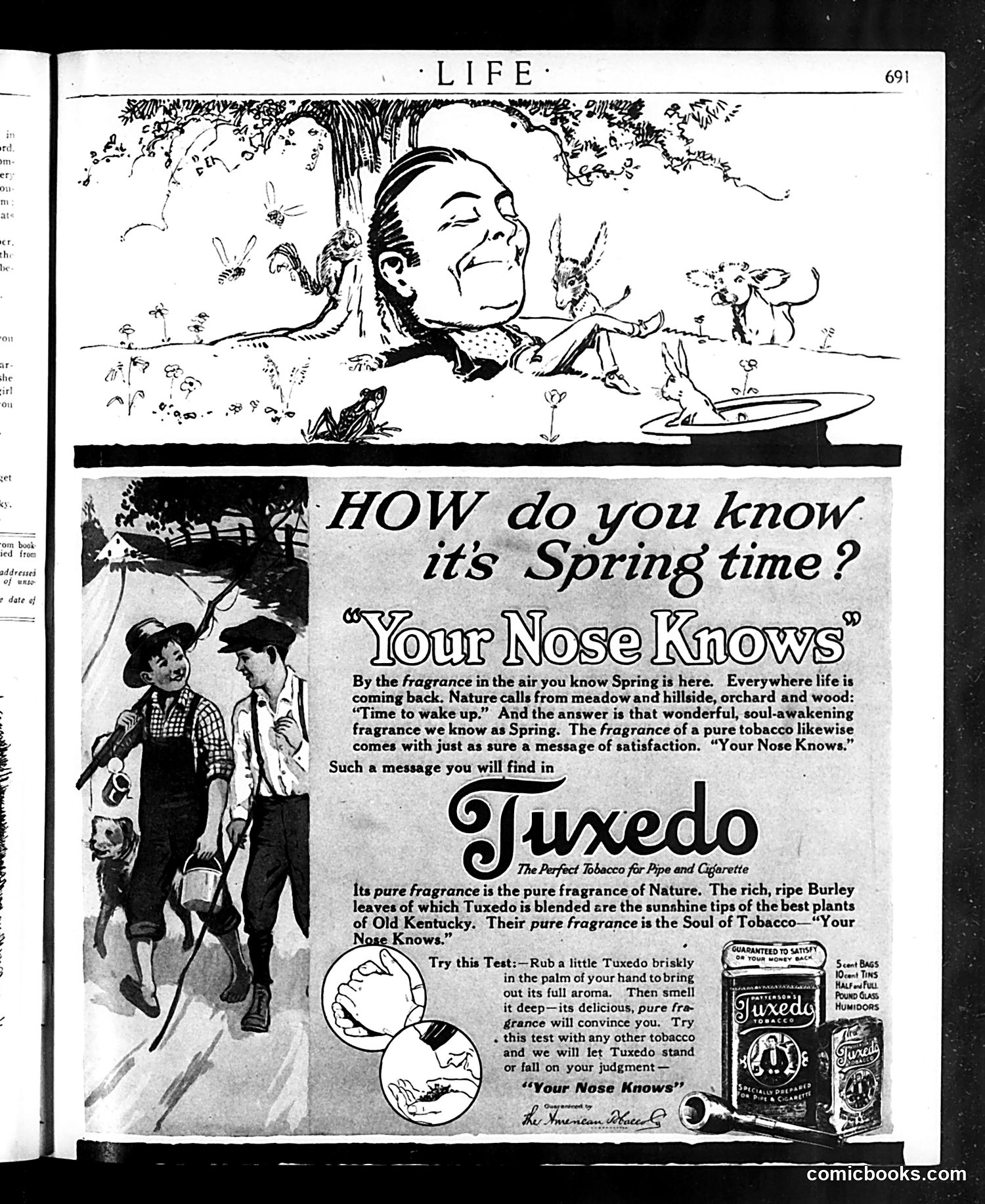
This page is primarily a **tobacco advertisement** for Tuxedo brand pipe and cigarette tobacco, disguised as editorial content in Life magazine. The top cartoon illustrates the tagline "Your Nose Knows"—depicting a man contentedly surrounded by spring imagery (animals, plants, blossoms) to evoke pleasant natural fragrances. Below, two men in period clothing walk outdoors, presumably enjoying spring air. The advertisement uses **poetic language about spring awakening** to create an association between natural fragrance and tobacco smoking. It claims Tuxedo's "pure fragrance" mirrors nature's spring scent, using pseudo-scientific language ("soul-awakening fragrance") to market the product. The "Try this Test" section encourages direct sensory comparison against competitors—a common early 20th-century advertising tactic before modern regulations restricted tobacco marketing. **For modern readers:** This represents an era when tobacco companies openly advertised in mass media without health warnings, using romanticized nature imagery to normalize smoking as a natural, wholesome pleasure.
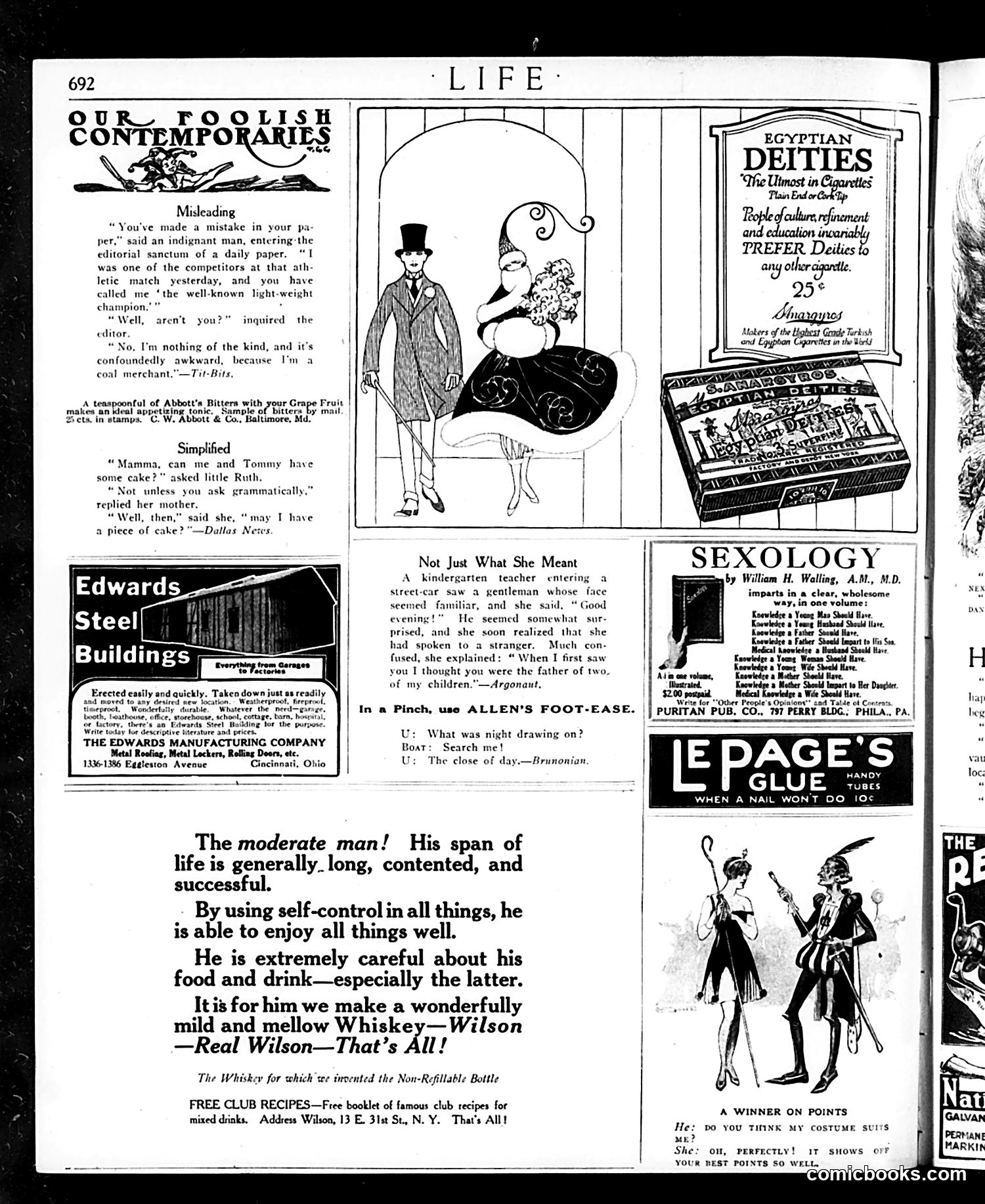
This page from *Life* magazine contains several short humorous anecdotes and advertisements typical of early 20th-century American satirical journalism. The main cartoons illustrate brief jokes: one depicts a misunderstanding where a man is mistakenly called a "light-weight champion" when he's actually a coal merchant; another shows a kindergarten teacher embarrassed after greeting a stranger, thinking he was "the father of two of my children" (implying an affair). The final cartoon, "A Winner on Points," shows a couple discussing a man's costume, with the woman remarking it "shows off your best points so well"—a flirtatious double entendre. The page is primarily **advertising-heavy**, featuring products like Egyptian Deities cigarettes, Edwards Steel Buildings, Allen's Foot-Ease, LePage's Glue, and Wilson Whiskey. A notable ad promotes *Sexology*, a medical text promising "a clear, wholesome way" to discuss the subject. The content reflects early 1900s attitudes: light domestic humor, social embarrassment jokes, and advertising that would seem quaint or inappropriate today.
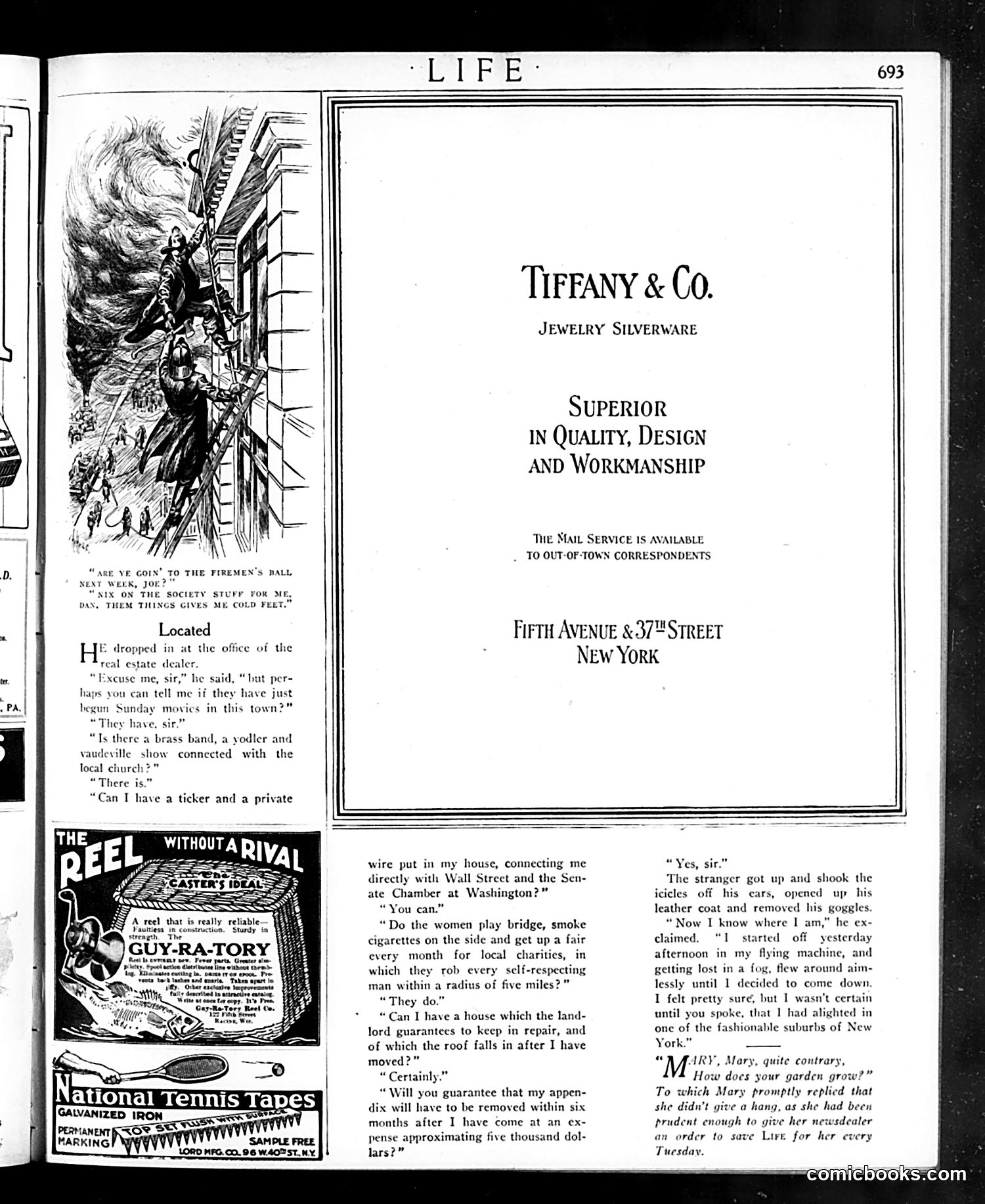
This page combines a **Tiffany & Co. advertisement** (right) with satirical content mocking American suburban life (left and center). The main cartoon depicts a stranger who has crash-landed via flying machine questioning a real estate agent about a town's amenities. His queries progress absurdly—from Sunday movies to church entertainment to Wall Street wire connections—each met with affirmation. When told the town has all these features *plus* unreliable landlords and guaranteed medical emergencies, the stranger concludes he's landed in "fashionable suburbs of New York." The satire targets **suburban pretension and conformity**: wealthy suburbs offer every modern convenience and social activity, yet remain fundamentally unreliable and materialistic. The flying machine arrival suggests he's stumbled upon this world by accident. The bottom item parodies the nursery rhyme "Mary, Mary, quite contrary," showing Mary dismissing gardening to instead subscribe to *Life* magazine—satirizing how advertising and consumerism have replaced traditional domestic interests. Both segments mock 1920s middle/upper-class American preoccupations with status symbols and entertainment over substance.
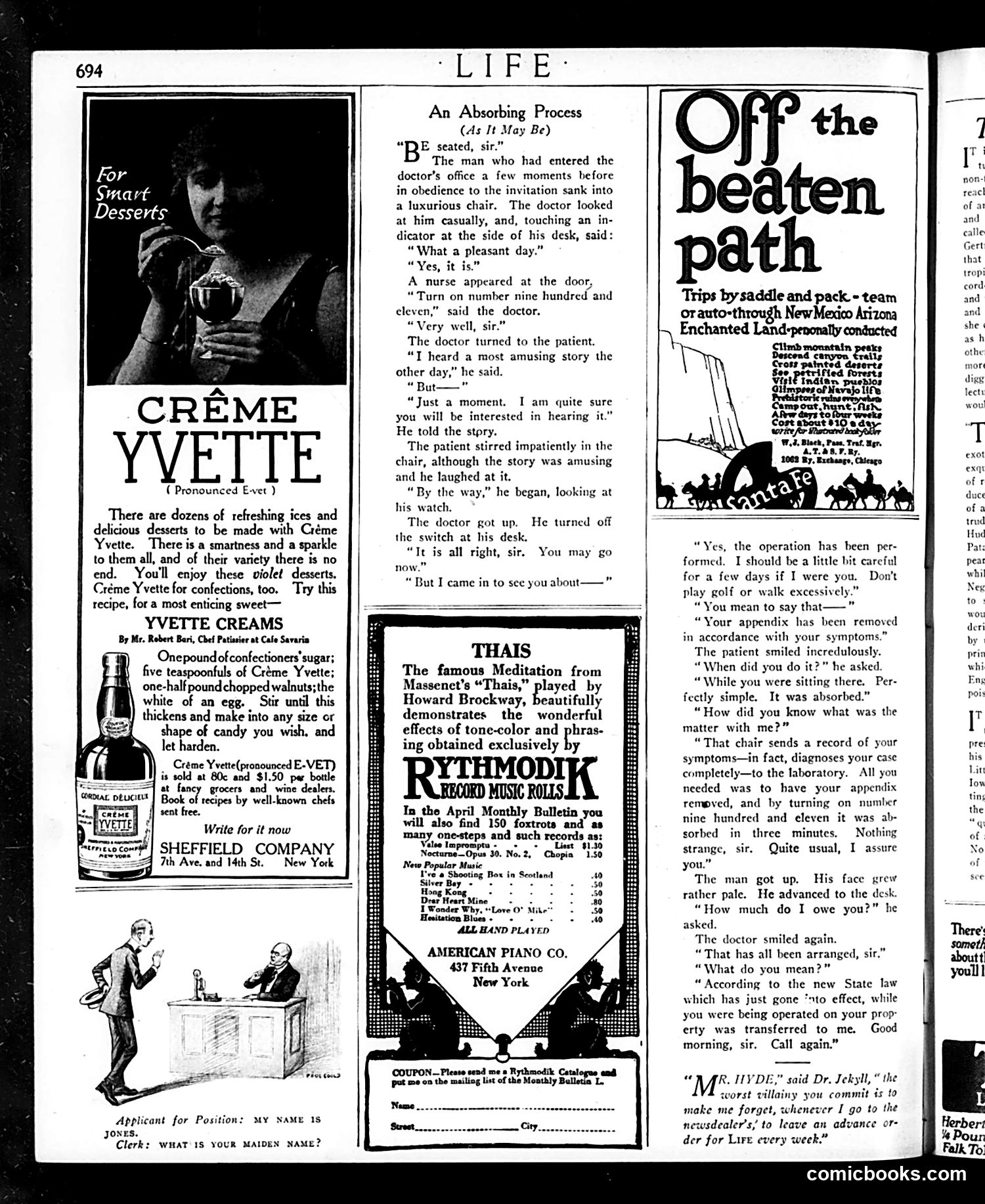
This page satirizes modern medical efficiency and automation. The cartoon "An Absorbing Process" imagines a future doctor who operates a machine (numbered switches) that simultaneously diagnoses patients, performs surgery (removing an appendix), and handles billing—all while the patient sits passively in a "luxurious chair." The humor targets the depersonalization of medicine: the doctor delays the patient's concerns by telling irrelevant stories, conducts an operation without the patient's knowledge or consent, and invokes "new State law" to justify the automatic billing. The term "absorbed" (used for both the appendix removal and the patient's involuntary payment) reinforces the satire. This likely reflects 1920s anxieties about mechanization, corporate efficiency encroaching on personal healthcare, and loss of patient agency—concerns that remain relevant today regarding medical bureaucracy and automated systems.
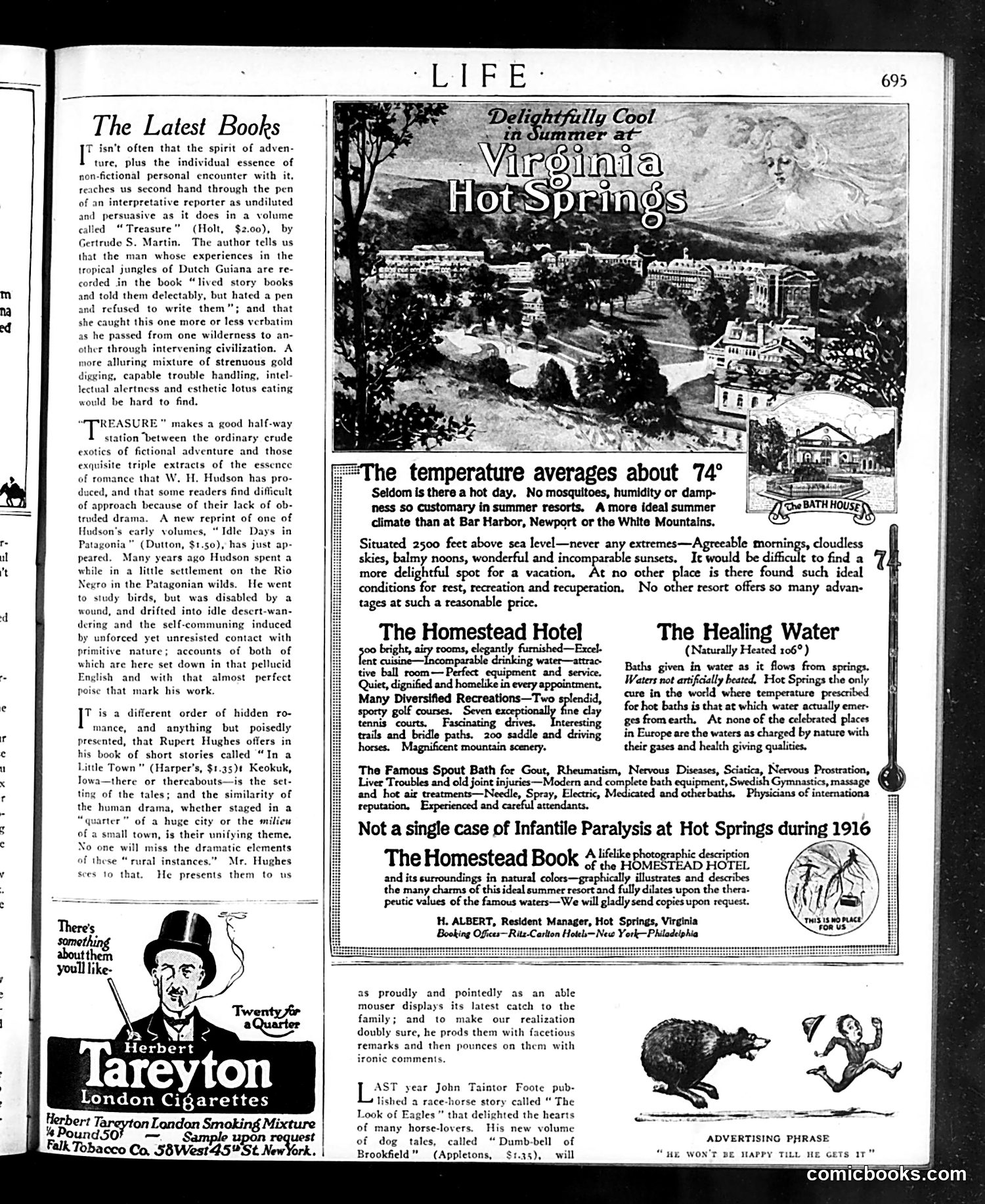
This page is primarily **advertising and book reviews**, not political satire. The political content is minimal. The only cartoon present is a **Herbert Tareyton Cigarettes advertisement** featuring a man in a top hat with the slogan "There's something about them you'll like—Twenty for a Quarter." This is straightforward product advertising with no satirical intent. The page's main content comprises book reviews of adventure and literary works by Gertrude S. Martin, W.H. Hudson, and Rupert Hughes, followed by large advertisements for **Virginia Hot Springs resort** and the Homestead Hotel, emphasizing their therapeutic waters and recreational facilities. The Herbert Tareyton ad's caricatured gentleman represents the aspirational, genteel consumer the cigarette brand marketed to—not a political figure or satirical target. This is a typical early-20th-century Life magazine page mixing literary criticism with advertising.
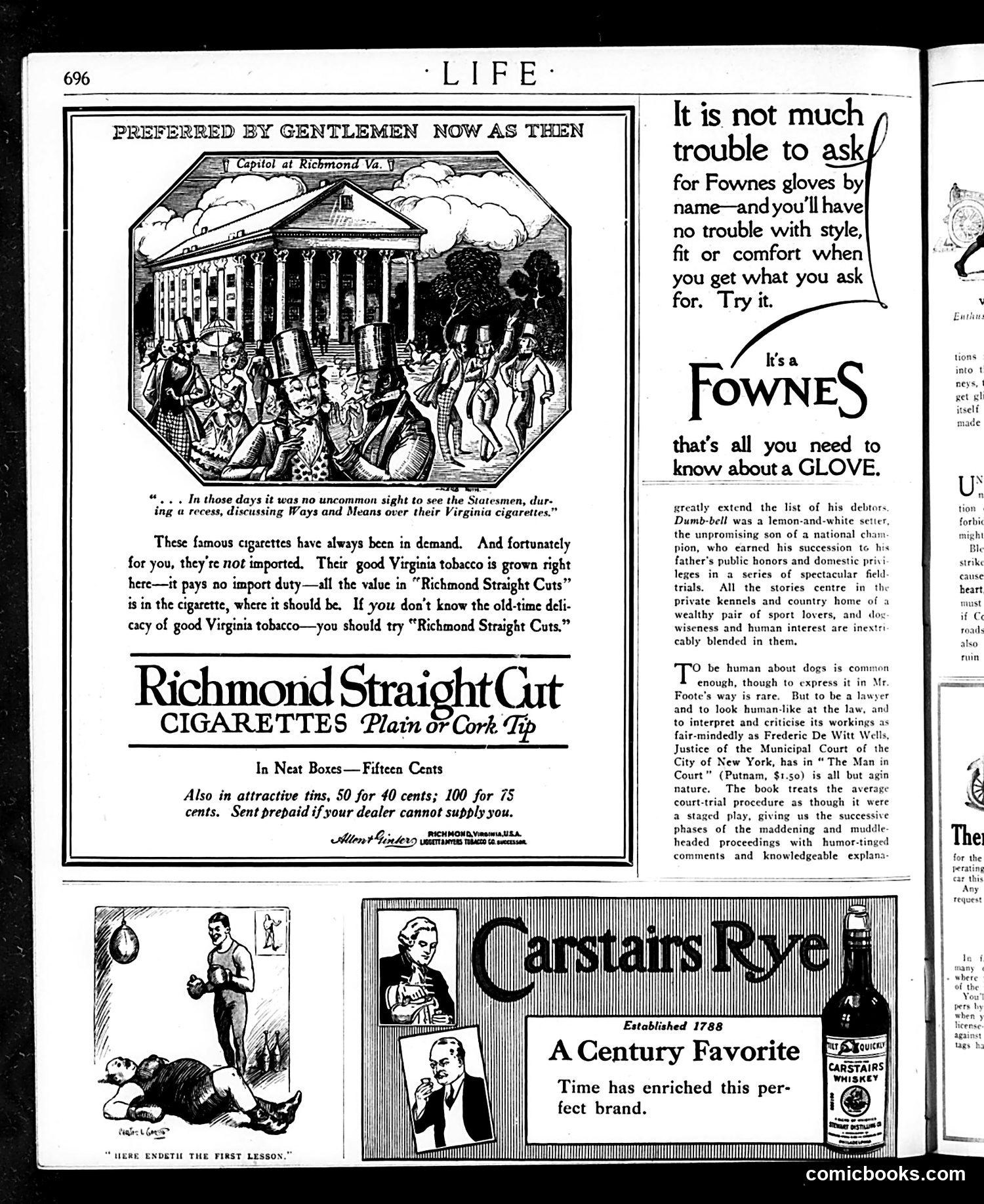
This page is primarily **advertising** for three products: Richmond Straight Cut cigarettes, Fownes gloves, and Carstairs whisky. The top advertisement features a historical engraving depicting statesmen at the Capitol in Richmond, Virginia, discussing legislation over cigarettes—a nostalgic appeal to tradition and respectability. The pitch emphasizes that Richmond cigarettes use domestically-grown Virginia tobacco, requiring no import duty, positioning them as patriotic and economical. Below that is a small cartoon labeled "Here Endeth the First Lesson" showing what appears to be a boxing or fighting lesson—likely satirizing some social or sporting activity, though the specific reference is unclear without more context. The remaining content includes book reviews and a Fownes gloves advertisement emphasizing quality and fit. **The satire is minimal**; this is largely a commercial page reflecting early 20th-century advertising practices that associated consumer products with gentility, patriotism, and social status.
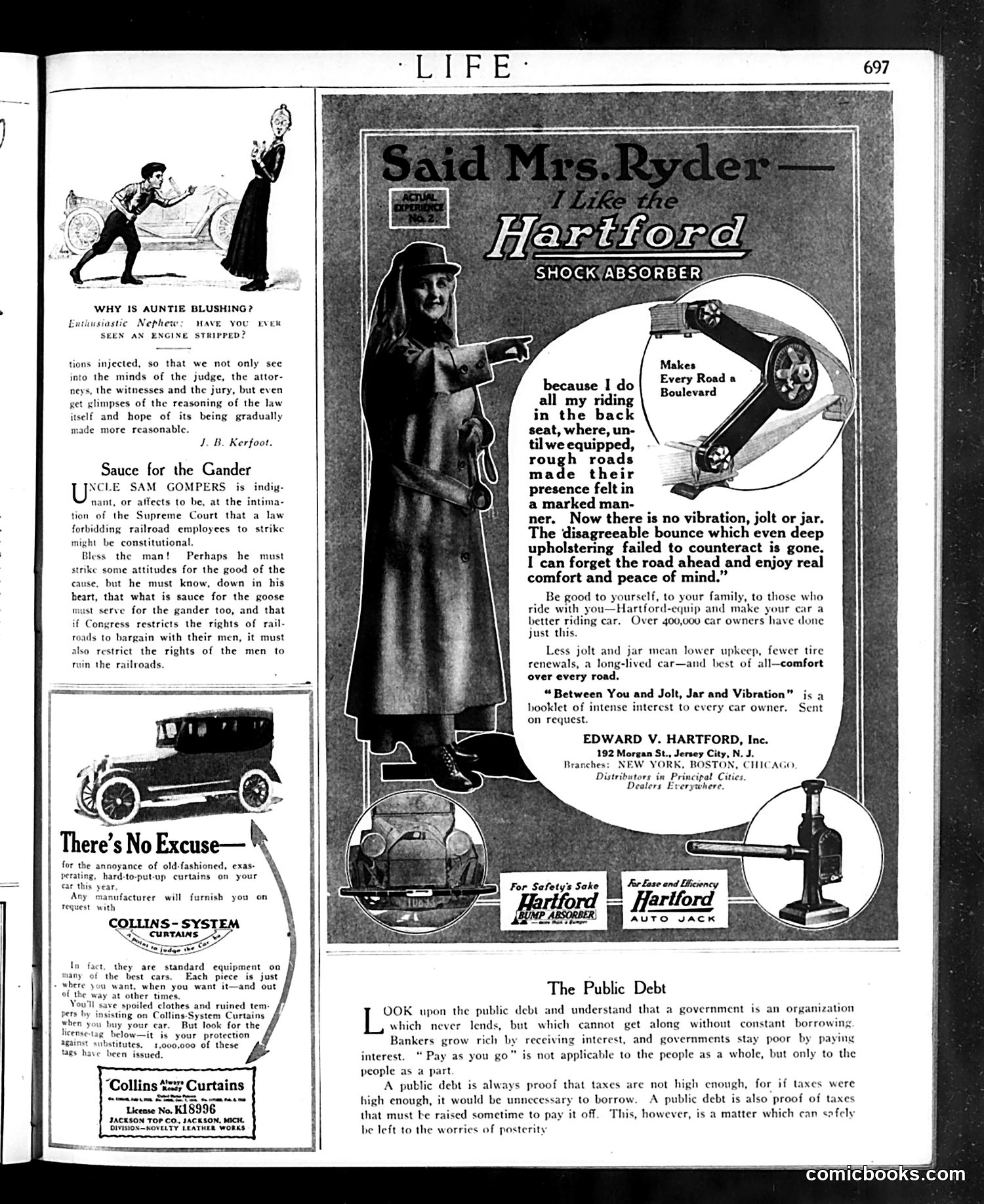
This page contains three distinct elements: **Top Left Cartoon**: A mild joke about a woman's embarrassment when a nephew asks if she's ever "seen an engine stripped"—a double entendre playing on Victorian prudishness. **Middle Section**: Two advertisements (Collins System Curtains and Hartford Shock Absorbers) with accompanying editorial content about labor rights. The "Sauce for the Gander" piece references Samuel Gompers's indignation over a Supreme Court ruling potentially restricting railroad workers' strike rights. The author argues if Congress restricts railroads' bargaining power, it must equally restrict workers'—a symmetrical fairness argument. **Bottom Section**: "The Public Debt" offers social commentary critiquing government borrowing practices. It argues public debt proves taxes are insufficiently high and represents a burden transferred to future generations—a fiscal conservative perspective typical of early 20th-century Life magazine's editorial stance. The page exemplifies Life's mix of humor, advertising, and political opinion aimed at educated readers.
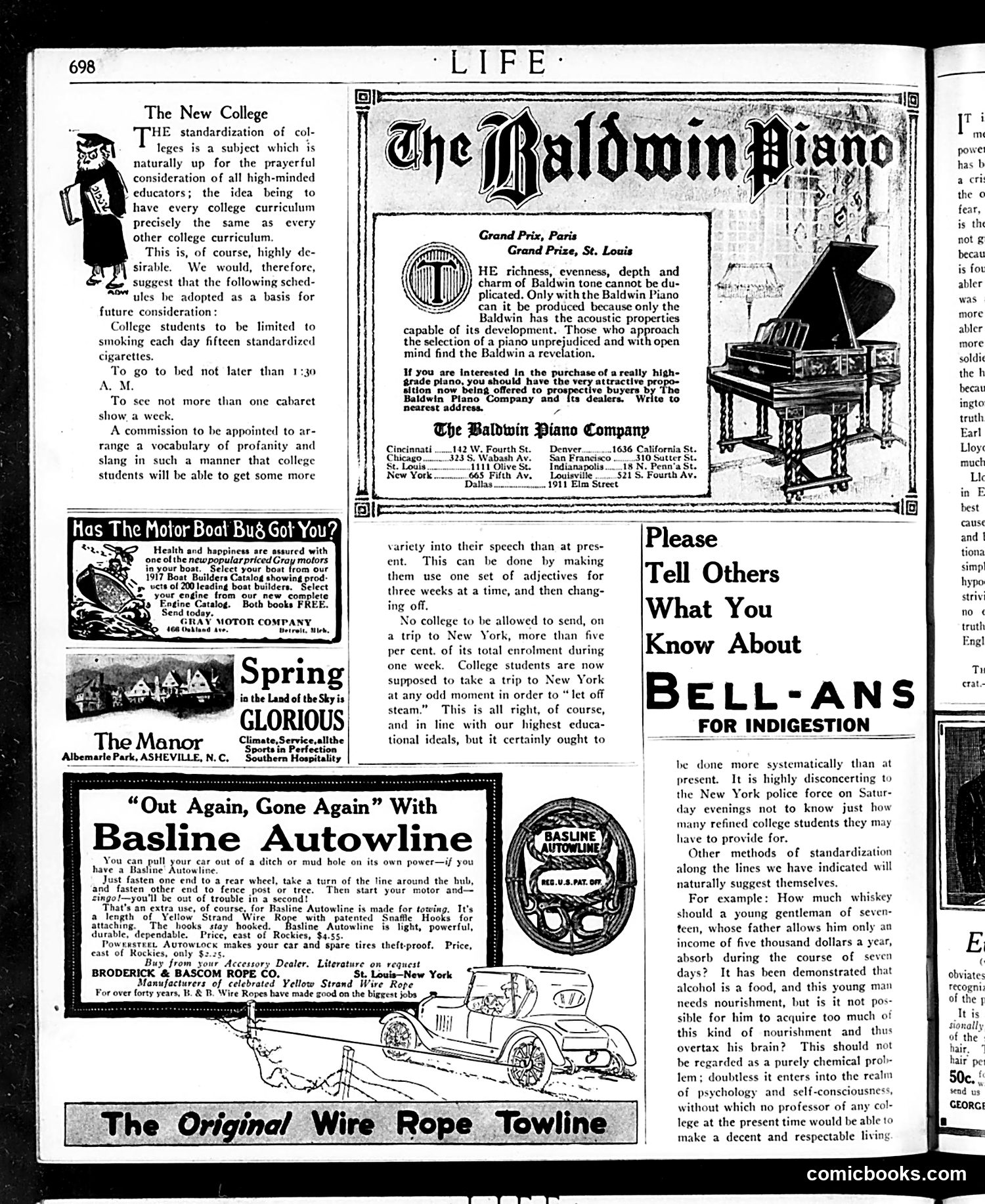
This page satirizes the early 20th-century movement toward standardizing college curricula and student conduct. The main article mockingly proposes absurd "standardization" rules: limiting students to 15 cigarettes daily, enforcing an 1:30 AM bedtime, restricting cabaret attendance to once weekly, and standardizing profanity vocabularies. The satire targets reformers' obsession with controlling student behavior. The joke extends to mocking college trips to New York, suggesting authorities should systematically track which students visit to help police manage "refined college students" causing weekend disturbances. The piece ridicules how standardization advocates claimed to improve education while actually proposing intrusive, paternalistic regulations that treat adults like children. The deadpan tone—presenting ridiculous rules as serious proposals—is the satire's primary vehicle, highlighting the absurdity of the standardization movement itself.
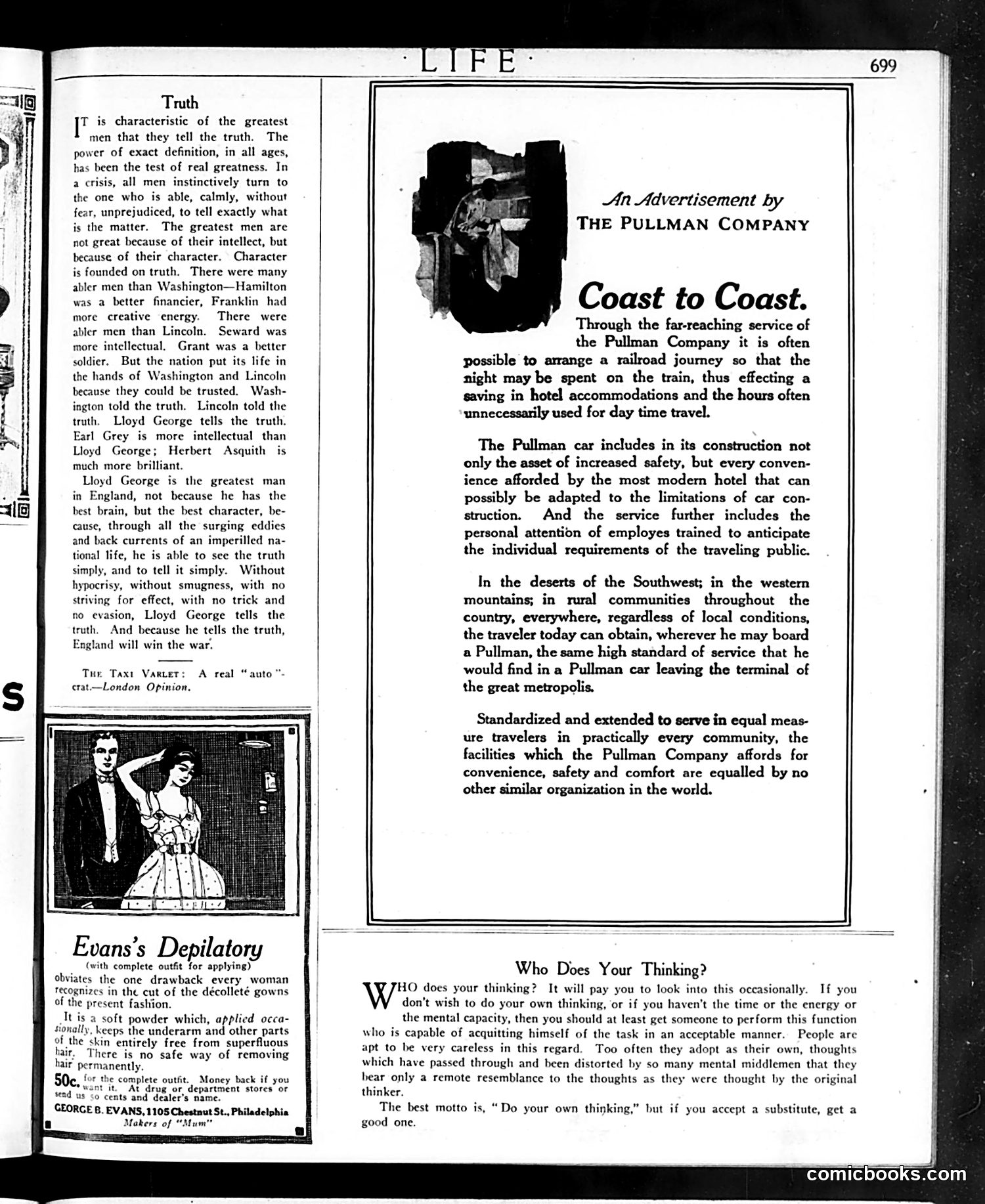
This page combines editorial content with advertisements typical of early 20th-century Life magazine (likely WWI-era, given references to Lloyd George and "England will win the war"). **The "Truth" Editorial:** Praises British Prime Minister Lloyd George as England's greatest leader, not for intellect but for truthfulness and character. The piece argues that in national crises, people trust those who tell truth plainly—comparing Lloyd George favorably to more brilliant but less straightforward contemporaries like Herbert Asquith. This is wartime propaganda celebrating British leadership. **The Advertisements:** Include Evans's Depilatory (hair removal powder for women in fashionable low-cut dresses) and a Pullman Company advertisement promoting railroad sleeping cars as economical alternatives to hotels. **"Who Does Your Thinking?":** A brief philosophical piece questioning whether readers think independently or blindly adopt others' ideas. The page reflects early 1900s concerns: British wartime morale, emerging consumer beauty products for women, railroad travel modernization, and intellectual self-reliance as a virtue.
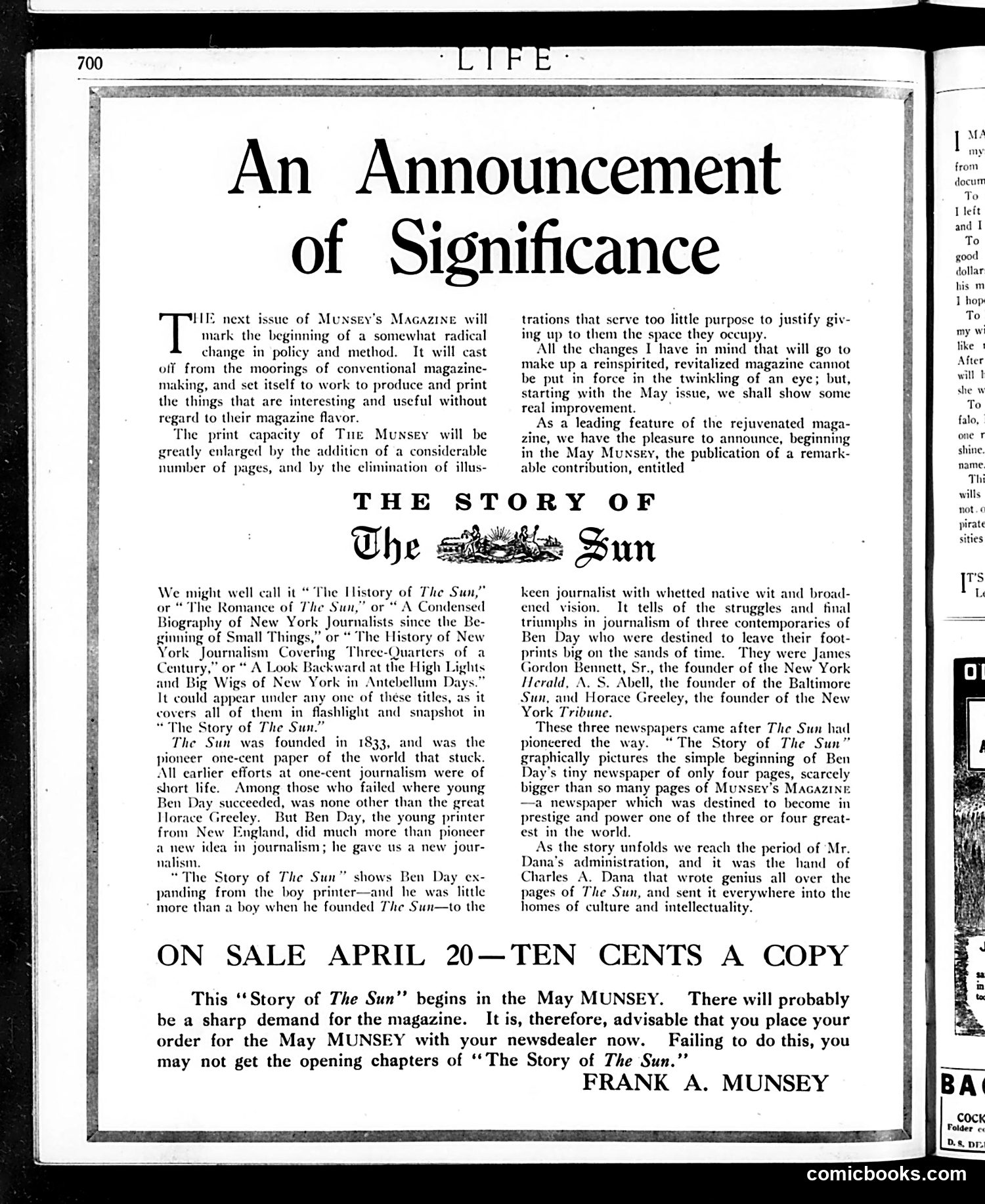
This is not a cartoon but rather a **magazine advertisement and editorial announcement** from *Life* magazine's April 1912 issue. **Content:** Frank A. Munsey announces major changes to *Munsey's Magazine*, including expanded pages and elimination of low-value illustrations. The centerpiece is promotion of an upcoming serialized history of *The New York Sun* newspaper, beginning in May's issue. **Historical Context:** The piece celebrates 19th-century American journalism pioneers—Ben Day (founder of *The Sun*, 1833), James Gordon Bennett Sr. (*New York Herald*), A.S. Abell (*Baltimore Sun*), and Horace Greeley (*New York Tribune*). It positions Charles A. Dana as a genius editor who elevated *The Sun* to greatness. **Purpose:** This is essentially a subscription pitch, warning readers that demand for the May issue will be high and encouraging immediate orders through newsdealers to avoid missing the serialization's opening chapters. No satire is evident; this appears straightforward promotional material celebrating American newspaper history.
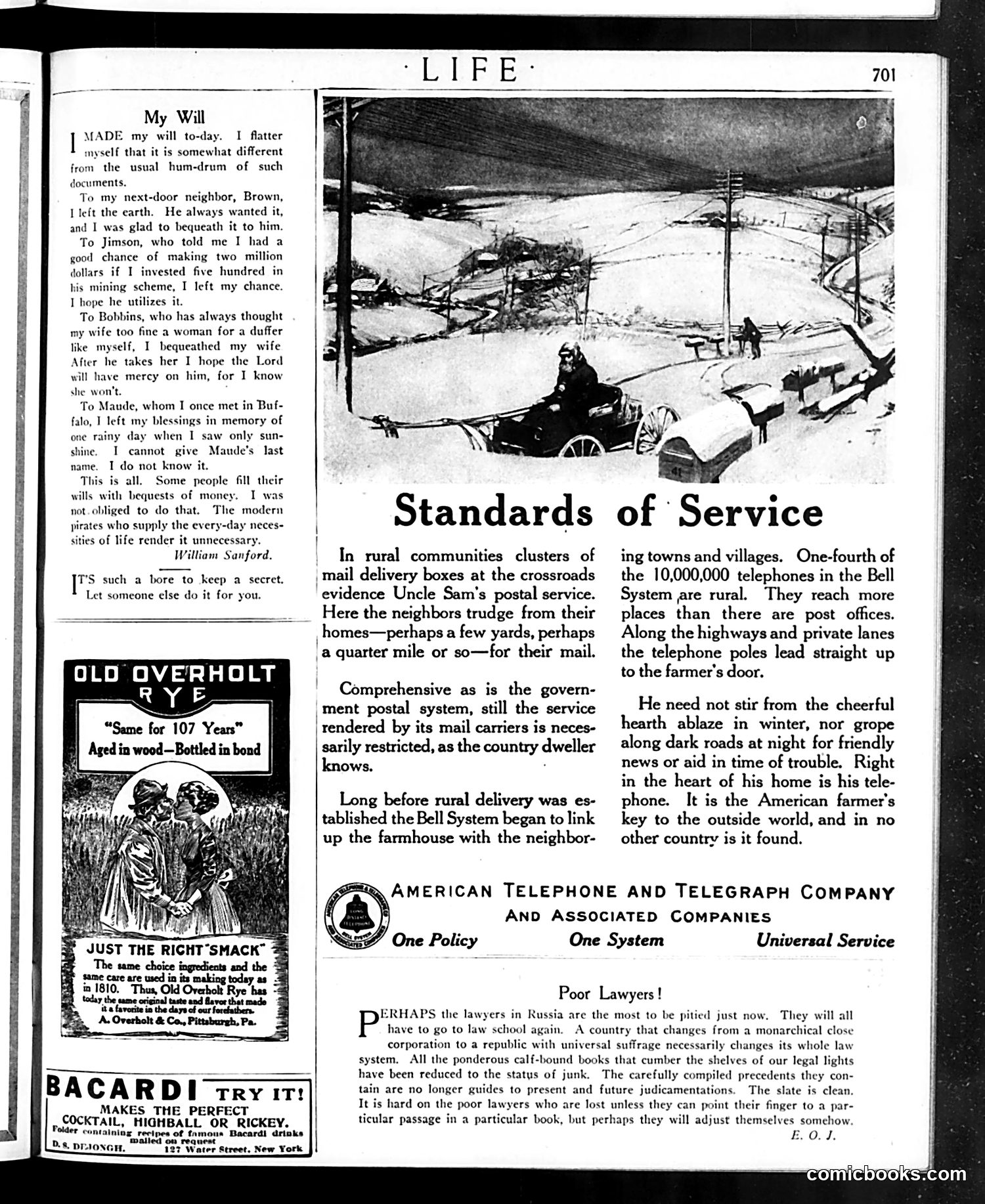
This page contains three distinct pieces of satire: **"My Will"** is a humorous essay mocking conventional will-writing. The narrator bequeaths abstract or insulting items to acquaintances—leaving his neighbor the "earth" he coveted, giving a swindler his "chance" at wealth, and (most pointedly) bequeathing his wife to a man who admired her, hoping "the Lord will have mercy on him, for I know she won't." The joke satirizes both overwrought testamentary documents and domestic relationships through exaggerated malice. **"Standards of Service"** is an AT&T advertisement celebrating rural telephone infrastructure—a genuine corporate pitch rather than satire, emphasizing how farmers stay connected via telephone poles and home lines. **"Poor Lawyers!"** satirizes Russian lawyers post-Revolution. The joke: following Russia's shift from monarchy to republic, old legal precedents become worthless "junk," leaving lawyers who depend on citing case law completely lost. It's Cold War-era humor mocking how legal systems collapse during radical political upheaval. The page also includes ads for Old Overholt Rye and Bacardi rum.
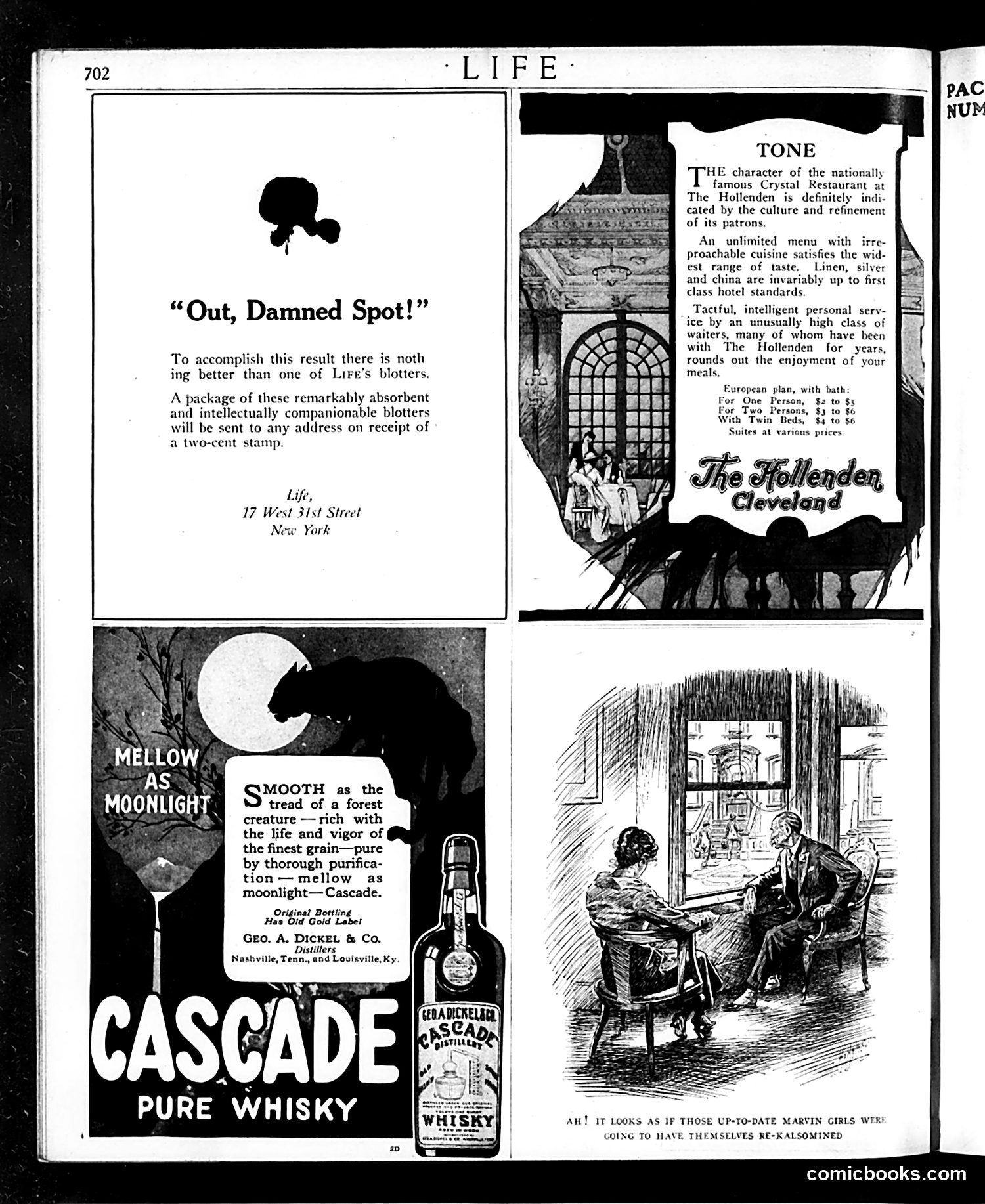
This page is primarily **advertisements interspersed with satirical content**. The top-left features Life magazine's own blotter ad with the headline "Out, Damned Spot!"—a Shakespeare reference (Lady Macbeth's obsession with bloodstains) applied humorously to ink stains, promoting Life's absorbent blotters. The right side advertises **The Hollenden, a Cleveland hotel**, emphasizing its refined clientele and service standards. The bottom-left promotes **Cascade Pure Whisky** via a poetic description evoking smoothness and quality. The bottom-right cartoon shows two men observing women, with the caption: "Ah! It looks as if those up-to-date Marvin girls were going to have themselves re-kalsomined." This is satirical commentary on women's fashion or cosmetic trends—"kalsomining" (applying whitewash/coating) is a metaphor for makeup application, mocking the "modern girl's" self-presentation as excessive or superficial. The page reflects early 20th-century attitudes toward women's cosmetics and fashion through humor.