
Life, 1917-04-19 · page 25 of 42
Life — April 19, 1917 — page 25: what you’re looking at
What you’re looking at
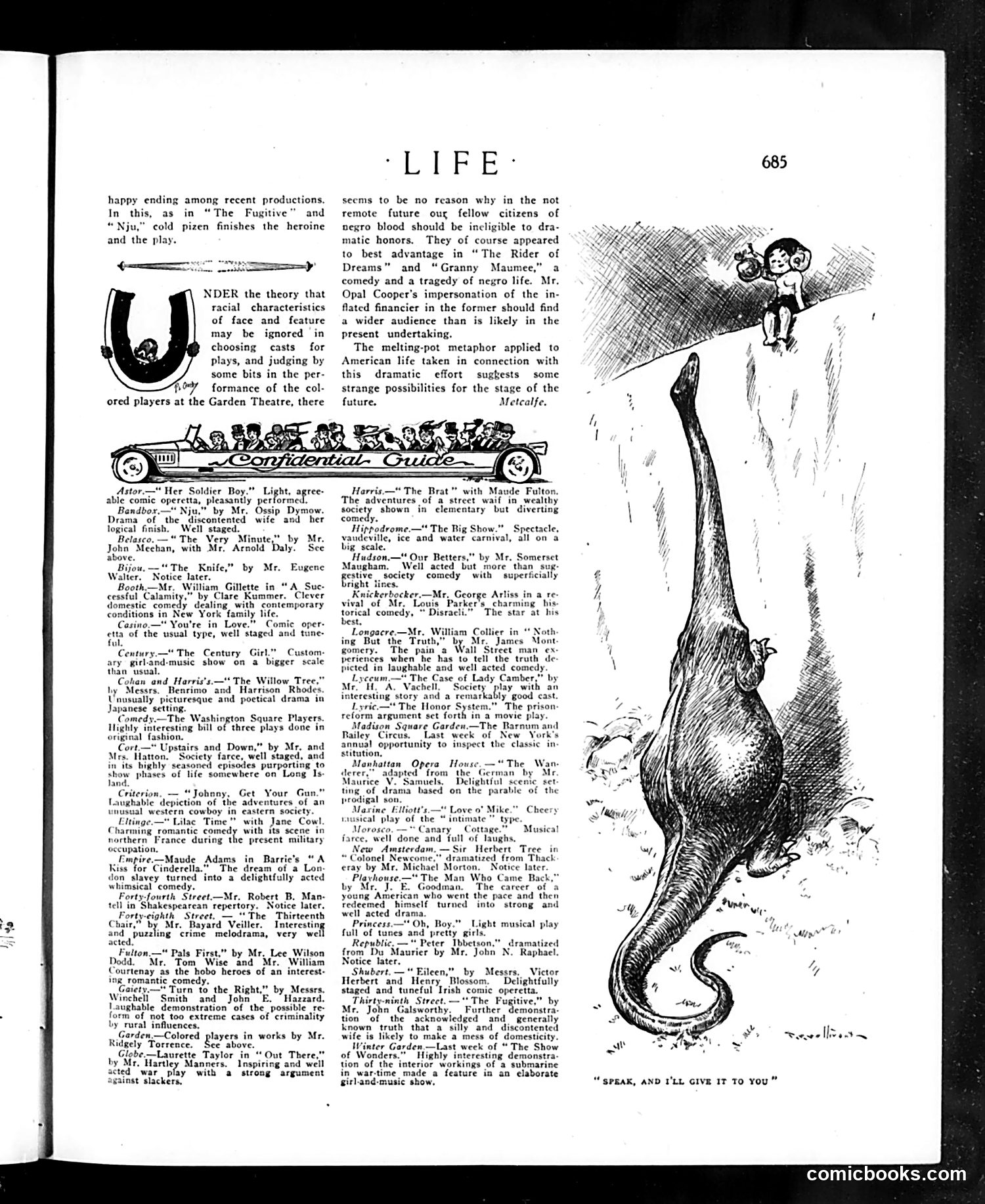
This page reviews Broadway theater productions, with particular focus on a significant cultural moment: Black actors performing at the Garden Theatre in works by Ridgely Torrence ("The Rider of Dreams" and "Granny Maumee"). The critic (Metcalfe) argues that these performances demonstrate Black actors deserve equal consideration for dramatic roles regardless of "racial characteristics." He praises Opal Cooper's performance as a financier, suggesting such casting should expand beyond segregated productions. The "melting-pot metaphor" reference connects theater integration to broader American assimilation debates. The accompanying cartoon (bottom right) appears to be unrelated theatrical illustration, captioned "Speak, and I'll Give It to You." This review reflects early 20th-century theatrical integration efforts and the contemporary racial debates surrounding who could perform which roles on stage—a progressive stance for the era, though framed in period-appropriate language that treats this as surprising or noteworthy.
📄 Transcribed text from this page (OCR, searchable)
Machine-transcribed from the original scan — historical spelling and the odd misread are preserved.
happy ending among recent productions. In this, as in “The Fugitive” and “Nju,” cold pizen finishes the heroine and the play. NDER the theory that racial characteristics of face and feature may be ignored in choosing casts for plays, and judging by some bits in the per- fie formance of the col- ored players at the Garden Theatre, there “LIF E- seems to be no reason why in the not remote future oug fellow citizens of negro blood should be incligible to dra- matic honors. They of course appeared to best advantage in “The Rider of Dreams" and “Granny Maumee,” a comedy and a tragedy of negro life. Mr. Opal Cooper's impersonation of the in- flated financier in the former should find a wider audience than is likely in the present undertaking. The melting-pot metaphor applied to American life taken in connection with this dramatic effort sugkests some strange possibilities for the stage of the future. Metealfe. Astor. Her Soldier Boy.” Light, agree- able comic operctia, picasanily perforce, Bandbox.—" Nju.” by Mr. Ossip Dymow. Drama of the discontented wife and her logical finish. Well staged. Belasco. —“ The Very Minute,” by Mr. John Meehan, with Mr. Arnold Daly. Sce above. Bijou, —‘ The Knife,” by Mr. Eugene Walter. ‘otice later. Booth.—Mr. William, Gillette in “ A_ Suc: geastul Calamity.” by Clare Kummer, Clever pedy: domestic co dealing with contemporary conditions in New York family life. Cesino.—" You're in Love.” Comic oper: etta of the usual type, well staged and tune- ful, Century.—" The Century Girl” Custom: ary girland-music show on a bigger scale than usual. Cohan and Harris's.— The Willow. Tree,” hy Messrs. Benrimo and Harrison Rhodes. Unusually picturesque and poetical drama in Japanese setting. Comedy.—The Washington Square Players Highly interesting bill of three plays done in original fashion. Cort—" Upstairs and Down,” by Mr. and Mrs. Hatton. Society farce, well staged, and in its highly seasoned episodes purporting to thow phases of life somewbere on Long Is: Jane terion, — “Johnny, Get Your Gun.” hable depiction of the adventures of an unusual western cowboy in eastern society. Eltinge.—" Lilac Time” with Jane Cowl. Charming romantic comedy with its scene in northern France during the present military ‘occupation, Empire.—Maude Adams in Barrie's “A Kiss for Cinderella.” The dream of a Lon: don slavey turned into a delightfully acted msical comedy. rth Street,—Mr. Robert B. Man- hakespearean repertory. Notice later. Forty-eighth Street. — “The Thirteenth Chair,” by Mr. Bayard Veiller. Interesting and ‘pussling crime melodrama, very wel acted. Fulton.— Pals First.” by Mr, Lee Wilson Dodd. Mr. Tom Wise and Mr. William Courtenay as the hobo heroes of an interest- ing_romantic comedy, . Gaiety.—"* Turn to the Right,” by Messrs. Winchell Smith and Jobn 'E, Hazzard, laughable demonstration’ of the possible re- form of not too extreme cases of criminality by rural influences, Garden.—Colored players in works by Mr. Ridgely Torrence. See above. Globe.—Laurette Taylor in “Out There,” by Mr, Hartley Manners. Inspiring and well acted “war play with a strong argument ainst slackers. Harris—" The Brat” with Maude Fulton. The adventures of a street waif in wealthy society shown in elementary but diverting comedy. Hippodrome.—* The Rig Show." Spectacle, vaudeville, ice and water carnival, all on a Vig scale. Hudson.—" Our Retters," by Mr. Somerset Maugham. Well acted but more than sug- estive society comedy with superficially right lines. Knickerbocker.—Mr, George Arliss in a re vival of Mr. Louis Parker's charming | torical comedy, “Disraeli.” The star at best, Longacre.—Mr. William Collier in “ Noth ing But the Truth,” by Mr. James Mont gomery. The pain’a Wail Sticet man ex- periences when he has to teil the truth de picted in laughable and well acted comedy Lyceum.—" The Case of Lady Camber." by Mr, ‘A. Vachell, Society ‘play. with an interesting story and a remarkably good cast. Lyric.—"* The Honor System.” The prison reform argument set forth ina movie play. Madison Square Garden.—The Rarnum and Railey Circus. Last week of New Yo annual opportunity to inspect the classic in stitution, Manhattan Opera House. —“ The Wan derer,” adapted from the German by Mr. Maurice V. Samuels, Delightful sce set ting of drama based on the parable of the prodigal son. Marine Eltiott’s.—" Love o' Mike.” Chery nusical play of the “i Morosco. —* Canary farce, well done and full of laughs. New Amsterdam. —Sir Herbert Tree in * Colonel Newconte,” dramatized from Thack cray by Mr, Michael Morton. Notice later Playhouse.—" The Man Who Came Ba by Mr. J. E. Goodman. The career of young American who went the pace and the redeemed himself turned into strong a! well acted drama. Princess.—" Oh, Boy.” Light musical play full of tunes and’ pretty girls Republic. —" Peter Thbetson,” dramatized from Du Maurier by Mr, Jobn N. Raphael. Notice later. Shubert. —“ Eileen,” by Messrs. Victor Herbert and Henry ‘Blossom. Delightfully staged and tuneful Irish comic operetta. Thirty-ninth Street. —" The Fugitive,” by Mr. John. Galsworthy, Further demonstra- tion ‘of the acknowledged and_ generally known truth that a silly and discontented wife is likely to make a mess of domesticity. Winter Garden —Last week of “ The Show of Wonders.” Highly interesting demonstra: tion of the interior workings of a submarine in war-time made a feature in an elaborate girland-music show, “SPEAK, AND I'LL GIVE IT To you” comicbooks.com