
Life, 1917-04-19 · page 24 of 42
Life — April 19, 1917 — page 24: what you’re looking at
What you’re looking at
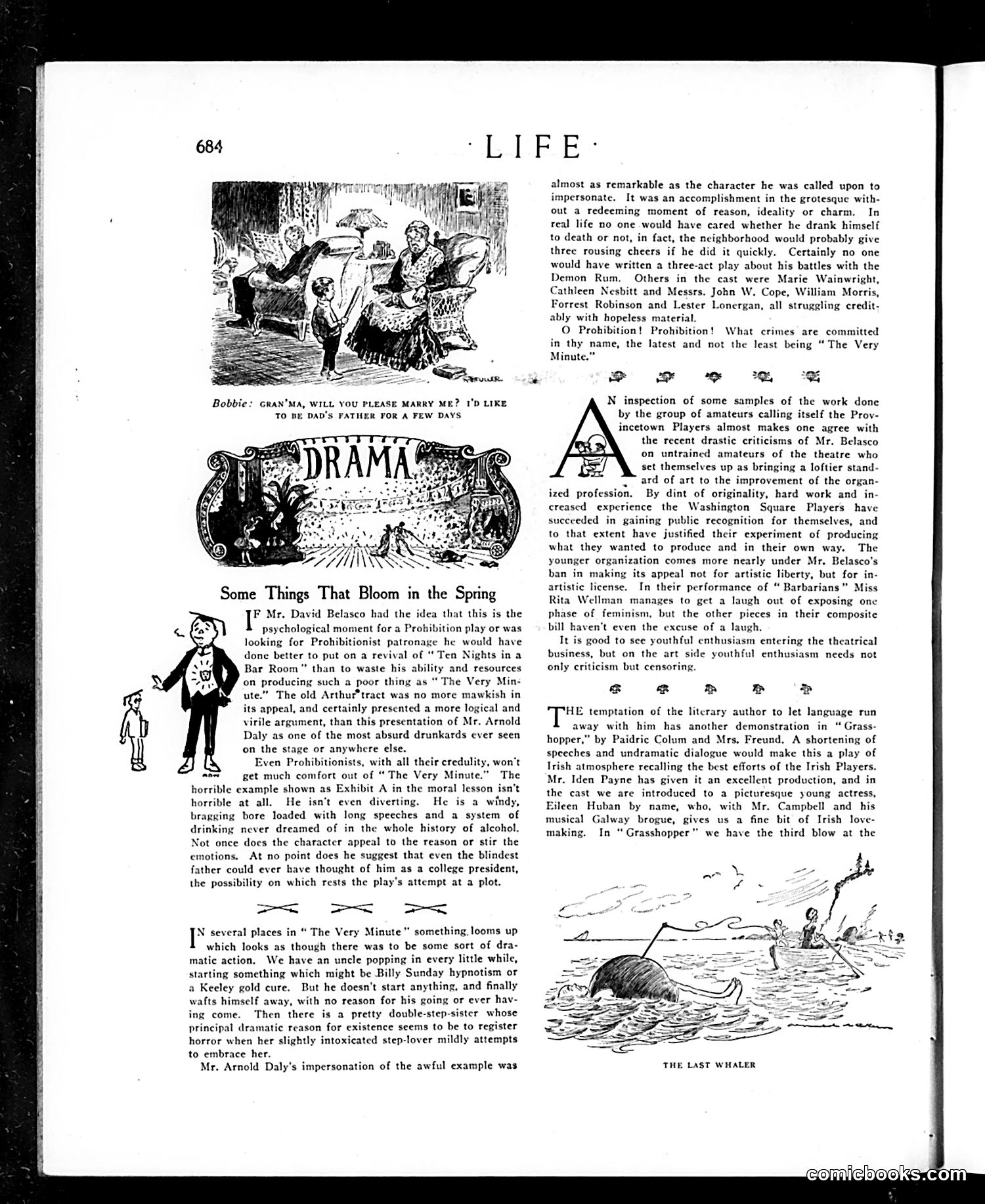
This page critiques David Belasco's theatrical production "The Very Minute," a Prohibition-themed play starring actor Arnold Daly. The reviewer savagely mocks the play as heavy-handed propaganda disguised as drama. **The Satire:** The critic argues the play fails even at promoting Prohibition—its ostensible goal. Daly's drunken character is unconvincing and unlikeable (a "windy, bragging bore"), not a cautionary tale. The reviewer suggests Belasco would've been better off reviving the 19th-century temperance melodrama "Ten Nights in a Bar Room," which at least had genuine emotional appeal. **Secondary Critique:** The page also attacks the Provincetown Players, an amateur theater group, for sacrificing artistic merit for self-righteous messaging. The reviewer distinguishes between the Washington Square Players (who earned credibility through quality work) and the Provincetown Players (who claim artistic license while producing propaganda). **Context:** This reflects 1920s debates over Prohibition's cultural impact and tensions between commercial theater and experimental drama.
📄 Transcribed text from this page (OCR, searchable)
Machine-transcribed from the original scan — historical spelling and the odd misread are preserved.
ae El fe i 7 77 Some Things That Bloom in the Spring I° Mr. David Belasco had the idea that this is the psychological moment for a Prohibition play or was looking for Prohibitionist patronage he would have done better to put on a revival of “Ten Nights in a Bar Room” than to waste his ability and resources on producing such a poor thing as “ The Very Min- ute.” The old Arthur*tract was no more mawkish in its appeal, and certainly presented a more logical and virile argument, than this presentation of Mr. Arnold Daly as one of the most absurd drunkards ever seen on the stage or anywhere else. Even Prohibitionists, with all their credulity, get much comfort out of “ The Very Minute. horrible example shown as Exhibit A in the moral lesson horrible at all. He isn't even diverting. He is a windy, bragging bore loaded with long speeches and a system of drinking never dreamed of in the whole history of alcohol. Not once does the character appeal to the reason or stir the emotions. At no point does he suggest that even the blindest father could ever have thought of him as a college president, the possibility on which rests the play’s attempt at a plot. oe inute” something. looms up >= I N several places in “ The Very which looks as though there was to be some sort of dra- matic action, We have an uncle popping in every little while, starting something which might be Billy Sunday hypnotism or a Keeley gold cure. But he doesn’t start anything, and finally wafts himself away, with no reason for his going or ever hav- ing come. Then there is a pretty double-step-sister whose principal dramatic reason for existence seems to be to register horror when her slightly intoxicated step-lover mildly attempts to embrace her. Mr. Arnold Daly's impersonation of the awful example was almost as remarkable as the character he was called upon to impersonate, It was an accomplishment in the grotesque with- out a redeeming moment of reason, ideality or charm. In real life no one would have cared whether he drank himself to death or not, in fact, the neighborhood would probably give three rousing cheers if he did it quickly. Certainly no one would have written a three-act play about his battles with the Demon Rum. Others in the cast were Marie Wainwright, Cathleen Nesbitt and Messrs. John W. Cope, William Morris, Forrest Robinson and Lester Lonergan, all struggling credit- ably with hopeless material. © Prohibition! Prohibition! What crimes are committed in thy name, the latest and not the least being “The Very SF SS eG N inspection of some samples of the work done by the group of amateurs calling itself the Prov- incetown Players almost makes one agree with the recent drastic criticisms of Mr. Belasco on untrained amateurs of the theatre who set themselves up as bringing a loftier stand- = ard of art to the improvement of the organ- ed profession. By dint of originality, hard work and in- creased experience the Washington Square Players have succeeded in gaining public recognition for themselves, and to that extent have justified their experiment of producing what they wanted to produce and in their own way. The younger organization comes more nearly under Mr, Belasco’s ban in making its appeal not for artistic liberty, but for in- artistic license. In their performance of “ Barbarians” Miss Rita Wellman manages to get a laugh out of exposing one phase of feminism, but the other pieces in their composite bill haven't even the excuse of a laugh. It is good to sce youthful enthusiasm entering the theatrical business, but on the art side youthful enthusiasm needs not only criticism but censoring. Ss g ci) B ® HE temptation of the literary author to let language run away with him has another demonstration in“ Grass- hopper,” by Paidric Colum and Mrs, Freund, A shortening of speeches and undramatic dialogue would make this a play of Irish atmosphere recalling the best efforts of the Irish Players. Mr. Iden Payne has given it an excellent production, and in the cast we are introduced to a picturesque young actress, jeen Huban by name, who, with Mr. Campbell and his musical Galway brogue, gives us a fine bit of Irish love- making. In “Grasshopper” we have the third blow at the