
Life, 1917-04-19 · page 8 of 42
Life — April 19, 1917 — page 8: what you’re looking at
What you’re looking at
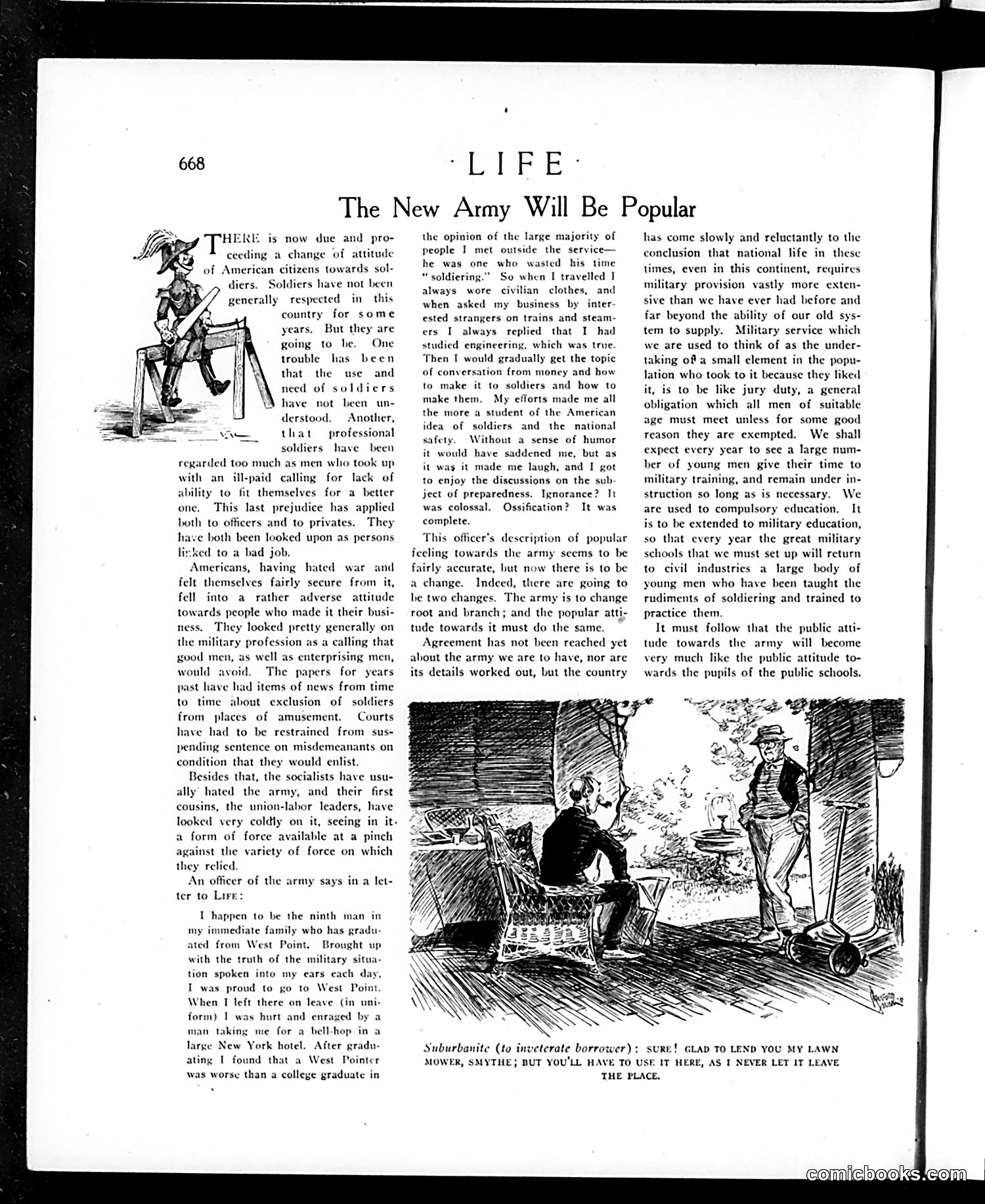
This page discusses changing American attitudes toward the military profession. The article argues that soldiers have historically been regarded poorly by American civilians, viewed as lacking ability or moral character. The author contends this prejudice is changing as the country recognizes military service's necessity. The accompanying cartoon depicts a suburbanite reluctantly lending his lawn mower to a soldier, with the caption emphasizing he'll never let it leave the place—a humorous commentary on American civilian reluctance to share or commit to military needs. The broader point: post-war America must develop greater respect for military service and integrate military training into civilian education to build national strength and prepare young men for potential future conflicts.
📄 Transcribed text from this page (OCR, searchable)
Machine-transcribed from the original scan — historical spelling and the odd misread are preserved.
“PB - The New Army Will Be Popular HE, ceeding a change of attitude of American citizens towards sol- diers. Soldiers have not been generally respected in- this country for some years, But they are going to he. One trouble been that the and need of soldiers not been un- derstood. Another, that professional soldiers been regarded too much as men who took up with an ill-paid calling for lack of ability to fit themselves for a better This last prejudice has applied both to officers and to privates. They have both been looked upon as persons linked to a bad job. Americans, having hated war and felt themselves fairly secure from it, fell into a rather adverse attitude is now due and pro- has use have have one, towards people who made it their busi- nerally on ing that good men, as well as enterprising men, would avoid. The papers for years past have had items of news from time to about exclusion of soldiers from places of amusement. Courts have had to be restrained from sus- pending sentence on misdemeanants on condition that they would enlist. Besides that, the socialists have usu- ally’ hated the army, and their first cousins, the union-labor leaders, € looked very coldly on it, seeing a form of force available at a pinch against the variety of force on which they relied. An officer of the army says ina let- ter to Lire: They looked pretty g the military profession as a time T happen to be the ninth man in my immediate family who has gradu- ated from West Point. Brought up with the truth of the military situa- tion spoken into my ears each day, I was proud to go to West Point. When I left there on leave (in uni- form) I was hurt and enraged taking me for a bell-hop in New York hotel. After gradu- I found that a West Pointer was worse than a college graduate in in it. the opinion of the large majority of people I met outside the service— he was one who his time “ soldering.” So when I travelled | always wore civilian clothes, and when asked my business by inter ested strangers on trains and steam- ers I always replied that I had studied engineering, which was true. Then I would gradually get the topic of conversation from money and how to make it to soldiers and how to make them. My efforts made me all the more a student of the American idea of soldiers and the national safety. Without a sense of humor it would have saddened me, but as it way it made me laugh, and I got to enjoy the discussions on the sub ject of preparedness. Ignorance? It Ossification? It was wasted was colossal. complete. his officer's description of popular fceling towards the army seems to be fairly accurate, but now there is to be a change. Indeed, there are going to he two changes. The army is to change root and branch; and the popular atti- tude towards it must do the same. Agreement has not been reached yet about the army we are to have, nor are its details worked out, but the country Suburbanite (to inveterate borrower): MOWER, SMYTHE; BUT YOU'LL HAVE To U: has come slowly and reluctantly to the conclusion that national life in these times, even in this continent, requires military provision vastly more exten- ive than we have ever had before and far beyond the ability of our old sys- tem to supply. Military service which we are used to think of as the under- taking ofa small element in the popu- jon who took to it because they liked it, is to be like jury duty, a general obligation which all men of suitable age must mect unless for some good reason they are exempted. We shall expect every year to see a large num- ber of young men give their time to military training, and remain under in- struction so long as is necessary. We are used to compulsory education, It is to be extended to military education, so that every year the great military schools that we must set up will return to civil industries a large body of young men who have been taught the rudiments of soldiering and trained to practice them. It must follow that the public atti- tude towards the army will become very much like the public attitude to- wards the pupils of the public schools. suRE! GLAD TO LEND YOU MY LAWN ET HERE, AS I NEVER LET IT LEAVE THE PLACE.