
Life, 1917-04-19 · page 20 of 42
Life — April 19, 1917 — page 20: what you’re looking at
What you’re looking at
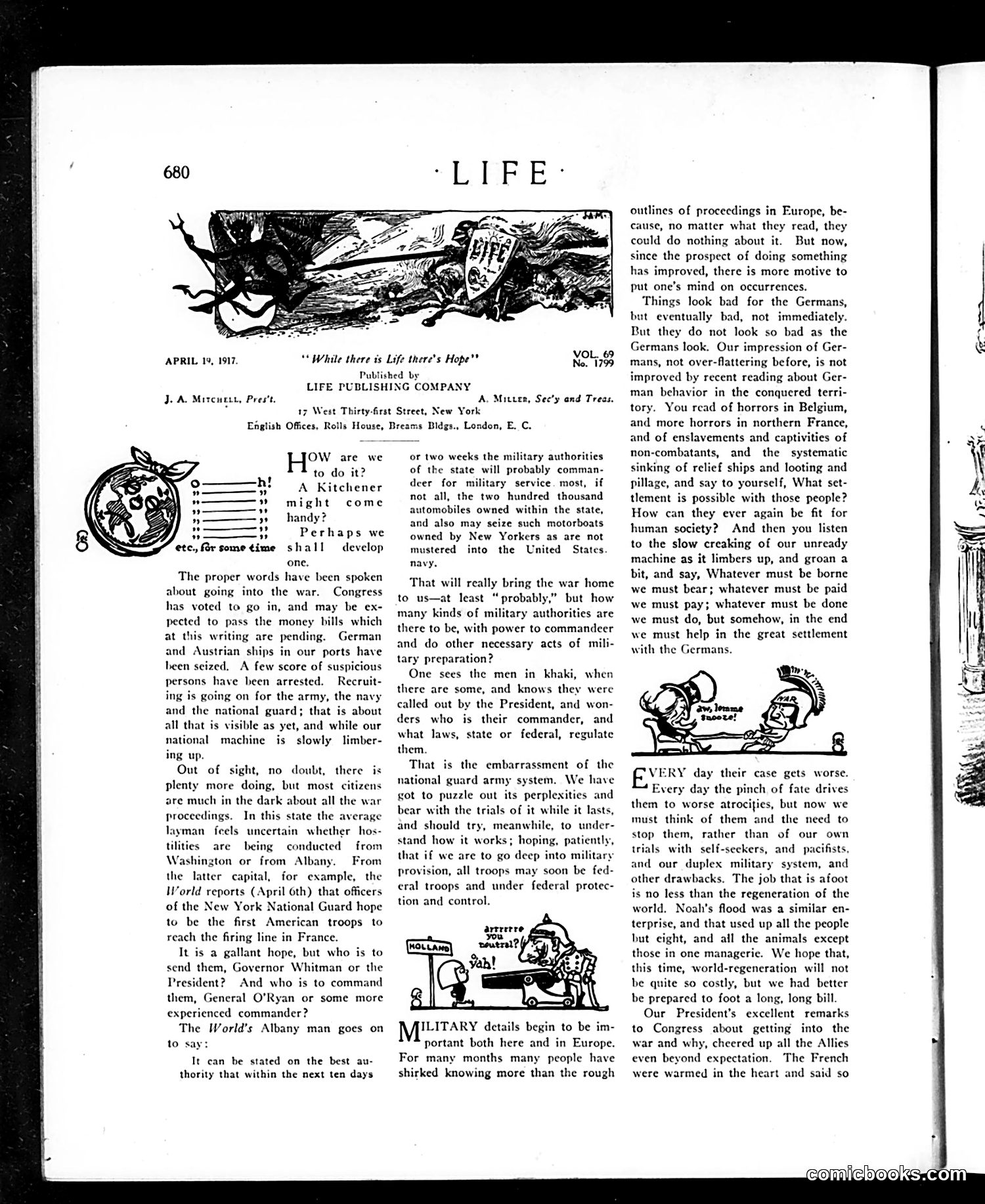
This editorial page addresses America's recent entry into World War I (declared April 6, 1917). The satirical cartoons and text mock the confusion and disorganization of American military mobilization. The main cartoon depicts a figure (likely representing American military/governmental authority) struggling to start a machine—representing the U.S. war effort. The caption "While there is Life there's Hope" is ironic commentary on America's unpreparedness. The article criticizes the chaotic command structure: unclear whether New York's Governor Whitman or President Wilson controls state troops, and whether General O'Ryan or an "experienced commander" leads them. The text mocks the National Guard system's ambiguities and the threat to commandeer private automobiles and motorboats. The editorial also expresses moral outrage at German behavior in occupied Belgium and France—"horrors," "enslavements," and "looting"—questioning how peace could ever be made with such a nation. Overall, the page satirizes American governmental confusion while validating the moral necessity of war against Germany.
📄 Transcribed text from this page (OCR, searchable)
Machine-transcribed from the original scan — historical spelling and the odd misread are preserved.
APRIL 19, 1917. “While there is Life there's Hope"* Published by LIFE PUBLISHING COMPANY J. A. Mircurtt, Pres't. A, Mitten, Sec’y and Treas. 17 West Thirty-first Street, New York English Offices, Rolls House, Breams Bidgs., London, E. C. OW are we to do it? A Kitchener might come handy? Perhaps we shall develop one. The proper words have been spoken about going into the war. Congress has voted to go in, and may be ex- pected to pass the money bills which at this writing are pending. German and Austrian ships in our ports have heen seized. A few score of suspicious persons have been arrested. Recruit- ing is going on for the army, the navy and the national guard; that is about all that is visible as yet, and while our national machine is slowly limber- ing up. Out of sight, no doubt, there is plenty more doing, but most citizens are much in the dark about all the war proceedings. In this state the average layman feels uncertain whether hos- tilities are being conducted from Washington or from Albany, From the latter capital, for example, the World reports (April 6th) that officers of the New York National Guard hope to be the first American troops to reach the firing line in France. It is a gallant hope, but who is to send them, Governor Whitman or the President? And who is to command them, General O’Ryan or some more experienced commander? The World’s Albany man goes on to say: It can be stated on the best au- thority that within the next ten days or two weeks the military authorities of the state will probably comman- deer for military service. most, if not all, the two hundred thousand automobiles owned within the state, and also may seize such motorboats owned by New Yorkers as are not mustered into the United States. navy. That will really bring the war home to us—at least “probably,” but how many kinds of military authorities are there to be, with power to commandeer and do other necessary acts of mili- tary preparation? One sees the men in khaki, when there are some, and knows they were called out by the President, and won- ders who is their commander, and what laws, state or federal, regulate them. That is the embarrassment of the national guard army system. We have got to puzzle out its perplexities and bear with the trials of it while it lasts, and should try, meanwhile, to under- stand how it works; hoping, patiently, that if we are to go deep into military provision, all troops may soon be fed- eral troops and under federal protec- tion and control. ILITARY details begin to be im- portant both here and in Europe. For many months many people have shirked knowing more than the rough outlines of proceedings in Europe, be- cause, no matter what they read, they could do nothing about it. But now, since the prospect of doing something has improved, there is more motive to put one’s mind on occurrences. Things look bad for the Germans, but eventually bad, not immediately. But they do not look so bad as the Germans look. Our impression of Ger- mans, not over-flattering before, is not improved by recent reading about Ger man behavior in the conquered terr’ tory. You read of horrors in Belgium, and more horrors in northern France, and of enslavements and captivities of non-combatants, and the systematic sinking of relief ships and looting and pillage, and say to yourself, What set- tlement is possible with those people? How can they ever again be fit for human society? And then you listen to the slow creaking of our unready machine as it limbers up, and groan a bit, and say, Whatever must be borne we must bear; whatever must be paid we must pay; whatever must be done we must do, but somehow, in the end we must help in the great settlement with the Germans. VERY day their case gets worse. Every day the pinch of fate drives them to worse atrocities, but now we must think of them and the need to stop them, rather than of our own trials with self-seckers, and pacifists, and our duplex military system, and other drawbacks. The job that is afoot is no less than the regeneration of the world. Noah's flood was a similar en- terprise, and that used up all the people but eight, and ail the animals except those in one manage! We hope that, this time, world-regeneration will not be quite so costly, but we had better be prepared to foot a long, long bill. Our President’s excellent remarks to Congress about getting into the war and why, cheered up all the Allies even beyond expectation. The French were warmed in the heart and said so