
Life, 1917-04-19 · page 21 of 42
Life — April 19, 1917 — page 21: what you’re looking at
What you’re looking at
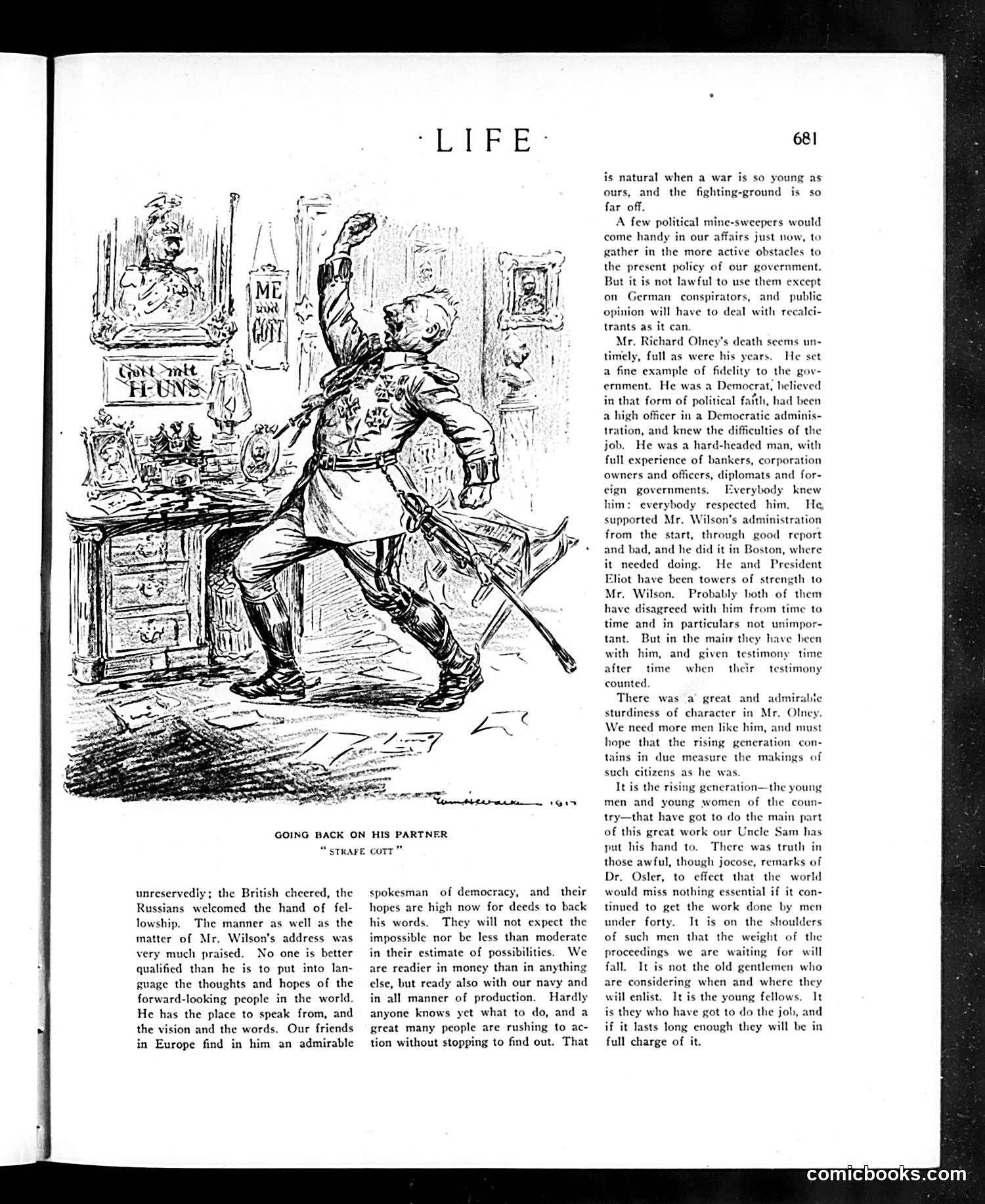
This cartoon satirizes perceived inconsistency in Wilson administration war policy. The figure labeled "Strafe Cott" (likely satirizing "Strafecott" or German strafing tactics) appears to represent Germany or German military strategy. The cartoon's title suggests an ally—possibly Britain or another Allied power—is abandoning partnership with this figure. The accompanying text discusses President Wilson's recent address praising Allied cooperation and American democratic values. However, the article critiques the gap between inspiring rhetoric and concrete action: "They will not expect the impossible nor be less than moderate in their estimate of possibilities." The satire targets the tension between Wilson's eloquent pro-democracy statements (which impressed Europeans) and the practical difficulties of translating those ideals into military/political strategy. The cartoon implies the administration may be inconsistently applying its stated principles. The text also eulogizes Richard Olney, a Democratic official who loyally supported Wilson despite disagreements, contrasting principled consistency with the wavering "strafe cott" partnership depicted.
📄 Transcribed text from this page (OCR, searchable)
Machine-transcribed from the original scan — historical spelling and the odd misread are preserved.
GOING BACK ON HIS PARTNER “ STRAFE COTT” unreservedly; the British cheered, the Russians welcomed the hand of fel- lowship. The manner as well as the matter of Mr. Wilson's address was very much praised. No one is better qualified than he is to put into lan- guage the thoughts and hopes of the forward-looking people in the world He has the place to speak from, and the vision and the words. Our friends in Europe find in him an admirable spokesman of democracy, and their hopes are high now for deeds to back his words. They will not expect the impossible nor be less than moderate in their estimate of possibilities. We are readier in money than in anything else, but ready also with our navy and in all manner of production. Hardly anyone knows yet what to do, and a great many people are rushing to ac- tion without stopping to find out. That 681 is natural when a war is so young as ours, and the fighting-ground is so far off. A few political mine-sweepers would come handy in our affairs just now, to gather in the more active obstacles to the present policy of our government. But it is not lawful to use them except on German conspirators, and public opinion will have to deal with recalei- trants as it can. Mr. Richard Olney’s death seems un- timely, full as were his years. He set a fine example of fidelity to the gov- ernment. He was a Democrat, believed in that form of political faith, had been a high officer in a Democratic adminis- tration, and knew the difficulties of the job. He was a hard-headed man, with full experience of bankers, corporation owners and officers, diplomats and for- eign governments. Everybody knew him: everybody respected him. He, supported Mr. Wilson's administration from the start, through good report and bad, and he did it in Boston, where it needed doing. He and President jot have been towers of strength to Mr. Wilson. Probably both of them have disagreed with him from time to time and in particulars not unimpor- tant. But in the maim they have heen with him, and given testimony time after time when their testimony counted. There great and admirabie sturdiness of character in Mr. Olney. We need more men like him, and must was hope that the rising generation con- ains in due measure the makings of such citizens as he was. It is the rising generation—the young men and young women of the coun- try—that have got to do the main part of this great work our Uncle Sam I put his hand to. There was truth in those awful, though jocose, remarks of Dr. Osler, to effect that the world would miss nothing essential if it con- tinued to get the work done by men under forty. It is on the shoulders of such men that the weight of the proceedings we are waiting for will fall. It is not the old gentlemen who are considering when and where they will enlist. It is the young fellows, It is they who have got to do the job, and if it lasts long enough they will be in full charge of it.