
A complete issue · 40 pages · 1917
Life — February 1, 1917
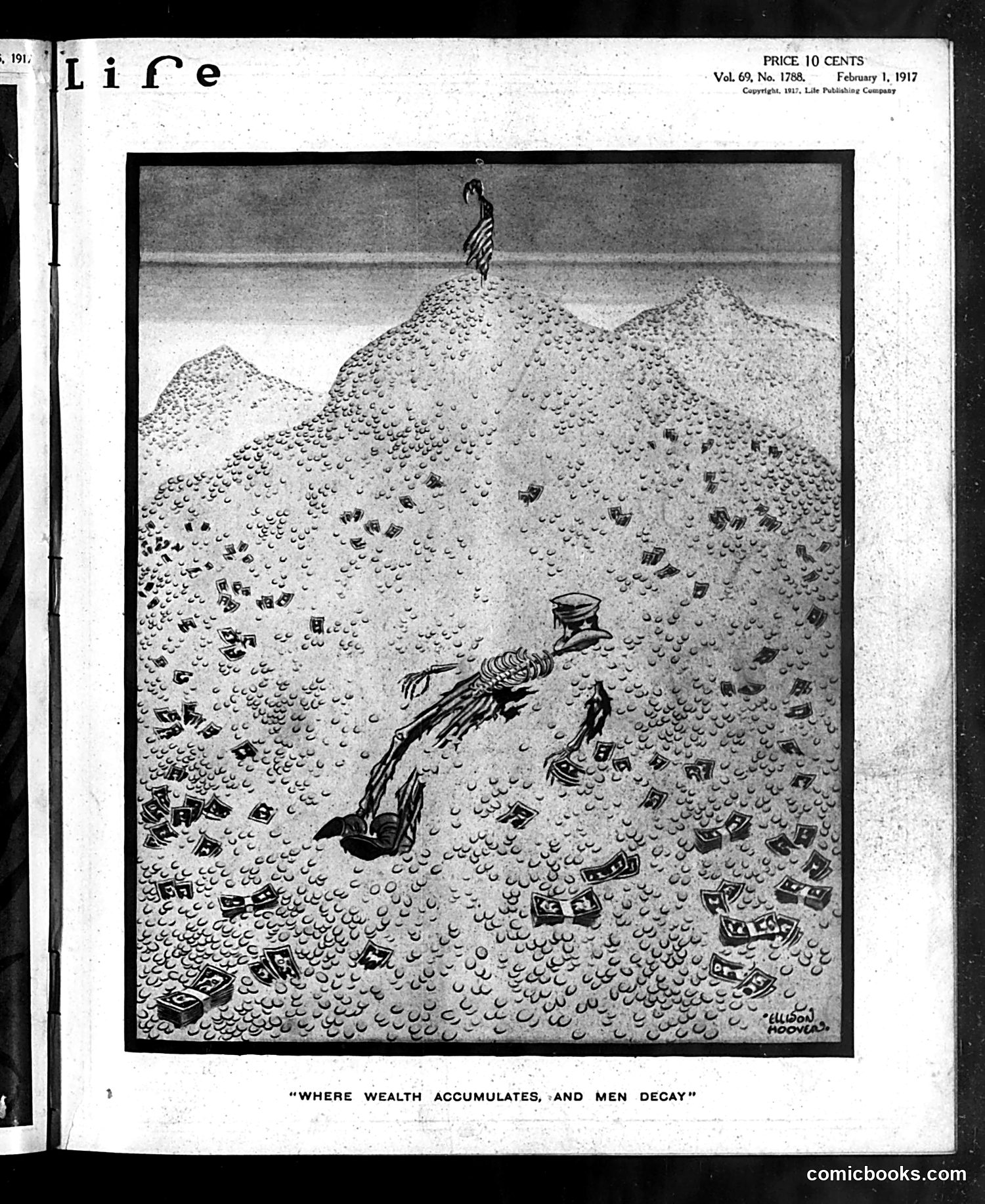
This 1917 cartoon depicts a man drowning in an ocean of money and coins while climbing toward a peak topped by a figure with a flag. The title, borrowed from Oliver Goldsmith's 1770 poem "The Deserted Village," critiques wealth inequality and capitalism's human costs. The composition shows: - **The struggling figure**: represents workers or the common man, literally sinking despite pursuing wealth - **The mountain of money**: symbolizes accumulated capital as an obstacle rather than benefit - **The distant peak**: suggests an unattainable goal of success - **The overall message**: wealth accumulation destroys human welfare and community—a pointed commentary during WWI era anxieties about industrialization, labor exploitation, and economic disparity The satire suggests capitalist systems prioritize money over human dignity.
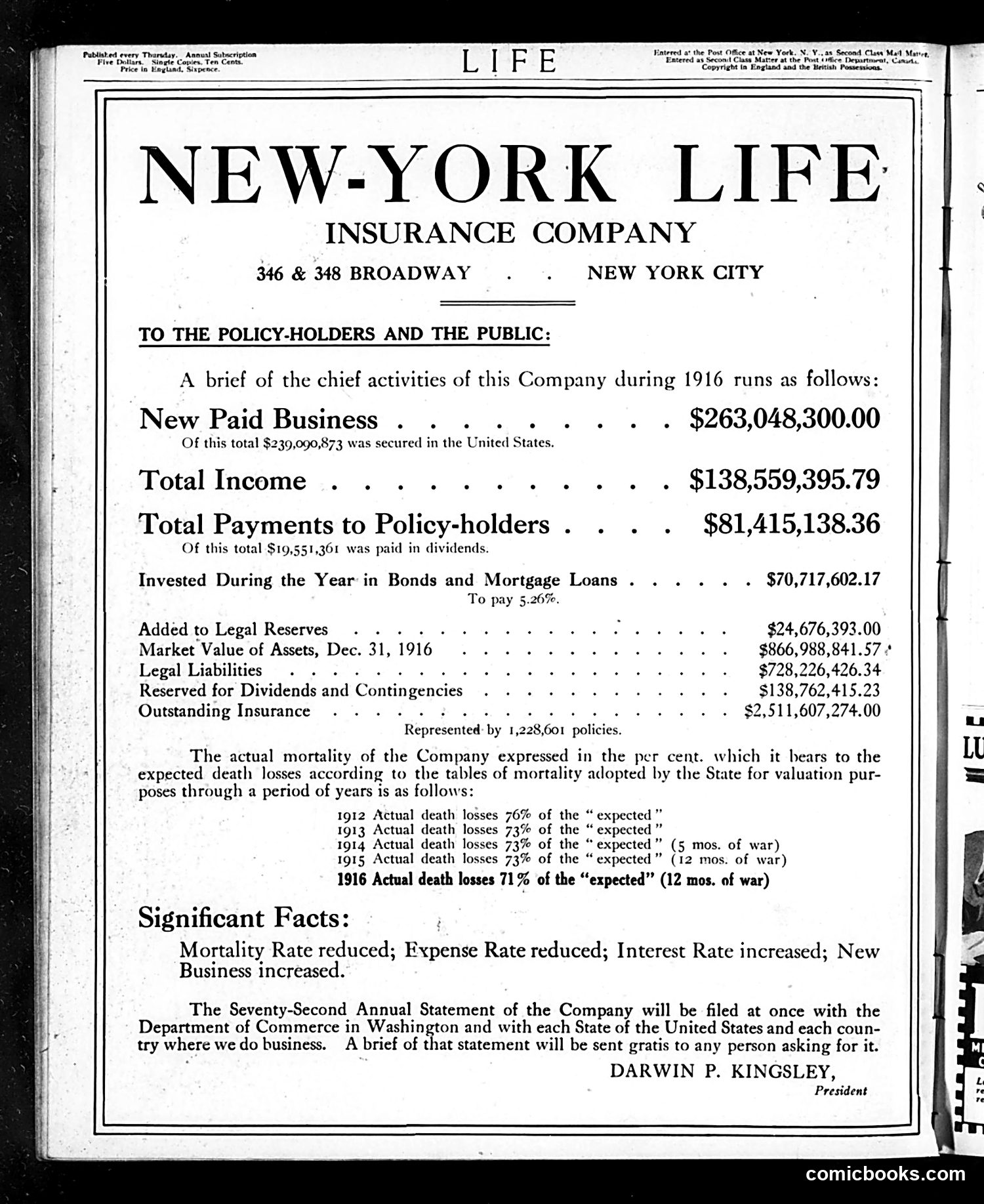
This page is **not a cartoon or satire** — it's a straightforward corporate advertisement for the New York Life Insurance Company, appearing in Life magazine in 1916. The content presents the company's annual financial statement, highlighting: - $263 million in new paid business - $138 million total income - Strong asset reserves of $866 million A notable section tracks "actual mortality" against "expected" death losses from 1912-1916, showing the company performed better than mortality tables predicted — even during World War I (note the parenthetical "12 mos. of war" for 1916). The "Significant Facts" section emphasizes improved efficiency: reduced mortality rates, reduced expenses, and increased interest earnings. This is corporate propaganda designed to reassure policyholders of the company's financial strength and competent management.
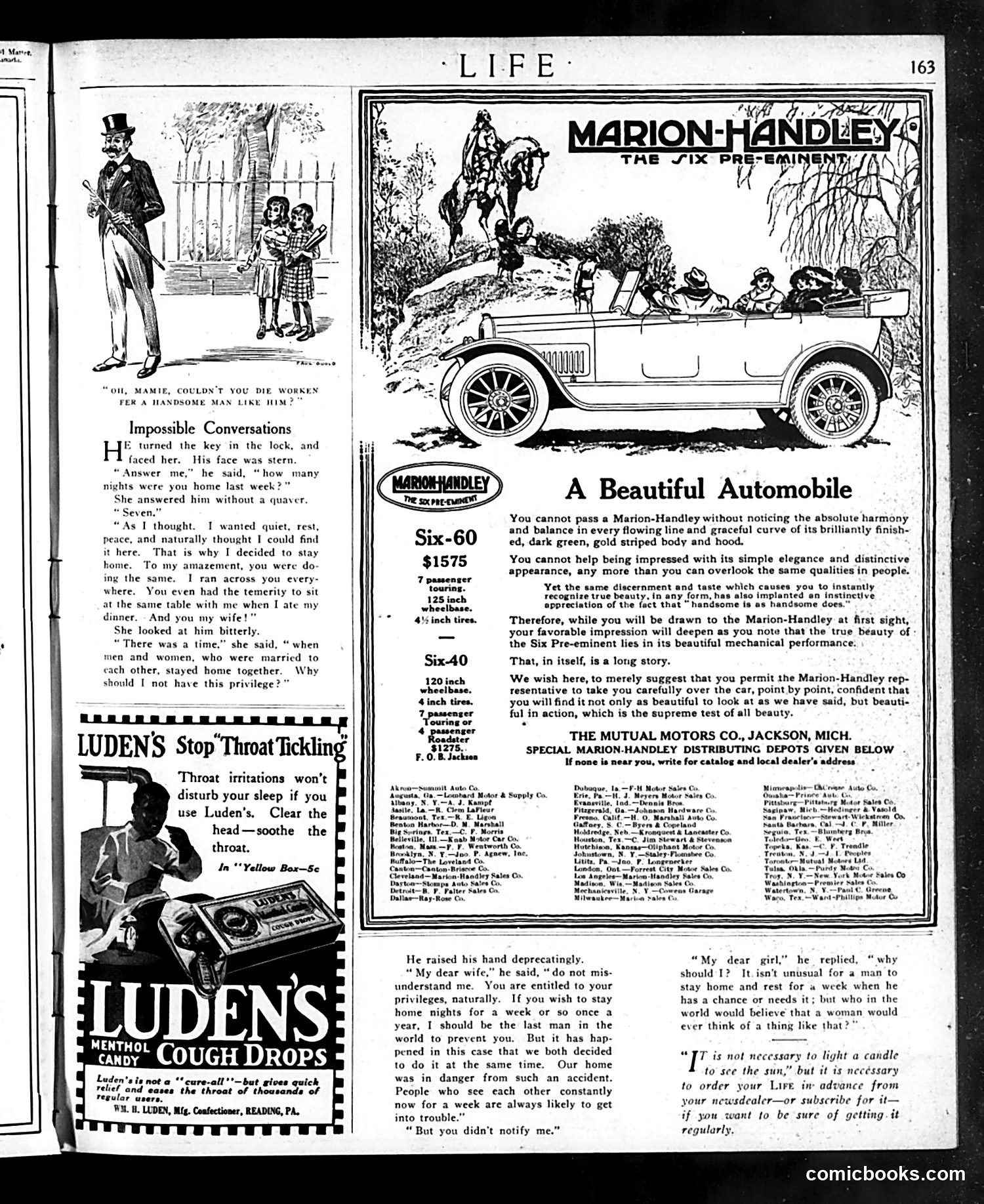
This page is primarily **advertising**, not political satire. The dominant content is a Marion-Handley automobile advertisement featuring a detailed illustration of an open-touring car with passengers. The ad emphasizes the vehicle's "absolute harmony and balance in every flowing line" and "distinctive appearance." Below is a Luden's Menthol Cough Drops advertisement. The left side contains a brief story titled "Impossible Conversations," depicting a domestic dispute between a husband and wife about his nights away from home. The husband defends his absences as necessary; she questions why she should tolerate it. This appears to be social commentary on marriage and gender dynamics, though it's minor editorial content rather than political satire. The page reflects 1920s consumer culture and advertising practices.
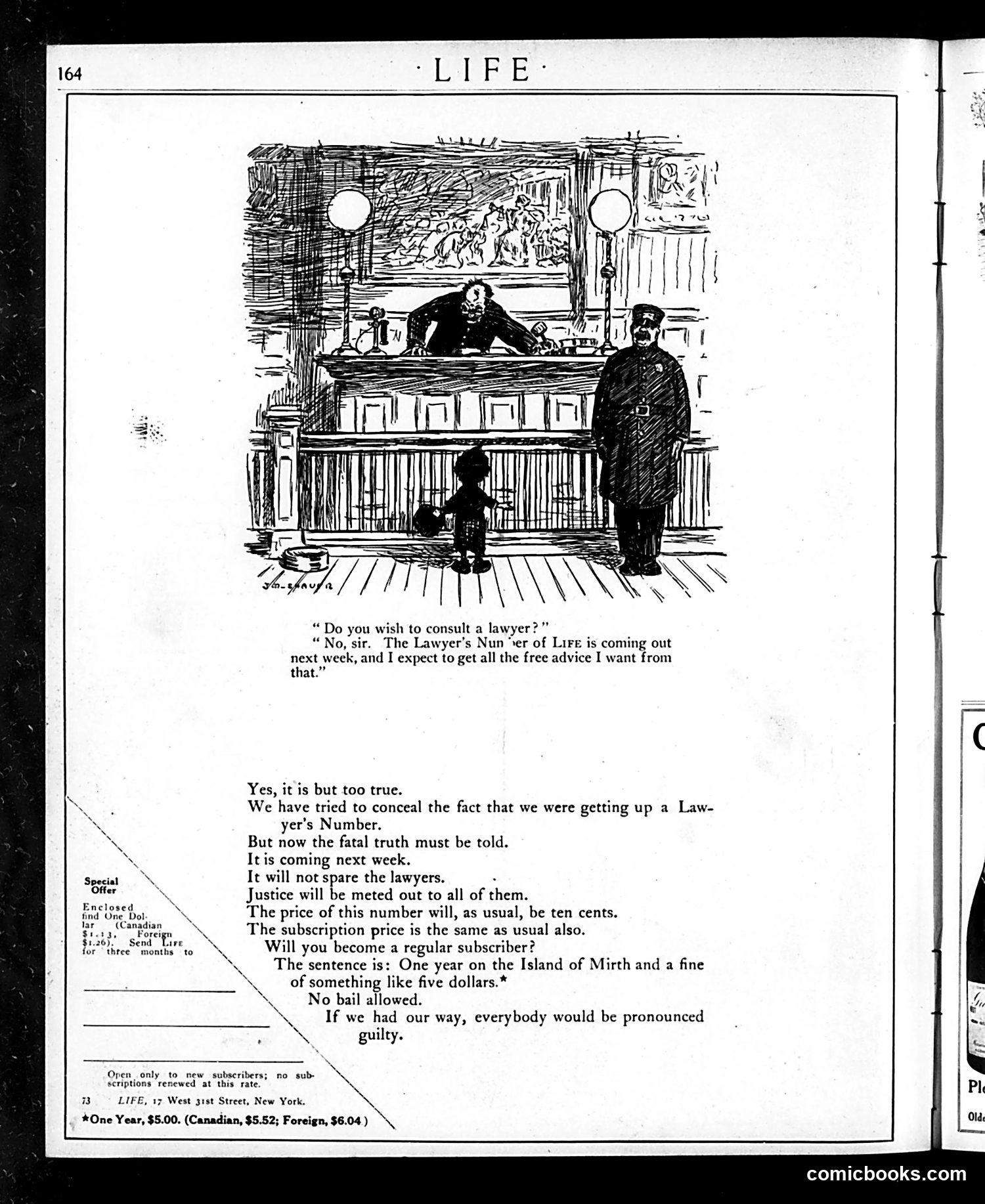
This cartoon satirizes lawyers by depicting a man in a law office who declines legal consultation, saying he'll wait for "The Lawyer's Number of Life" coming next week to get free advice instead. The accompanying text announces that Life magazine will publish a special "Lawyer's Number" mocking the legal profession. The satire escalates with dark humor: Life promises to expose lawyers ("Justice will be meted out to all of them"), charge only ten cents, and offer a subscription sentence of "one year on the Island of Mirth and a fine of something like five dollars." The final jab states "If we had our way, everybody would be pronounced guilty"—suggesting lawyers deserve collective punishment. This reflects early 20th-century American skepticism toward lawyers as a self-interested profession exploiting clients.
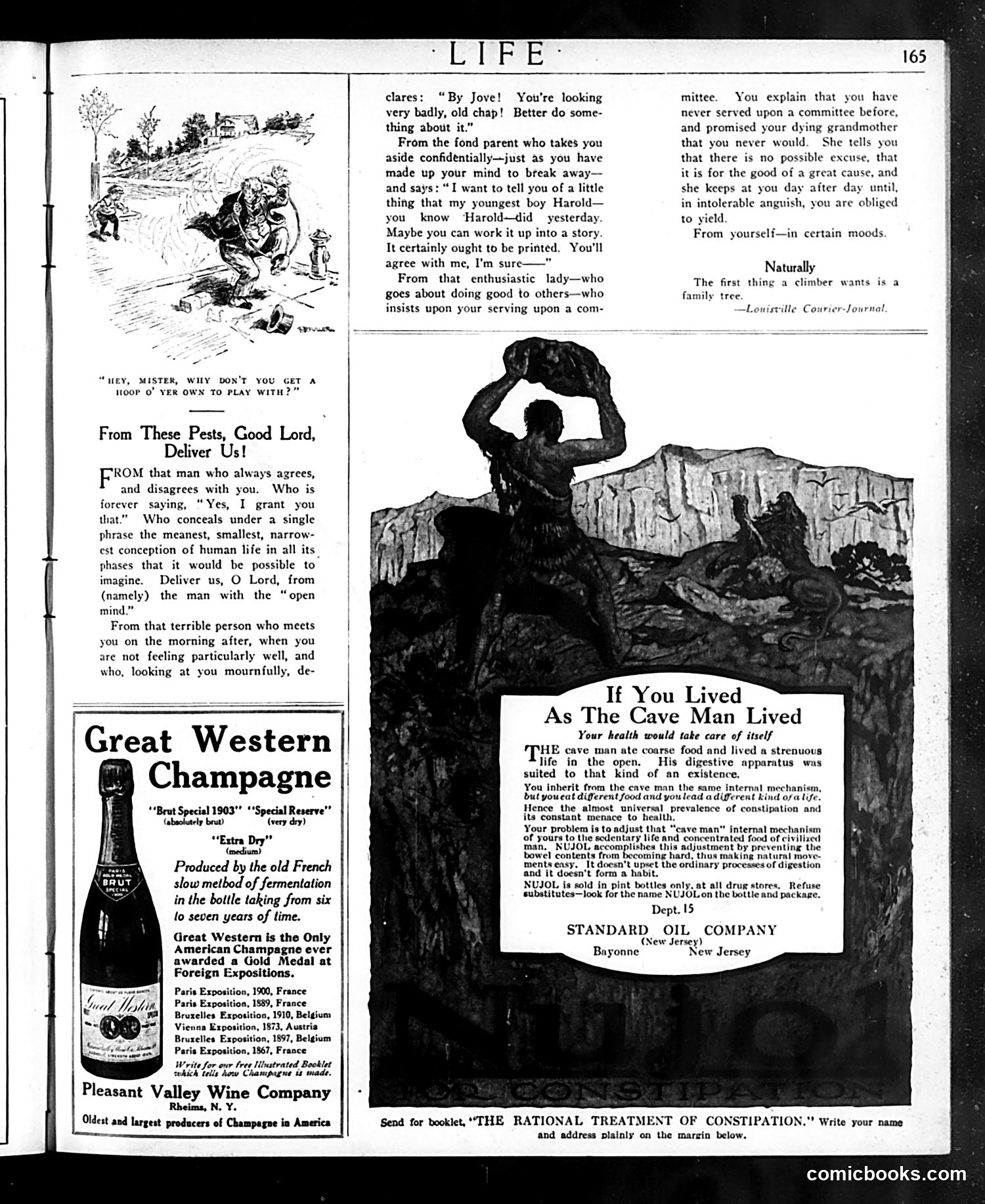
This Life magazine page is primarily **advertising and humor columns** rather than political satire. The top section contains a humorous essay titled "From These Pests, Good Lord, Deliver Us!" that catalogs annoying character types—people who constantly agree with you, those who are perpetually gloomy, etc. It's gentle social satire about everyday personality quirks rather than political commentary. The page includes advertisements for **Great Western Champagne** (prominently featuring a gold-medal-winning bottle) and a **Standard Oil Company product** (Nujol) claiming to treat constipation by mimicking the cave man's natural digestive process. The cartoon at top-left shows children playing, with the caption "Hey, mister, why don't you get a hoof o' yer own to play with?"—simple humor about playground dynamics, not political satire.
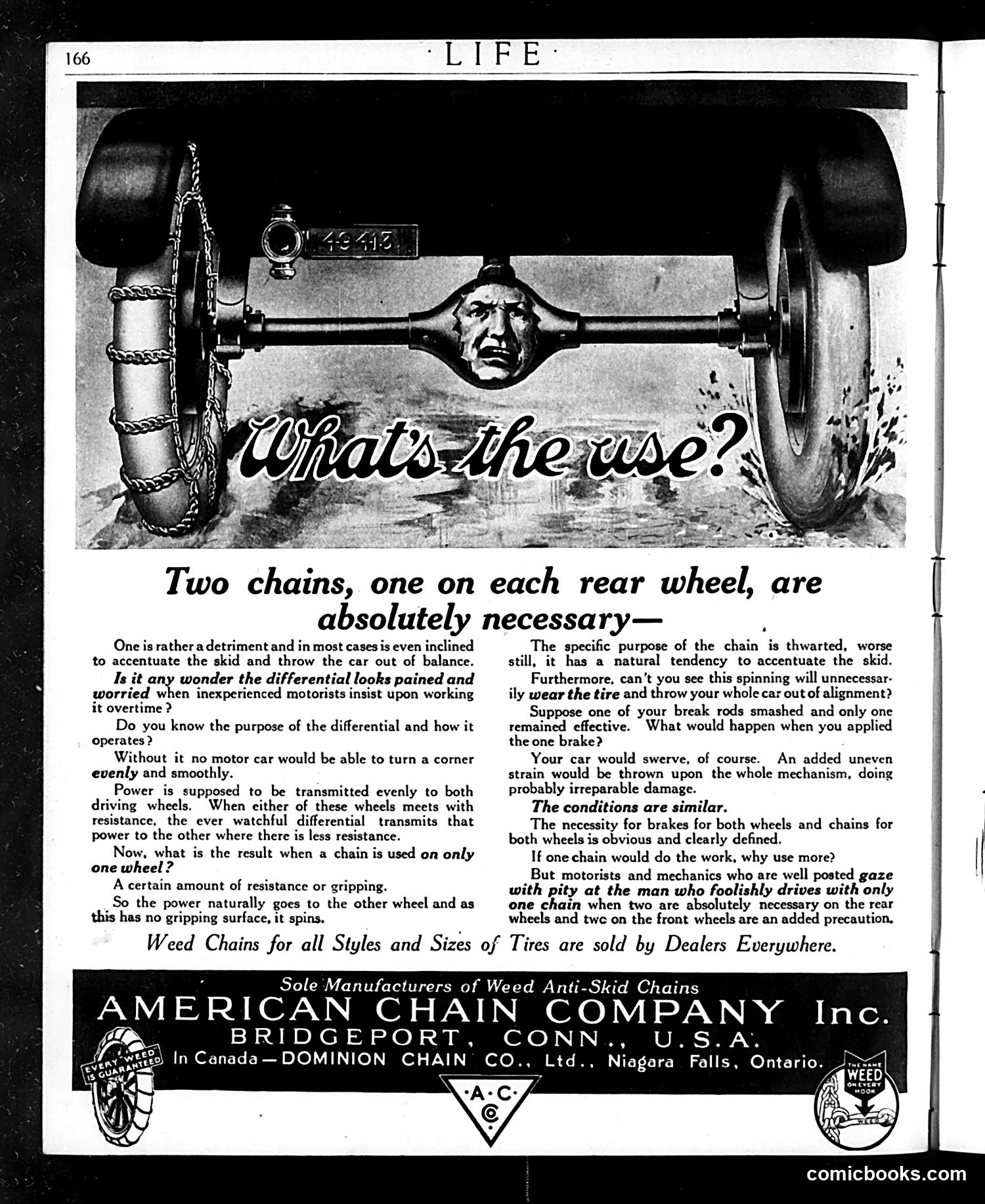
This is primarily a **product advertisement** for Weed tire chains, not political satire. The page uses a humorous visual metaphor to sell automotive safety equipment. The cartoon shows a grotesque face/head forming the differential mechanism of a car's rear axle, with the caption "What's the use?" The accompanying text explains why two chains—one on each rear wheel—are necessary for traction and safe braking, not just one. The "face" isn't a caricature of a specific political figure, but rather a generic scary visage used to comedically personify mechanical failure. The advertisement argues that motorists who skimp on safety chains risk disaster, making the product seem essential rather than optional. This reflects early automotive safety concerns from the pre-modern tire era.
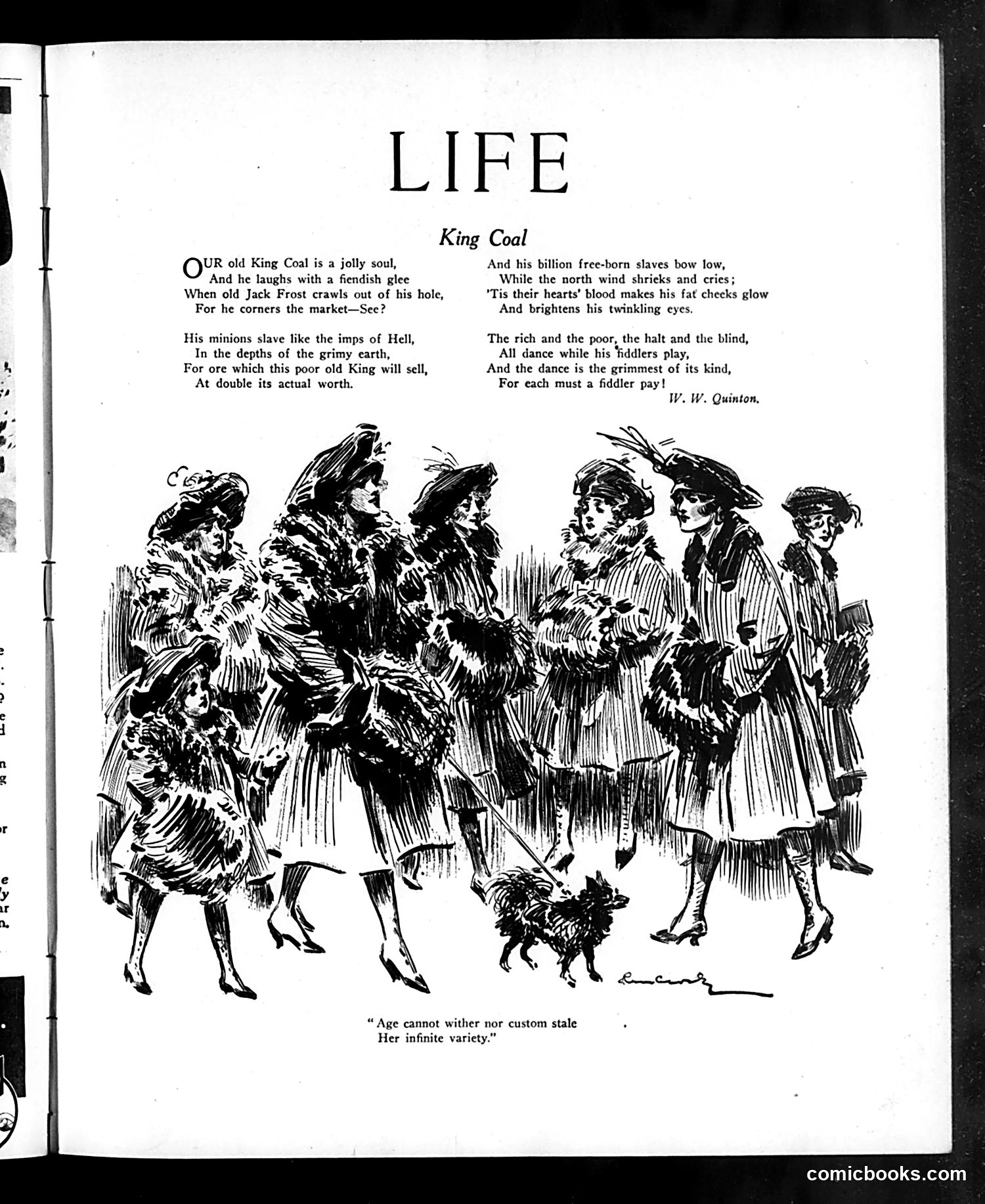
This page satirizes the coal industry and labor exploitation during the industrial era. "King Coal" personifies coal as a despotic ruler whose wealth comes from enslaving workers ("billion free-born slaves"). The poem by W.W. Quinton describes his minions as "slave like the imps of Hell" laboring in mines for minimal wages. The illustration shows well-dressed women dancing while a small figure (possibly representing labor or the working class) is forced to play fiddle. The caption "'Age cannot wither nor custom stale / Her infinite variety'" suggests the exploitation is systemic and enduring. This critiques how wealthy industrialists profit from brutal working conditions while the upper class enjoys the fruits of that labor, indifferent to human suffering below.
This is a satirical opera parody by Friedfish von Flotow, presented at the Five and Ten Century Theatre. The piece mocks high operatic conventions through absurdist humor—featuring characters like "Lady Haricot" (a massacring Italian soprano), "Nancy" (a German contralto), and various performers speaking in exaggerated pseudo-foreign gibberish mixed with English. The satire targets pretentious opera culture: overwrought emotion, incomprehensible foreign languages, and elaborate staging. References to characters suffering from "nostalgia" and "pneumonia" mock operatic melodrama. The nonsensical dialogue and stage directions ("Kosher motzas jakey einstein") suggest that much operatic performance is meaningless spectacle designed to confound rather than move audiences.
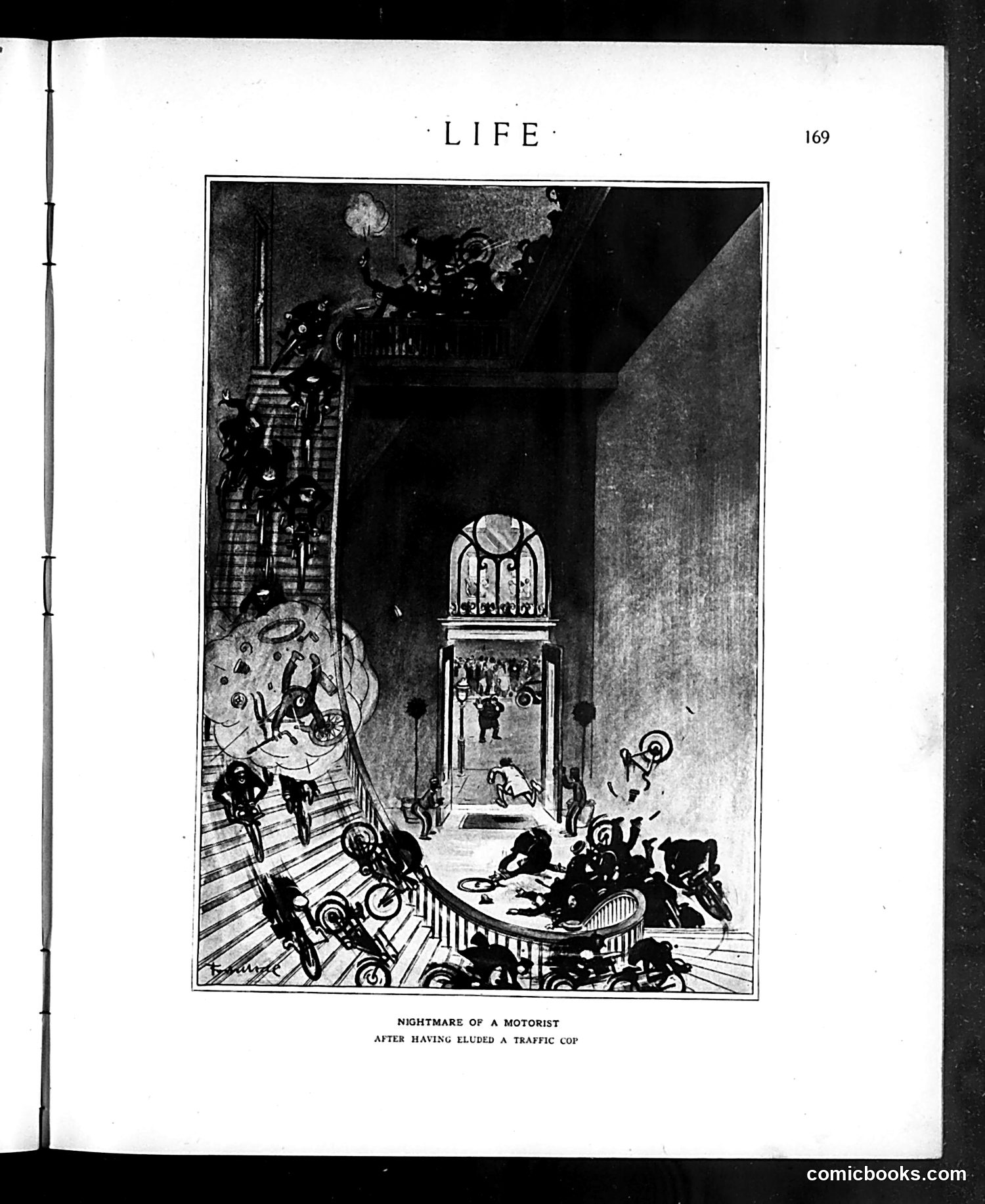
This satirical illustration depicts a surreal, nightmarish vision experienced by a motorist who has successfully evaded a traffic police officer. The image shows a chaotic scene where motorcycles and cyclists swarm around an architectural interior—appearing to pursue or torment the driver in a dreamlike sequence. The satire targets early automotive culture and traffic enforcement tensions. The motorist's "nightmare" humorously inverts the power dynamic: having escaped a cop, the driver imagines being hunted by an overwhelming swarm of two-wheeled vehicles. This likely satirizes anxieties about traffic law enforcement, reckless driving, and the growing dangers of motor vehicles in early 20th-century urban streets. The exaggerated, surreal visual style amplifies the absurdity of the scenario.
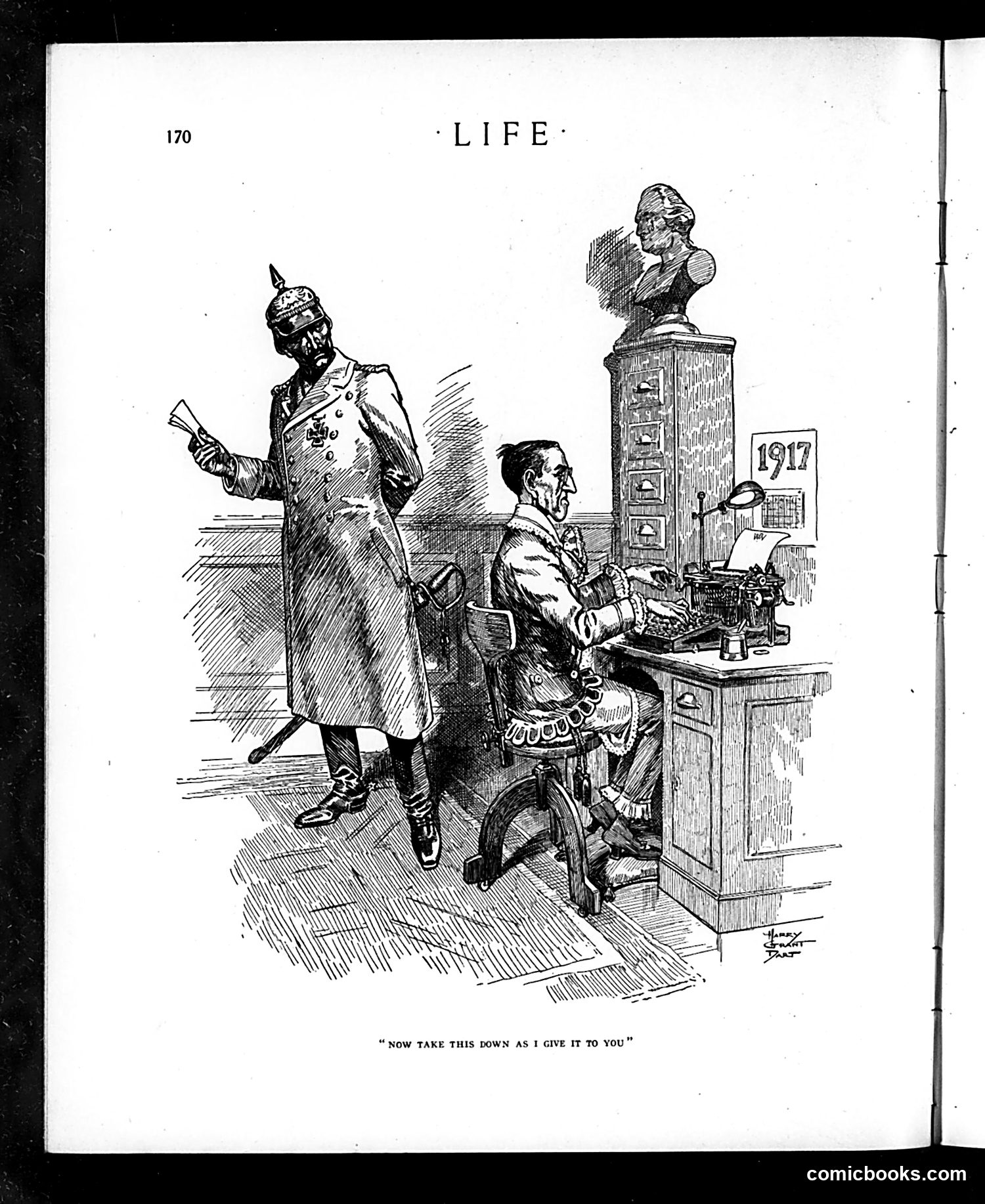
This is a 1917 political cartoon from Life magazine satirizing German military authority during World War I. A stern German officer wearing a spiked Prussian helmet (the "Pickelhaube") stands imposingly over a seated man at a desk, apparently dictating policy. The caption reads: "NOW TAKE THIS DOWN AS I GIVE IT TO YOU." The cartoon critiques German authoritarianism and militarism, suggesting that civilian leadership is subordinated to military command. The bust on the pedestal in the background, likely representing a German historical figure, emphasizes the weight of Prussian military tradition. The 1917 date marks America's entry into WWI, making this anti-German propaganda supporting the American war effort against the Central Powers.
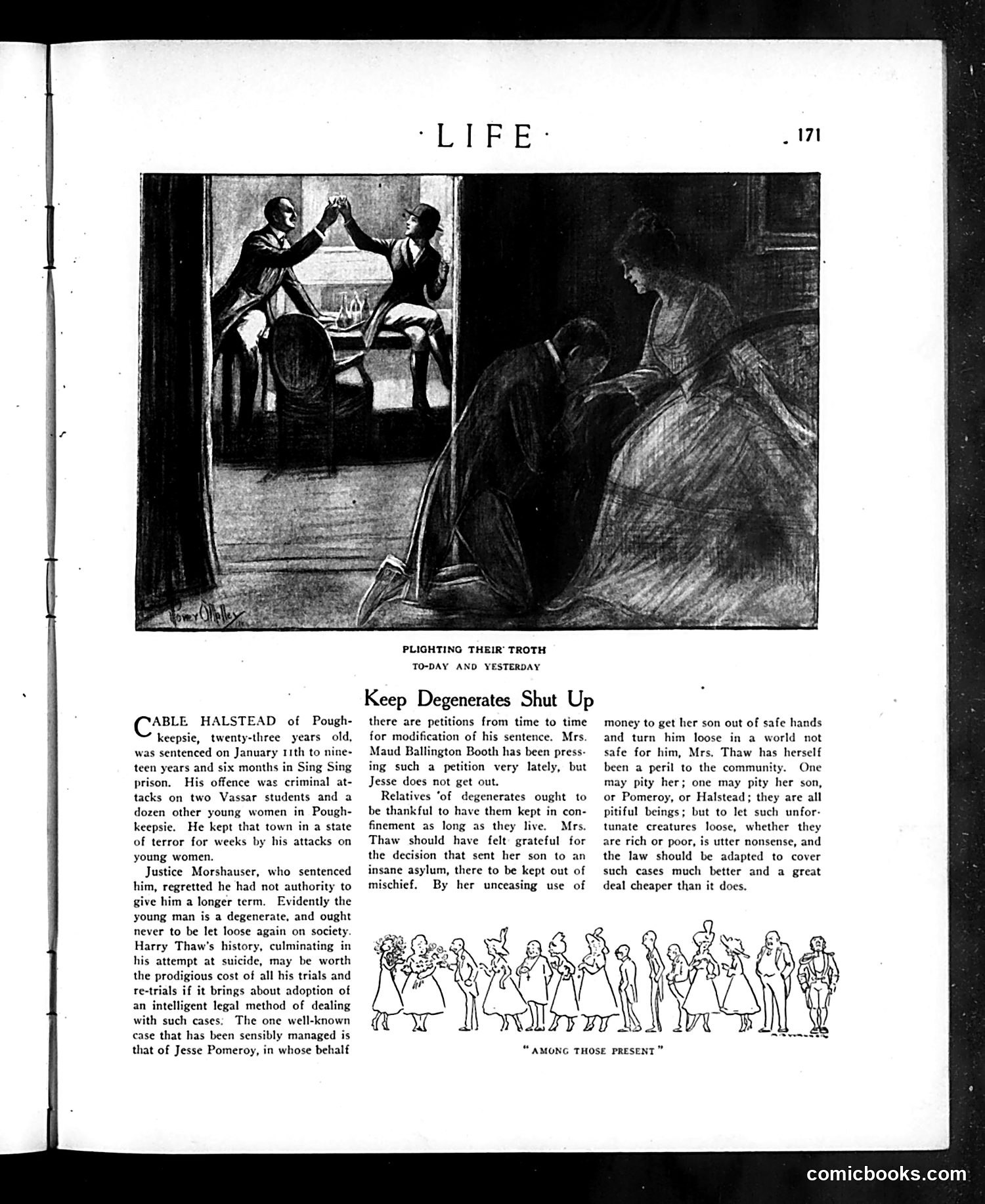
This *Life* magazine page satirizes the case of Cable Halstead, a 23-year-old from Poughkeepsie sentenced to 19 years for attacking young women. The article criticizes the justice system's handling of "degenerates," arguing such criminals should remain institutionalized rather than released to society. The top illustration shows two scenes: left depicts violence ("Plighting Their Troth To-day and Yesterday"), while right shows a woman pleading—likely Halstead's mother seeking petition for sentence reduction. The satire targets relatives of criminals who petition for mercy, and argues that rehabilitation is impossible for repeat offenders. The bottom illustration of ordinary citizens ("Among Those Present") suggests society must account for such dangerous individuals in their midst.
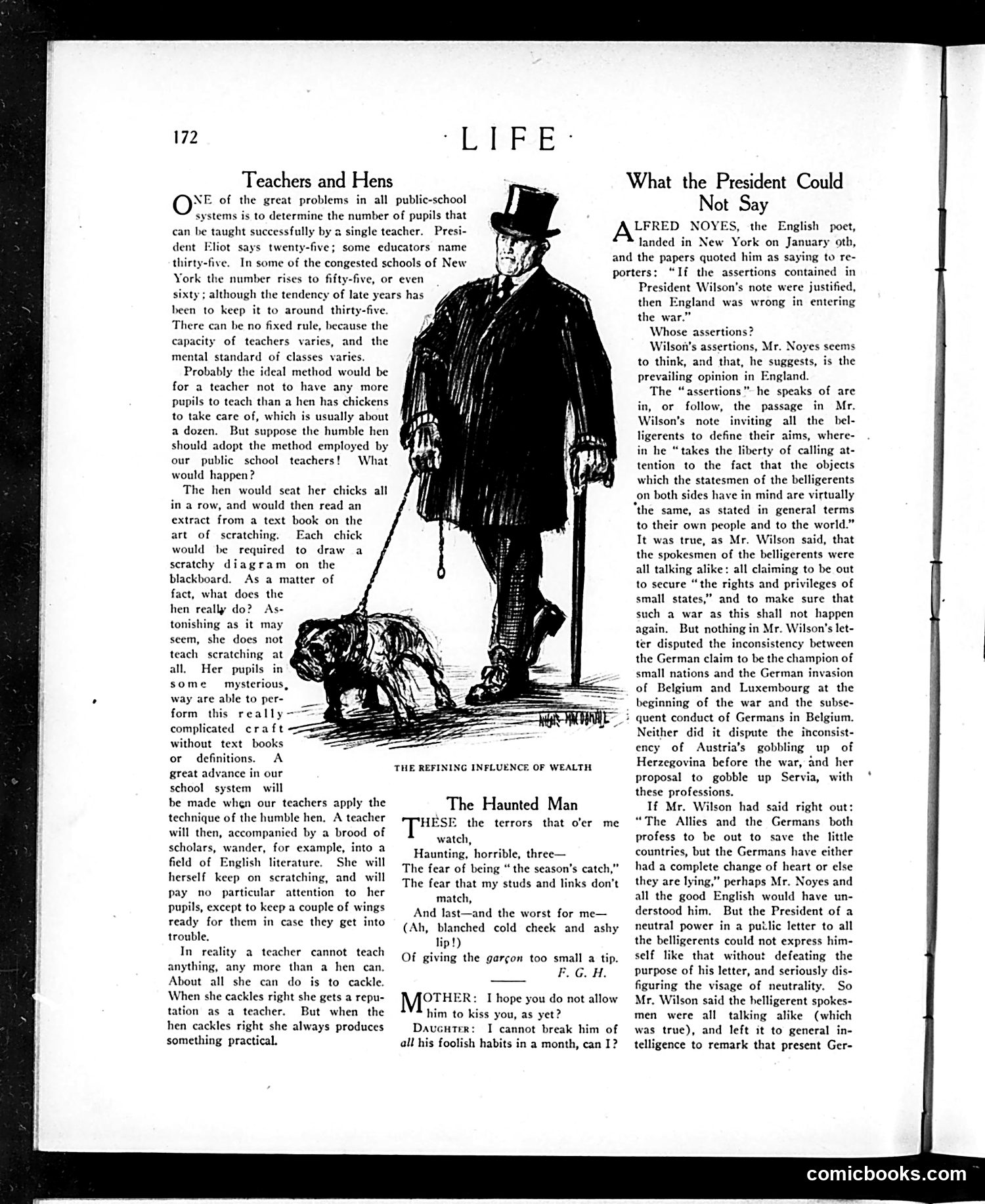
The cartoon "The Refining Influence of Wealth" depicts a wealthy man in top hat and overcoat walking a small, scraggly dog. The satire suggests that wealth doesn't necessarily improve character or manners—the well-dressed gentleman appears no more refined than his shabby companion. This mocks the assumption that financial success correlates with moral superiority or social refinement. The adjacent article "Teachers and Hens" humorously compares teaching methods, proposing that hens' scratching techniques might improve classroom instruction. It's lighthearted educational satire about pedagogical efficiency and class sizes in early 20th-century schools. "What the President Could Not Say" critiques President Wilson's WWI neutrality proclamations, suggesting his stated neutrality masked bias toward the Allies over Germany—a serious political commentary on American foreign policy during the conflict.
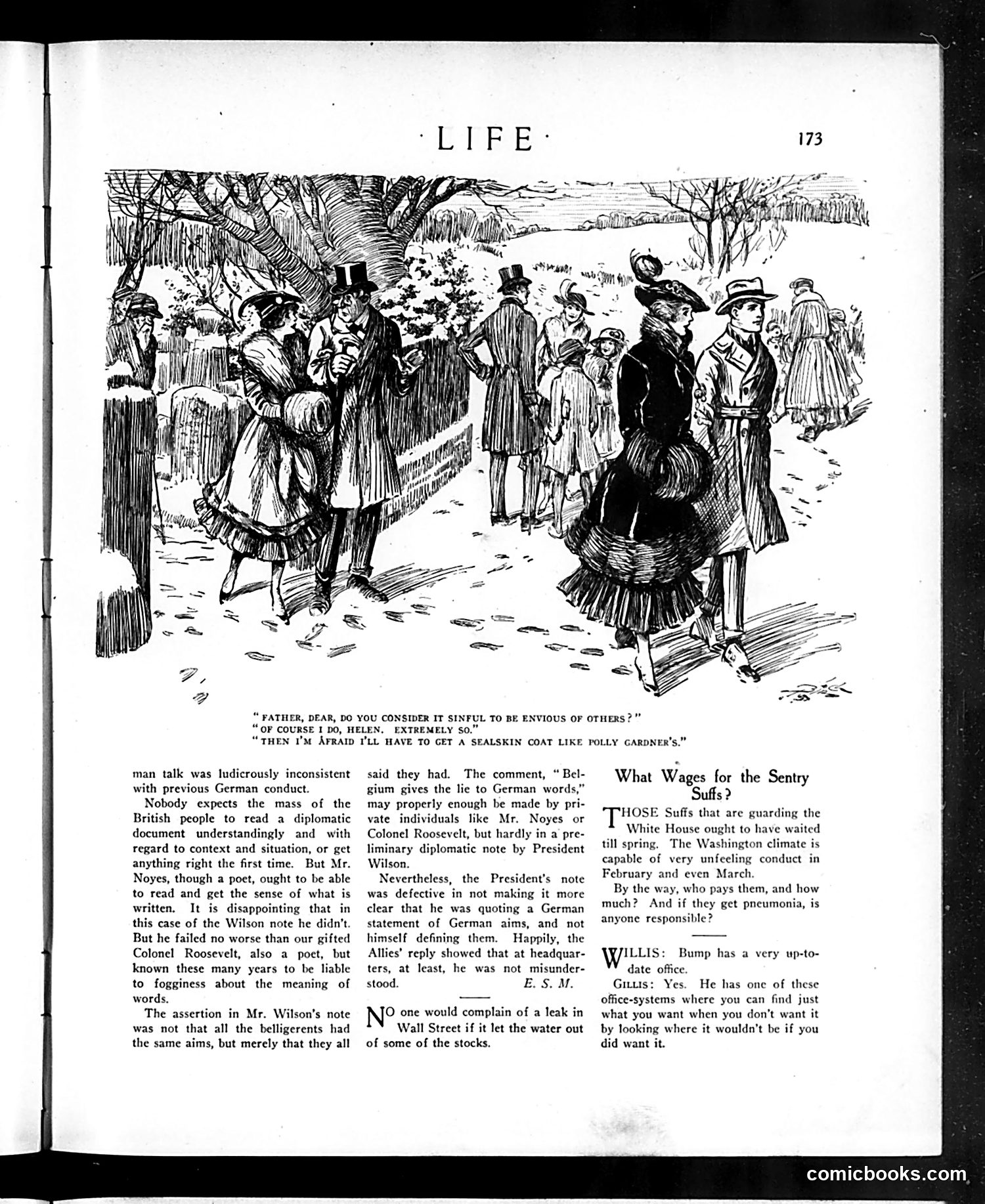
This **Life magazine** page features a winter social scene with multiple figures in formal dress. The cartoon's caption quotes a character named Helen discussing envy and a "sealskin coat like Polly Gardener's" — suggesting wealthy competition over luxury goods. The accompanying text discusses diplomatic tensions, likely referencing **President Wilson's diplomatic notes** regarding German conduct (probably WWI-era). The commentary mocks both the diplomatic language and the incompetence of belligerents' statements. Below, a brief dialogue between "Willis" and "Gillis" jokes about office politics and inefficient bureaucratic systems. The overall page satirizes **American society during wartime** — contrasting trivial wealthy concerns (fur coats, office gossip) with serious diplomatic failures and governmental dysfunction.
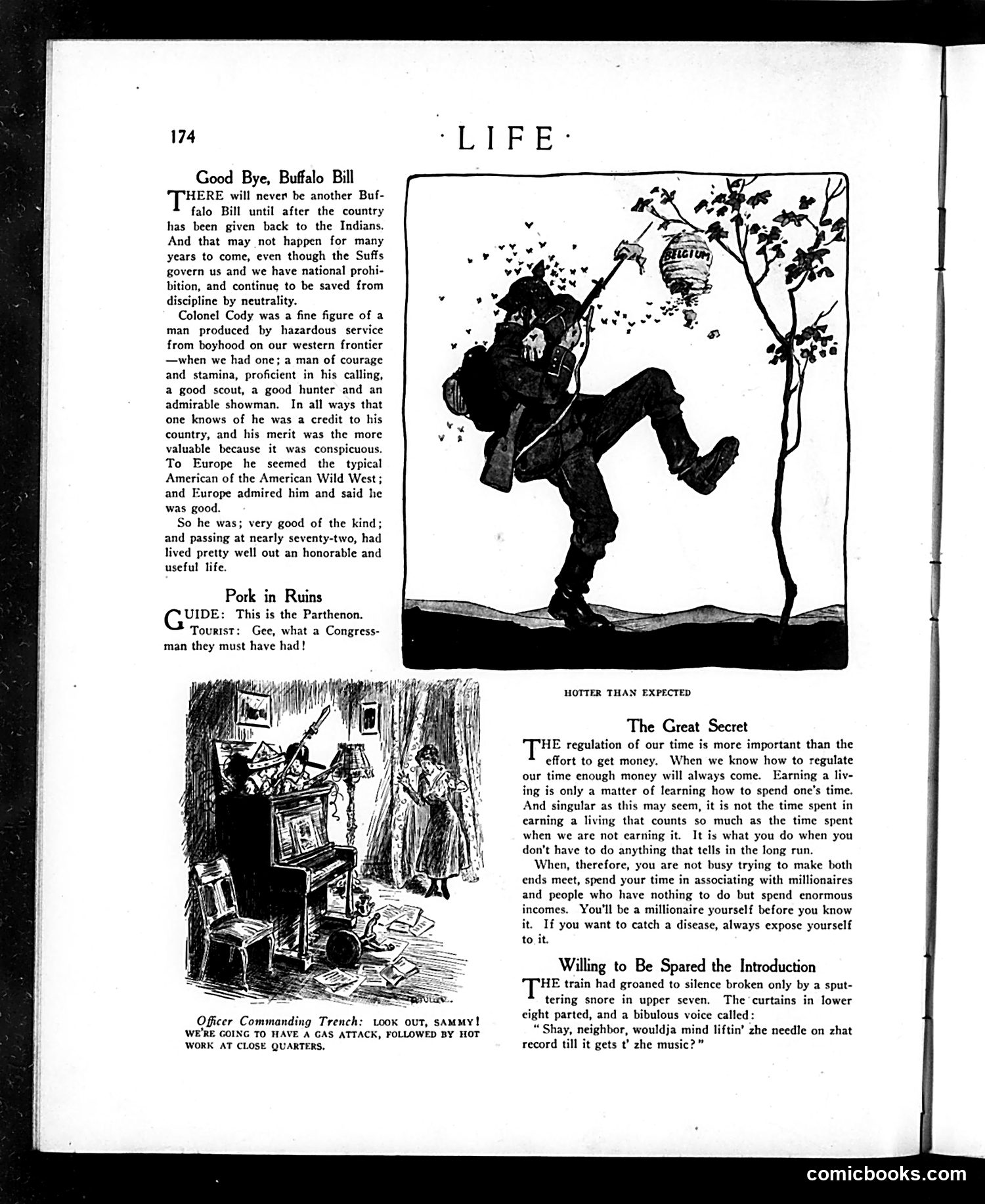
The page contains three separate satirical pieces: 1. **"Good Bye, Buffalo Bill"**: An obituary-style tribute to Colonel William F. Cody, praising him as emblematic of the American Wild West frontiersman—brave, skilled, and admirable to Europeans. The text notes he lived nearly seventy-two years. 2. **"Pork in Ruins"**: A brief joke where a tourist asks a guide about the Parthenon, and the guide quips that even congressmen would be awed by it—satirizing Congress as greedy or foolish. 3. **"The Great Secret"** and **"Hotter Than Expected"**: Articles discussing time management and wealth-building, plus a humorous train scene about uncomfortable conditions. The illustrations use period-typical pen-and-ink style to complement these satirical commentaries on American life and politics.
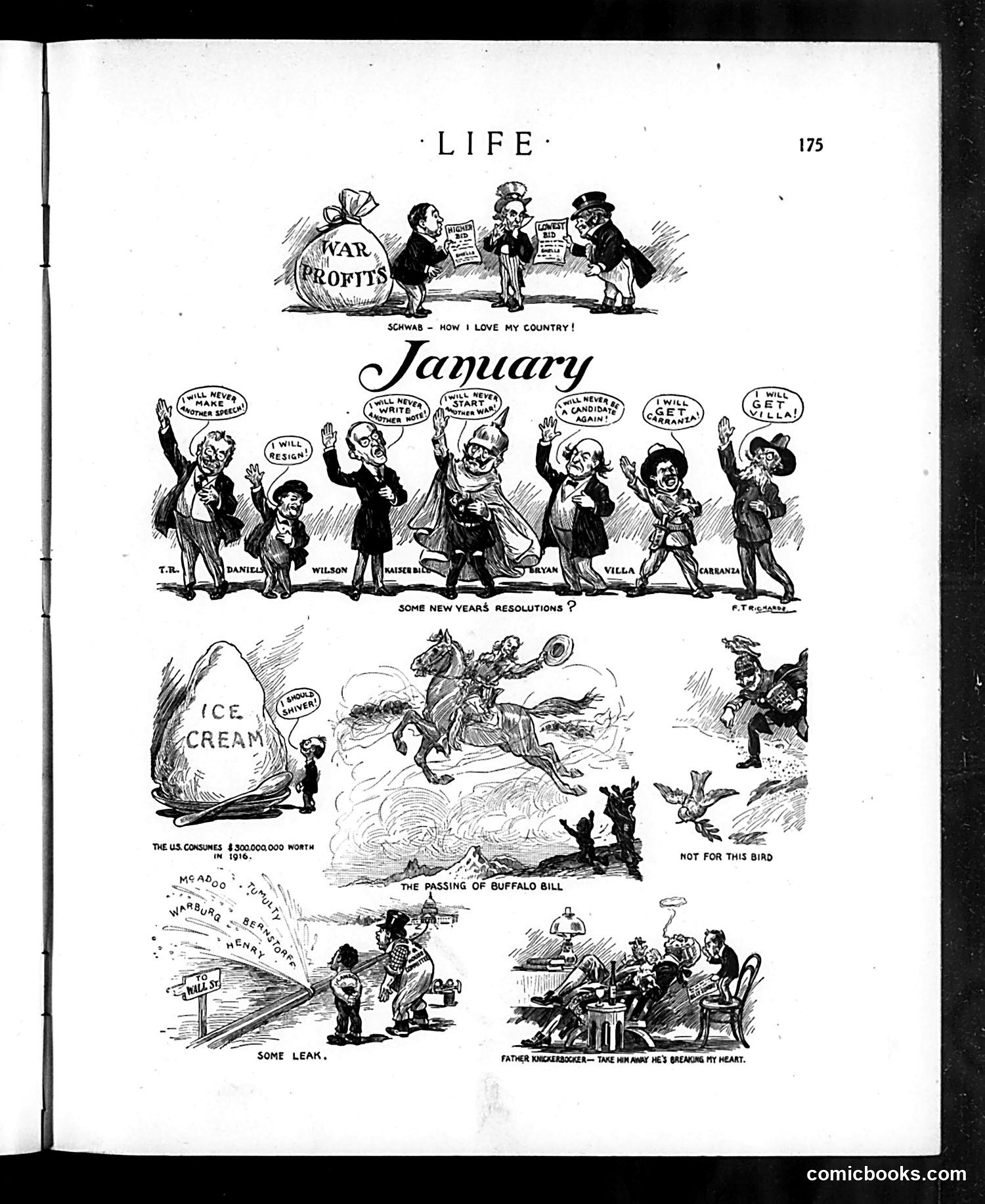
This page contains satirical cartoons about early 20th-century American politics and society. **Top cartoon**: Shows war profiteers ("War Profits") with Uncle Sam, mocking how politicians love their country while enriching themselves through conflict. **Middle section**: "Some New Year's Resolutions" features caricatured political figures (labeled T.R., Daniel, Wilson, Kaiser Bill, Servan, Villa, Carranza) making mock promises they'll never keep—satirizing politicians' empty rhetoric about reform. **Lower cartoons**: - "The Passing of Buffalo Bill" depicts the famous figure's decline - "Some Leak" references government corruption or information breaches - The final cartoon about "Father Knickerbocker" appears to mock New York City leadership The page uses exaggerated caricature and ironic commentary typical of Life's satirical approach to contemporary politics.
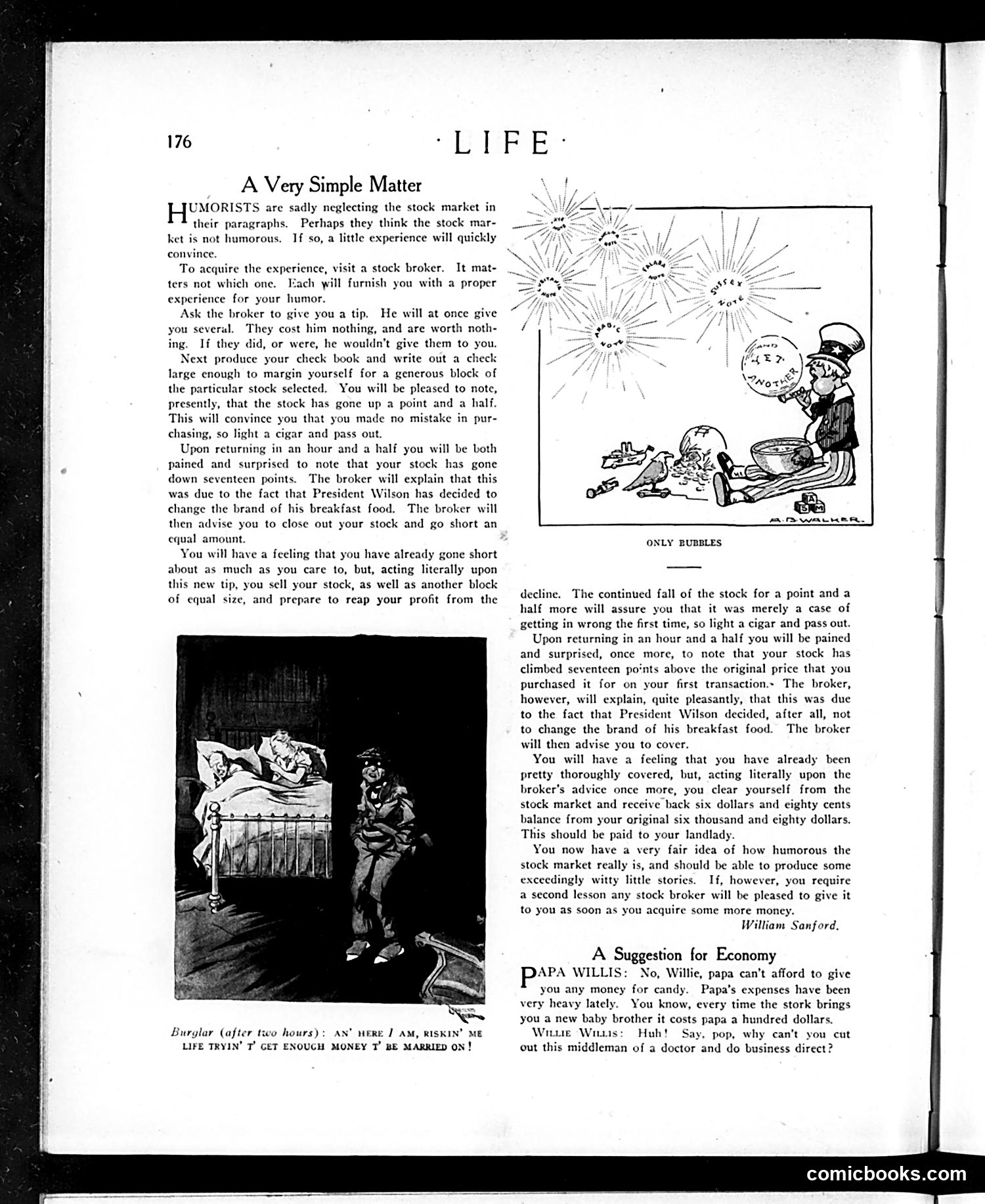
**"A Very Simple Matter"** satirizes stock market speculation, likely during the 1910s Wilson era. The text mockingly walks a novice investor through losing money: buy stock on a broker's worthless "tip," watch it fluctuate wildly based on absurd reasons (President Wilson changing breakfast cereal brands), follow contradictory broker advice, and end with $6.80 remaining from a $6,080 investment. The humor lies in the relentless cycle of poor decision-making and the broker's absurd explanations for market movements. **The cartoon below** shows a burglar at a window saying he's struggling "to get enough money t' be married on"—commenting that crime barely pays, mirroring the article's theme that ordinary people lose money through various schemes. **"A Suggestion for Economy"** features a child asking his father why he can't eliminate the "middleman" (the doctor) and handle childbirth directly, sarcastically suggesting that medical costs for each new baby (one hundred dollars) could be avoided. The joke critiques both unnecessary expenses and naive cost-cutting logic.
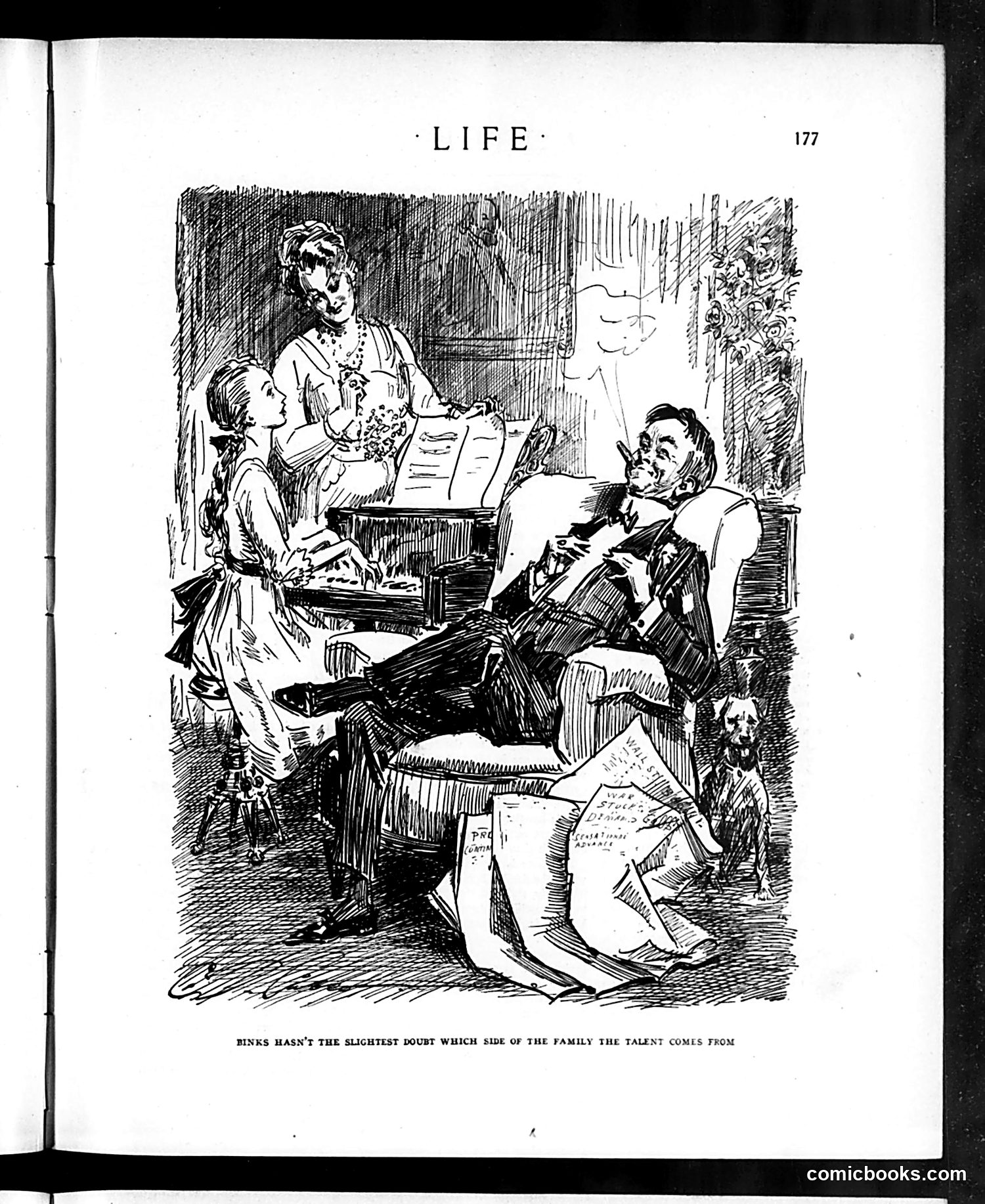
This is a domestic comedy cartoon depicting a family music lesson scene. A man reclines leisurely while his wife stands at a piano with their young daughter, who appears to be learning to play. Sheet music is scattered on the floor near the man. The caption's joke plays on class and gender assumptions of the era: "Binks hasn't the slightest doubt which side of the family the talent comes from." The humor suggests the husband assumes musical ability comes from his wife's family line—implying he himself lacks such refinement or talent. This satirizes Victorian-era masculine attitudes where men might distance themselves from "cultured" pursuits like music while expecting their wives to nurture such accomplishments in children. The small dog observing the scene adds to the domestic tableau. This represents typical early-20th-century upper-middle-class humor about family dynamics.
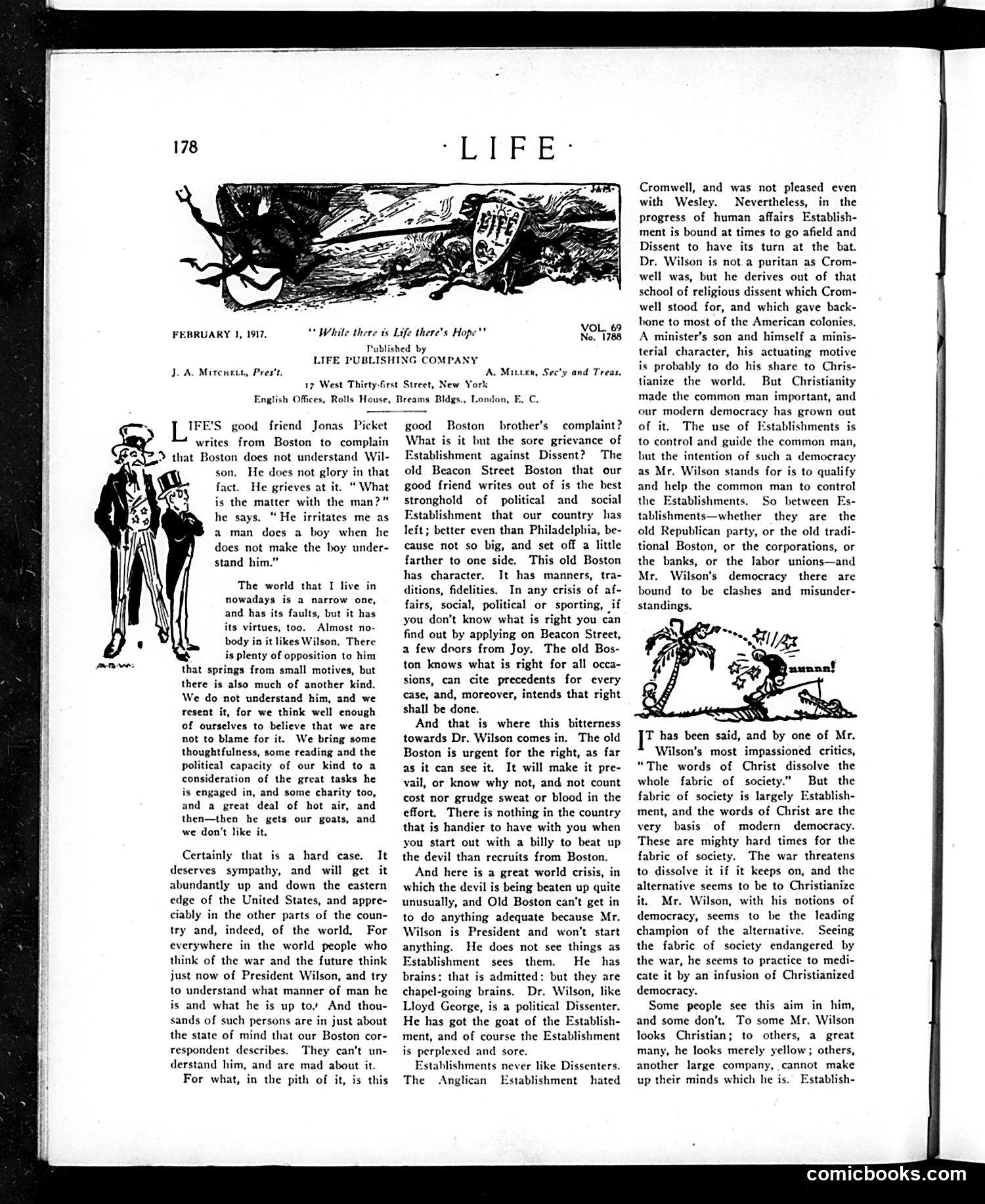
This piece responds to complaints from a Boston correspondent that President Wilson is incomprehensible and frustrating. The author argues the real conflict is ideological: Boston's old-money "Establishment" (represented by elite Beacon Street families) clashes with Wilson's "Dissent." The satire identifies Wilson as a "political Dissenter"—a chapel-going intellectual, compared to Lloyd George—who won't simply defer to Boston's traditional authority and certainty about "the right." The author sardonically notes that Establishments historically hated Dissenters (citing Cromwell and Wesley), yet Dissenters often drive historical progress. The cartoon's Uncle Sam figure reinforces patriotic themes. The joke: Boston's complaint masks its loss of influence over national policy during wartime. Wilson's democratic, independent thinking infuriates the old establishment more than actual policy disagreement.
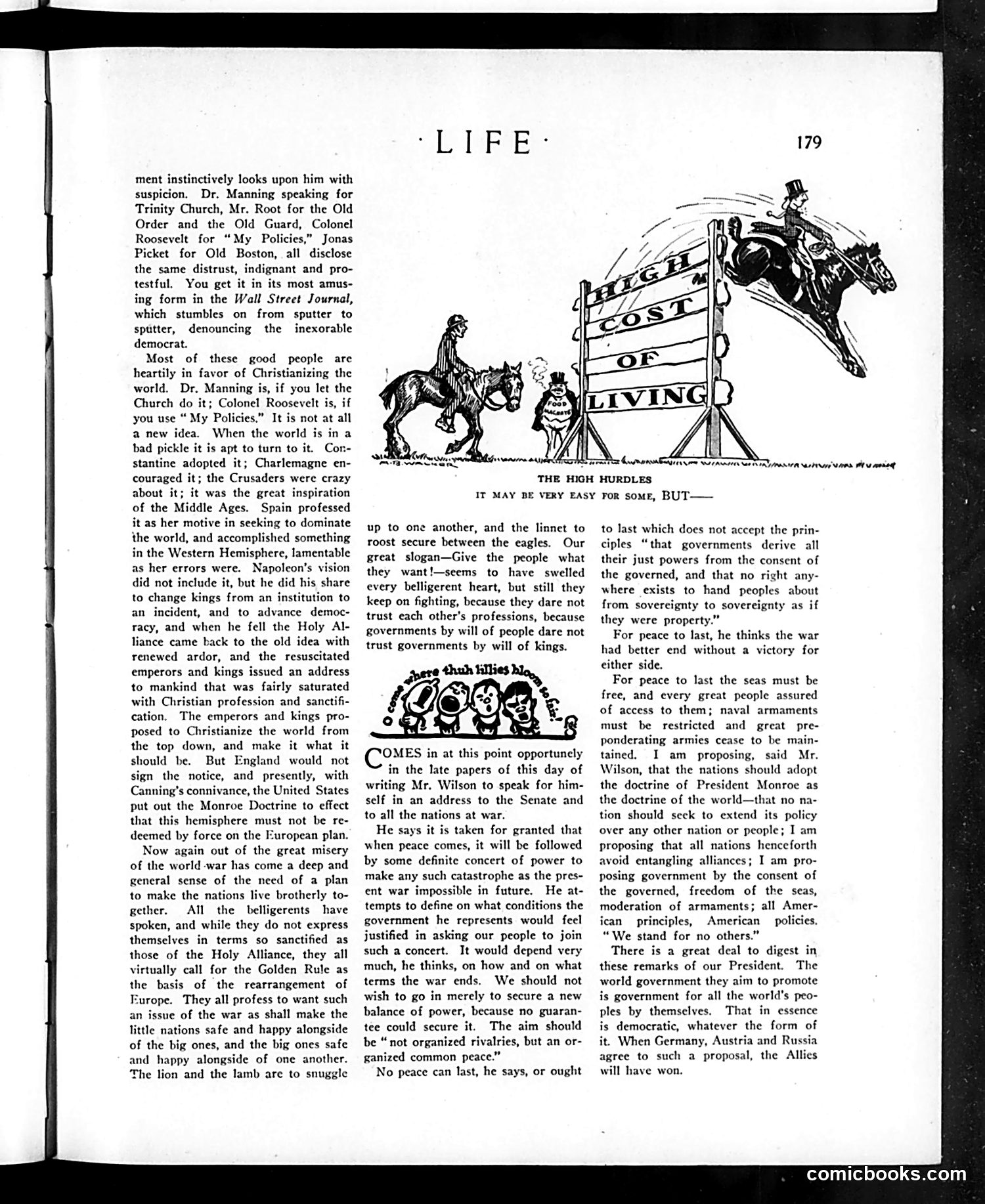
This Life magazine page critiques post-World War I peace efforts, specifically referencing President Wilson's proposals for a League of Nations. The cartoon depicts obstacles (labeled "High Cost of Living") that impede progress toward peace. The text argues that while all belligerents rhetorically support peace and protecting smaller nations—"the lion and the lamb are to snuggle"—they cannot trust each other because governments led by elected peoples distrust governments led by kings. This reflects the fundamental tension between democratic and monarchical powers negotiating the war's end. Wilson's proposed solution—an "organized common peace" rather than "organized rivalries"—is presented as idealistic but potentially difficult to achieve given the entrenched suspicions among nations. The satire highlights the gap between lofty rhetoric about making the world safe and the practical realities of international diplomacy.
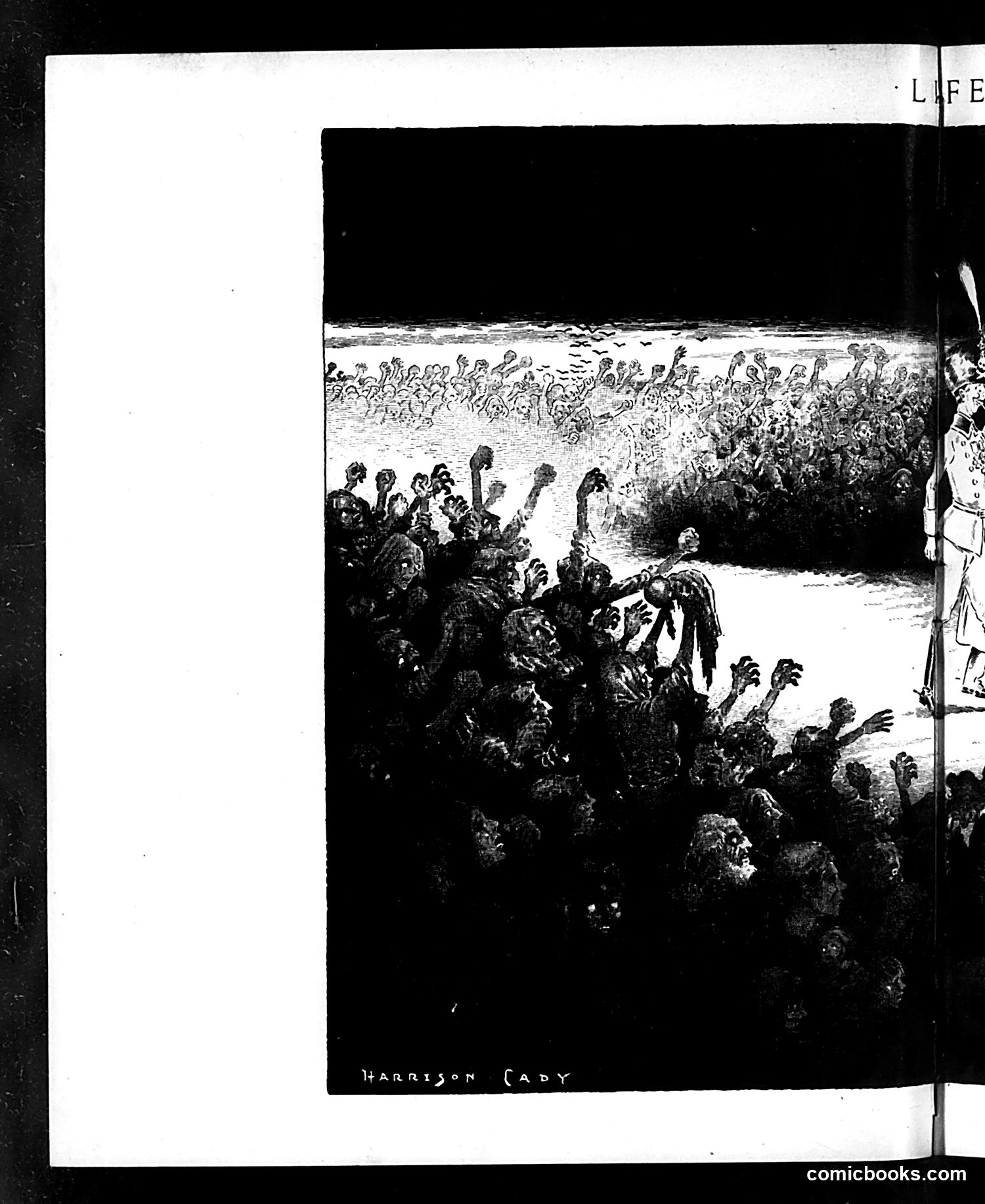
This page from *Life* magazine features a cartoon credited to "Harrison Cady" showing a large crowd of people with raised arms gathered at what appears to be a waterfront or beach area. The composition suggests a mass gathering or demonstration, with figures densely packed and gesturing upward. Without clearer text or additional context on this page, the specific political or social reference remains unclear. The image could depict a public rally, protest, or celebratory gathering typical of early-to-mid 20th century American satire. The dramatic perspective and crowded composition emphasize scale and collective action, likely meant to satirize contemporary social movements or public sentiment. The OCR text appears corrupted and provides no readable caption to clarify the intended subject or joke.
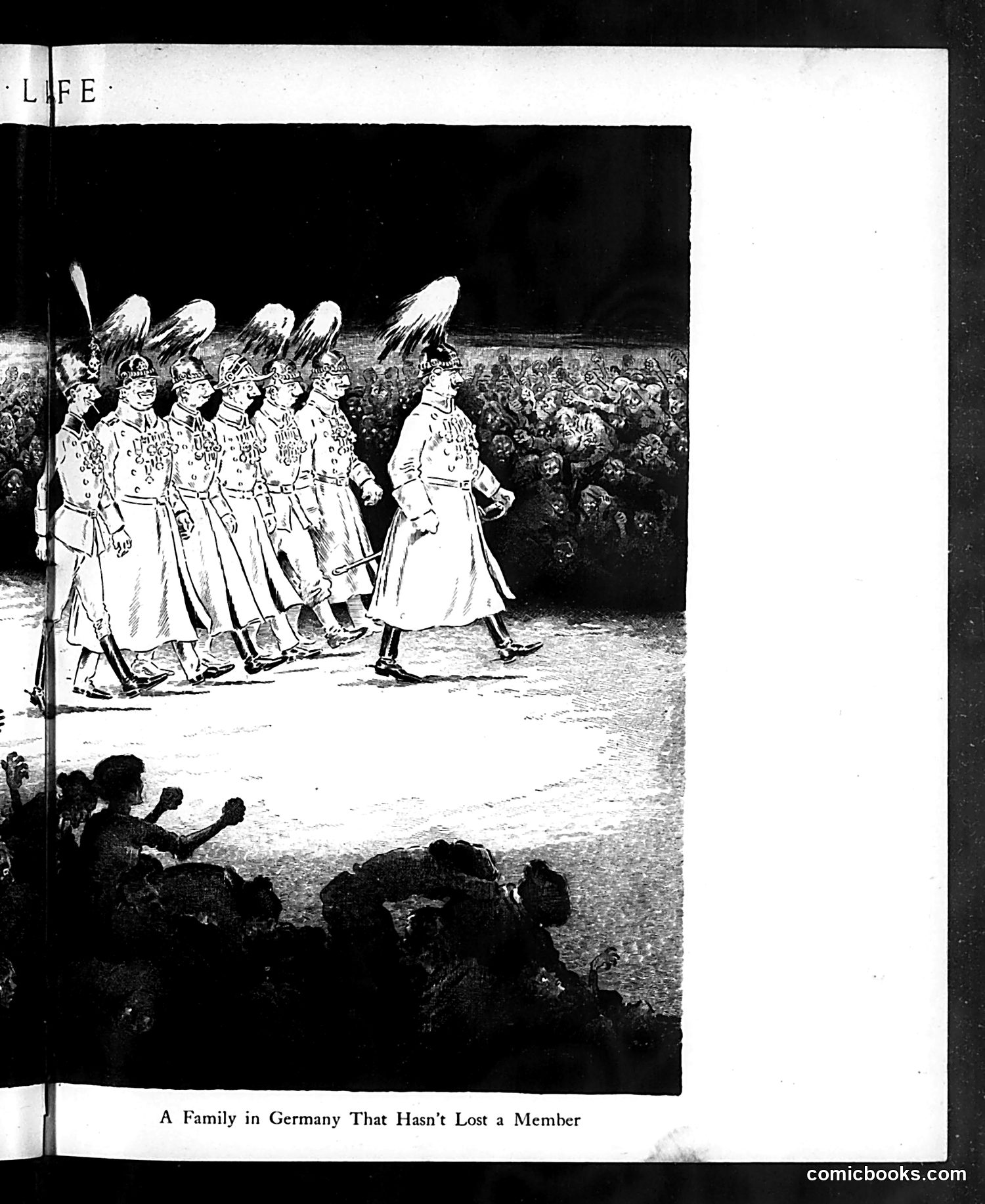
This satirical cartoon from *Life* magazine depicts military figures in formal dress uniforms with distinctive tall feathered headgear, standing before a large crowd. The caption reads "A Family in Germany That Hasn't Lost a Member." The satire appears to target German militarism and warfare, suggesting that a German military family has avoided casualties—likely an ironic commentary on the devastating human cost of German military conflicts (probably World War I, given *Life*'s era). The implication is that such a family is exceptionally rare or even nonexistent, given Germany's heavy wartime losses. The elaborate military dress and formal ceremony underscore the glorification of military service, which the satire critiques as disconnected from the actual human suffering war inflicts.
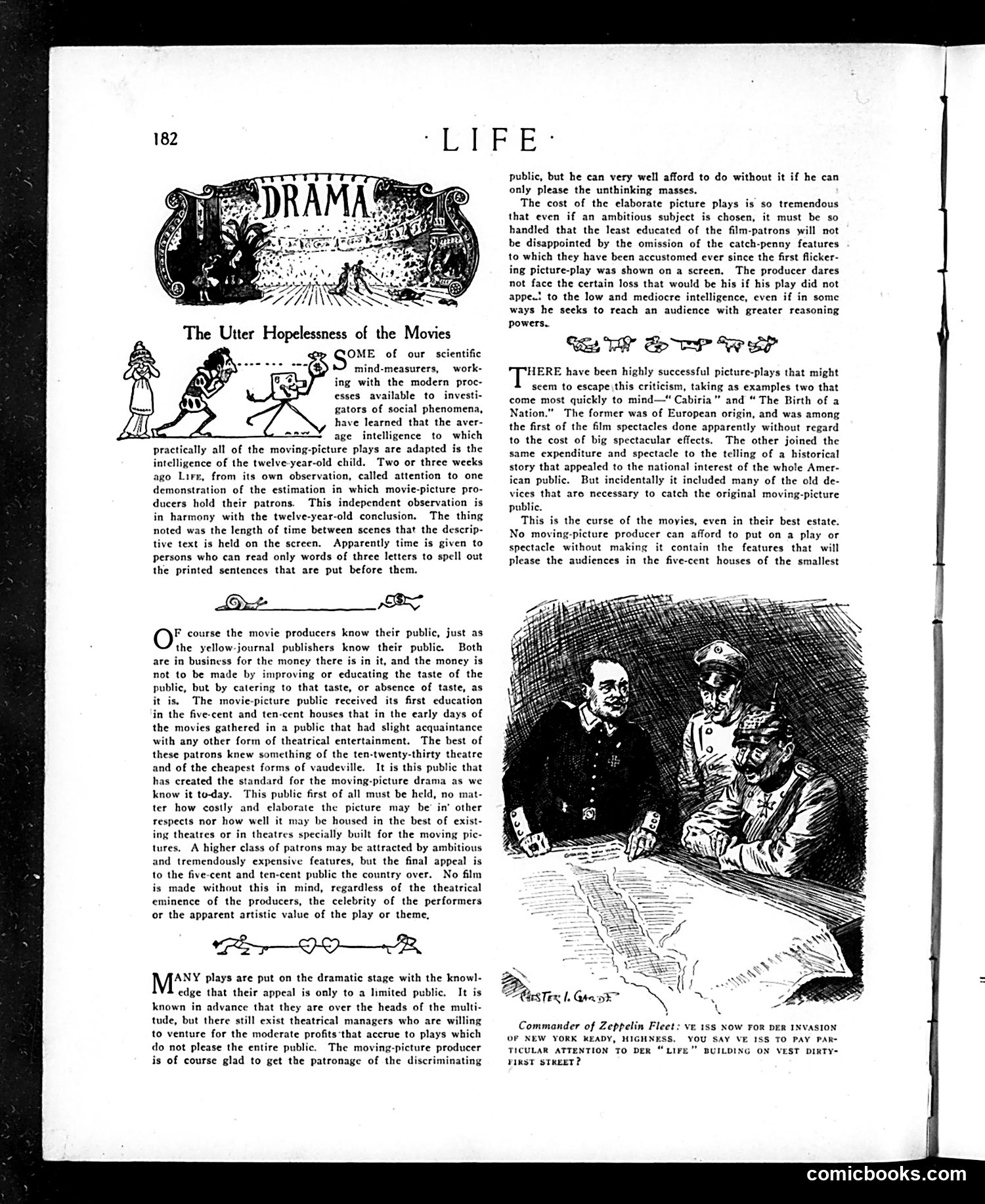
This article criticizes the film industry's deliberate pandering to low-brow audiences. Life argues that movie producers intentionally craft films for the intelligence level of a twelve-year-old child, as evidenced by slow text cards requiring minimal reading ability. The satire's key point: Unlike theatrical producers who accept modest profits from sophisticated plays, film producers *cannot afford* to alienate mass audiences because movies are so expensive to produce. They must please the "unthinking masses" at five-cent and ten-cent theaters, even when this means avoiding artistic ambition. The cartoon (bottom right, by Cesare, dated 1917) depicts a Zeppelin commander warning New York's Life Building about invasion—a topical joke about wartime anxiety, likely sarcastically contrasting trivial entertainment concerns with genuine public threats. Life's conclusion: the film industry is economically trapped serving the lowest common denominator, making artistic elevation "utterly hopeless."
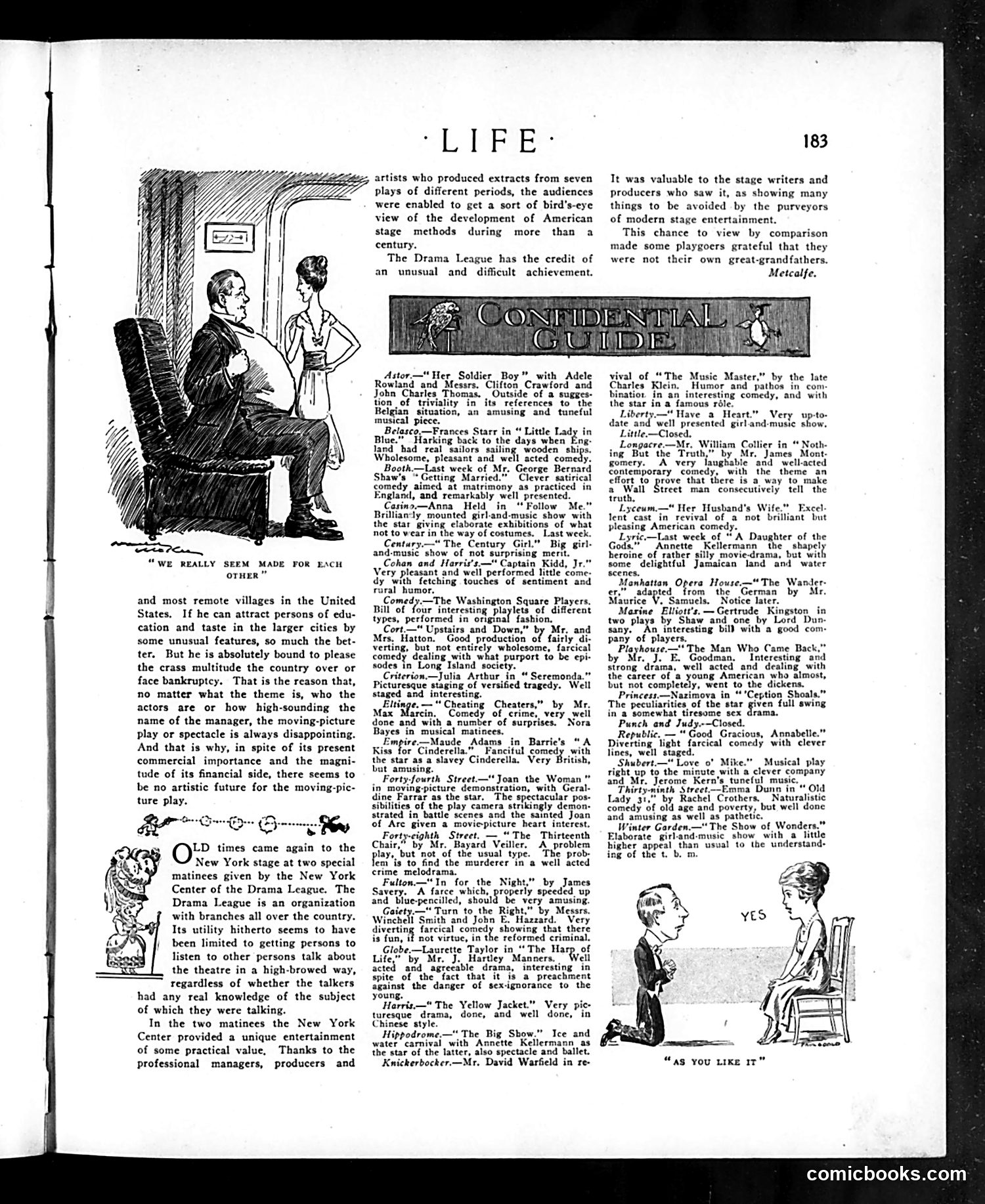
This page reviews New York theatrical productions and includes a satirical cartoon about romantic compatibility. ## The Cartoon The main illustration shows a well-dressed man seated while a woman stands before him in an assertive pose. His caption reads "WE REALLY SEEM MADE FOR EACH OTHER"—a sarcastic comment on their obvious mismatch. The woman's body language (hands on hips) and his resigned expression suggest an uncomfortable or incompatible couple, likely satirizing hasty romantic decisions or forced social pairings of the era. ## The Theater Reviews The page catalogs brief reviews of current Broadway productions, organized by theater name (Astor, Belasco, Booth, etc.). Reviews note performers like Adele Rowland, Frances Starr, and Maude Adams, and mention show types: comedies, musicals, and George Bernard Shaw's "Getting Married." The text emphasizes production quality and entertainment value rather than artistic merit—reflecting early 20th-century theater's commercial focus.
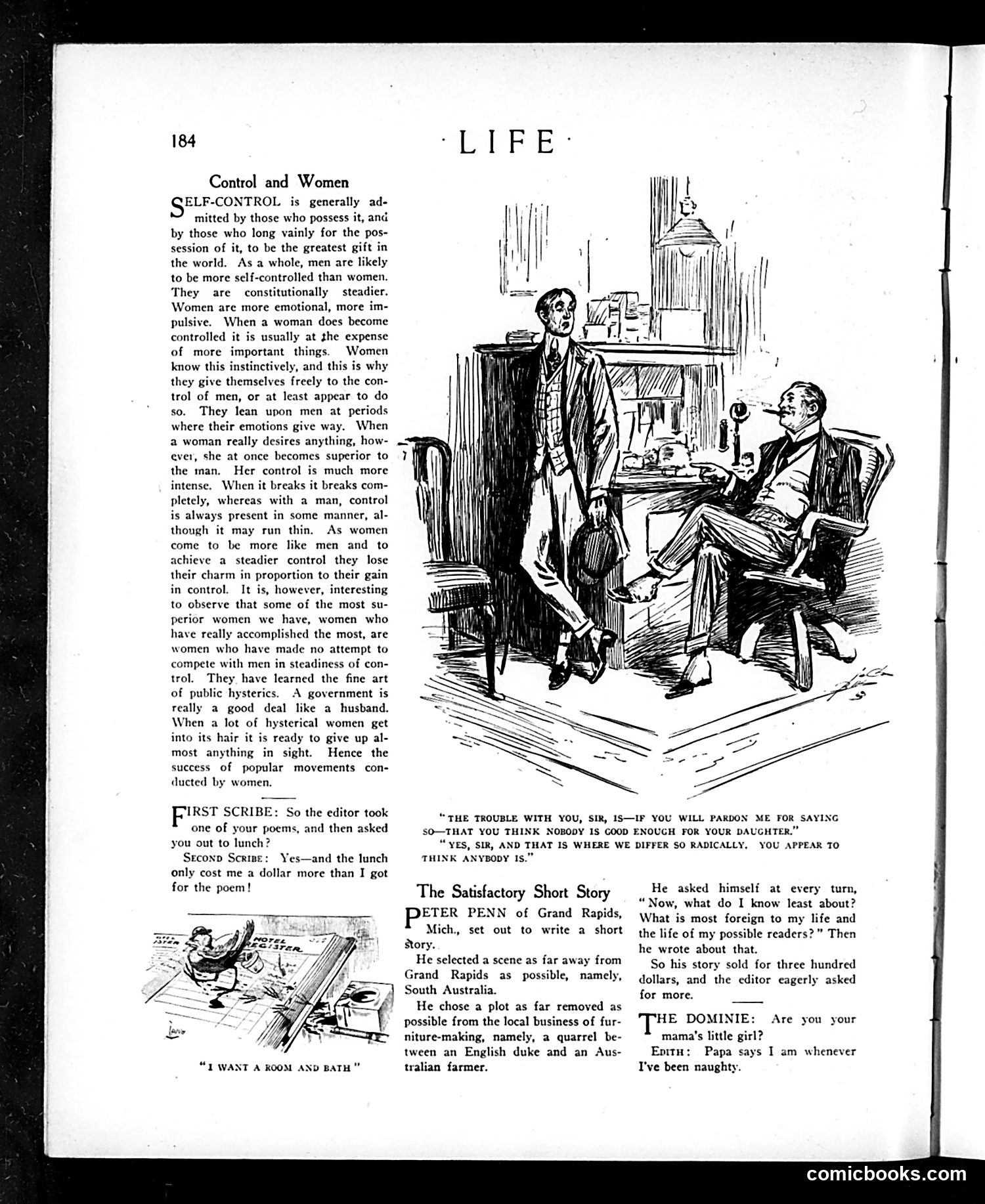
This page satirizes gender stereotypes and women's emerging social power through three pieces: **Main Essay**: Argues women are naturally more emotional and impulsive than men, but paradoxically suggests their "public hysterics" make them politically effective—like how governments cave to emotional demands from women's movements. The essay presents this as witty observation while reinforcing period assumptions about female inferiority balanced against female manipulation. **"First Scribe" Joke**: Mocks struggling writers—the poet sold work for minimal payment, then spent more on lunch than earnings. **"The Satisfactory Short Story"**: Satirizes formulaic magazine fiction: Peter Penn deliberately writes about subjects he knows nothing about (Australian farms, English dukes), and the strategy succeeds commercially—suggesting editors prefer exotic escapism over authentic experience. **Cartoon dialogue**: A father objects to a suitor, claiming "nobody is good enough" for his daughter; the suitor replies he agrees, implying even the daughter isn't worthy—dark humor about marriage market cynicism.
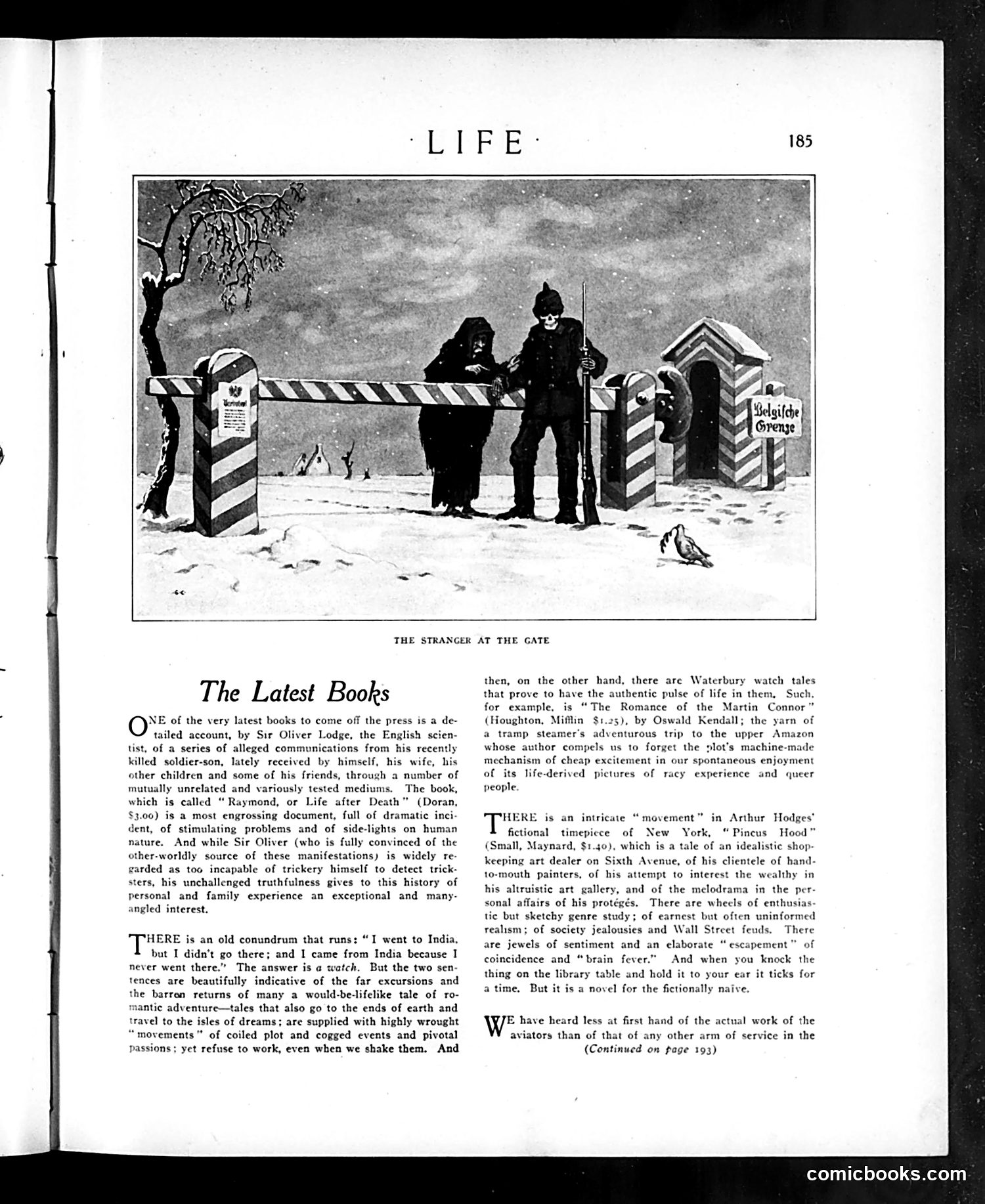
This cartoon satirizes border security or immigration control. Two officials in dark coats and hats stand at a striped gate (marked with text appearing to reference a border or customs post) in a snowy landscape, confronting a figure in dark clothing seeking entry. A bare tree and small structure complete the stark scene. The image likely comments on early 20th-century anxieties about who should be permitted entry into a country or community. The title "The Stranger at the Gate" suggests themes of exclusion, suspicion of outsiders, or immigration policy debates that were prominent in America during this era. The accompanying text discusses Sir Oliver Lodge's spiritualist book "Raymond, or Life after Death"—an ironic pairing suggesting skepticism about allowing uncertain or unverified "visitors" (literal or metaphorical) past society's gatekeepers.
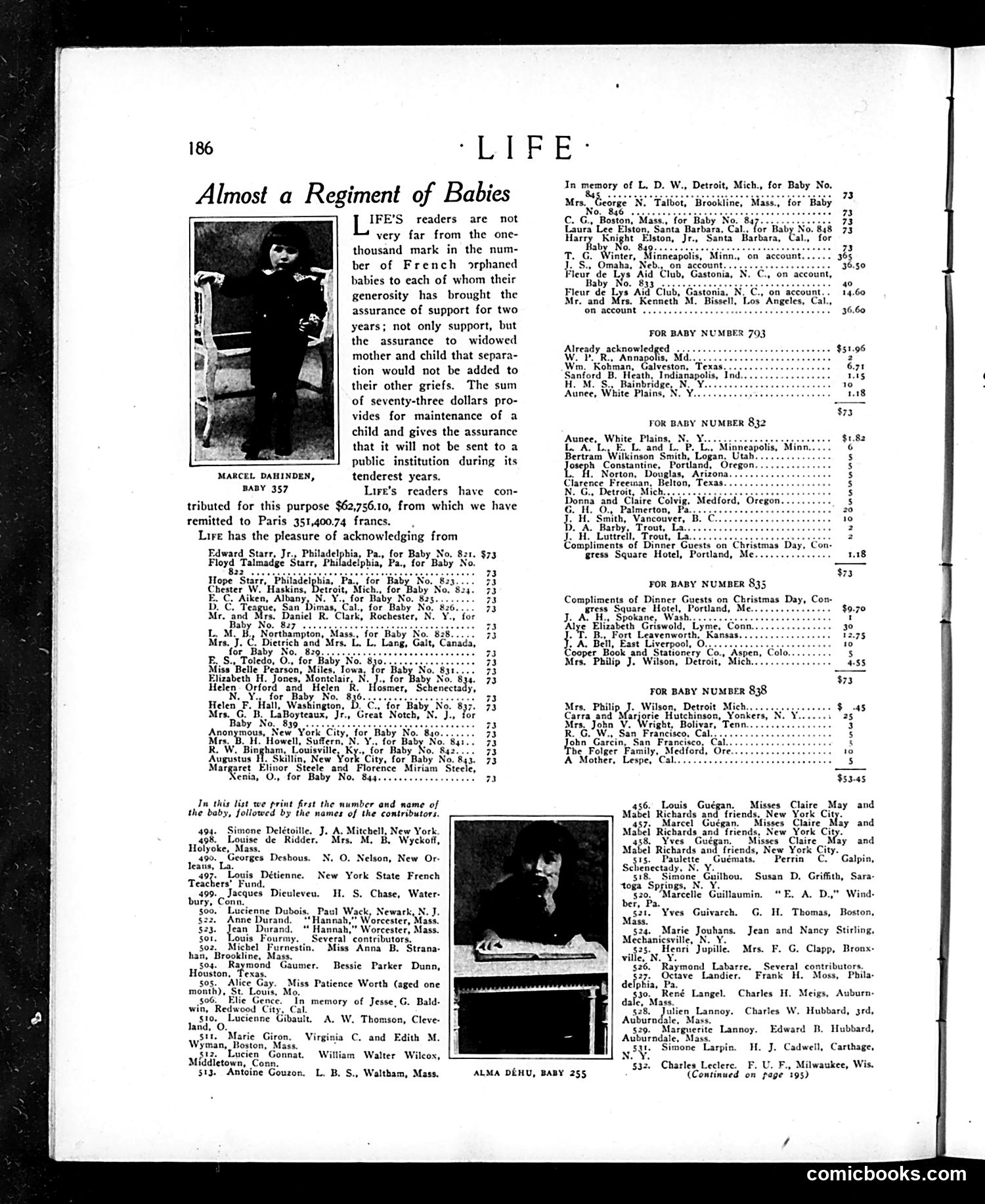
This page documents Life magazine's charitable fundraising campaign for French orphaned children following World War I. The main article announces that readers have contributed over $62,000 to support approximately 1,000 French war orphans, with $73 providing two years of maintenance for each child. The two photographs show individual French orphans being sponsored—Marcel Dahinden (Baby 357) and Alma Dehu (Baby 255)—personalizing the charitable effort. The bulk of the page lists donor names and amounts, organized by baby number, creating a public acknowledgment of contributors. Many donations came from individuals, while some came from organized groups (like "Dinner Guests on Christmas Day" at a Portland hotel). **Context for modern readers:** This represents post-WWI American charitable efforts toward European war victims, reflecting both genuine humanitarian concern and the magazine's role in mobilizing middle-class philanthropic support during a period of significant international need.
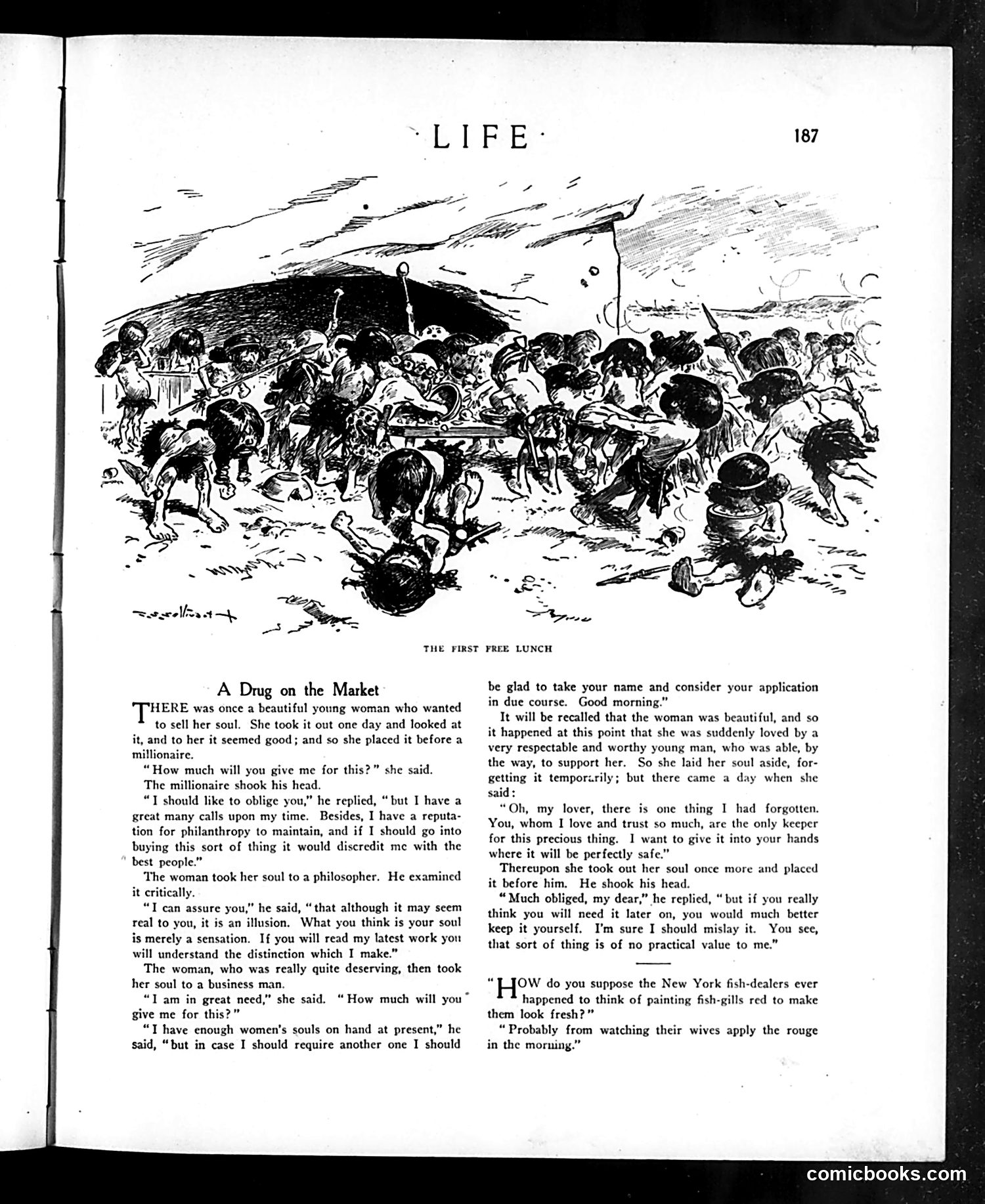
This satirical story mocks the commodification of morality in the Gilded Age. A woman tries to sell her soul to various representatives of society—a millionaire (concerned with reputation), a philosopher (who denies souls exist), and a businessman (who has no use for them). None value it. The satire's point: spirituality and morality have become literally worthless in modern commerce and intellectual life. The millionaire fears scandal, the philosopher denies metaphysical reality, and the businessman sees no profit. Only romantic love temporarily makes her forget her soul matters. The accompanying joke about fish-dealers painting gills red—mimicking women applying rouge—extends the theme: artifice and deception are now standard practice in business and society. This reflects Progressive Era concerns about materialism eroding traditional values.
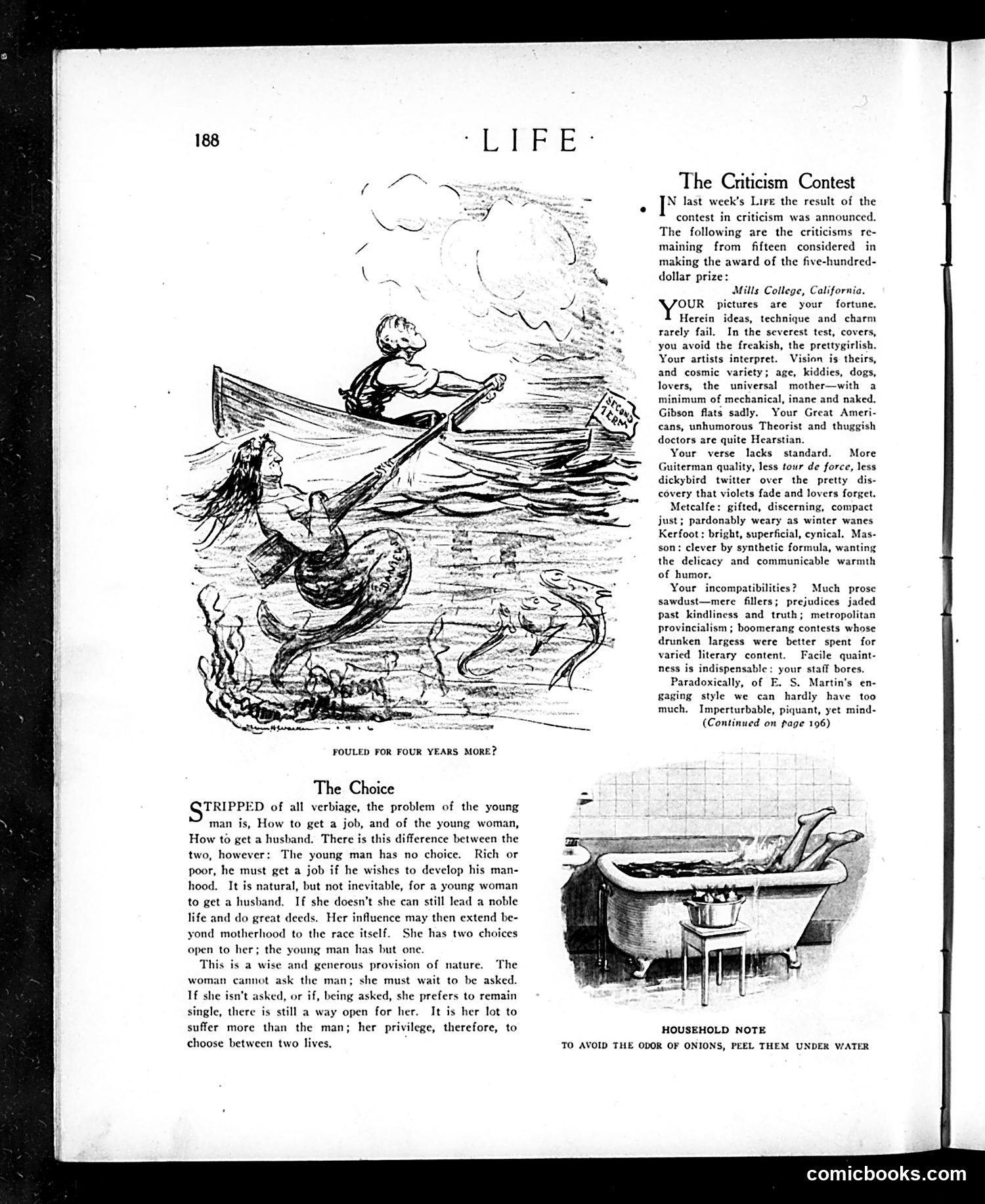
This page contains two distinct sections: **"The Criticism Contest"** announces results of Life magazine's competition judging submissions. The text presents critiques of various contributors—likely cartoonists, poets, and writers for Life itself. References include "Gibson" (likely Charles Dana Gibson, famous illustrator), "E.S. Martin" (Life's editor), and unnamed contributors like Metcalfe and Kerfoot. The cartoon above shows a figure in a boat surrounded by water creatures, captioned "FOULED FOR FOUR YEARS MORE?"—apparently satirizing the magazine's own work or its critics. **"The Choice"** is an editorial essay arguing that young women have greater life options than young men. It claims men must work to develop manhood, while women can either marry or pursue meaningful lives unmarried—thus women possess "two choices" versus men's "one." The essay presents this as "nature's wise provision," reflecting early 20th-century gender ideology. The household tip about onions appears incidental filler.
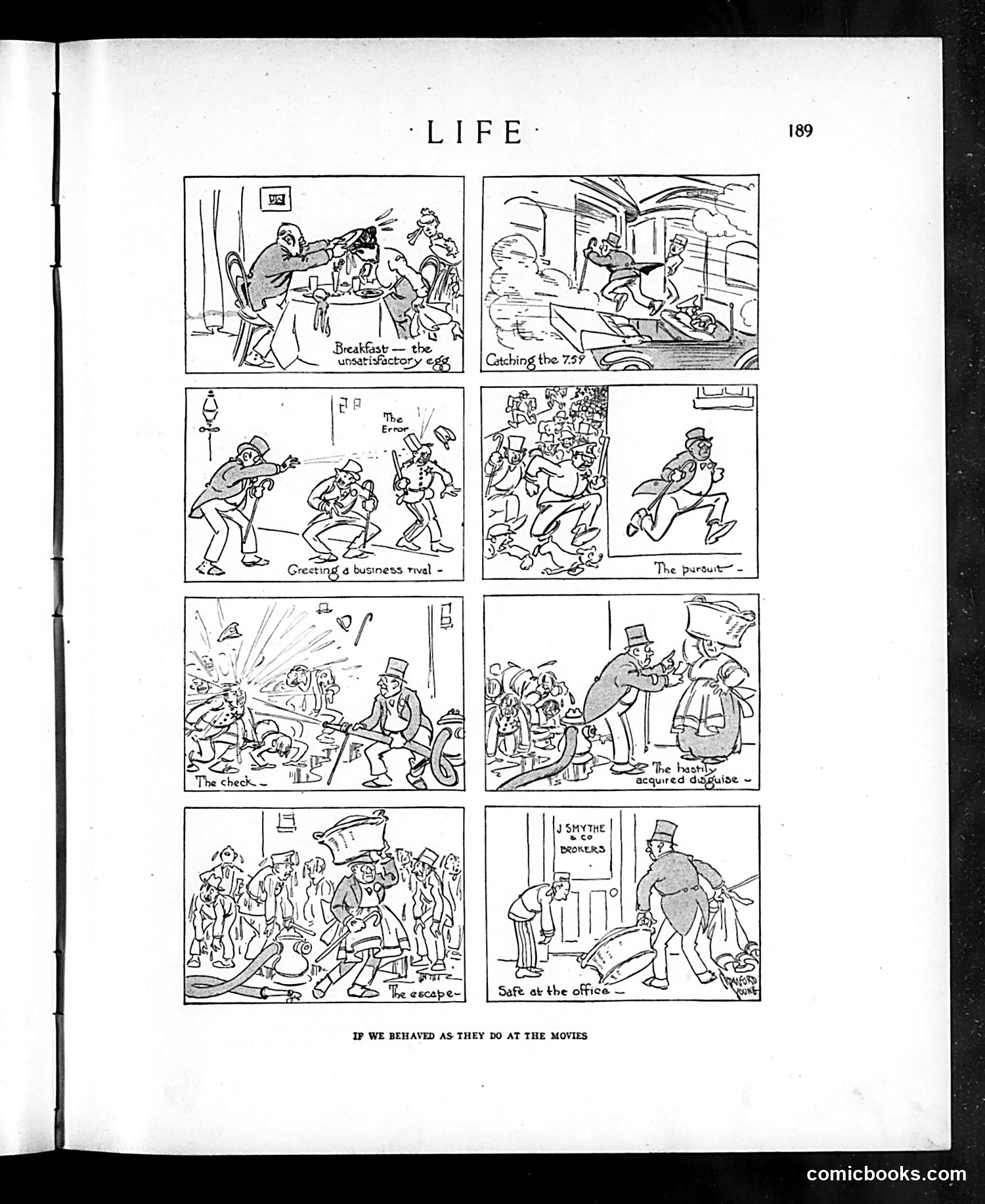
This is a humorous comic strip showing eight scenes of everyday life reimagined with the exaggerated, dramatic behavior typical of silent film acting. The caption suggests the joke: *what if people actually behaved like movie characters in real situations?* The panels depict: - Breakfast chaos and slapstick violence - Fishing and pursuit scenes - Business interactions with theatrical gestures - A violent restaurant confrontation ("The check") - Romantic disguises and elaborate schemes - A chaotic office escape with physical comedy - An over-the-top safe arrival at work The satire mocks silent cinema's conventions—extreme facial expressions, impossible stunts, melodramatic reactions to minor incidents, and constant physical comedy. It's gentle social commentary on how artificial and absurd movie behavior would be if applied to mundane daily life. The cartoonist is poking fun at both movie conventions and audiences who enjoyed such exaggerated entertainment.
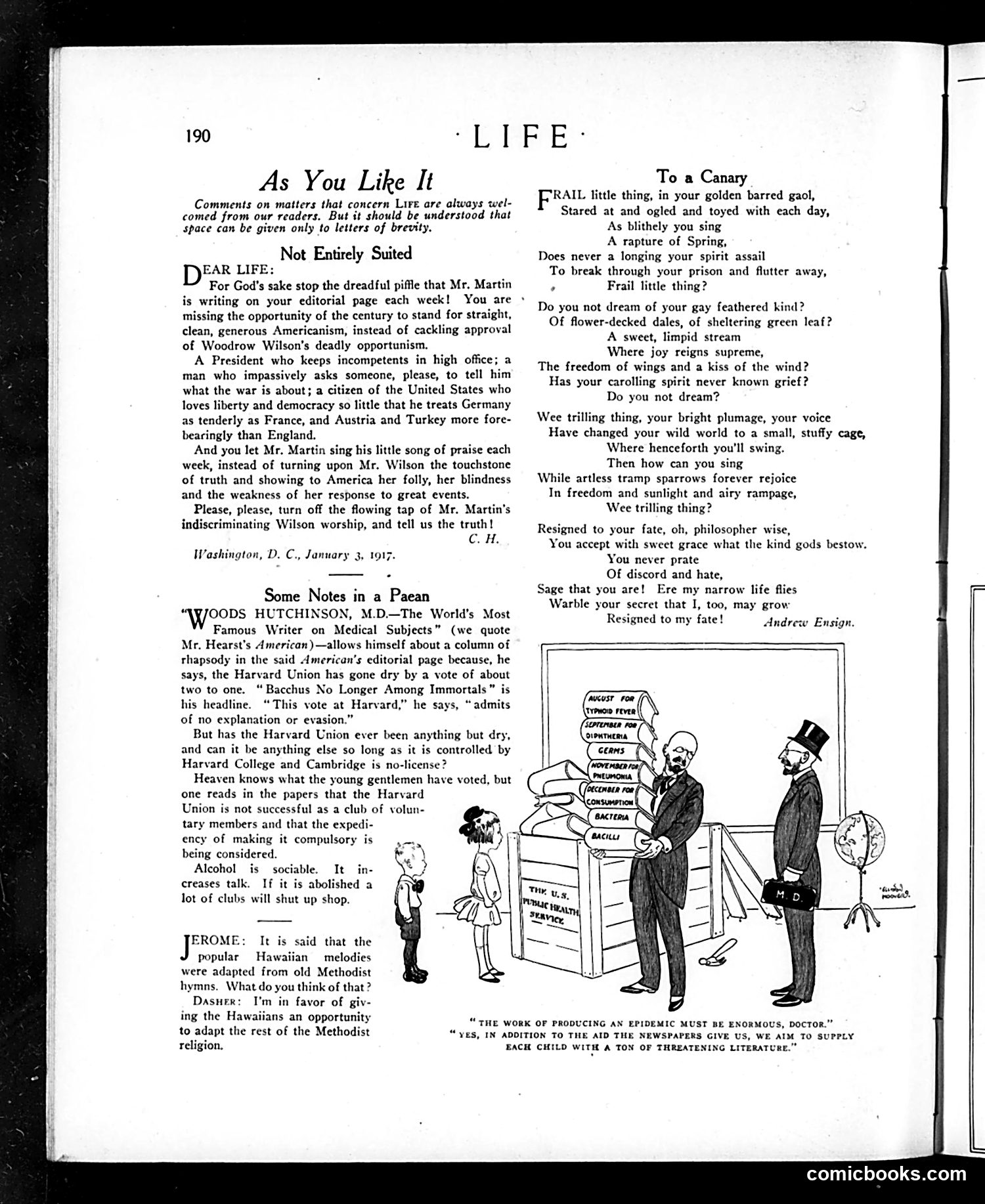
This page contains reader letters and satirical commentary on contemporary issues: **"Not Entirely Suited"** attacks President Woodrow Wilson's foreign policy as weak and insufficiently pro-Allied. The writer criticizes Wilson for treating Germany too gently compared to other Central Powers, and censures Life's columnist Mr. Martin for praising Wilson instead of condemning him. This reflects pre-American entry WWI debate (the U.S. entered April 1917). **"Some Notes in a Paean"** mocks a Hearst newspaper columnist's outrage over Harvard's union voting to go dry (prohibition). The writer sardonically notes the Harvard Union was never a serious drinking establishment anyway—it's controlled by the college itself—and suggests making it mandatory would only work if alcohol were served. **The cartoon** depicts public health officials distributing disease-causing materials alongside newspapers, sardonically suggesting both newspapers and official "threatening literature" help spread epidemics as effectively as deliberate disease distribution. **"To a Canary"** is a sentimental poem questioning captivity's constraints.

This page is **primarily an advertisement**, not political satire. It's a Republic Tire Company ad from Life magazine promoting automobile tires through testimonial-style marketing. The illustration shows a racing car with large tires, emphasizing speed and performance. The ad's key message is that Republic Tires are superior and inspire customer loyalty—once drivers try them, they become repeat buyers regardless of what car they own. The "Prodium Process" is presented as the tire's exclusive manufacturing advantage. The ad uses persuasive rhetoric common to early 20th-century advertising: claims that satisfied customers become enthusiastic advocates, and suggestions that asking any Republic Tire user will confirm the product's superiority. There is **no political cartoon or satire present**. This is straightforward commercial advertising from the Youngstown, Ohio-based Republic Rubber Company, designed to appear alongside Life's editorial content.
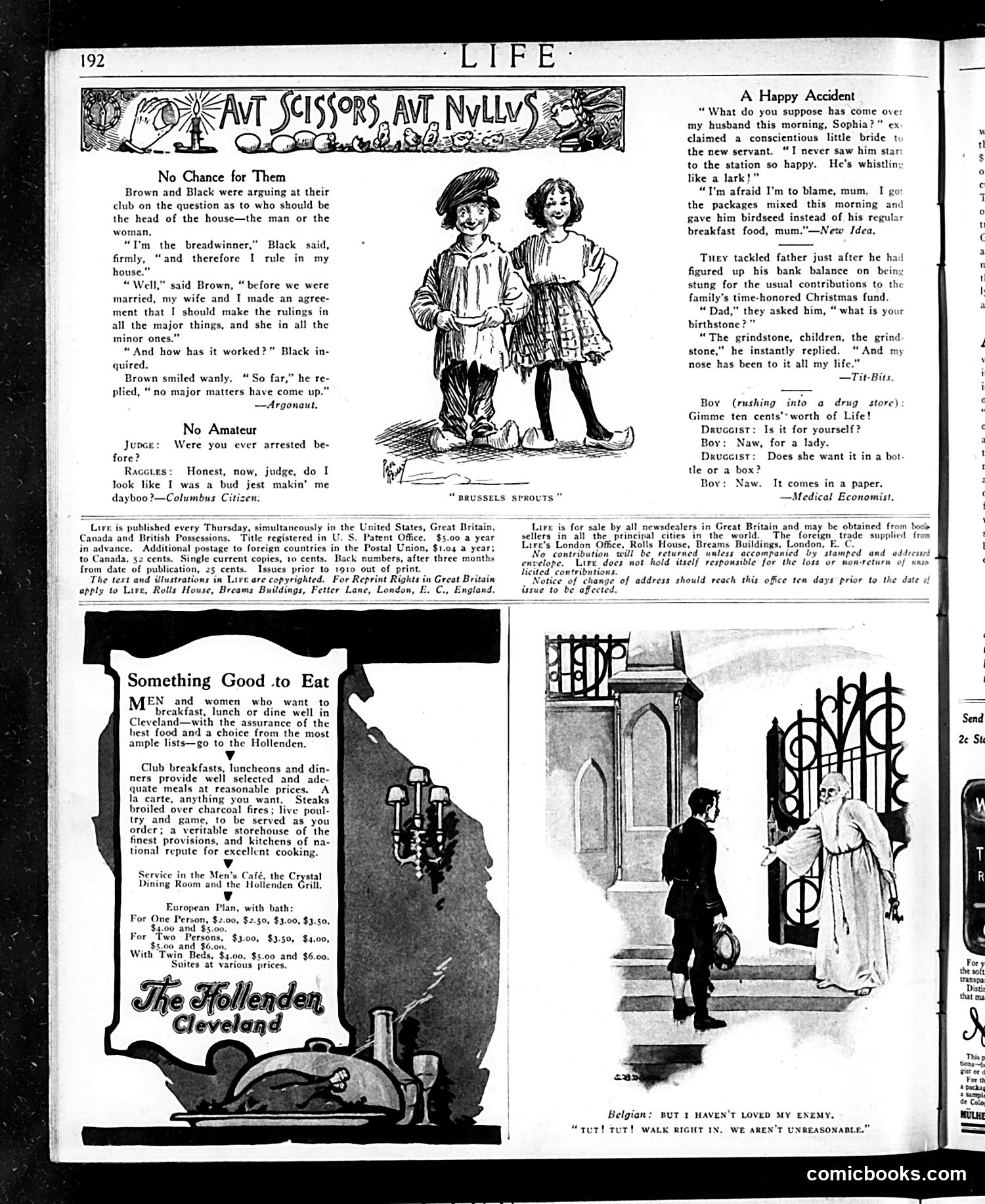
This page contains several short humorous pieces typical of early 20th-century satirical magazines: **"No Chance for Them"**: A joke about marital power dynamics. Brown claims his pre-marriage agreement giving him control of "major" decisions has worked perfectly—because no major issues have arisen, implying his wife controls everything that actually matters. **"No Amateur"**: A brief courtroom joke playing on dialect humor, where a defendant's rough speech suggests he's a career criminal rather than a novice. **Other humor pieces**: Short jokes about domestic life, including one where mixed-up birdseed makes a husband cheerful, and another where a father calls his birthstone "the grindstone" (suggesting grinding, hard work). **The Belgian cartoon** (bottom right) appears to reference WWI-era attitudes, depicting Belgium welcoming an enemy with forced civility—likely commenting on wartime occupation or complicated relationships. The page also contains **The Hollenden hotel advertisement** promoting Cleveland dining facilities. Overall, the page reflects period humor focused on marriage, class, and contemporary events, with broad comedic appeal to Life's early 1900s readership.
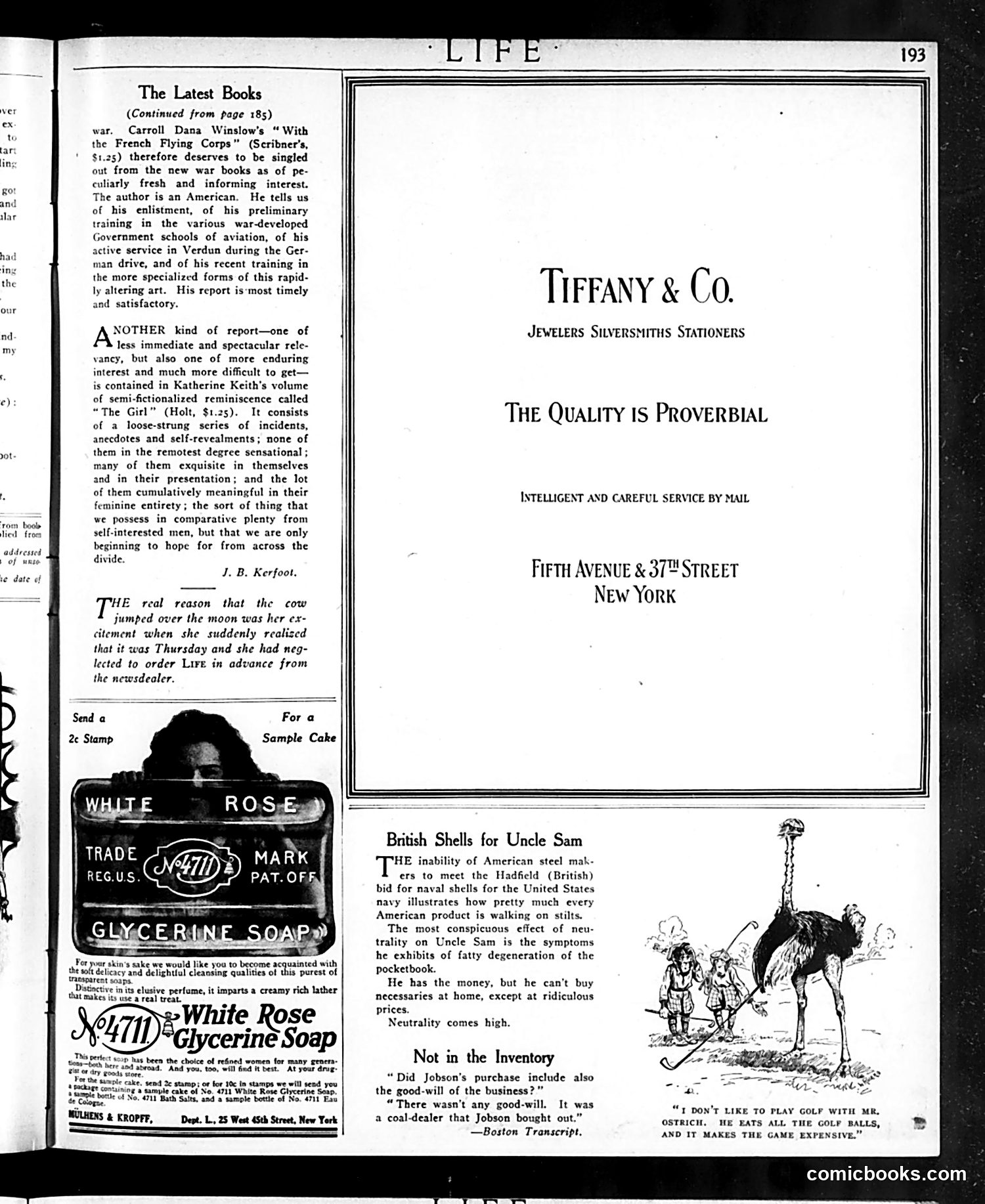
This page is primarily **advertising and book reviews**, not political satire. The main elements are: **Book Reviews Section**: Discusses war-related books, including Carroll Dana Winslow's account of service with the French Flying Corps and Katherine Keith's memoir "The Girl." **The One Joke**: A brief humorous quip about a cow jumping over the moon—the punchline being that the cow was excited because it suddenly realized it was Thursday and she'd forgotten to order LIFE magazine in advance from the newsdealer. This is self-promotional advertising disguised as humor. **"British Shells for Uncle Sam"**: A brief editorial comment on American neutrality during WWI. It criticizes American steel makers' inability to meet British specifications for naval shells, sarcastically suggesting U.S. industry is weakened and dependent on imports despite American wealth—framed as a cost of maintaining neutrality. **Cartoon**: Shows an ostrich refusing to golf with someone because the bird eats golf balls, making the game expensive. The page is mostly **advertisements** (Tiffany & Co., White Rose Soap) interspersed with light editorial content.
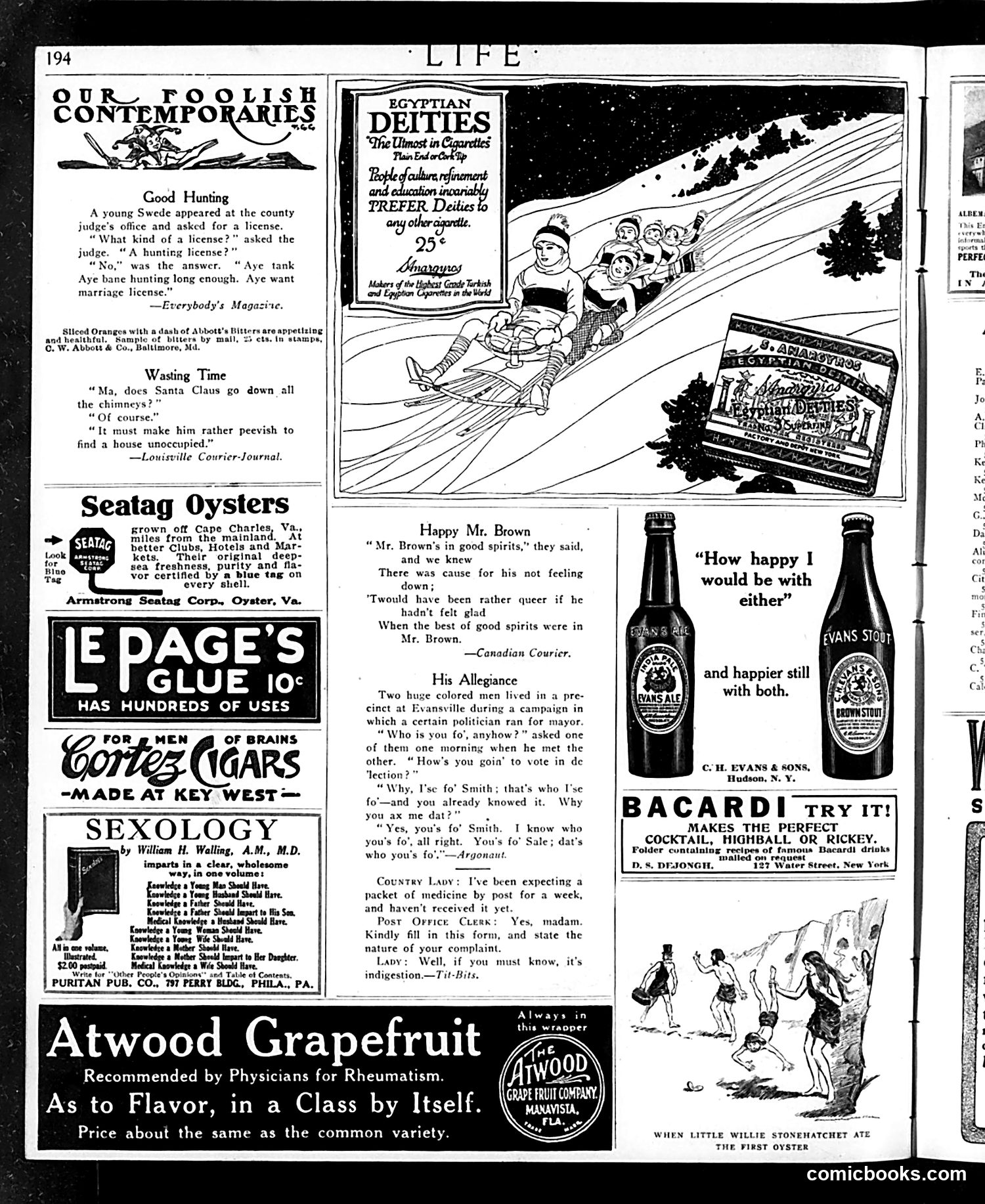
This page from *Life* magazine contains several short humorous anecdotes under "Our Foolish Contemporaries," alongside period advertisements. The jokes mock everyday absurdities: a Swedish immigrant's malapropism (seeking a "marriage license" after long hunting), Santa's inefficiency visiting empty houses, and voter confusion in a Black precinct where a man supports "Smith" but is really voting for "Sale" (likely a candidate's name or a pun on political corruption). The "Happy Mr. Brown" item uses a pun: his good spirits literally mean alcohol—specifically liquor—explaining his cheerfulness. It's a play on the double meaning of "spirits." The remaining content is primarily **advertisements** for products like Seatag Oysters, Le Page's Glue, Cortez Cigars, Bacardi rum, and Atwood Grapefruit. The cartoon illustration shows children discovering an oyster, likely promoting oyster consumption. The page reflects early 20th-century American humor: ethnic stereotyping, domestic life observations, and straightforward product marketing.
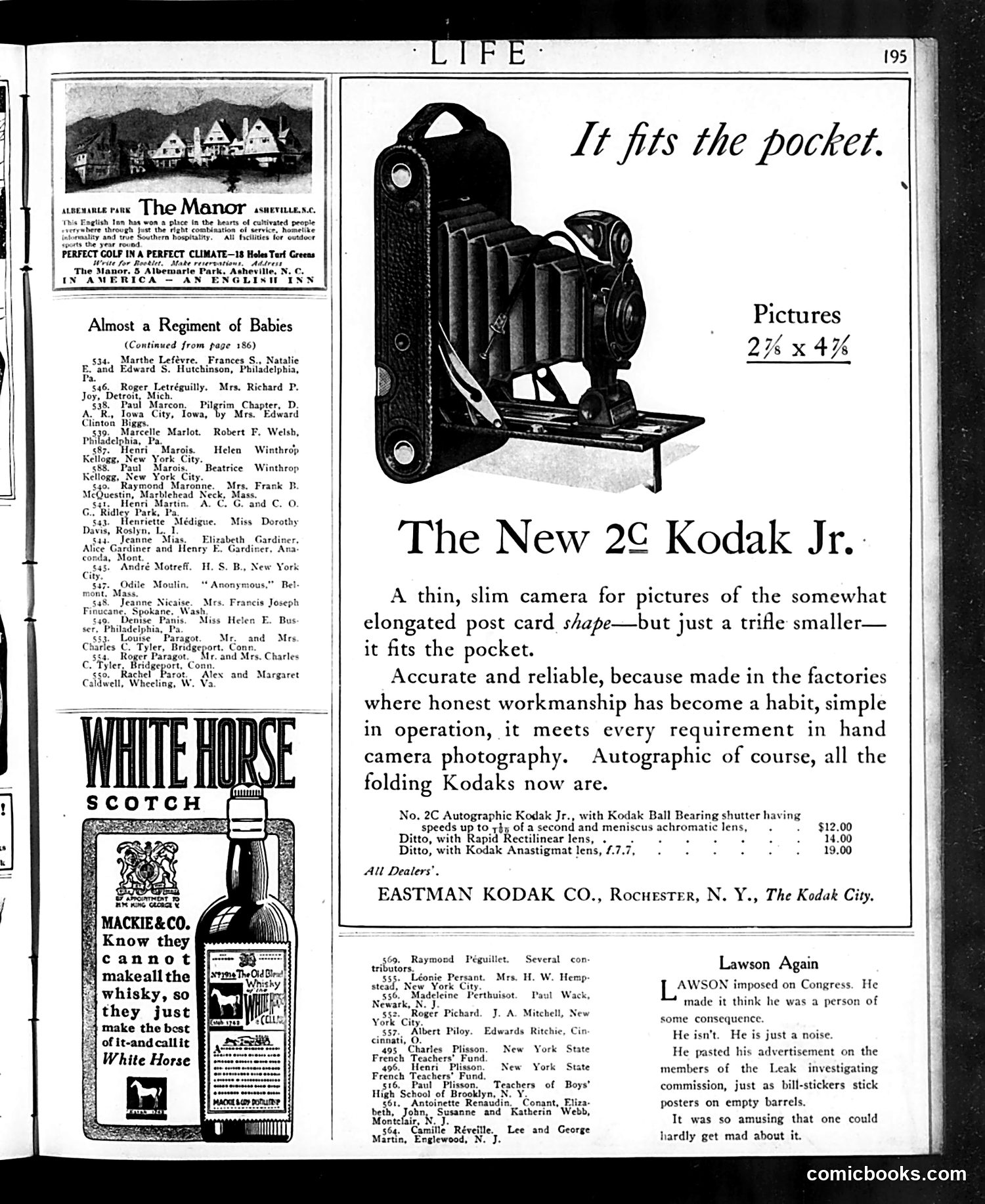
This page is primarily **advertising** for two products: The Manor resort (top left) and the **Kodak 2C Jr. camera** (center-right). The camera ad emphasizes portability—"it fits the pocket"—targeting amateur photographers with an affordable, reliable folding camera. The left side contains a continuation of "Almost a Regiment of Babies," listing names of infants, apparently a humorous feature tracking newborns born to notable families. Below the camera ad is a brief **political satire** titled "Lawson Again," criticizing someone named Lawson who "imposed on Congress" by making false claims. The piece compares his deception to pasting "bill-stickers" advertisements on empty barrels—he's merely noise and empty rhetoric, not substance. The author notes Congress was fooled but the hoax was ultimately amusing rather than damaging. The White Horse Scotch whisky advertisement appears at bottom left, using period marketing language about quality and tradition.
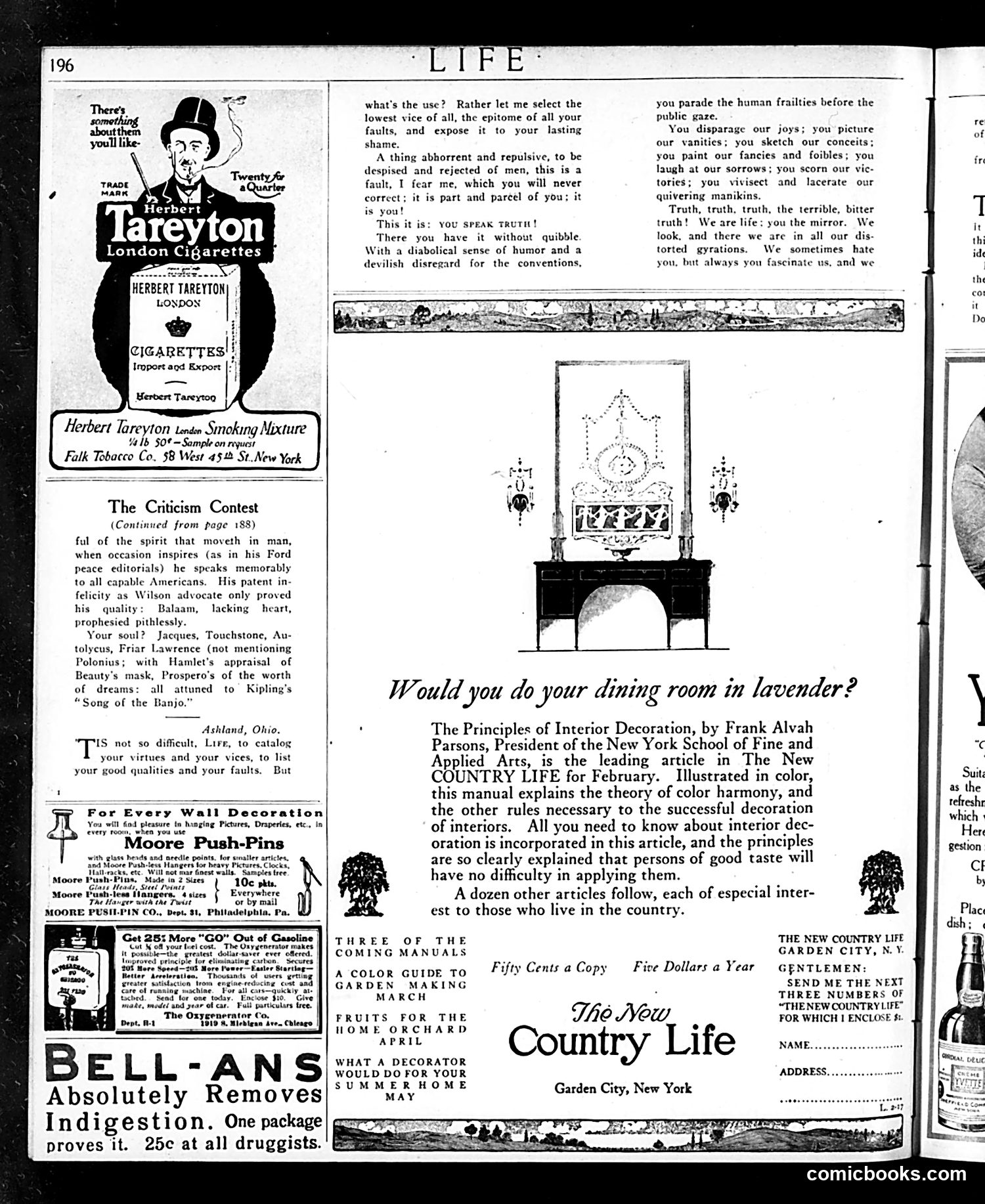
This page is primarily **advertising and promotional content** rather than political satire. The main elements include: **"The Criticism Contest"** (top): A literary piece continuing from page 188, where the author playfully attacks *Life* magazine itself for its defining characteristic—speaking uncomfortable truths. The piece personifies *Life* as a mirror that "disparages our joys" and "paints our foibles," suggesting the magazine's satirical mission is to expose human vanities and follies to public scrutiny. This is essentially *Life* explaining its own purpose: honest social criticism. **Advertisements dominate the page**: Herbert Tareyton cigarettes, Moore Push-Pins, gasoline additives, Bell-Ans indigestion remedy, and interior decoration guides. **The decorative illustration** ("Would you do your dining room in lavender?") promotes *Country Life* magazine's interior design articles. The page reflects early 20th-century magazine culture, where satire coexisted with commercial advertising, and publications explicitly defined their editorial missions to readers.
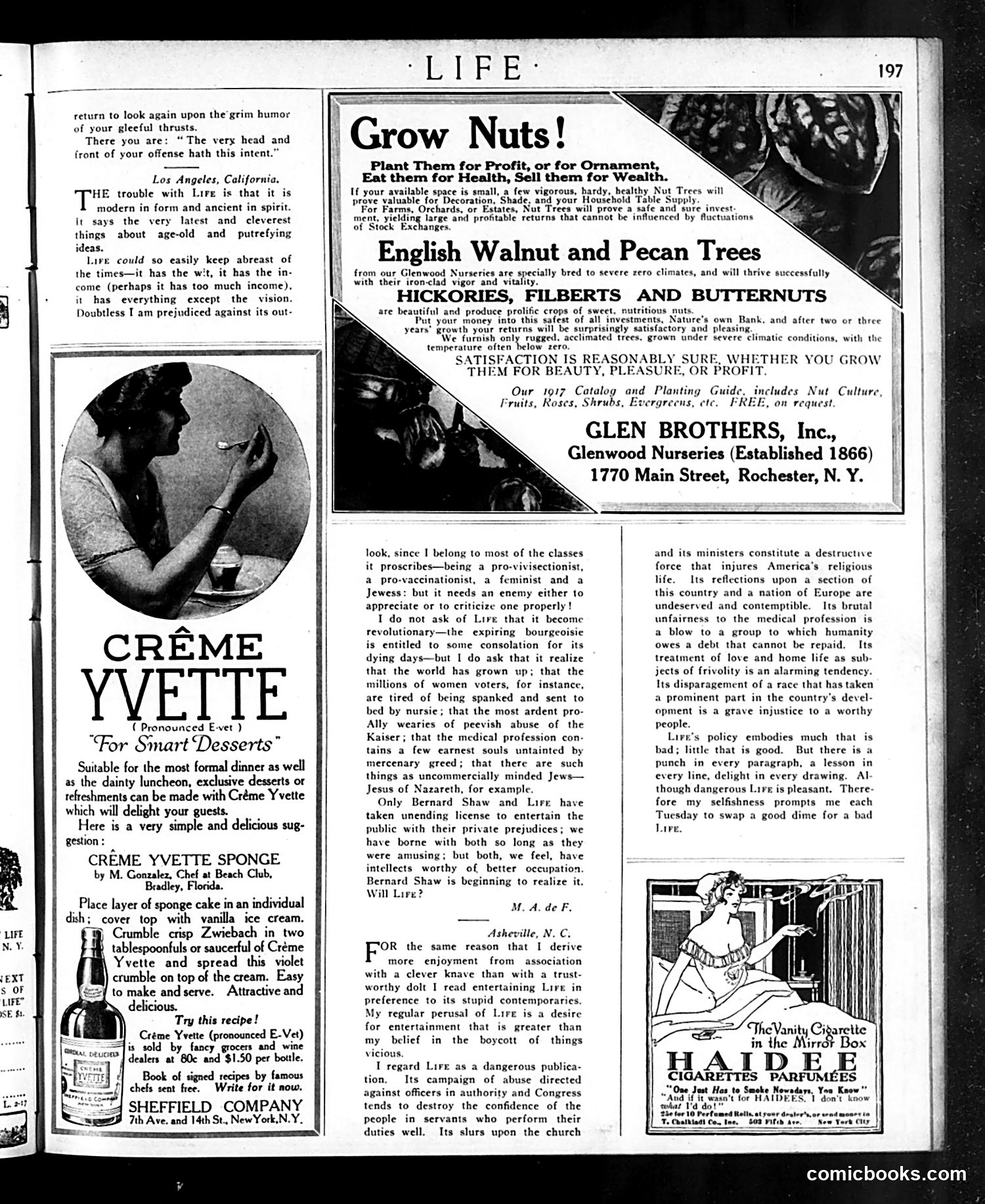
This page contains a reader's letter criticizing *Life* magazine itself. A correspondent from Los Angeles argues that while *Life* is modern in style and clever, it remains "ancient in spirit"—defending outdated ideas through satire rather than advancing genuine social progress. The writer, identifying as "a pro-vivisectionist, a pro-vaccinationist, a feminist and a Jewess," suggests *Life* needs enemies to function and lacks the vision to keep pace with modern times. She specifically faults the magazine for treating women voters as children needing discipline, mocking Allied war efforts, and stereotyping the medical profession and Jewish people—comparing *Life* unfavorably to Bernard Shaw as entertainers who've overstayed their license to indulge private prejudices. The page also contains period advertisements (Crème Yvette liqueur, Glen Brothers Nurseries) unrelated to the editorial content.
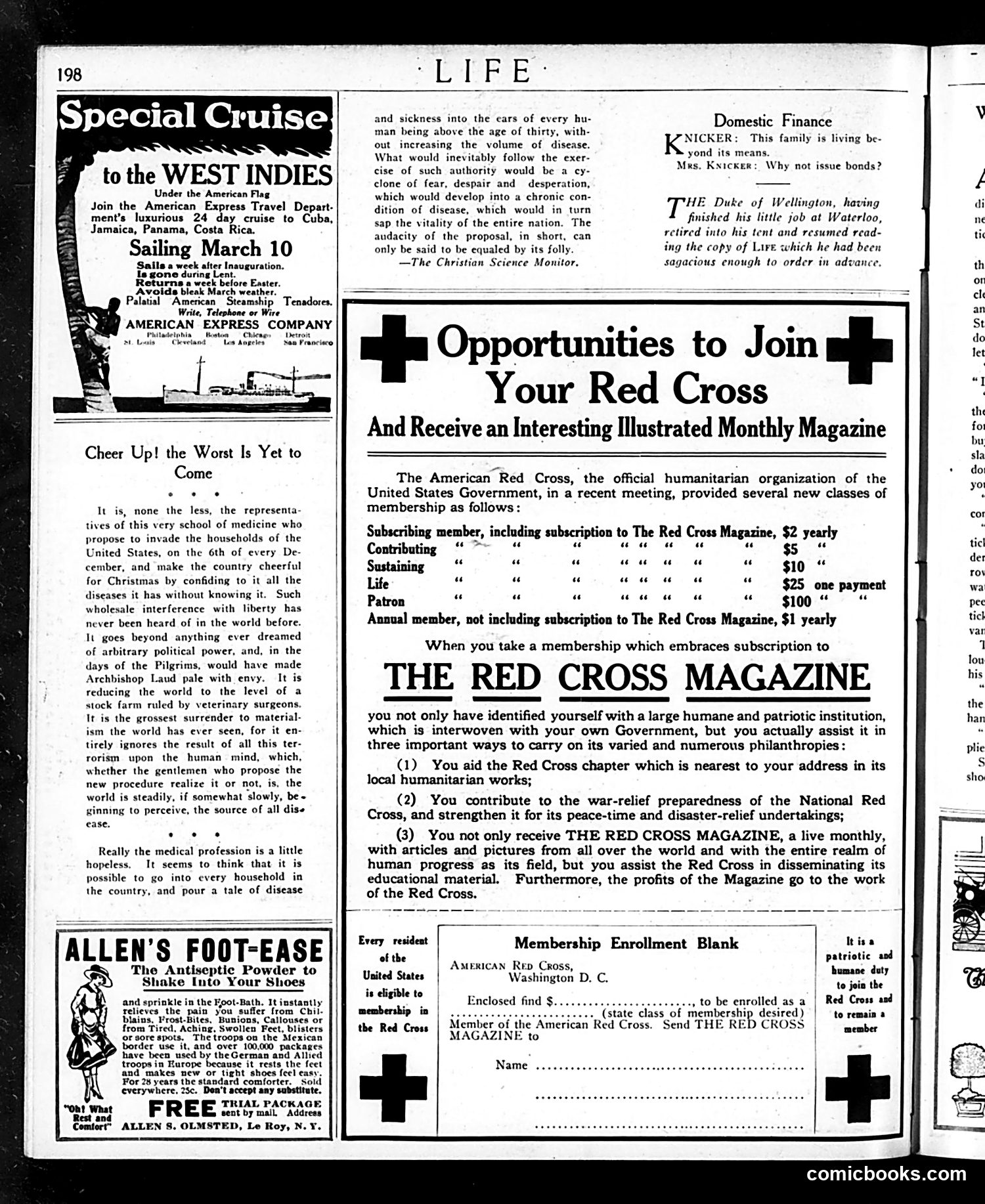
This page from *Life* magazine (appears to be early 1900s based on references) contains mostly advertisements and public service announcements rather than satirical cartoons. The main content includes: 1. **A cruise advertisement** to the West Indies, noting it sails "a week after Inauguration" and avoids "bleak March weather"—typical travel marketing. 2. **An editorial criticism** of medical professionals proposing household disease surveillance on December 6th. The piece sarcastically attacks this as invasive government overreach, comparing it to authoritarian control and arguing that fear itself causes illness. This reflects early-20th-century resistance to medical interventionism. 3. **Allen's Foot-Ease advertisement** promoting an antiseptic powder. 4. **A brief "Domestic Finance" joke** about a family living beyond means, with a wife suggesting issuing bonds. 5. **A Red Cross membership recruitment drive** listing various membership tiers and benefits. The page is primarily promotional material rather than political satire, reflecting the magazine's mixed content model of that era.
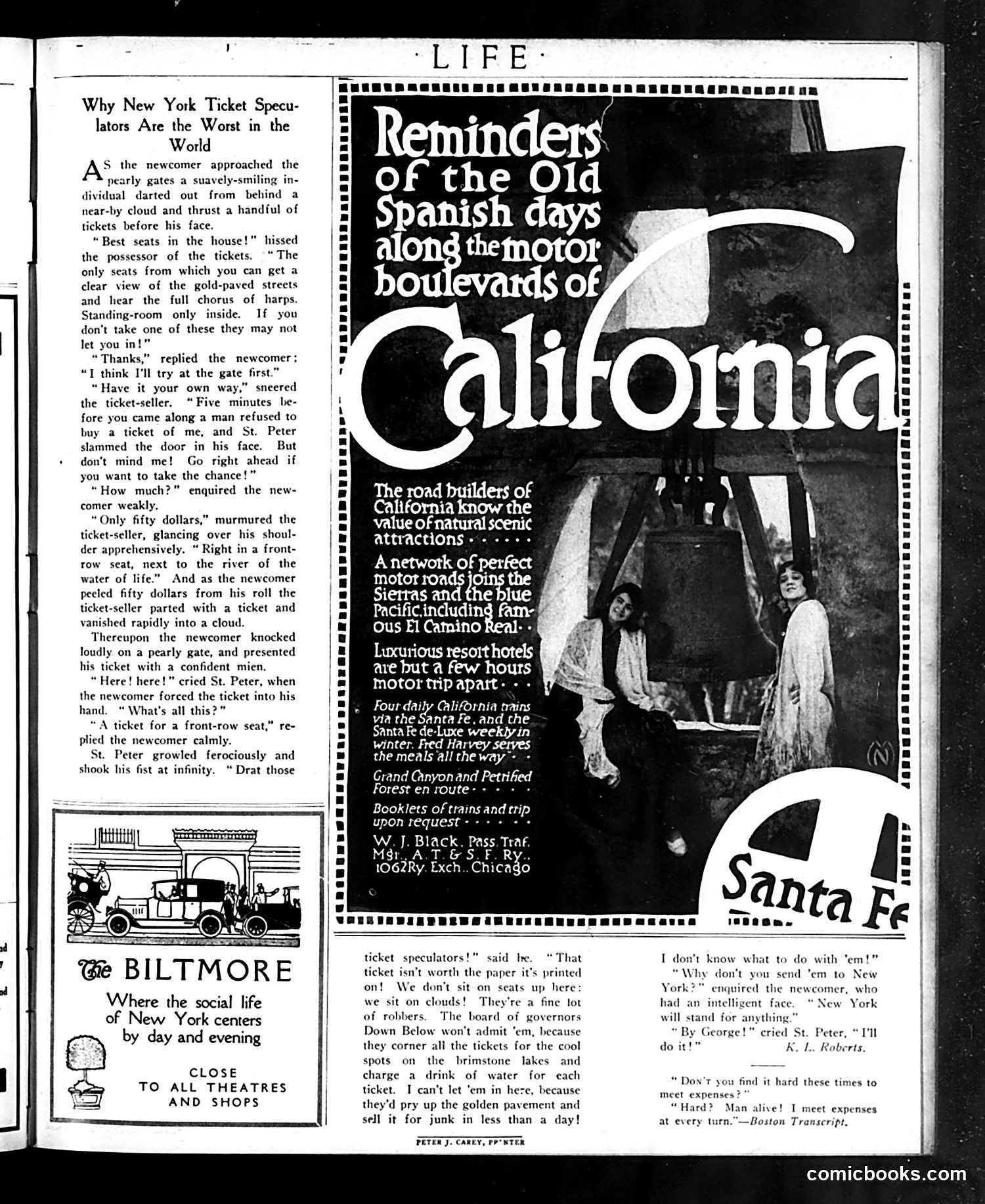
This cartoon by K.L. Roberts satirizes New York ticket speculators—scalpers who resold theater tickets at inflated prices. The joke: a newcomer to Heaven encounters a scalper selling "best seats" for $50, only to have St. Peter reject the ticket as worthless fraud. The satire works on two levels. First, it mocks scalpers' brazen dishonesty and predatory tactics (threatening the buyer, fabricating scarcity). Second, it uses the afterlife as absurdist commentary: even in Heaven, these con artists operate. St. Peter's exasperation—and his final solution to send them to New York—suggests scalpers are so corrupt they belong nowhere but that morally bankrupt city. The humor hinges on readers' contemporary frustration with theatrical ticket fraud, a recognized social problem in early 20th-century New York. The piece positions theater-goers as victims of systemic exploitation by organized scalpers.
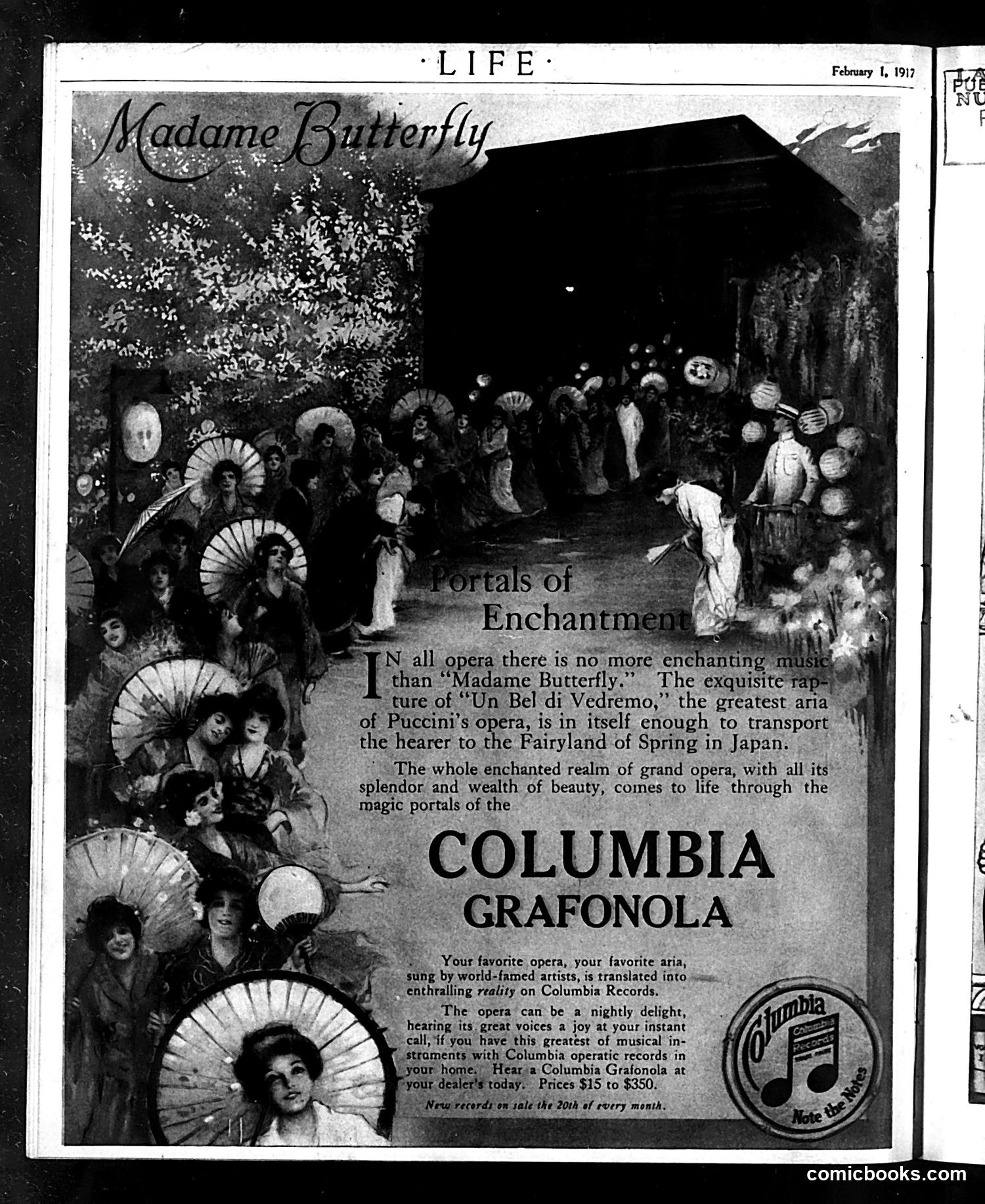
This is **advertising, not satire or political commentary**. It's a Columbia Grafonola (record player) advertisement from February 1, 1917, promoting the opera "Madame Butterfly." The page features a theatrical scene illustration showing figures in Japanese-inspired costumes with parasols, referencing Puccini's opera set in Japan. The text emphasizes that listeners can experience this "enchanted realm of grand opera" through Columbia Records at home. The advertisement targets middle-to-upper-class consumers by promising access to world-class operatic performance—"your favorite opera, your favorite aria"—via recorded technology. The pricing ($15-$350) and promotional language ("nightly delight," "greatest of musical instruments") suggest this is luxury consumer marketing rather than editorial content or satire. There are no political caricatures or jokes visible—this is straightforward product promotion in a magazine known for humor and commentary.