
Life, 1917-02-01 · page 22 of 40
Life — February 1, 1917 — page 22: what you’re looking at
What you’re looking at
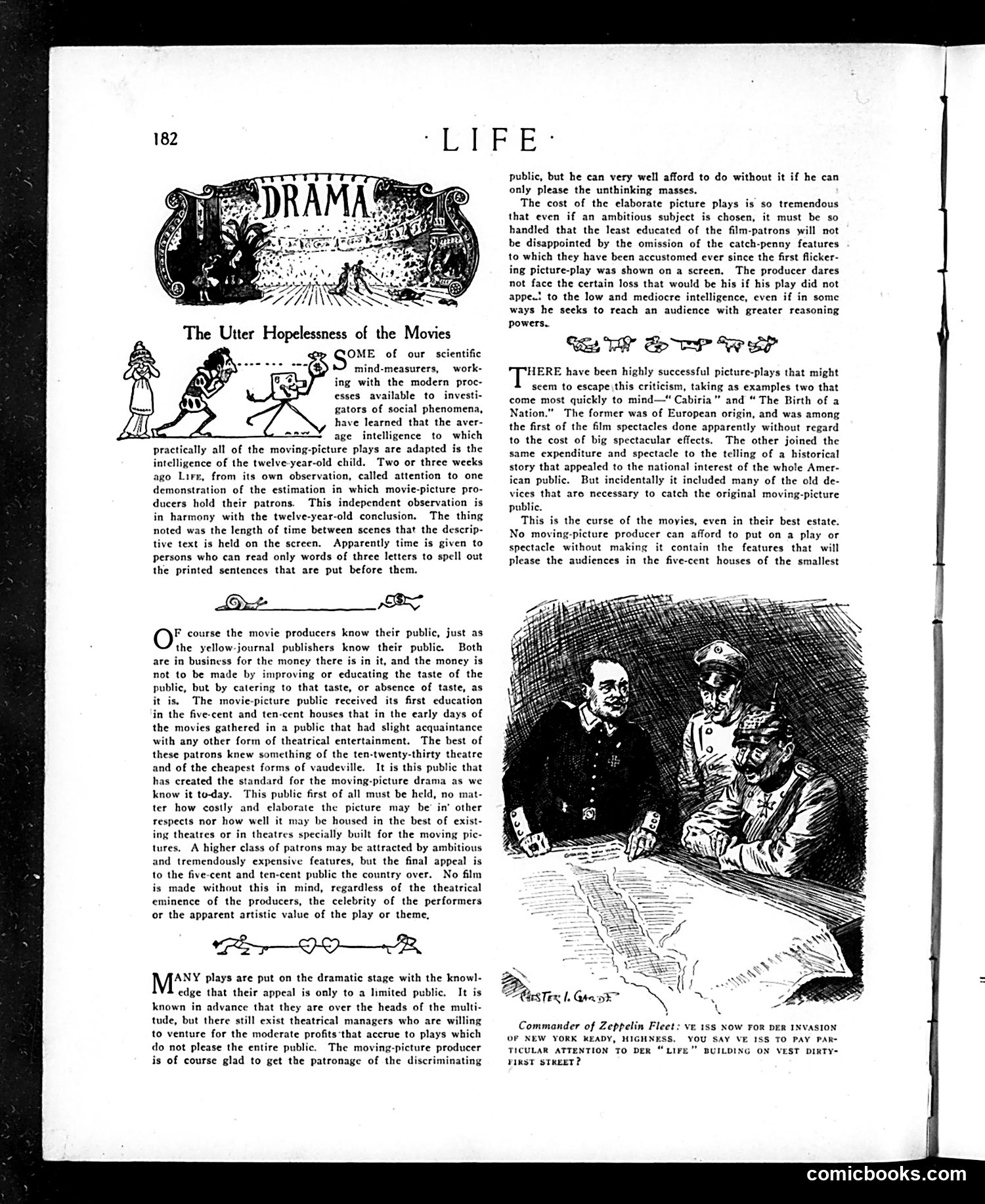
This article criticizes the film industry's deliberate pandering to low-brow audiences. Life argues that movie producers intentionally craft films for the intelligence level of a twelve-year-old child, as evidenced by slow text cards requiring minimal reading ability. The satire's key point: Unlike theatrical producers who accept modest profits from sophisticated plays, film producers *cannot afford* to alienate mass audiences because movies are so expensive to produce. They must please the "unthinking masses" at five-cent and ten-cent theaters, even when this means avoiding artistic ambition. The cartoon (bottom right, by Cesare, dated 1917) depicts a Zeppelin commander warning New York's Life Building about invasion—a topical joke about wartime anxiety, likely sarcastically contrasting trivial entertainment concerns with genuine public threats. Life's conclusion: the film industry is economically trapped serving the lowest common denominator, making artistic elevation "utterly hopeless."
📄 Transcribed text from this page (OCR, searchable)
Machine-transcribed from the original scan — historical spelling and the odd misread are preserved.
os Ol |S weg The Utter Hopelessness of the Movies OME of our scientific mind-measurers, work- ing with the modern proc- esses available to investi- gators of social phenomena, have learned that the aver- age intelligence to which practically all of the moving-picture plays are adapted is the intelligence of the twelve-year-old child. Two or three weeks ago Lirr, from its own observation, called attention to one demonstration of the estimation in which movie-picture pro- ducers hold their patrons. This independent observation is in harmony with the twelve-year-old conclusion. The thing noted was the length of time between scenes that the descrip- tive text is held on the screen. Apparently time is given to persons who can read only words of three letters to spell out the printed sentences that are put before them. Overs SES F course the movie producers know their public, just as the yellow-journal publishers know their public. Both are in business for the money there is in it, and the money is not to be made by improving or educating the taste of the public, but by catering to that taste, or absence of taste, as it is. The movie-picture public received its first education in the five-cent and ten-cent houses that in the early days of the movies gathered in a public that had slight acquaintance with any other form of theatrical entertainment. The best of these patrons knew something of the ten-twenty-thirty theatre and of the cheapest forms of vaudeville. It is this public that has created the standard for the moving-picture drama as we know it to-day. This public first of all must be held, no mat- ter how costly and elaborate the picture may be’ in’ other respects nor how well it may be housed in the best of exist- ing theatres or in theatres specially built for the moving pic- tures. A higher class of patrons may be attracted by ambitious and tremendously expensive features, but the final appeal is to the five-cent and ten-cent public the country over. No film is made without this in mind, regardless of the theatrical eminence of the producers, the celebrity of the performers or the apparent artistic value of the play or theme, Py 9- DR ANY plays are put on the dramatic stage with the knowl- edge that their appeal is only to a limited public. It is known in advance that they are over the heads of the multi- tude, but there still exist theatrical managers who are willing to venture for the moderate profits ‘that accrue to plays which do not please the entire public. The moving-picture producer is of course glad to get the patronage of the discriminating public, but he can very well afford to do without it if he can only please the unthinking masses. The cost of the elaborate picture plays is so tremendous that even if an ambitious subject is chosen, it must be so handled that the least educated of the film-patrons will not be disappointed by the omission of the catch-penny features to which they have been accustomed ever since the first flicker- ing picture-play was shown on a screen, The producer dares not face the certain loss that would be his if his play did not appe.t to the low and mediocre intelligence, even if in some ways he seeks to reach an audience with greater reasoning | ye eer Wer HERE have been highly successful picture-plays that might seem to escape this criticism, taking as examples two that come most quickly to mind—“ Cabiria” and “ The Birth of a Nation.” The former was of European origin, and was among the first of the film spectacles done apparently without regard to the cost of big spectacular effects. The other joined the same expenditure and spectacle to the telling of a historical story that appealed to the national interest of the whole Amer- ican public. But incidentally it included many of the old de- vices that are necessary to catch the original moving-picture public. This is the curse of the moyies, even in their best estate. No moving-picture producer can afford to put on a play or spectacle without making it contain the features that will please the audiences in the five-cent houses of the smallest Drere 1. Qrask” Commander of Zeppelin Fleet: v OF NEW YORK KEADY, MIGHNESS, TICULAR ATTENTION TO DER FIRST STREET? 18S NOW FOR DER INVASION YOU SAY VE ISS TO PAY PAR- “LIFE” BUILDING ON VEST DIRTY- comicbooks.com