
Life, 1917-02-01 · page 25 of 40
Life — February 1, 1917 — page 25: what you’re looking at
What you’re looking at
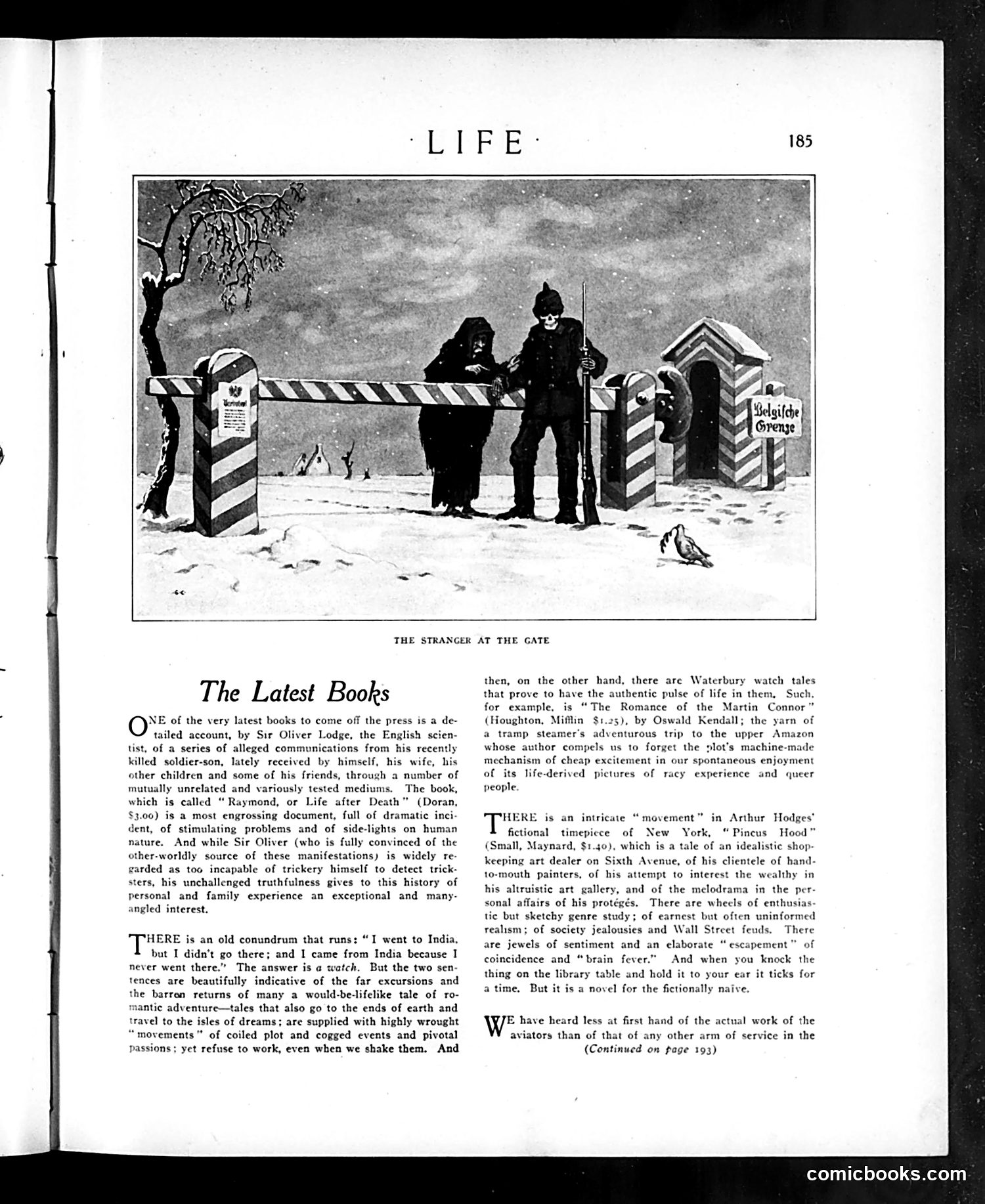
This cartoon satirizes border security or immigration control. Two officials in dark coats and hats stand at a striped gate (marked with text appearing to reference a border or customs post) in a snowy landscape, confronting a figure in dark clothing seeking entry. A bare tree and small structure complete the stark scene. The image likely comments on early 20th-century anxieties about who should be permitted entry into a country or community. The title "The Stranger at the Gate" suggests themes of exclusion, suspicion of outsiders, or immigration policy debates that were prominent in America during this era. The accompanying text discusses Sir Oliver Lodge's spiritualist book "Raymond, or Life after Death"—an ironic pairing suggesting skepticism about allowing uncertain or unverified "visitors" (literal or metaphorical) past society's gatekeepers.
📄 Transcribed text from this page (OCR, searchable)
Machine-transcribed from the original scan — historical spelling and the odd misread are preserved.
THE STRANGER AT THE GATE The Latest Books E of the very latest books to come off the press is a de- tailed account, by Sir Oliver Lodge, the English scien- tist, of a series of alleged communications from his recently killed soldier-son, lately received by himself, his wife, his other children and some of his friends, through a number of mutually unrelated and variously tested mediums. The book, which is called “Raymond, or Life after Death” (Doran, $3.00) is a most engrossing document, full of dramatic inci dent, of stimulating problems and of side-lights on human nature. And while Sir Oliver (who is fully convinced of the other-worldly source of these manifestations) is widely re- garded as too incapable of trickery himself to detect trick- sters, his unchallenged truthfulness gives to this history of personal and family experience an exceptional and many- angled interest. HERE is an old conundrum that runs: “I went to India, but I didn’t go there; and 1 came from India because I never went there.” The answer is a watch. But the two sen- tences are beautifully indicative of the far excursions and the barren returns of many a would-be-lifelike tale of ro- mantic adventure—tales that also go to the ends of earth and travel to the isles of dreams; are supplied with highly wrought “movements” of coiled plot and cogged events and pivotal passions; yet refuse to work, even when we shake them. And then, on the other hand, there are Waterbury watch tales that prove to have the authentic pulse of life in them, Such. for example, is “The Romance of the Martin Connor” (Houghton, Mifflin $1.25), by Oswald Kendall; the yarn of a tramp steamer’s adventurous trip to the upper Amazon whose author compels us to forget the plot's machine-made mechanism of cheap excitement in our spontaneous enjoyment of its life-derived pictures of racy experience and queer people. HERE jis an intricate “movement” in Arthur Hodges’ fictional timepicce of New York, “Pincus Hood” (Small, Maynard, $1.30), which is a tale of an idealistic shop- keeping art dealer on Sixth Avenue, of his clientele of hand- to-mouth painters, of his attempt to interest the wealthy in his altruistic art gallery, and of the melodrama in the per- sonal affairs of his protégés. There are wheels of enthusias- tic but sketchy genre study; of earnest but often uninformed realism; of society jealousies and Wall Street feuds. There are jewels of sentiment and an elaborate “escapement” of coincidence and “brain fever.” And when you knock the thing on the library table and hold it to your ear it ticks for a time, But it is a novel for the fictionally naive. E have heard less at first hand of the actual work of the aviators than of that of any other arm of service in the (Continued on page 193) comicbooks.com