
Life, 1917-02-01 · page 18 of 40
Life — February 1, 1917 — page 18: what you’re looking at
What you’re looking at
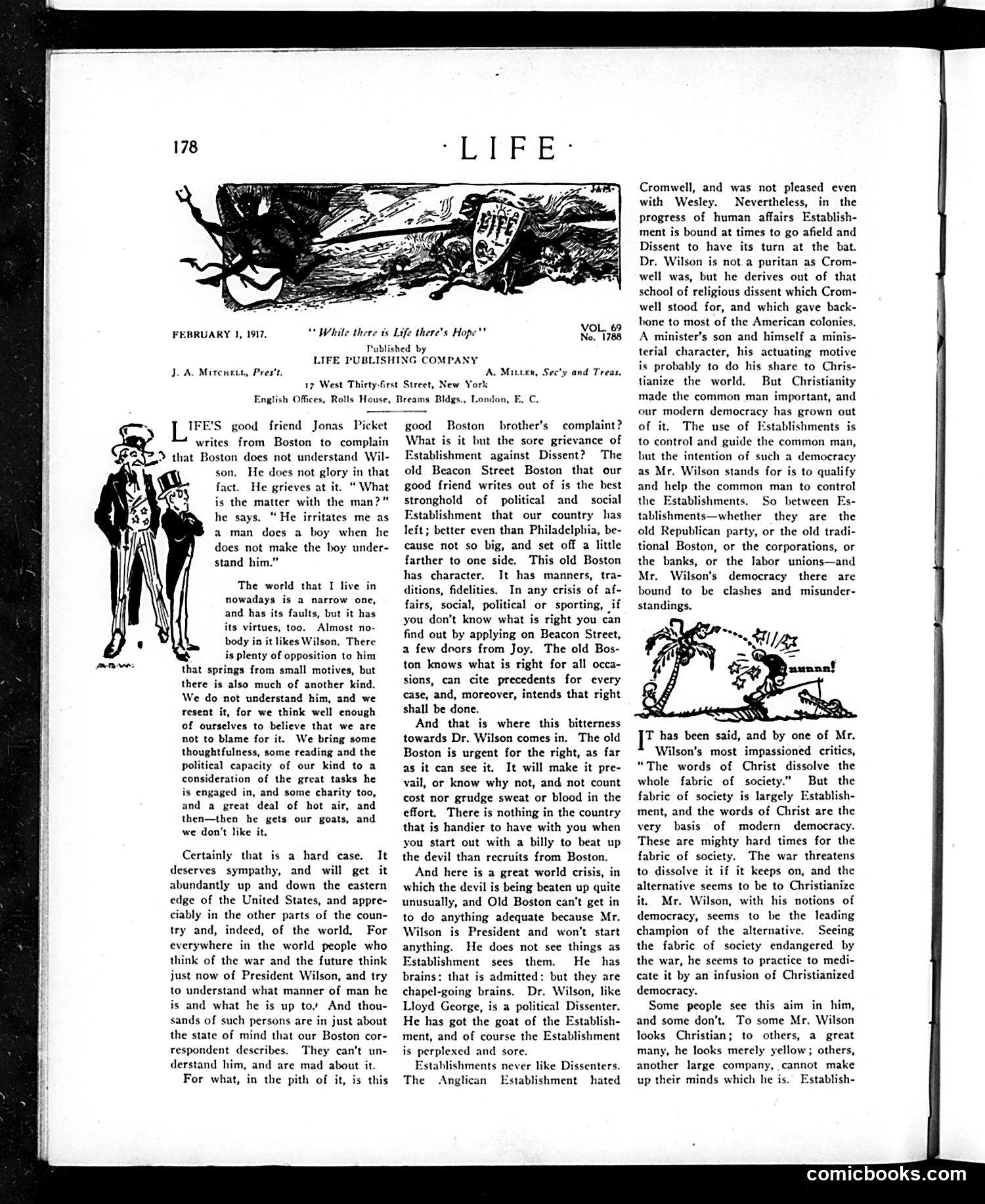
This piece responds to complaints from a Boston correspondent that President Wilson is incomprehensible and frustrating. The author argues the real conflict is ideological: Boston's old-money "Establishment" (represented by elite Beacon Street families) clashes with Wilson's "Dissent." The satire identifies Wilson as a "political Dissenter"—a chapel-going intellectual, compared to Lloyd George—who won't simply defer to Boston's traditional authority and certainty about "the right." The author sardonically notes that Establishments historically hated Dissenters (citing Cromwell and Wesley), yet Dissenters often drive historical progress. The cartoon's Uncle Sam figure reinforces patriotic themes. The joke: Boston's complaint masks its loss of influence over national policy during wartime. Wilson's democratic, independent thinking infuriates the old establishment more than actual policy disagreement.
📄 Transcribed text from this page (OCR, searchable)
Machine-transcribed from the original scan — historical spelling and the odd misread are preserved.
FEBRUARY 1, 1917. “* While there ts Life there's Hope"* No, 1788 Published by LIFE PUBLISHING COMPANY J. A, Mitcnets, Pres‘t, A. Miter, Secty and Treas. 17 West Thirty-first Street, New York English Offices, Rolls House, Breams Bldgs., IFE’S good friend Jonas Picket writes from Boston to complain that Boston does not understand Wil- son. He does not glory in that fact. He grieves at it. “ What is the matter with the man?” he says. “He irritates me as a man does a boy when he does not make the boy under- stand him.” The world that I live in nowadays is a narrow one, and has its faults, but it has its virtues, too. Almost no- body in it likes Wilson, There is plenty of opposition to him that springs from small motives, but there is also much of another kind. We do not understand him, and we resent it, for we think well enough of ourselves to believe that we are not to blame for it. We bring some thoughtfulness, some reading and the political capacity of our kind to a consideration of the great tasks he is engaged in, and some charity too, and a great deal of hot air, and then—then he gets our goats, and we don't like it. Certainly that is a hard case. It deserves sympathy, and will get it abundantly up and down the eastern edge of the United States, and appre- ciably in the other parts of the coun- try and, indeed, of the world, For everywhere in the world people who think of the war and the future think just now of President Wilson, and try to understand what manner of man he is and what he is up to And thou- sands of such persons are in just about the state of mind that our Boston cor- respondent describes. They can’t un- derstand him, and are mad about it. For what, in the pith of it, is this London, E. C. Boston brother’s complaint? What is it but the sore grievance of Establishment against Dissent? The old Beacon Street Boston that our good friend writes out of is the best stronghold of political and social good Establishment that our country has left ; better even than Philadelphia, be- cause not so big, and set off a little farther to one side. has character. This old Boston It has manners, tra- ditions, fidelities. In any crisis of af- fairs, social, political or sporting, if you don’t know what is right you can find out by applying on Beacon Street, a few doors from Joy. The old Bos- ton knows what is right for all occa- sions, can cite precedents for every case, and, moreover, intends that right shall be done. And that is where this bitterness towards Dr. Wilson comes in. The old Boston is urgent for the right, as far as it can see it. It will make it pre- vail, or know why not, and not count cost nor grudge sweat or blood in the effort. There is nothing in the country that is handier to have with you when you start out with a billy to beat up the devil than recruits from Boston. And here is a great world crisis, in which the devil is being beaten up quite unusually, and Old Boston can't get in to do anything adequate because Mr. Wilson is President and won't start anything. He does not see things as Establishment sees them. He has brains: that is admitted: but they are chapel-going brains. Dr. Wilson, like Lloyd George, is a political Dissenter. He has got the goat of the Establish- ment, and of course the Establishment is perplexed and sore. Establishments never like Dissenters. The Anglican Establishment hated Cromwell, and was not pleased even with Wesley. Nevertheless, in the progress of human affairs Establish- ment is bound at times to go afield and Dissent to have its turn at the bat. Dr. Wilson is not a puritan as Crom- well was, but he derives out of that school of religious dissent which Crom- well stood for, and which gave back- hone to most of the American colonies, A minister’s son and himself a minis- terial character, his actuating motive is probably to do his share to Chris- tianize the world. But Christianity made the common man important, and our modern democracy has grown out of it. The use of blishments is to control and guide the common man, but the intention of such a democracy as Mr. Wilson stands for is to qualify and help the common man to control the Establishments. So between Es- tablishments—whether they are the old Republican party, or the old tradi- tional Boston, or the corporations, or the banks, or the labor unions—and Mr. Wilson’s democracy there are bound to be clashes and misunder- standings. I". has been said, and by one of Mr. Wilson’s most impassioned critics, “The words of Christ dissolve the whole fabric of society.” But the fabric of society is largely Establish- ment, and the words of Christ are the very basis of modern democracy. These are mighty hard times for the fabric of society. The war threatens to dissolve it if it keeps on, and the alternative seems to be to Christianize it, Mr. Wilson, with his notions of democracy, seems to be the leading champion of the alternative. Seeing the fabric of society endangered by the war, he seems to practice to medi- cate it by an infusion of Christianized democracy. Some people see this aim in him, and some don’t. To some Mr. Wilson looks Christian; to others, a great many, he looks merely yellow; others, another large company, cannot make up their minds which he is. Establish- comicbooks.com