
Life, 1917-02-01 · page 12 of 40
Life — February 1, 1917 — page 12: what you’re looking at
What you’re looking at
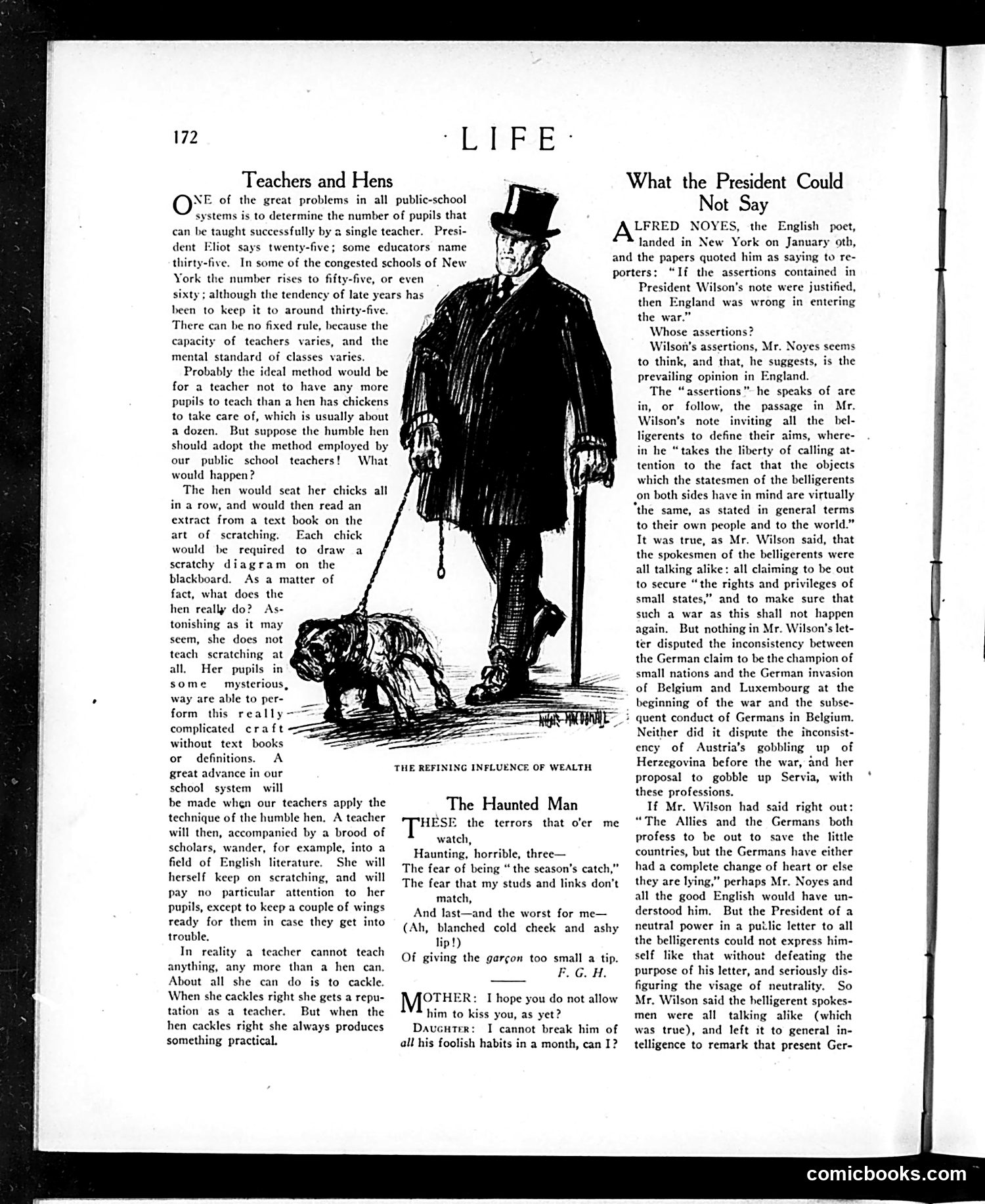
The cartoon "The Refining Influence of Wealth" depicts a wealthy man in top hat and overcoat walking a small, scraggly dog. The satire suggests that wealth doesn't necessarily improve character or manners—the well-dressed gentleman appears no more refined than his shabby companion. This mocks the assumption that financial success correlates with moral superiority or social refinement. The adjacent article "Teachers and Hens" humorously compares teaching methods, proposing that hens' scratching techniques might improve classroom instruction. It's lighthearted educational satire about pedagogical efficiency and class sizes in early 20th-century schools. "What the President Could Not Say" critiques President Wilson's WWI neutrality proclamations, suggesting his stated neutrality masked bias toward the Allies over Germany—a serious political commentary on American foreign policy during the conflict.
📄 Transcribed text from this page (OCR, searchable)
Machine-transcribed from the original scan — historical spelling and the odd misread are preserved.
172 Teachers and Hens NE of the great problems in all public-school systems is to determine the number of pupils that can be taught successfully by a single teacher. thirty-five. In some of the congested schools of New York the number rises to fifty-fiv Presi- sixty; although the tendency of late years has been to keep it to around thirty-five. There can be no fixed rule, because the capacity of teachers varies, and the mental standard of classes varies. Probably the ideal method would be for a teacher not to have any more pupils to teach than a hen has chickens to take care of, which is usually about a dozen. But suppose the humble hen should adopt the method employed by our public school teachers! What would happen? The hen would seat her chicks all in a row, and would then read an extract from a text book on the art of scratching. Each chick would be required to draw a scratchy diagram on the blackboard. As a matter of fact, what does the hen really do? tonishing as it may seem, she does not teach scratching at all. Her pupils in some mysterious, way are able to per- form this really - complicated craft without text books or definitions. A great advance in our school system will be made when our teachers apply the technique of the humble hen, A teacher will then, accompanied by a brood of scholars, wander, for example, into a field of English literature. She will herself keep on scratching, and. will pay no particular attention to her pupils, except to keep a couple of wings ready for them in case they get into trouble. In reality a teacher cannot teach anything, any more than a hen can. About all she can do is to cackle. When she cackles right she gets a repu- tation as a teacher. But when the hen cackles right she always produces something practical. THE REFINING INFLUENCE OF WEALTH. The Haunted Man HESE the terrors that o'er me watch, Haunting, horrible, three— The fear of being “ the season’s catch,” The fear that my studs and links don’t match, And last—and the worst for me— (Ah, blanched cold cheek and ashy lip!) Of giving the gargon too small a tip. F.G. H. I cannot break him of all his foolish habits in a month, can I? What the President Could Not Say LFRED NOYES, the English poet, landed in New York on January oth, and the papers quoted him as saying to re- porters: “If the assertions contained in President Wilson's note were justified, then England was wrong in entering the war. Whose assertions? Wilson's assertions, Mr. Noyes seems to think, and that, he suggests, is the prevailing opinion in England. The “assertions” he speaks of are in, or follow, the passage in Mr. Wilson’s note inviting all the bel- ligerents to define their aims, where- in he “takes the liberty of calling at- tention to the fact that the objects which the statesmen of the belligerents on both sides have in mind are virtually “the same, as stated in general terms to their own people and to the world.” It was true, as Mr. Wilson said, that the spokesmen of the belligerents were all talking alike: all claiming to be out to secure “the rights and privileges of small states,” and to make sure that such a war as this shall not happen again. But nothing in Mr. Wilson's let- ter disputed the inconsistency between the German claim to be the champion of small nations and the German invasion of Belgium and Luxembourg at the beginning of the war and the subse- > quent conduct of Germans in Belgium. Neither did it dispute the inconsist- ency of Austria’s gobbling up of Herzegovina before the war, and her proposal to gobble up Servia, with these professions. If Mr. Wilson had said right out: “The Allies and the Germans both profess to be out to save the little countries, but the Germans have either had a complete change of heart or else they are lying,” perhaps Mr. Noyes and all the good English would have un- derstood him. But the President of a neutral power in a putlic letter to all the belligerents could not express him- self like that without defeating the purpose of his letter, and seriously dis- figuring the visage of neutrality. So Mr. Wilson said the helligerent spokes- men were all talking alike (which was true), and left it to general in- telligence to remark that present Ger- comicbooks.com