
Life, 1917-02-01 · page 19 of 40
Life — February 1, 1917 — page 19: what you’re looking at
What you’re looking at
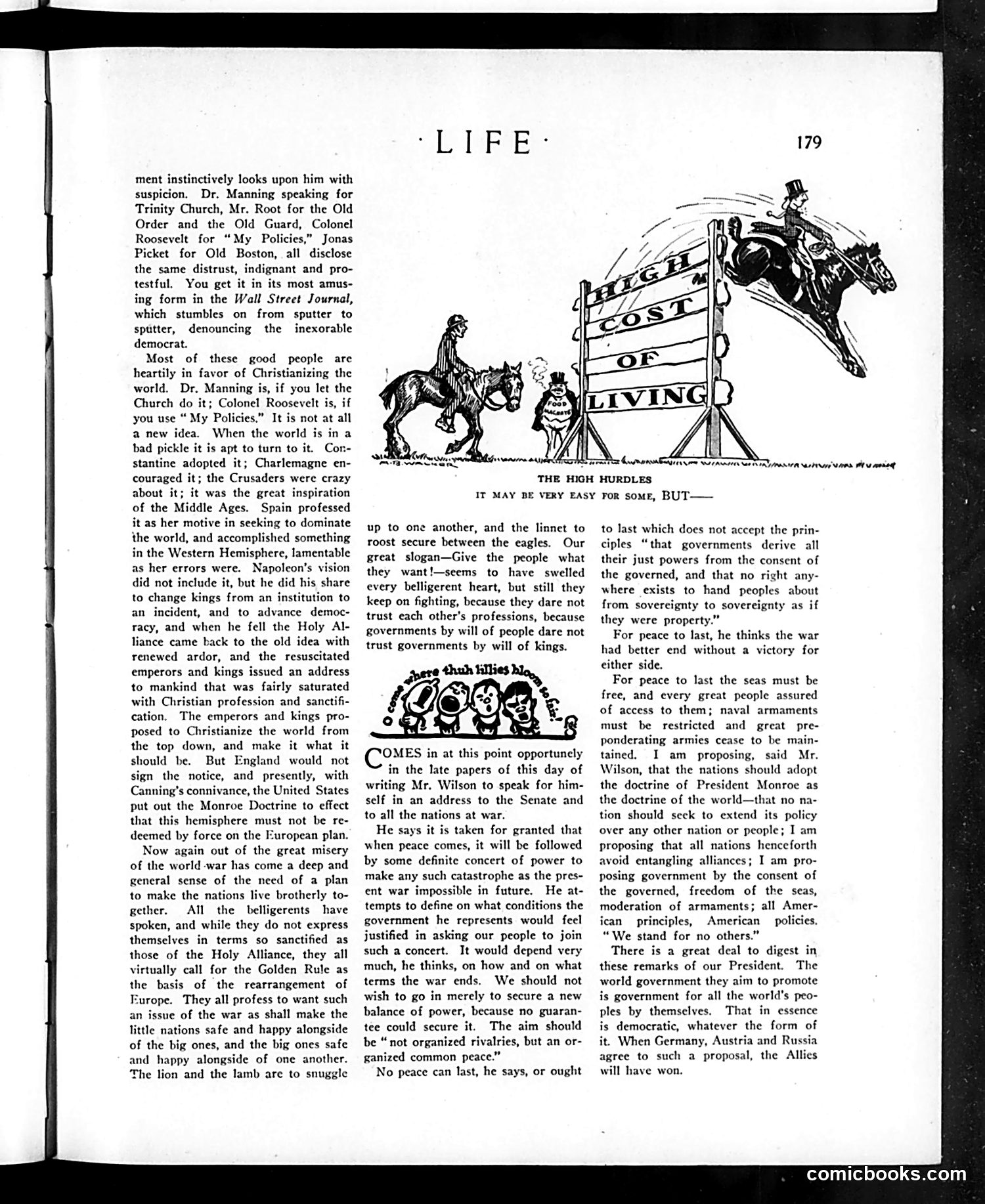
This Life magazine page critiques post-World War I peace efforts, specifically referencing President Wilson's proposals for a League of Nations. The cartoon depicts obstacles (labeled "High Cost of Living") that impede progress toward peace. The text argues that while all belligerents rhetorically support peace and protecting smaller nations—"the lion and the lamb are to snuggle"—they cannot trust each other because governments led by elected peoples distrust governments led by kings. This reflects the fundamental tension between democratic and monarchical powers negotiating the war's end. Wilson's proposed solution—an "organized common peace" rather than "organized rivalries"—is presented as idealistic but potentially difficult to achieve given the entrenched suspicions among nations. The satire highlights the gap between lofty rhetoric about making the world safe and the practical realities of international diplomacy.
📄 Transcribed text from this page (OCR, searchable)
Machine-transcribed from the original scan — historical spelling and the odd misread are preserved.
ment instinctively looks upon him with suspicion. Dr. Manning speaking for Trinity Church, Mr. Root for the Old Order and the Old Guard, Colonel Roosevelt for “My Policies,” Jonas Picket for Old Boston, all disclose the same distrust, indignant and pro- testful. You get it in its most amus- ing form in the Wall Street Journal, which stumbles on from sputter to spttter, denouncing the inexorable democrat. Most of these good people are heartily in favor of Christianizing the world. Dr, Manning is, if you let the Church do it; Colonel Roosevelt is, if you use “ My Policies.” It is not at all a new idea. When the world is in a bad pickle it is apt to turn to it. Cor- stantine adopted it; Charlemagne en- couraged it; the Crusaders were crazy about it; it was the great inspiration of the Middle Ages. Spain professed it as her motive in seeking to dominate ‘the world, and accomplished something in the Western Hemisphere, lamentable as her errors were. Napoleon's vision did not include it, but he did his share to change kings from an institution to an incident, and to advance democ- racy, and when he fell the Holy Al- liance came back to the old idea with renewed ardor, and the resuscitated emperors and kings issued an address to mankind that was fairly saturated with Christian profession and sanctifi- cation. The emperors and kings pro- posed to Christianize the world from the top down, and make it what it should be. But England would not sign the notice, and presently, with Canning’s connivance, the United States put out the Monroe Doctrine to effect that this hemisphere must not be re- deemed by force on the European plan. Now again out of the great misery of the world -war has come a deep and general sense of the need of a plan to make the nations live brotherly to- gether, All the belligerents have spoken, and while they do not express themselves in terms so sanctified as those of the Holy Alliance, they all virtually call for the Golden Rule as the basis of the rearrangement of Europe. They all profess to want such an issue of the war as shall make the little nations safe and happy alongside of the big ones, and the big ones safe and happy alongside of one another. The lion and the lamb are to snuggle THE HIGH HURDLES IT MAY BE VERY EASY FoR some, BUT—— up to one another, and the linnet to roost secure between the eagles. Our great slogan—Give the people what they want!—seems to have swelled every belligerent heart, but still they keep on fighting, because they dare not trust each other's professions, because governments by will of people dare not trust governments by will of kings. (@oMES in at this point opportuncly in the late papers of this day of writing Mr. Wilson to speak for him- self in an address to the Senate and to all the nations at war. He says it is taken for granted that when peace comes, it will be followed by some definite concert of power to make any such catastrophe as the pres- ent war impossible in future. He at- tempts to define on what conditions the government he represents would feel justified in asking our people to join such a concert. It would depend very much, he thinks, on how and on what terms the war ends. We should not wish to go in merely to secure a new balance of power, because no guaran- tee could secure it. The aim should be “not organized rivalries, but an or- ganized common peace.” No peace can last, he says, or ought to last which does not accept the prin- ciples “that governments derive all their just powers from the consent of the governed, and that no right any- where exists to hand peoples about from sovereignty to sovereignty as if they were property.” For peace to last, he thinks the war had better end without a victory for either side. For peace to last the seas must be free, and every great people assured of access to them; naval armaments must be restricted and great pre- ponderating armies cease to be main- tained. I am proposing, said Mr. Wilson, that the nations should adopt the doctrine of President Monroe as the doctrine of the world—that no na- tion should seck to extend its policy over any other nation or people; I am proposing that all nations henceforth void entangling alliances; I am pro- posing government by the consent of the governed, freedom of the seas, moderation of armaments; all Amer- ican principles, American _ policies. “We stand for no others.” There is a great deal to digest in these remarks of our President. The world government they aim to promote is government for all the world’s peo- ples by themselves, That in essence is democratic, whatever the form of it. When Germany, Austria and Russia agree to such a proposal, the Allies will have won. comicbooks.com HONS LATE NTAYIPOS MONIES HO