
Life, 1917-02-01 · page 7 of 40
Life — February 1, 1917 — page 7: what you’re looking at
What you’re looking at
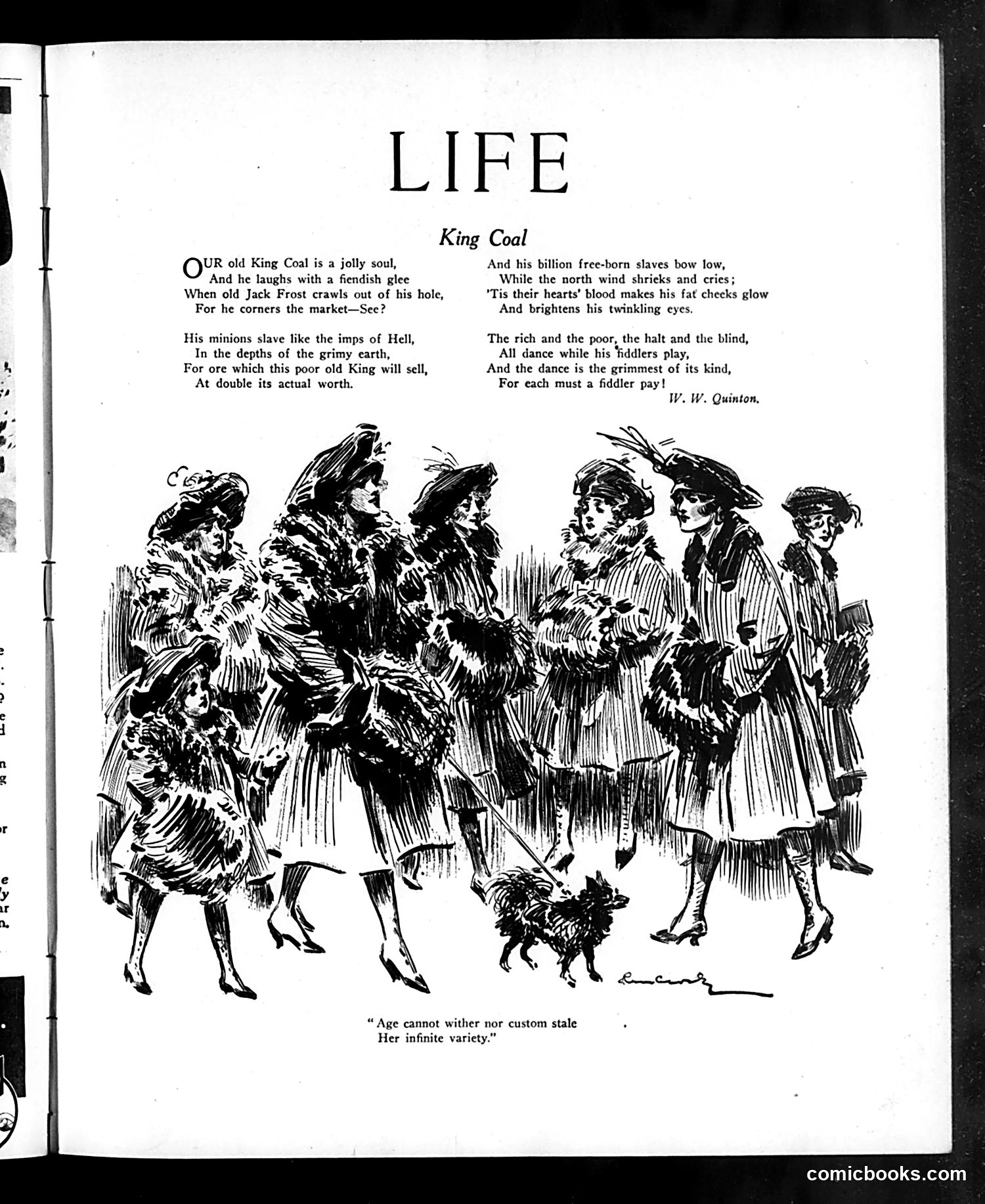
This page satirizes the coal industry and labor exploitation during the industrial era. "King Coal" personifies coal as a despotic ruler whose wealth comes from enslaving workers ("billion free-born slaves"). The poem by W.W. Quinton describes his minions as "slave like the imps of Hell" laboring in mines for minimal wages. The illustration shows well-dressed women dancing while a small figure (possibly representing labor or the working class) is forced to play fiddle. The caption "'Age cannot wither nor custom stale / Her infinite variety'" suggests the exploitation is systemic and enduring. This critiques how wealthy industrialists profit from brutal working conditions while the upper class enjoys the fruits of that labor, indifferent to human suffering below.
📄 Transcribed text from this page (OCR, searchable)
Machine-transcribed from the original scan — historical spelling and the odd misread are preserved.
LIFE King Coal And his billion free-born slaves bow low, While the north wind shrieks and cries; 'Tis their hearts’ blood makes his fat checks glow And brightens his twinkling eyes. UR old King Coal is a jolly soul, And he laughs with a fiendish glee When old Jack Frost crawls out of his hole, For he corners the market—See? The rich and the poor, the halt and the blind, All dance while his ‘fiddlers play, And the dance is the grimmest of its kind, For each must a fiddler pay! His minions slave like the imps of Hell, In the depths of the grimy earth, For ore which this poor old King will sell, At double its actual worth. W. W. Quinton, “ Age cannot wither nor custom stale Her infinite variety.” comicbooks.com