
Life, 1917-02-01 · page 24 of 40
Life — February 1, 1917 — page 24: what you’re looking at
What you’re looking at
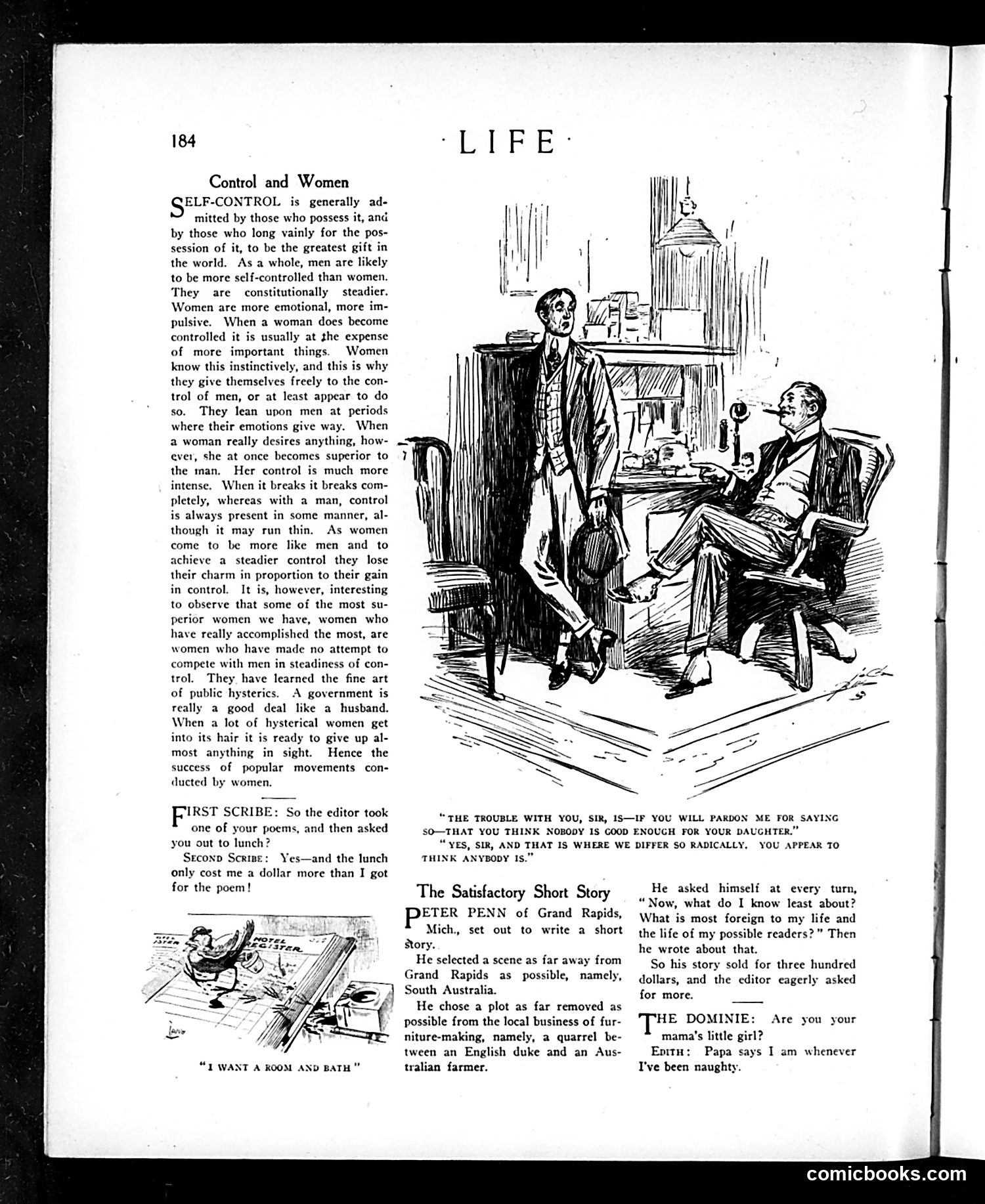
This page satirizes gender stereotypes and women's emerging social power through three pieces: **Main Essay**: Argues women are naturally more emotional and impulsive than men, but paradoxically suggests their "public hysterics" make them politically effective—like how governments cave to emotional demands from women's movements. The essay presents this as witty observation while reinforcing period assumptions about female inferiority balanced against female manipulation. **"First Scribe" Joke**: Mocks struggling writers—the poet sold work for minimal payment, then spent more on lunch than earnings. **"The Satisfactory Short Story"**: Satirizes formulaic magazine fiction: Peter Penn deliberately writes about subjects he knows nothing about (Australian farms, English dukes), and the strategy succeeds commercially—suggesting editors prefer exotic escapism over authentic experience. **Cartoon dialogue**: A father objects to a suitor, claiming "nobody is good enough" for his daughter; the suitor replies he agrees, implying even the daughter isn't worthy—dark humor about marriage market cynicism.
📄 Transcribed text from this page (OCR, searchable)
Machine-transcribed from the original scan — historical spelling and the odd misread are preserved.
184 Control and Women ELF-CONTROL is generally ad- mitted by those who possess it, and by those who long vainly for the pos- session of it, to be the greatest gift in the world. As a whole, men are likely to be more self-controlled than women. They are constitutionally steadier. Women are more emotional, more im- pulsive. When a woman does become controlled it is usually at the expense of more important things. Women know this instinctively, and this is why they give themselves freely to the con- trol of men, or at least appear to do so. They lean upon men at periods where their emotions give way. When a woman really desires anything, how- ever, she at once becomes superior to the man. Her control is much more intense, When it breaks it breaks com- pletely, whereas with a man, control is always present in some manner, al- though it may run thin. As women come to be more like men and to achieve a steadier control they lose their charm in proportion to their gain in control. It is, however, interesting to observe that some of the most su- perior women we have, women who have really accomplished the most, are women who have made no attempt to compete with men in steadiness of con- trol. They have learned the fine art of public hysterics. A government is really a good deal like a husband. When a lot of hysterical women get into its hair it is ready to give up al- most anything in sight. Hence the success of popular movements con- ducted by women. IRST SCRIBE: So the editor took one of your poems, and then asked you out to lunch? Seconp Scrine: Yes—and the lunch only cost me a dollar more than I got for the poem! “WANT A ROOM AND BATH" SO—THAT YOU THINK NOBODY IS GOOD ENOUGH FOR YOUR DAU! “YES, SIR, AND THAT IS WHERE WE DIFFER SO RADICALLY, THINK ANYBODY Is.” The Satisfactory Short Story ETER PENN of Grand Rapids, Mich., set out to write a short Story. He selected a scene as far away from Grand Rapids as possible, namely, South Australia. He chose a plot as far removed as possible from the local business of fur- niture-making, namely, a quarrel be- tween an English duke and an Aus- tralian farmer. YOU APPEAR TO He asked himself at every turn, “Now, what do I know least about? What is most foreign to my life and the life of my possible readers?” Then he wrote about that. So his story sold for three hundred dollars, and the editor eagerly asked for more. 'HE DOMINIE: mama’s little girl? Epitu: Papa says 1 am whenever I've been naughty. Are you your comicbooks.com