
A complete issue · 38 pages · 1917
Life — January 11, 1917
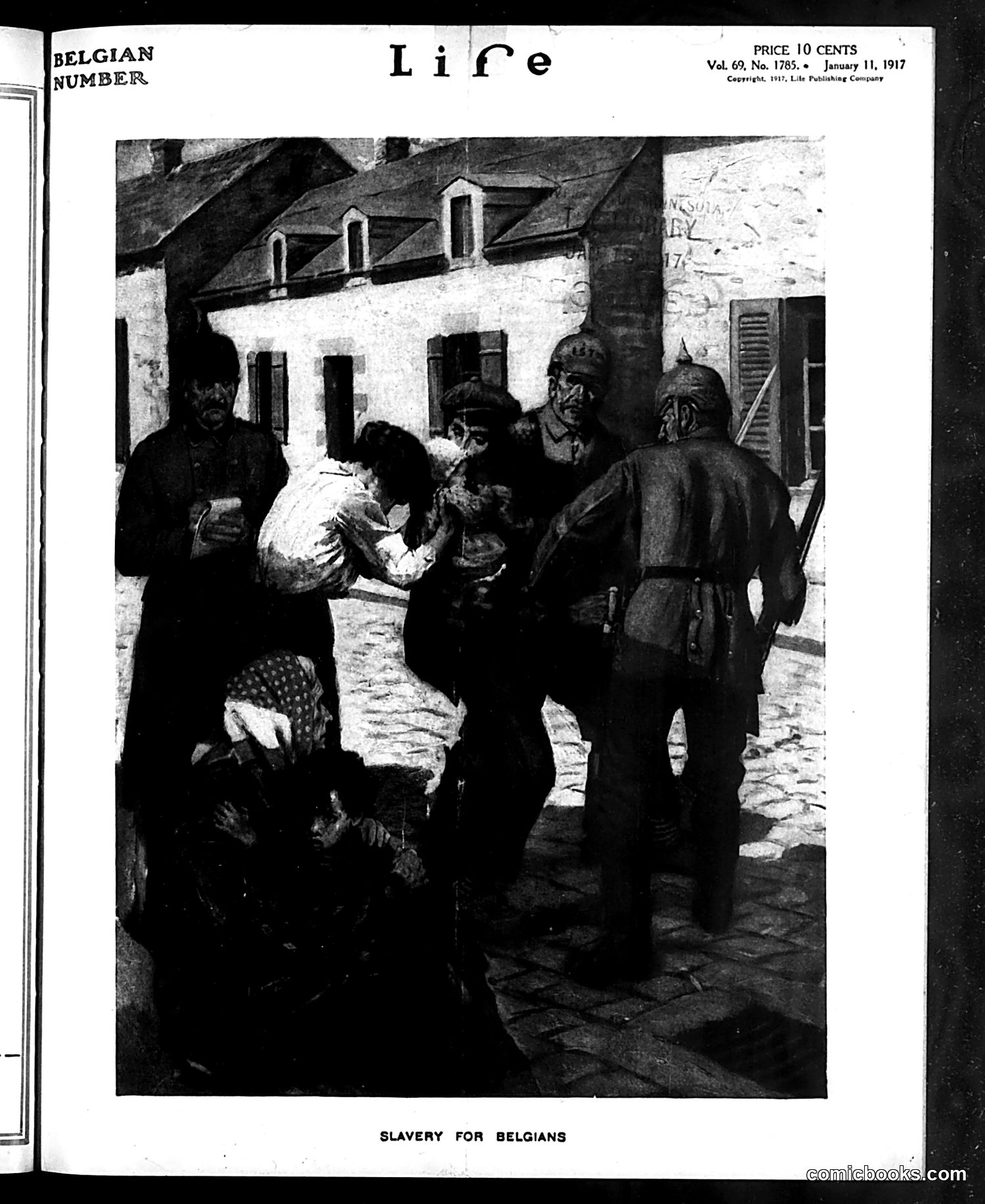
This Life magazine cover from January 11, 1917 depicts German soldiers forcing Belgian civilians into forced labor during World War I's occupation of Belgium. The caption "Slavery for Belgians" sarcastically indicts German military practices. The image shows armed soldiers (wearing military uniforms and helmets) coercing civilians—including women and a person kneeling—in a village courtyard. This reflects documented German forced labor policies in occupied Belgium, which American audiences found shocking and atrocity-worthy. Published while the U.S. remained officially neutral (though leaning pro-Allied), the image served propaganda purposes, portraying Germany as barbaric and justifying eventual American entry into the war. The satire works through bitter understatement: calling systematic coercion "slavery" while depicting its brutal reality.
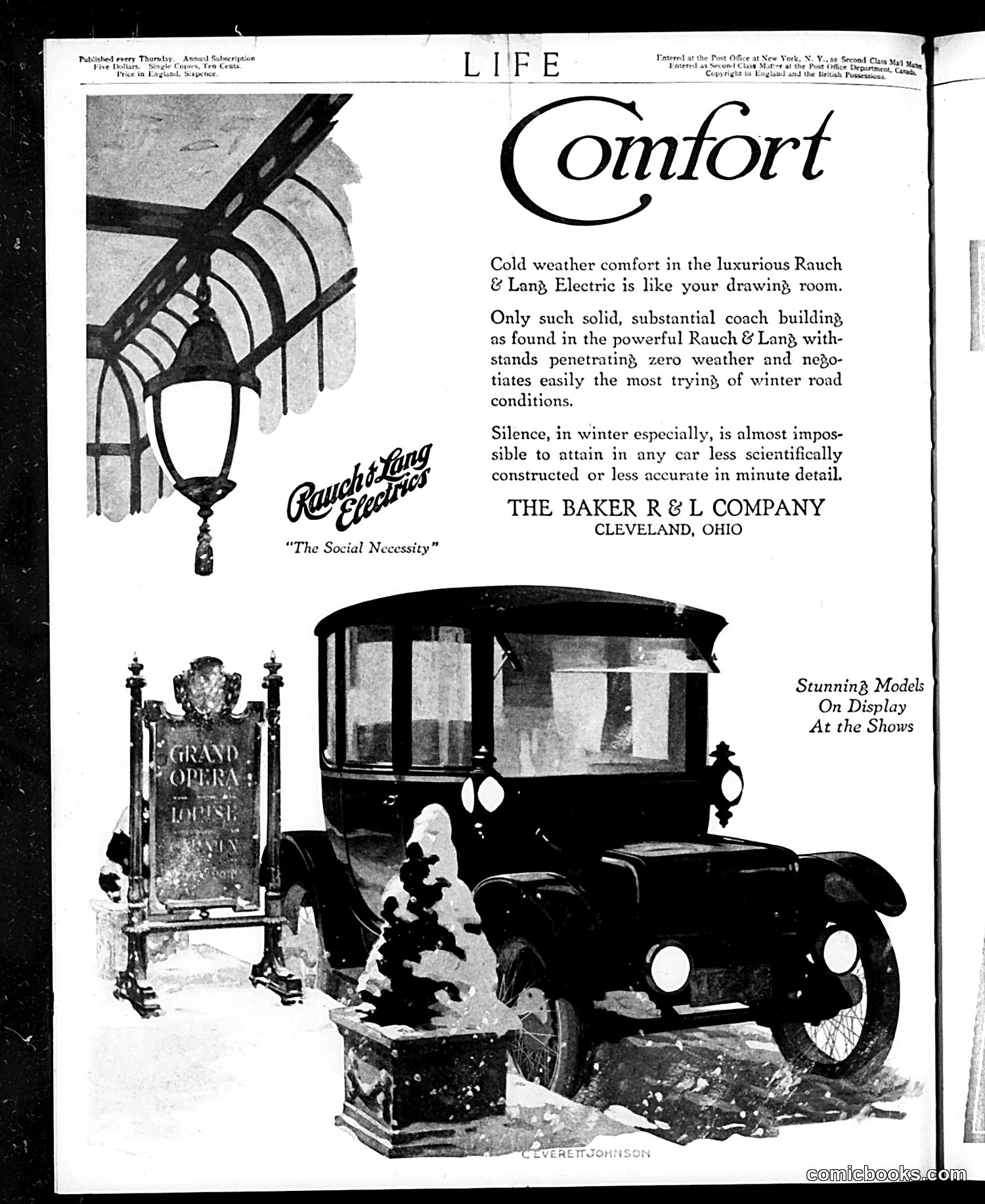
This page is primarily **advertising content**, not satire or political commentary. It features an advertisement for the Rauch & Lang Electric automobile, promoting their luxury coach-building and winter comfort features. The ad emphasizes the vehicle's solid construction, silence, and ability to handle harsh winter conditions. The imagery shows an elegant electric car parked in snow near the Grand Opera House, positioning it as a "social necessity" for affluent customers. The only potentially humorous element is the tagline "The Social Necessity" beneath a Rauch & Lang Electrics lamp—suggesting that owning this luxury vehicle is practically essential for refined society. This reflects early 1900s advertising strategies targeting wealthy urban professionals, before gasoline-powered cars dominated the market.
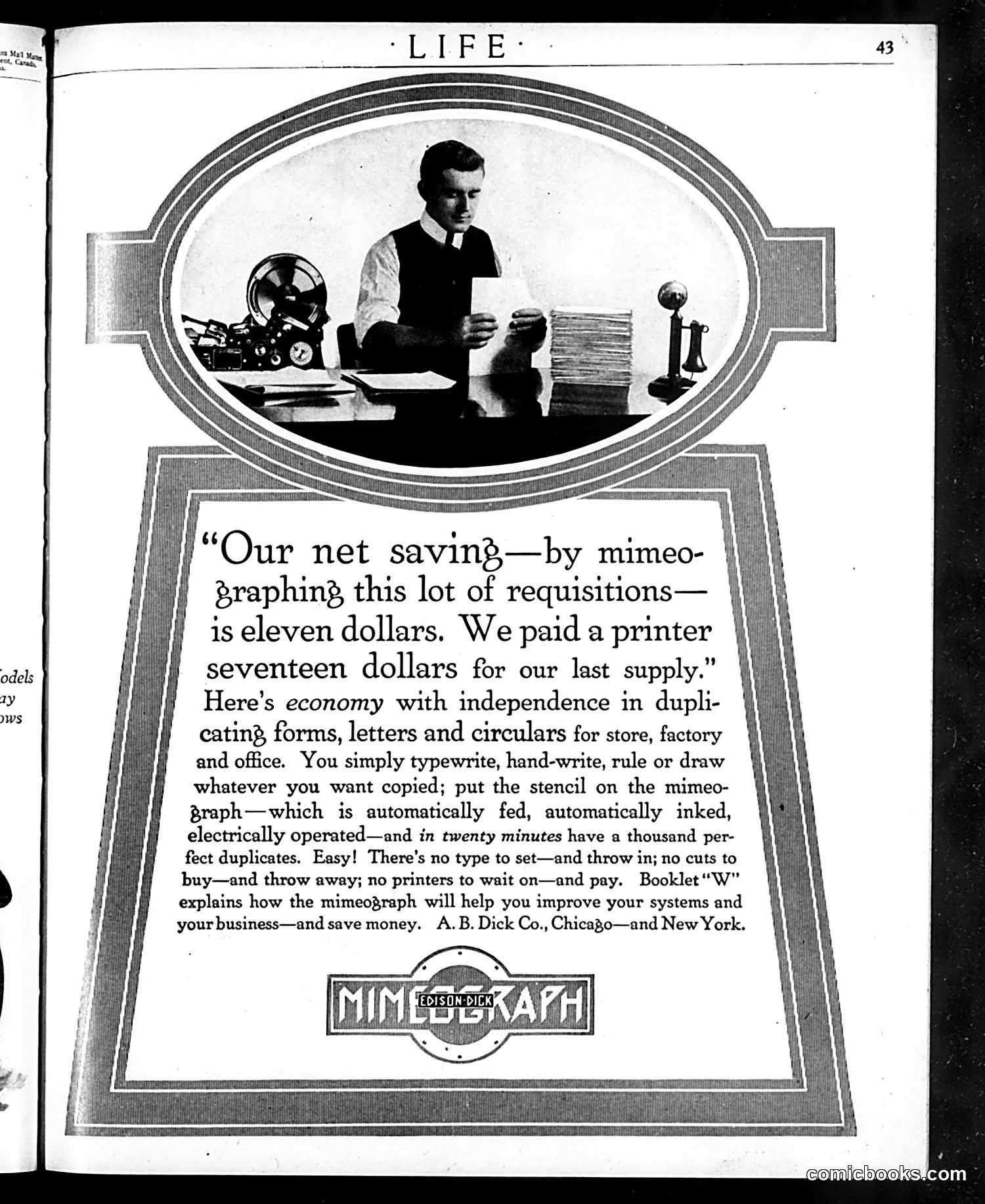
This is **not a cartoon or satire**, but rather a **straightforward advertisement** for the mimeograph machine, placed in *Life* magazine (page 43). The ad features a businessman at his desk demonstrating the A.B. Dick mimeograph—a duplicating device. The text emphasizes cost savings: the company saved $11 by mimeographing requisition forms instead of hiring a printer ($17 for their previous supply). The appeal targets small business owners and office managers, highlighting the mimeograph's efficiency: automatic feeding, inking, and electrical operation could produce "a thousand perfect duplicates" in twenty minutes. This reflects early-20th-century business culture where office automation was novel and genuinely revolutionary, promising independence from expensive outside printing services.
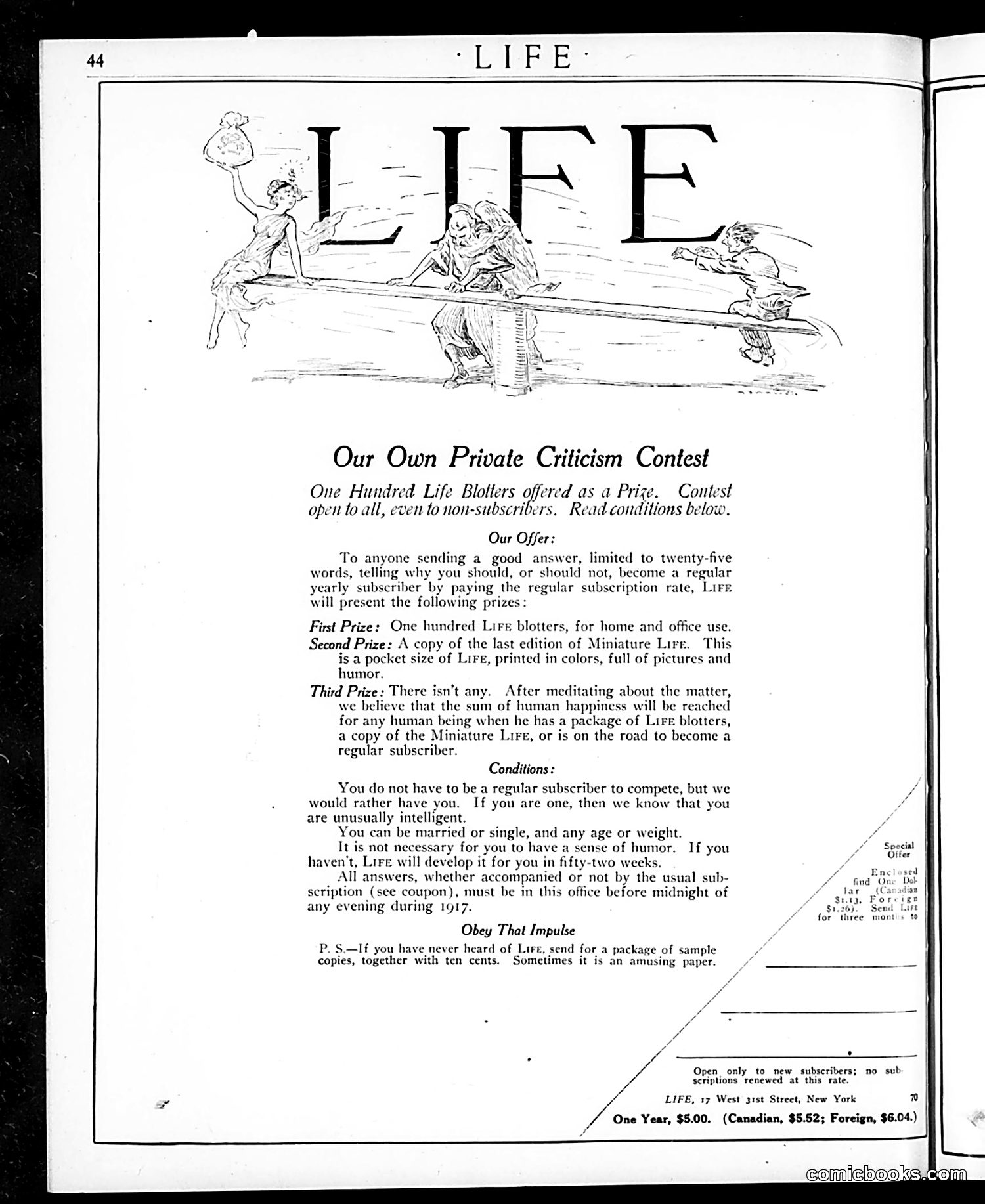
This page is primarily an **advertisement/contest announcement** rather than political satire. Life magazine is promoting "Our Own Private Criticism Contest," inviting readers to submit 25-word answers explaining why they should or shouldn't become regular subscribers. The illustration shows a **tug-of-war scene with cherubic figures**, which humorously represents the "contest" concept—the visual metaphor of competition and pulling/persuasion aligns with Life's pitch to convince readers to subscribe. The contest offers prizes: 100 Life blotters (first prize), a miniature Life edition (second), or guaranteed subscription benefits (third). The tone is self-aware and tongue-in-cheek—Life essentially asks readers to convince themselves why the magazine is worthwhile. The 1917 date and subscription rates ($5 yearly) provide historical context for this vintage promotional piece.
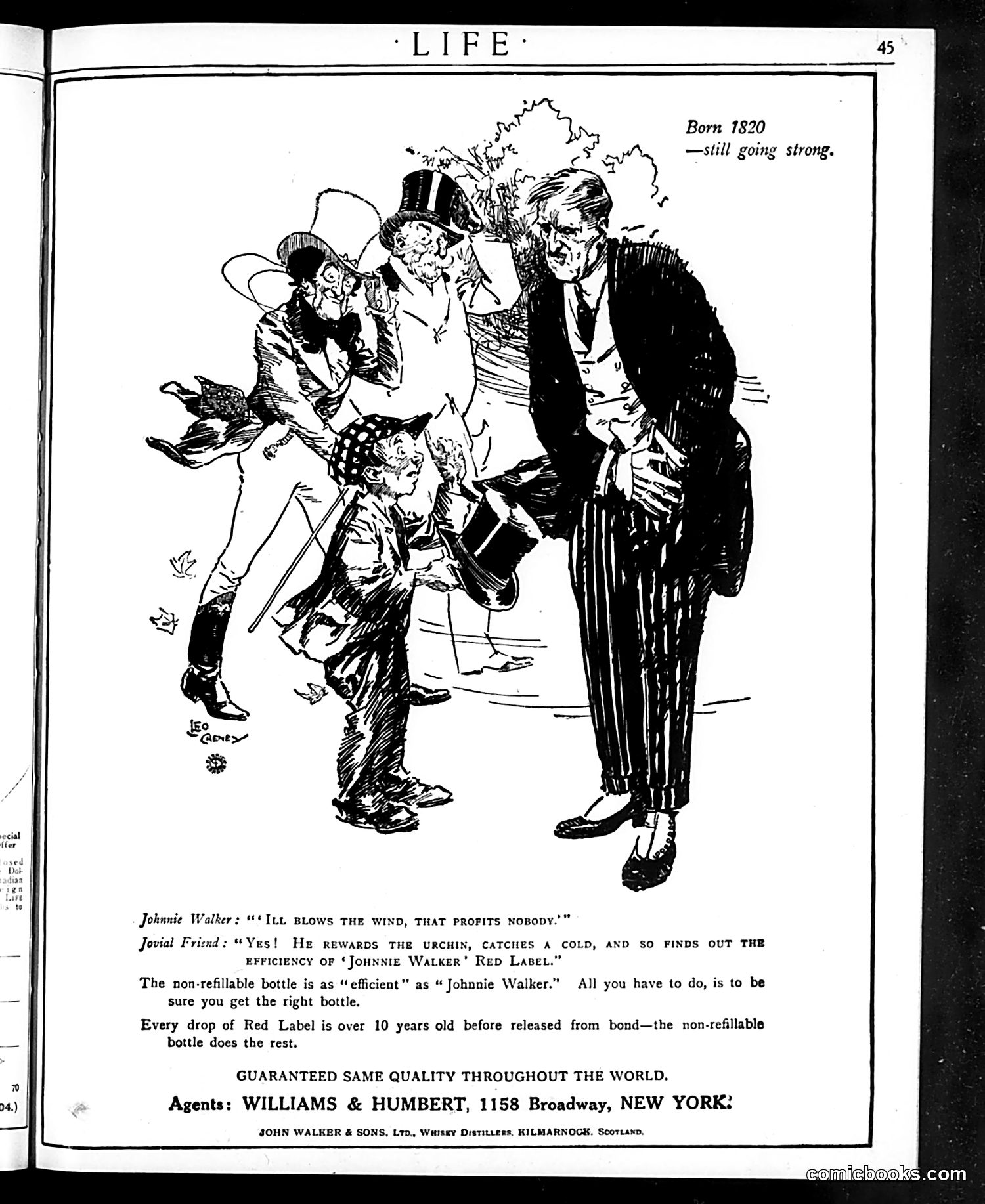
This page is primarily **advertising for Johnnie Walker Red Label whisky**, disguised as satirical editorial content. The cartoon depicts a well-dressed gentleman (representing "Johnnie Walker," the brand's mascot) demonstrating the bottle's durability to skeptical onlookers. The joke plays on the phrase "it blows the wind that profits nobody"—suggesting that while others might profit from inferior bottles, the non-refillable Johnnie Walker bottle itself is so reliable it needs no replacement. The ad emphasizes that every drop has aged over 10 years before release, and bottles maintain consistent quality globally. The "Born 1820—still going strong" caption references the brand's founding date. This represents early 20th-century advertising masquerading as magazine humor, blending product promotion with satirical cartoon style to appeal to *Life* magazine's educated readership.
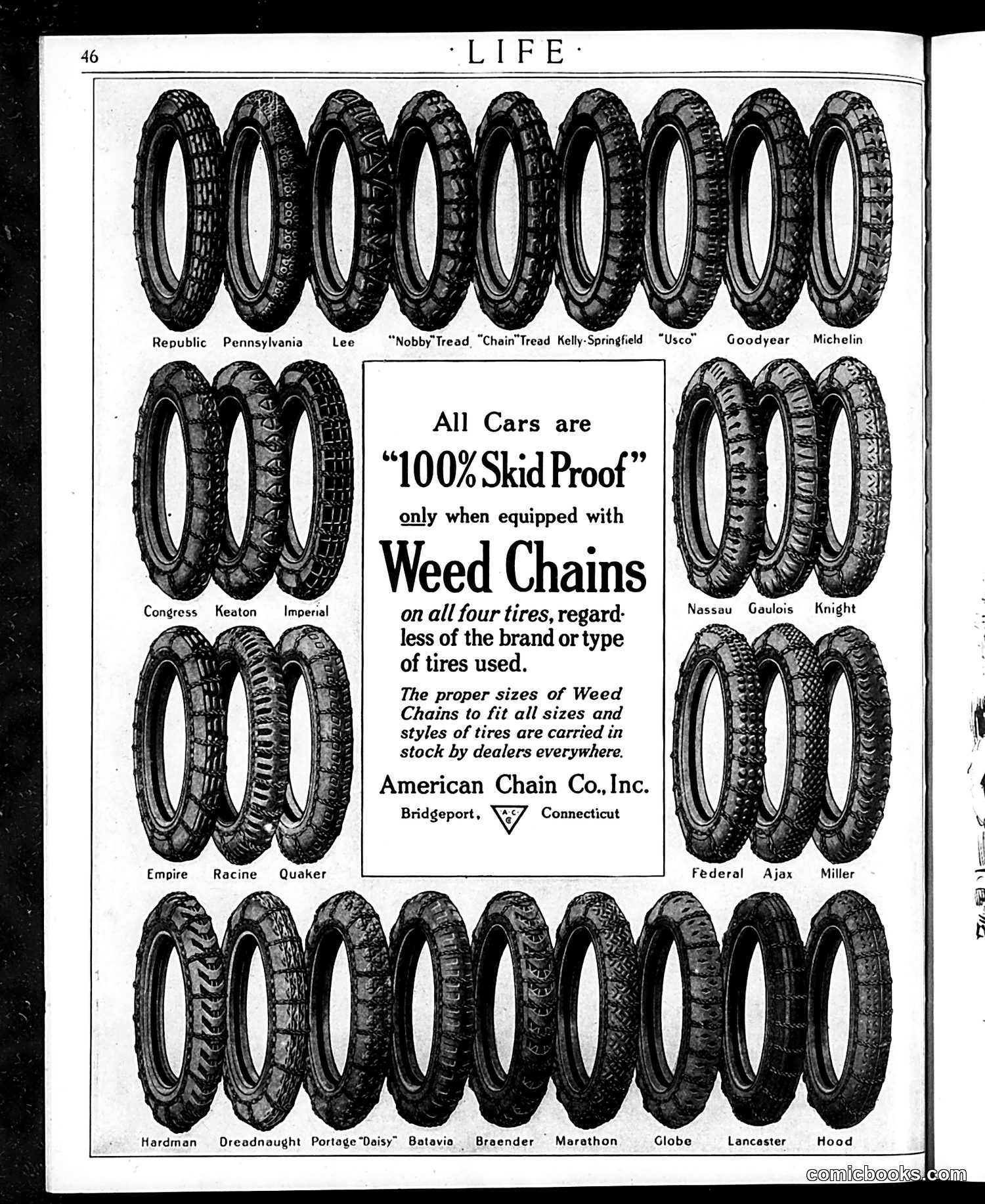
This page is **not a cartoon or satirical content**—it's a straightforward **advertisement for Weed Chains**, tire chains manufactured by American Chain Co., Inc. in Bridgeport, Connecticut. The ad displays numerous tire brands of the era (Republic, Pennsylvania, Lee, Goodrich, Michelin, etc.) to demonstrate compatibility. The central message claims cars are "100% Skid Proof" only when equipped with Weed Chains on all four tires, "regardless of the brand or type of tires used." This reflects early automotive safety concerns, when tire chains were essential winter equipment for traction on snow and ice. The advertisement emphasizes universal compatibility to appeal to all car owners, regardless of their tire choice.
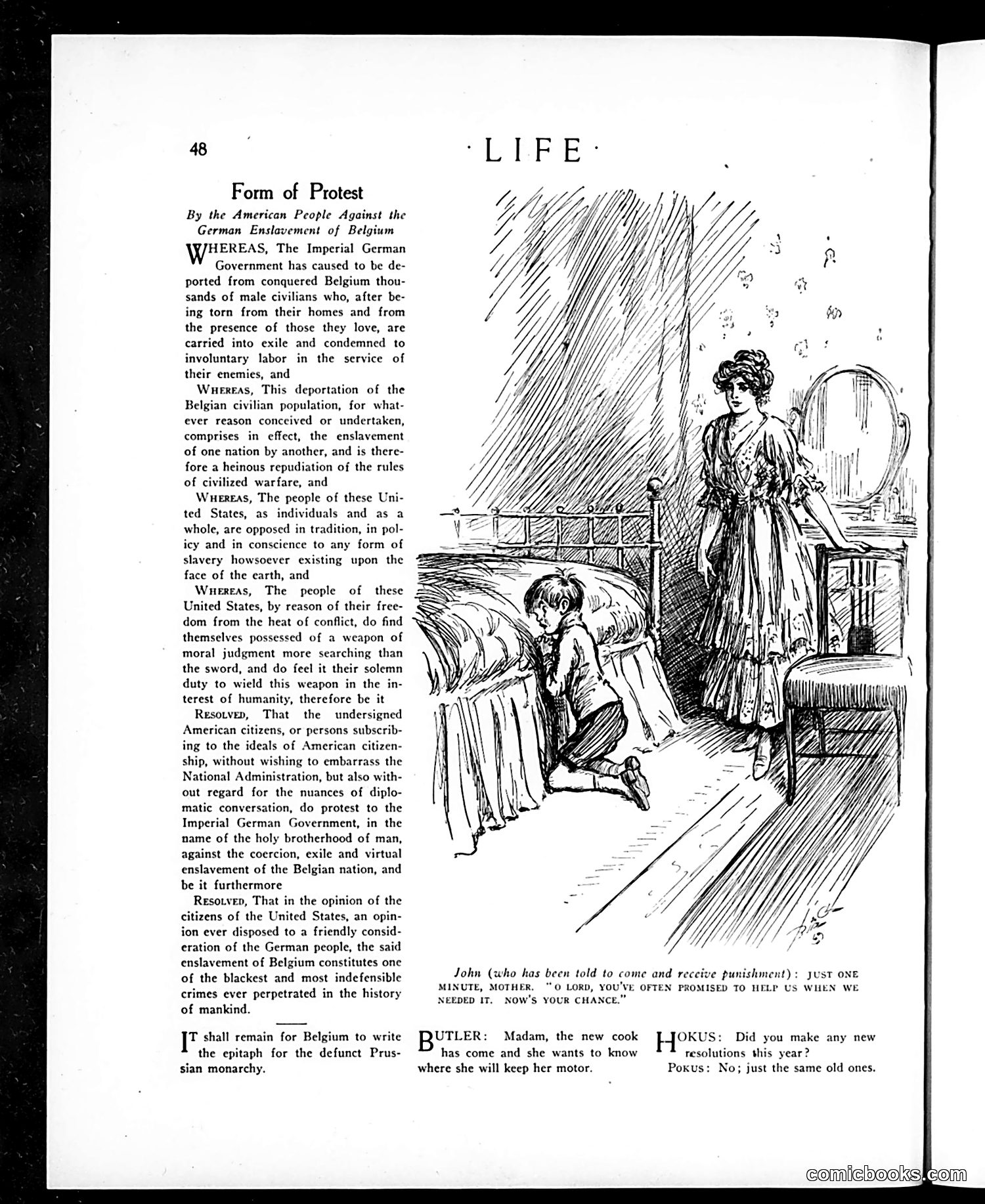
This page contains a formal "Form of Protest" condemning Germany's deportation of Belgian civilians during World War I. The text argues this constitutes enslavement and a crime against humanity, calling on Americans to oppose such coercion. The accompanying illustration depicts a domestic scene with a woman and child. The caption below shows a conversation between characters named Butler, Hokus, and Pokus discussing a new cook and motor-car—mundane household matters presented in stark contrast to the serious protest above. This juxtaposition appears designed to highlight the disconnect between comfortable American civilian life and the suffering of Belgian civilians under German occupation, making a moral argument that Americans cannot ignore such atrocities simply by focusing on everyday concerns.
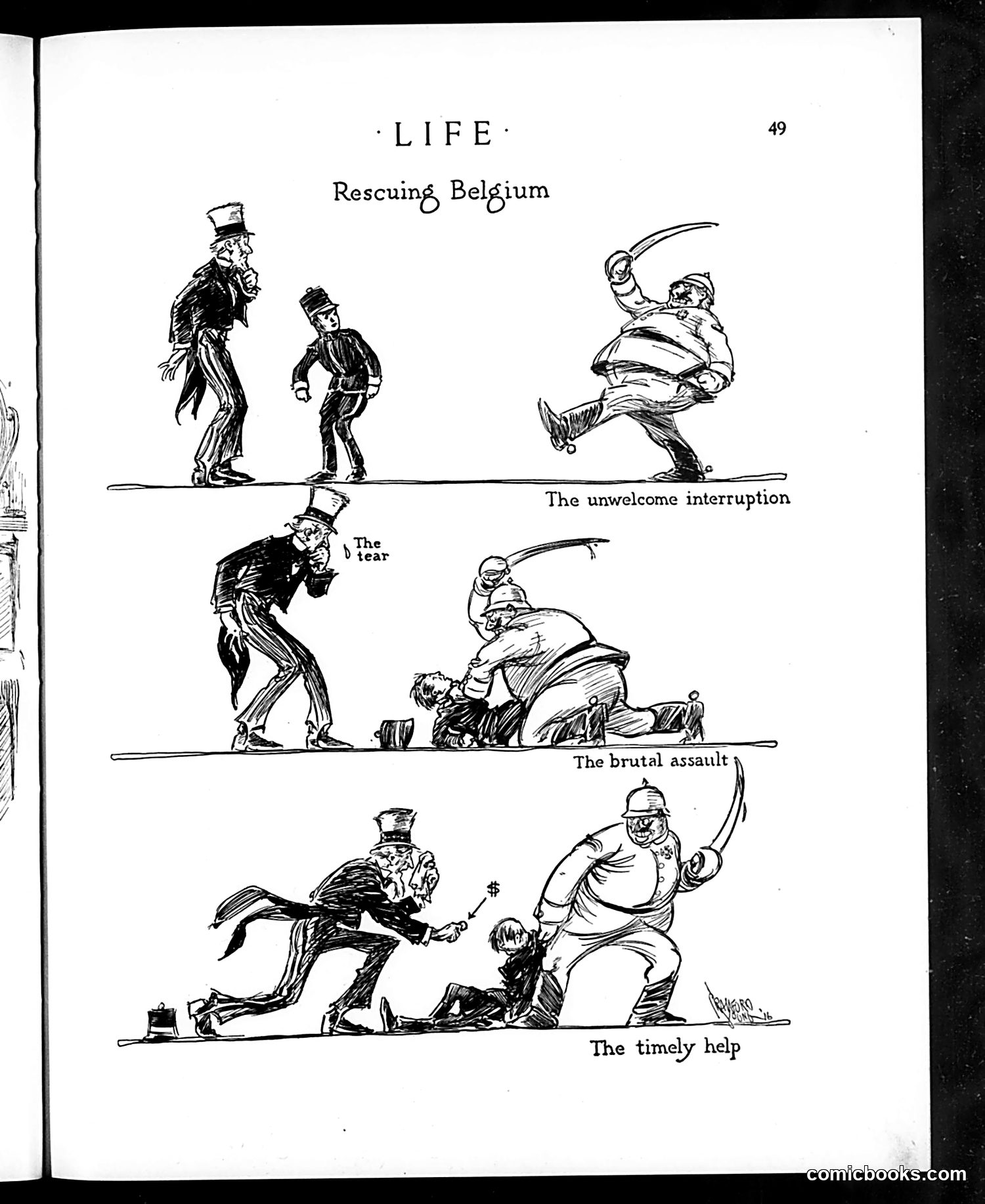
This political cartoon satirizes Allied intervention in Belgium during World War I. The page shows four scenes depicting increasingly violent "rescue" attempts: 1. **"The unwelcome interruption"** - A figure (likely representing an Allied power) brandishes a sword while two others watch. 2. **"The tear"** - Shows distress as violence escalates. 3. **"The brutal assault"** - Depicts a figure beating a prone person with a curved weapon. 4. **"The timely help"** - Shows armed figures with money ($), suggesting mercenary motives. The satire suggests that Allied "rescue" of Belgium involved brutal violence and was motivated by profit rather than humanitarian concern. The cartoon critiques the gap between stated noble intentions and actual violent, exploitative conduct during WWI intervention.
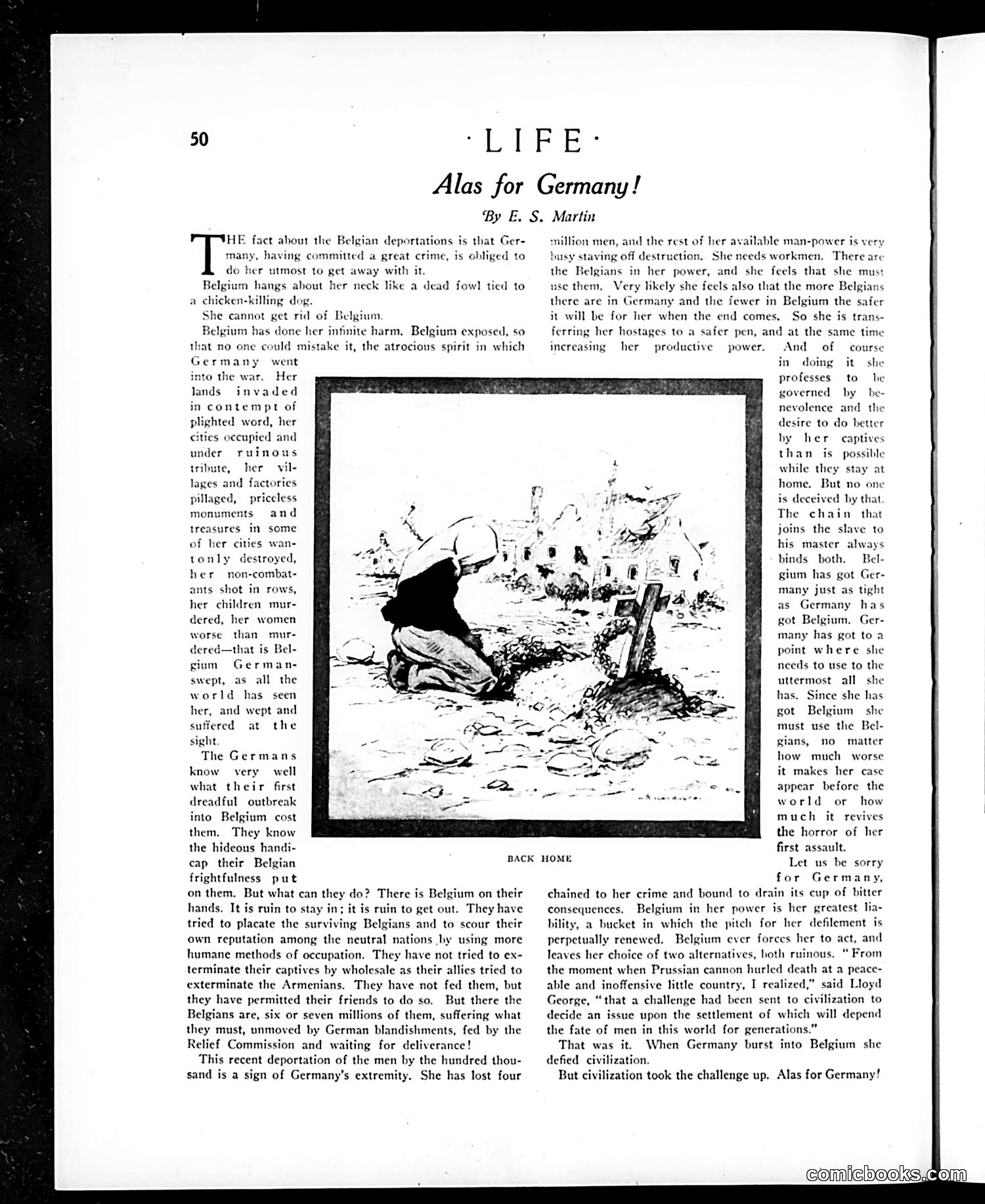
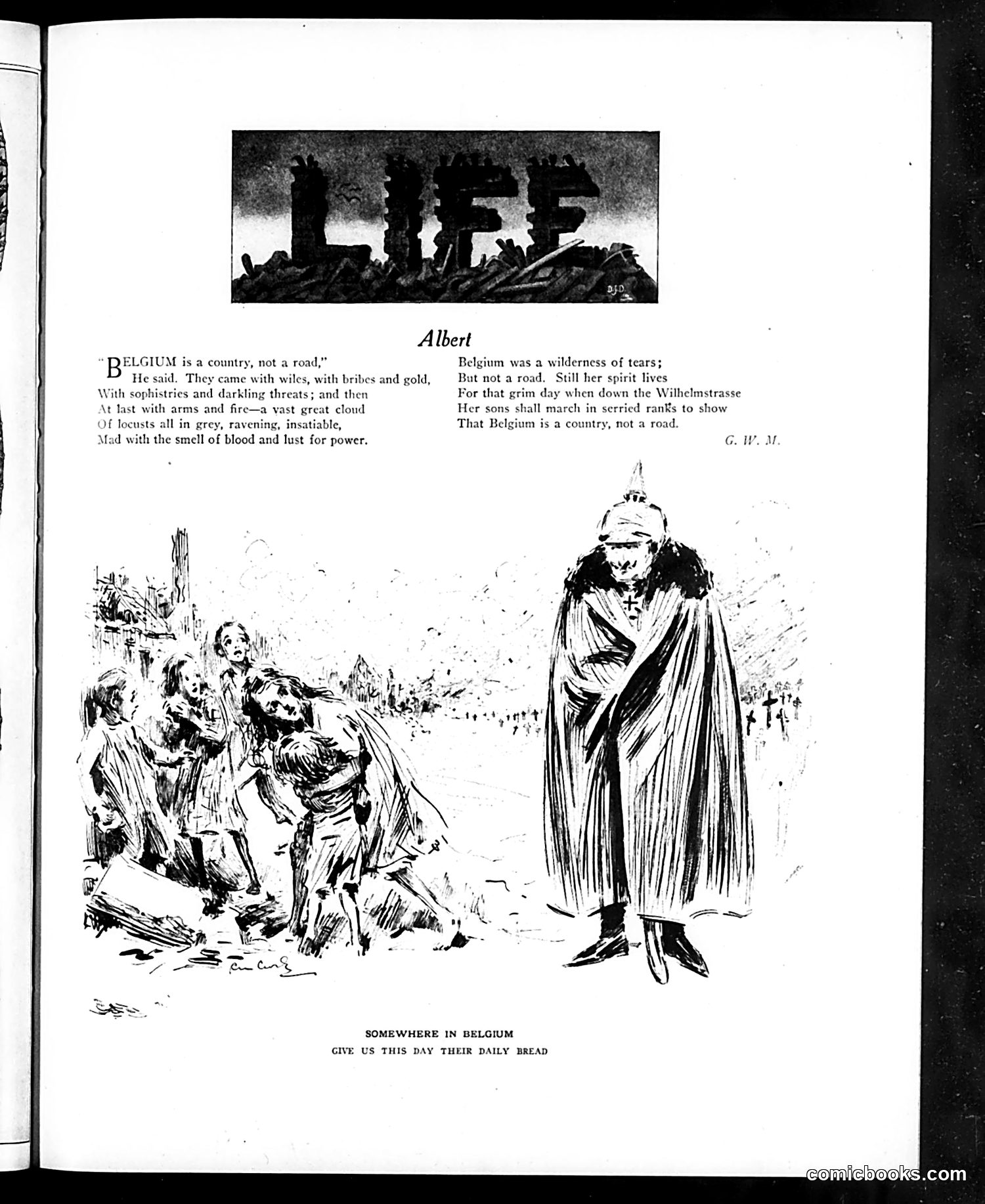
This 1915 Life magazine article condemns German military conduct in Belgium during World War I. The central illustration titled "BACK HOME" depicts a grieving Belgian woman in devastated ruins—referencing Germany's invasion and occupation of Belgium, which involved documented atrocities against civilians. Martin argues that Germany's brutal treatment of Belgium—deportations, executions, property destruction—represents a catastrophic moral failure that will ultimately doom Germany. He notes Belgium faces enslavement but contends civilization itself has taken up the challenge against German militarism. The piece uses Belgium's suffering as evidence of German "extremity" and warns that Germany's crimes create consequences binding both nations together, with Germany's ultimate defeat seemingly inevitable. It's propaganda supporting the Allied cause through accounts of German wartime atrocities.
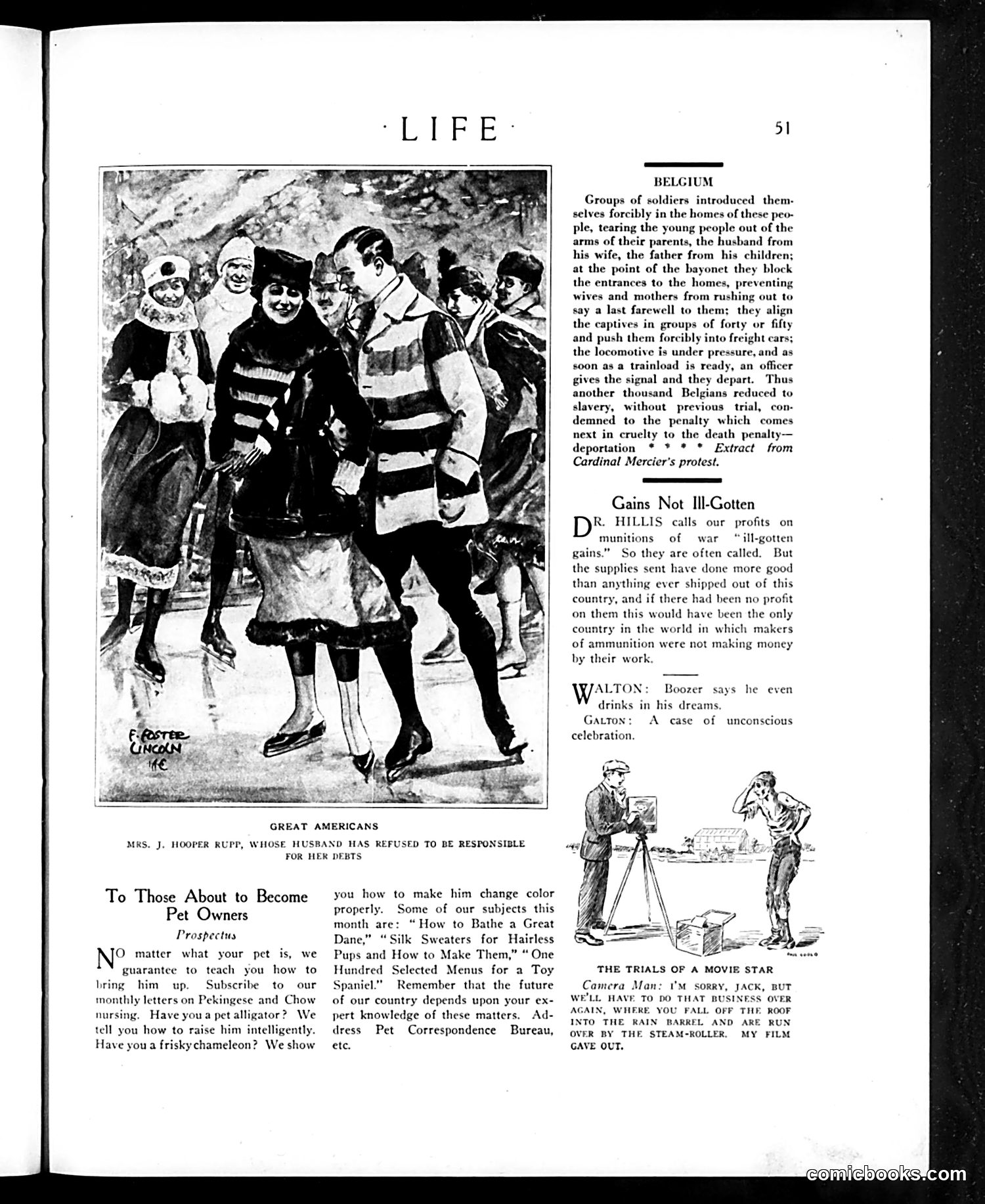
The main cartoon, titled "Great Americans," depicts **Mrs. J. Hooper Ruff, whose husband has refused to be responsible for her debts**. The illustration shows a woman in an elegant coat surrounded by soldiers, apparently being forcibly separated from civilians. This satirizes Belgian military conduct during WWI—the accompanying text references Cardinal Mercier's protest against German soldiers forcibly removing Belgian civilians (particularly young people) into "freight cars" for deportation to forced labor. The cartoon's irony: while atrocities occur in Belgium, an American woman's marital financial troubles are deemed equally noteworthy as "great American" problems. The page also contains unrelated pet-care advice and brief comedic sketches about film production.
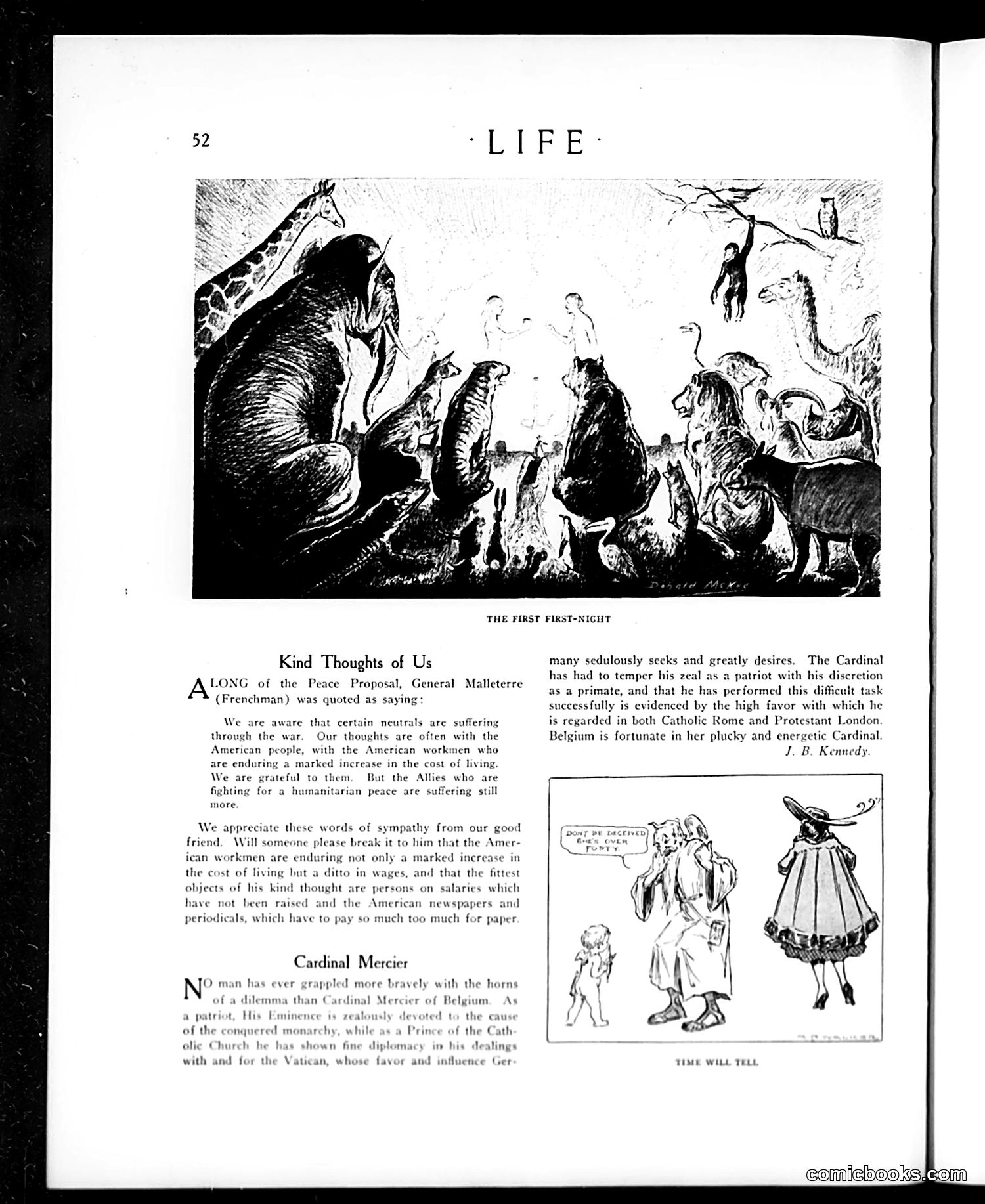
**Top Illustration ("The First First-Night"):** A surreal gathering of animals and human figures around a campfire. The scene appears allegorical—possibly representing humanity's first night or primordial gathering. A giraffe, elephant, and various other creatures observe people. The meaning is unclear without additional context. **"Kind Thoughts of Us":** Commentary on General Malléterre's Peace Proposal, sympathizing with American workers suffering from increased living costs during the war. The text requests acknowledgment that American workers deserve wage increases. **"Cardinal Mercier":** Praises the Belgian Cardinal's patriotic resistance to German occupation, noting his diplomatic skill balancing Catholic Church interests with Belgian sovereignty. **"Time Will Tell":** A small cartoon (lower right) appears to reference future consequences, though details remain unclear from the image alone.
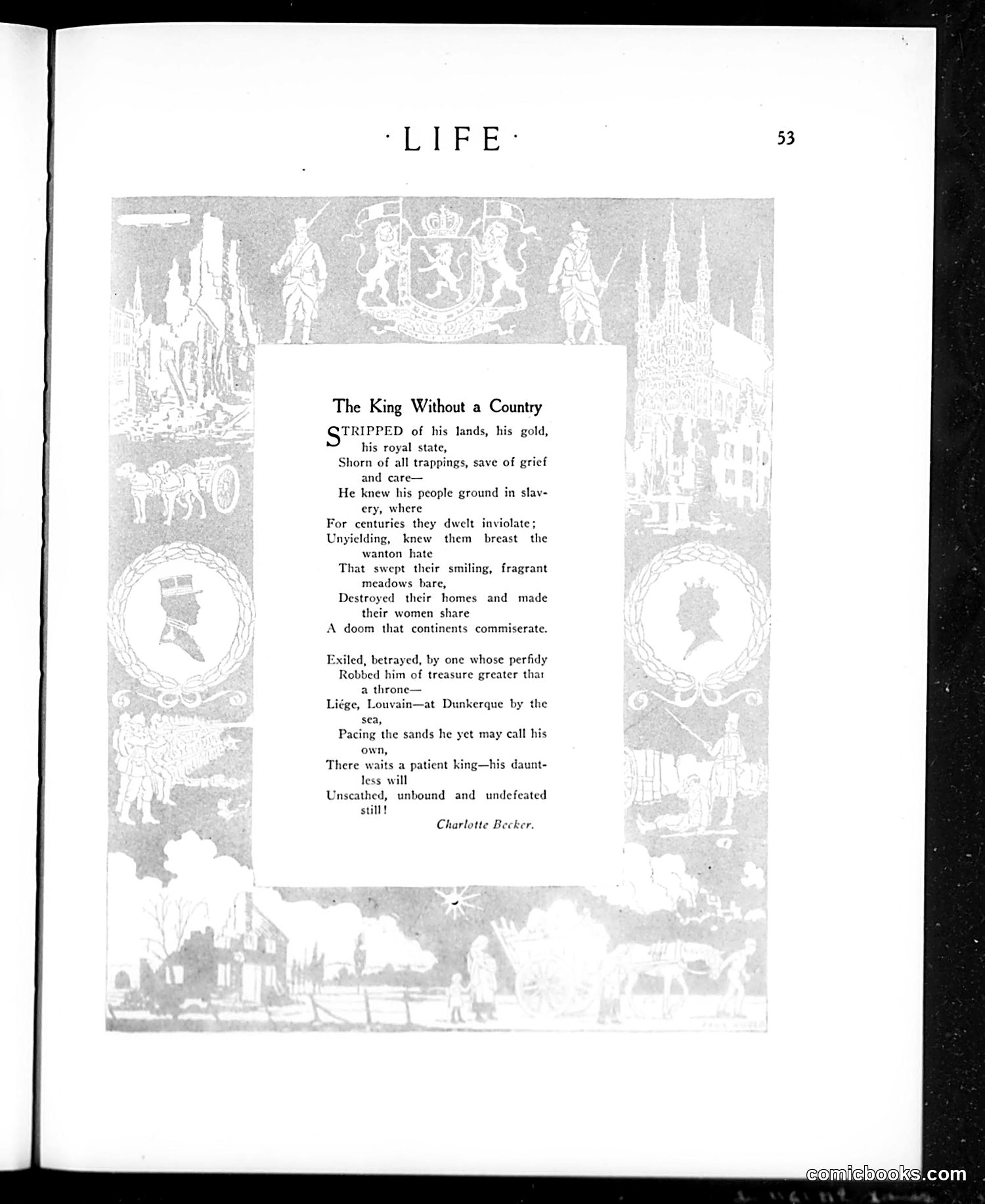
This poem, illustrated with decorative medieval and architectural imagery, appears to be a sympathetic portrayal of a deposed or exiled European monarch. The text references a king stripped of lands, gold, and royal state, whose people suffered centuries of oppression and slavery under foreign rule. The poem specifically mentions "Liège, Louvain—at Dunkerque by the sea," Belgian locations, suggesting this concerns **Belgian independence or a Belgian king during conflict** (likely WWI era, given Life's publication context). The final lines celebrate the king's "dauntless will / Unscathed, unbound and undefeated still," framing exile as noble endurance rather than defeat. The ornamental border treatment elevates the subject as heroic rather than satirical.
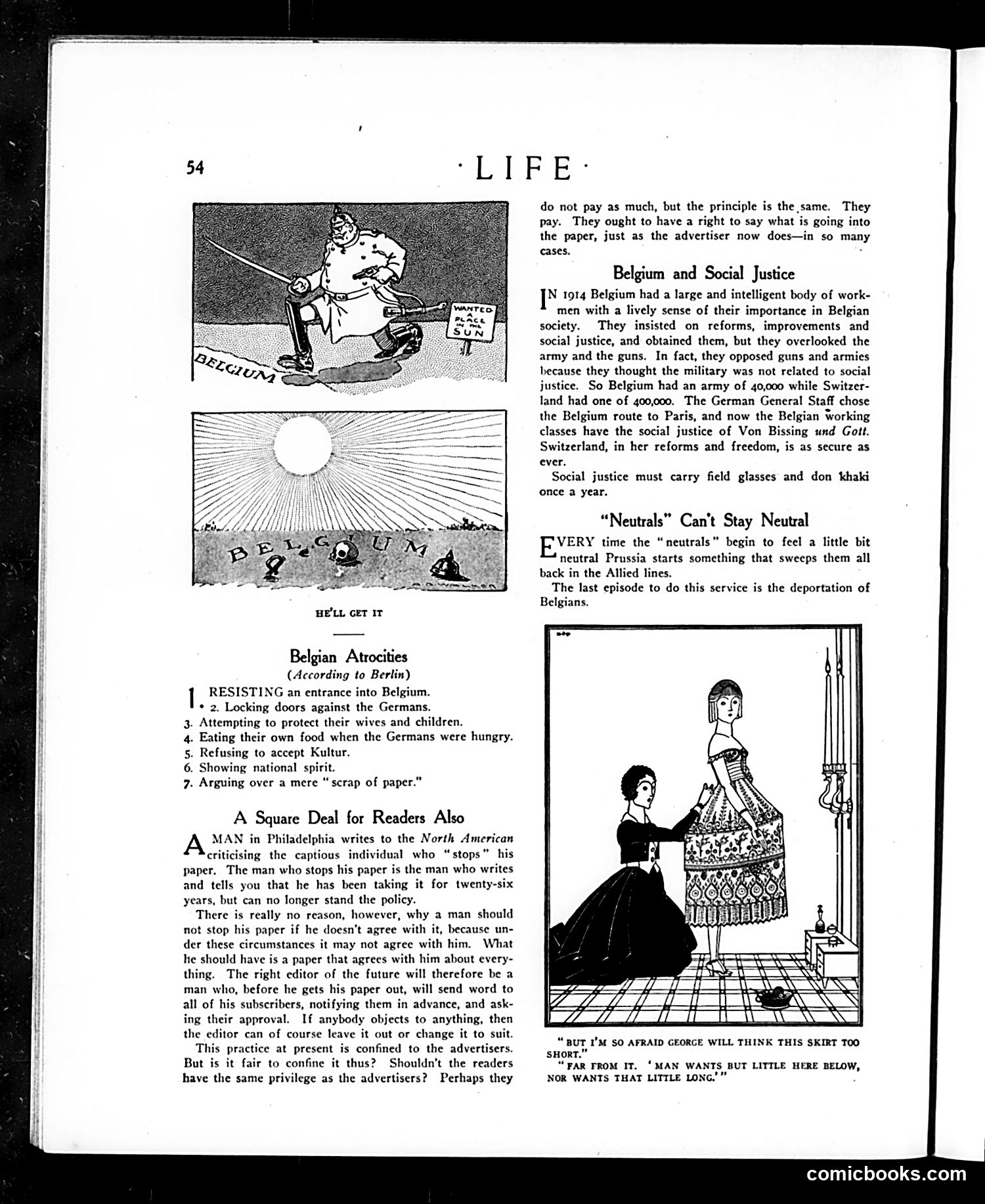
This page contains WWI-era political satire about Belgium. The top cartoon depicts Belgium as a figure being crushed, labeled with German demands. Below, another cartoon shows Belgium sinking into darkness, captioned "HE'LL GET IT." The text discusses Belgium's resistance to German invasion and occupation during World War I. A section titled "Belgian Atrocities (According to Berlin)" sarcastically lists seven items Germans claimed Belgians did—like "locking doors against the Germans" and "refusing to accept German Kultur"—mocking German propaganda. The page also addresses editorial responsibility, arguing newspaper editors should allow reader input rather than unilaterally controlling content based on advertiser interests. The satire defends Belgium's sovereignty and criticizes German invasion and propaganda while questioning editorial independence.
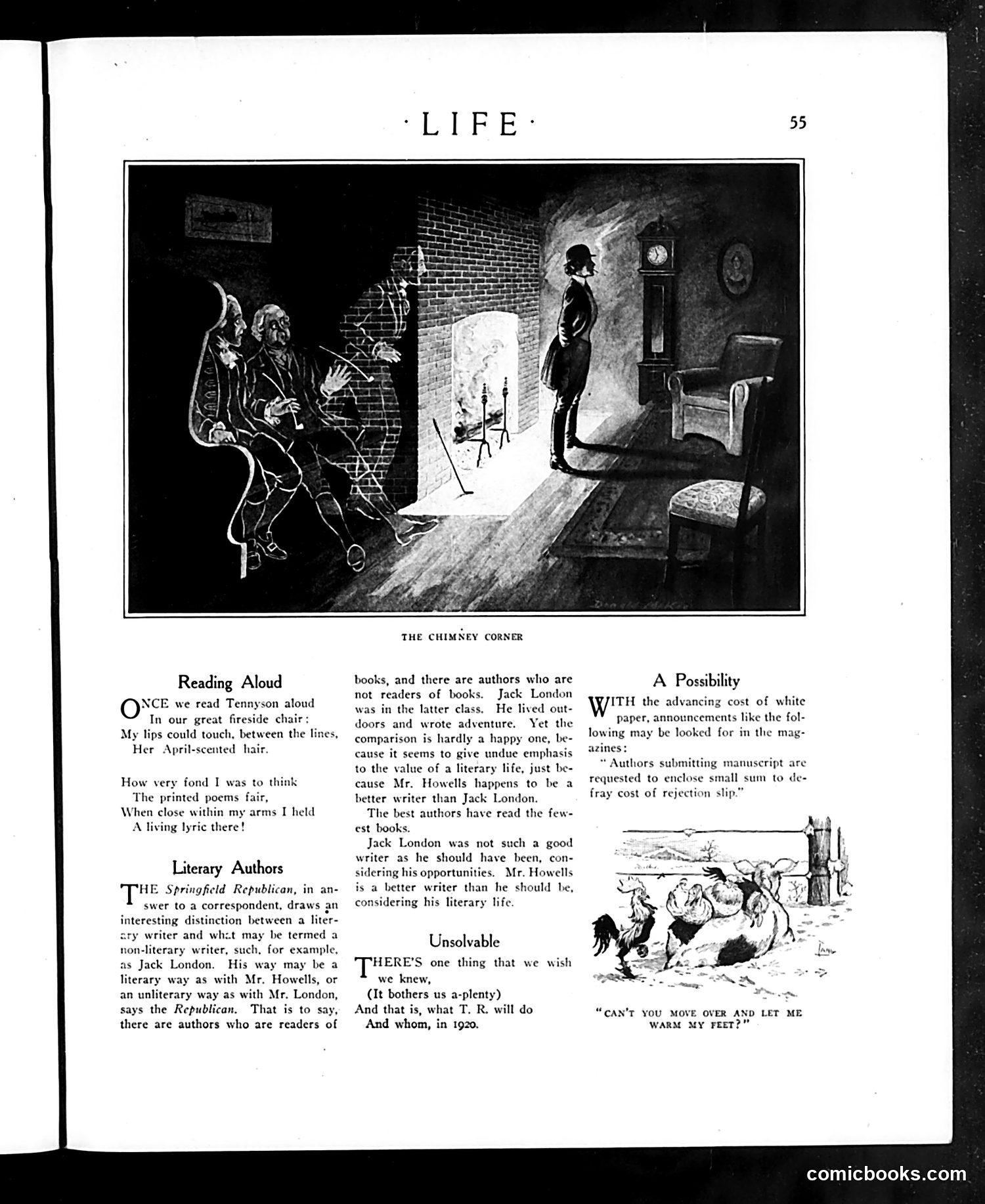
**Main Illustration ("The Chimneys Corner"):** A dark, atmospheric drawing depicting two figures outside a doorway encountering a well-dressed man. The scene suggests a supernatural or mysterious encounter—possibly depicting a ghost or apparition (the bright white figure in the doorway). **Text Content:** The page contains three short editorial pieces discussing literary topics: 1. **"Reading Aloud"** — reflects on Tennyson read by a woman 2. **"Literary Authors"** — contrasts "literary" authors like Mr. Howells with "non-literary" writers like Jack London, debating whose work has greater value 3. **"Unsolvable"** — a brief complaint about T.R. (Theodore Roosevelt), likely referencing his unpredictable political positions in 1920 **The cartoon's purpose** remains unclear without additional context, though its Gothic atmosphere suggests commentary on popular entertainment or literature trends of the era.
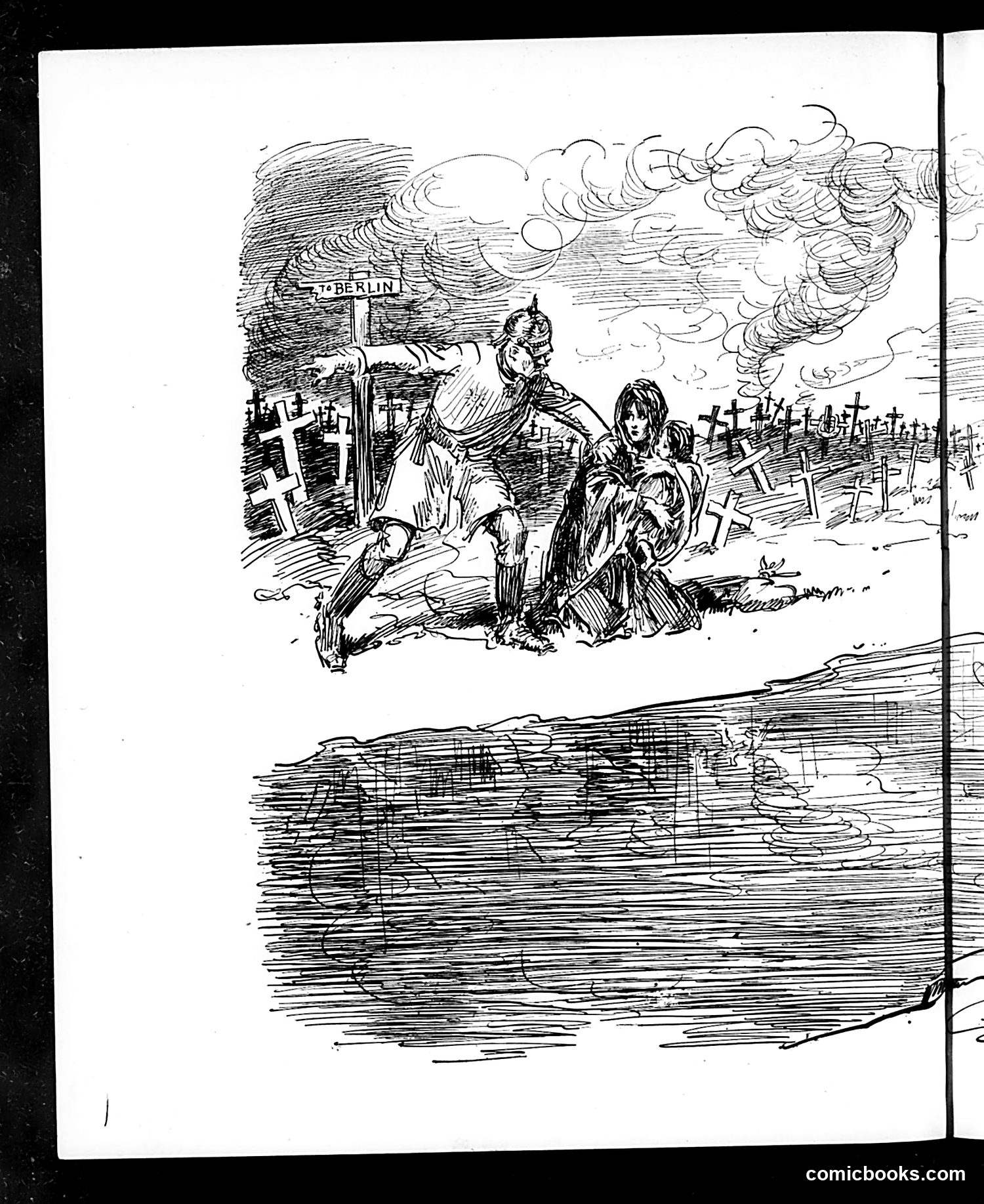
This appears to be a World War I-era satirical cartoon depicting the human cost of warfare. The central figure is a skeletal or death-like character standing in a cemetery marked "BERLIN," surrounded by numerous crosses indicating graves. Two grieving figures (likely representing bereaved women or civilians) kneel before the crosses in mourning. The cartoon serves as anti-war commentary, illustrating the devastating casualties and destruction resulting from the conflict. By personifying death itself presiding over a Berlin graveyard, the artist critiques the war's horrific toll on human life. The imagery suggests this was likely created for American audiences during WWI, when Life magazine regularly published satirical commentary on the European conflict and its consequences.
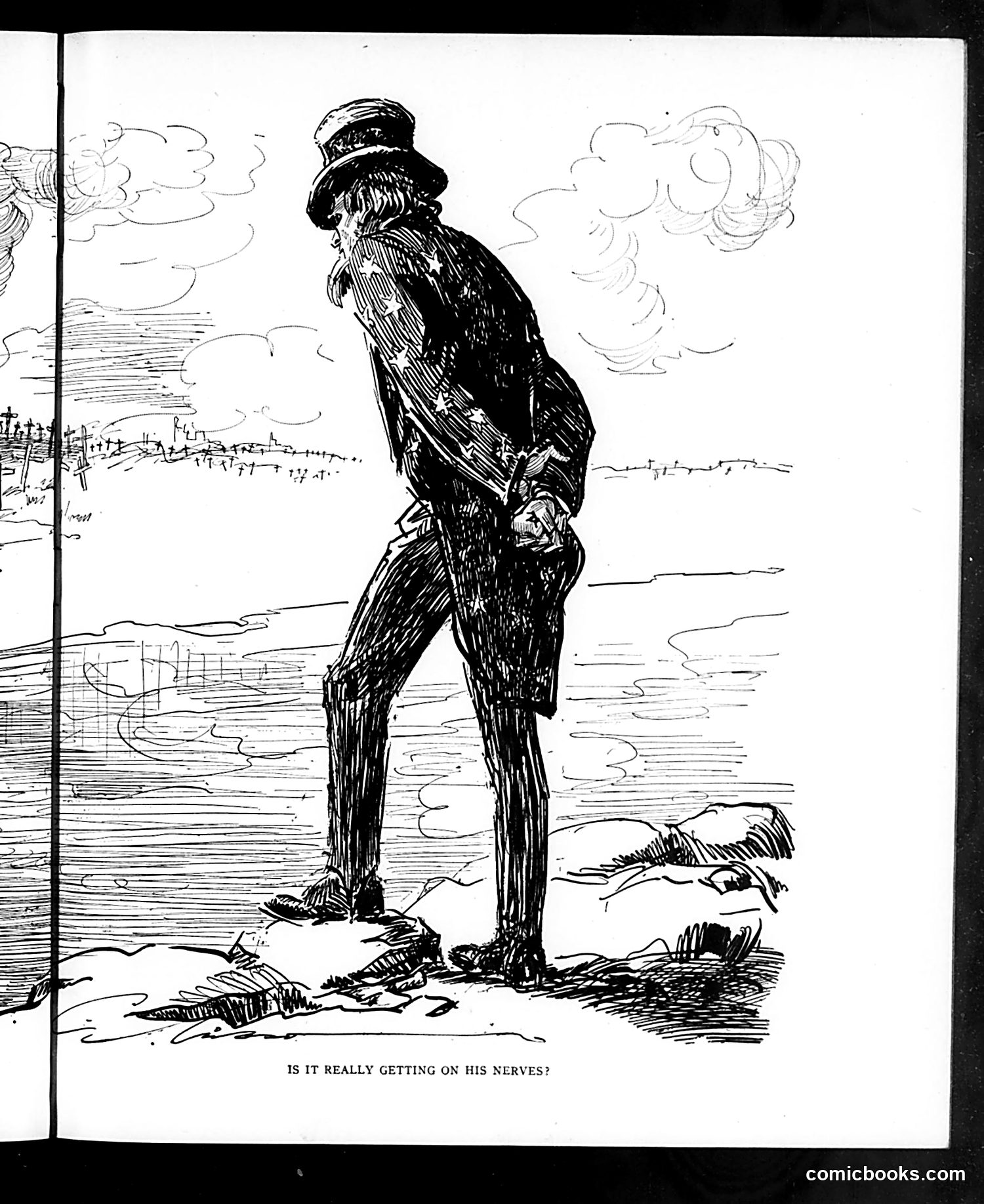
This is a political cartoon depicting a tall, thin military or uniformed figure standing tensely on a beach, gazing out at the water. The figure's posture—rigid, stressed—combined with the caption "IS IT REALLY GETTING ON HIS NERVES?" suggests commentary about someone under psychological strain or pressure. The specific identity of the figure remains unclear from the image alone, though the military uniform and wartime beach setting suggest this likely comments on a military leader or official during a conflict period. Without additional context about the publication date or surrounding articles, I cannot definitively identify who is depicted or what specific historical crisis prompted this satire. The cartoon's point appears to be questioning whether military pressure is genuinely affecting someone's mental state.
This page comments on early World War I peace negotiations. Germany had proposed an armistice, which the Allies rejected as insincere and lacking concrete terms. The article criticizes Germany's proposal as a "sham," noting Germany made no mention of its violations (particularly the deportation of Belgian citizens). The central focus shifts to President Woodrow Wilson, who had initiated peace inquiries. Life's editors defend Wilson's efforts while acknowledging widespread American hostility toward him. Critics, they note, resent that Wilson might receive credit for peace efforts, viewing his involvement as self-serving reputation-building rather than genuine humanitarian concern. The small cartoon (bottom left) appears to mock this cynicism, though details are unclear. The piece's tone is sardonic—simultaneously supporting peace exploration while recognizing the Allies' justified skepticism about German sincerity.
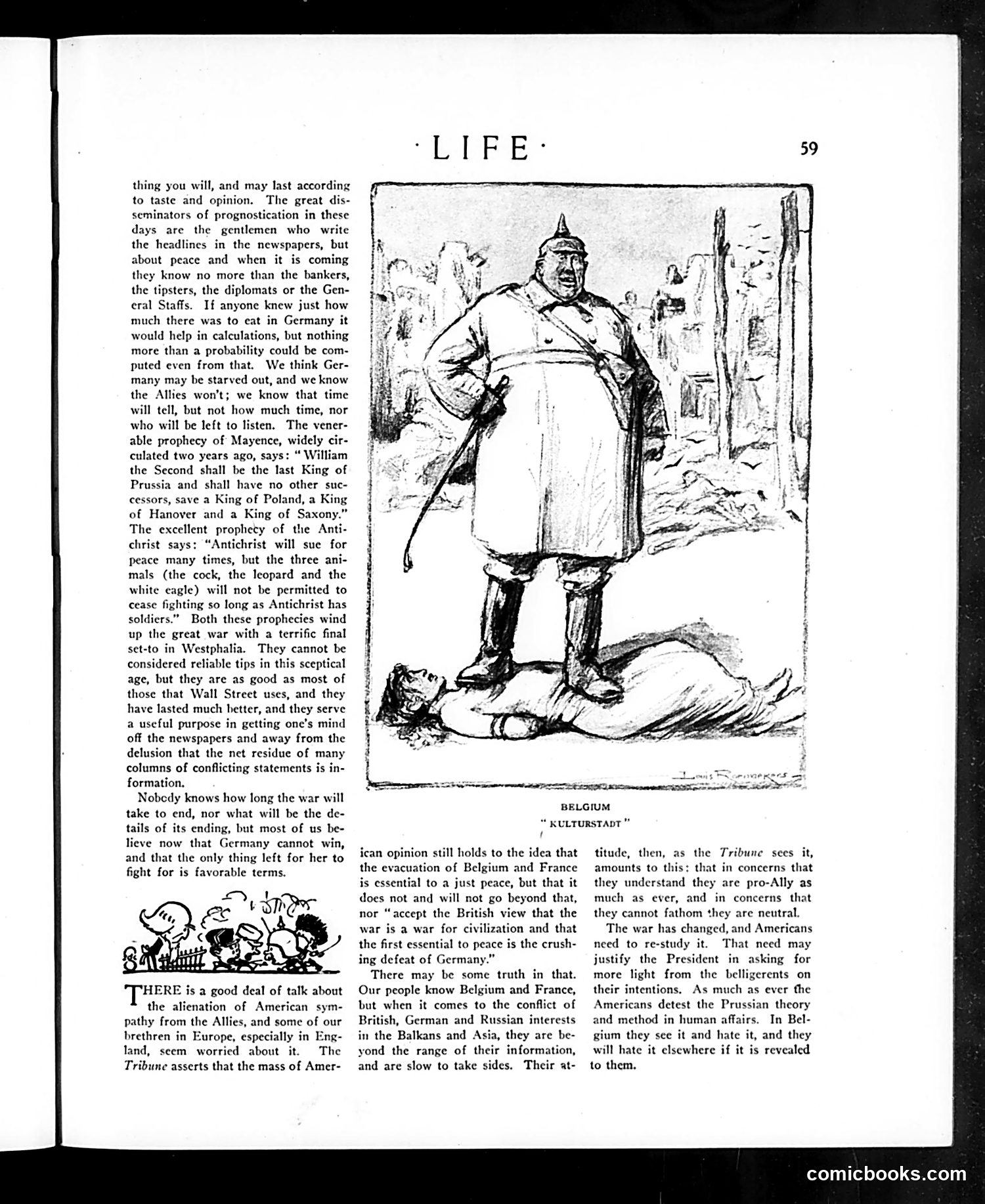
This WWI-era cartoon depicts a German soldier standing over a dead Belgian civilian, sarcastically labeled "Kulturstadt" (German culture/civilization). The image critiques German military conduct in Belgium, specifically referencing documented atrocities committed during the 1914 invasion—widespread killing of civilians, destruction, and occupation. The accompanying text discusses American attitudes toward the war: while Americans support Allied evacuation of Belgium and France, they remain neutral on broader geopolitical conflicts (Balkans, Asia). The article argues Americans "detest the Prussian theory and method in human affairs" and will oppose Germany if its brutality is revealed to them. The cartoon's bitter irony equates German "Kultur" with violence and death, suggesting that Germany's claim to civilized superiority is contradicted by its treatment of occupied territories. This reflects contemporary American propaganda portraying Germany as barbaric.
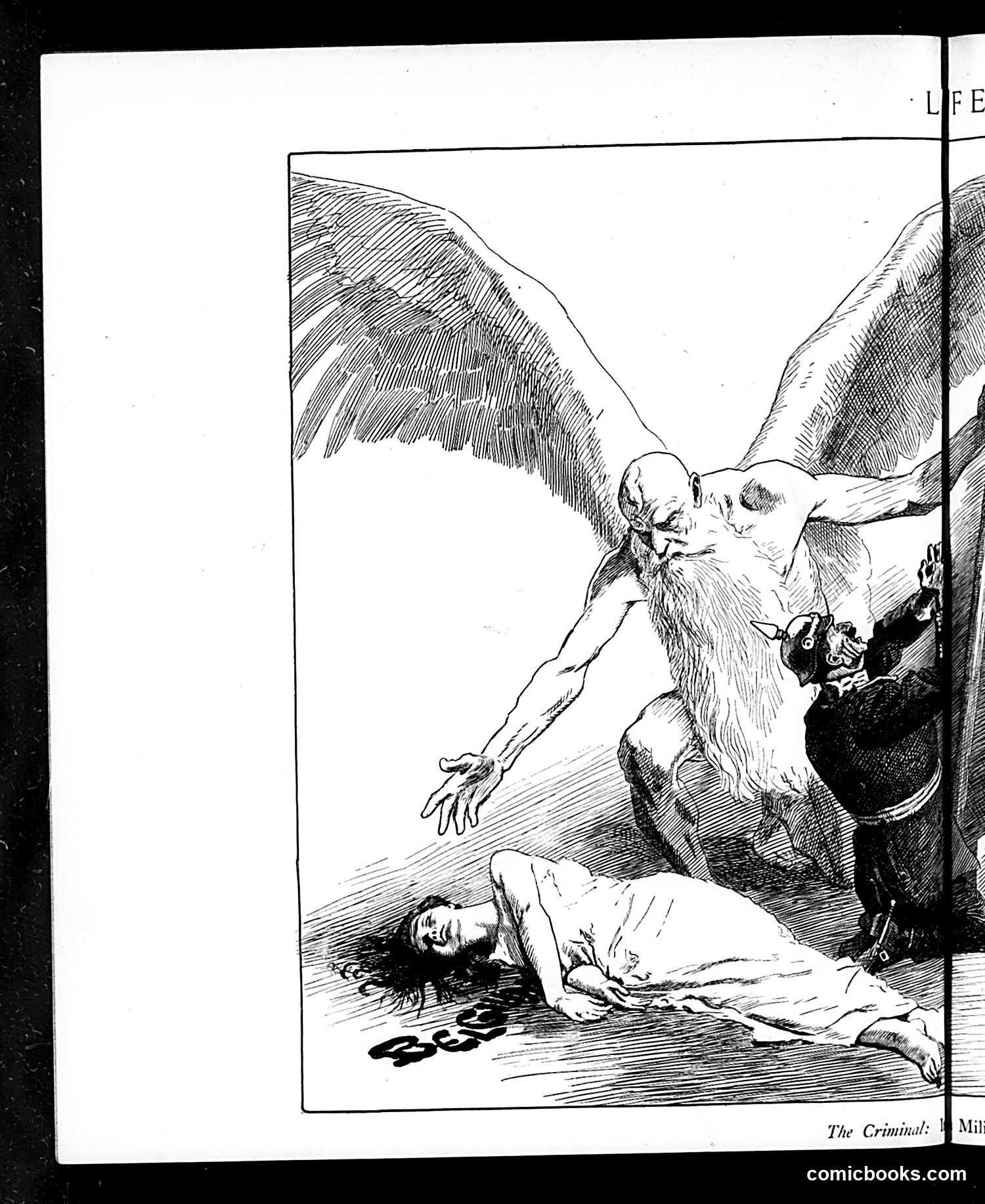
This appears to be a dramatic illustration from *Life* magazine showing a winged demonic or supernatural figure looming over a prone human figure on the ground. The standing figure has a long beard and displays an aggressive, menacing posture with an outstretched arm, while the recumbent figure appears vulnerable or defeated. The caption reads "The Criminal," suggesting a moral or political commentary about criminality or evil. Without additional context or visible date information, the specific historical reference is unclear. The allegorical style—using a supernatural figure to represent an abstract concept—was common in satirical illustration of the era, but the particular crime, criminal, or political scandal being referenced cannot be determined from this image alone.
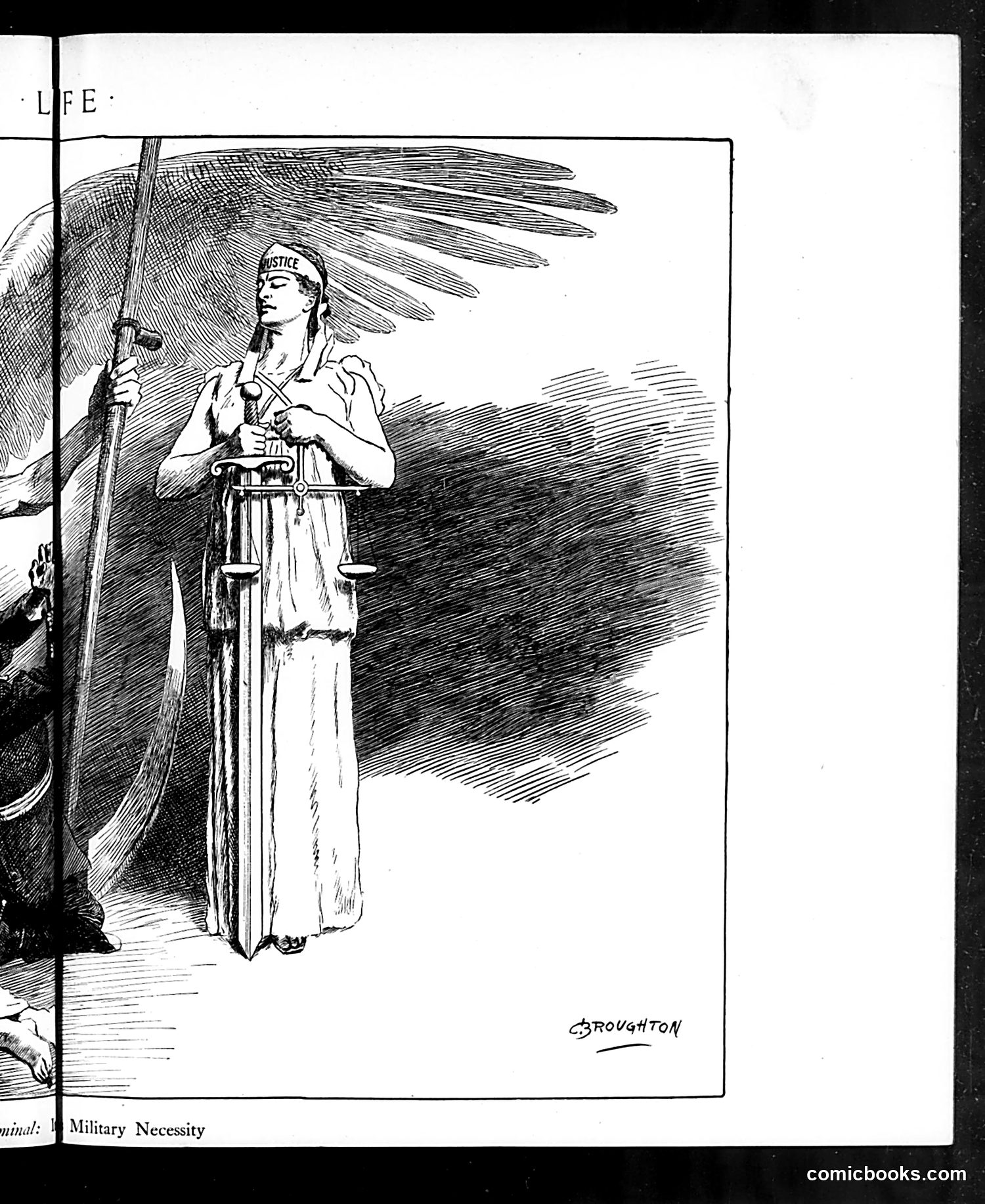
This cartoon depicts **Lady Justice** (identifiable by her headband labeled "JUSTICE," scales, and sword) standing in a dramatic pose with large wings. The artist is **Broughton** (signed lower right). The caption references **"Military Necessity,"** suggesting this cartoon critiques the invocation of military necessity as justification for actions that might otherwise violate justice or legal principles. The dark, ominous shading on the right side and Lady Justice's stern expression suggest concern or disapproval. This likely comments on wartime policies—possibly WWI-era—where governments claimed military necessity to justify measures that compromised civil liberties or legal standards. The satirical point: military arguments are being used to override traditional justice and fairness.
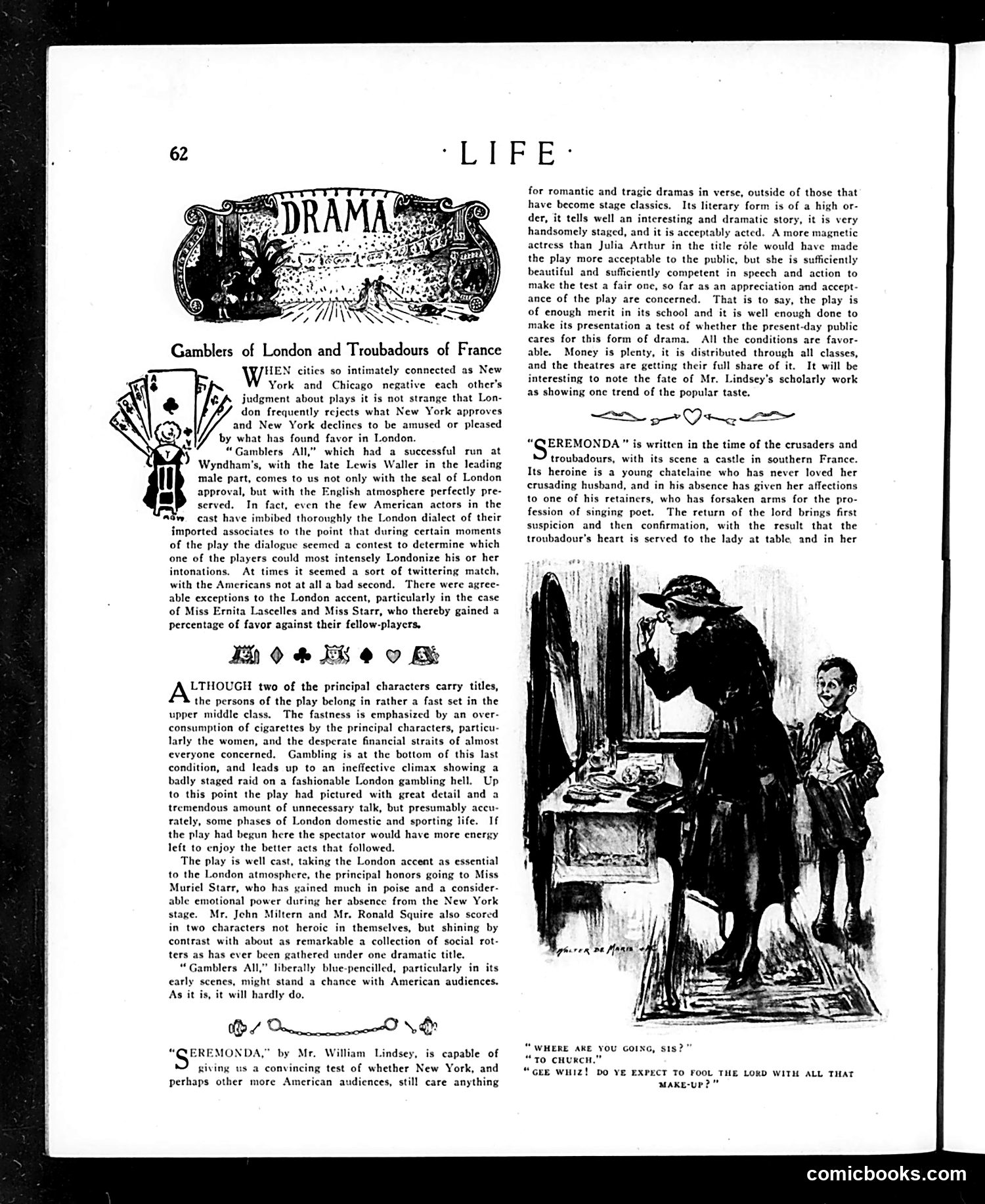
This is a theater review page from *Life* magazine discussing London plays being performed in New York. The page critiques two productions: **"Gamblers All"** - A London play about upper-middle-class characters involved in gambling and financial desperation. The review notes that American actors in the cast have adopted exaggerated London accents, creating an unintentionally comedic "twittering match" of competing pronunciations. The critic praises actress Muriel Starr's poise but suggests the play needs heavy editing to appeal to American audiences. **"Seremonda"** - A verse drama by William Lindsey, testing whether American audiences still appreciate romantic/tragic drama in poetic form. Julia Arthur stars, though the critic suggests a "more magnetic actress" would help. The illustration shows a domestic scene, likely from one of these plays. The page reflects early 20th-century theater criticism and the cultural divide between London and New York theatrical tastes—a recurring theme in *Life*'s satirical commentary on Anglo-American cultural pretension.
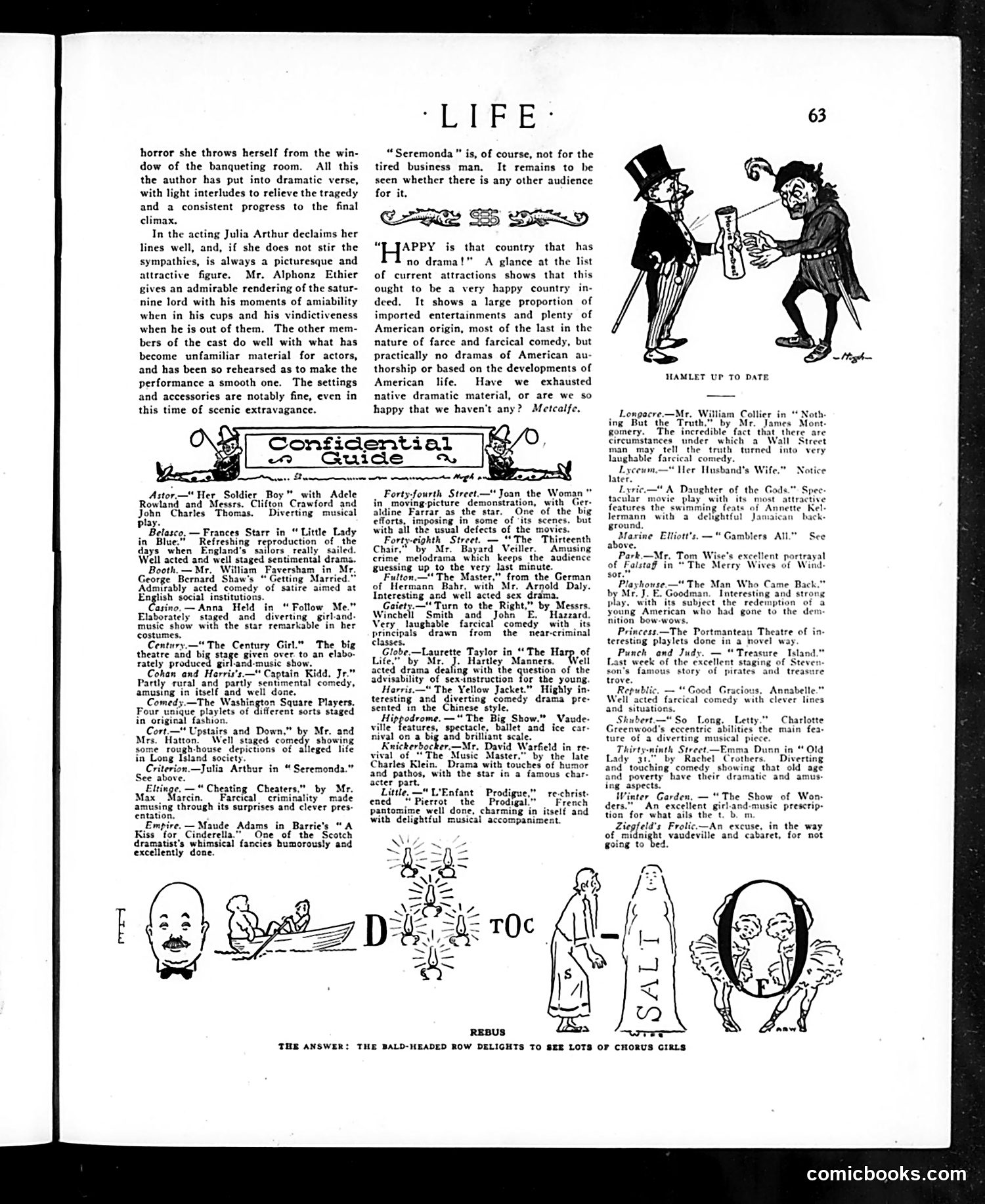
This is a theater review section from *Life* magazine (early 20th century). The main content critiques current Broadway productions, with critic Metcalfe lamenting America's lack of serious native drama. He observes that theaters showcase mostly imported entertainments and American farces/comedies rather than serious plays based on American life—humorously suggesting this means America is "that country that has no drama" (referencing the saying "happy is the country that has no history"). The "Confidential Guide" lists current shows with brief assessments: Julia Arthur in the serious drama *Seremonda*, various comedies and musicals (Anna Held, Maude Adams), and notably a Geraldine Farrar film. The cartoons at bottom appear to be visual jokes, including a rebus puzzle ("D to C"). The satire critiques American theater's escapism and commercialism rather than engagement with contemporary American experience.
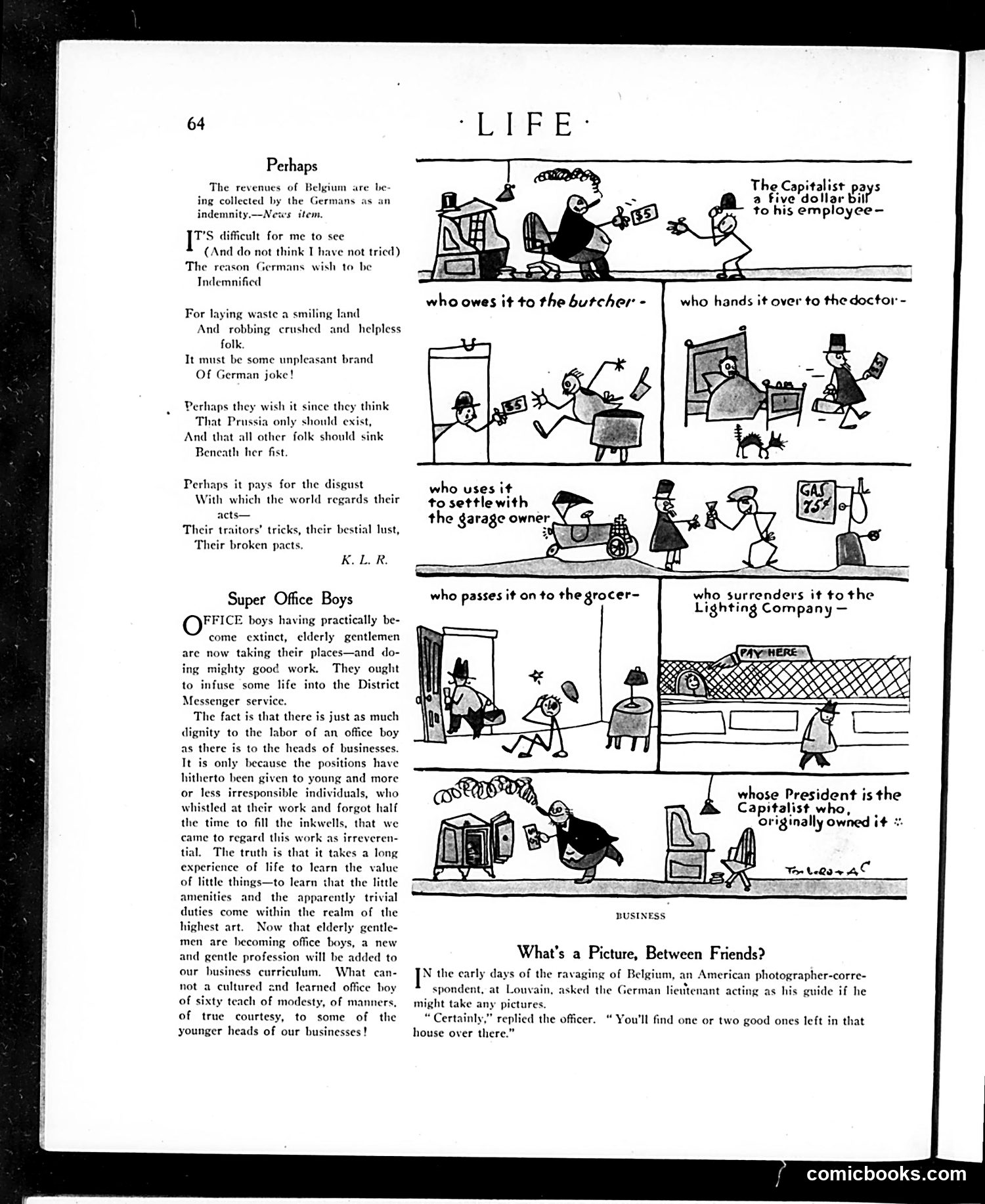
This page contains two distinct pieces of WWI-era American satire: **"Perhaps" poem** (top left): A bitter commentary on German war indemnities imposed on Belgium. The author (K.L.R.) sarcastically questions why Germany demands payment from a nation it has devastated, suggesting German motivations are either a cruel "joke," desires for Prussian dominance, or compensation for world disgust at German conduct ("traitors' tricks," "bestial lust," "broken pacts"). **"The Capitalist pays a five dollar bill"** (top right): A circular diagram-cartoon showing money's journey through economic classes—from capitalist employer to employee to butcher to doctor to garage owner to grocer to lighting company to the capitalist's president. It satirizes wealth circulation in capitalism. **"Super Office Boys"** (center): Praises elderly men replacing boy messengers in offices, arguing this restores dignity to menial work and introduces courtesy and careful attention to detail. **"What's a Picture, Between Friends?"** (bottom): A darkly humorous anecdote about a German officer casually directing an American photographer to destroyed Belgian buildings as photo subjects, implying German indifference to destruction.
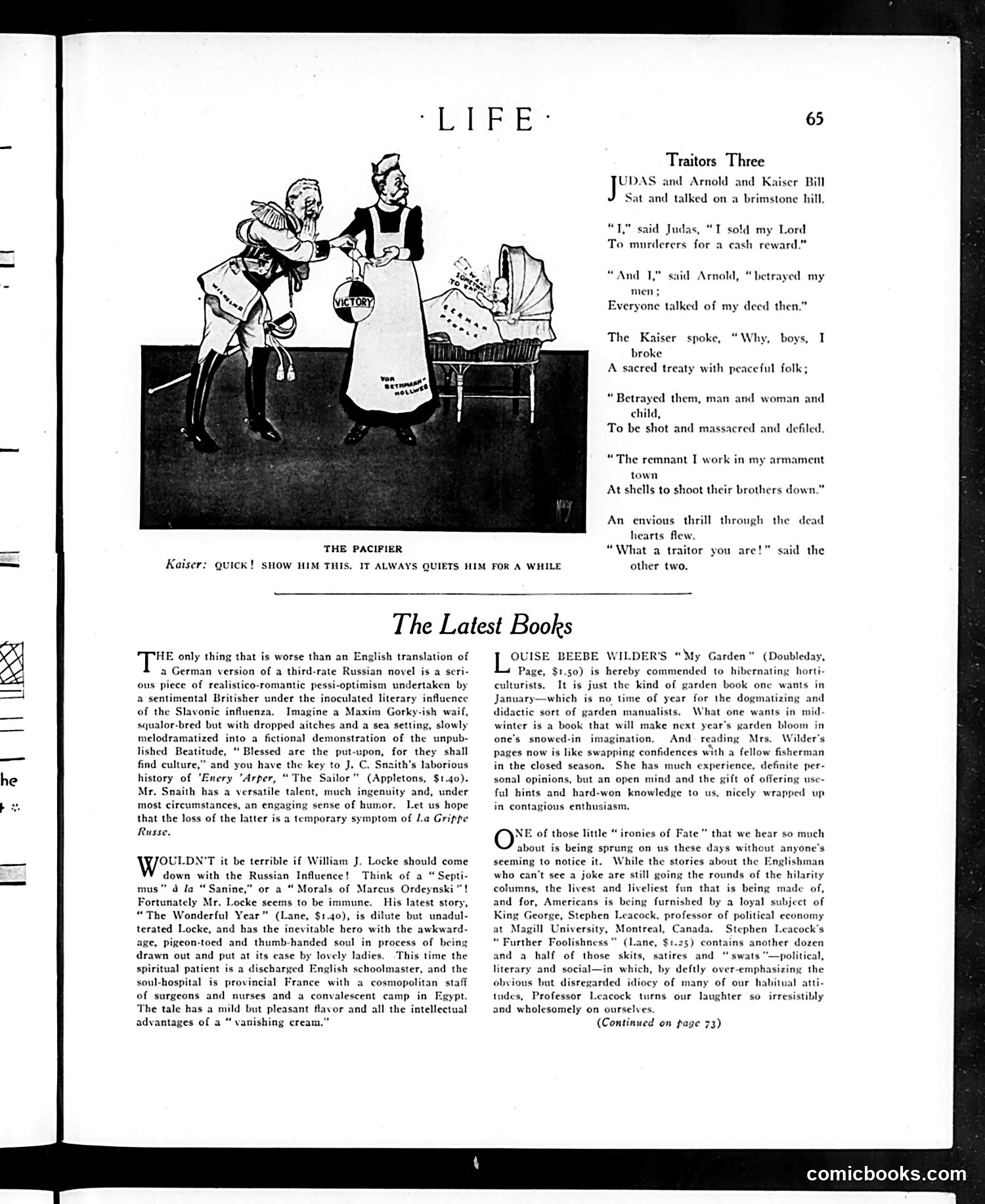
**The Cartoon:** Shows the Kaiser being given a pacifier labeled "VICTORY" to quiet him, suggesting he's childishly demanding or unstable—a wartime caricature mocking German leadership as infantile and needing appeasement. **The Poem:** Compares Kaiser Wilhelm II to biblical traitor Judas and American Revolutionary traitor Benedict Arnold. All three confess their betrayals, but the Kaiser's transgression—breaking a treaty with peaceful nations, leading to deaths of civilians and soldiers—surpasses theirs in scale and moral enormity. The dead souls express envious admiration for his unprecedented treachery. **Context:** This reflects World War I-era American sentiment portraying Germany as history's greatest betrayer for violating Belgian neutrality (the "sacred treaty") and conducting what Americans viewed as atrocities. The satire equates the Kaiser with archetypal villains, positioning Germany's actions as uniquely contemptible rather than merely another nation's wartime conduct.
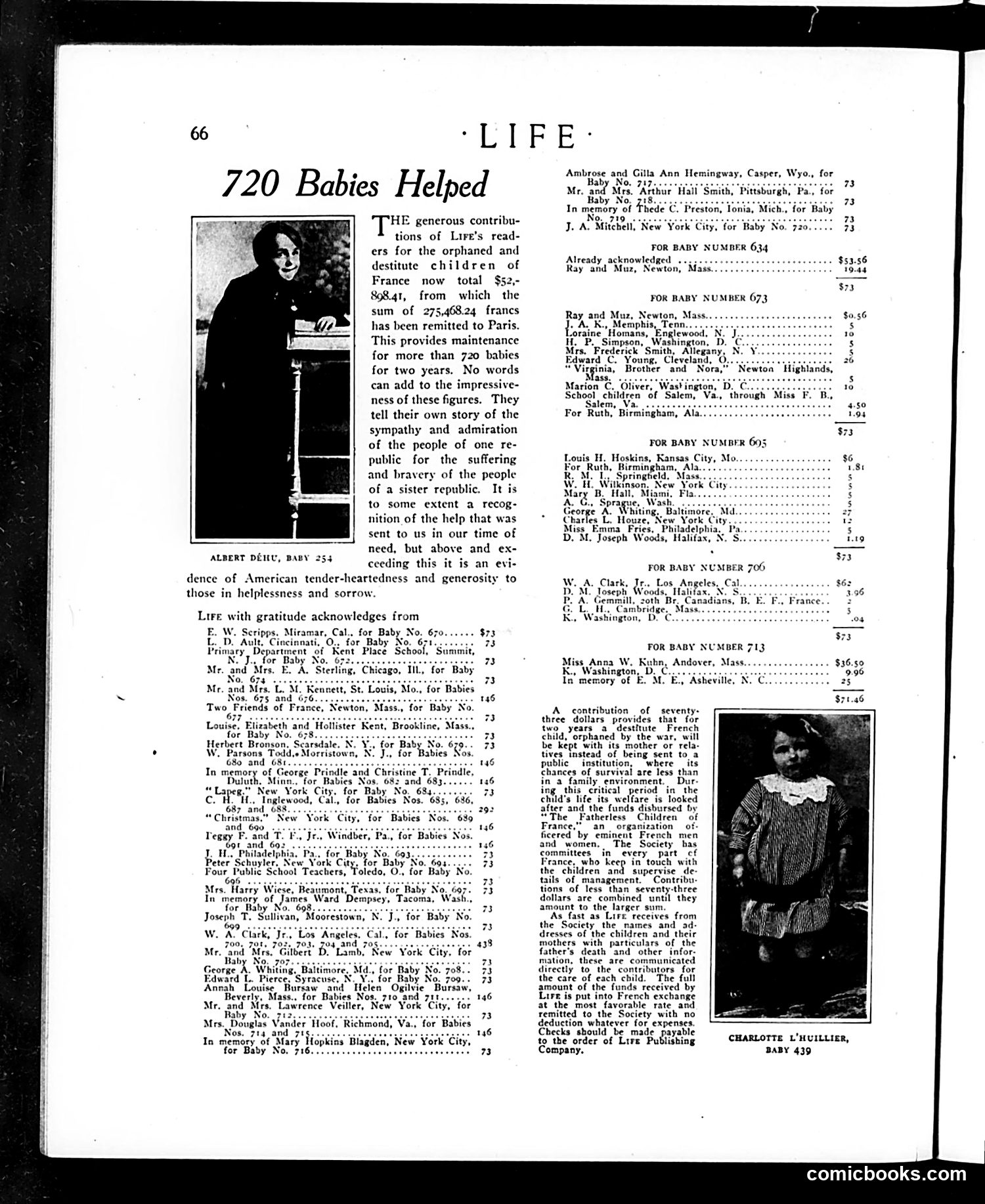
This page documents Life magazine's charitable fundraising campaign to aid French war orphans following World War I. The publication had collected $52,884.41 from readers, converted to 275,468.24 francs and sent to Paris. This sum supports over 720 orphaned French children for two years. The article emphasizes American generosity toward France, described as a "sister republic," partly reciprocating French aid to America during the war. The accompanying photograph shows Albert Denu, identified as "Baby 254" — likely a visual representation of one beneficiary to humanize the cause. The bulk of the page lists individual donors' names and the specific baby numbers their contributions support, a common practice in early 20th-century fundraising to recognize donors and create personal connections between American benefactors and French children. This reflects post-WWI American sympathy for war-devastated European nations.
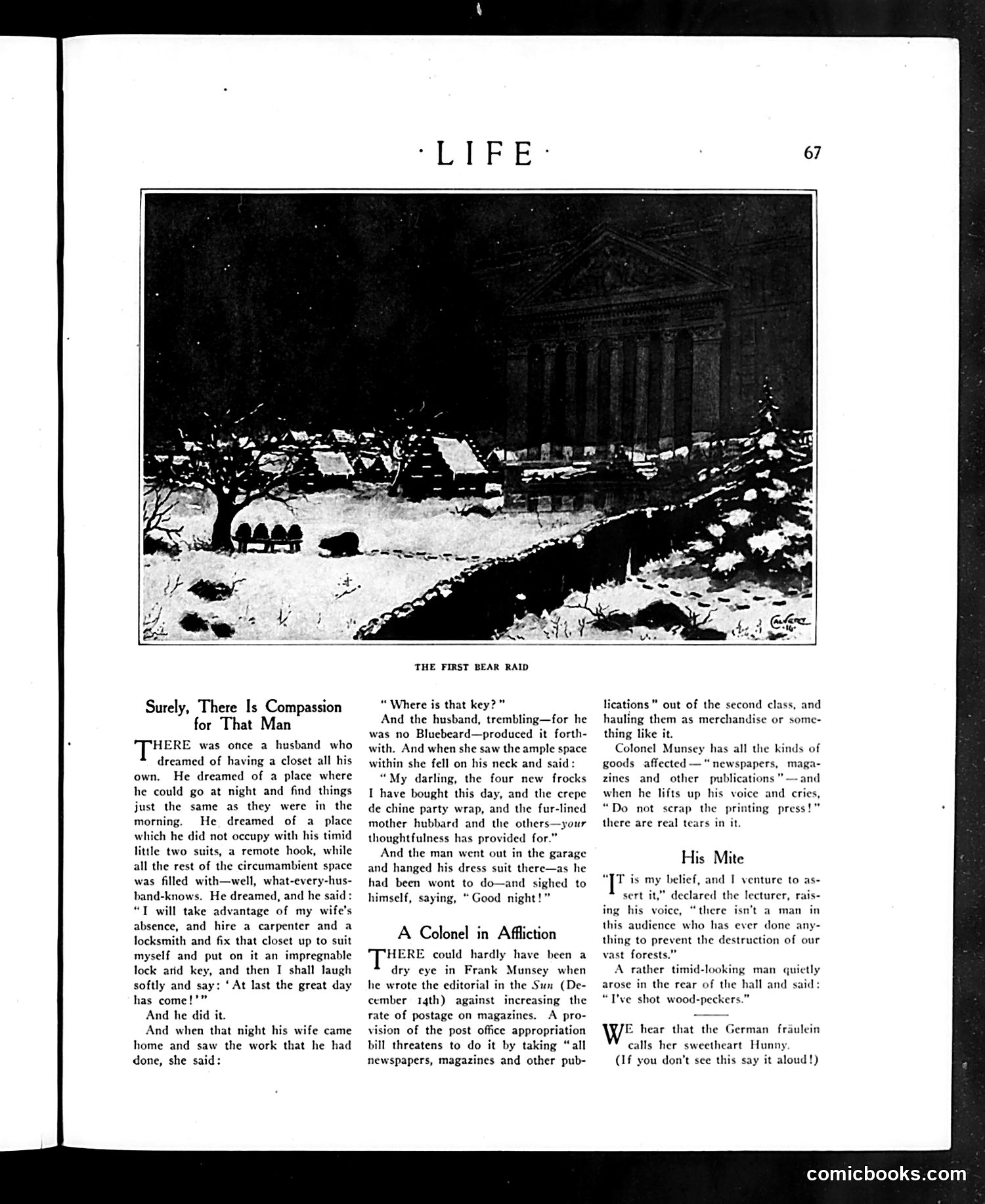
This page contains three satirical pieces typical of Life's humor: 1. **"Surely, There Is Compassion for That Man"**: A domestic comedy about a husband who installs a private closet with a lock, hoping for personal space. When his wife returns and sees the empty space, she immediately claims it for her own clothing, defeating his purpose entirely. The satire targets gender dynamics and marital compromise. 2. **"A Colonel in Affliction"**: Mocks Frank Munsey's editorial opposing increased postal rates on magazines. The joke is that Munsey's self-interested outcry against the rate hike—which would affect his own publications—is presented as emotional advocacy for the "printing press," when he's actually protecting his profit margins. 3. **"His Mite"** and **"We hear that the German fraulein..."**: Brief joke items. The first mocks someone claiming forest conservation by shooting woodpeckers. The second is a pun playing on "Hunny" sounding like "Hun," the contemporary derogatory term for Germans during WWI. The page demonstrates Life's focus on social commentary and wordplay humor.
This page presents reader submissions to *Life* magazine's criticism contest. The content reveals early-20th-century attitudes toward satire and social commentary. **No. 10** praises *Life*'s independence and wit, claiming its fearless criticism attracts intellectually superior readers ("persons with a sense of humor are the most intellectual"). It defends *Life*'s refusal of theatrical advertising, arguing truthful reviewing builds readership among truth-seekers, despite generating fewer ads. **No. 11** offers mixed praise: *Life* succeeds through uniqueness but sometimes descends into excessive irreverence—particularly endless mockery of doctors, preachers, and a recurring character named Josephus. The critic argues satire should avoid needless offense while maintaining wit. **No. 12** (partial) appears to criticize *Life*'s advertising practices. The submissions reveal *Life*'s self-conception as an intelligent, truth-telling publication while acknowledging contemporary criticism that its satire could be mean-spirited and repetitive.
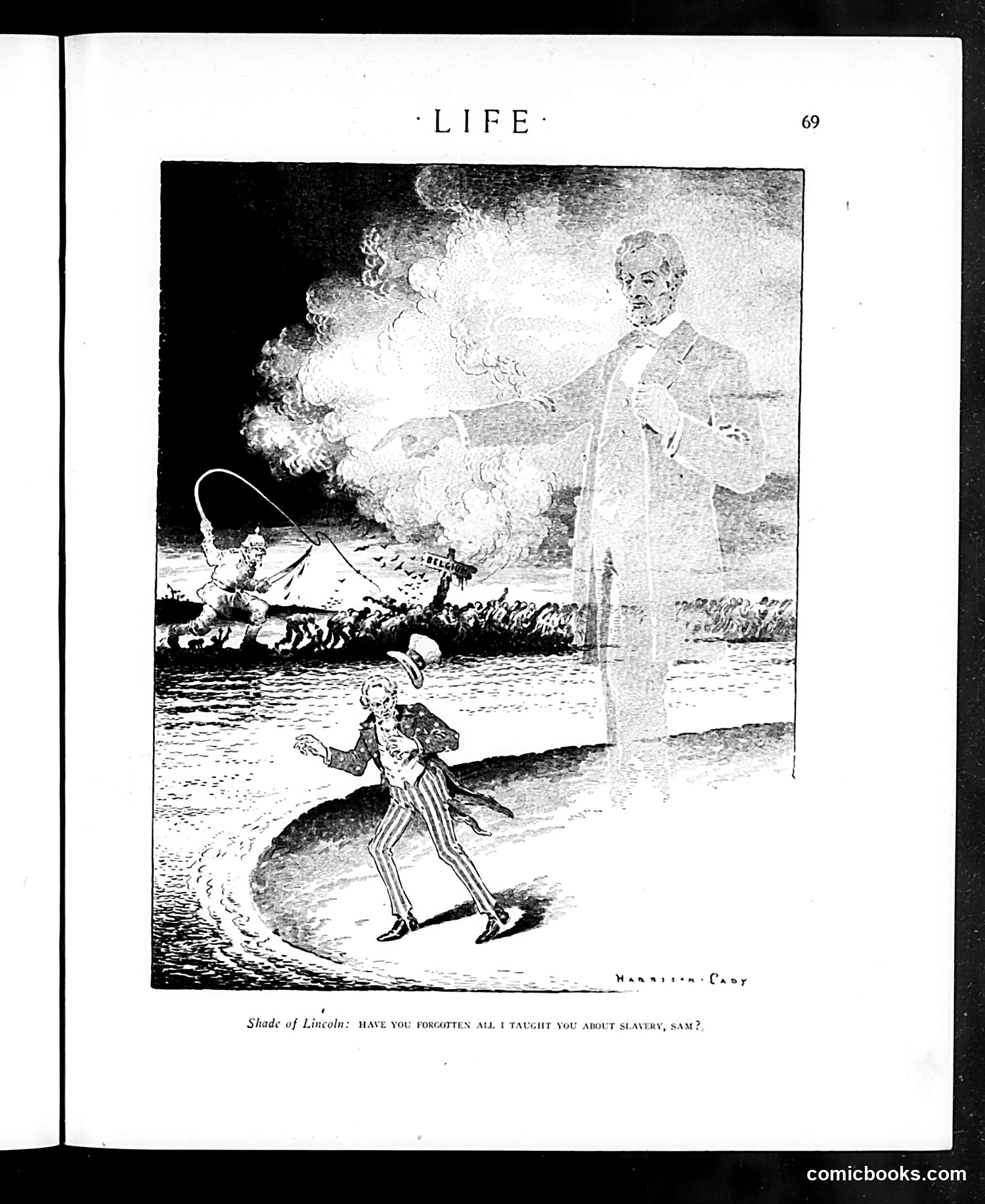
This political cartoon depicts the ghost of Abraham Lincoln confronting a figure labeled "Sam" (likely Uncle Sam, representing the United States government). Lincoln appears disappointed, asking if Sam has forgotten lessons about slavery. The cartoon likely critiques post-Civil War American policy—possibly regarding Reconstruction, the treatment of formerly enslaved people, or rollback of civil rights protections. The specter of Lincoln invokes his legacy as the president who ended slavery through the Emancipation Proclamation. The small figure in striped clothing at the bottom appears to represent an African American, emphasizing the cartoon's concern with racial justice. The satire suggests the nation is betraying Lincoln's anti-slavery principles through contemporary political or social failures.
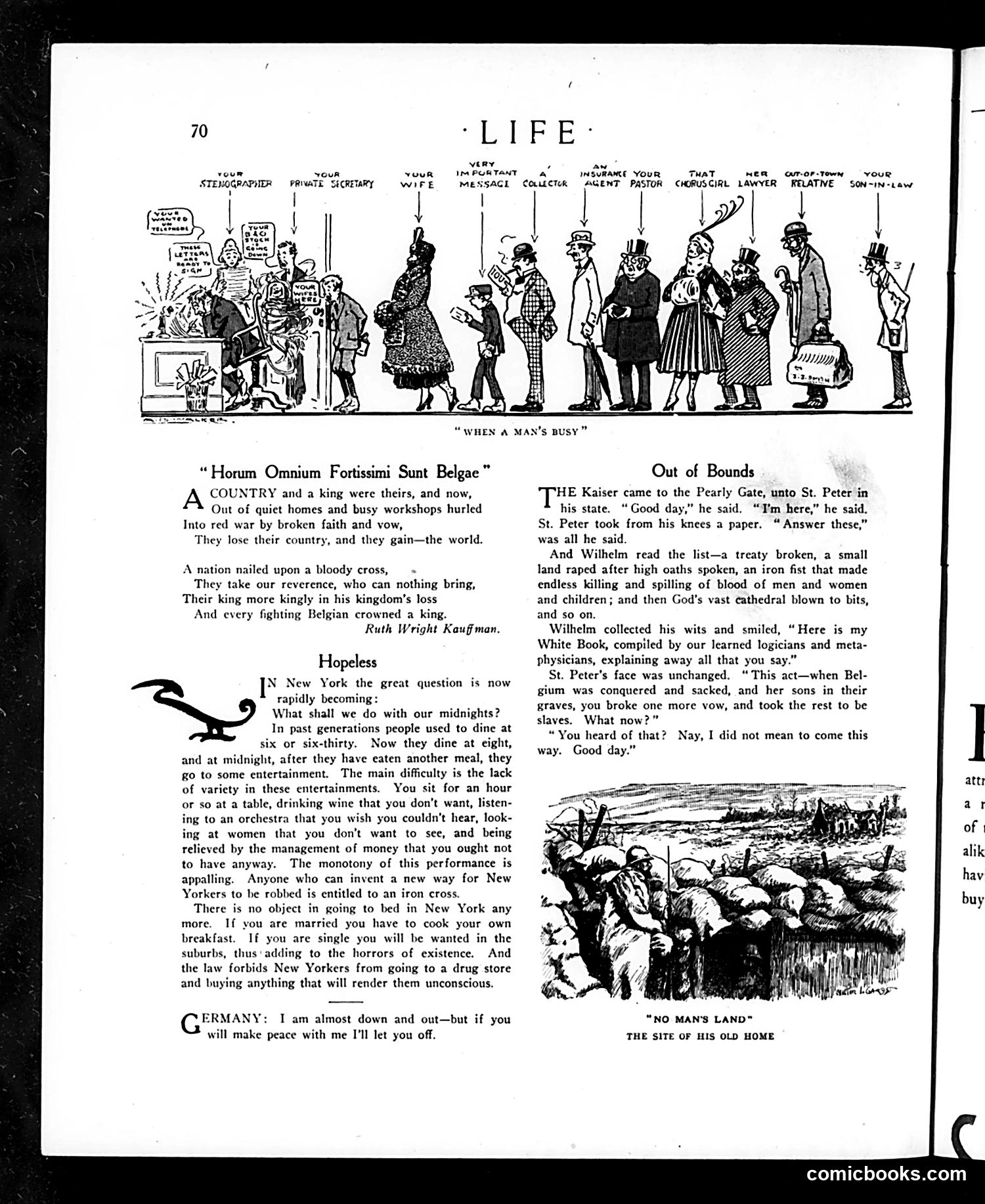
**Top Cartoon ("When a Man's Busy"):** A satirical diagram showing various people interrupting a busy man—his stenographer, private secretary, wife, insurance agent, pastor, and others all demanding his attention simultaneously. This mocks the chaos of modern urban life and competing demands on professional men's time. **"Horum Omnium Fortissimi Sunt Belgae":** A patriotic poem honoring Belgium's resistance during WWI, describing Belgians as a nation "nailed upon a bloody cross" who lose their country but gain moral authority through suffering. **"Hopeless":** Social satire about New York nightlife—mocking the wealthy's endless quest for midnight entertainment after late dinners, criticizing the monotony and expense of nightclubs and orchestras. It's satirizing upper-class ennui during wartime. **"Out of Bounds":** An allegorical dialogue where Kaiser Wilhelm arrives at heaven's gates and St. Peter confronts him with Germany's WWI atrocities (Belgian invasion, broken treaties, destruction). Wilhelm's attempt to justify himself with a "White Book" (Germany's official war justification) fails. The page reflects 1917-1918 American anti-German sentiment during WWI.
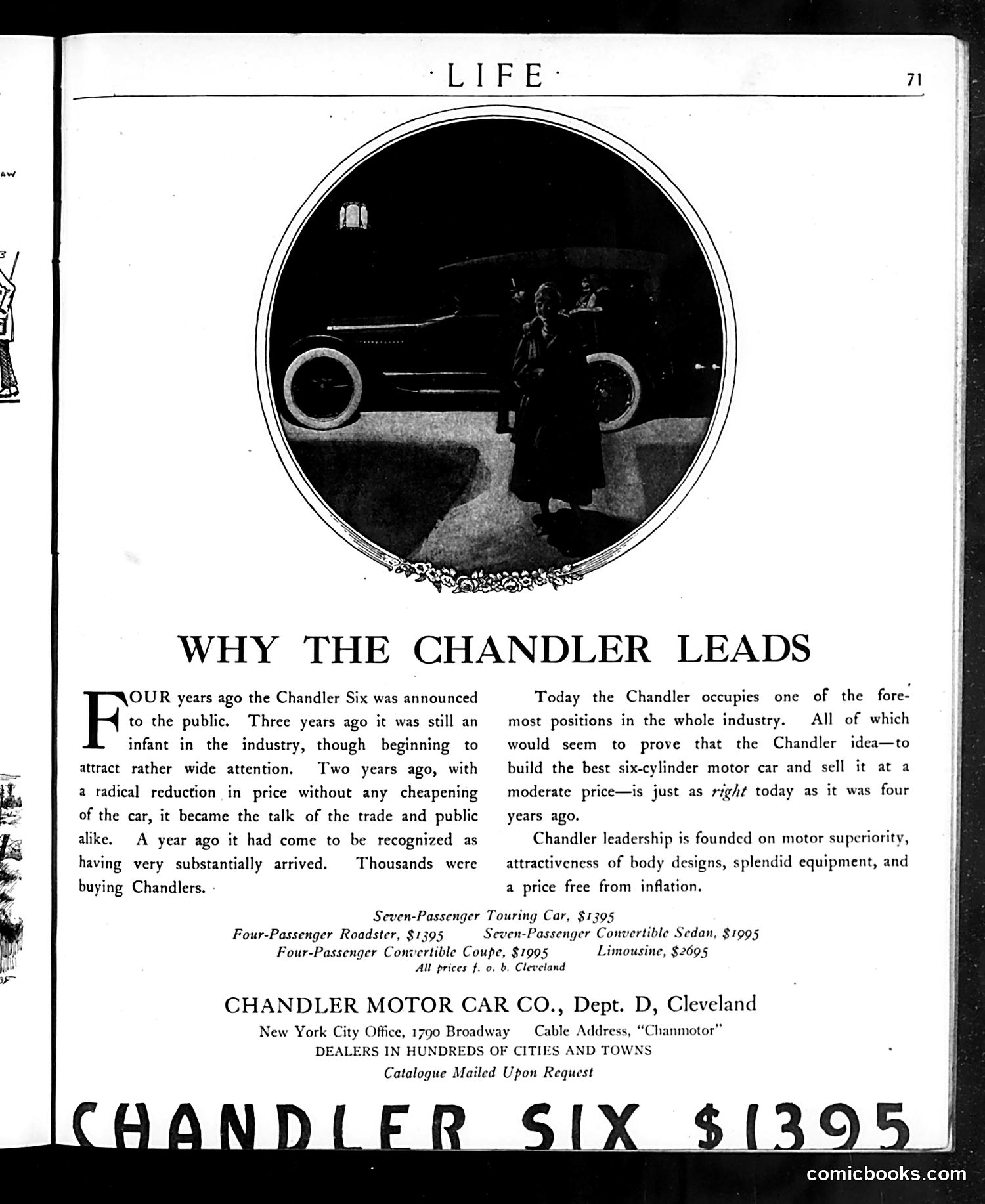
This is a full-page advertisement for the Chandler Motor Car Company, not a political cartoon. The circular photograph shows a woman in dark clothing standing beside a Chandler automobile. The ad's narrative traces the car's market success over four years—from announcement through growing recognition to current market leadership. It emphasizes that the Chandler's strategy of offering a quality six-cylinder car at moderate price "is just as right today as it was four years ago," suggesting stability and proven value during a period of economic inflation (referenced as "a price free from inflation"). The ad lists multiple models and prices ($1,395–$2,695) and notes dealers in hundreds of cities, positioning Chandler as an established, widely-available competitor in the automobile market. There is no satire or political content—this is straightforward commercial advertising aimed at middle-class automobile buyers.
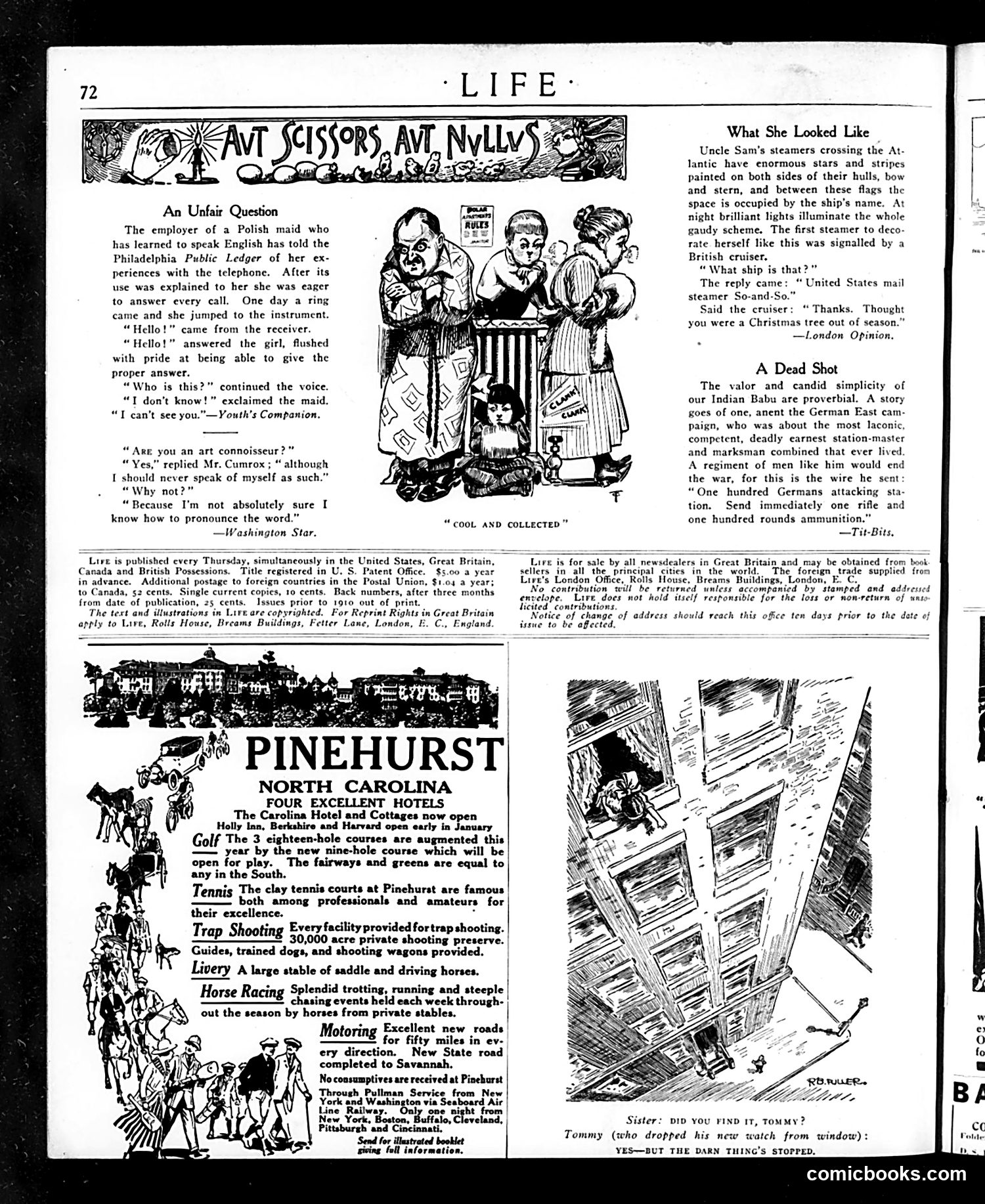
This page contains three brief humorous anecdotes typical of Life's satirical humor: 1. **"An Unfair Question"**: A Polish immigrant maid, newly learning English, answers a telephone. When asked "Who is this?" she replies "I can't see you"—she hasn't yet grasped that telephones transmit voice without visual contact. The joke mocks immigrants' unfamiliarity with modern technology. 2. **"Cool and Collected"** (cartoon): Three figures discuss art connoisseurship. One admits he won't claim expertise because he can't pronounce the word—satirizing pretentious art critics who use fancy vocabulary they don't understand. 3. **"A Dead Shot"**: An Indian station-master during a German military attack sends a laconic telegram requesting "one rifle and one hundred rounds ammunition" to defend against 100 attacking Germans. The joke celebrates understated competence and calm efficiency under fire. The page also contains a substantial Pinehurst, North Carolina resort advertisement promoting golf, tennis, trap shooting, and horse racing.
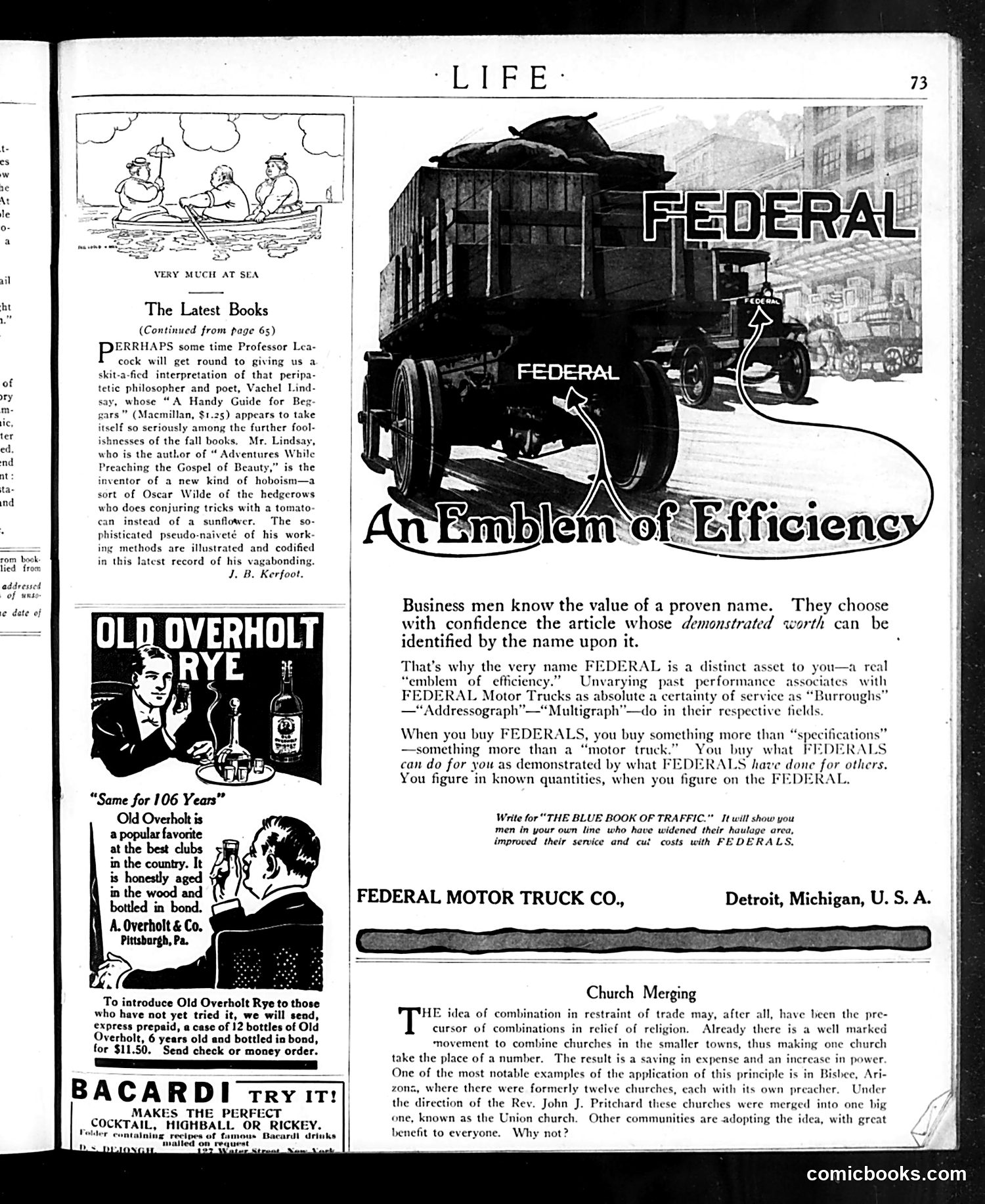
This page is primarily **advertising content** rather than political satire. It contains: 1. **Book Review Section** ("The Latest Books"): A brief mention of Vachel Lindsay's "A Handy Guide for Beggars," describing him as an eccentric poet-philosopher who invented a new form of hoboing. 2. **Liquor Advertisements**: Ads for Old Overholt Rye whiskey (emphasizing its 106-year history) and Bacardi rum—notable because this appears to be from the **Prohibition era** (1920-1933), making these ads anachronistic or potentially violating contemporary restrictions. 3. **Federal Motor Trucks Advertisement**: The largest ad, promoting trucks as reliable, efficient business tools with proven performance records. 4. **"Church Merging" Brief**: A short article praising the consolidation of multiple small-town churches (like Bisbee, Arizona's twelve churches merging into one "Union church") as economically sensible and spiritually beneficial—reflecting 1920s-era efficiency movements. The page reflects early 20th-century business optimism and standardization ideology.
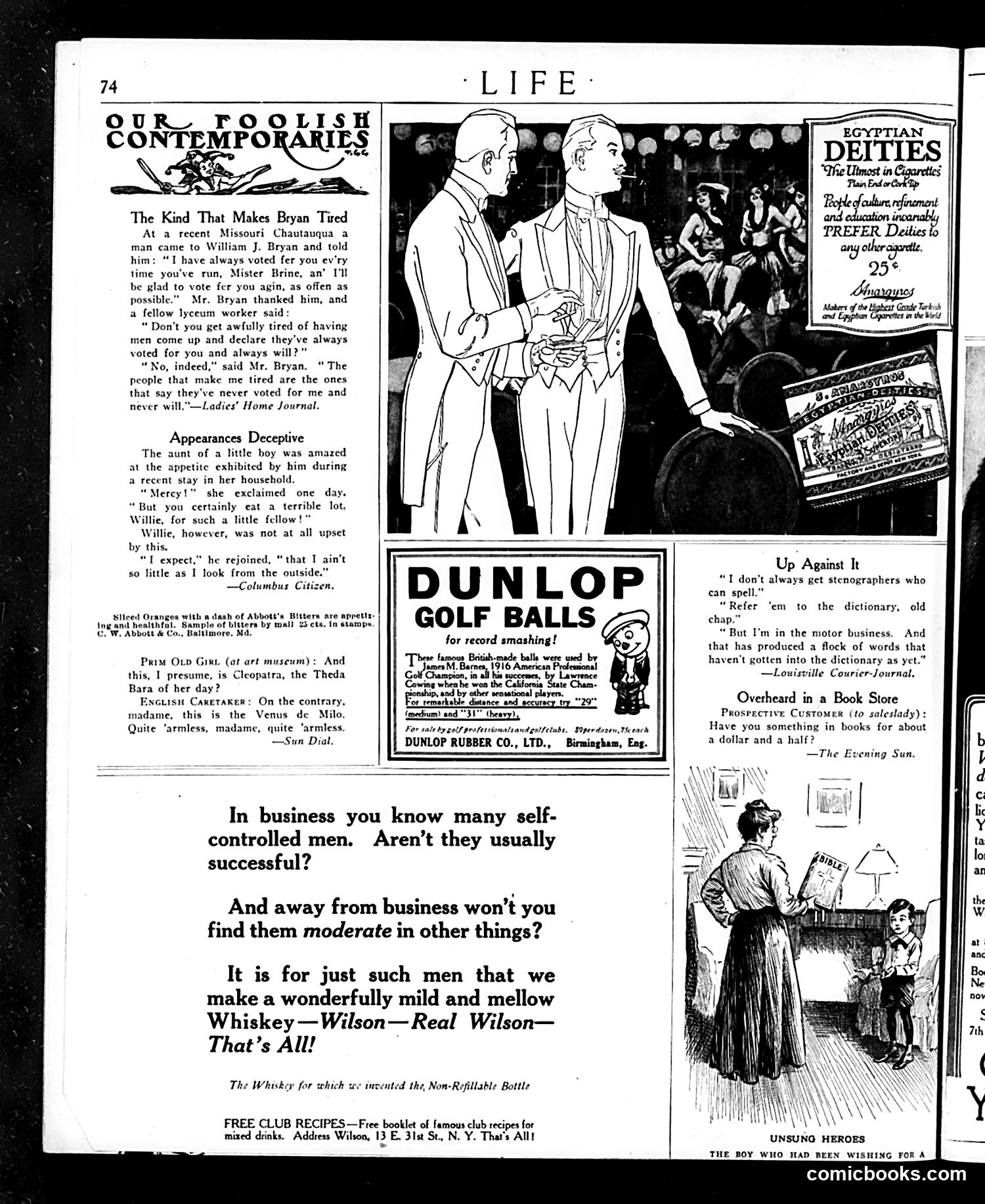
This page contains several short humorous anecdotes typical of early 20th-century American humor magazines. The main political reference is **William Jennings Bryan**, the three-time Democratic presidential candidate. The opening joke contrasts Bryan's exhaustion with supporters who claim perpetual loyalty versus those who say they've never voted for him—suggesting the latter's honesty is more refreshing than hollow partisan promises. Other content includes: - A joke about a boy's appetite ("I ain't so little as I look from the outside") - A museum guard mistaking classical sculpture for Theda Bara (a famous silent film actress), playing on her exotic film roles - Workplace humor about stenographers and new "motor business" terminology not yet in dictionaries - Advertisements for golf balls, Egyptian cigarettes, and Wilson whiskey The page reflects period concerns: political rhetoric, silent cinema culture, and emerging automobile industry jargon. The whiskey ad emphasizes "self-controlled men" and moderation—likely coded language given Prohibition era debates.
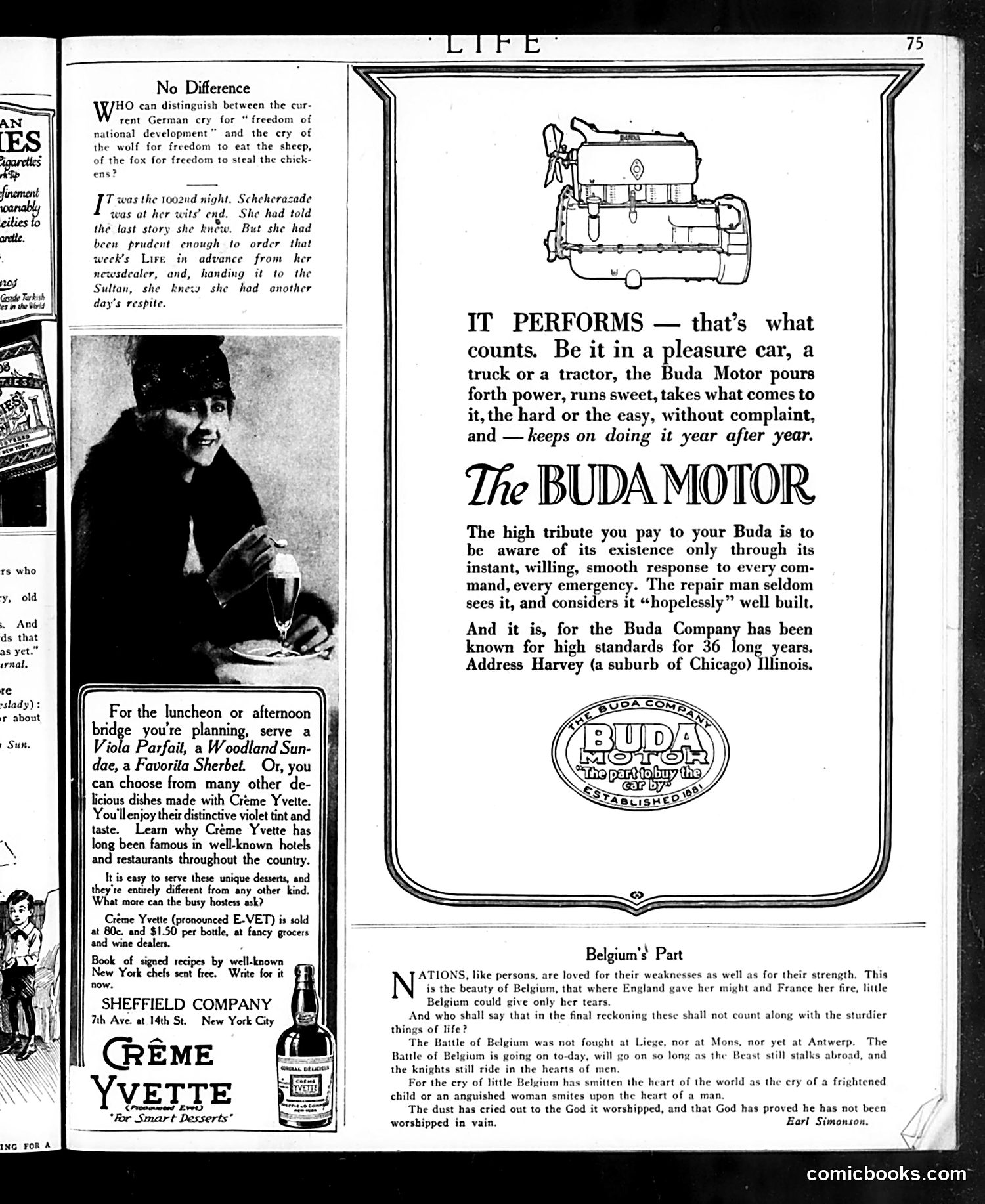
This page mixes editorial commentary with advertising, reflecting American attitudes during World War I. **"No Difference"** opens with political satire: it equates Germany's calls for "freedom of national development" with predatory animals seeking freedom to prey—a sharp condemnation of German expansionism. The accompanying Scheherazade anecdote (the storyteller from *Arabian Nights*) is a meta-joke: even Life magazine itself becomes the "story" keeping readers engaged, implying the publication's cultural importance. **"Belgium's Part"** is earnest wartime propaganda, not satire. It romanticizes Belgium's suffering and resistance, portraying the nation's "tears" and moral witness as spiritually equivalent to military strength. Written by Earl Simonson, it frames Belgium as a sympathetic victim whose cry "has smitten the heart of the world"—appealing to American sentiment ahead of U.S. entry into the war (1917). The advertisements (Buda Motors, Crème Yvette) are standard commercial content, offering escapist luxury during wartime.
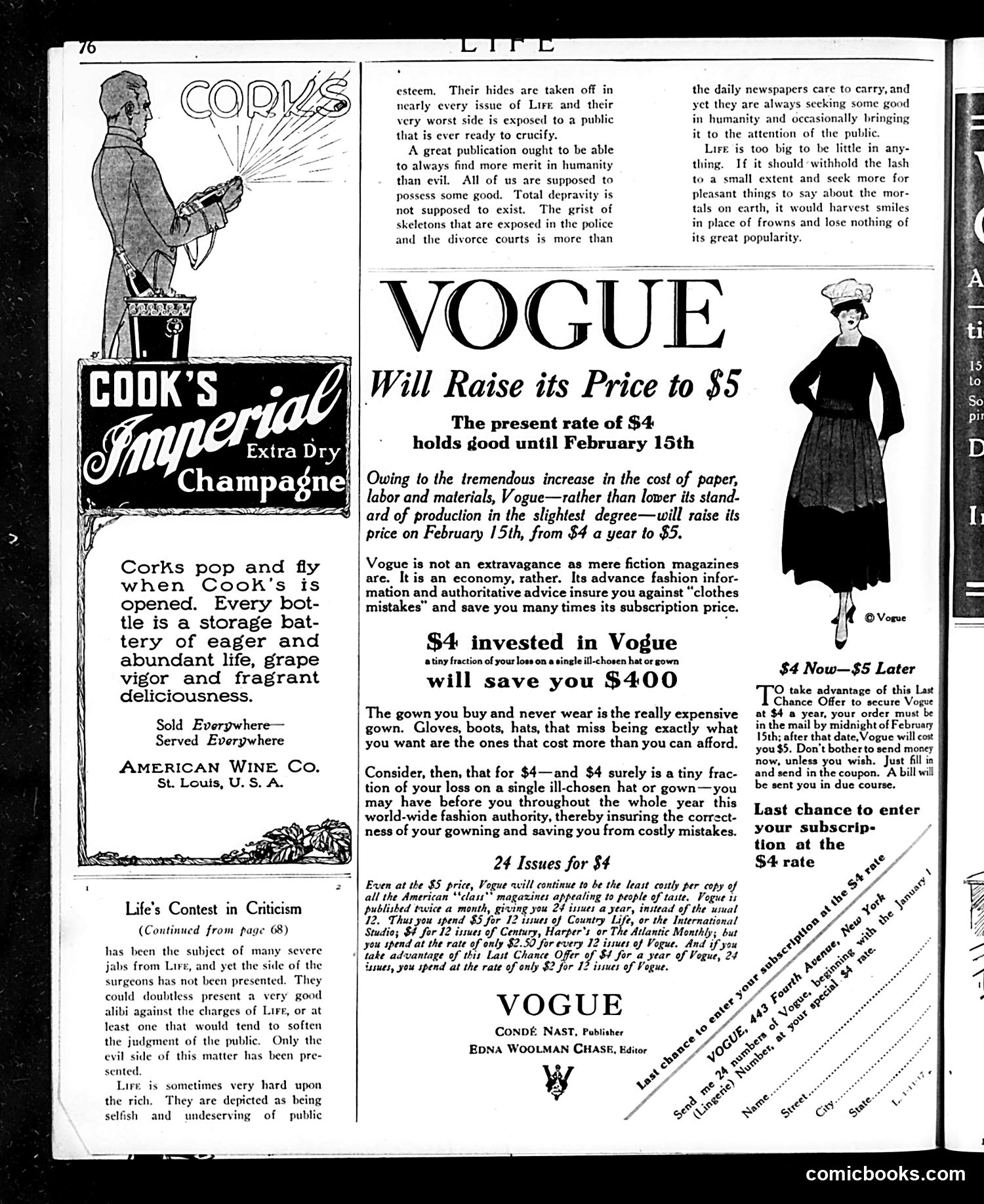
This page contains two advertisements and editorial commentary about magazine criticism. **The Cook's Imperial Champagne ad** (left) uses a simple visual joke: a man holds a champagne bottle labeled with the brand name, which also reads as "CORKS"—the bottle's contents literally "pop and fly when Cook's is opened." **The Vogue price-increase announcement** (right) dominates the page. Vogue is raising its subscription price from $4 to $5 yearly, effective February 15th. The pitch argues this isn't extravagance but economy: the magazine's fashion advice supposedly saves subscribers $400 annually by preventing costly clothing mistakes. At $5/year for 24 bimonthly issues, Vogue claims better value than competitors like *Century* or *Harper's* at $4/year for 12 issues. **The editorial text** above discusses *Life* magazine's critical approach, defending its satirical attacks on the wealthy and powerful while acknowledging criticism that it focuses excessively on society's flaws rather than virtues. The advertisements reflect early 20th-century luxury marketing to affluent readers.
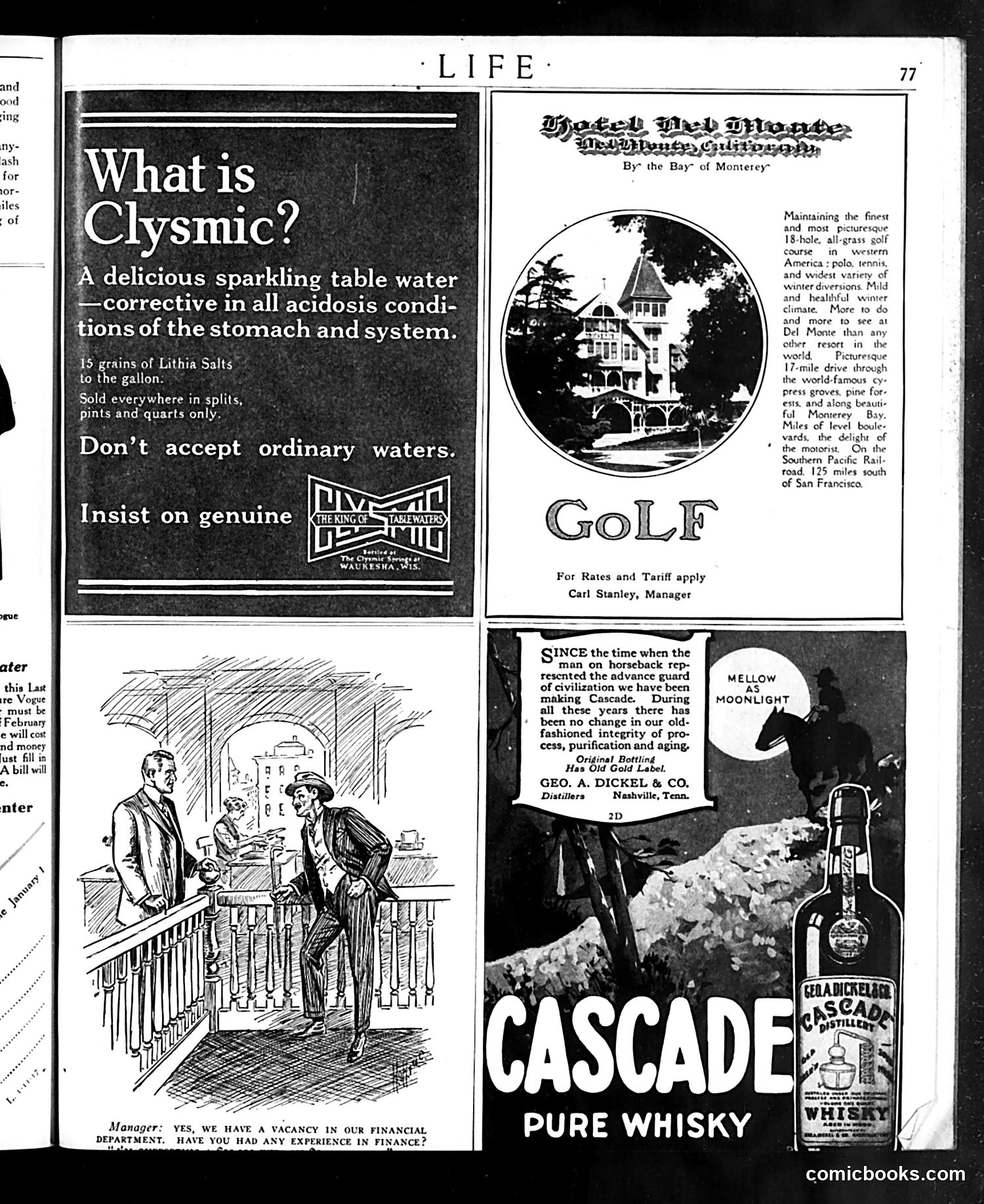
This is primarily an **advertisement page** from an early 20th-century issue of Life magazine, containing three unrelated ads: 1. **Clysmic water** (top left): A patent medicine ad claiming to treat stomach acidity, containing lithia salts. The tagline "Don't accept ordinary waters" emphasizes branded authenticity. 2. **Del Monte Golf Resort** (top right): A travel advertisement for Monterey Bay's prestigious golf destination, highlighting 18-hole courses and scenic drives as luxury amenities. 3. **Cascade Whiskey** (bottom right): A spirits ad emphasizing old-fashioned production methods and "old-fashioned integrity." The **cartoon** (bottom left) is a standalone joke: a job interviewer asks an applicant if they have financial experience, unrelated to the surrounding ads. The page reflects early 1900s advertising priorities: patent medicines (now regulated), luxury tourism, and alcohol—all presented as lifestyle markers for affluent readers.
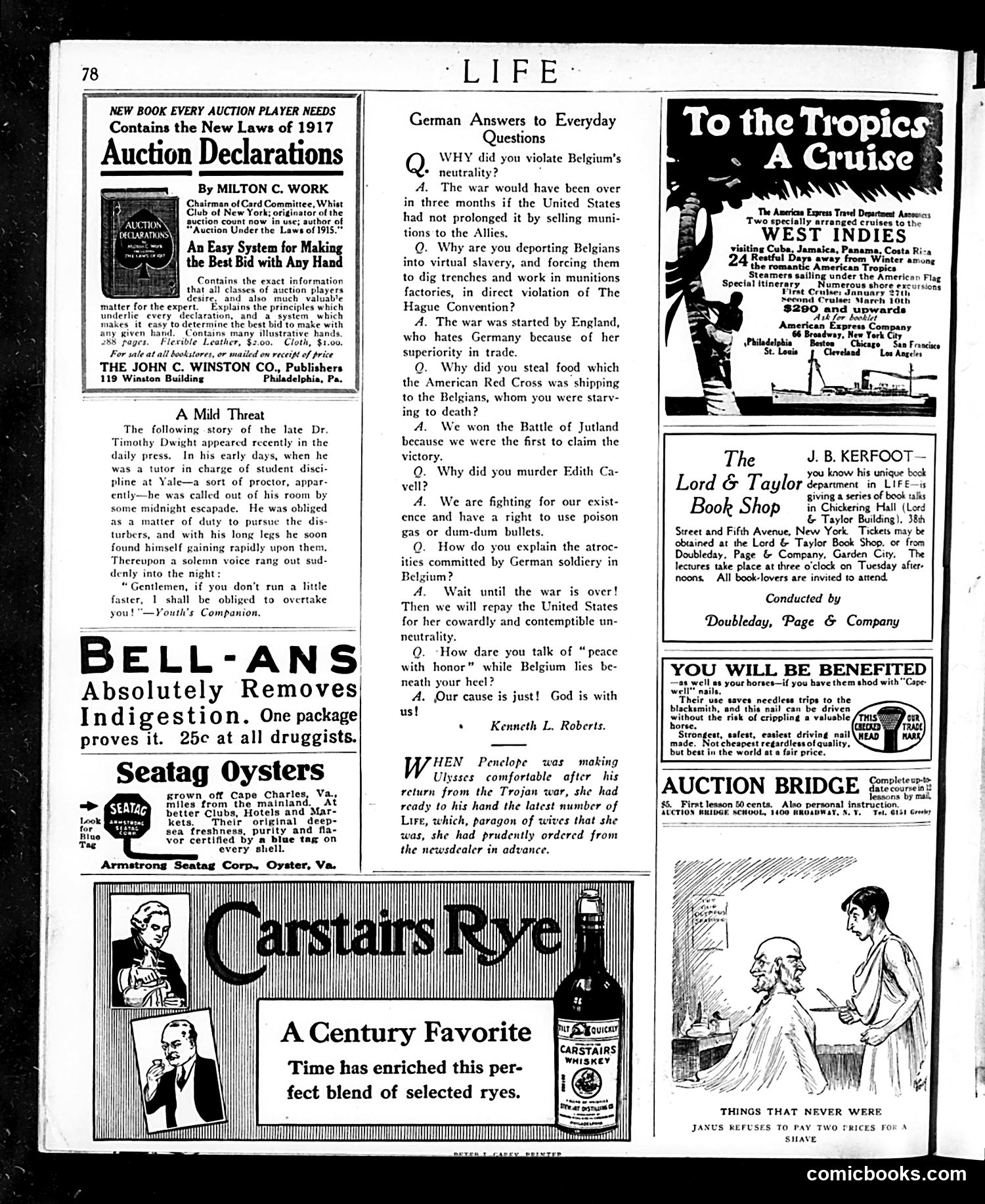
This page contains a biting satirical Q&A piece by Kenneth L. Roberts mocking German justifications for World War I atrocities. Published during America's neutrality period (the "New Laws of 1917" reference dates this), it exposes the logical absurdity and hypocrisy of German propaganda. The satire works by presenting German "answers" to serious charges—Belgian neutrality violations, forced labor, murdering nurse Edith Cavell, using poison gas—that deliberately *avoid* addressing the actual questions. Each response either deflects blame onto enemies (England, the U.S.), makes irrelevant claims (the Battle of Jutland), or punts responsibility ("wait until the war is over"). The final answer—"Our cause is just! God is with us!"—crystallizes the satire: Germany reduces all moral accountability to circular patriotic assertion. This reflects American frustration with German conduct and propaganda during the conflict, particularly resonating with readers sympathetic to Belgium's suffering and horrified by documented atrocities.