
Life, 1917-01-11 · page 25 of 38
Life — January 11, 1917 — page 25: what you’re looking at
What you’re looking at
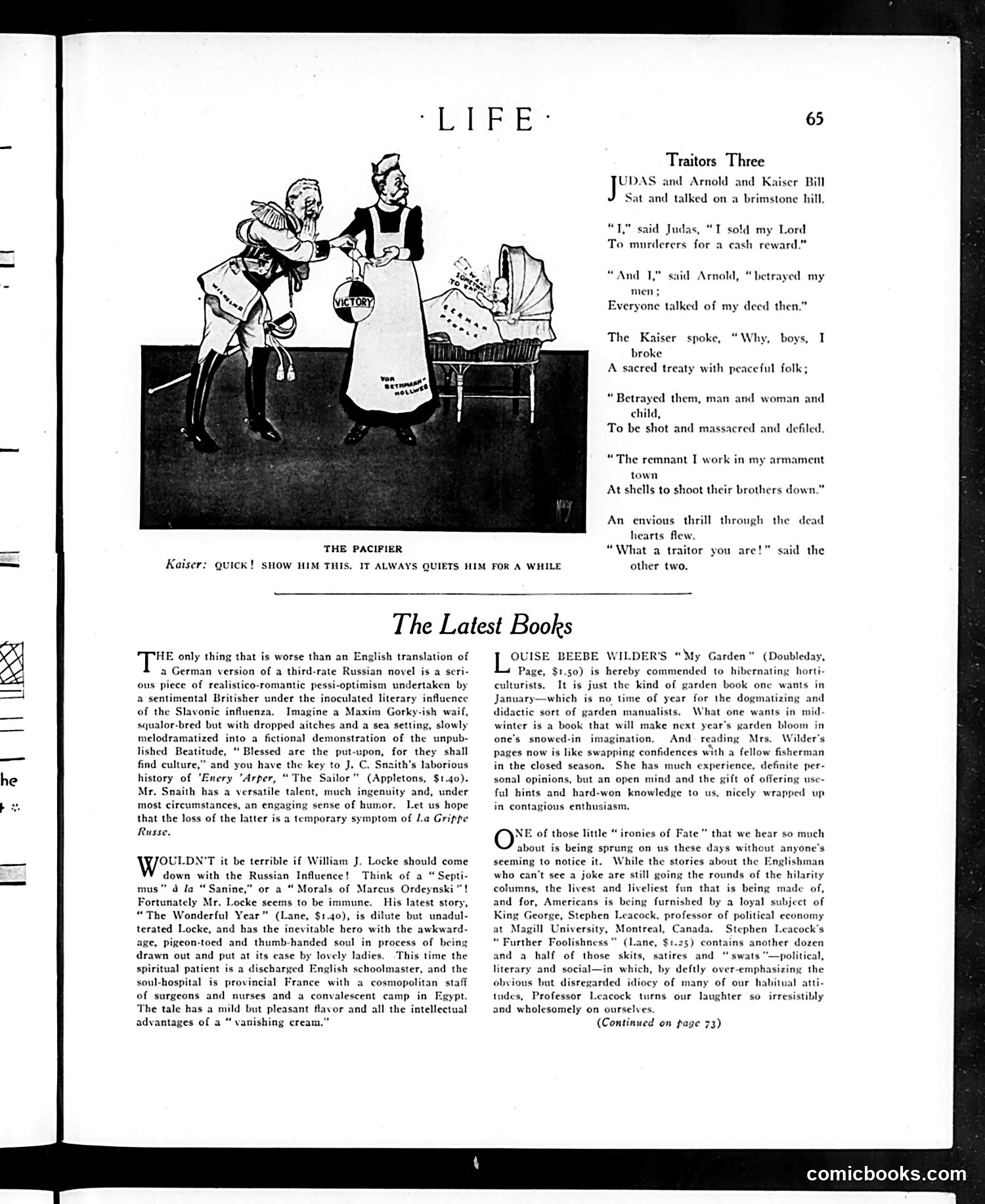
**The Cartoon:** Shows the Kaiser being given a pacifier labeled "VICTORY" to quiet him, suggesting he's childishly demanding or unstable—a wartime caricature mocking German leadership as infantile and needing appeasement. **The Poem:** Compares Kaiser Wilhelm II to biblical traitor Judas and American Revolutionary traitor Benedict Arnold. All three confess their betrayals, but the Kaiser's transgression—breaking a treaty with peaceful nations, leading to deaths of civilians and soldiers—surpasses theirs in scale and moral enormity. The dead souls express envious admiration for his unprecedented treachery. **Context:** This reflects World War I-era American sentiment portraying Germany as history's greatest betrayer for violating Belgian neutrality (the "sacred treaty") and conducting what Americans viewed as atrocities. The satire equates the Kaiser with archetypal villains, positioning Germany's actions as uniquely contemptible rather than merely another nation's wartime conduct.
📄 Transcribed text from this page (OCR, searchable)
Machine-transcribed from the original scan — historical spelling and the odd misread are preserved.
THE PACIFIER er: QUICK! SHOW HIM THIS. IT ALWAYS QUIETS HIM FOR A WHILE 65 Traitors Three UDAS and Arnold and Kaiser Bill Sat and talked on a brimstone hill. “T," said Judas, “T sold my Lord To murderers for a cash reward.” “And 1," said Arnold, “betrayed my men; Everyone talked of my deed then.” The Kaiser spoke, “Why, boys, I broke A sacred treaty with peaceful folk; “Betrayed them, man and woman and child, To be shot and massacred and defiled. “The remnant I work in my armament town At shells to shoot their brothers down.” An envious thrill through the dead hearts flew. “What a traitor you ar other two. id the The Latest Books OUISE BEEBE WILDER'S “My Garden” (Doubleday, Page, $1.50) is hereby commended to hibernating horti HE only thing that is worse than an English translation of a German version of a third-rate Russian novel is a seri- ous piece of realistico-romantic pessi-optimism undertaken by a sentimental Britisher under the inoculated literary influence of the Slavonic influenza. Imagine a Maxim Gorky-ish waif, squalor-bred but with dropped aitches and a sea setting, slowly melodramatized into a fictional demonstration of the unpub- lished Beatitude, “Blessed are the put-upon, for they shall find culture,” and you have the key to J. C. Snaith’s laborious history of 'Enery ‘Arper, “The Sailor” (Appletons, $1.40). Mr. Snaith has a versatile talent, much ingenuity and, under most circumstances, an engaging sense of humor. Let us hope that the loss of the latter is a temporary symptom of La Grippe Russe. OULDN’T it be terrible if William J. Locke should come down with the Russian Influence! Think of a “Sept mus” 4 la “Sanine,” or a “ Morals of Marcus Ordeynski”! Fortunately Mr. Locke seems to be immune. His latest story, “The Wonderful Year” (Lane, $1.40), is dilute but unadul- terated Locke, and has the inevitable hero with the awkward- age, pigeon-toed and thumb-handed soul in process of being drawn out and put at its case by lovely ladies. ‘This time the spiritual patient is a discharged English schoolmaster, and the soul-hospital is provincial France with a cosmopolitan. staf of surgeons and nurses and a convalescent camp in Egypt The tale has a mild but pleasant flavor and all the intellectual advantages of a “ vanishing cream. culturists, It is just the kind of garden book one wants in January—which is no time of year for the dogmatizing and didactic sort of garden manualists. What one wants in mid winter is a book that will make next year’s garden bloom in one’s snowed-in imagination. And reading Mrs. Wilder's pages now is like swapping confidences with a fellow fisherman in the closed season, She has much experience, definite per- sonal opinions, but an open mind and the gift of offering use- ful hints and hard-won knowledge to us, nicely wrapped up in contagious enthusiasm. O E of those little “ ironies of Fate" that we hear so much about is being sprung on us these days without anyone's seeming to notice it. While the stories about the Englishman who can't see a joke are still going the rounds of the hilarity columns, the livest and liveliest fun that is being made of, and for, Americans is being furnished by a loyal subject of King George, Stephen Leacock, professor of political economy at Magill University, Montreal, Canada. Stephen Leacock’s “ Further Foolishness” (Lane, $1.25) contains another dozen and a half of those skits, satires and literary and social—in which, by deftly over-emphasizing the obvious but disregarded idiocy of many of our habitual atti- tudes, Professor Leacock turns our laughter so. irresistibly and wholesomely on ourselves. (Continued on page 73) swats ""—political, comicbooks.com