
Life, 1917-01-11 · page 18 of 38
Life — January 11, 1917 — page 18: what you’re looking at
What you’re looking at
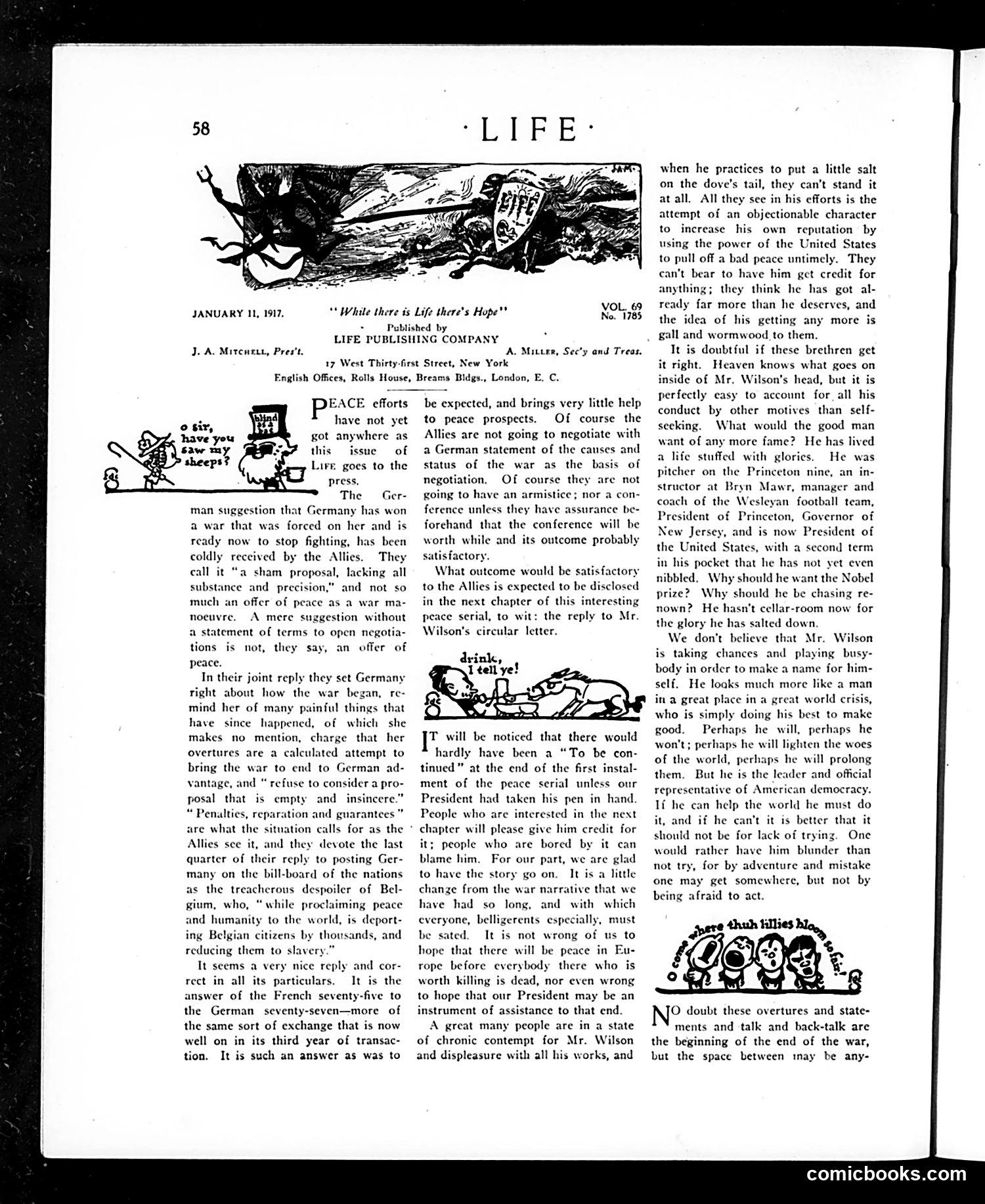
This page comments on early World War I peace negotiations. Germany had proposed an armistice, which the Allies rejected as insincere and lacking concrete terms. The article criticizes Germany's proposal as a "sham," noting Germany made no mention of its violations (particularly the deportation of Belgian citizens). The central focus shifts to President Woodrow Wilson, who had initiated peace inquiries. Life's editors defend Wilson's efforts while acknowledging widespread American hostility toward him. Critics, they note, resent that Wilson might receive credit for peace efforts, viewing his involvement as self-serving reputation-building rather than genuine humanitarian concern. The small cartoon (bottom left) appears to mock this cynicism, though details are unclear. The piece's tone is sardonic—simultaneously supporting peace exploration while recognizing the Allies' justified skepticism about German sincerity.
📄 Transcribed text from this page (OCR, searchable)
Machine-transcribed from the original scan — historical spelling and the odd misread are preserved.
JANUARY 11, 1917, ‘* While there is Life there's Hope"* VOL. 69 No. 1785 Published by LIFE PUBLISHING COMPANY J. A. Mitcnent, Pres’t. A. Miter, Sec’y and Treas. 17 West Thirty-first Street, New York English Offices, Rolls House, Breams Bldgs., London, E. C. ACE efforts have not yet got anywhere as this issue of Lire goes to the press, The — Ger- man suggestion that Germany has won a war that was forced on her and is ready now to stop fighting, has been coldly received by the Allies. They call it “a sham proposal, lacking all substance and precision,” and not so much an offer of peace as a war ma- noeuvre. A mere suggestion without a statement of terms to open negoti tions is not, they say, an offer of peace. In their joint reply they set Germany right about how the war began, re- mind her of many painful things that have since happened, of which she makes no mention, charge that her overtures are a calculated attempt to bring the war to end to German ad- vantage, and “ refuse to consider a pro- posal that is empty and_ insincere.” “ Penalti reparation and guarantees” are what the situation calls for as the Allies sce it, and they devote the last quarter of their reply to posting Ger- many on the bill-board of the nations as the treacherous despoiler of Bel- gium, who, “while proclaiming peace and humanity to the world, is deport- ing Belgian citizens by thousands, and reducing them to slavery.” It seems a very nice reply and cor- rect in all its particulars. It is the answer of the French seventy-five to the German seventy-seven—more of the same sort of exchange that is now well on in its third year of transac- tion. It is such an answer as was to be expected, and brings very little help to peace prospects. Of course the Allies are not going to negotiate with a German statement of the causes and status of the war as the basis of negotiation, Of course they are not going to have an armistice; nor a con- ference unless they have assurance be- forehand that the conference will be worth while and its outcome probably satisfactory. What outcome would be satisfactory to the Allies is expected to be disclosed in the next chapter of this interesting peace serial, to wit: the reply to Mr. Wilson’s circular letter. T will be noticed that there would hardly have been a “To be con- tinued” at the end of the first instal- ment of the peace serial unless our President had taken his pen in hand. People who are interested in the next chapter will please give him credit for it; people who are bored by it can blame him. For our part, we are glad to have the story go on. It is a little change from the war narrative that we have had so long, and with which everyone, belligerents especially, must be sated. It is not wrong of us to hope that there will be peace in Eu- rope before everybody there who is worth killing is dead, nor even wrong to hope that our President may be an instrument of assistance to that end. A great many people are in a state of chronic contempt for Mr. Wilson and displeasure with all his works, and when he practices to put a little salt on the dove’s tail, they can't stand it at all. All they see in his efforts is the attempt of an objectionable character to increase his own reputation by using the power of the United States to pull off a bad peace untimely. They can't bear to have him get credit for anything; they think he has got al- ready far more than he deserves, and the idea of his getting any more is gall and wormwood.to them, It is doubtful if these brethren get it right. Heaven knows what goes on inside of Mr, Wilson’s head, but it is perfectly easy to account for. all his conduct by other motives than self- secking. What would the good man want of any more fame? He has lived a life stuffed with glories. He was pitcher on the Princeton nine, an in- structor at Bryn Mawr, manager and h of the Wesleyan football team, President of Princeton, Governor of New Jersey, and is now President of the United States, with a second term in his pocket that he has not yet even nibbled. Why should he want the Nobel priz Why should he be chasing re- nown? He hasn't cellar-room now for the glory he has salted down We don't believe that Mr. Wilson is taking chances and playing busy- body in order to make a name for him- self. He loaks much more like a man in a great place in a great world crisis, who is simply doing his best to make good. Perhaps he will, perhaps he won't; perhaps he will lighten the woes of the world, perhaps he will prolong them. But he is the leader and official representative of American democracy. If he can help the world he must do it, and if he can't it is better that it should not be for lack of trying. One would rather have him blunder than not try, for by adventure and mistake one may get somewhere, but not by being afraid to act. 'O doubt these overtures and state- ments and talk and back-talk are the beginning of the end of the war, but the space between imay be any- comicbooks.com