
Life, 1917-01-11 · page 10 of 38
Life — January 11, 1917 — page 10: what you’re looking at
What you’re looking at
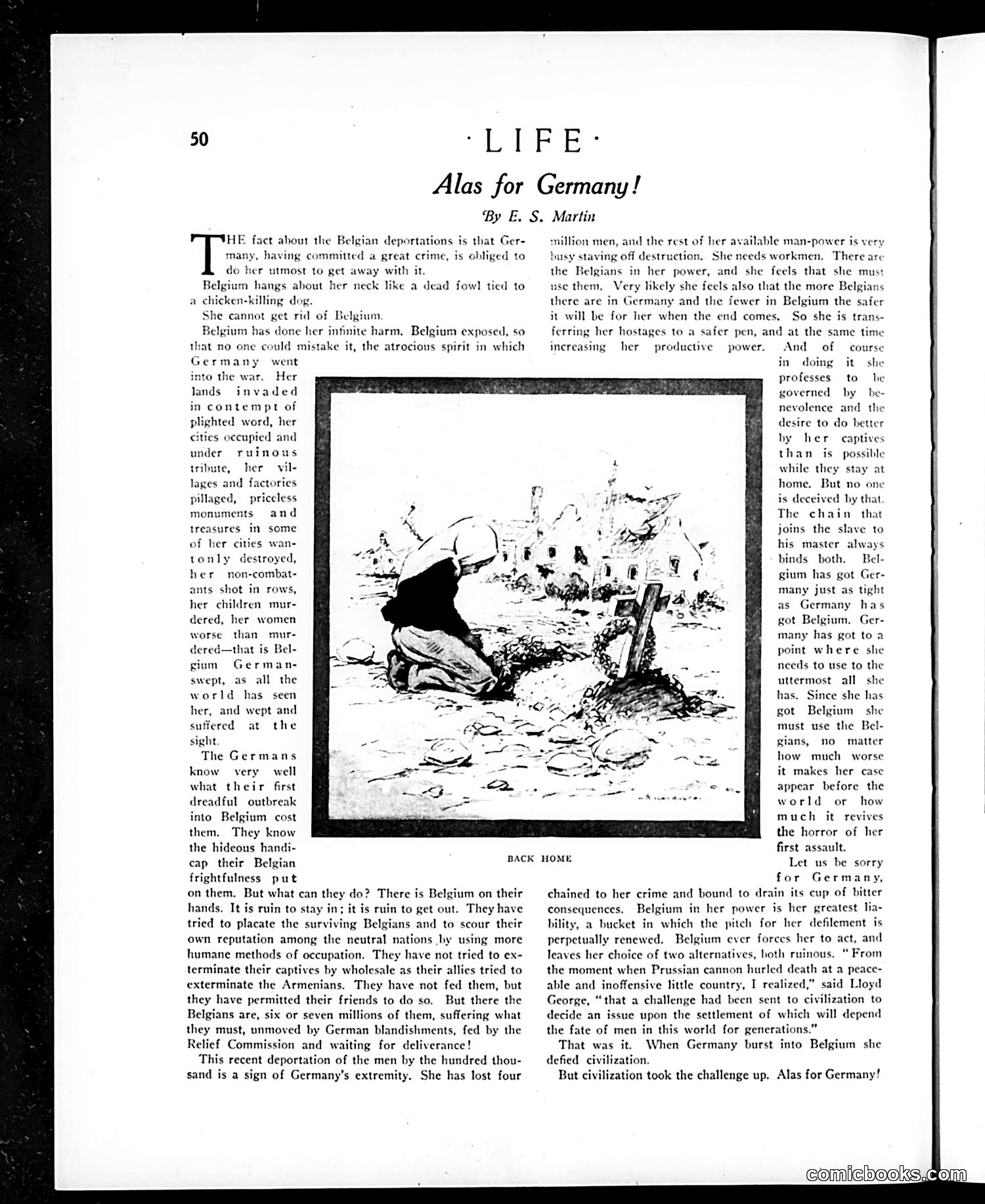
This 1915 Life magazine article condemns German military conduct in Belgium during World War I. The central illustration titled "BACK HOME" depicts a grieving Belgian woman in devastated ruins—referencing Germany's invasion and occupation of Belgium, which involved documented atrocities against civilians. Martin argues that Germany's brutal treatment of Belgium—deportations, executions, property destruction—represents a catastrophic moral failure that will ultimately doom Germany. He notes Belgium faces enslavement but contends civilization itself has taken up the challenge against German militarism. The piece uses Belgium's suffering as evidence of German "extremity" and warns that Germany's crimes create consequences binding both nations together, with Germany's ultimate defeat seemingly inevitable. It's propaganda supporting the Allied cause through accounts of German wartime atrocities.
📄 Transcribed text from this page (OCR, searchable)
Machine-transcribed from the original scan — historical spelling and the odd misread are preserved.
‘LINE * Alas for Germany! By E. S. Martin HE fact about the Belgian deportations is that Ger- many, having committed a gr do her utmost to get away with it. t crime, is obliged to Belgium hangs about her neck like a dead fowl tied to a chicken-killing dog. She cannot get rid of Belgium: Belgium has done her infinite harm, Belgium exposed, so that no one could mistake it, the atrocious spirit in which Germany went into the war. Her lands invaded in contempt of plighted word, her cities occupied and under ruinous tribute, her vil- lages and factories pillaged, priceless monuments and treasures in some of her cities wan- tonly destroyed, her non-combat- ts shot in rows, her children mur- dered, her women worse than = mur- dered—that is Bel- gium = German- swept, as all the world has seen her, and wept and suffered at the sight The Germans know very well what their first dreadful outbreak into Belgium cost them. They know the hideous handi- cap their Belgian frightfulness put on them. But what can they do? There is Belgium on their hands. It is ruin to stay inj it is ruin to get out. They have tried to placate the surviving Belgians and to scour their own reputation among the neutral nations by using more humane methods of occupation. They have not tried to ex- terminate their captives by wholesale as their allies tried to exterminate the Armenians. They have not fed them, but they have permitted their friends to do so. But there the Belgians are, six or seven millions of them, suffering what they must, unmoved by German blandishments, fed by the Relief Commission and waiting for deliverance! This recent deportation of the men by the hundred thou- sand is a sign of Germany’s extremity. She has lost four BACK HOME million men, and the rest of her available man-power is ve asy staving off destruction. She needs workmen. There are the Belgians in her power, and she feels that she must use them. Very likely she feels also that the more Belgia there are in Germany and the fewer in Belgium the safer it will be for her when the end comes. So she is trans- ferring her hostages to a safer pen, and at the same time And of in doing it she professes to he governed by be- nevolence and the increasing her productive power. course desire to do better hy her captives than is possible while they stay at home. But no one is deceived by that T chain that joins the slave to his master always binds both. Bel- gium has got Ger- many just as tight as Germany has got Belgium. C many has got to a point where she needs to use to the uttermost all she has. Since she has got Belgium she must use the Bel- gians, no matter how much worse it makes her case appear before the world or how much it revives the horror of her first assault. Let us be sorry for Germany, chained to her crime and bound to drain its cup of bitter consequences. Belgium in her power is her greatest bility, a bucket in which the pitch for her defilement is perpetually renewed. Belgium ever forces her to act, and leaves her choice of two alternatives, hoth ruinous. “ From the moment when Prussian cannon hurled death at a peace- able and inoffensive little country, I realized,” said Lloyd George, “that a challenge had been sent to civilization to decide an issue upon the settlement of which will depend the fate of men in this world for generations.” That was it. When Germany burst into Belgium she defied civilization. But civilization took the challenge up. Alas for Germany!