
Life, 1917-01-11 · page 19 of 38
Life — January 11, 1917 — page 19: what you’re looking at
What you’re looking at
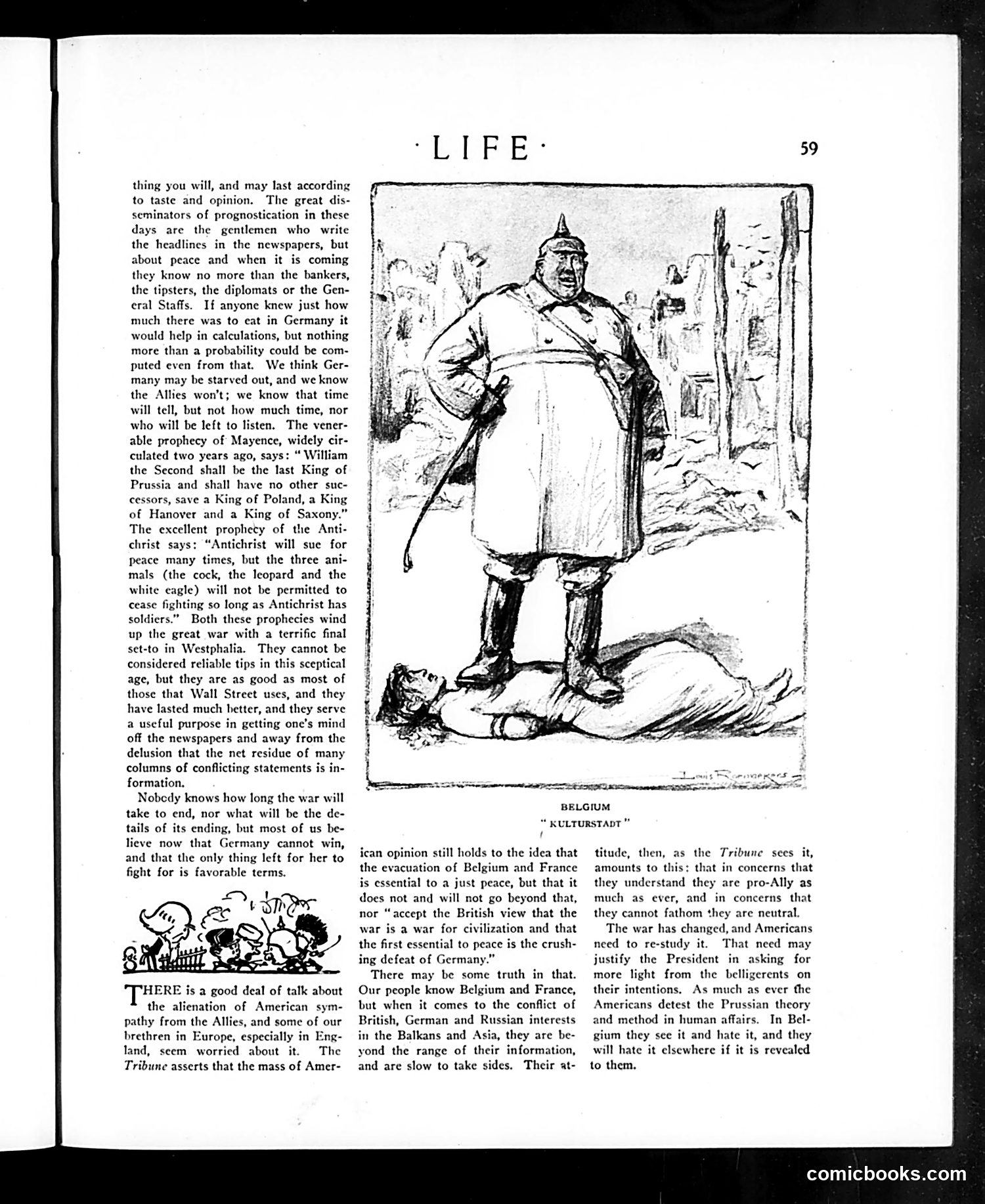
This WWI-era cartoon depicts a German soldier standing over a dead Belgian civilian, sarcastically labeled "Kulturstadt" (German culture/civilization). The image critiques German military conduct in Belgium, specifically referencing documented atrocities committed during the 1914 invasion—widespread killing of civilians, destruction, and occupation. The accompanying text discusses American attitudes toward the war: while Americans support Allied evacuation of Belgium and France, they remain neutral on broader geopolitical conflicts (Balkans, Asia). The article argues Americans "detest the Prussian theory and method in human affairs" and will oppose Germany if its brutality is revealed to them. The cartoon's bitter irony equates German "Kultur" with violence and death, suggesting that Germany's claim to civilized superiority is contradicted by its treatment of occupied territories. This reflects contemporary American propaganda portraying Germany as barbaric.
📄 Transcribed text from this page (OCR, searchable)
Machine-transcribed from the original scan — historical spelling and the odd misread are preserved.
thing you will, and may last according to taste and opinion. The great dis- seminators of prognostication in these days are the gentlemen who write the headlines in the newspapers, but about peace and when it is coming they know no more than the bankers, the tipsters, the diplomats or the Gen- eral Staffs. If anyone knew just how much there was to eat in Germany it would help in calculations, but nothing more than a probability could be com- puted even from that. We think Ger- many may be starved out, and we know the Allies won't; we know that time will tell, but not how much time, nor who will be left to listen. The vener- able prophecy of Mayence, widely cir- culated two years ago, says: “ William the Second shall be the last King of Prussia and shall have no other suc- cessors, save a King of Poland, a King of Hanover and a King of Saxony.” The excellent prophecy of the Anti- christ says: “Antichrist will sue for peace many times, but the three ani- mals (the cock, the leopard and the white eagle) will not be permitted to cease fighting so long as Antichrist has soldiers.” Both these prophecies wind up the great war with a terrific final set-to in Westphalia. They cannot be considered reliable tips in this sceptical age, but they are as good as most of those that Wall Street uses, and they have lasted much better, and they serve a useful purpose in getting one’s mind off the newspapers and away from the delusion that the net residue of many columns of conflicting statements is in- formation, Nobcedy knows how long the war will take to end, nor what will be the de- tails of its ending, but most of us be- lieve now that Germany cannot win, and that the only thing left for her to fight for is favorable terms. 'HERE is a good deal of talk about the alienation of American sym- pathy from the Allies, and some of our brethren in Europe, especially in Eng- land, seem worried about it. The Tribune asserts that the mass of Amer- BELGIUM KULTURSTADT " ican opinion still holds to the idea that the evacuation of Belgium and France is essential to a just peace, but that it does not and will not go beyond that, nor “accept the British view that the war is a war for civilization and that the first essential to peace is the crush- ing defeat of Germany.” There may be some truth in that. Our people know Belgium and France, but when it comes to the conflict of British, German and Russian interests in the Balkans and Asia, they are be- yond the range of their information, and are slow to take sides. Their at- titude, then, as the Tribune sees it, amounts to this: that in concerns that they understand they are pro-Ally as much as ever, and in concerns that they cannot fathom they are neutral. The war has changed, and Americans need to re-study it. That need may justify the President in asking for more light from the belligerents on their intentions. As much as ever the Americans detest the Prussian theory and method in human affairs. In Bel- gium they see it and hate it, and they will hate it elsewhere if it is revealed to them, comicbooks.com