
Life, 1917-01-11 · page 22 of 38
Life — January 11, 1917 — page 22: what you’re looking at
What you’re looking at
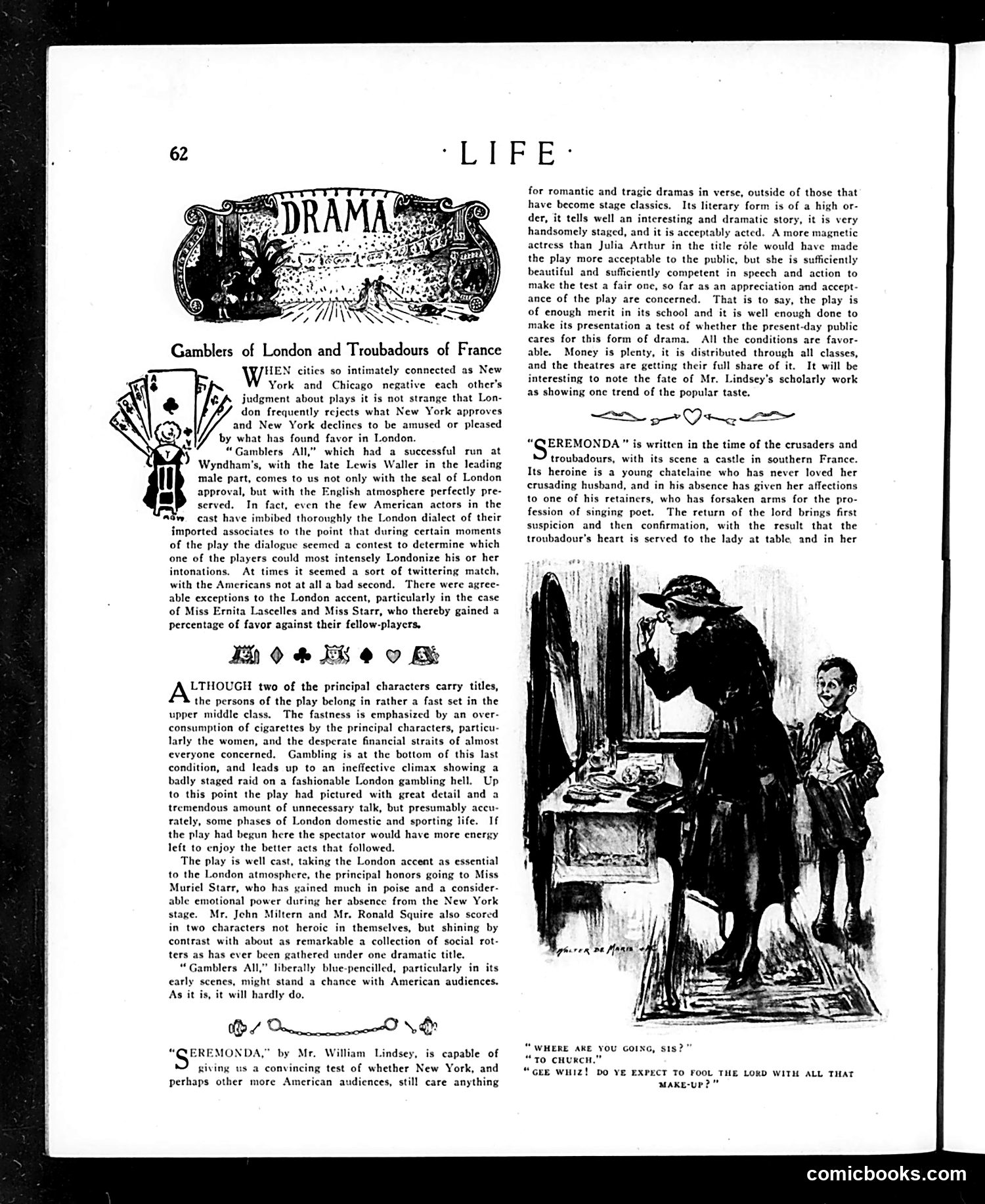
This is a theater review page from *Life* magazine discussing London plays being performed in New York. The page critiques two productions: **"Gamblers All"** - A London play about upper-middle-class characters involved in gambling and financial desperation. The review notes that American actors in the cast have adopted exaggerated London accents, creating an unintentionally comedic "twittering match" of competing pronunciations. The critic praises actress Muriel Starr's poise but suggests the play needs heavy editing to appeal to American audiences. **"Seremonda"** - A verse drama by William Lindsey, testing whether American audiences still appreciate romantic/tragic drama in poetic form. Julia Arthur stars, though the critic suggests a "more magnetic actress" would help. The illustration shows a domestic scene, likely from one of these plays. The page reflects early 20th-century theater criticism and the cultural divide between London and New York theatrical tastes—a recurring theme in *Life*'s satirical commentary on Anglo-American cultural pretension.
📄 Transcribed text from this page (OCR, searchable)
Machine-transcribed from the original scan — historical spelling and the odd misread are preserved.
“LIFE: Gamblers of London and Troubadours of France HEN cities so intimately connected as New York and Chicago negative each other's [2A judgment about plays it is not strange that Lon- don frequently rejects what New York approves and New York declines to be amused or pleased by what has found favor in London. ) “Gamblers All," which had a successful run at Wyndham's, with the late Lewis Waller in the leading male part, comes to us not only with the seal of London approval, but with the English atmosphere perfectly pre- served. In fact, even the few American actors in the cast have imbibed thoroughly the London dialect of their imported associates to the point that during certain moments of the play the dialogue seemed a contest to determine which one of the players could most intensely Londonize his or her intonations, At times it seemed a sort of twittering match, with the Americans not at all a bad second. There were agree- able exceptions to the London accent, particularly in the case of Miss Ernita Lascelles and Miss Starr, who thereby gained a Percentage of favor against their fellow-playcrs, FB) & o° & LTHOUGH two of the principal characters carry titles, the persons of the play belong in rather a fast set in the upper middle class, The fastness is emphasized by an over- consumption of cigarettes by the principal characters, particu- larly the women, and the desperate financial straits of almost everyone concerned, Gambling is at the bottom of this last condition, and leads up to an ineffective climax showing a badly staged raid on a fashionable London gambling hell. Up to this point the play had pictured with great detail and a tremendous amount of unnecessary talk, but presumably accu- rately, some phases of London domestic and sporting life. If the play had begun here the spectator would have more energy left to enjoy the better acts that followed. The play is well cast, taking the London accent as essential to the London atmosphere, the principal honors going to Miss Muriel Starr, who has gained much in poise and a consider- able emotional power during her absence from the New York stage. Mr. John Miltern and Mr. Ronald Squire also scored in two characters not heroic in themselves, but shining by contrast with about as remarkable a collection of social rot- ters as has ever been gathered under one dramatic title, “Gamblers All,” liberally blue-pencilled, particularly in its early scenes, might stand a chance with American audiences. it will hardly do, / Onno NG “Ss! JONDA,” by Mr. William Lindsey, is capable of giving us a convincing test of whether New York, and perhaps other more American audiences, still care anything for romantic and tragic dramas in verse, outside of those that have become stage classics, Its literary form is of a high or- der, it tells well an interesting and dramatic story, it is very handsomely staged, and it is acceptably acted. A more magnetic actress than Julia Arthur in the le role would have made the play more acceptable to the public, but she is sufficiently beautiful and sufficiently competent in speech and action to make the test a fair one, so far as an appreciation and accept- ance of the play are concerned. That is to say, the play is of enough merit in its school and it is well enough done to make its presentation a test of whether the present-day public cares for this form of drama. All the conditions are favor- able. Money is plenty, it is distributed through all classes, and the theatres are getting their full share of it. It will be interesting to note the fate of Mr. Lindsey's scholarly work as showing onc trend of the popular taste. mem. = OO HY “QEREMONDA " is written in the time of the crusaders and troubadours, with its scene a castle in southern France. Its heroine is a young chatelaine who has never loved her crusading husband, and in his absence has given her affections to one of his retainers, who has forsaken arms for the pro- fession of singing poet. The return of the lord brings first suspicion and then confirmation, with the result that the troubadour's heart is served fo the lady at table and in her “ WHERE ARE YOU GOING, “To CHURCH.” “GEE WHIZ! DO YE EXPECT TO FOOL THE LORD WITH ALL THAT MAKE-UP?" comicbooks.com