
A complete issue · 48 pages · 1916
Life — June 15, 1916
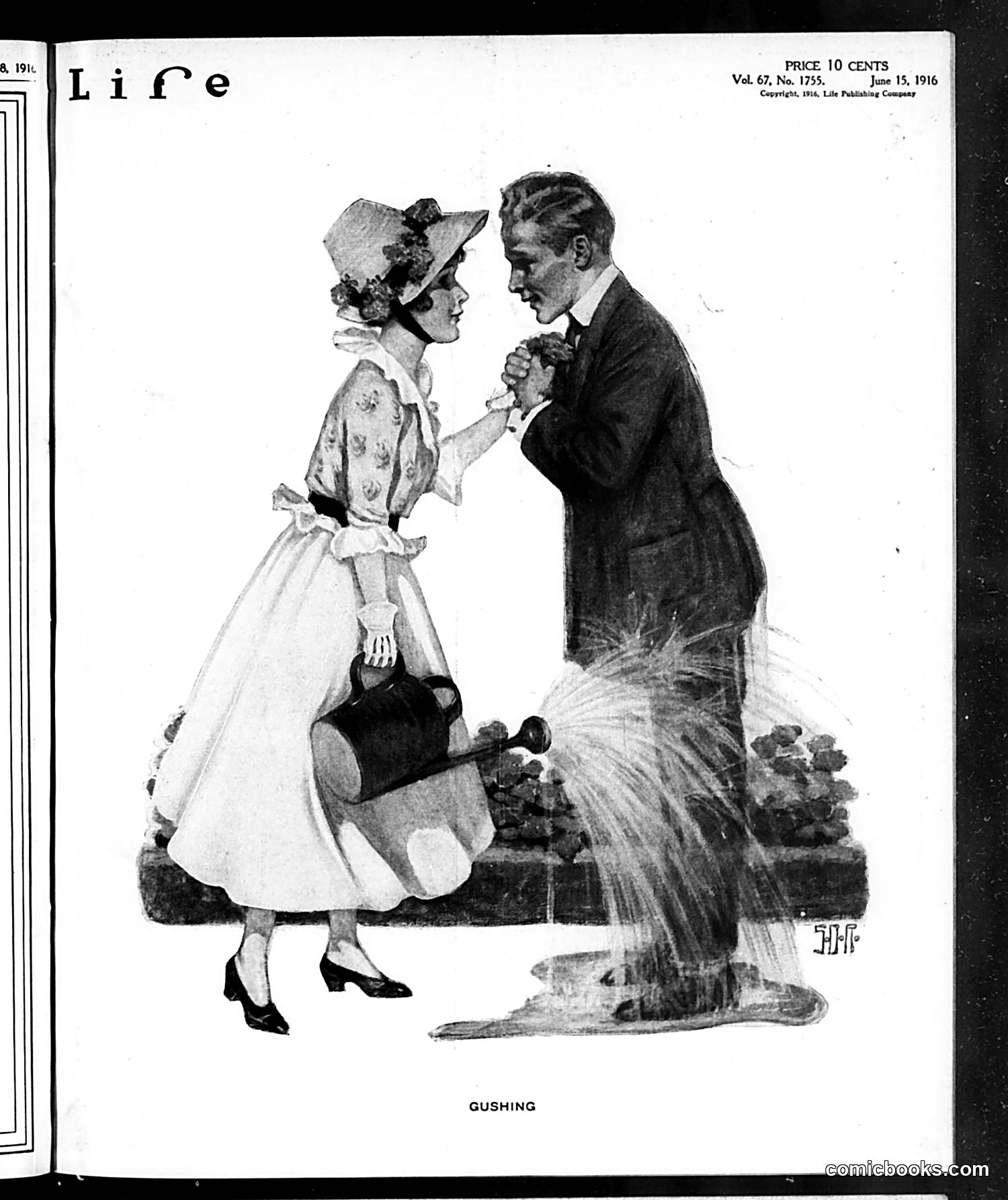
This cartoon satirizes excessive sentimentality or flattery in courtship. The illustration shows a man in formal attire kneeling before a woman in a garden setting, appearing to deliver fervent romantic declarations. The caption "GUSHING" labels this exaggerated emotional display. The satire mocks men who overstate their feelings or resort to melodramatic behavior to impress women. The woman's somewhat bemused expression suggests she recognizes the performance as insincere or overwrought. This reflects early 20th-century social commentary on courtship rituals and the tension between genuine emotion and performative romance during the Edwardian era. The cartoon exemplifies Life magazine's characteristic humor about contemporary social manners and dating conventions.
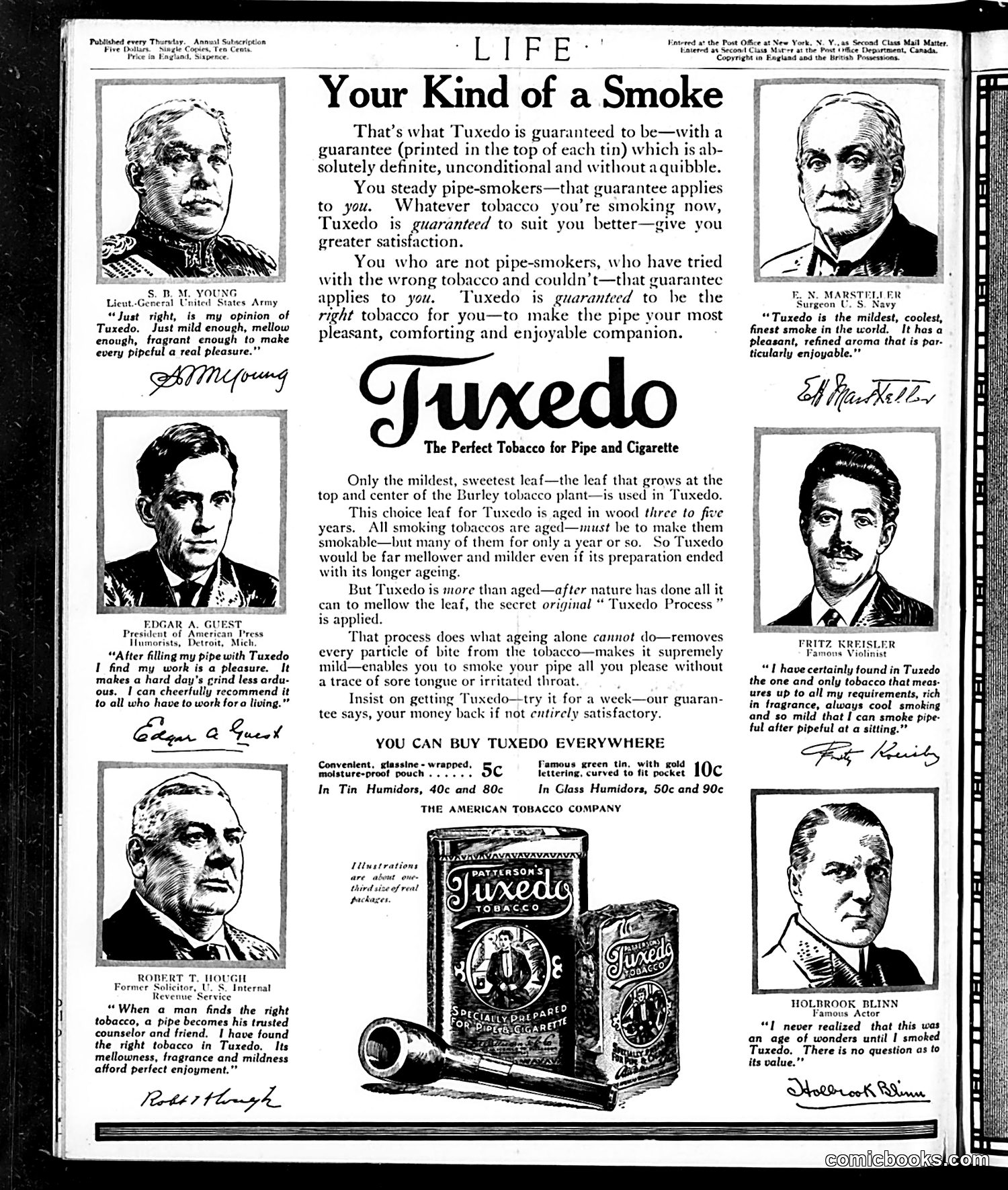
This is **not a cartoon or satire page** — it's a **tobacco advertisement** for Tuxedo brand pipe and cigarette tobacco from The American Tobacco Company. The page features testimonials from six named public figures (S.H.M. Young, E.N. Marsteller, Edgar A. Guest, Fritz Kreisler, Robert Lansing, and Holbrook Blinn) endorsing Tuxedo as superior tobacco. Each testimonial emphasizes mildness, flavor, and satisfaction. The ad highlights Tuxedo's special aging process and claims it removes harshness. Pricing information and product packaging are displayed centrally. This represents **early 20th-century celebrity endorsement advertising** — a common marketing practice before tobacco health warnings existed. The prestigious names lend credibility to product claims that would be illegal to make today.
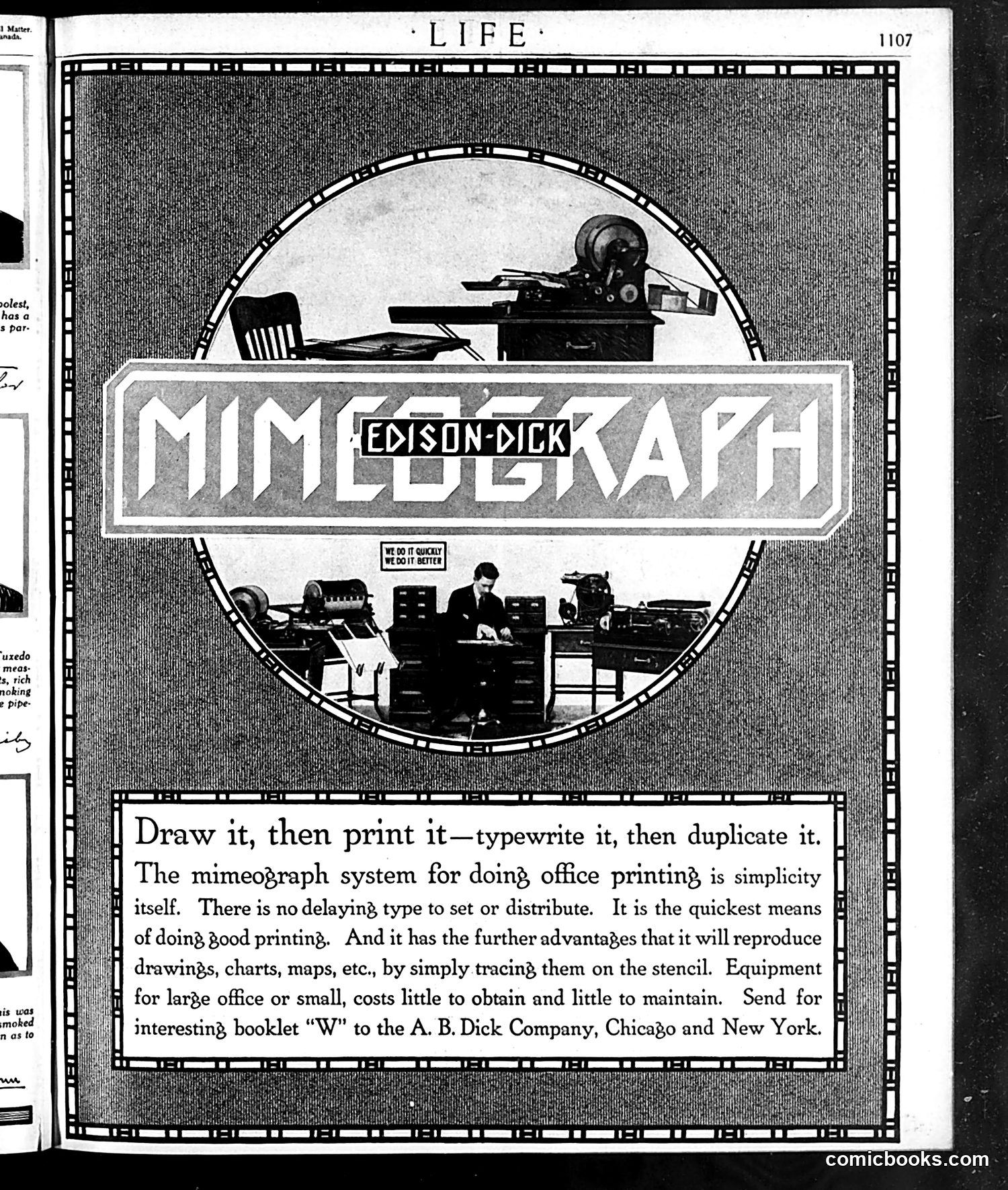
This is a **product advertisement**, not political satire. The page promotes the Edison-Dick mimeograph system for office use. The circular vignette shows an office worker operating mimeograph equipment. The ad emphasizes the machine's simplicity: "Draw it, then print it—typewrite it, then duplicate it." The marketing pitch highlights practical advantages for businesses—no complex typesetting required, quick reproduction of documents, ability to copy drawings and charts via stencil tracing, and low equipment costs for offices of any size. The tagline "We do it quicker, we do it better" appears on a small banner. The ad concludes by directing interested readers to request booklet "W" from the A.B. Dick Company in Chicago and New York.
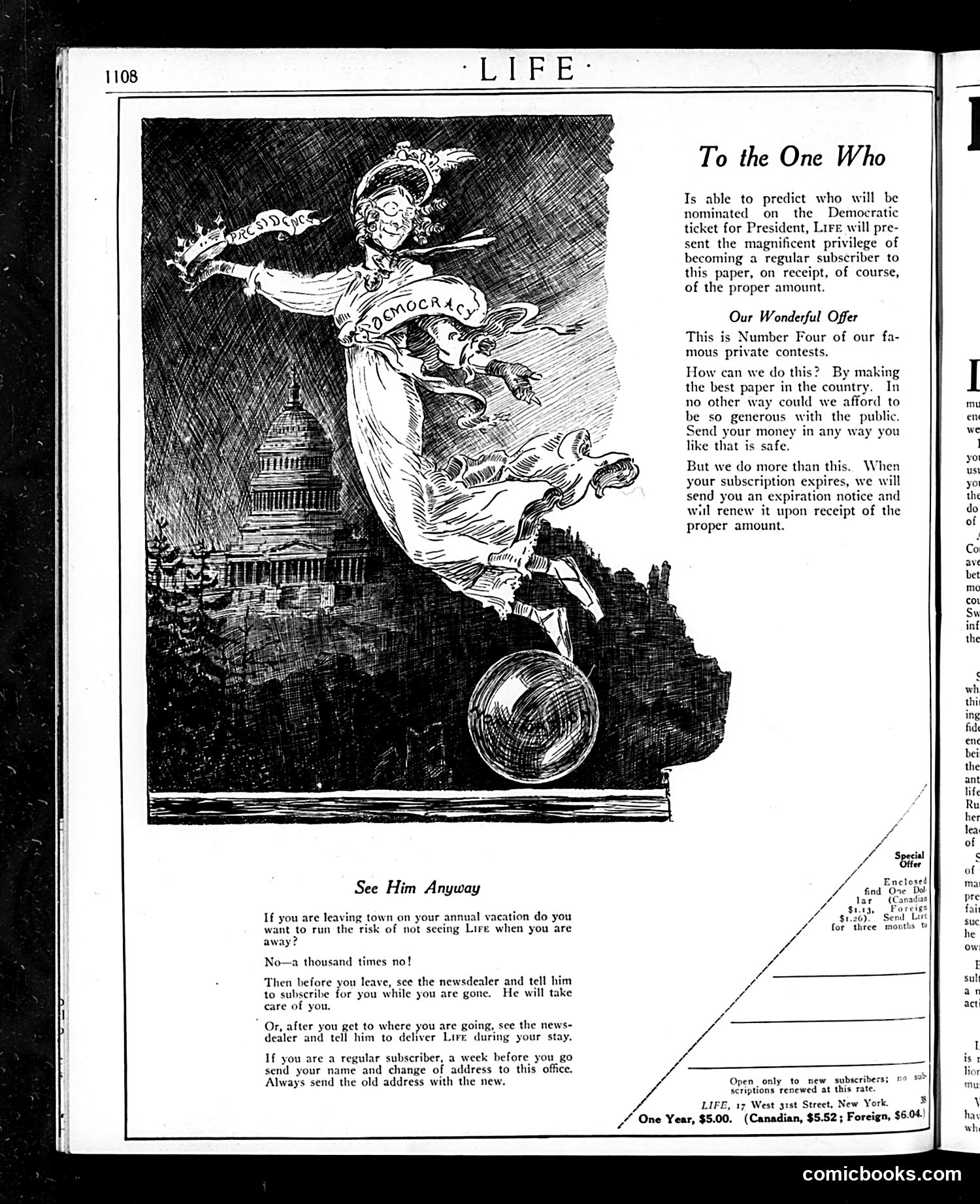
This page is primarily a **subscription advertisement for Life magazine**, not political satire. The large illustration depicts **Lady Democracy** (allegorical female figure in classical dress) floating above the U.S. Capitol building, holding a globe. She appears surrounded by small figures, likely representing political candidates or interests competing for influence. The cartoon's message connects to the text below: "To the One Who Is able to predict who will be nominated on the Democratic ticket for President." This references an **upcoming Democratic presidential nomination**, though the specific year is unclear from this excerpt. The satire is mild—essentially promoting Life magazine subscriptions by offering readers a "wonderful offer" to predict the election outcome, playing on contemporary political uncertainty and public interest in presidential contests.
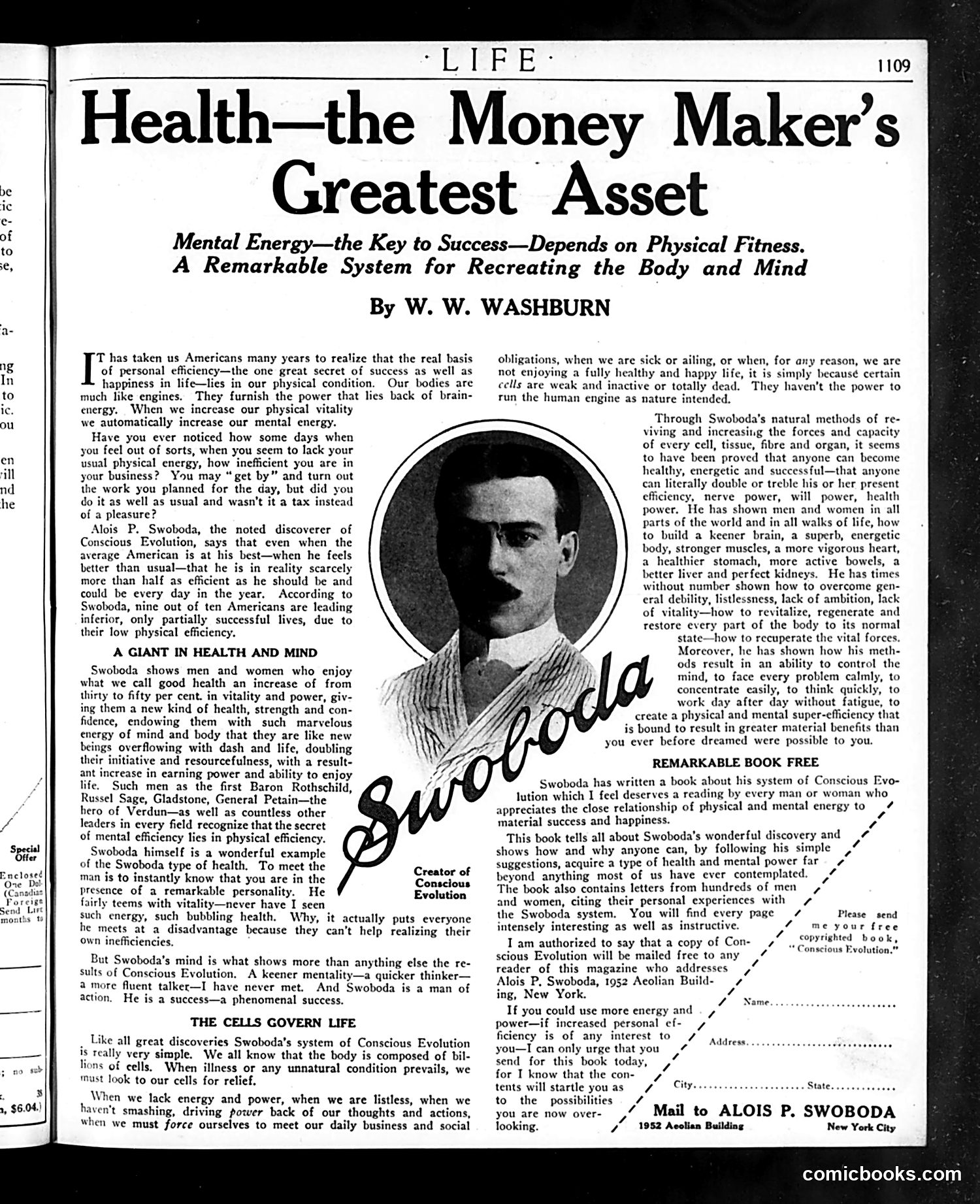
This is **not a political cartoon or satire**, but rather a **health/wellness advertisement** masquerading as editorial content. The page promotes "Swoboda's system of Conscious Evolution," featuring a portrait of Alois P. Swoboda, who claimed to have discovered methods for improving physical and mental health. The article argues that good health is essential to business success and mental energy. This appears to be a **paid advertorial** from the 1950s—a common practice where advertisements were formatted to look like magazine articles. The piece promotes Swoboda's book and includes a mail-in coupon for readers interested in his health system. There is **no satire or political commentary** here; it's straightforward (if dubious) health promotion typical of mid-20th century popular magazines.
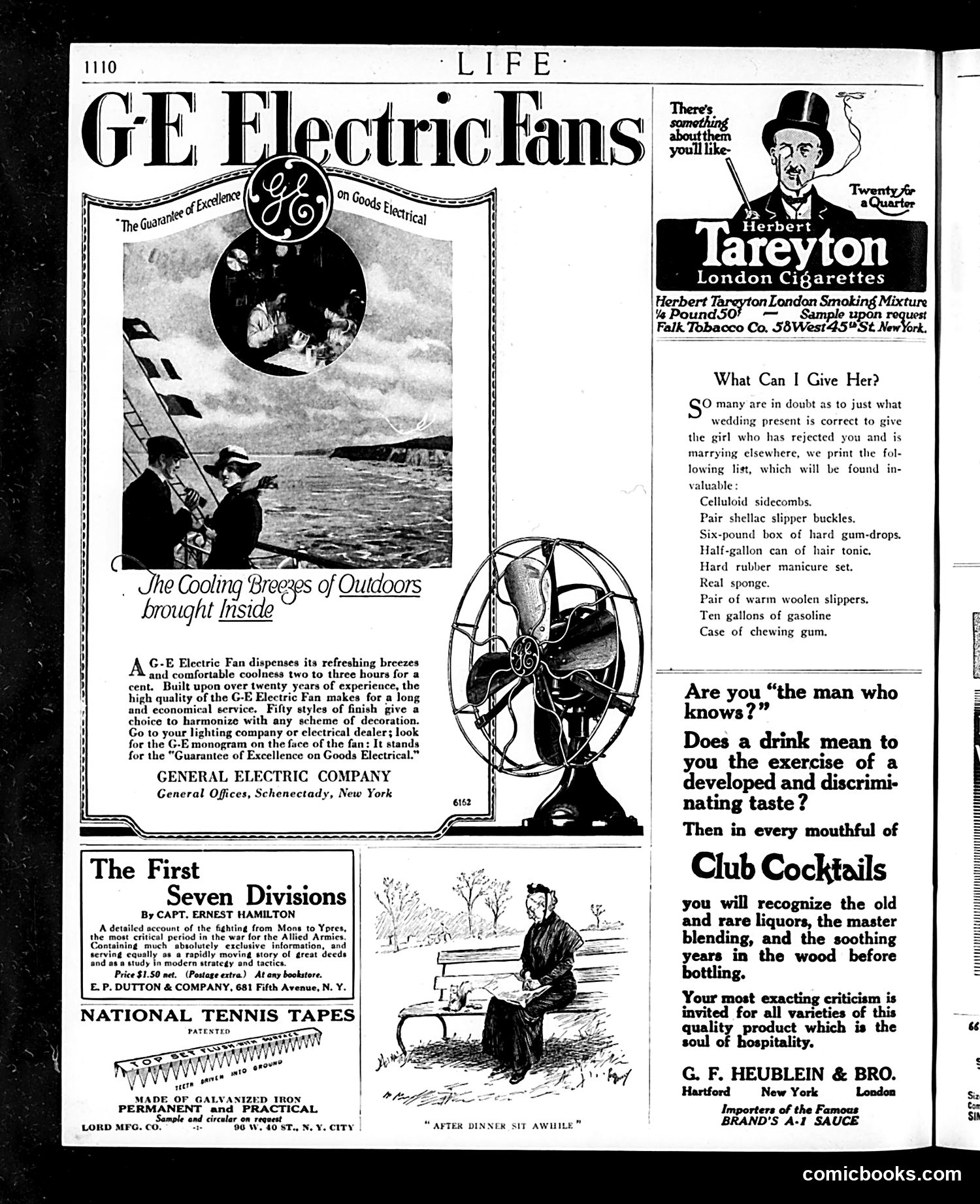
This page is primarily **advertising** rather than editorial content or political satire. The main advertisements include: 1. **GE Electric Fans** - promotes cooling appliances for home comfort 2. **Herbert Tareyton London Cigarettes** - luxury tobacco product 3. **Club Cocktails** - spirits advertisement emphasizing refined taste and hospitality 4. **National Tennis Tapes** - sports equipment for galvanized iron court construction 5. **"The First Seven Divisions"** - appears to be a book advertisement by E.P. Dutton The small illustration "After Dinner Sit Awhile" depicts leisure activities typical of early 20th-century affluent life. **No political cartoons or satirical commentary are present.** This represents LIFE magazine's commercial function as a vehicle for consumer advertising to middle and upper-class readers during the 1920s era.
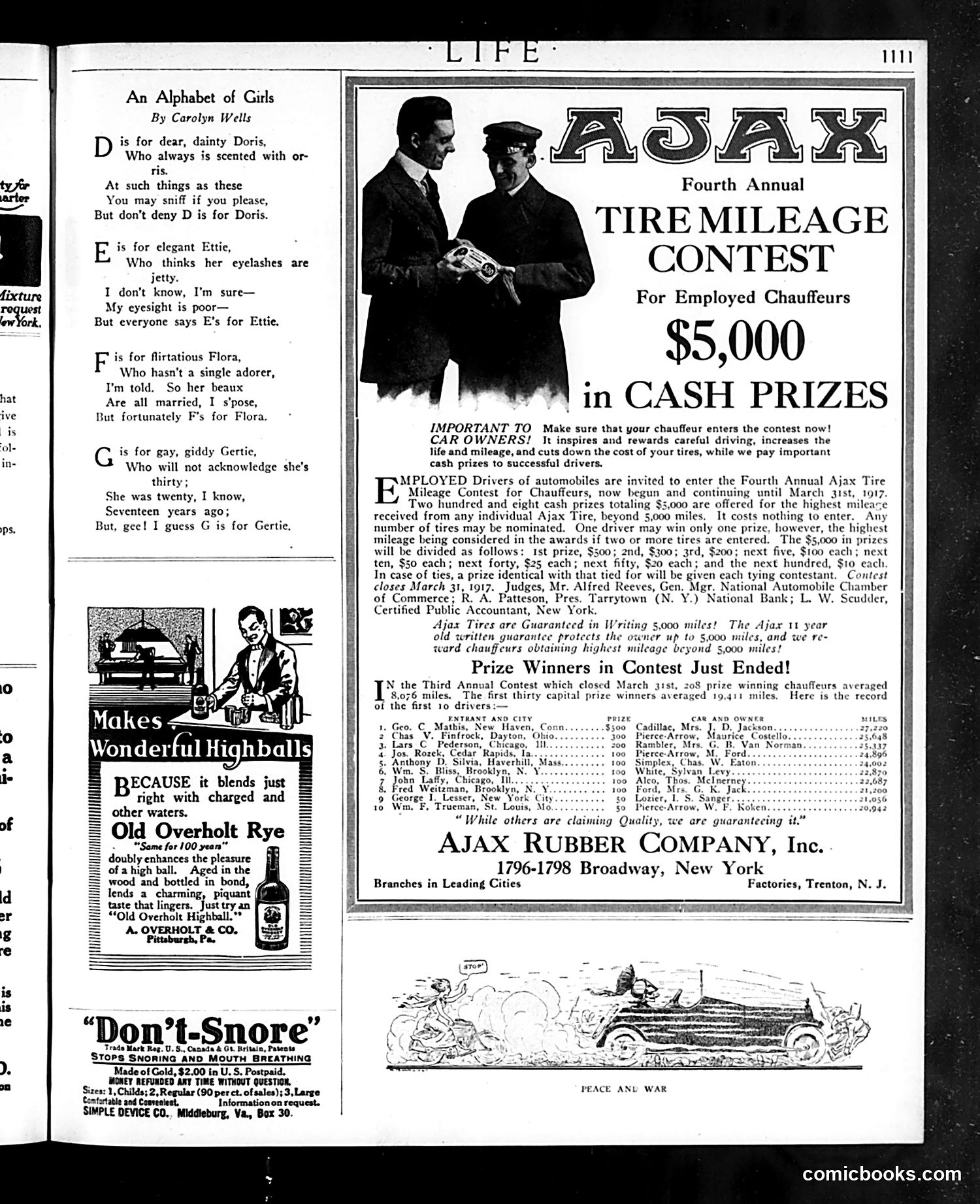
This page contains a satirical poem titled "An Alphabet of Girls" by Carolyn Wells, alongside period advertisements. The poem uses alphabetical entries to gently mock female stereotypes of the era—dainty girls obsessed with appearance ("D is for dear, dainty Doris"), vain women concerned with eyelashes ("E is for elegant Eutie"), flirtatious women ("F is for flirtatious Flora"), and giddy girls ("G is for gay, giddy Gertie"). The primary advertisement promotes Ajax Rubber Company's Fourth Annual Tire Mileage Contest for employed chauffeurs, offering $5,000 in cash prizes. The contest reflects the early automobile era's focus on driver skill and tire durability. Below appear advertisements for Old Overholt Rye whiskey and "Don't Snore" products, typical of 1917-era Life magazine content mixing social commentary with commercial messaging.
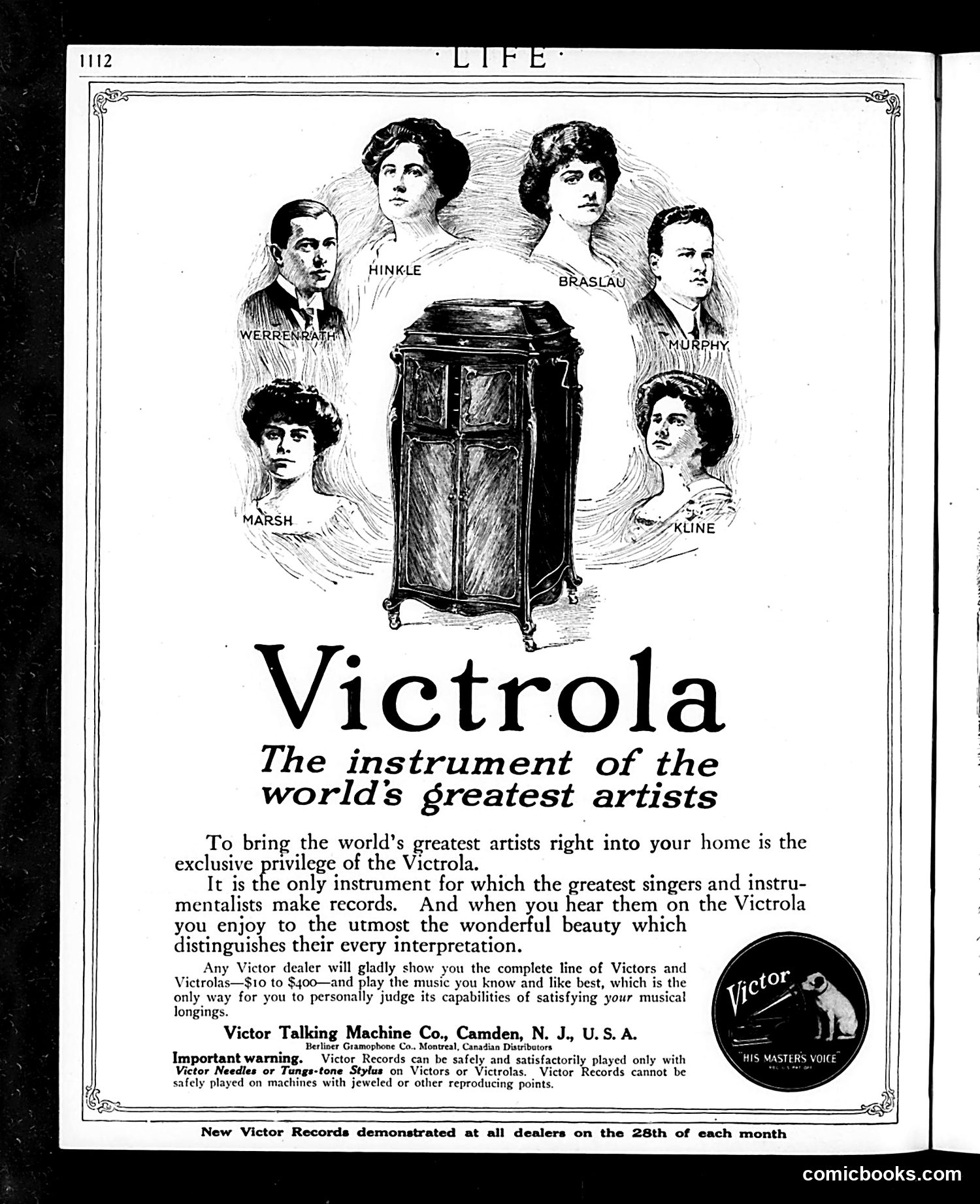
This is a **product advertisement**, not political satire. It promotes the Victrola, an early phonograph/record player, as "the instrument of the world's greatest artists." The six portrait heads surrounding the central device identify famous performers of the era: Hinkle, Braslau, Murphy, Werrenrath, Marsh, and Kline. These appear to be prominent singers and musicians whose recordings were available on Victor Records. The ad's appeal is straightforward: owning a Victrola allows middle-class households to experience world-class musical performances at home. It emphasizes exclusivity ("only instrument for which the greatest singers...make records") and quality sound reproduction. The "His Master's Voice" logo appears in the corner—Victor's trademark featuring a dog listening to a phonograph horn.
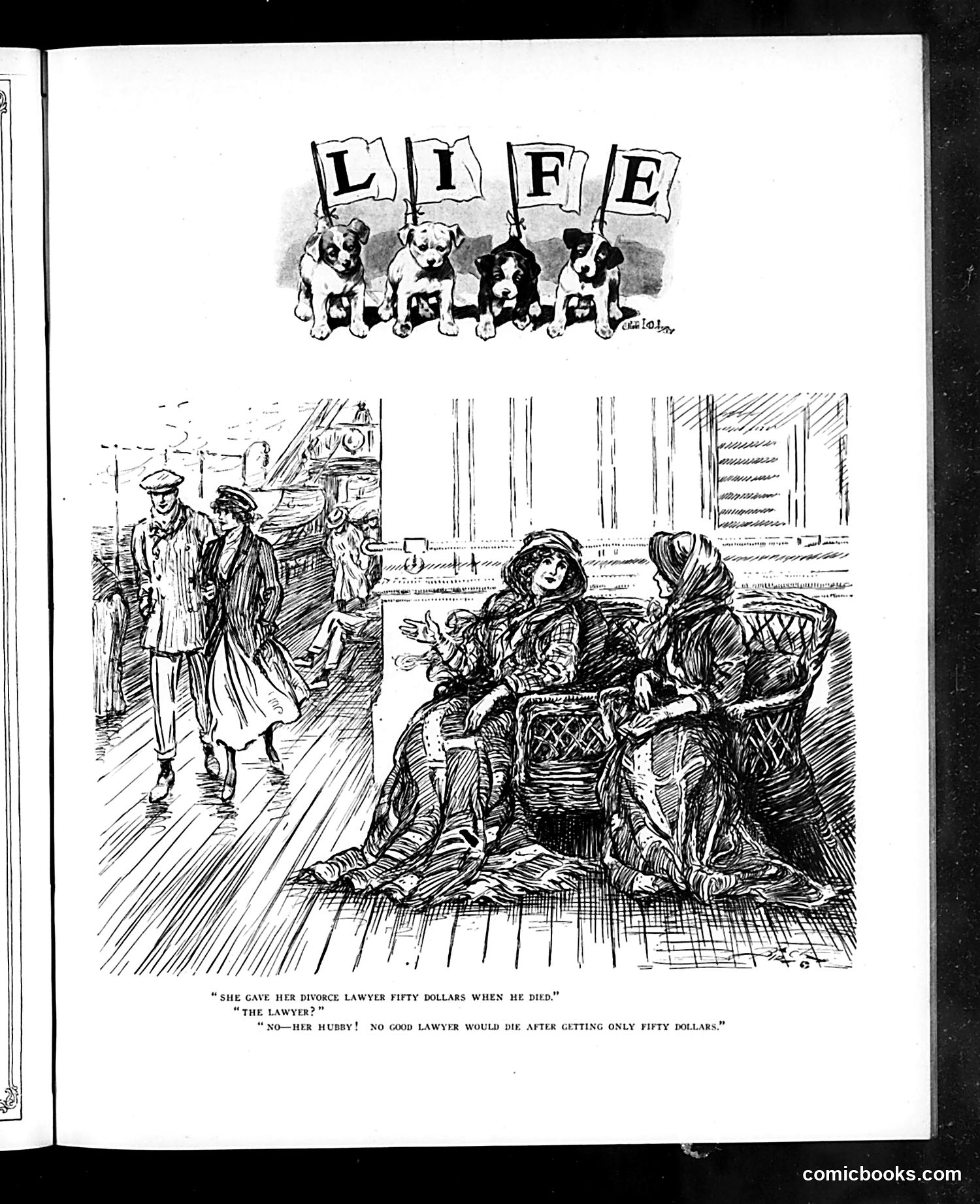
This page contains two distinct items: **Top:** A cartoon header showing four dogs holding flags spelling "LIFE," apparently the magazine's mascot or logo. **Bottom:** A single-panel comic strip depicting what appears to be a domestic scene on a ship or boat deck. A couple (man and woman in early 20th-century dress) stands apart while three women sit together in conversation. The joke's punchline reads: "She gave her divorce lawyer fifty dollars when he died" / "The lawyer?" / "No—her husband! No good lawyer would die after getting only fifty dollars." This satirizes both the expense of divorce proceedings and the cynical assumption that lawyers prioritize profit over all else—even death. The humor targets lawyer stereotypes about greed rather than any specific political figure or event.
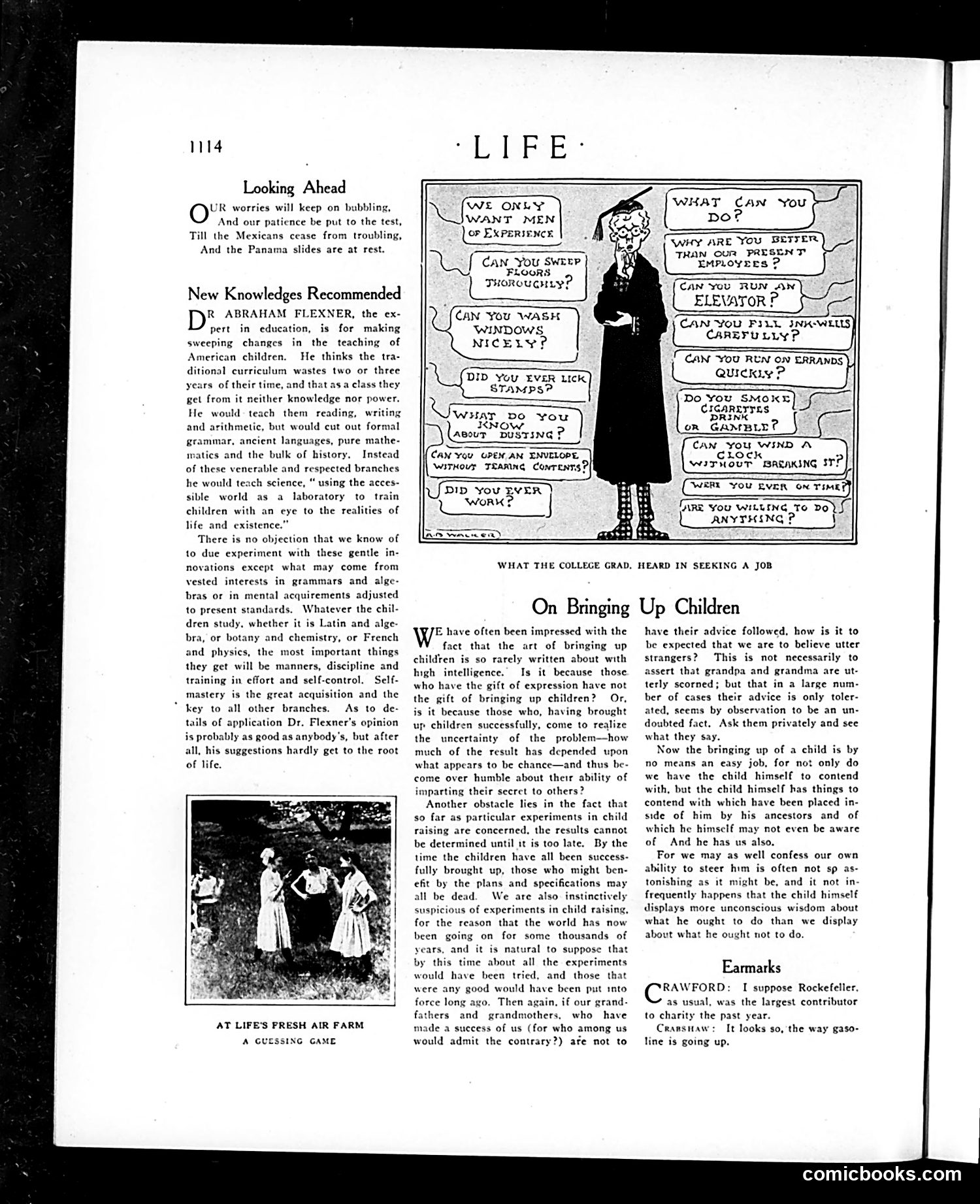
The main cartoon, titled "What the College Grad Heard in Seeking a Job," depicts an employer interrogating a job applicant with absurdly trivial questions: "Can you sweep floors thoroughly?" "Can you wash windows nicely?" "Did you ever lick stamps?" and "Do you smoke cigarettes, drink liquor, or gamble?" **The satire:** The cartoon mocks the disconnect between college education and actual job requirements in the early 20th century. Despite graduating, the applicant faces menial, unskilled questions—suggesting either that college degrees held little practical value for employment, or that employers deliberately undervalued educated workers by offering only low-wage positions. The accompanying article "On Bringing Up Children" discusses parenting philosophy, while "New Knowledges Recommended" reviews progressive educator Dr. Abraham Flexner's curriculum reform ideas.
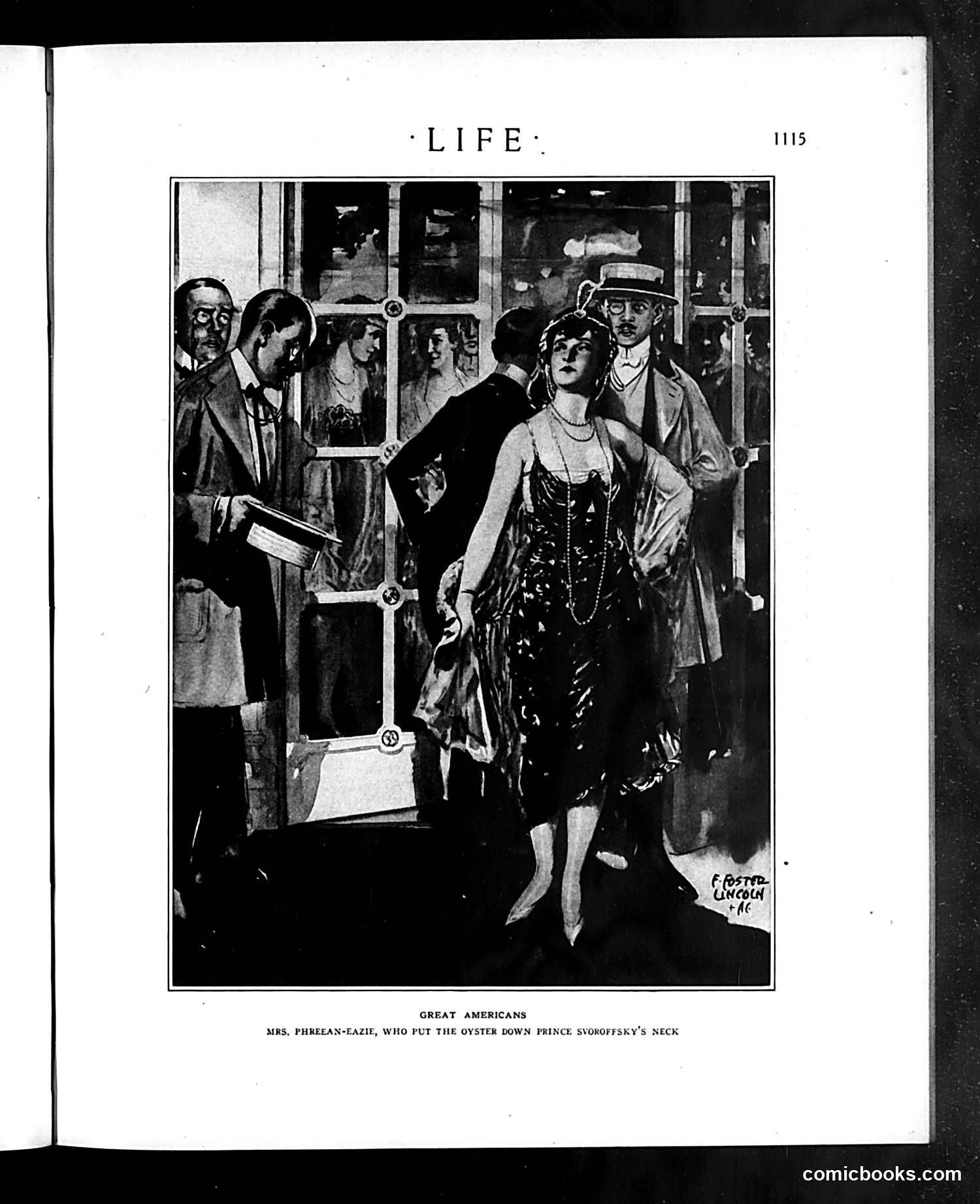
This is a satirical illustration from *Life* magazine titled "Great Americans," featuring Mrs. Phelan-Eazie, who is credited with putting "the oyster down Prince Svoroffsky's neck." The cartoon depicts a woman in 1920s attire (beaded dress, long pearl necklace) exiting what appears to be a formal venue or restaurant, surrounded by well-dressed men in suits and hats. The caption's phrasing—"put the oyster down"—suggests a practical joke or humorous incident involving food and a named aristocrat, likely a Russian prince given the Slavic surname. The satire appears to mock both the woman's boldness and the social pretension of high society gatherings. The illustration's style and the reference to "Great Americans" implies the cartoon celebrates this woman's irreverent behavior toward a foreign noble, reflecting post-WWI American attitudes toward European aristocracy.
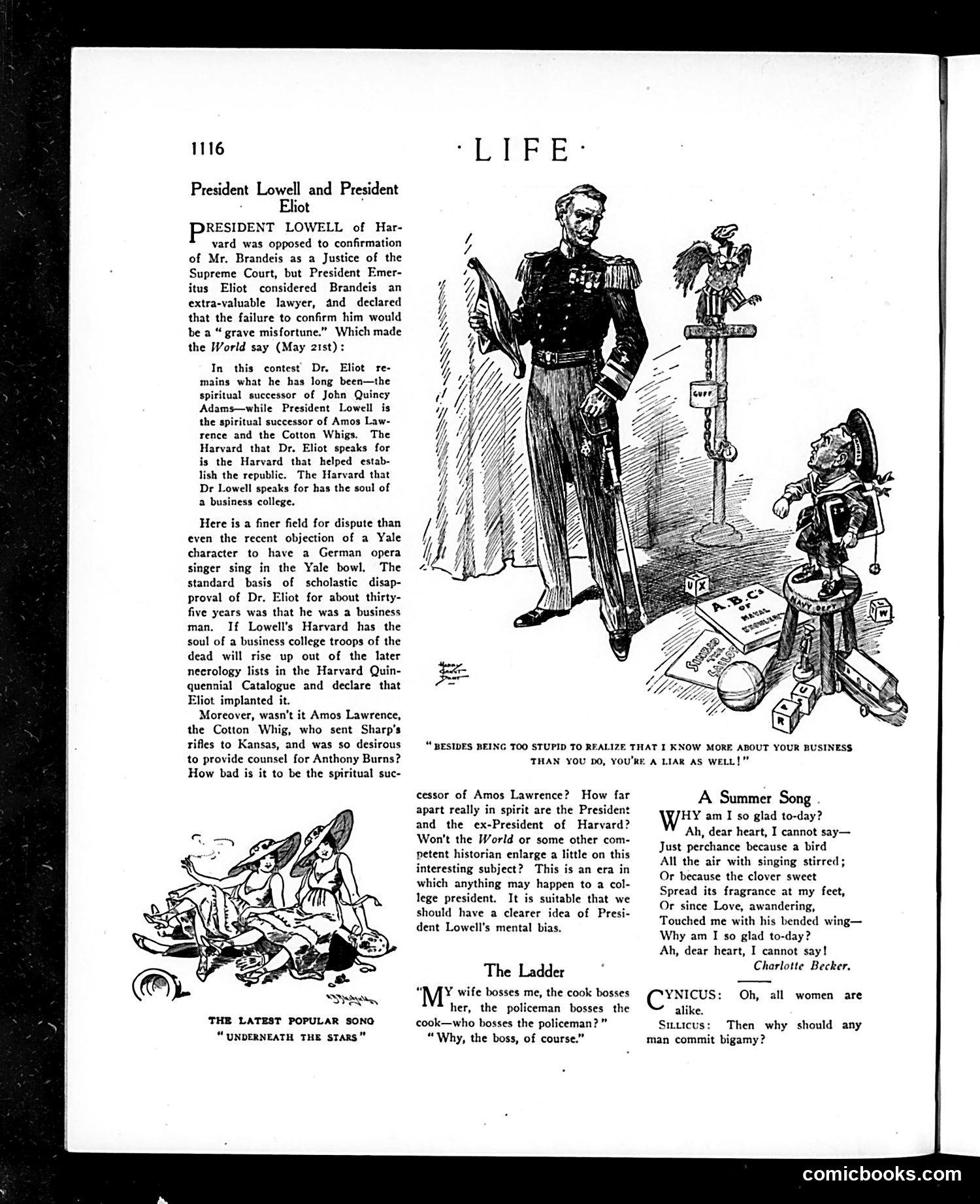
This page satirizes **President Lowell of Harvard**, who opposed confirming **Louis Brandeis as a Supreme Court Justice**. The text argues Lowell's objection was hypocritical—he claims to represent Harvard's intellectual tradition (linking himself to John Quincy Adams and others), yet opposes Brandeis despite his qualifications. The main cartoon depicts a military figure holding a sword, confronted by a smaller figure claiming superior business knowledge—illustrating Lowell's arrogance. The satire suggests Lowell, despite heading an educational institution, lacks moral authority to judge others' fitness for high office. The page also includes unrelated lighter pieces: a popular song parody and classical philosophical jokes about women and bigamy, typical of *Life*'s mixed satirical content.
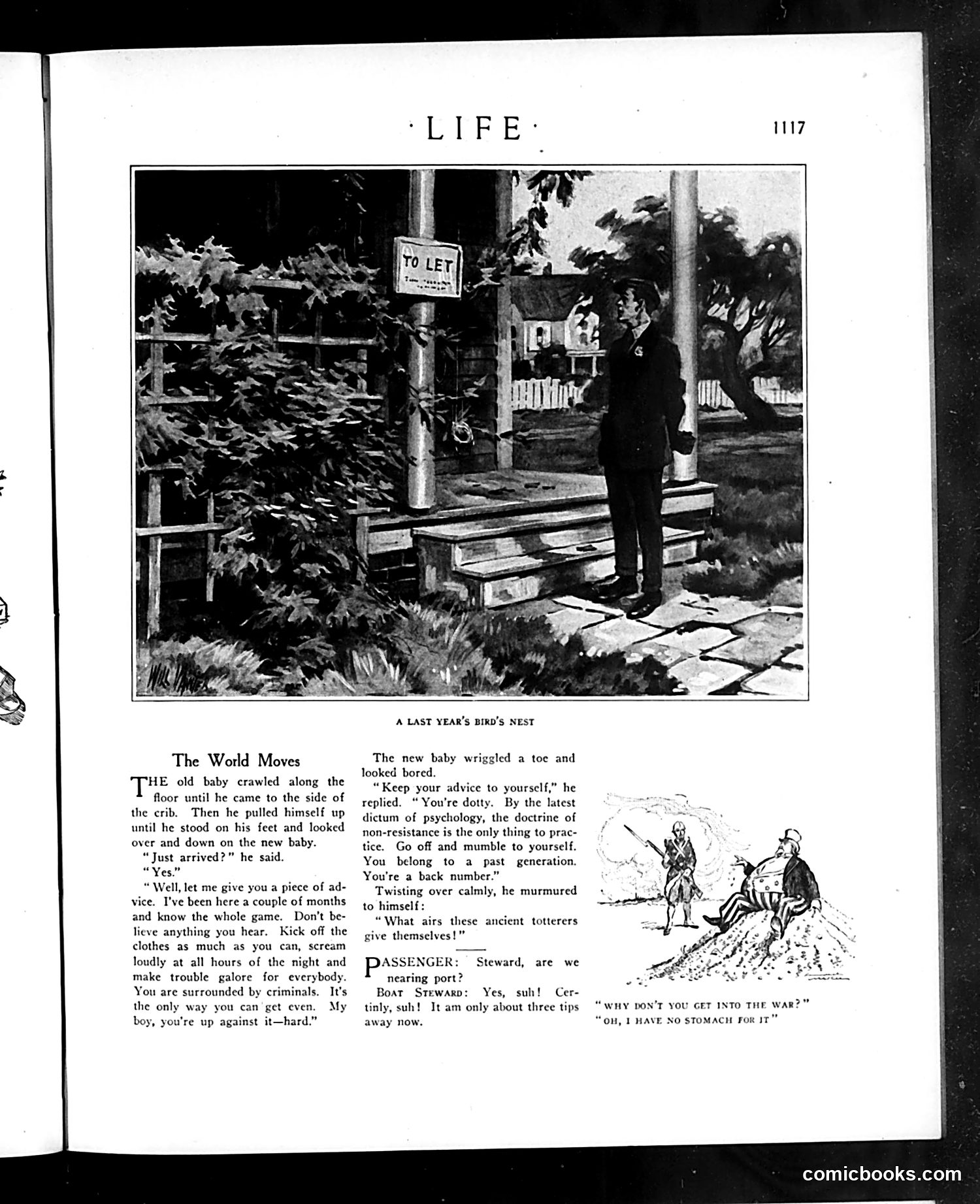
This page contains two pieces of social satire: **Top illustration**: A man in formal dress examines a house marked "TO LET" (for rent), while another man lectures him harshly about life's difficulties. The satirical point mocks generational conflict—an older man dismissing a younger generation's complaints about economic hardship and housing scarcity, telling him to "go and mumble to yourself" and that he belongs to "a past generation." **Bottom cartoon**: Two men on a ship discuss seasickness. One asks if the other will arrive at port soon; the other replies he's "only about three tips away now"—a joke about the passenger having vomited multiple times already. Both pieces mock contemporary social anxieties: housing scarcity and generational dismissal in the top; physical discomfort and maritime travel in the bottom. The satire targets unsympathetic attitudes toward younger people's legitimate struggles.
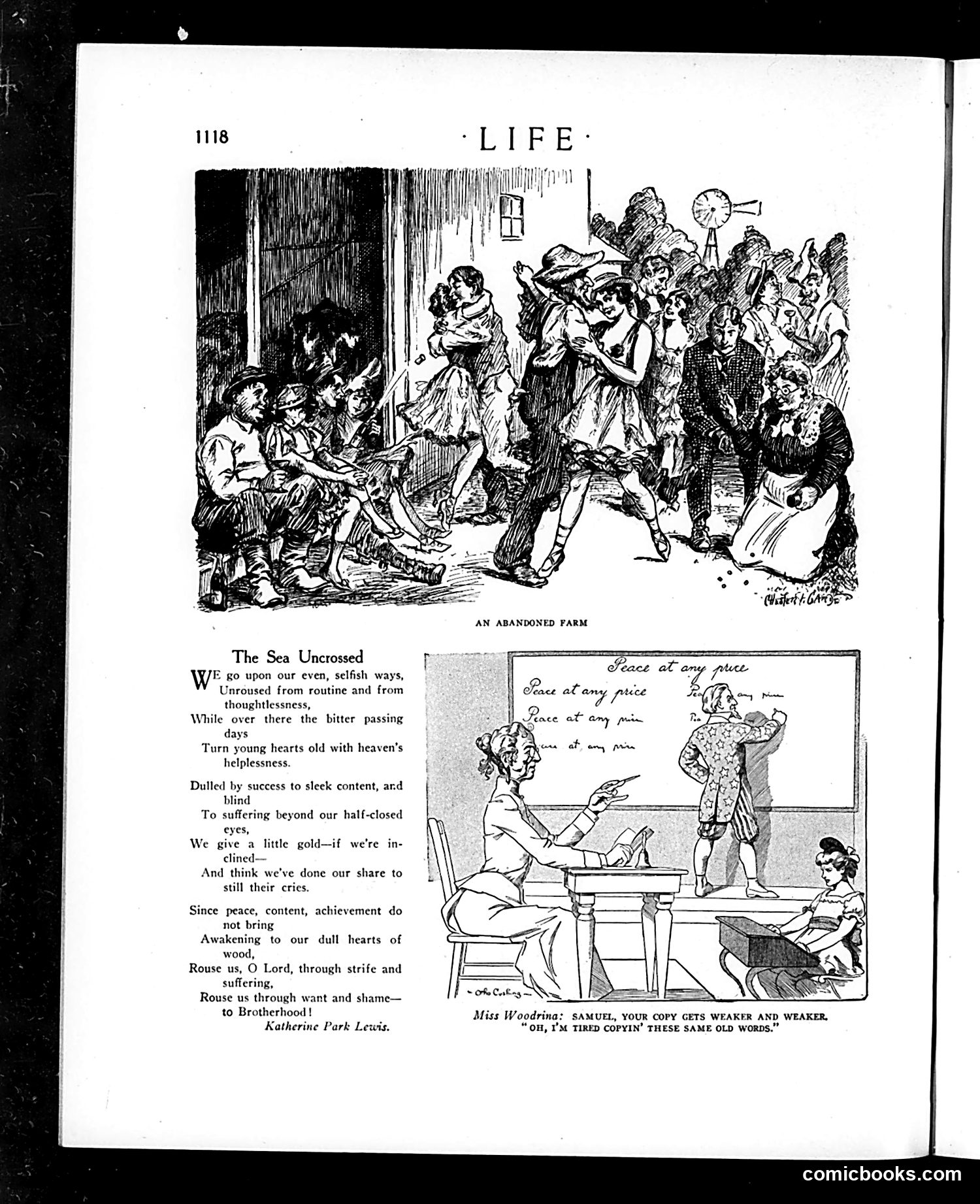
**Top illustration:** "An Abandoned Farm" depicts a crowded scene of people (appearing to be rural poor or displaced persons) gathered at a derelict farm building, suggesting themes of rural poverty, displacement, or social upheaval. **Poem:** Katherine Park Lewis's "The Sea Uncrossed" expresses spiritual and social critique, lamenting selfishness, suffering, and inequality while calling for awakening through "strife and suffering" rather than material comfort. **Bottom cartoon:** Shows a woman (Miss Woodring) at a desk copying text, with a man (Samuel) observing. The caption jokes that her copy "gets weaker and weaker" from repeating "these same old words"—satirizing tedious, repetitive office work or possibly critiquing worn-out rhetoric. The page overall addresses social inequality and the spiritual emptiness of modern life.
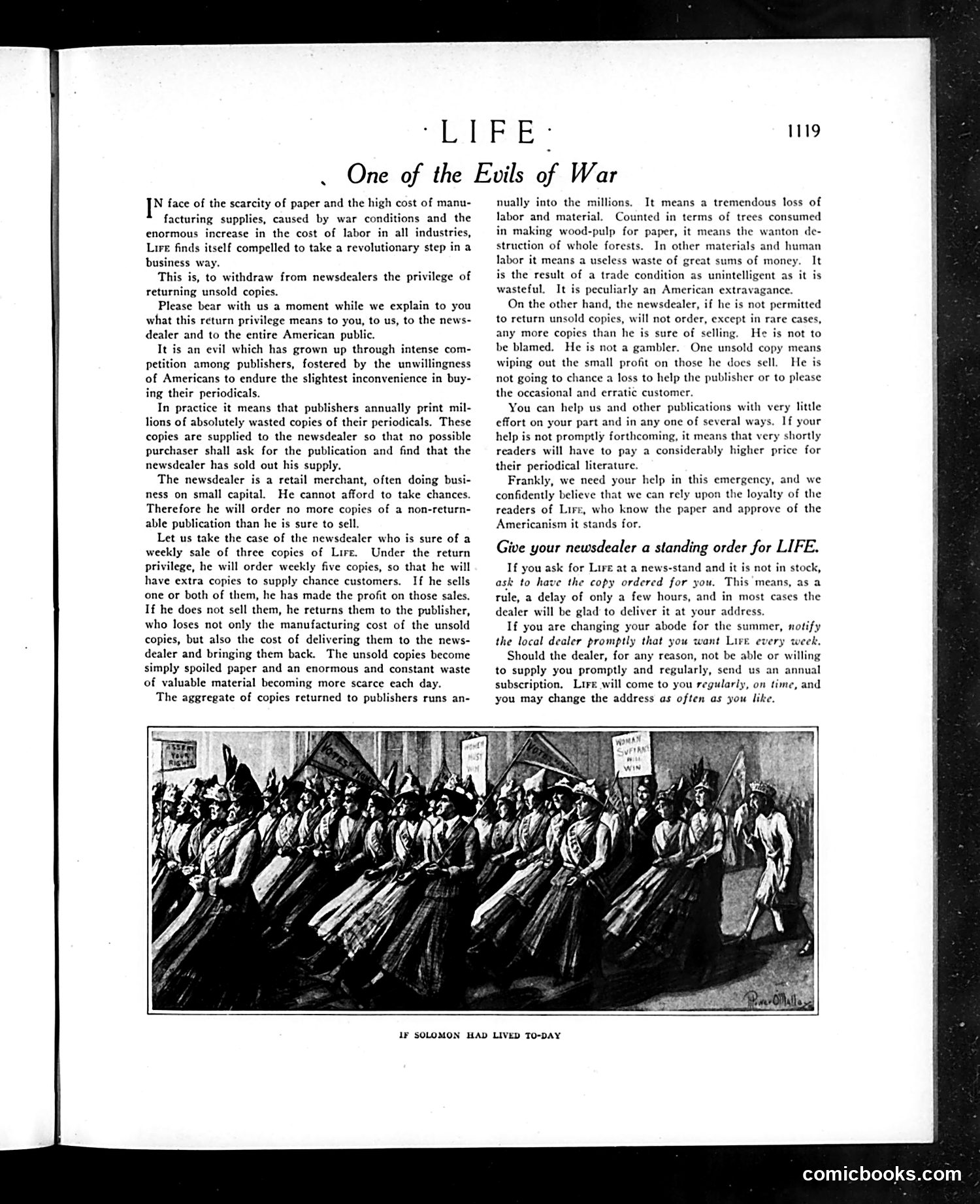
This page is a **wartime editorial**, not a political cartoon. The text argues against a specific business practice: newspapers' privilege of returning unsold copies. **The Argument:** The author contends that during wartime paper shortages and labor cost increases, allowing publishers to print millions of excess copies—only to destroy unsold ones—wastes critical resources. This destruction represents "useless waste of great sums of money" and valuable materials needed for the war effort. **The Call to Action:** Readers are urged to give newsdealer standing orders for *Life* magazine, ensuring copies sell rather than get wasted. The accompanying illustration (captioned "IF SOLOMON HAD LIVED TO-DAY") appears to satirize the absurdity of this waste, though the specific imagery is unclear from reproduction quality. The piece essentially frames subscription loyalty as patriotic wartime conservation.
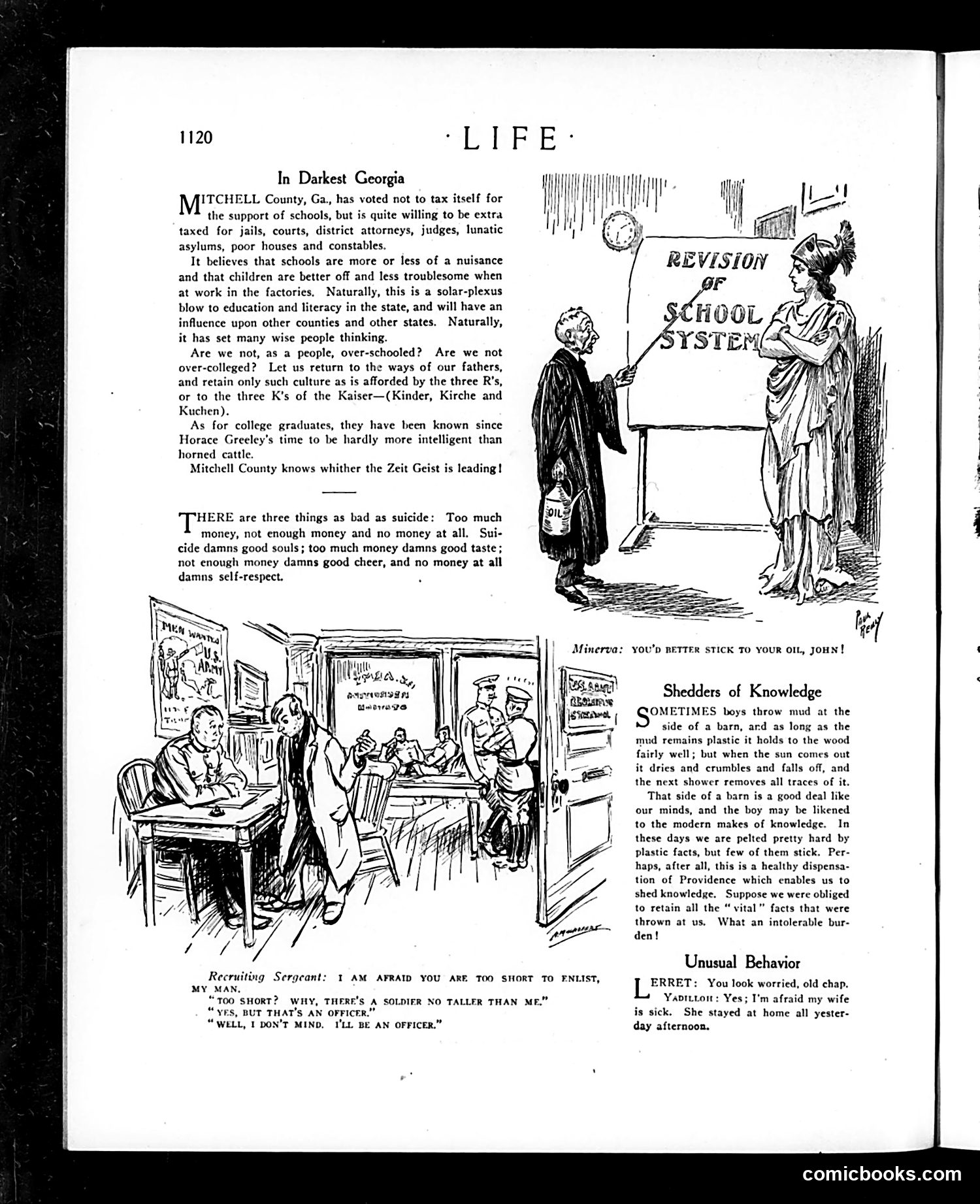
This page contains four distinct satirical pieces: **"In Darkest Georgia"** mocks Mitchell County, Georgia's decision to fund jails and asylums while refusing school taxes. The satire suggests this reveals backward priorities—investing in punishment rather than education. The reference to the "three K's of the Kaiser" sarcastically equates this anti-education stance with Prussian militarism, implying such thinking is un-American and authoritarian. **"Shedders of Knowledge"** uses a barn-mud metaphor to satirize how modern education imparts facts that don't stick—they're temporary and eventually forgotten, like mud sliding off a barn wall. It questions whether retaining "vital facts" is even desirable. **The recruiting cartoon** shows a short man being rejected for military service but accepting a commission as an officer instead—a joke about military incompetence and how officer rank was sometimes awarded regardless of qualifications. **"Unusual Behavior"** is a domestic humor piece where a husband finds his wife's staying home from social activities suspicious and worrying—likely satirizing anxious masculine attitudes toward female independence.
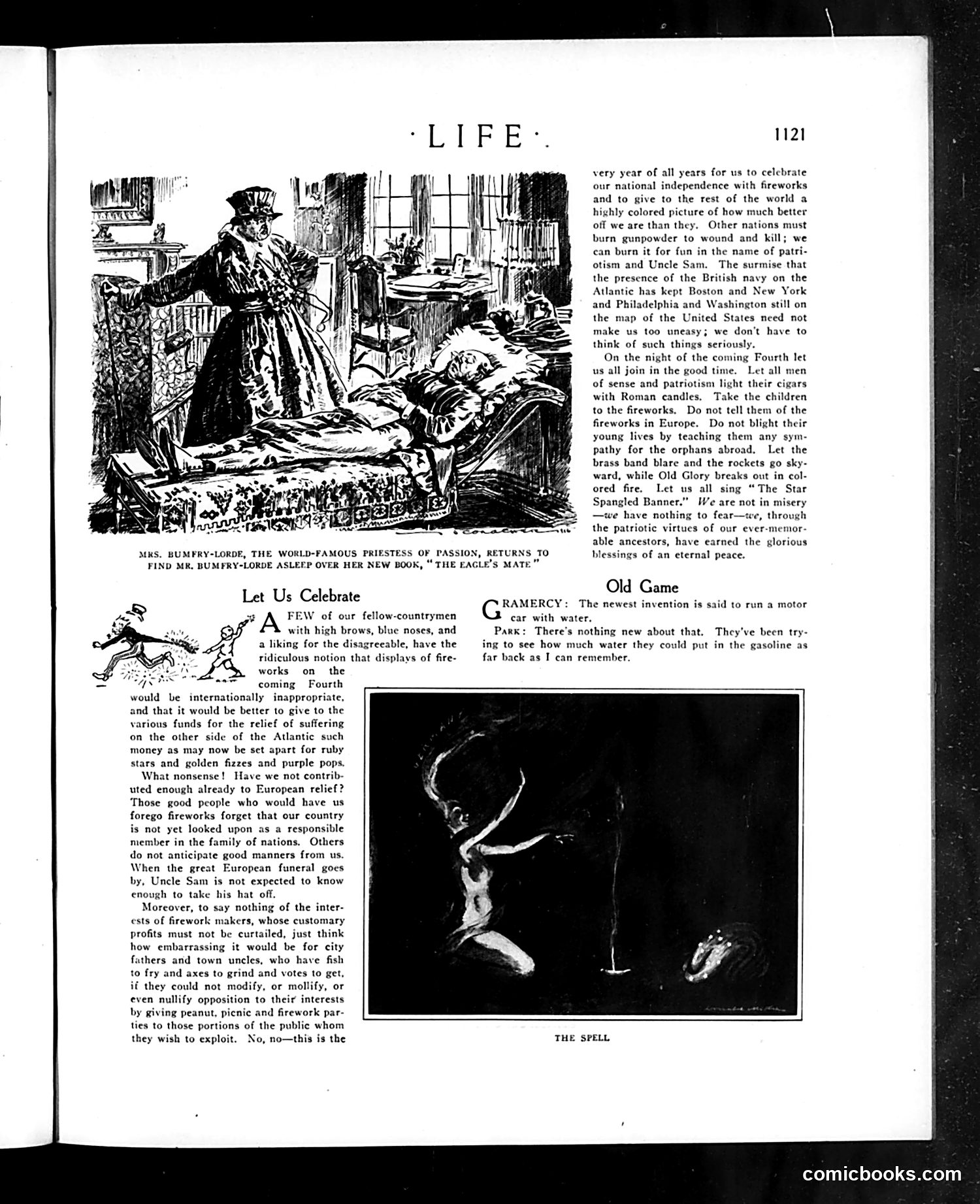
This page satirizes American patriotic hypocrisy around Fourth of July celebrations, likely during or shortly after World War I. The main article "Let Us Celebrate" mocks arguments for continuing fireworks displays despite European suffering. The author presents the counterargument sarcastically: that fireworks are essential for American prestige (to show other nations we're prosperous), that discontinuing them would embarrass politicians who use them to manipulate voters, and that we've already contributed enough to European relief. The top illustration shows "Mrs. Bumfry-Lorde," described as a "world-famous priestess of passion," sleeping over a book—likely mocking sentimental or frivolous attitudes toward serious matters. The small "Old Game" comic mocks technological fakery: one character claims to have invented a water-powered motor car; the other cynically notes people have been adulterating gasoline with water for years—a reference to either wartime rationing practices or simple consumer fraud. The central image titled "The Spell" appears to show a figure under hypnotic influence, reinforcing the page's theme of Americans being manipulated into nationalist fervor.
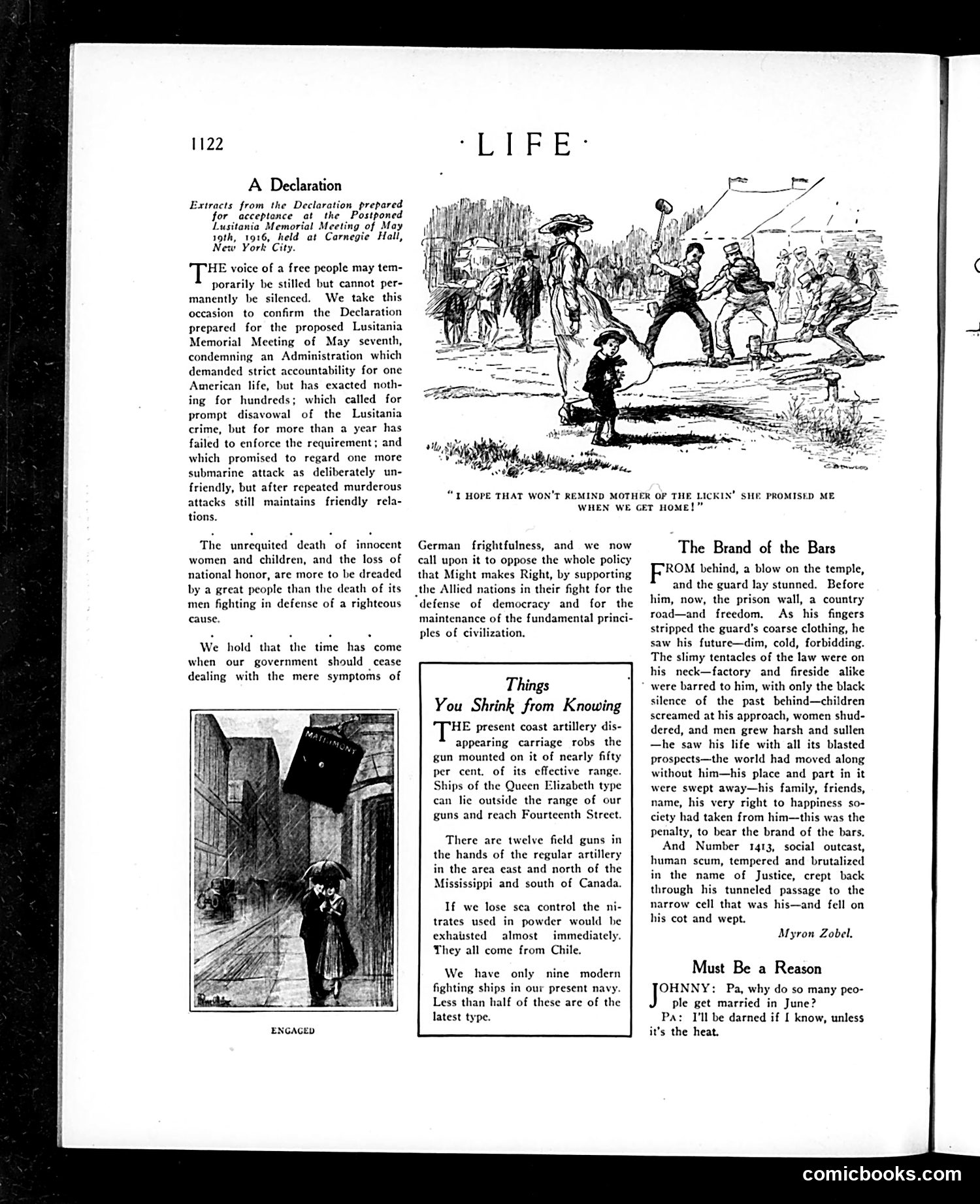
This page contains **pro-Allied war advocacy** from May 1916, during American neutrality debates over the Lusitania sinking (1915). **Main Declaration:** Criticizes President Wilson's administration for demanding accountability for one American life (the Lusitania) while tolerating repeated German submarine attacks without retaliation. It calls for the U.S. to actively support Allied nations against German "frightfulness." **"Things You Shrink from Knowing":** A propaganda section listing American military weaknesses—insufficient coastal guns, limited modern warships, and dependence on Chilean nitrates for gunpowder—to argue the U.S. needs stronger defense/military action. **"The Brand of the Bars":** A dark story about an escaped convict facing permanent social ostracism, illustrating how society punishes criminals beyond imprisonment. **"Must Be a Reason":** A light joke where a father attributes June marriages to heat, providing comic relief amid serious content. The page represents Life's interventionist stance before America's 1917 entry into World War I.
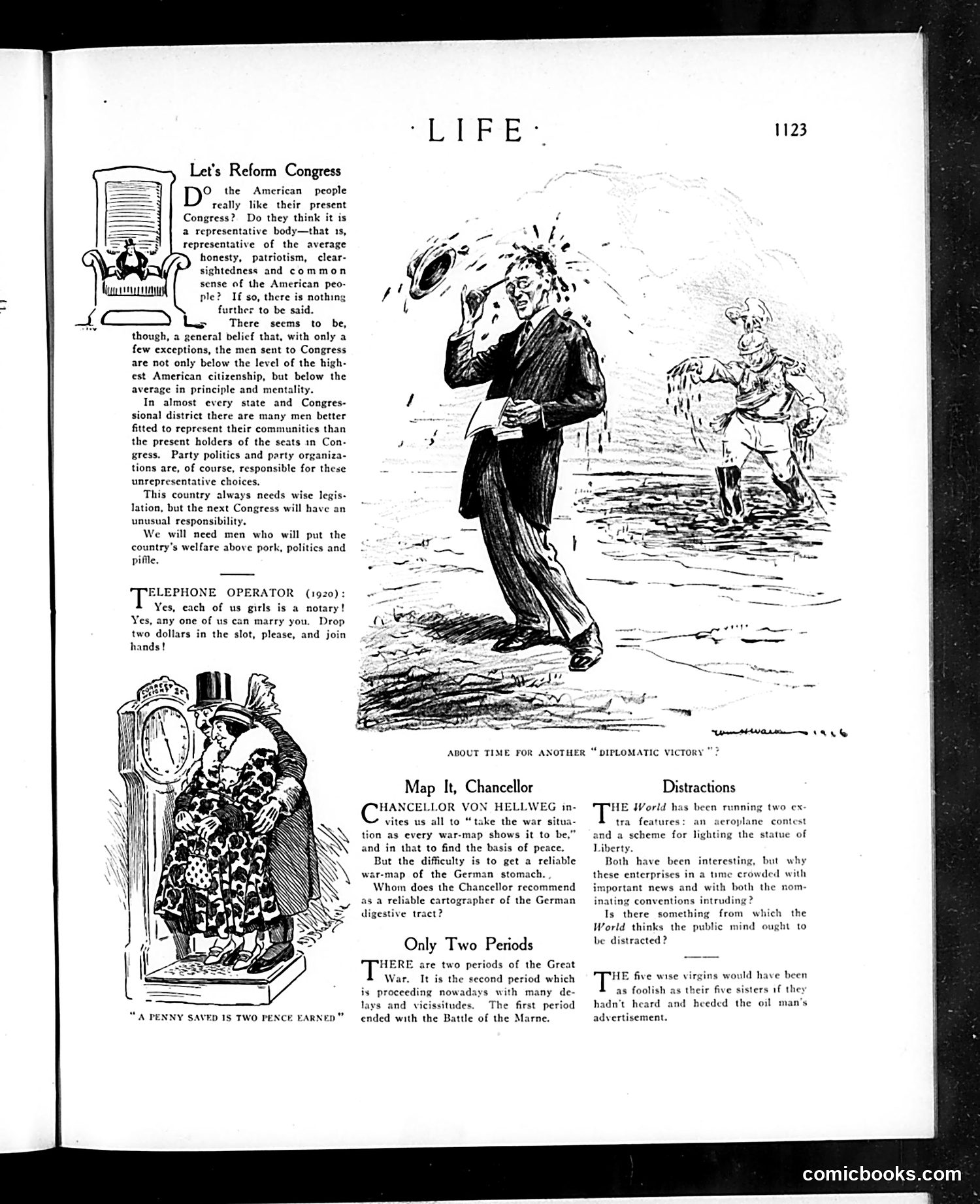
This page contains several satirical pieces criticizing American institutions and wartime distraction: **"Let's Reform Congress"** argues that congressmen are generally below-average in honesty and competence compared to citizens they represent. The piece blames party politics for selecting unrepresentative candidates and calls for reform prioritizing national welfare over "pork, politics and piffle." **"Map It, Chancellor"** mocks German Chancellor von Bethmann Hollweg's appeal to examine war-maps for peace, sarcastically asking who can map "the German stomach"—implying German war aims are driven by appetite/greed rather than legitimate grievance. **"Only Two Periods"** references the two phases of WWI (pre- and post-Battle of the Marne). **"Distractions"** criticizes the World newspaper for running trivial stories (airplane contests, Statue of Liberty lighting) when serious news dominates—nominating conventions and the war. The joke suggests newspapers distract readers from important matters. The page reflects Progressive-era skepticism toward both democratic institutions and wartime media manipulation.
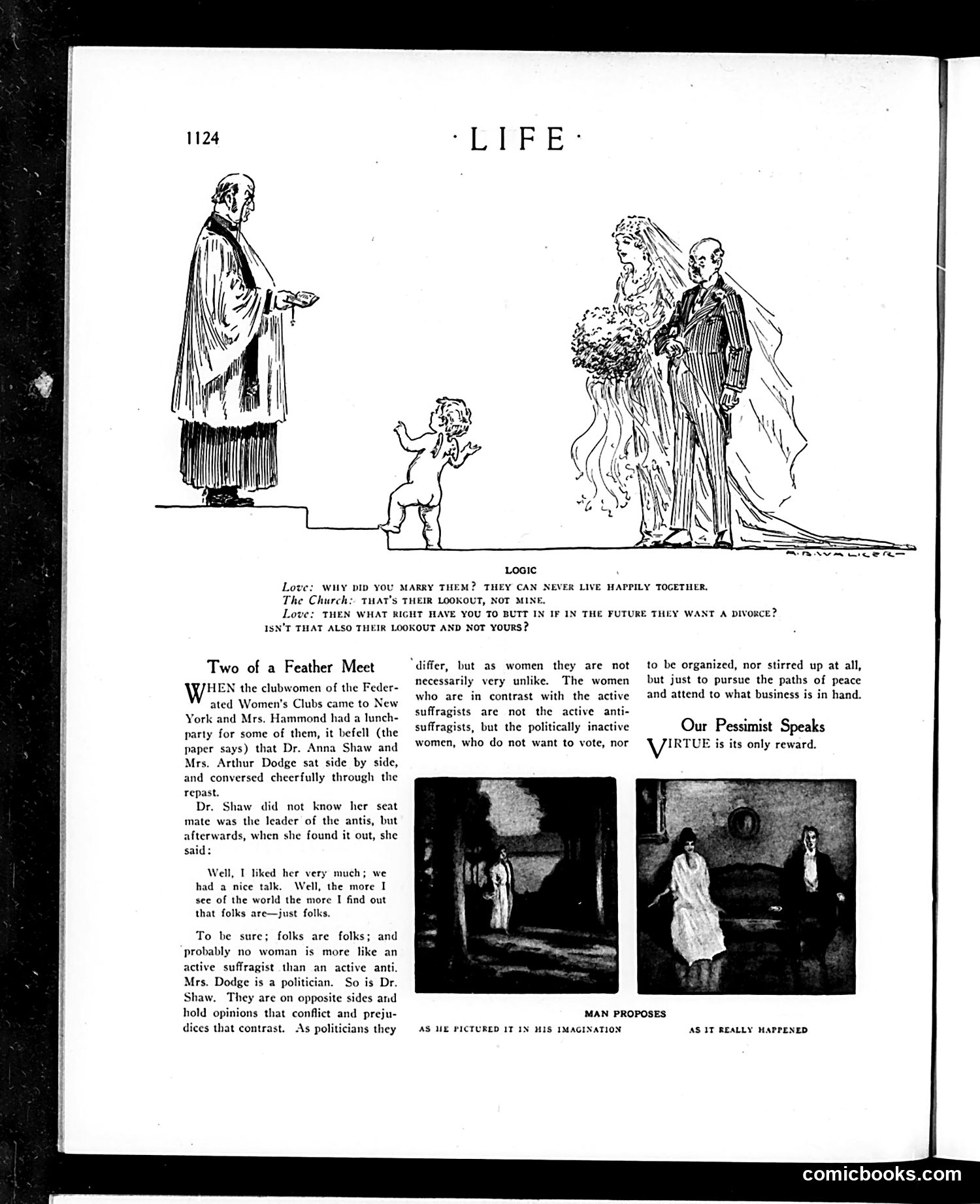
**Top cartoon ("Logic"):** A priest lectures a couple about marriage, claiming the Church shouldn't interfere in divorce. The satire mocks the Church's hypocrisy: it demands authority to *perform* marriages but refuses responsibility for their failures—"that's their lookout, not mine." **Main article ("Two of a Feather Meet"):** Dr. Anna Shaw (suffragist leader) and Mrs. Arthur Dodge (anti-suffrage leader) had a pleasant lunch despite opposing the women's vote. The piece wryly observes they're more alike than different—both are politically active women with strong opinions. The real divide, it suggests, is between *active* women (pro- or anti-suffrage) versus *politically inactive* women who simply want peace. **Bottom section ("Our Pessimist Speaks"):** Two photographs contrast a man's idealized marriage proposal with grim reality, illustrating romantic disappointment. The caption "Virtue is its only reward" suggests cynicism about marriage prospects. The page satirizes institutional hypocrisy, women's political divisions, and marital disillusionment.
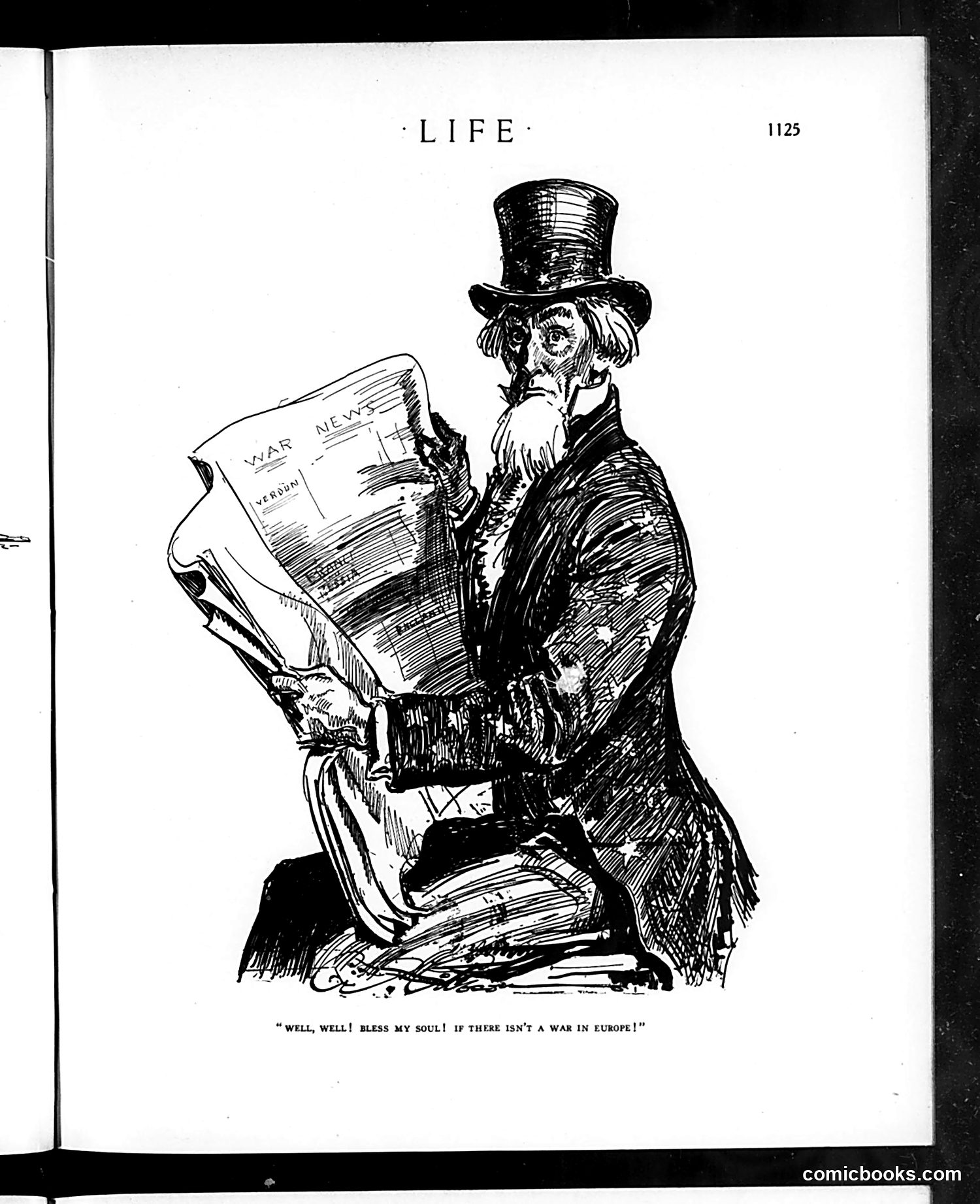
This is a satirical cartoon from *Life* magazine (page 1125) depicting an elderly man with a long beard, wearing a top hat and formal coat, reading a newspaper headlined "WAR NEWS." The figure appears to represent an older generation or establishment figure reacting to European conflict. The caption reads: "Well, well! Bless my soul! If there isn't a war in Europe!" The satire likely mocks either American isolationism or the complacency of older political/social leaders regarding European warfare—suggesting they're surprised by conflicts despite warning signs, or that they're indifferent to international affairs. The cartoon's tone is ironic, implying the character's surprised reaction is either willfully ignorant or out-of-touch with reality. Without the specific publication date visible, the exact conflict referenced remains unclear, though European wars occurred frequently during *Life*'s publication era.
This *Life* editorial discusses Theodore Roosevelt's potential nomination as the 1916 Republican presidential candidate—"Our Colonel" who refuses to fade from politics despite past defeats (the failed 1912 Progressive "Bull Moose" campaign and his disastrous 1913 River of Doubt expedition). The piece expresses divided Republican anxiety: half fear Roosevelt *will* be nominated again, half fear he *won't*. The author notes Roosevelt likely won't run himself but will support whoever the Republicans nominate, making him a powerful kingmaker. The editorial also discusses alternative candidates: Judge Hughes (described as having done "so far, just..."), Mr. Herrick (a "war-hero of 1914"), and Brand Whitlock, sarcastically suggesting Democrats might draft Whitlock if Republicans over-emphasize pro-France positions. The satire targets Republican indecision and Roosevelt's inescapable political dominance—he's "trebly deceased" yet remains central to party strategy against Wilson's re-election.
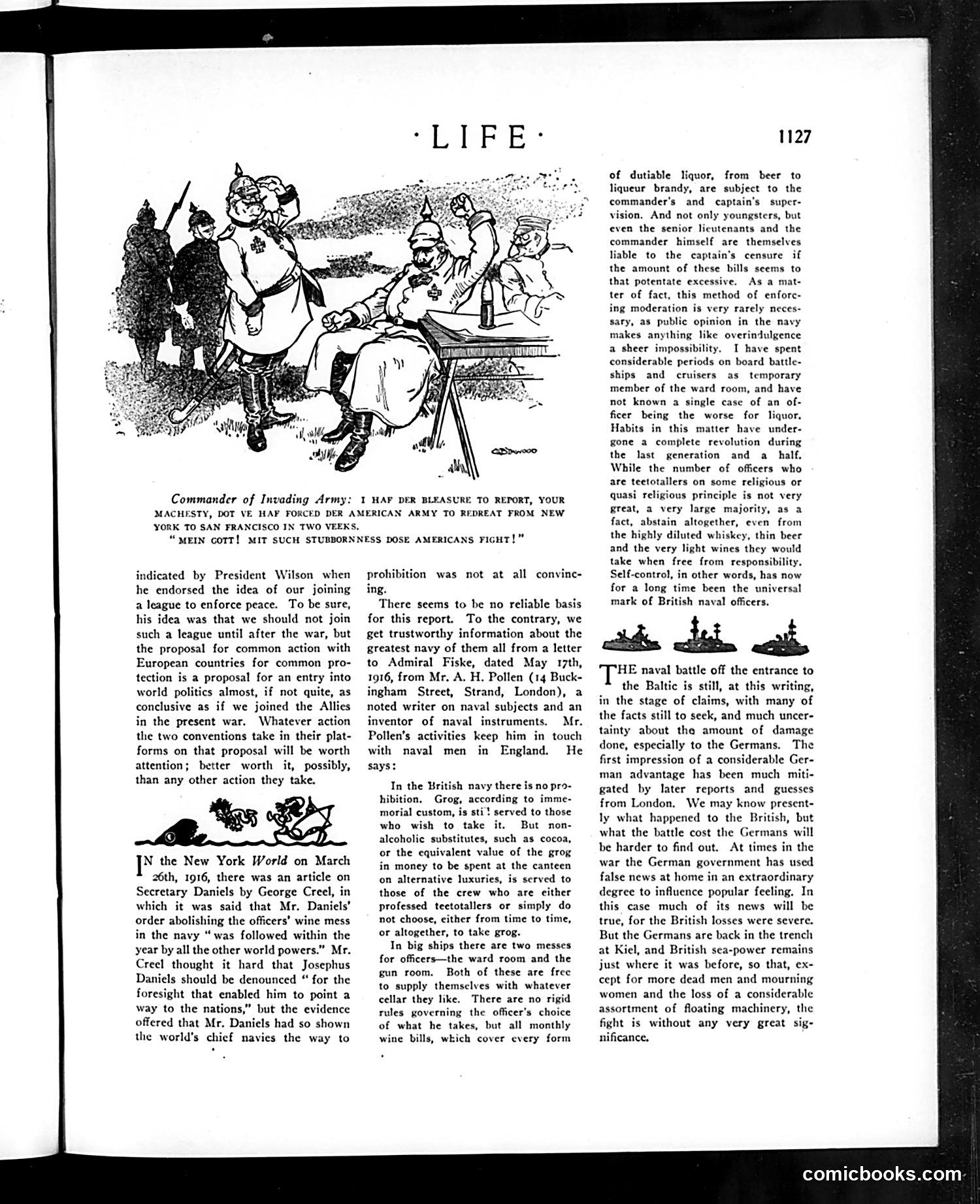
**The Cartoon:** The top illustration depicts a German military commander reporting to the Kaiser in exaggerated German accent, claiming he's forced the American Army to retreat from New York to San Francisco in two weeks. The joke satirizes German military overconfidence during World War I—the absurd boast that Germany could invade and conquer the entire continental United States. **The Context:** This appears from a 1916 Life magazine, when America was still officially neutral but debate raged about potential involvement. The cartoon mocks German military bravado and implicitly supports American military capability by making the German threat ridiculous. **The Text Discussion:** The article's main topic concerns Secretary of the Navy Josephus Daniels' controversial prohibition of alcohol in naval officer messes. Daniels believed this showed moral leadership to other world powers. The text presents evidence from a British naval authority arguing that the British Navy never adopted such prohibition—they maintain officer drinking privileges while relying on self-control and peer pressure rather than rules. The satire critiques Daniels' naive assumption that America's policy influenced global practice.
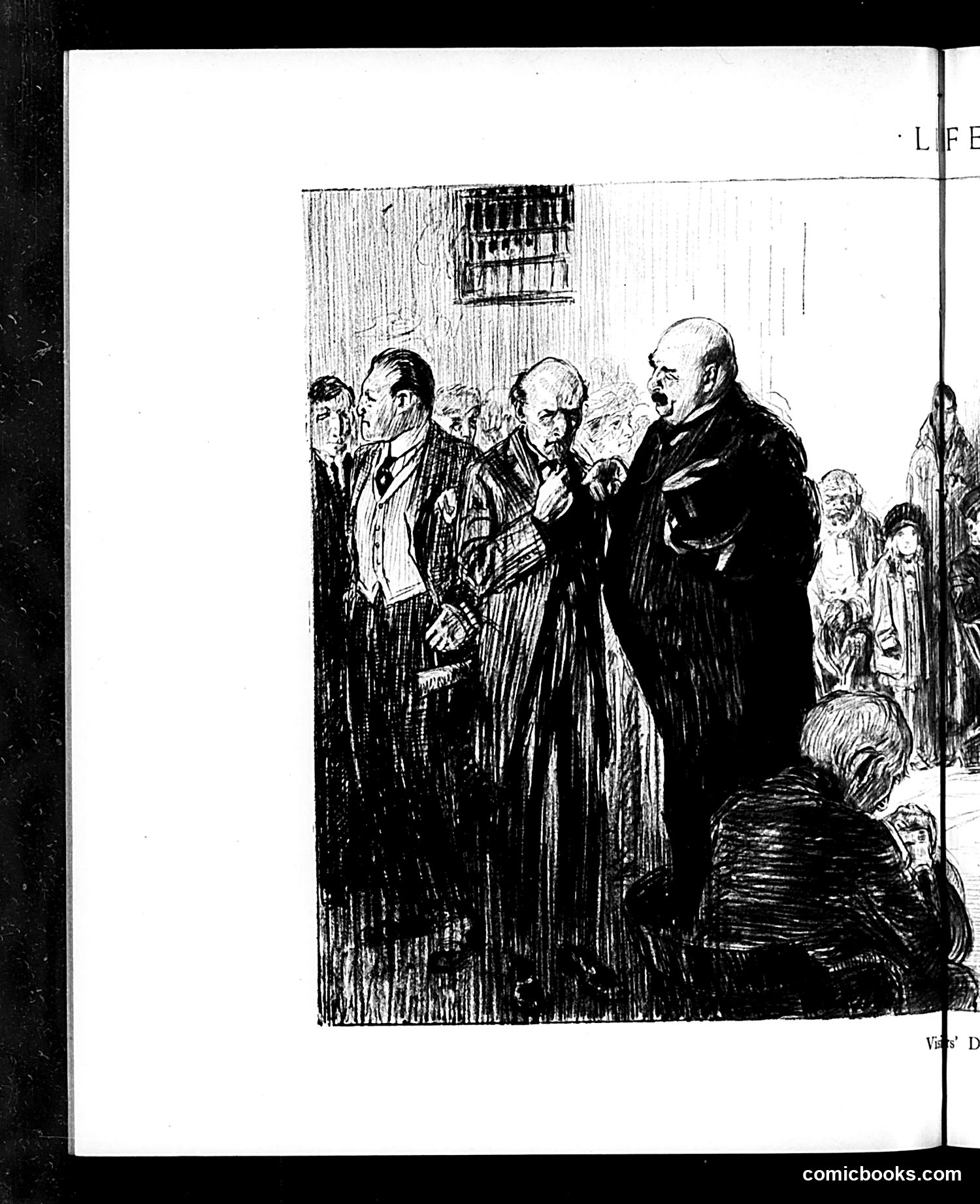
This is a black and white sketch depicting what appears to be a formal institutional or governmental scene. A group of men in dark suits and formal attire stand in an interior space with vertical wall paneling and a barred window visible above. The figures display animated expressions and gestures, suggesting debate or heated discussion. However, the OCR text is largely illegible—appearing to be corrupted character data rather than readable words. Without legible caption text or identifying labels, I cannot reliably determine which specific political figures or event this cartoon references, nor can I accurately explain the satirical point being made. The artistic style suggests late 19th or early 20th-century publication, but the specific context remains unclear.
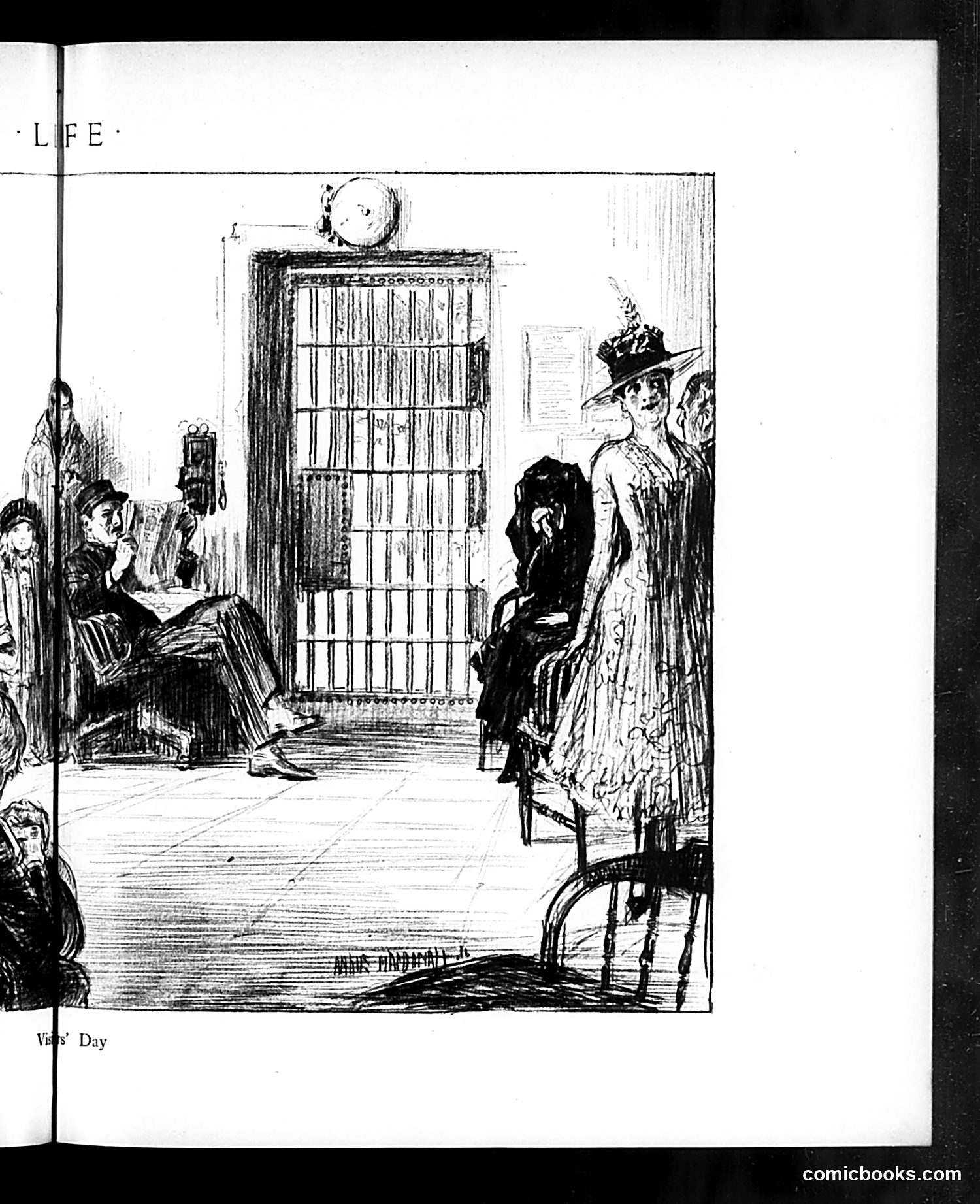
This sketch depicts a visiting room in what appears to be a jail or prison. On the left, several visitors sit conversing with inmates. The central focus is a large barred door, above which hangs a clock. On the right, a well-dressed woman in an elaborate hat and feathered coat stands—likely a visitor of some social standing. The scene's satire appears to comment on the contrast between visitors and prisoners, or possibly on the spectacle of "visiting day" itself. Without the full article text, the specific satirical target remains unclear, but the cartoon likely critiques either prison conditions, the social dynamics of visitation, or contemporary attitudes toward incarceration. The style is characteristic of early-to-mid 20th-century editorial illustration.
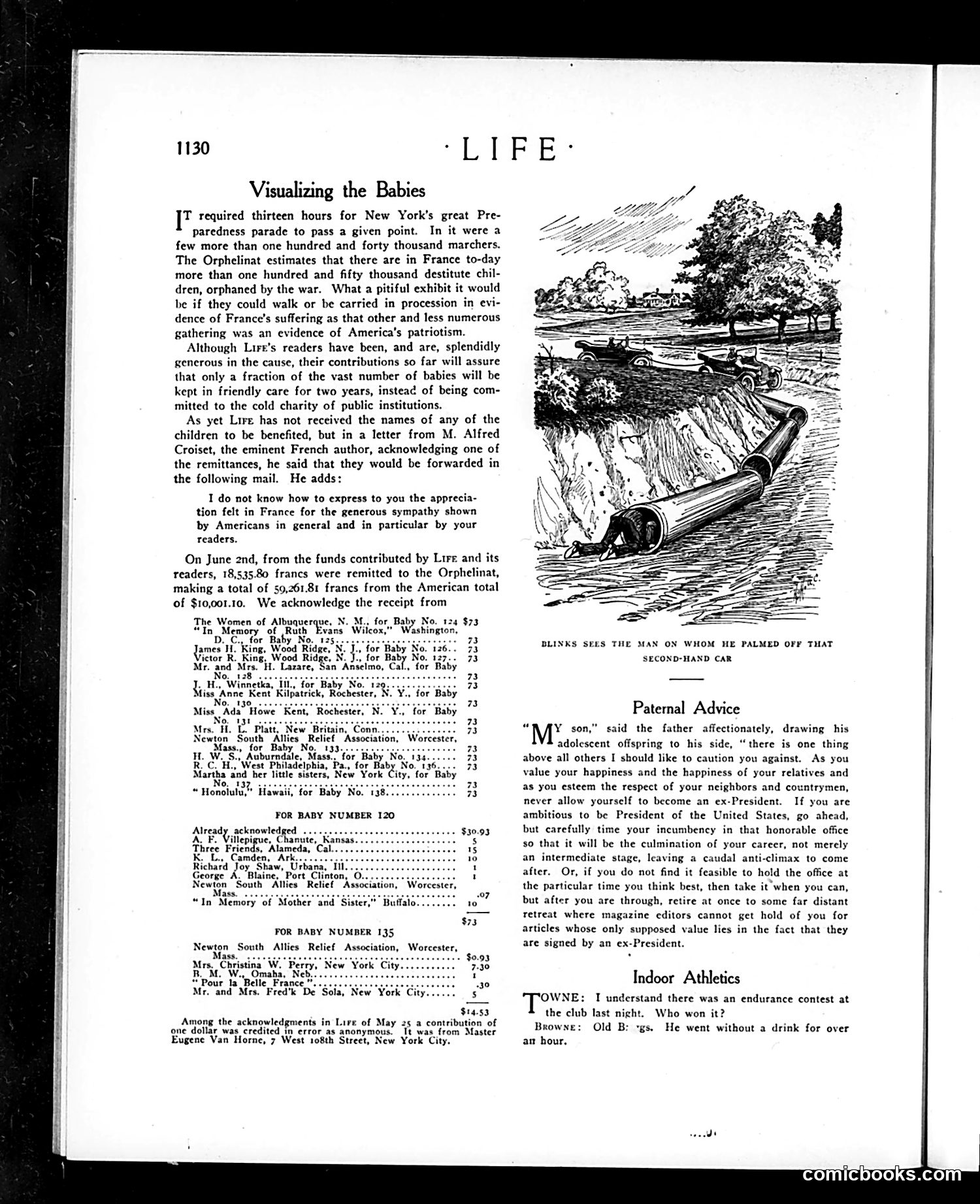
This page from *Life* magazine contains three distinct items: 1. **"Visualizing the Babies"** (main article): A charitable campaign comparing New York's 140,000-person Preparedness parade to France's 150,000 war orphans. The text sarcastically suggests orphans paraded as evidence of French suffering would match American patriotic displays. *Life* solicited reader donations to support French orphans for two years rather than consigning them to public institutions. The listings show individual and group contributions ($73 per child). 2. **Cartoon "Blinks Sees the Man"** (right): A comic about a man encountering someone to whom he'd sold a defective second-hand car—a common era-appropriate joke about dishonest used-car salesmen and buyer's remorse. 3. **"Paternal Advice"** (bottom right): Satirical advice warning against becoming an "ex-President," suggesting political ambition should climax in office, not transition through it—likely referencing Theodore Roosevelt's failed 1912 comeback attempt.
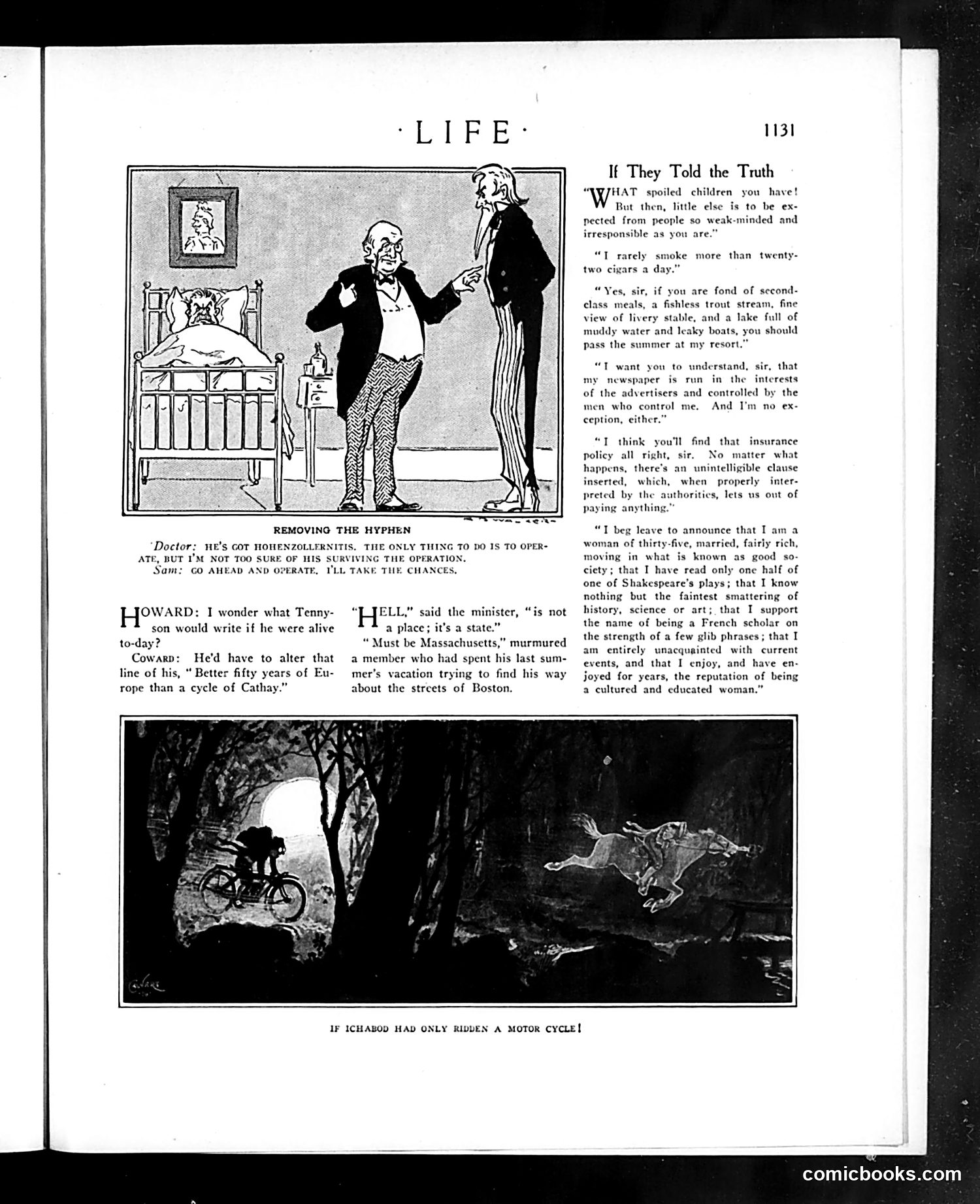
**Top Cartoon - "Removing the Hyphen":** Shows a doctor proposing surgery on a patient with "Homenzollernitis" (referencing the German royal House of Hohenzollern). This is WWI-era satire about German-American hyphenated identity. The "operation" represents calls to eliminate German cultural influence from America. The cowards' discussion of Tennyson's line about "Europe" versus "Cathay" satirizes American isolationism versus involvement in European affairs. **Bottom Cartoon - "If Ichabod Had Only Ridden a Motor Cycle":** References Washington Irving's Headless Horseman legend. The dark cartoon suggests a motorcyclist meets the supernatural horseman—likely mocking the "progress" of modern technology as ironically dangerous, a common early-20th-century anxiety. **Right Column - "If They Told the Truth":** Series of mock-honest confessions from various professionals (doctor, newspaper publisher, insurance agent, socialite) admitting their actual vices and incompetence. Pure satire exposing hypocrisy in respectable society—a recurring Life magazine theme.
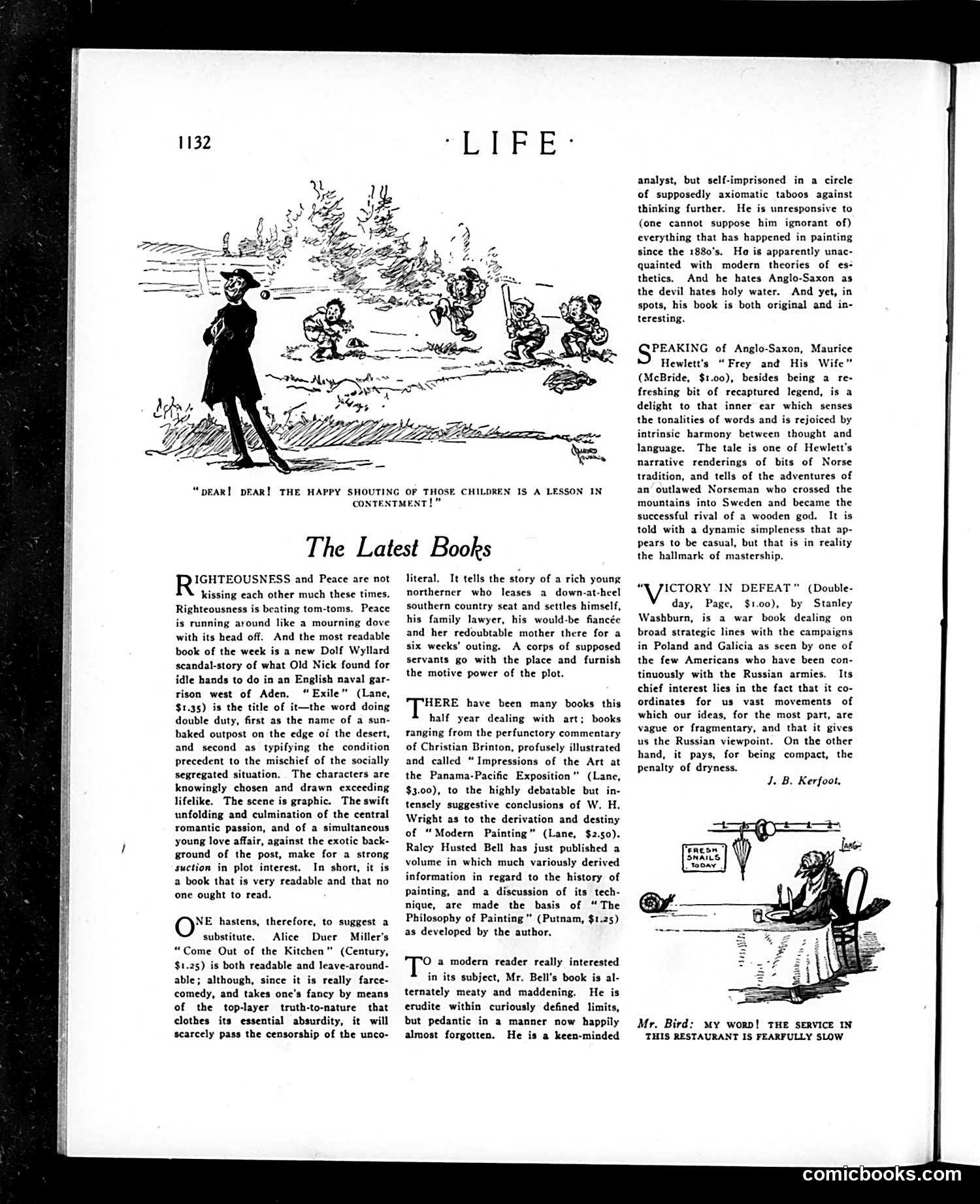
This page is a **book review section** from Life magazine, not primarily political satire. The main cartoon shows a figure observing children playing outdoors with the caption "DEAR! DEAR! THE HAPPY SHOUTING OF THOSE CHILDREN IS A LESSON IN CONTENTMENT!"—a gentle, ironic commentary on simple pleasures versus adult concerns. The text reviews several contemporary books (circa 1915), critiquing their merits. Notable targets include: - A Dolf Wyllard naval scandal novel deemed unreadable despite being "very readable" - Raley Husted Bell's "Philosophy of Painting," which the reviewer criticizes as pedantic, stuck in 1880s aesthetics, and hostile to Anglo-Saxon language - Maurice Hewlett's Norse legend retelling, praised for linguistic harmony The small cartoon at bottom right shows a restaurant server, captioned about slow service—typical period humor about dining establishments. The overall tone is literary criticism wrapped in satirical wit rather than political commentary.
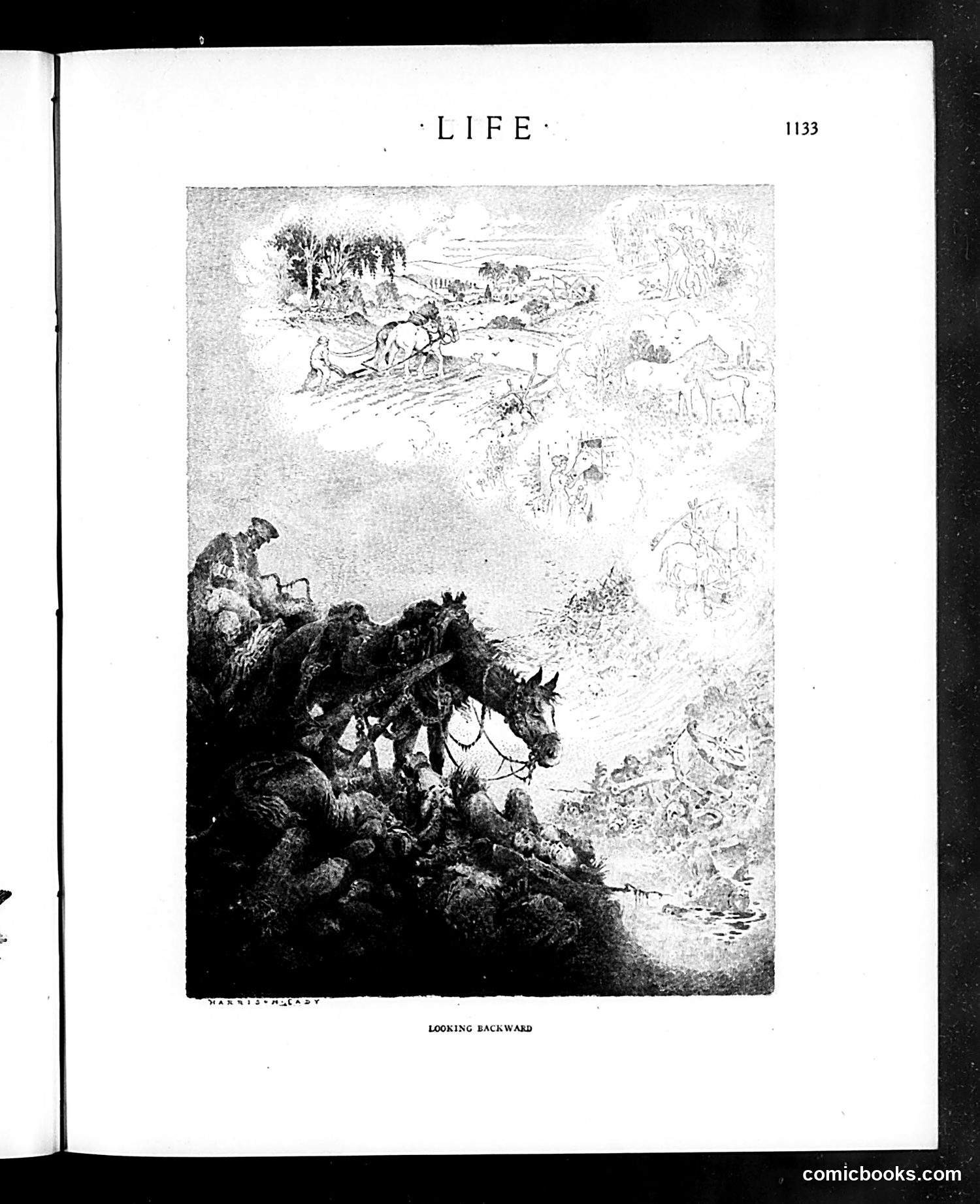
This illustration depicts a figure mounted on a horse-drawn cart or wagon, positioned prominently in the foreground on the left. The rider appears to be looking back over their shoulder toward a distant landscape filled with smaller figures and pastoral scenes. The title "Looking Backward" suggests reflection on the past or nostalgia. Without additional context from Life magazine's publication date or accompanying text, the specific political or social commentary remains unclear. The composition—contrasting a large, somewhat grotesque foreground figure against idyllic background scenes—likely invites ironic commentary on memory, progress, or social change, but the exact satirical target cannot be confidently determined from the image alone.
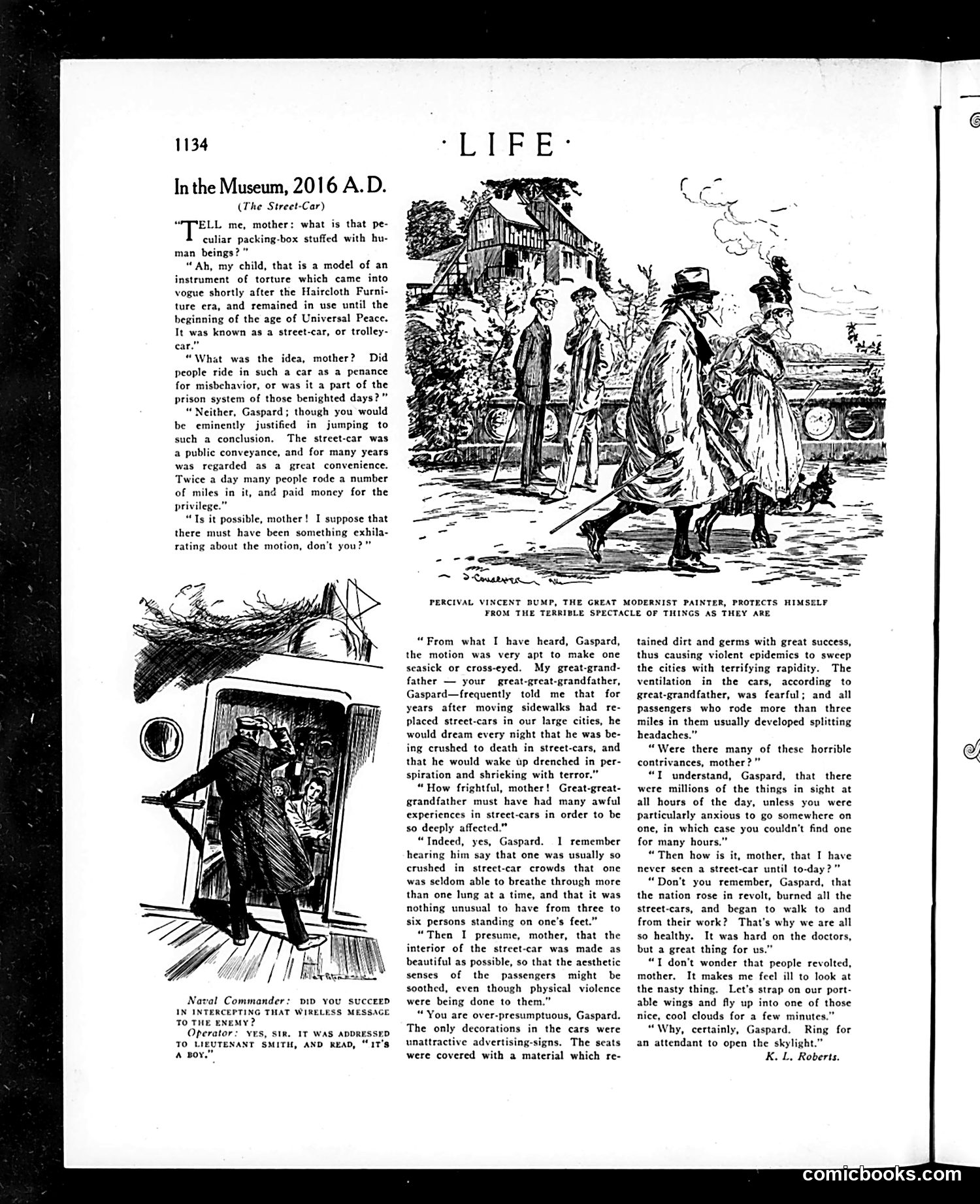
This satirical piece imagines a future where street-cars have become historical artifacts viewed with horror. A mother explains to her child "Gaspard" that street-cars were once common public transportation, but are now regarded as instruments of torture—causing seasickness, crushing crowds, poor ventilation, disease-spreading seats, and inadequate advertising decoration. The satire mocks the street-car system's genuine problems (overcrowding, filth, discomfort) by having future generations treat them as relics of a barbaric age. The joke inverts perspective: what was once considered "a great convenience" becomes retrospectively absurd. The page also includes unrelated vignettes: a Naval Commander joke about intercepting wireless messages, and a modernist painter avoiding reality—both typical Life magazine humor of the early 1900s. The satire reflects contemporary frustration with urban transit conditions.
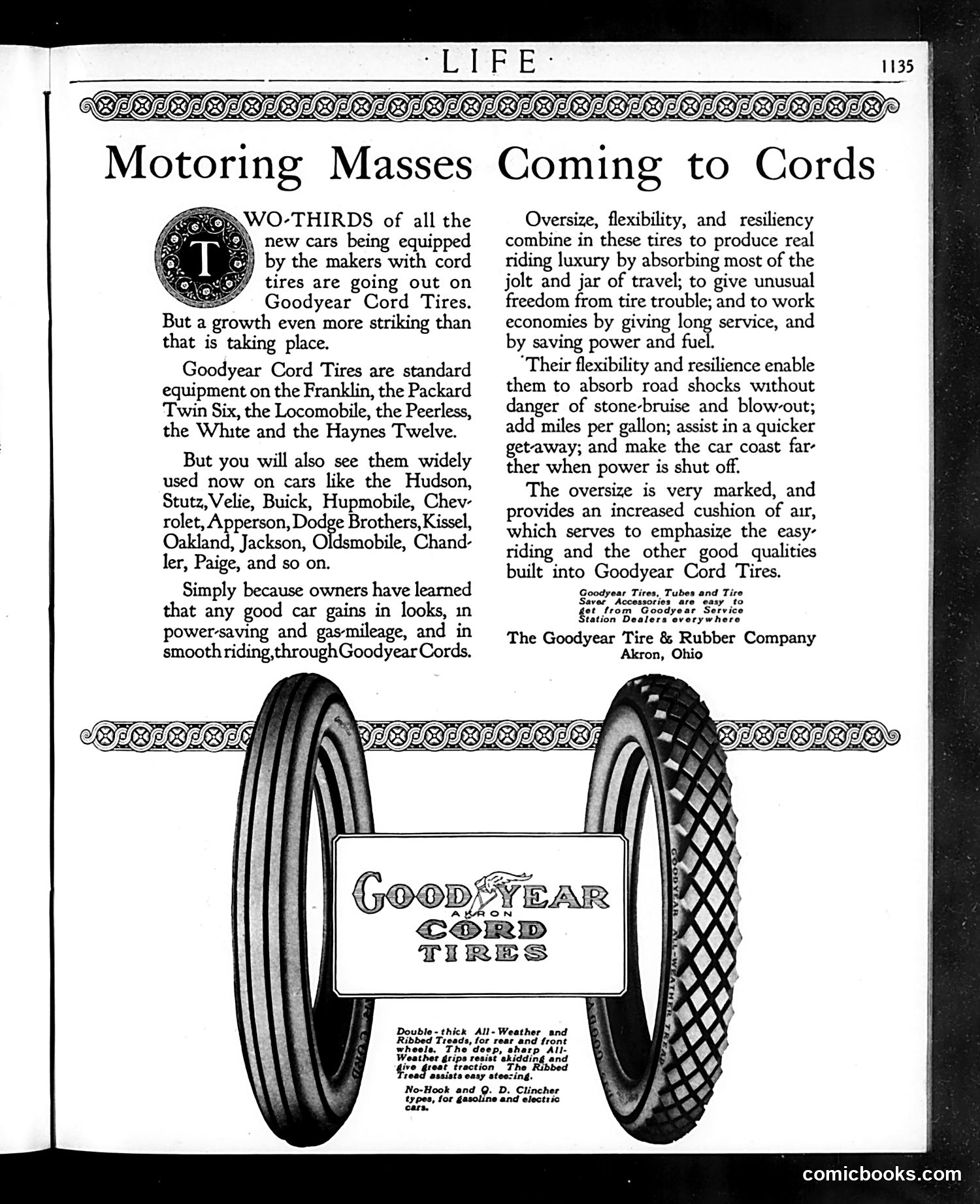
This is a **commercial advertisement**, not political satire. It promotes Goodyear Cord Tires to automobile manufacturers and owners during the early automotive era (appears to be 1920s based on car models listed). The "point" is marketing strategy: Goodyear notes that cord tires are becoming standard equipment on luxury brands (Franklin, Packard, Locomobile), and the ad celebrates their expanding adoption across mid-range vehicles (Hudson, Buick, Chevrolet, Oldsmobile, etc.). The visual shows two tire designs—smooth and ribbed—demonstrating product variety. The text emphasizes practical benefits: better shock absorption, longer service life, improved fuel economy, and safer handling. There is **no satire or political commentary**. This is straightforward industrial advertising highlighting a tire technology's competitive advantage during an era when automobile reliability and tire quality were major consumer concerns.
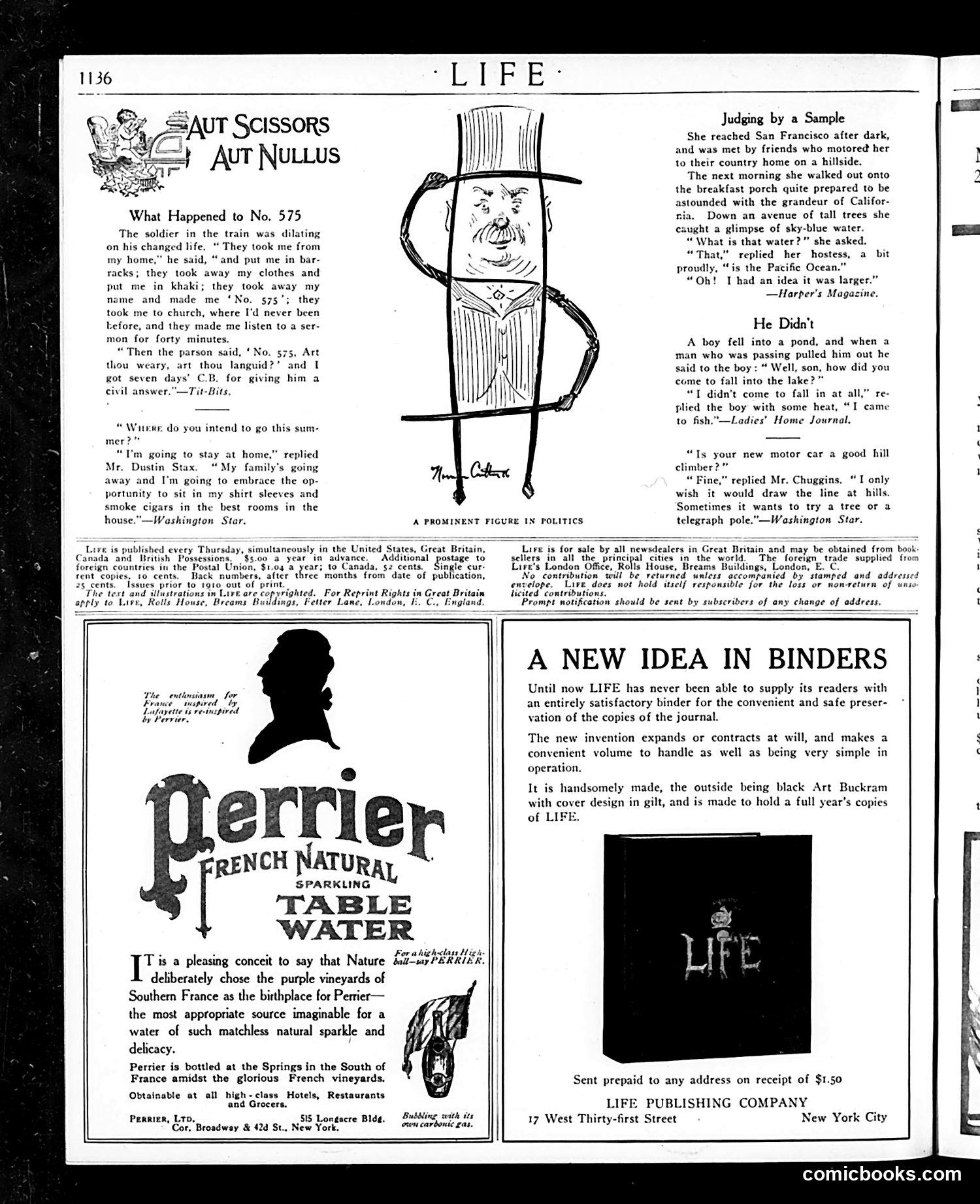
This page from *Life* magazine contains several short humorous anecdotes typical of early 20th-century American satire: **"What Happened to No. 575"** mocks military dehumanization—a soldier describes losing his identity, clothes, name, and even religious freedom upon enlistment, reduced to a number. **"Judging by a Sample"** jokes about California tourism: an Eastern visitor expects the Pacific Ocean to be impressively vast, disappointed by what she sees. **"He Didn't"** and the motor car joke are brief, punchy humor about literal-mindedness and mechanical unreliability. The page also advertises a new *Life* magazine binder and Perrier sparkling water. The silhouetted "Perrier" advertisement appeals to French sophistication as a selling point. The cartoon titled **"A Prominent Figure in Politics"** (upper right) appears to caricature a political figure, though the specific identity is unclear from the image alone—typical of *Life*'s editorial commentary on contemporary politicians.
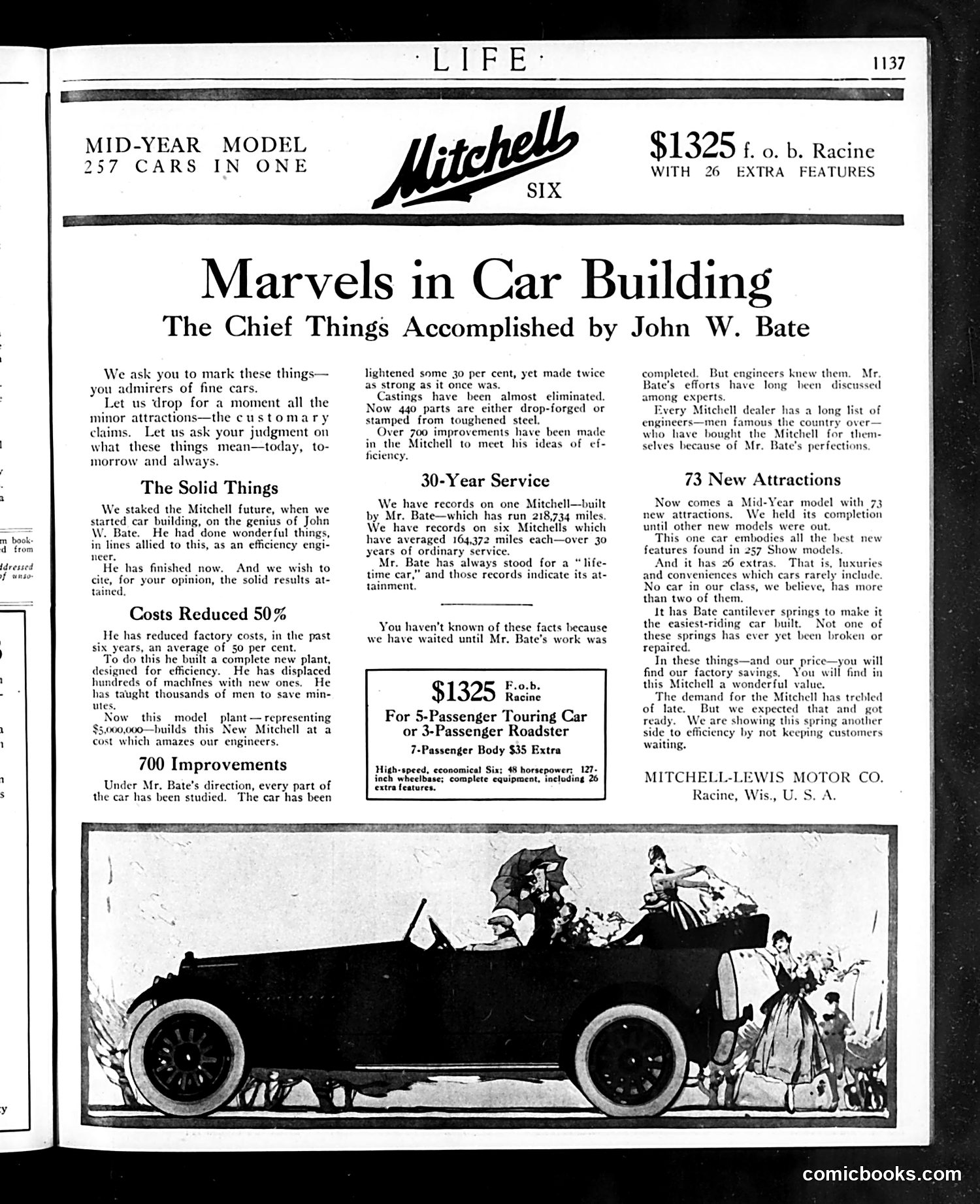
This page is primarily **automotive advertising**, not political satire. It's a 1920s promotional piece for the Mitchell Six automobile manufactured in Racine, Wisconsin. The illustrated cartoon at the bottom depicts a **fashionable touring car filled with well-dressed passengers** — likely representing aspirational consumers of the era. The imagery emphasizes leisure, elegance, and modernity. The text celebrates engineer **John W. Bate's achievements**: 50% cost reduction, 700 improvements, and durability (citing a car with 218,734 miles). The "73 New Attractions" and 26 "extra features" appeal to middle-class buyers seeking both value and luxury. The price ($1,325 f.o.b. Racine) and repeated emphasis on "factory savings" target practical consumers during the competitive automobile boom. There is **no political content** — this is straightforward commercial marketing emphasizing engineering excellence and value proposition, typical of Life magazine's advertising revenue model during the 1920s.
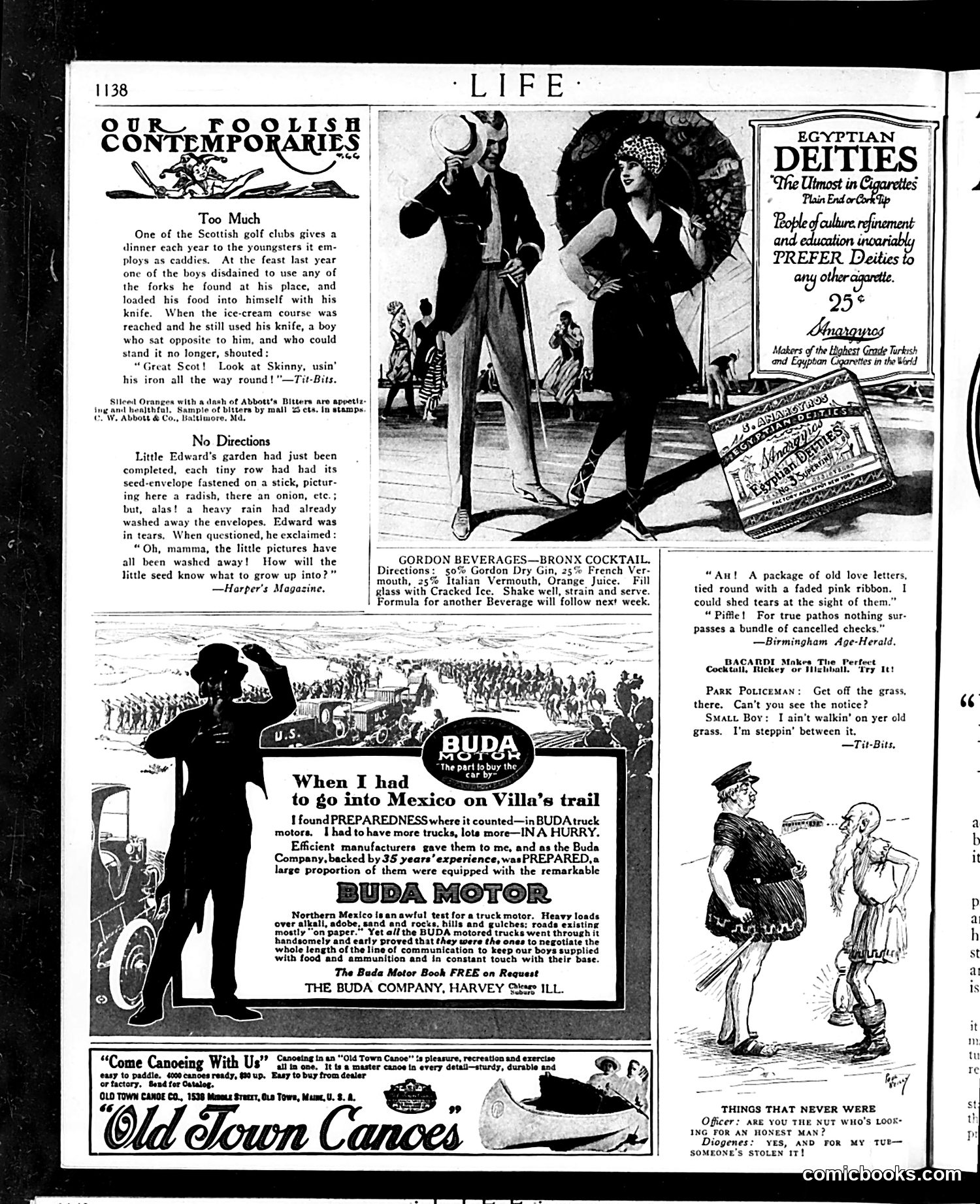
This is primarily an **advertising and humor page** from Life magazine, with several distinct sections: **Humor Columns ("Our Foolish Contemporaries"):** Three brief, genteel jokes about social awkwardness—a Scottish caddy using only a knife at a formal dinner, a child confused about seed packets after rain, and a boy stepping between grass rather than on it. These represent gentle, class-conscious humor typical of the era. **Advertisements:** The page features three substantial ads: Buda truck motors (emphasizing "preparedness" and military readiness, likely WWI-era), Old Town Canoes, and Egyptian Deities cigarettes. The Buda ad specifically references Mexico and military supply lines, suggesting early 20th-century context. **Classical Cartoon:** A small sketch titled "Things That Never Were" depicts Diogenes (the ancient Greek philosopher famous for seeking an honest man) discovering his lantern has been stolen—a cynical joke about dishonesty. Overall, this reflects early 20th-century American middlebrow humor and consumer culture, with subtle period anxieties about military preparedness evident in advertising.
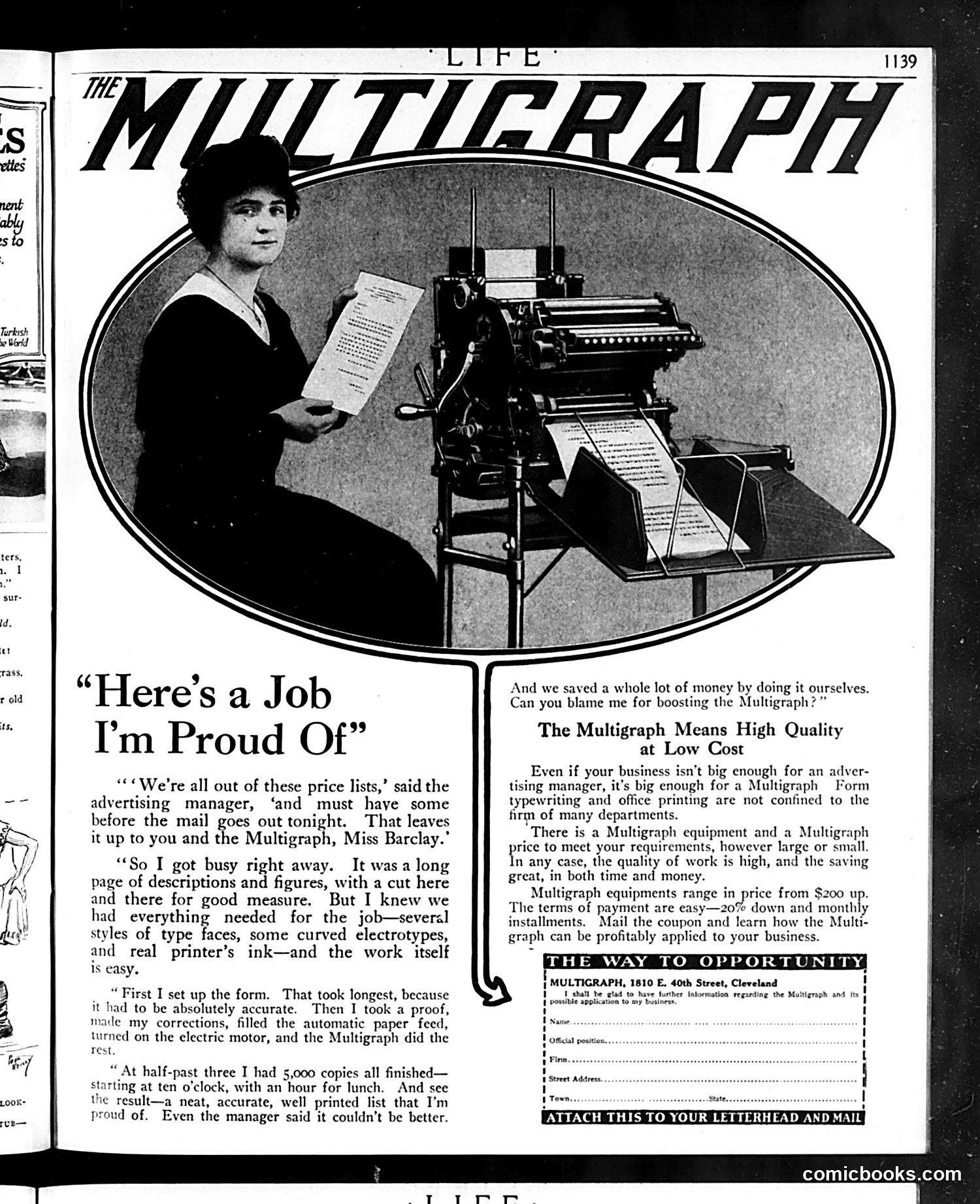
This is **not political satire but commercial advertising** disguised as a testimonial narrative. The page presents Miss Barclay, an office worker, describing how a Multigraph machine (an early photocopying/duplicating device) enabled her to produce 5,000 printed price lists in a single workday—efficiently and cost-effectively. The "job I'm proud of" frame celebrates workplace productivity and labor-saving technology. For modern readers, the significance lies in the historical context: this represents early-20th-century office automation advertising, targeting small businesses. The narrative emphasizes speed, accuracy, and self-sufficiency—a business didn't need an external print shop if it owned a Multigraph. The coupon below invites inquiries, making this a sales pitch wrapped in an inspirational employee success story. The tone reflects period optimism about technology improving both efficiency and worker satisfaction.
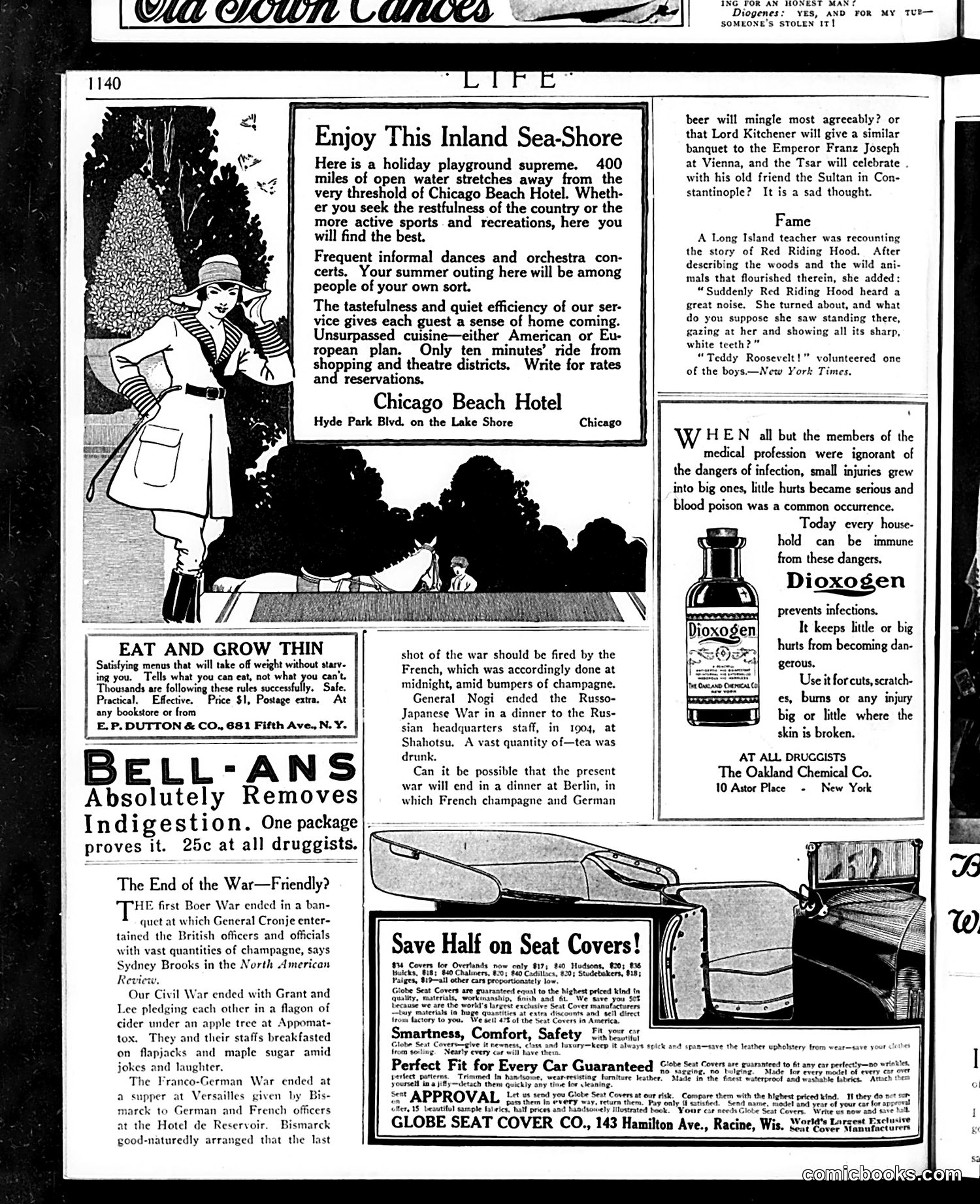
This page is primarily **advertising**, with one notable satirical piece. The main satire is "The End of the War—Friendly?" which references World War I (then ongoing). The author humorously catalogs how previous major wars ended in convivial banquets: the Boer War, American Civil War, Franco-German War, and Russo-Japanese War all concluded with enemies dining together peacefully. The piece sardonically asks whether WWI might similarly end with French champagne and German beer mingling at a Berlin dinner, or the Tsar celebrating with the Sultan in Constantinople—presenting this as absurdly unlikely given the war's bitterness. The joke relies on readers knowing these historical precedents and recognizing the implicit contrast: WWI's scale and horror made such friendly reconciliation seem impossibly naive. The other content consists of hotel, patent medicine, diet book, and car seat cover advertisements typical of the era—standard commercial fare for *Life* magazine.
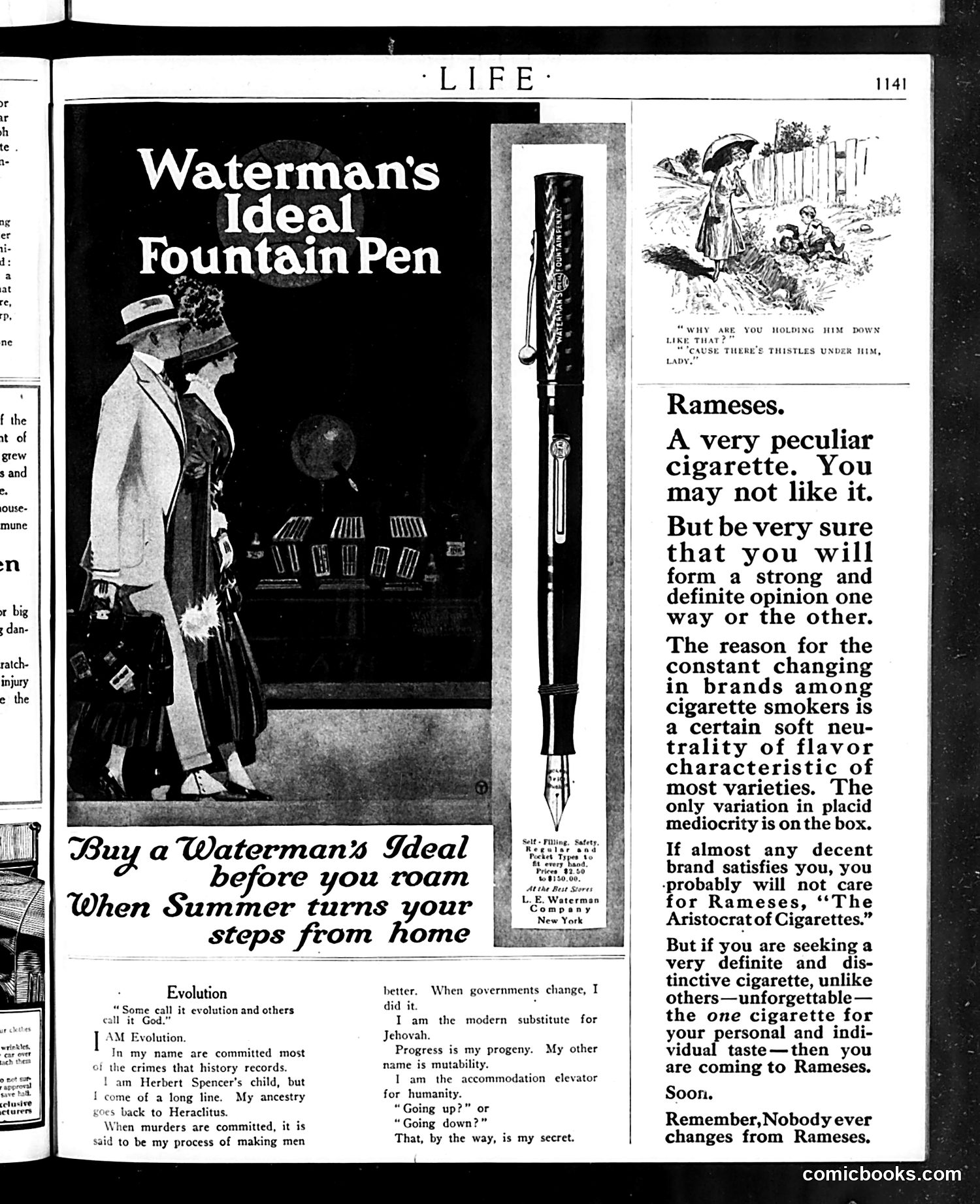
This page contains **two advertisements** and a short satirical piece, typical of Life magazine's format. **"Evolution" piece**: A philosophical satire personifying Evolution as a modern force replacing traditional religion (Jehovah). It critiques Social Darwinism—the misuse of evolutionary theory to justify social upheaval, crime, and government change as "natural progress." The reference to Herbert Spencer (a 19th-century philosopher who popularized "survival of the fittest") anchors this as commentary on how evolution was weaponized to rationalize harmful policies. **Waterman's Fountain Pen ad**: A conventional advertisement targeting travelers ("before you roam / When Summer turns your steps from home"), showing a well-dressed couple with luggage at what appears to be a train station or travel hub. **Rameses Cigarettes ad**: Markets cigarettes as distinctive and memorable, contrasting themselves against "placid mediocrity" of competitors. The name "Aristocrat of Cigarettes" and emphasis on forming "strong opinion" suggests appeal to discerning consumers seeking status differentiation. All three are period advertising/content typical of this magazine's satirical yet commercial nature.
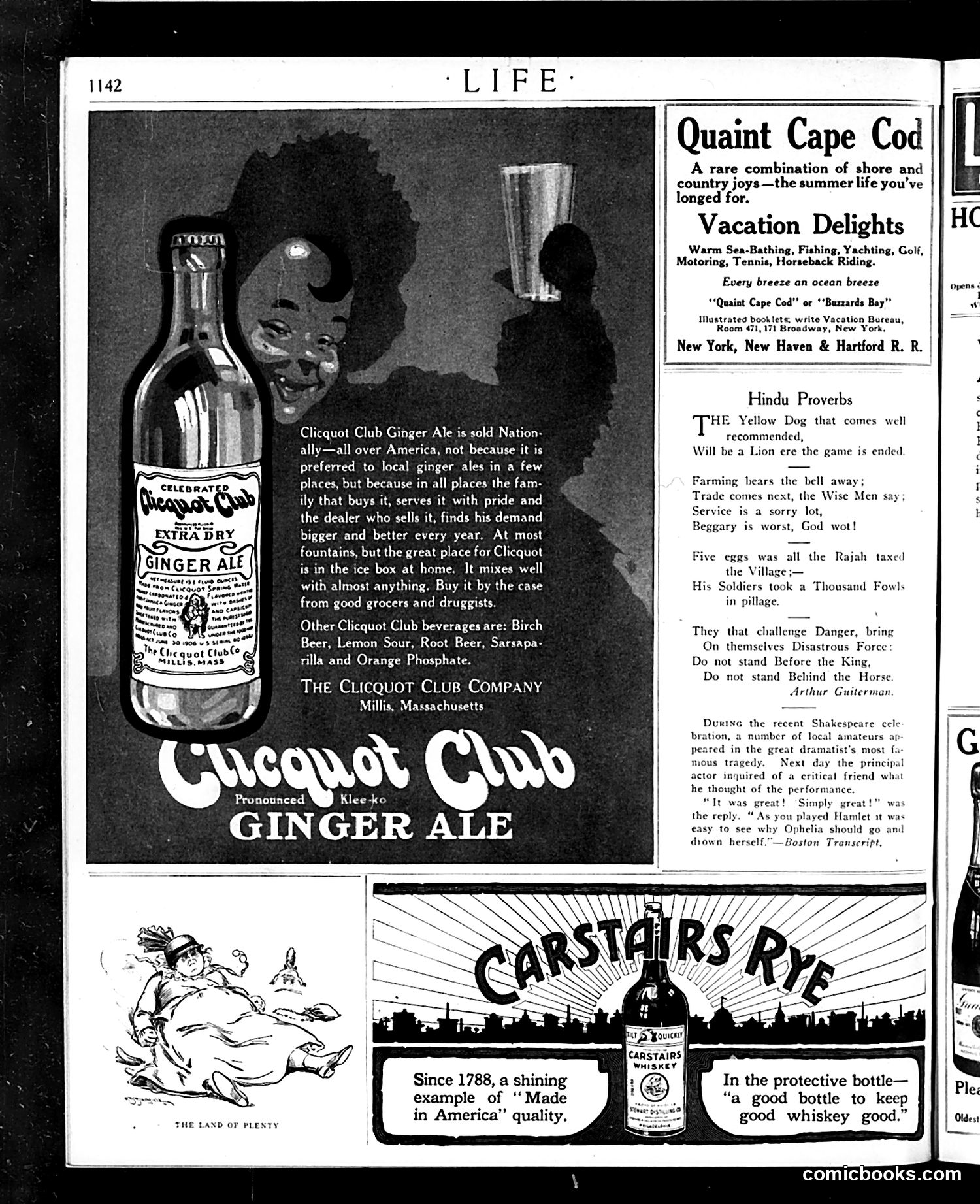
This **LIFE magazine page is primarily advertisements**, not political satire. The page contains three main ads: 1. **Clicquot Club Ginger Ale** (top): A product ad emphasizing national distribution and quality, with silhouettes of people enjoying the beverage. 2. **Cape Cod vacation** (right): Tourism promotion for summer activities. 3. **Carstairs Rye Whiskey** (bottom): Spirits advertisement claiming "Made in America" quality since 1788. The page also includes **"Hindu Proverbs"** by Arthur Guiterman—apparently a regular column—offering moral observations about work, service, and consequences. One brief anecdote mocks amateur Shakespearean actors, with a critic's diplomatic praise masking the poor quality of the performance. **No significant political cartoon or satire is present.** This is a typical commercial page from Life's advertising-heavy era, reflecting early-to-mid 20th-century consumer culture and editorial filler.
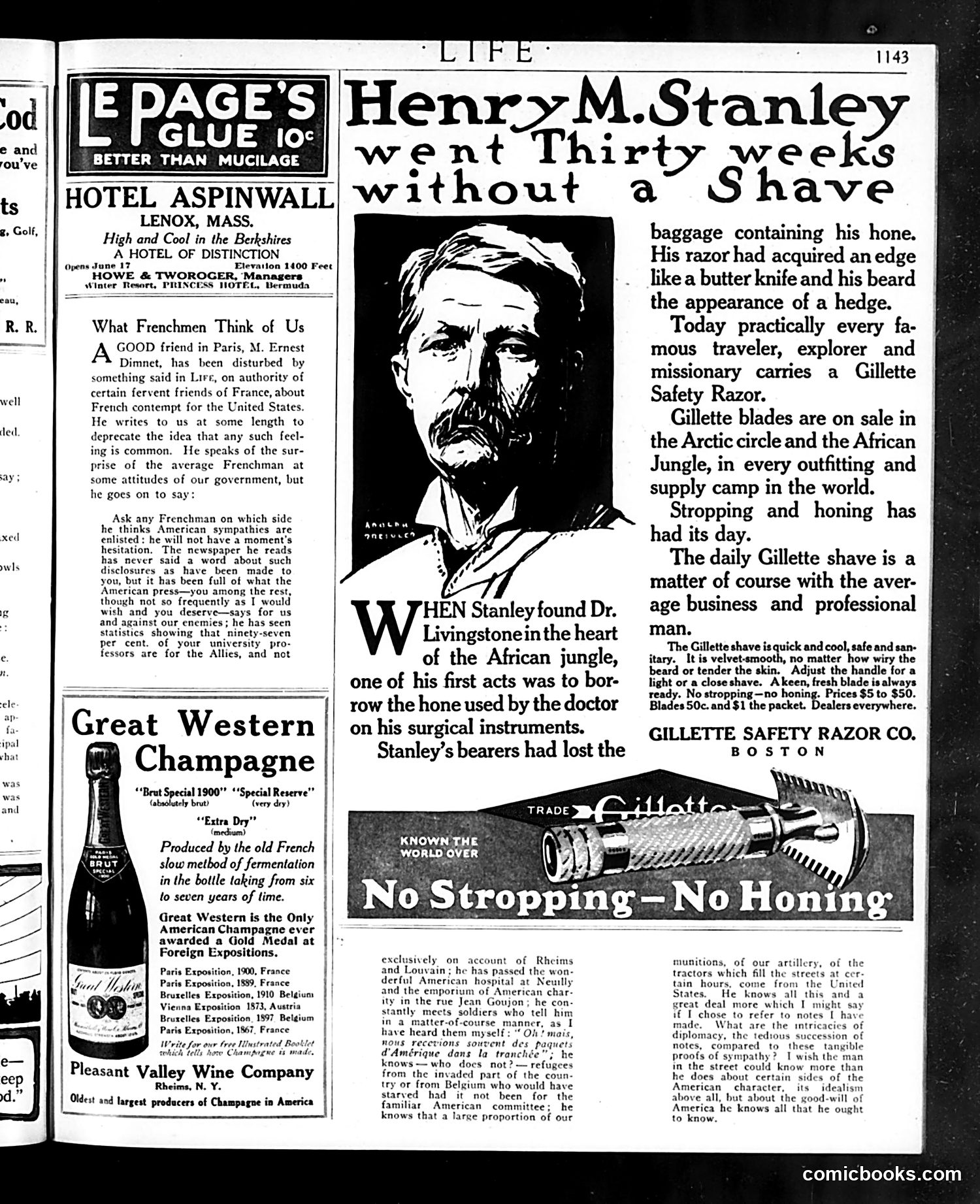
This page contains two main elements: **Main Feature: "Henry M. Stanley went Thirty weeks without a Shave"** This is an advertisement for Gillette Safety Razors disguised as editorial content. It references the famous 1871 meeting between explorer Henry Morton Stanley and missionary David Livingstone in Africa. The narrative hook claims Stanley borrowed Livingstone's surgical hone to sharpen his razor after 30 weeks without shaving. The joke/satire: The story uses this historical anecdote to pitch modern razors—arguing that unlike explorers of old who needed stropping and honing, today's travelers (and businessmen) should carry convenient Gillette razors requiring no maintenance. **Secondary Content:** A brief essay, "What Frenchmen Think of Us," defends American reputation in France against claims of French contempt. It argues French citizens recognize American support for Allied causes in WWI, citing American hospitals and charitable committees helping Belgian/French refugees. Both pieces reflect early-1910s concerns: American international relations and marketing to adventurous men.
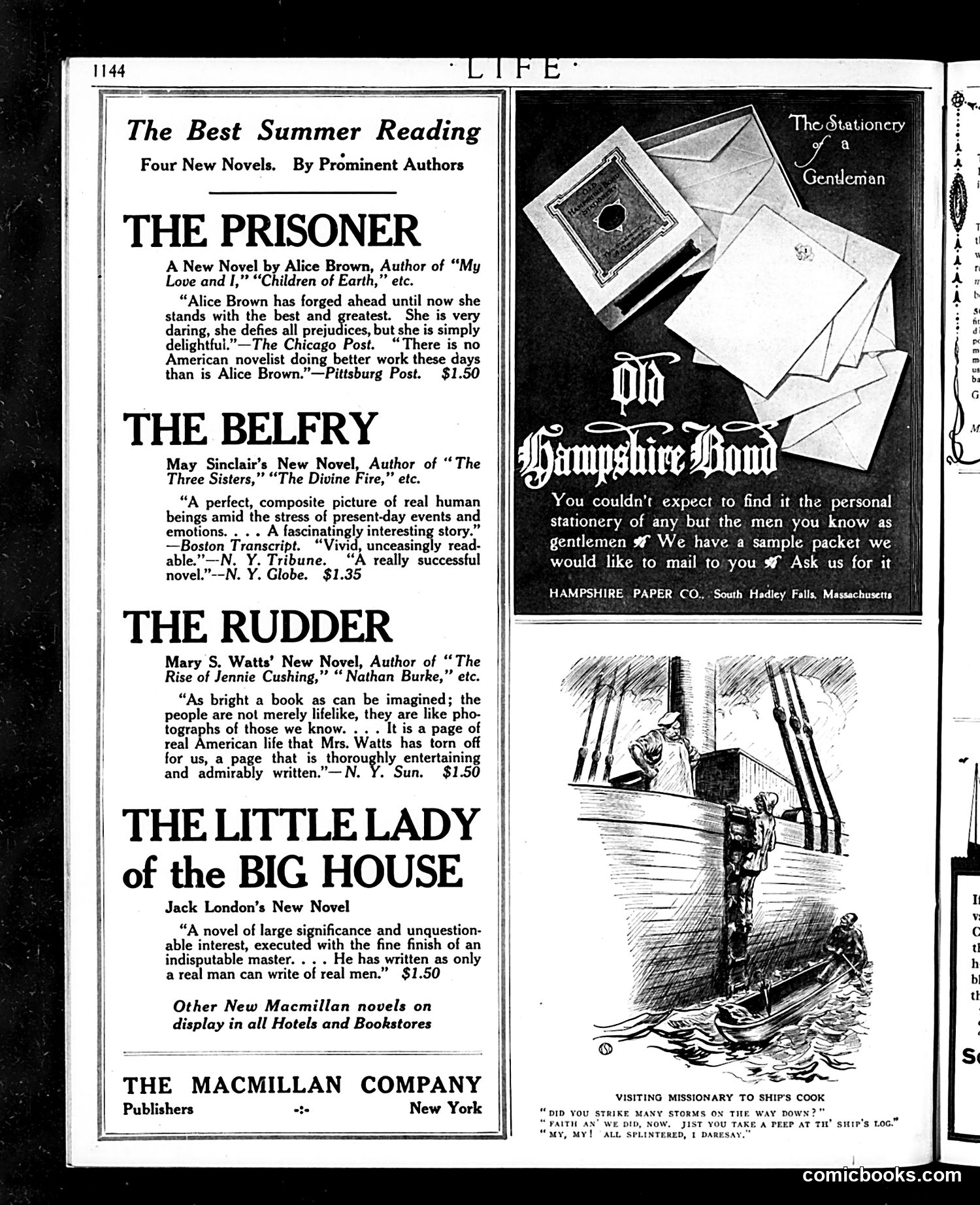
This page is primarily **advertising for new novels** from the Macmillan Company, featuring four 1911-era literary releases by prominent authors like Alice Brown, May Sinclair, Mary S. Watts, and Jack London, with critical praise and prices ($1.35-$1.50). The right side contains a **stationery advertisement** for Hampshire Paper Co., using the appeal that quality writing paper signals gentlemanly status. At the bottom is a **single-panel cartoon** depicting a conversation between a visiting missionary and a ship's cook. The joke relies on Irish dialect humor (common in the era) where the cook misunderstands the missionary's inquiry about storms. When asked if they encountered storms "on the way down," the cook interprets this literally and shows damage to the ship's log as evidence—a pun on "log" (both the ship's record and literal wood). The humor stems from the cook's working-class misinterpretation of refined language.
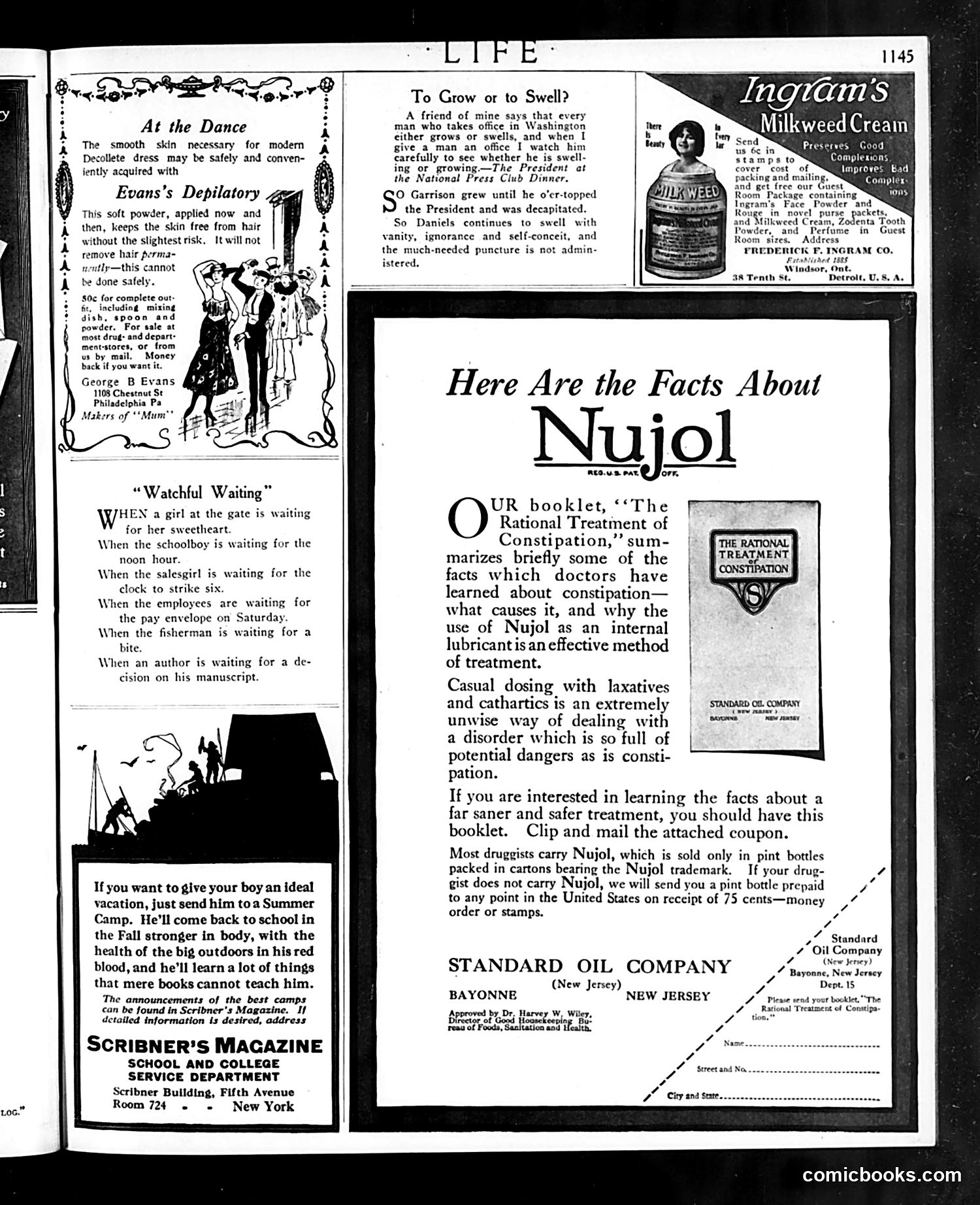
This page contains political satire and period advertisements rather than traditional cartoons. **"To Grow or to Swell?" section:** The piece satirizes government officials under President Wilson, using a metaphor about growth versus swelling. It references two figures: **Garrison** (appears to be a cabinet member who "grew" and was removed/"decapitated") and **Daniels** (likely Josephus Daniels, Secretary of the Navy), criticized for swelling "with vanity, ignorance and self-conceit." The satire suggests these officials inflated their importance rather than genuinely developing in office—a critique of ego and incompetence in Wilson's administration. **"Watchful Waiting":** A poetic piece playing on the phrase "watchful waiting," Wilson's foreign policy approach, by listing mundane situations of waiting (girls, schoolboys, employees). It's gentle social humor rather than sharp political satire. **The advertisements** (Evans's Depilatory, Ingram's Milkweed Cream, Nujol laxative, Scribner's Magazine, Summer Camps) represent typical early-20th-century product marketing, notably promoting remedies and beauty products by modern standards of questionable efficacy.
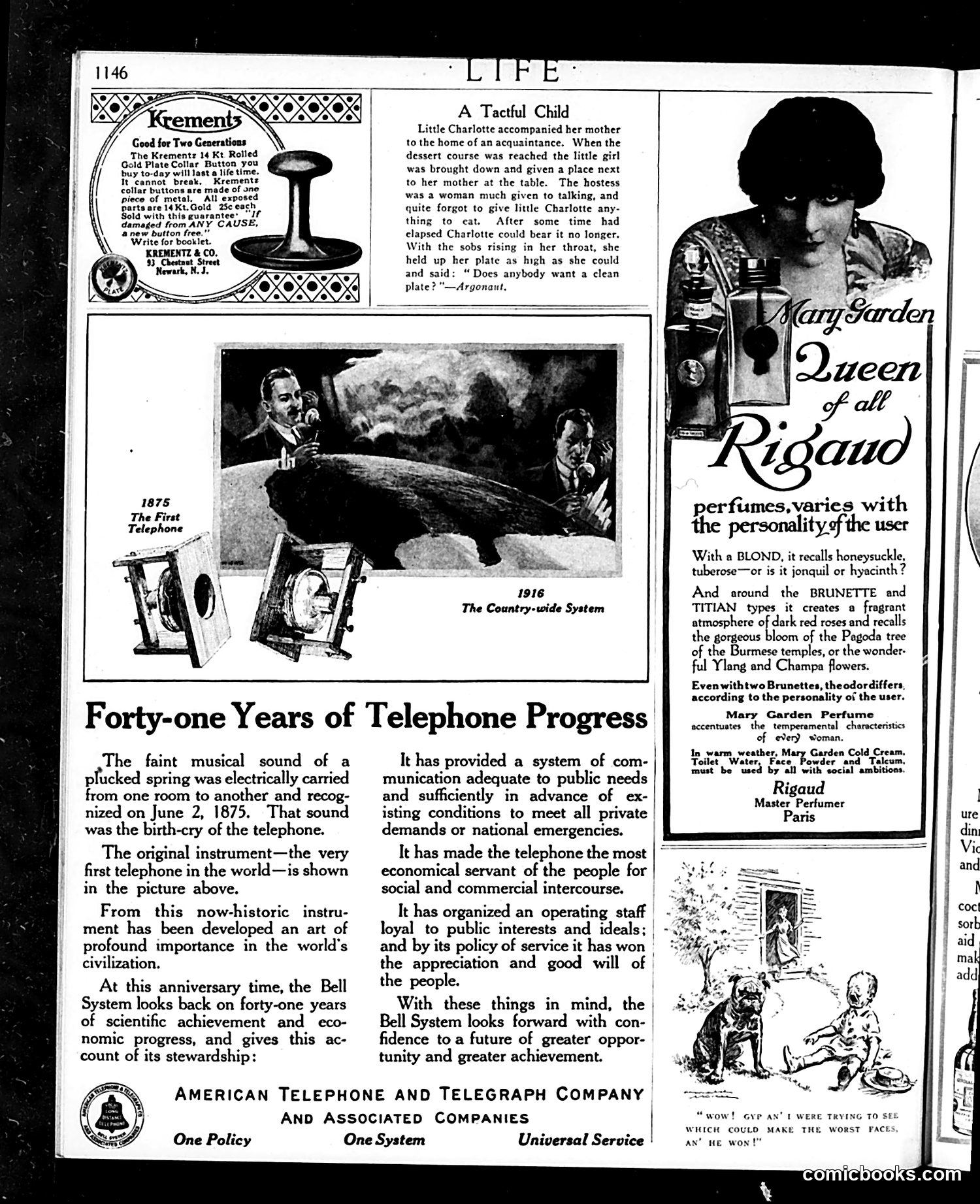
This page contains three distinct elements: **"A Tactful Child"** (top): A brief humorous anecdote about a neglected child guest who, ignored during dessert, sarcastically holds up her empty plate asking if anyone wants a "clean plate"—a pointed, polite rebuke of the hostess's inattention. The joke relies on the child's understated wit. **"Forty-one Years of Telephone Progress"** (center): A corporate advertisement from AT&T celebrating the telephone's 41st anniversary (dating from 1875). It includes images of the original 1875 telephone and a 1916 "country-wide system," framing telephony as a civilizing achievement. The text presents the Bell System's self-congratulatory narrative about serving public needs and earning public goodwill. **Mary Garden Perfume advertisement** (right): A fragrance ad claiming the scent "varies with the personality of the user"—adapting differently for blondes, brunettes, and redheads, supposedly enhancing each woman's natural characteristics. The bottom cartoon shows children making faces, unrelated to the perfume. The page is primarily **advertising-driven**, with one brief satirical anecdote amid commercial content typical of early 20th-century *Life* magazine.
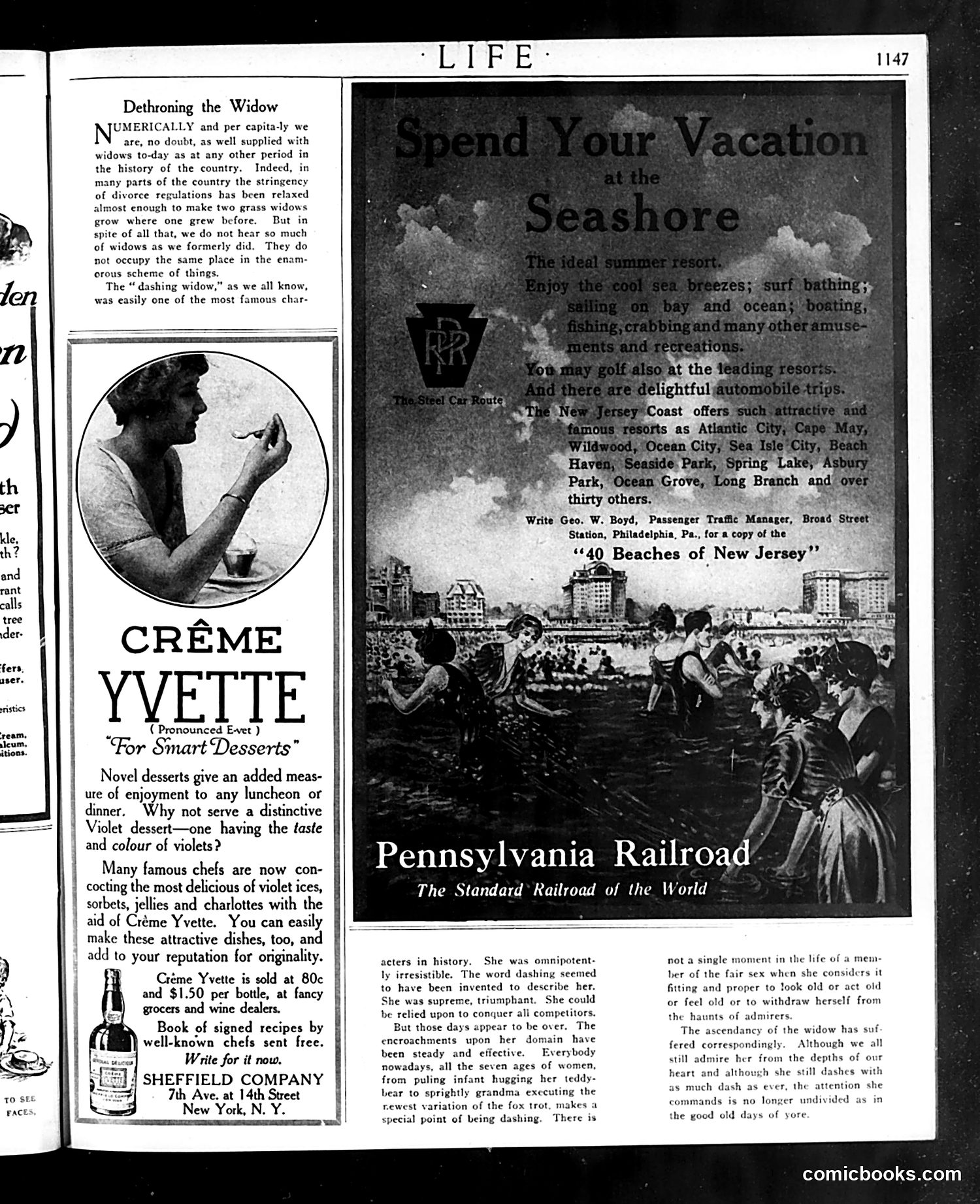
This article argues that the cultural archetype of the "dashing widow"—a famous character type in history known for irresistible charm and romantic conquests—has lost cultural prominence. The author attributes this decline to modern social changes: relaxed divorce laws creating "grass widows," and crucially, the fact that *all women* now occupy the role once exclusive to widows. From infants to grandmothers, contemporary women actively cultivate dashingness and romantic appeal. The widow's former monopoly on seduction and attention has evaporated. She no longer commands undivided admiration "as in the good old days." The piece reflects early-20th-century anxiety about shifting gender dynamics and women's expanded social freedom, presented through wry humor about obsolete romantic archetypes. The page also includes unrelated advertisements for liqueur and railroad vacations.
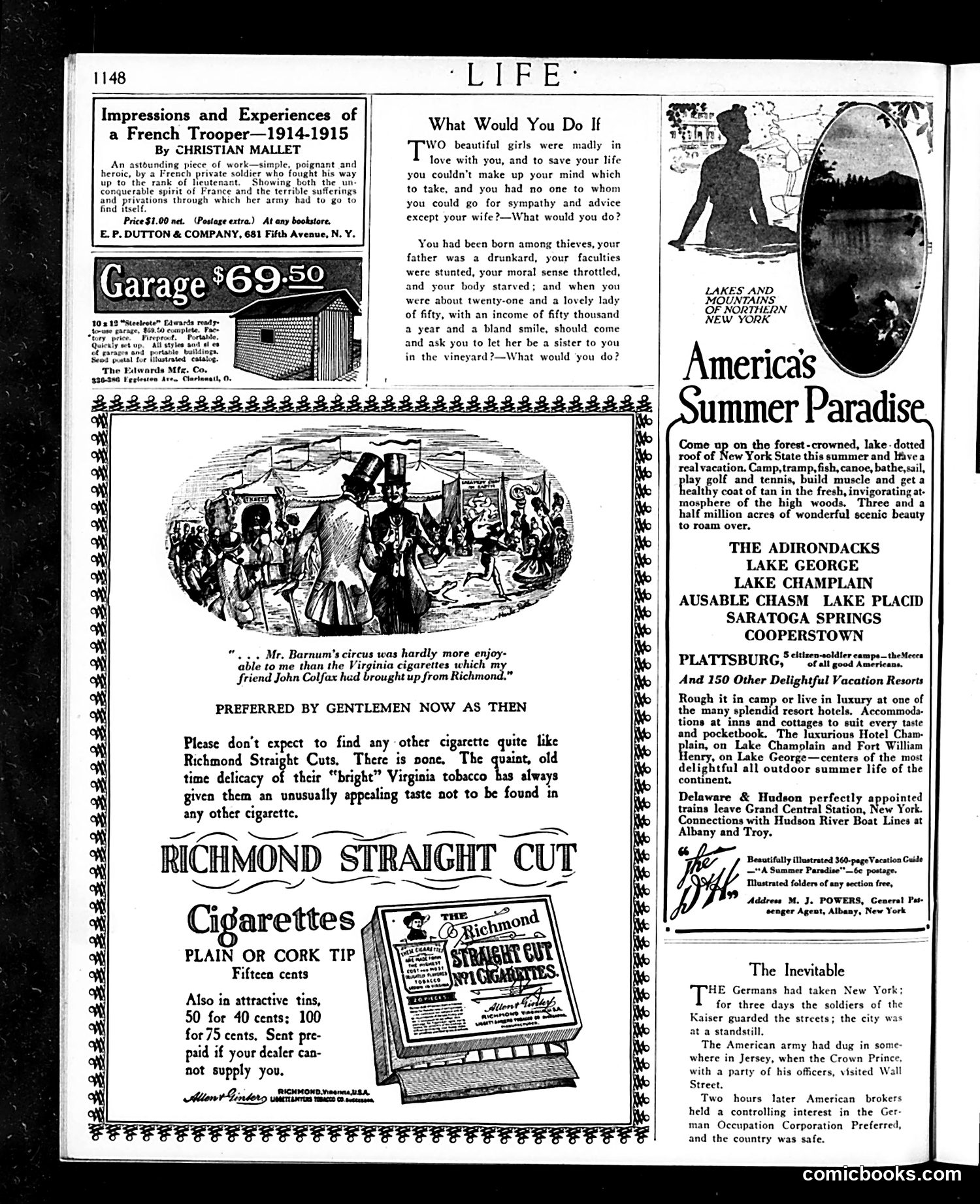
This page mixes advertising with satirical content typical of Life magazine's format. **"What Would You Do If" Column**: A recurring advice-column parody posing absurd ethical dilemmas to readers—two women competing for affection, or accepting improper "sisterhood" from a wealthy older woman. The humor lies in the impossibility of these scenarios and the magazine's mock-serious tone. **"The Inevitable" Story**: A brief satirical piece about German occupation of New York during WWI. The joke is darkly comic: despite military invasion and the Crown Prince touring occupied Wall Street, American brokers quickly gain financial control of a "German Occupation Corporation." The satire mocks American capitalism's power—suggesting financiers could "save the country" through shrewd business dealing rather than military force. This reflects 1914-1915 anxieties about potential German invasion. **Advertisements**: Richmond Straight Cut cigarettes, vacation resorts in upstate New York, and a French soldier memoir round out the page—standard period advertising and content.
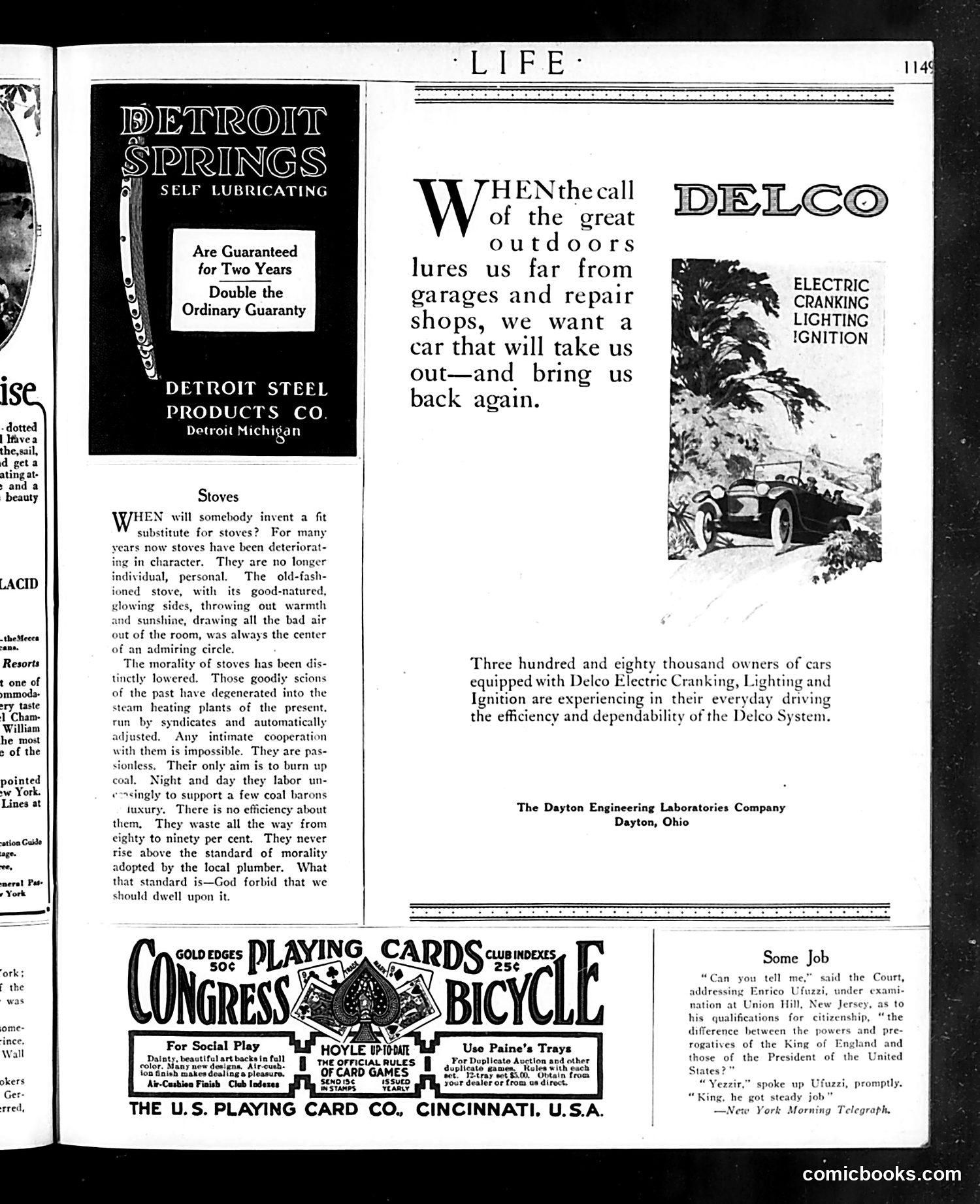
This page is primarily **advertising** with a brief humorous anecdote at the bottom. The ads promote Detroit-era automotive and household products: Detroit Springs lubricating oil (guaranteed two years), Delco electric car systems (cranking, lighting, ignition), and Congress Bicycle playing cards. The editorial content includes a nostalgic essay criticizing modern heating stoves—lamenting that old-fashioned parlor stoves with "good-natured, glowing sides" have been replaced by impersonal, inefficient steam heating plants run by syndicates and plumbers with questionable morals. The author views this as moral decline. The final joke concerns an immigration naturalization test where an Italian applicant, Enrico Ufuzzi, is asked to distinguish between the powers of the English king and U.S. President. His answer—"King, he got steady job"—is presented as humorous malapropism, playing on immigrant unfamiliarity with American civics and accent stereotypes common to early-20th-century American humor.
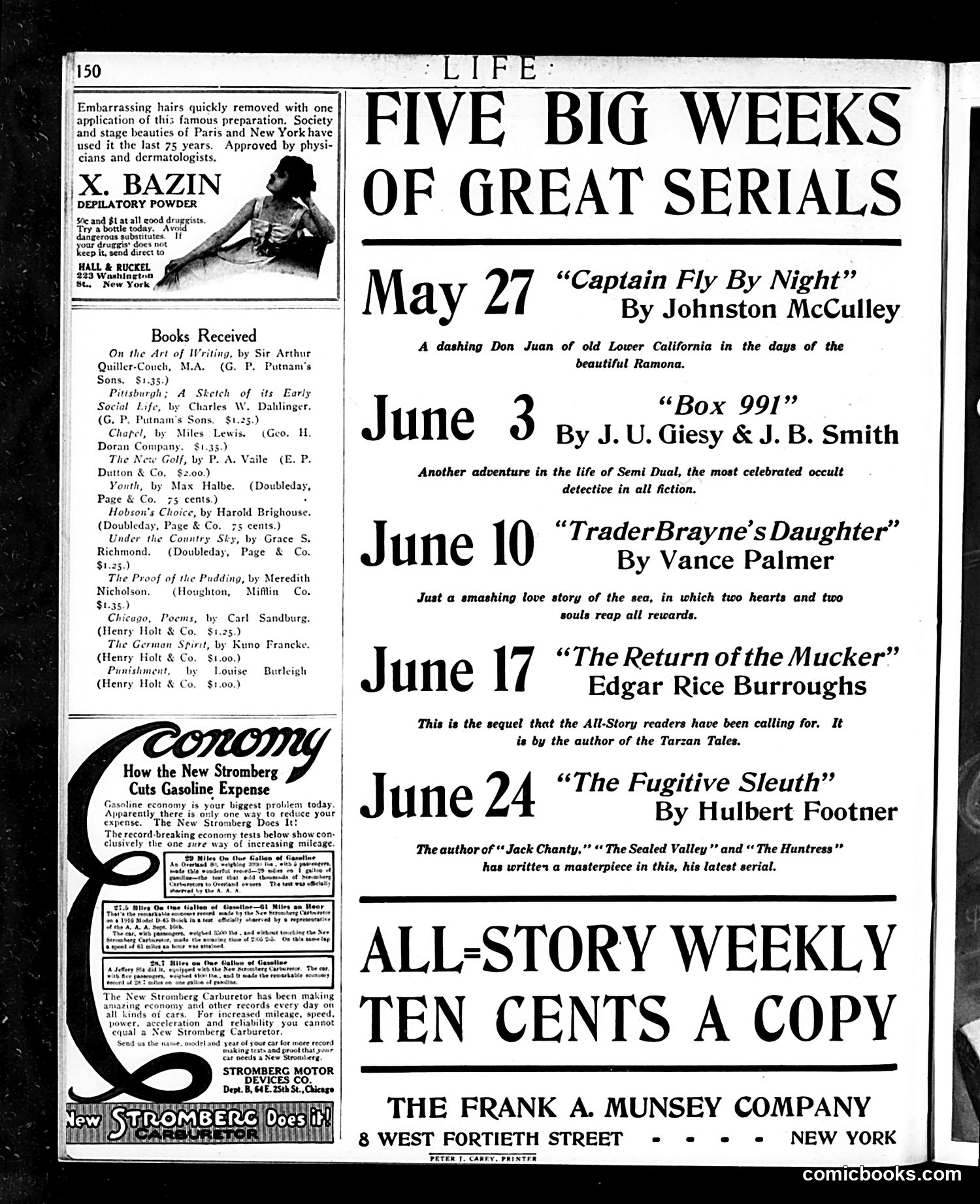
This page is primarily **advertising and promotional content**, not satire or political cartoons. It's from *Life* magazine's promotional section for *All-Story Weekly*, a companion pulp fiction magazine. The page advertises five serialized adventure stories running in June, featuring popular genres of the era: swashbuckling romance ("Captain Fly By Night"), occult detective fiction ("Box 991"), sea adventures ("Trader Brayne's Daughter"), and adventure serials by famous authors like Edgar Rice Burroughs (who wrote *Tarzan*). Supporting ads include X. Bazin depilatory powder (emphasizing its long-standing use among "society and stage beauties") and a Stromberg carburetor promoting fuel economy—typical early-1900s consumer products. The page reflects the era's popular entertainment: adventure serials, exotic settings, and occult detectives were mass-market staples. The "ten cents a copy" price targets working-class readers seeking affordable fiction entertainment.
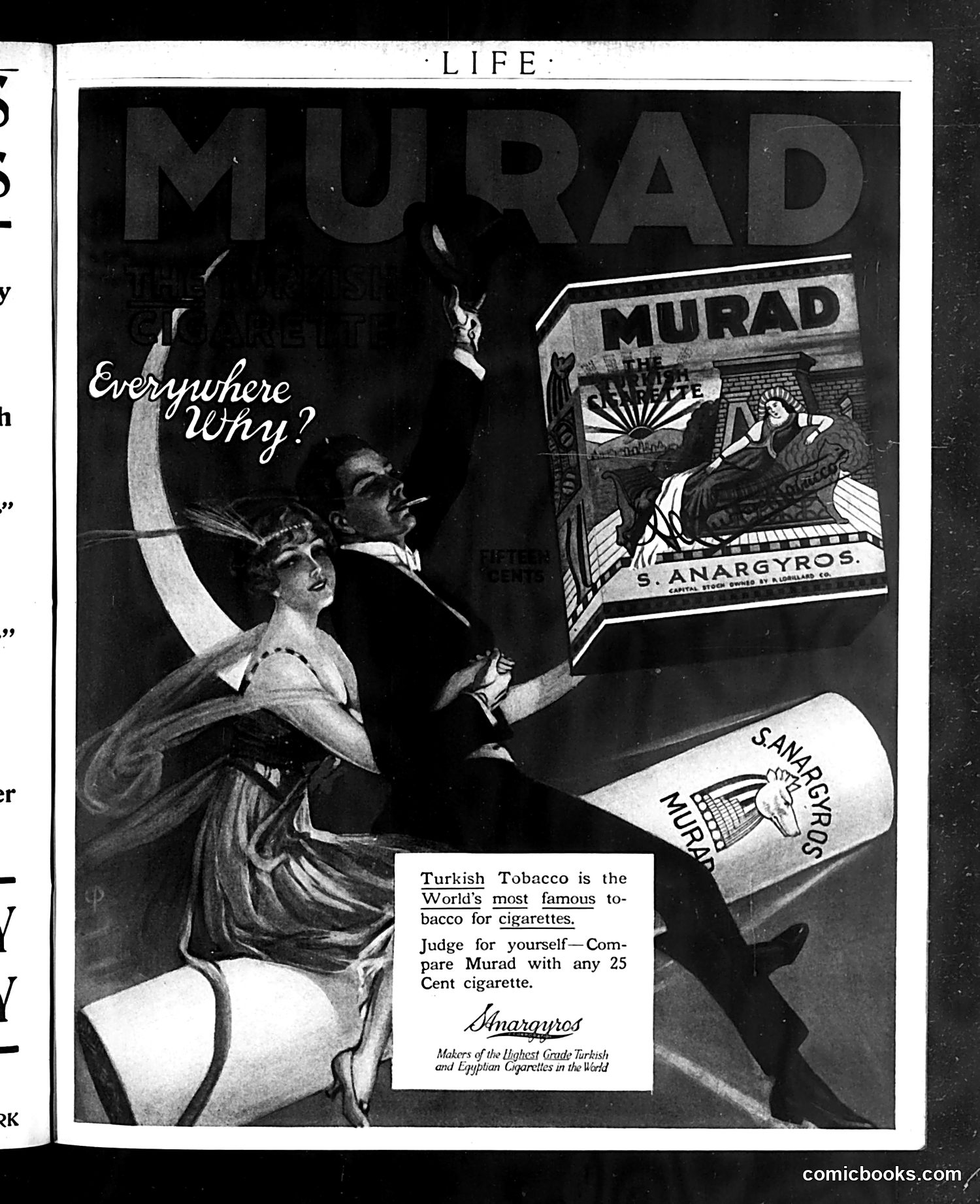
This is a **cigarette advertisement**, not political satire. It promotes Murad brand Turkish tobacco cigarettes, made by Anargyros (the text appears partially cut off). The image depicts a classical allegorical female figure (likely representing quality or luxury) gesturing toward Murad cigarette packages. The accompanying text challenges readers to compare Murad with any 25-cent cigarette, implying Murad offers superior quality. The advertisement emphasizes that Turkish tobacco is "the World's most famous tobacco for cigarettes" and claims Anargyros manufactures "the Highest Grade Turkish and Egyptian Cigarettes in the world." This represents early 20th-century cigarette marketing before tobacco health warnings existed—when such ads regularly appeared in mainstream publications like *Life* magazine.
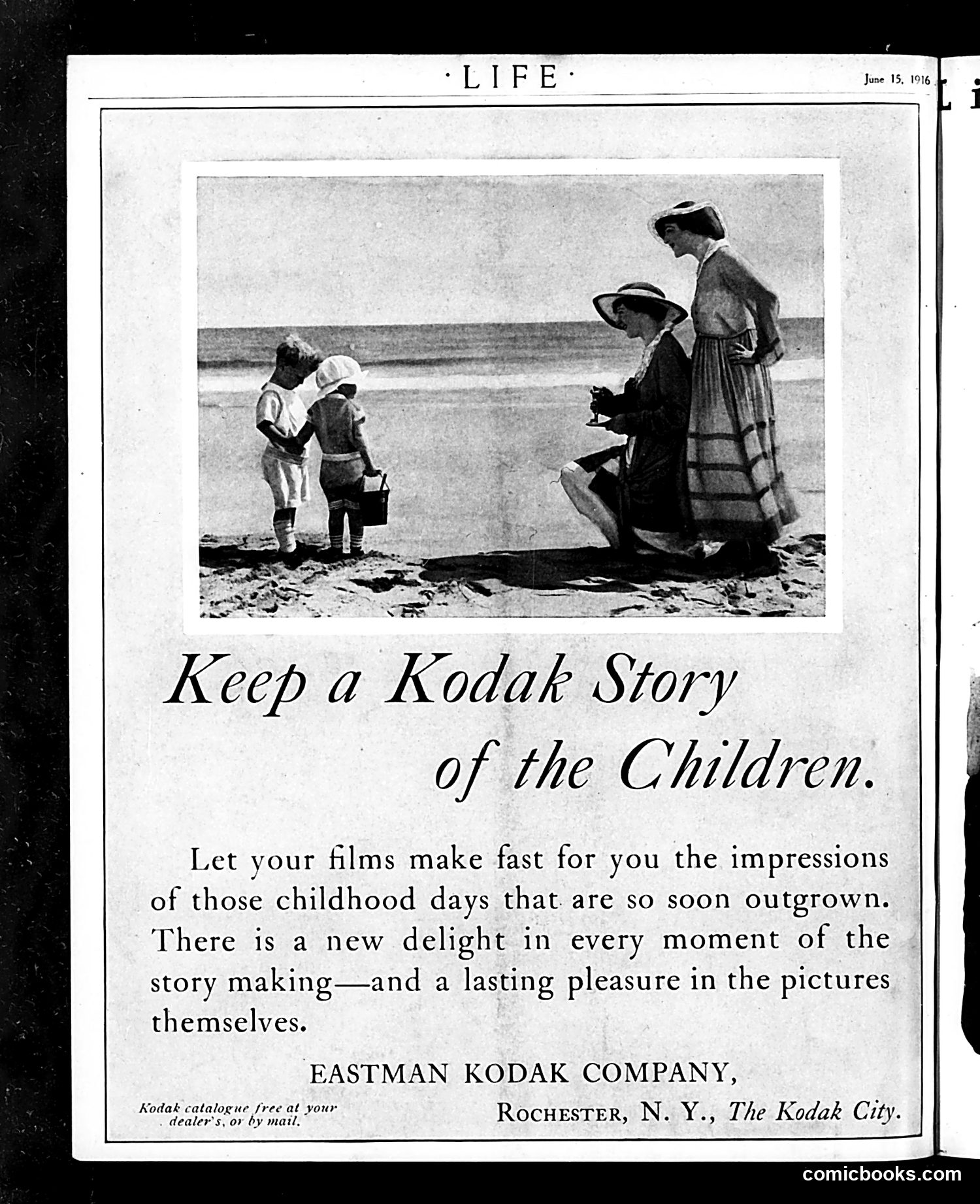
This is **an advertisement, not a cartoon**. It's a Kodak camera company ad from the June 15, 1916 *Life* magazine. The image shows an adult woman with two young children at a beach. The ad promotes photography as a way to preserve childhood memories before children "outgrow" those moments. The tagline "Keep a Kodak Story of the Children" suggests families should use cameras to document everyday life. This reflects early 20th-century marketing that positioned consumer cameras as tools for middle-class family life and sentimentality. The beach setting and dressed figures convey leisure and prosperity. The ad associates Kodak with capturing fleeting, precious moments—a marketing approach that became central to consumer photography's appeal for generations. There is no political satire here; this is straightforward product advertising.