
Life, 1916-06-15 · page 10 of 48
Life — June 15, 1916 — page 10: what you’re looking at
What you’re looking at
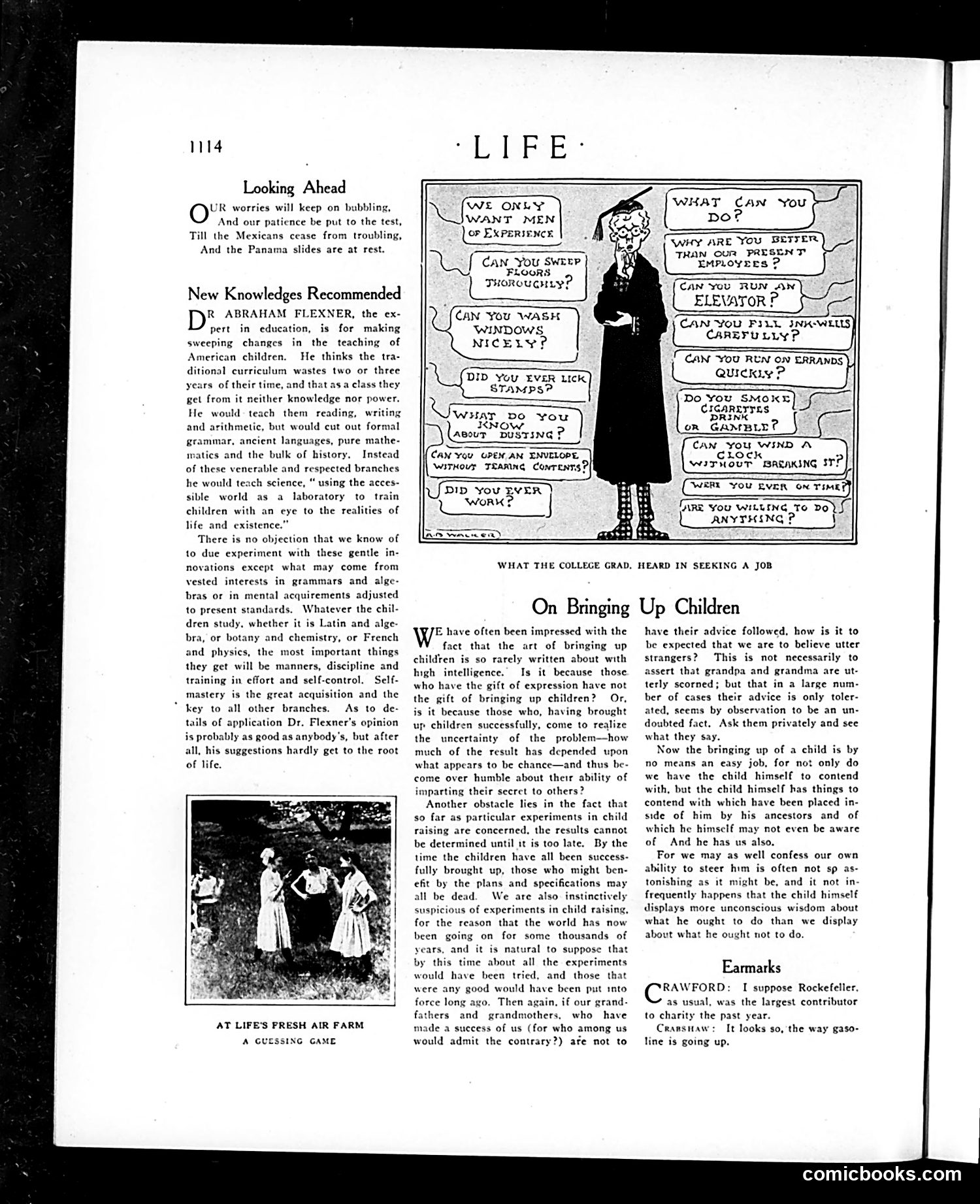
The main cartoon, titled "What the College Grad Heard in Seeking a Job," depicts an employer interrogating a job applicant with absurdly trivial questions: "Can you sweep floors thoroughly?" "Can you wash windows nicely?" "Did you ever lick stamps?" and "Do you smoke cigarettes, drink liquor, or gamble?" **The satire:** The cartoon mocks the disconnect between college education and actual job requirements in the early 20th century. Despite graduating, the applicant faces menial, unskilled questions—suggesting either that college degrees held little practical value for employment, or that employers deliberately undervalued educated workers by offering only low-wage positions. The accompanying article "On Bringing Up Children" discusses parenting philosophy, while "New Knowledges Recommended" reviews progressive educator Dr. Abraham Flexner's curriculum reform ideas.
📄 Transcribed text from this page (OCR, searchable)
Machine-transcribed from the original scan — historical spelling and the odd misread are preserved.
V4 Looking Ahead UR worries will keep on bubbling, And our patience be put to the test, Till the Mexicans cease from troubling, And the Panama slides are at rest. New Knowledges Recommended R ABRAHAM FL! pert in education, is for making sweeping changes in the teaching of American children. He thinks the tra- ditional curriculum wastes two or three years of their time, and that as a class they get from it neither knowledge nor power. He would teach them reading, writing and arithmetic, but would cut out formal grammar, ancient languages, pure mathe- matics and the bulk of history, Instead of these venerable and respected branches he would teach science, “ using the acces- sible world laboratory to train children with an eye to the realities of ER, the ex- as a life and existence.” There is no objection that we know of to due experiment with these gentle in- novations except what may come from vested interests in grammars and alge- bras or in mental acquirements adjusted to present standards. Whatever the chil- dren study, whether it is Latin and alge- bra, or botany and chemistry, or French and physics, the most important things they get will be manners, discipline and training in. effort and self-control. Self- mastery is the great acquisition and the * key to all other branches. As to de- tails of application Dr. Flexner’s opinion is probably as good as anybody's, but after all, his suggestions hardly get to the root of life. AT LIFE'S FRESH AIR FARM A GUESSING GAME WE ONLY WANT MEN oF EXPERIENCE TL femneas CAN_You Swrep | BHorouaney? FLOORS CAN You WASH WINDOWS NICELY? WHAT DO You KKNow > AwouT DUSTING! CaN YoU OPEN AN ENVELOPE WiTHOUs FEARING Conrenns?| DID you EVER WHAT THE COLLEGE GRAD. On Bringing E have often been impressed with the fact that the art of bringing up children is so rarely written about with high intelligence. Is it because those who have the gift of expression have not the gift of bringing up children? Or, is it because those who, having brought up children successfully, come to realize the uncertainty of the problem—how much of the result has depended upon what appears to be chance—and thus be- come over humble about their ability of imparting their secret to others? Another obstacle lies in the fact that so far as particular experiments in child raising are concerned, the results cannot be determined until it is too late, By the time the children have all been success- fully brought up, those who might ben- efit by the plans and specifications may all be dead. We are also instinctively suspicious of experiments in child raising, for the reason that the world has now been going oa! fa? some thousands of years, and it is natural to suppose that by this time about all the experiments would have been tried, and those that were any good would have been put into force long ago, Then again, if our grand- fathers and grandmothers, who have made’a success of us (for who among us would admit the contrary?) ate not to WHAT CAN You Do? WHY ARE You BETTER THAN OUR PRESENT EMPLOYEES 2 CAN You RUN AN ELEVATOR ? eae CAN You FILL INKWLLUS CAREFULLY P CAN "You RUN ON ERRANDS Quickiy P Do You SMOKE Yee. CIGARETTES DRINK on _ GAMBLE? AN ee WIND A Lock . WaT OUT BREAKING STP WERE YOU EVEN ON TIME = IARE YOU WILLING To Do ea ANYTHING P HEARD IN SEEKING A JOB Up Children have their advice followed, how is it to be expected that we are to believe utter strangers? This is not necessarily to assert that grandpa and grandma are ut- terly scorned; but that in a large num- ber of cases their advice is only toler- ated, seems by observation to be an un- doubted fact. Ask them privately and see what they say. Now the bringing up of a child is by no means an easy job, for not only do we have the child himself to contend with, but the child himself has things to contend with which have been placed in- side of him by his ancestors and of which he himself may not even be aware of And he has us also. For we may as well confess our own ability to steer him is often not sp as- tonishing as it might be, and it not in- frequently happens that the child himself displays more unconscious wisdom about what he ought to do than we display about what he ought not to do. Earmarks RAWFORD: I suppose Rockefeller, as usual, was the largest contributor to charity the past year. Cransitaw: It looks so, the way gaso- line is going up. comicbooks.com