
Life, 1916-06-15 · page 23 of 48
Life — June 15, 1916 — page 23: what you’re looking at
What you’re looking at
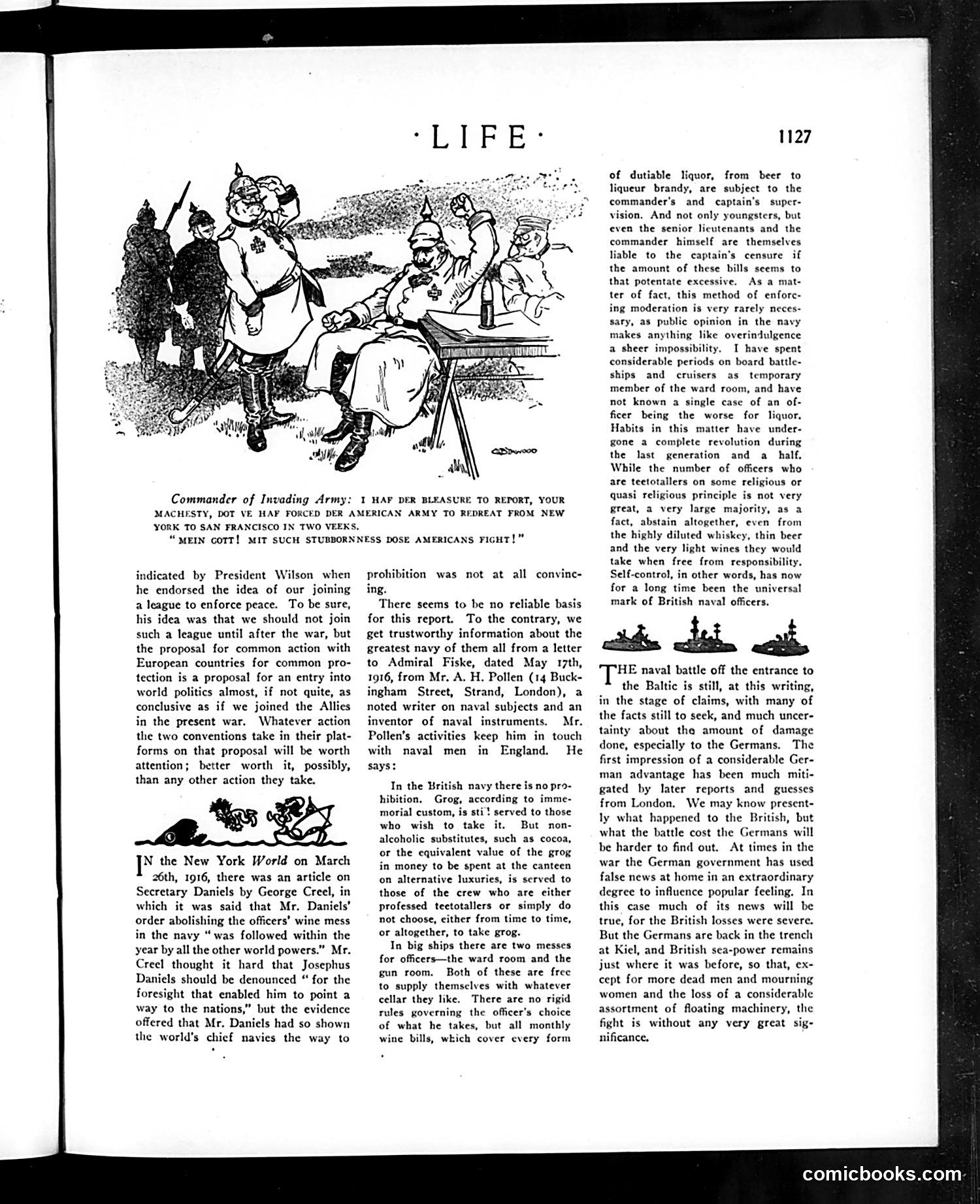
**The Cartoon:** The top illustration depicts a German military commander reporting to the Kaiser in exaggerated German accent, claiming he's forced the American Army to retreat from New York to San Francisco in two weeks. The joke satirizes German military overconfidence during World War I—the absurd boast that Germany could invade and conquer the entire continental United States. **The Context:** This appears from a 1916 Life magazine, when America was still officially neutral but debate raged about potential involvement. The cartoon mocks German military bravado and implicitly supports American military capability by making the German threat ridiculous. **The Text Discussion:** The article's main topic concerns Secretary of the Navy Josephus Daniels' controversial prohibition of alcohol in naval officer messes. Daniels believed this showed moral leadership to other world powers. The text presents evidence from a British naval authority arguing that the British Navy never adopted such prohibition—they maintain officer drinking privileges while relying on self-control and peer pressure rather than rules. The satire critiques Daniels' naive assumption that America's policy influenced global practice.
📄 Transcribed text from this page (OCR, searchable)
Machine-transcribed from the original scan — historical spelling and the odd misread are preserved.
Commander of Invading Army: 1 HAF DER BLEASURE TO REPORT, YOUR MACHESTY, DOT VE HAF FORCED DER AMERICAN ARMY TO REDREAT FROM NEW YORK TO SAN FRANCISCO IN TWO VEEKS. “MEIN GOTT! MIT SUCH STUBBOR indicated by President Wilson when he endorsed the idea of our joining a league to enforce peace. To be sure, his idea was that we should not join such a league until after the war, but the proposal for common action with European countries for common pro- tection is a proposal for an entry into world politics almost, if not quite, as conclusive as if we joined the Allies in the present war. Whatever action the two conventions take in their plat- forms on that proposal will be worth attention; better worth it, possibly, than any other action they take. Ses N the New York World on March 26th, 1916, there was an article on Secretary Daniels by George Creel, in which it was said that Mr. Daniels’ order abolishing the officers’ wine mess in the navy “was followed within the year by all the other world powers.” Mr. Creel thought it hard that Josephus Daniels should be denounced “ for the foresight that enabled him to point a way to the nations,” but the evidence offered that Mr. Daniels had so shown the world’s chief navies the way to ESS DOSE AMERICANS FIGHT!” prohibition was not at all convinc- ing. There seems to be no reliable basis for this report. To the contrary, we get trustworthy information about the greatest navy of them all from a letter to Admiral Fiske, dated May 17th, 1916, from Mr, A. H. Pollen (14 Buck- ingham Street, Strand, London), a noted writer on naval subjects and an inventor of naval instruments. Mr. Pollen’s activities keep him in touch with naval men in England. He says: In the British navy there is no pro- hibition, Grog, according to imme- morial custom, is sti! served to those who wish to take it. But non- alcoholic substitutes, such as cocoa, or the equivalent value of the grog in money to be spent at the canteen on alternative luxuries, is served to those of the crew who are cither professed teetotallers or simply do not choose, either from time to time, or altogether, to take grog. In big ships there are two messes for officers—the ward room and the gun room. Both of these are free to supply themselves with whatever cellar they like. There are no rigid rules governing the officer's choice of what he takes, but all monthly wine bills, which cover every form 1127 of dutiable liquor, from beer to liqueur brandy, are subject to the commander's and captain's super- vision. And not only youngsters, but even the senior lieutenants and the commander himself are themselves liable to the captain's censure if the amount of these bills seems to that potentate excessive. As a mat- ter of fact, this method of enforc- ing moderation is very rarely neces- sary, as public opinion in the navy makes anything like overindulgence a sheer impossibility, I have spent considerable periods on board battle- ships and cruisers as temporary member of the ward room, and have not known a single case of an of- ficer being the worse for liquor. Habits in this matter have under- gone a complete revolution during the last generation and a_ half. While the number of officers who are teetotallers on some religious or quasi religious principle is not very great, a very large majority, as a fact, abstain altogether, even from the highly diluted whiskey, thin beer and the very light wines they would take when free from responsibility. Self-control, in other words, has now for a long time been the universal mark of British naval officers. tds cid, cab, 'HE naval battle off the entrance to the Baltic is still, at this writing, in the stage of claims, with many of the facts still to seek, and much uncer- tainty about the amount of damage done, especially to the Germans. The first impression of a considerable Ger- man advantage has been much miti- gated by later reports and guesses from London. We may know present- ly what happened to the British, but what the battle cost the Germans will be harder to find out. At times in the war the German government has used false news at home in an extraordinary degree to influence popular feeling. In this case much of its news will be true, for the British losses were severe. But the Germans are back in the trench at Kiel, and British sea-power remains just where it was before, so that, ex- cept for more dead men and mourning women and the loss of a considerable assortment of floating machinery, the fight is without any very great sig- nificance, comicbooks.com