
Life, 1916-06-15 · page 30 of 48
Life — June 15, 1916 — page 30: what you’re looking at
What you’re looking at
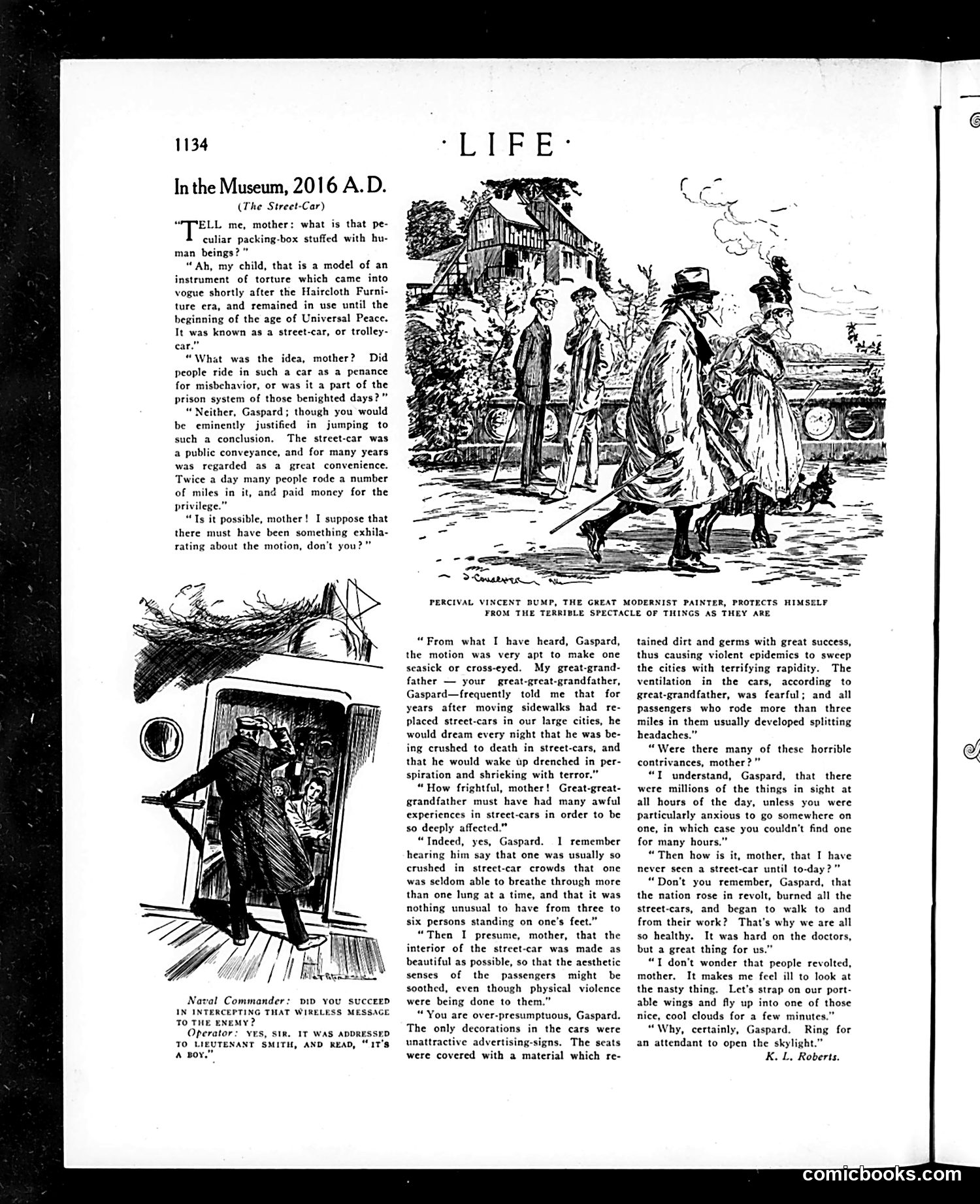
This satirical piece imagines a future where street-cars have become historical artifacts viewed with horror. A mother explains to her child "Gaspard" that street-cars were once common public transportation, but are now regarded as instruments of torture—causing seasickness, crushing crowds, poor ventilation, disease-spreading seats, and inadequate advertising decoration. The satire mocks the street-car system's genuine problems (overcrowding, filth, discomfort) by having future generations treat them as relics of a barbaric age. The joke inverts perspective: what was once considered "a great convenience" becomes retrospectively absurd. The page also includes unrelated vignettes: a Naval Commander joke about intercepting wireless messages, and a modernist painter avoiding reality—both typical Life magazine humor of the early 1900s. The satire reflects contemporary frustration with urban transit conditions.
📄 Transcribed text from this page (OCR, searchable)
Machine-transcribed from the original scan — historical spelling and the odd misread are preserved.
1134 In the Museum, 2016 A.D. (The Street-Car) " ELL me, mother: what is that pe- culiar packing-box stuffed with hu- man beings?” “Ah, my child, that is a model of an instrument of torture which came into vogue shortly after the Haircloth Furni- ture era, and remained in use until the beginning of the age of Universal Peace. It was known as a street-car, or trolley- What was the idea, mother? Did people ride in such a car as a penance for misbehavior, or was it a part of the prison system of those benighted days?” “Neither, Gaspard; though you would be eminently justified in jumping to such a conclusion, The street-car was a public conveyance, and for many years was regarded as a great convenience. Twice a day many people rode a number of miles in it, and paid money for the privilege.” “Is it possible, mother! I suppose that there must have been something exhila- rating about the motion, don't you?” Naval Commander: pip you succeed IN INTERCEPTING THAT WIRELESS MESSAGE TO THE ENEMY? Operator: Yes, SIR. 1T WAS ADDRESSED TO LIEUTENANT SMITH, AND READ, “17'S A Boy.” PERCIVAL VINCENT BUMP, THE GREAT MODERNIST PAINTER, PROTECTS HIMSELF FROM THE TERRIBLE SPECTACLE OF THINGS AS THEY ARE “From what I have heard, Gaspard, the motion was very apt to make one seasick or cross-eyed. My great-grand- father — your great-great-grandfather, Gaspard—frequently told me that for years after moving sidewalks had re- placed street-cars in our large cities, he would dream every night that he was be- ing crushed to death in street-cars, and that he would wake up drenched in per- spiration and shrieking with terror.” “How frightful, mother! Great-great- grandfather must have had many awful experiences in street-cars in order to be so deeply affected.” “Indeed, yes, Gaspard. 1 remember hearing him say that one was usually so crushed in strect-car crowds that one was seldom able to breathe through more than one lung at a time, and that it was nothing unusual to have from three to six persons standing on one’s feet.” “Then I presume, mother, that the interior of the street-car was made as beautiful as possible, so that the aesthetic senses of the passengers might be soothed, even though physical violence were being done to them.” “ You are over-presumptuous, Gaspard. The only decorations in the cars were unattractive advertising-signs. The seats were covered with a material which re- tained dirt and germs with great success, thus causing violent epidemics to sweep the cities with terrifying rapidity. The ventilation in the cars, according to great-grandfather, was fearful; and all Passengers who rode more than three miles in them usually developed splitting headaches.” “Were there many of these horrible contrivances, mother?” “I understand, Gaspard, that there were millions of the things in sight at all hours of the day, unless you were particularly anxious to go somewhere on one, in which case you couldn't find one for many hours.” “ Then how is it, mother, that I have never seen a street-car until to-day?” “Don't you remember, Gaspard, that the nation rose in revolt, burned all the street-cars, and began to walk to and from their work? That's why we are all so healthy. It was hard on the doctors, but a great thing for us.” “T don’t wonder that people revolted, mother. It makes me feel ill to look at the nasty thing. Let's strap on our port- able wings and fly up into one of those nice, cool clouds for a few minutes.” “Why, certainly, Gaspard. Ring for an attendant to open the skylight.” K. L. Roberts. comicbooks.com