
Life, 1916-06-15 · page 28 of 48
Life — June 15, 1916 — page 28: what you’re looking at
What you’re looking at
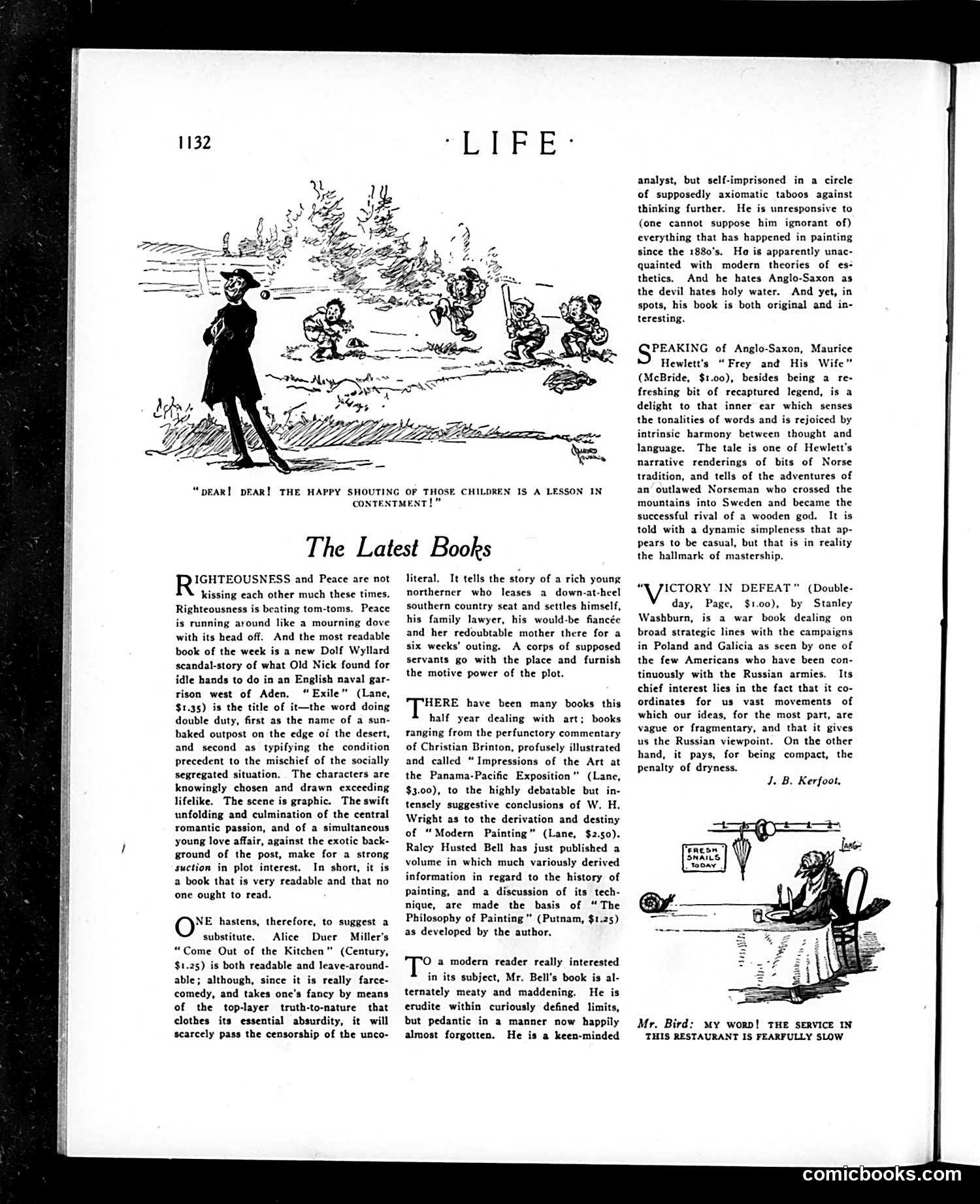
This page is a **book review section** from Life magazine, not primarily political satire. The main cartoon shows a figure observing children playing outdoors with the caption "DEAR! DEAR! THE HAPPY SHOUTING OF THOSE CHILDREN IS A LESSON IN CONTENTMENT!"—a gentle, ironic commentary on simple pleasures versus adult concerns. The text reviews several contemporary books (circa 1915), critiquing their merits. Notable targets include: - A Dolf Wyllard naval scandal novel deemed unreadable despite being "very readable" - Raley Husted Bell's "Philosophy of Painting," which the reviewer criticizes as pedantic, stuck in 1880s aesthetics, and hostile to Anglo-Saxon language - Maurice Hewlett's Norse legend retelling, praised for linguistic harmony The small cartoon at bottom right shows a restaurant server, captioned about slow service—typical period humor about dining establishments. The overall tone is literary criticism wrapped in satirical wit rather than political commentary.
📄 Transcribed text from this page (OCR, searchable)
Machine-transcribed from the original scan — historical spelling and the odd misread are preserved.
wR 1S A LESSON IN The Latest Books IGHTEOUSNESS and Peace are not kissing each other much these times. Righteousness is beating tom-toms. Peace is running around like a mourning dove with its head off. And the most readable book of the week is a new Dolf Wyllard scandal-story of what Old Nick found for idle hands to do in an English naval gar- rison west of Aden, “Exile” (Lane, $1.35) is the title of it—the word doing double duty, first as the name of a sun- baked outpost on the edge of the desert, and second as typifying the condition precedent to the mischief of the socially segregated situation. The characters are knowingly chosen and drawn exceeding lifelike. The scene is graphic. The swift unfolding and culmination of the central romantic passion, and of a simultaneous young love affair, against the exotic back- ground of the post, make for a strong suction in plot interest. In short, it is a book that is very readable and that no ‘one ought to read. NE hastens, therefore, to suggest a substitute. Alice Duer Miller's “Come Out of the Kitchen” (Century, $1.25) is both readable and leave-around- able; although, since it is really farce- comedy, and takes one’s fancy by means of the top-layer truth-to-nature that clothes its essential absurdity, it will scarcely pass the censorship of the unco- literal. It tells the story of a rich young northerner who leases a down-at-heel southern country seat and settles himself, his family lawyer, his would-be fiancée and her redoubtable mother there for a six weeks’ outing. A corps of supposed servants go with the place and furnish the motive power of the plot. HERE have been many books this half year dealing with art; books ranging from the perfunctory commentary of Christian Brinton, profusely illustrated and called “Impressions of the Art at the Panama-Pacific Exposition” (Lane, $3.00), to the highly debatable but in- tensely suggestive conclusions of W. H. Wright as to the derivation and destiny of “Modern Painting” (Lane, $2.50). Ralcy Husted Bell has just published a volume in which much variously derived information in regard to the history of painting, and a discussion of its tech- nique, are made the basis of “The Philosophy of Painting" (Putnam, $1.25) as developed by the author. 'O a modern reader really interested in its subject, Mr. Bell’s book is al- ternately meaty and maddening. He is erudite within curiously defined limits, but pedantic in a manner now happily almost forgotten. He is a keen-minded analyst, but self-imprisoned in a circle of supposedly axiomatic taboos against thinking further. He is unresponsive to (one cannot suppose him ignorant of) everything that has happened in painting since the 1880's. He is apparently unac- quainted with modern theories of es- thetics. And he hates Anglo-Saxon as the devil hates holy water. And yet, in spots, his book is both original and in- teresting. PEAKING of Anglo-Saxon, Maurice Hewlett’s “Frey and His Wife” (McBride, $1.00), besides being a re- freshing bit of recaptured legend, is a delight to that inner ear which senses the tonalities of words and is rejoiced by intrinsic harmony between thought and language. The tale is one of Hewlett’s narrative renderings of bits of Norse tradition, and tells of the adventures of an outlawed Norseman who crossed the mountains into Sweden and became the successful rival of a wooden god. It is told with a dynamic simpleness that ap- pears to be casual, but that is in reality the hallmark of mastership. * ICTORY IN DEFEAT" (Double- day, Page, $1.00), by Stanley Washburn, is a war book dealing on broad strategic lines with the campaigns in Poland and Galicia as seen by one of the few Americans who have been con- tinuously with the Russian armies. Its chief interest lies in the fact that it co- ordinates for us vast movements of which our ideas, for the most part, are vague or fragmentary, and that it gives us the Russian viewpoint. On the other hand, it pays, for being compact, the penalty of dryness. J. B. Kerfoot, Mr. Bird: sty worp! THE SERVICE IN THIS RESTAURANT IS FEARFULLY SLOW comicbooks.com