
Life, 1916-06-15 · page 18 of 48
Life — June 15, 1916 — page 18: what you’re looking at
What you’re looking at
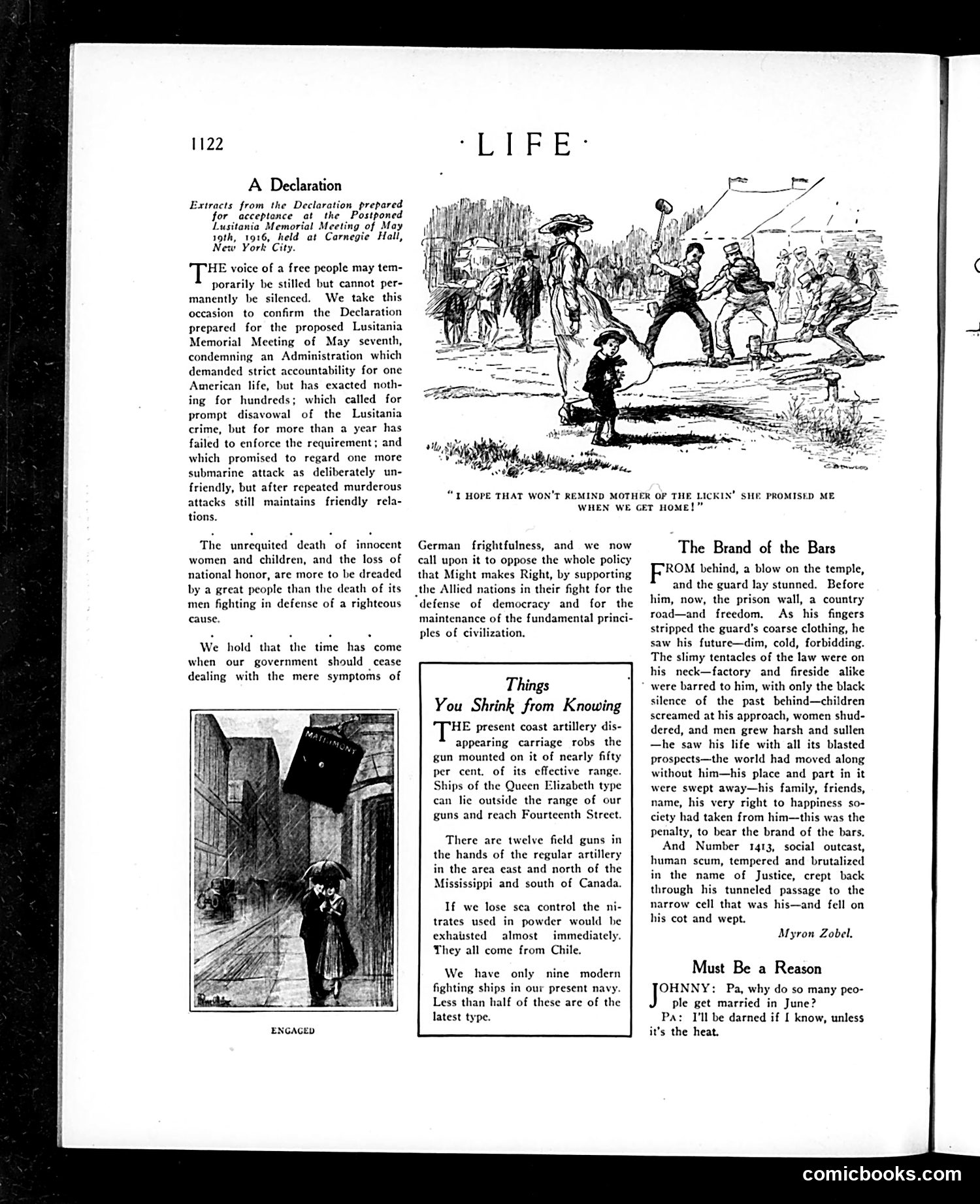
This page contains **pro-Allied war advocacy** from May 1916, during American neutrality debates over the Lusitania sinking (1915). **Main Declaration:** Criticizes President Wilson's administration for demanding accountability for one American life (the Lusitania) while tolerating repeated German submarine attacks without retaliation. It calls for the U.S. to actively support Allied nations against German "frightfulness." **"Things You Shrink from Knowing":** A propaganda section listing American military weaknesses—insufficient coastal guns, limited modern warships, and dependence on Chilean nitrates for gunpowder—to argue the U.S. needs stronger defense/military action. **"The Brand of the Bars":** A dark story about an escaped convict facing permanent social ostracism, illustrating how society punishes criminals beyond imprisonment. **"Must Be a Reason":** A light joke where a father attributes June marriages to heat, providing comic relief amid serious content. The page represents Life's interventionist stance before America's 1917 entry into World War I.
📄 Transcribed text from this page (OCR, searchable)
Machine-transcribed from the original scan — historical spelling and the odd misread are preserved.
1122 A Declaration Extracts from the Declaration prepared for acceptonce at the Postponed Lusitania Memorial Meeting of May 19th, 1916, held at Carnegie Hall, New York’ City. HE voice of a free people may tem- porarily be stilled but cannot per- manently be silenced. We take this occasion to confirm the Declaration prepared for the proposed Lusitania Memorial Meeting of May seventh, condemning an Administration which demanded strict accountability for one American life, but has exacted noth- ing for hundreds; which called for prompt disavowal of the Lusitania crime, but for more than a year has failed to enforce the requirement ; and which promised to regard one more submarine attack as deliberately un- friendly, but after repeated murderous attacks still maintains friendly rela- tions. The unrequited death of innocent women and children, and the loss of national honor, are more to be dreaded by a great people than the death of its men fighting in defense of a righteous cause. We hold that the time has come when our government should cease dealing with the mere symptoms of ENGAGED “Y HOPE THAT WON'T REMIND MOTHER OF THE LICKIN’ PROMISED ME WHEN WE GET HOME!” German frightfulness, and we now call upon it to oppose the whole policy that Might makes Right, by supporting the Allied nations in their fight for the defense of democracy and for the maintenance of the fundamental princi- ples of civilization, Things You Shrink from Knowing ] te present coast artillery dis- appearing carriage robs the gun mounted on it of nearly fifty per cent. of its effective range. Ships of the Queen Elizabeth type can lie outside the range of our guns and reach Fourteenth Street. There are twelve field guns in the hands of the regular artillery in the area east and north of the Mississippi and south of Canada. If we lose sca control the ni- trates used in powder would be exhaiisted almost immediately. They all come from Chile. We have only nine modern fighting ships in our present navy. Less than half of these are of the latest type. The Brand of the Bars FRoM behind, a blow on the temple, and the guard lay stunned. Before him, now, the prison wall, a country road—and freedom. As his fingers stripped the guard’s coarse clothing, he saw his future—dim, cold, forbidding. The slimy tentacles of the law were on his neck—factory and fireside alike were barred to him, with only the black silence of the past behind—children screamed at his approach, women shud- dered, and men grew harsh and sullen —he saw his life with all its blasted prospects—the world had moved along without him—his place and part in it were swept away—his family, friends, name, his very right to happiness so- ciety had taken from him—this was the penalty, to bear the brand of the bars. And Number 1413, social outcast, human scum, tempered and brutalized in the name of Justice, crept back through his tunneled passage to the narrow cell that was his—and fell on his cot and wept. Myron Zobel. Must Be a Reason OHNNY: Pa, why do so many peo- ple get married in June? Pa: I'll be darned if I know, unless it’s the heat. comicbooks.com