
A complete issue · 40 pages · 1916
Life — May 25, 1916
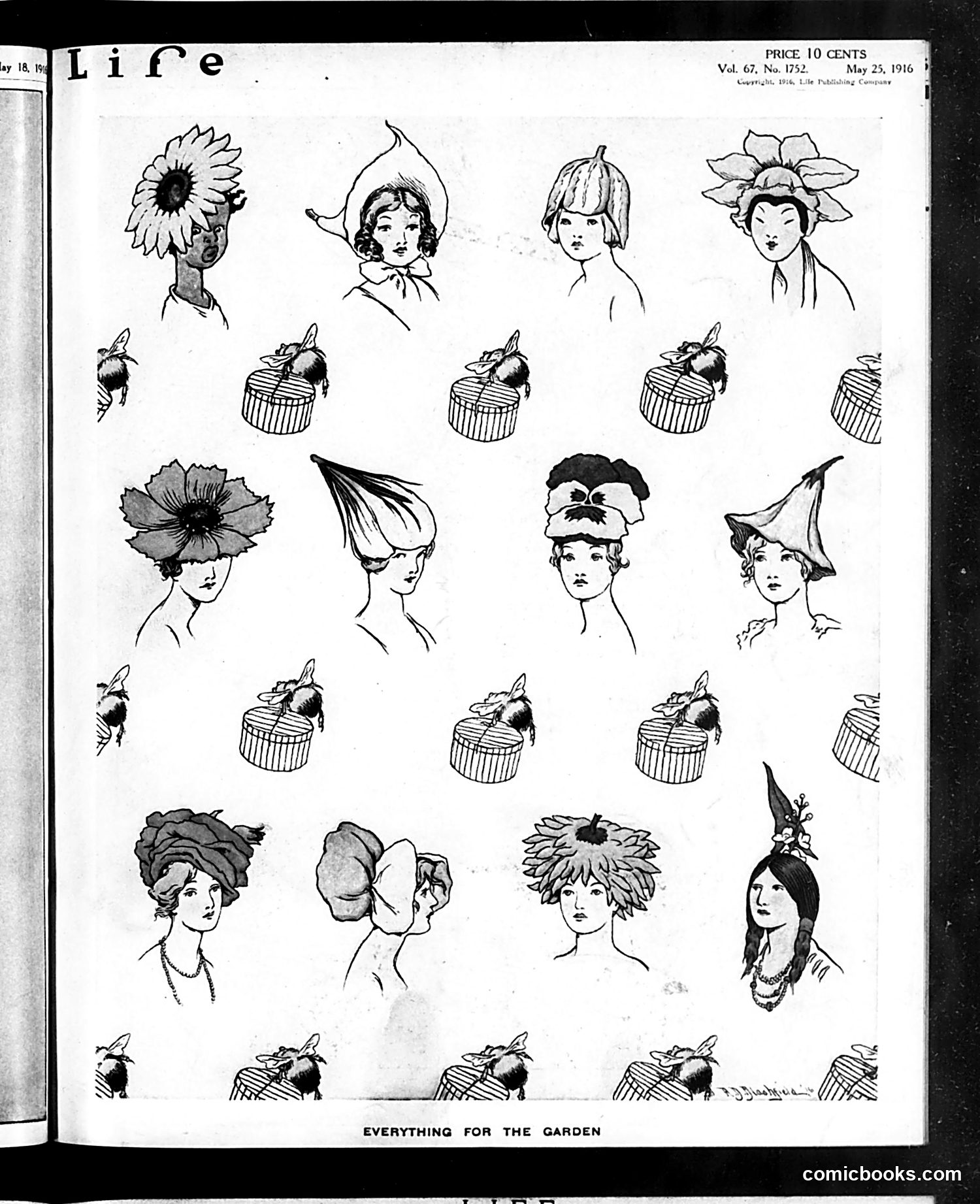
This is a humorous fashion illustration page from *Life* magazine (May 23, 1916) satirizing women's elaborate hat designs of the era. The caption "Everything for the Garden" is ironic—these extravagant hats aren't practical garden wear but rather fashionable creations featuring absurd decorations. The designs show hats adorned with oversized sunflowers, onions in baskets, corn husks, large bows, and pointed shapes—literally garden vegetables and plants as millinery ornaments. Small hat boxes labeled with produce items fill the margins. The satire mocks the era's exaggerated fashion trends, particularly the impractical nature of women's millinery that incorporated enormous, decorative elements. It's commentary on how far removed haute couture had become from functional clothing, even when allegedly "garden-themed."
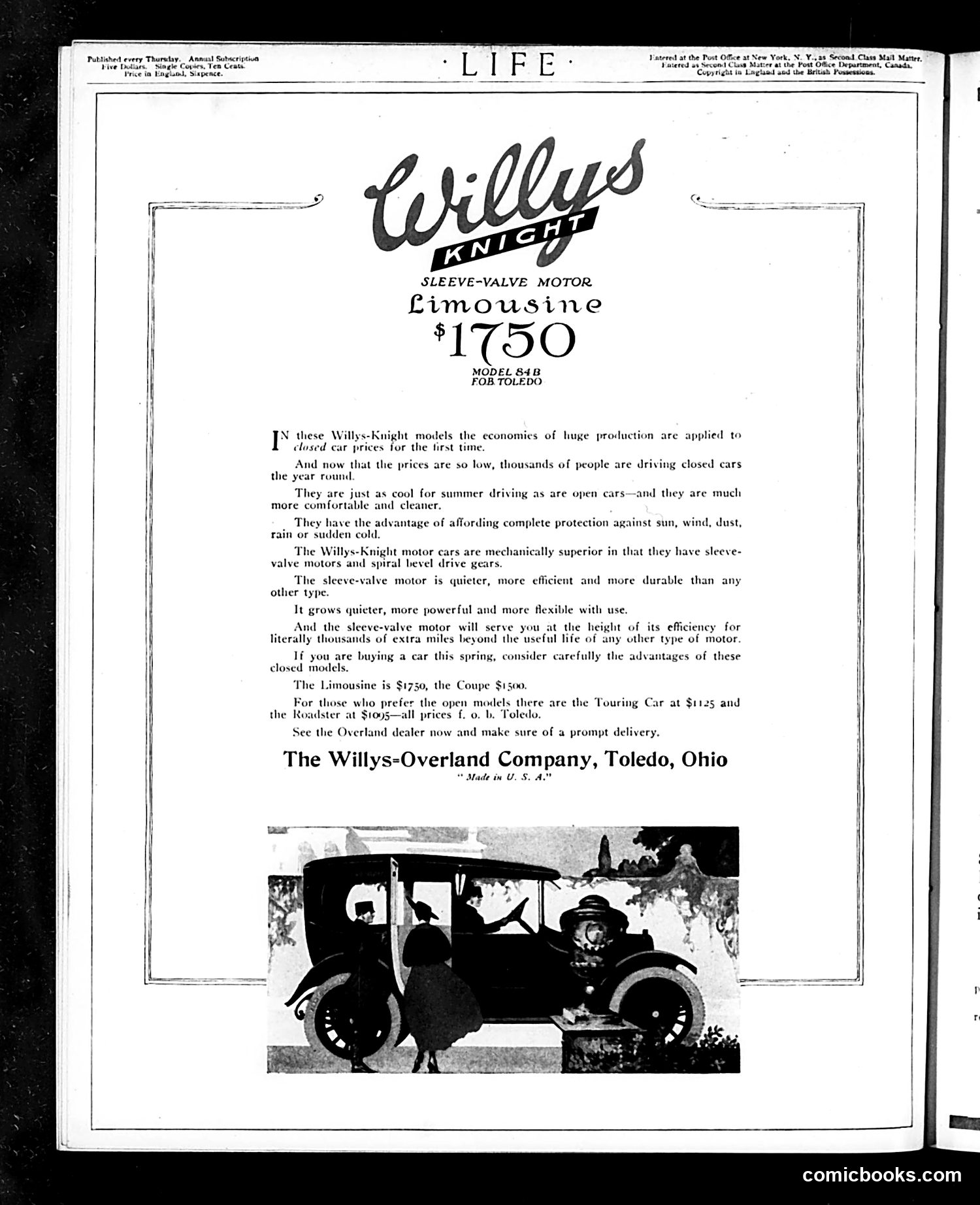
This is primarily an **advertisement**, not a political cartoon. It promotes the Willys-Knight Limousine, a closed-car automobile priced at $1,750 (Model 84B for Toledo). The ad's text emphasizes the limousine's practical advantages: protection from weather, mechanical superiority via "sleeve-valve motors and spiral bevel drive gears," and comfort for year-round driving. It positions closed cars as increasingly affordable and desirable compared to open vehicles. The illustration shows a stylized limousine with passengers, depicting the vehicle as elegant and modern. **Historical context**: This reflects early 1910s-20s automotive marketing when closed cars were transitioning from luxury items to mainstream products. The ad targets middle-class buyers considering this investment.
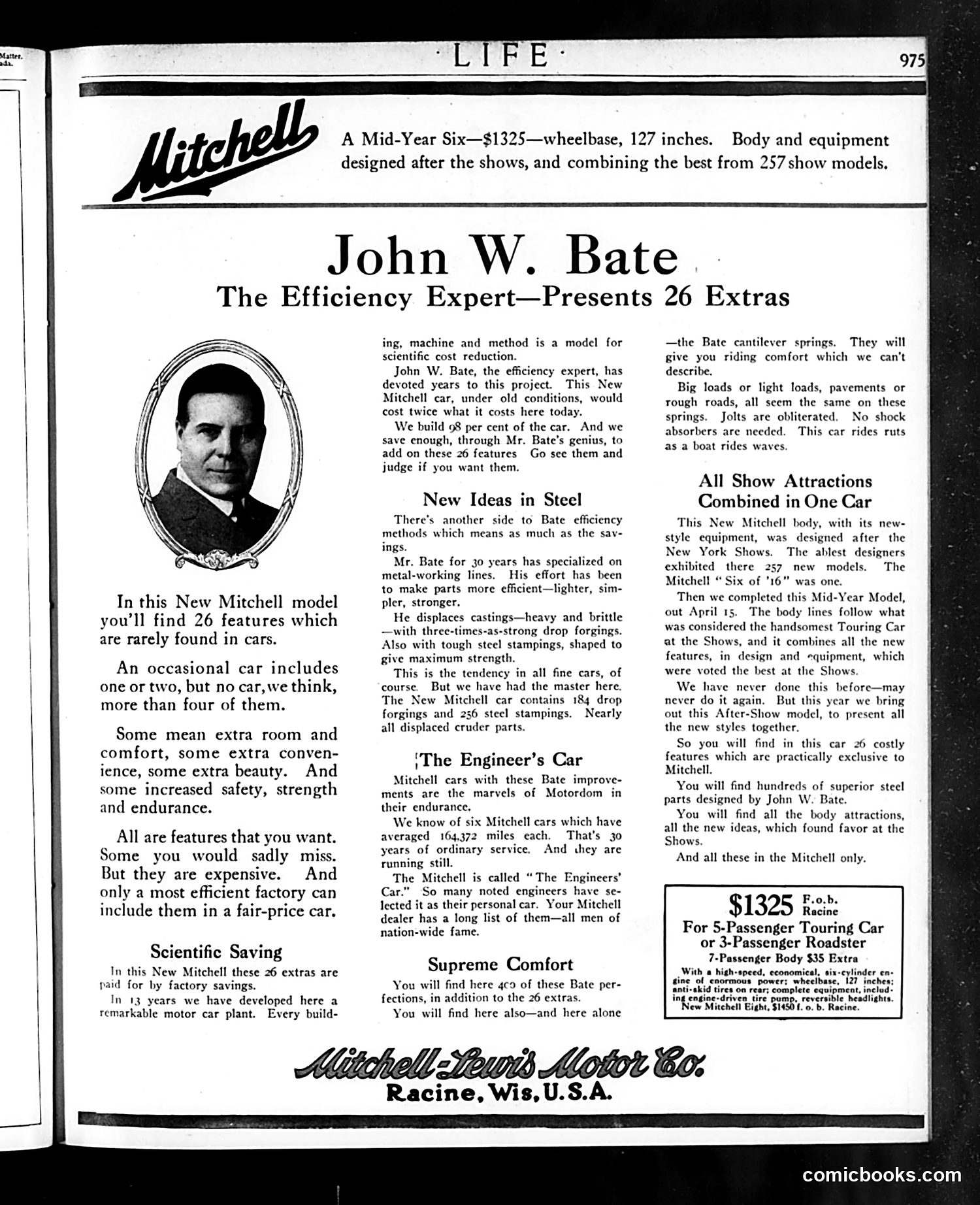
This is **not a political cartoon or satire page**—it's a straightforward advertisement for the Mitchell automobile, published in *Life* magazine (which ran both humor and ads). The page features John W. Bate, identified as an "efficiency expert," promoting 26 special features in a new Mitchell Mid-Year Six automobile priced at $1,325. The text emphasizes practical engineering improvements: lighter construction, better steel stampings, and superior comfort features. The "humor" angle is purely commercial: the ad suggests that owning this car means you've combined all desirable automotive features—a sales pitch framed as engineering expertise rather than satire. This represents typical early 1900s automotive advertising that blended technical claims with aspirational messaging.
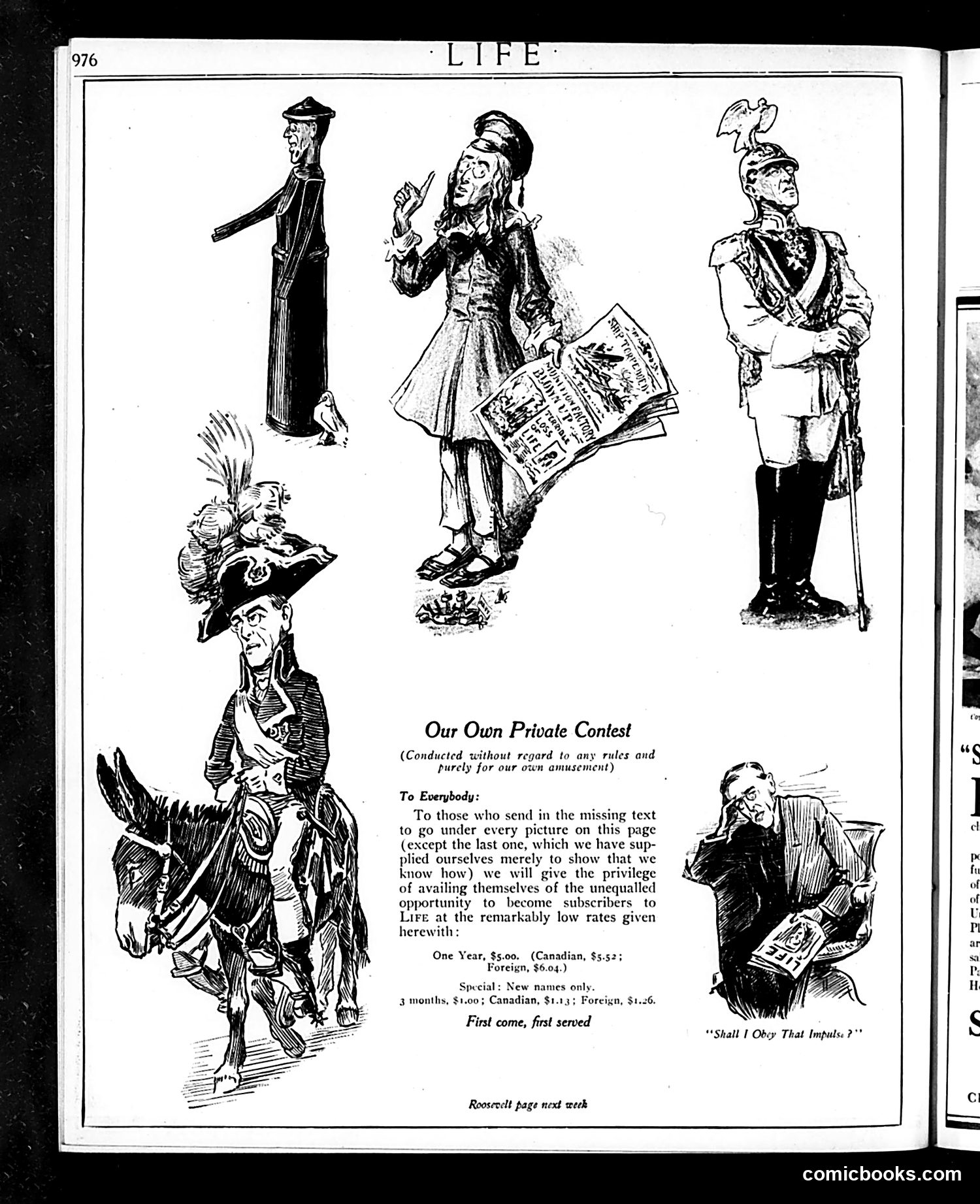
This page features "Our Own Private Contest," a reader participation game where Life magazine invites subscribers to fill in missing captions under illustrated figures. The drawings depict various character types in exaggerated styles typical of early-20th-century satirical illustration: military officers, nobility, a mounted aristocrat, and common folk examining newspapers. The contest itself is the content—not political commentary on specific figures. However, the character types suggest satire of military pretension, royal authority, and social hierarchy. The emphasis on "without regard to any rules and purely for our own amusement" indicates Life's irreverent editorial stance. Subscription details and pricing are provided, offering new readers discounted rates for joining Life's audience, making this also a recruitment advertisement.
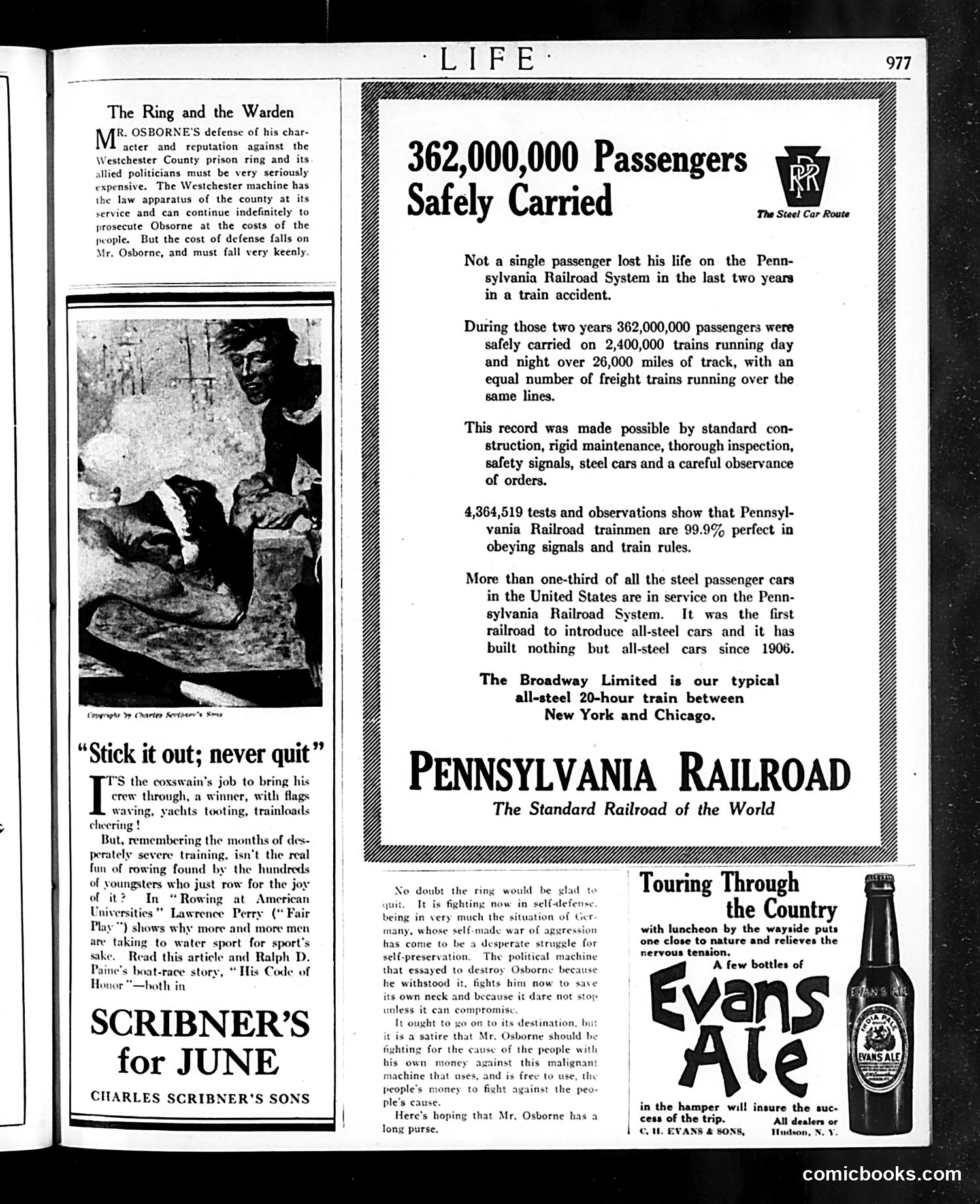
This page is primarily **advertising and editorial content**, not political satire. The left side features "The Ring and the Warden," a brief editorial defending Mr. Osborne's character against attacks by "Westchester County politicians" regarding some county apparatus. The accompanying photograph and caption "Stick it out; never quit" illustrate perseverance through hardship, referencing rowing and boxing metaphors. Below that is a Scribner's Books advertisement. The right side is dominated by a **Pennsylvania Railroad advertisement** touting its safety record: 362 million passengers carried with zero train-accident fatalities over two years. This is accompanied by an Evans Ale advertisement. The page reflects early-20th-century magazine layout: editorial defense of a local figure mixed with corporate advertising, typical of Life magazine's dual function as satirical commentary and revenue-generating publication.
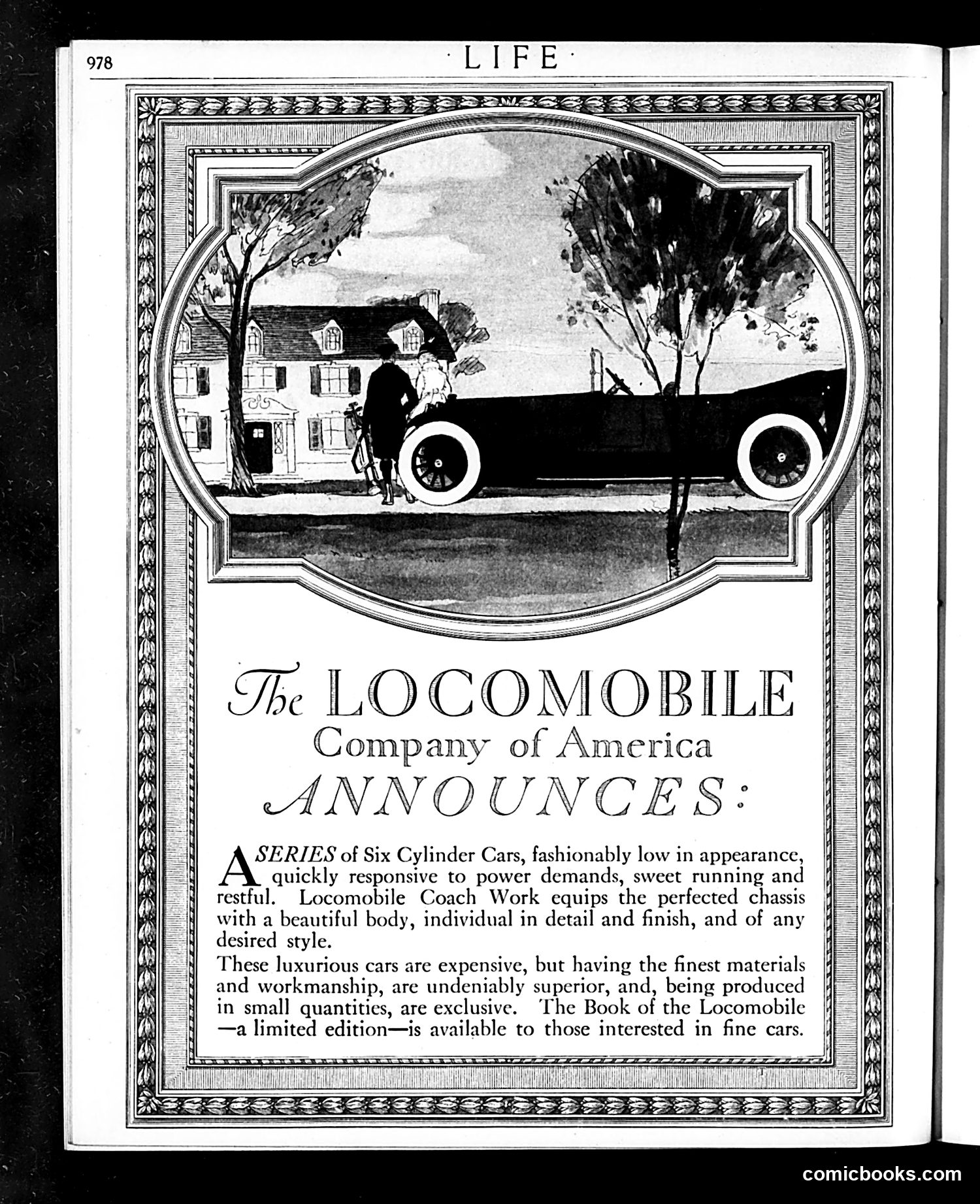
This page is **primarily an advertisement**, not satirical content. It's a full-page ad for The Locomobile Company of America announcing a new series of six-cylinder automobiles. The ad emphasizes luxury features: the cars are described as "fashionably low in appearance," responsive, and featuring custom coachwork from Locomobile Coach Works. The text stresses exclusivity—these are expensive, high-quality vehicles "produced in small quantities." The illustration shows a well-dressed couple examining or standing beside a sleek, open-air touring car parked before a substantial house, suggesting affluent ownership. This is a straightforward luxury marketing appeal to wealthy readers of *Life* magazine, emphasizing craftsmanship, exclusivity, and status rather than satire.
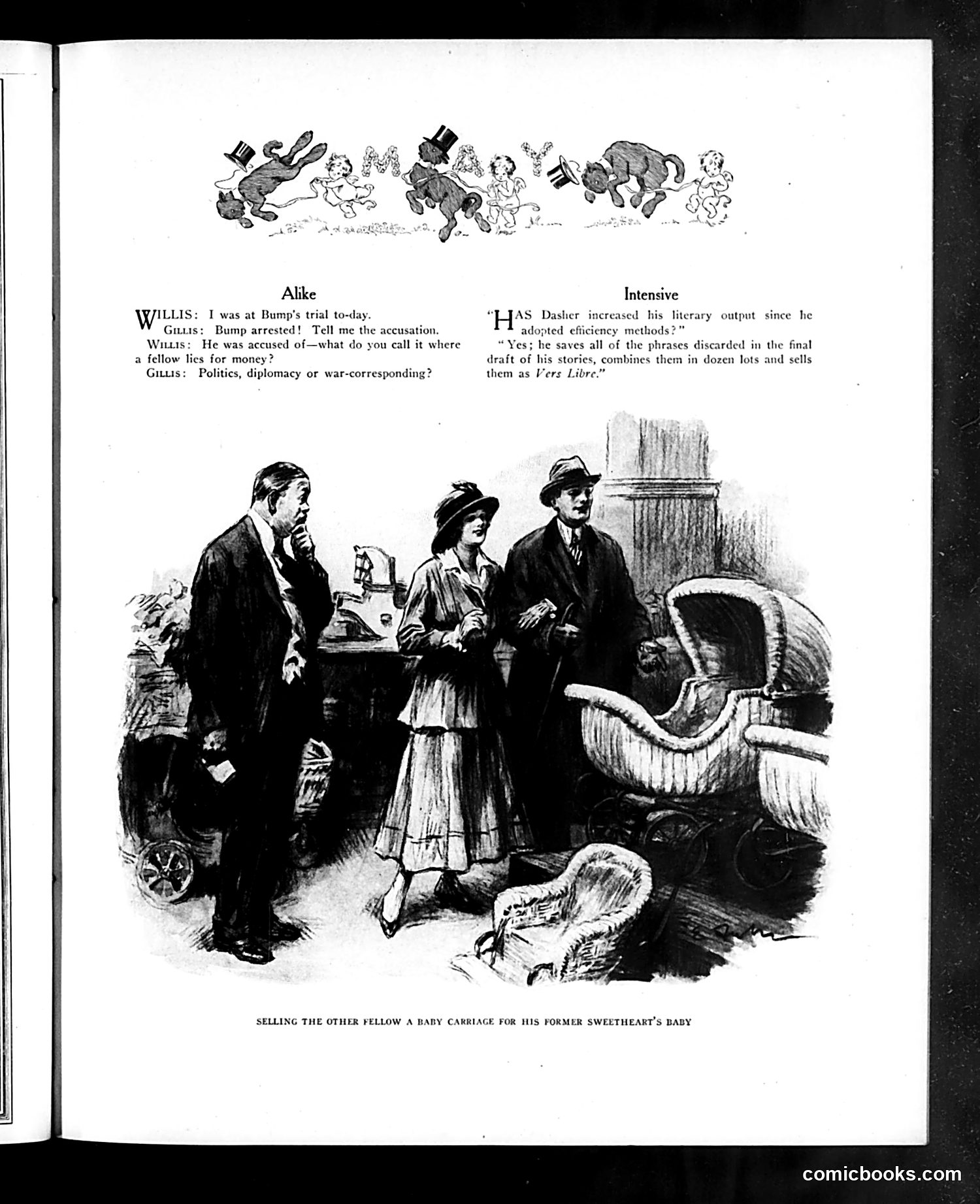
This page from *Life* magazine contains two separate items: **"Alike" (left):** A brief dialogue joke where Willis accuses someone named Bump of lying for money. When pressed on the specifics—whether it's politics, diplomacy, or war-corresponding—Gillis responds that all three are essentially the same thing. The humor relies on cynicism about how politicians, diplomats, and journalists essentially engage in the same dishonest practices. **"Intensive" (right):** A quip about an author named Dasher who increased productivity by adopting "efficiency methods"—saving discarded phrases from drafts and reusing them in multiple stories, selling them as *Vers Libre* (free verse poetry). The satire mocks both modernist literary trends and hack writers recycling material. **Main illustration:** Shows a man attempting to sell a baby carriage to a couple, captioned as "selling the other fellow a baby carriage for his former sweetheart's baby"—satirizing opportunistic salesmanship and moral compromise.
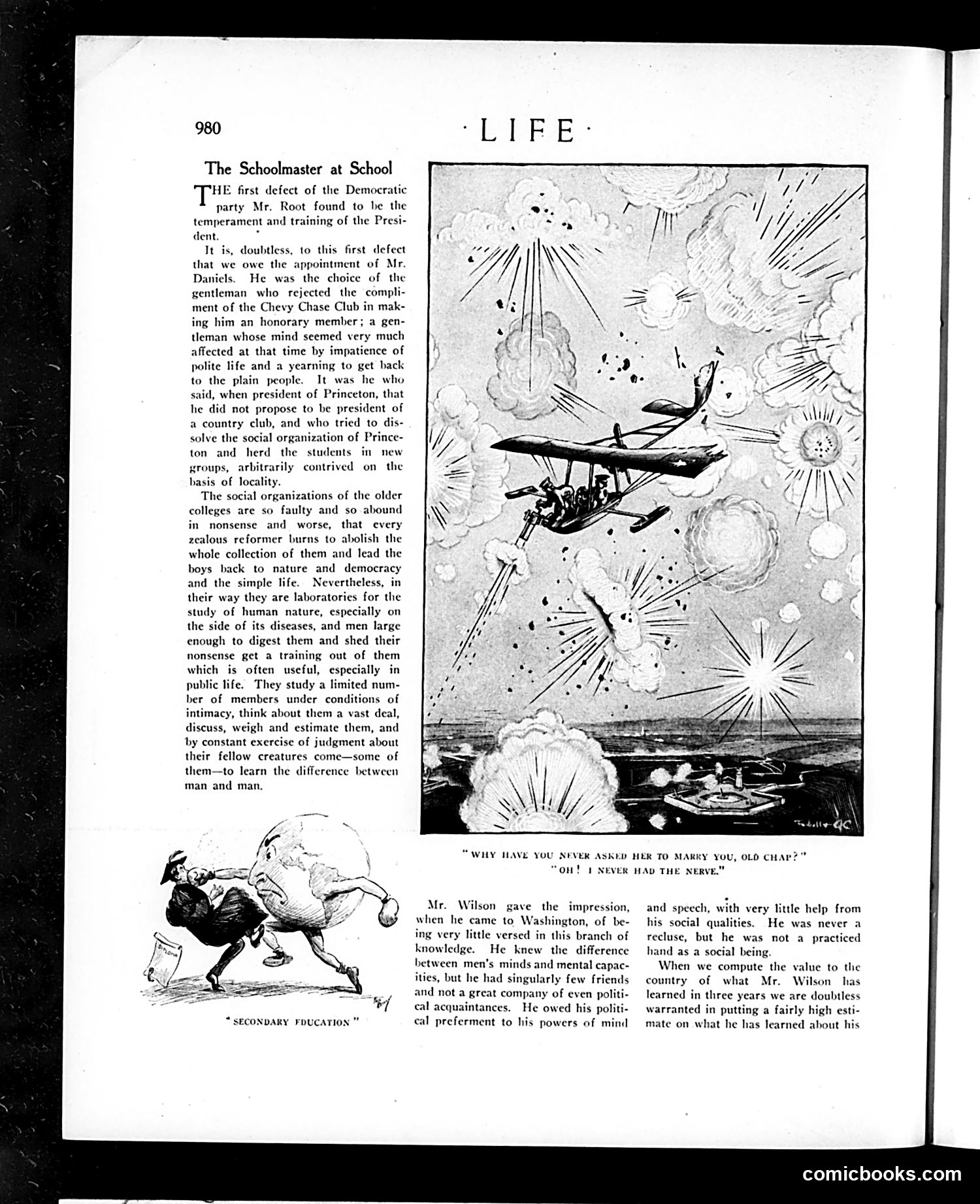
This page contains two distinct elements: **Main Article:** "The Schoolmaster at School" critiques educational institutions' rigid social hierarchies. The text argues that college social organizations (clubs, fraternities) are "faulty and nonsensical," advocating instead for studying human nature through direct observation and democratic principles. **Political Cartoon:** The top illustration shows an airplane amid explosions, captioned "Why have you never asked her to marry you, old chap?" / "Oh! I never had the nerve." This appears to be satirizing wartime romance and masculine anxiety—the speaker suggesting that surviving aerial bombardment requires less courage than marriage proposals. **Lower Cartoon:** "Secondary Education" depicts a figure being crushed, likely satirizing authoritarian teaching methods or the burden of traditional education. The page targets institutional rigidity and social conformity prevalent in early 20th-century American society.
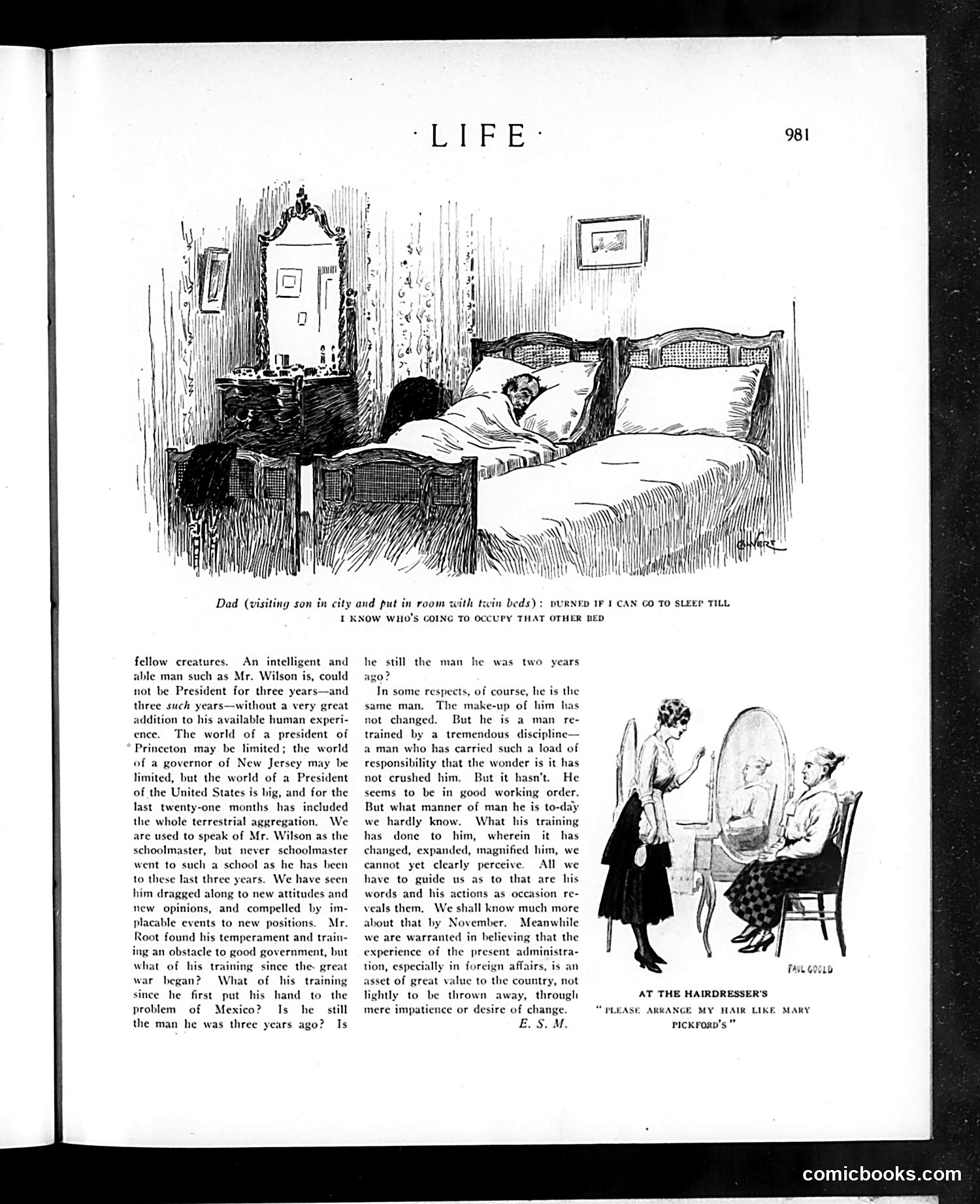
**Top Cartoon: "Dad (visiting son in city and put in room with twin beds)"** A father visits his son in the city and worries about sharing a bedroom with twin beds, humorously concerned about who will occupy the other bed. The joke plays on Victorian-era prudishness about sleeping arrangements and implications of impropriety. **Bottom Cartoon: "At the Hairdresser's"** A woman requests her hair be arranged "like Mary Pickford's" — referencing the famous silent film actress Mary Pickford, a major star of the early 20th century. This reflects the common practice of women requesting fashionable hairstyles modeled after popular celebrities. **Text**: Discusses President Wilson's qualifications and administrative experience, suggesting his fitness for office despite previous roles as schoolmaster and governor.
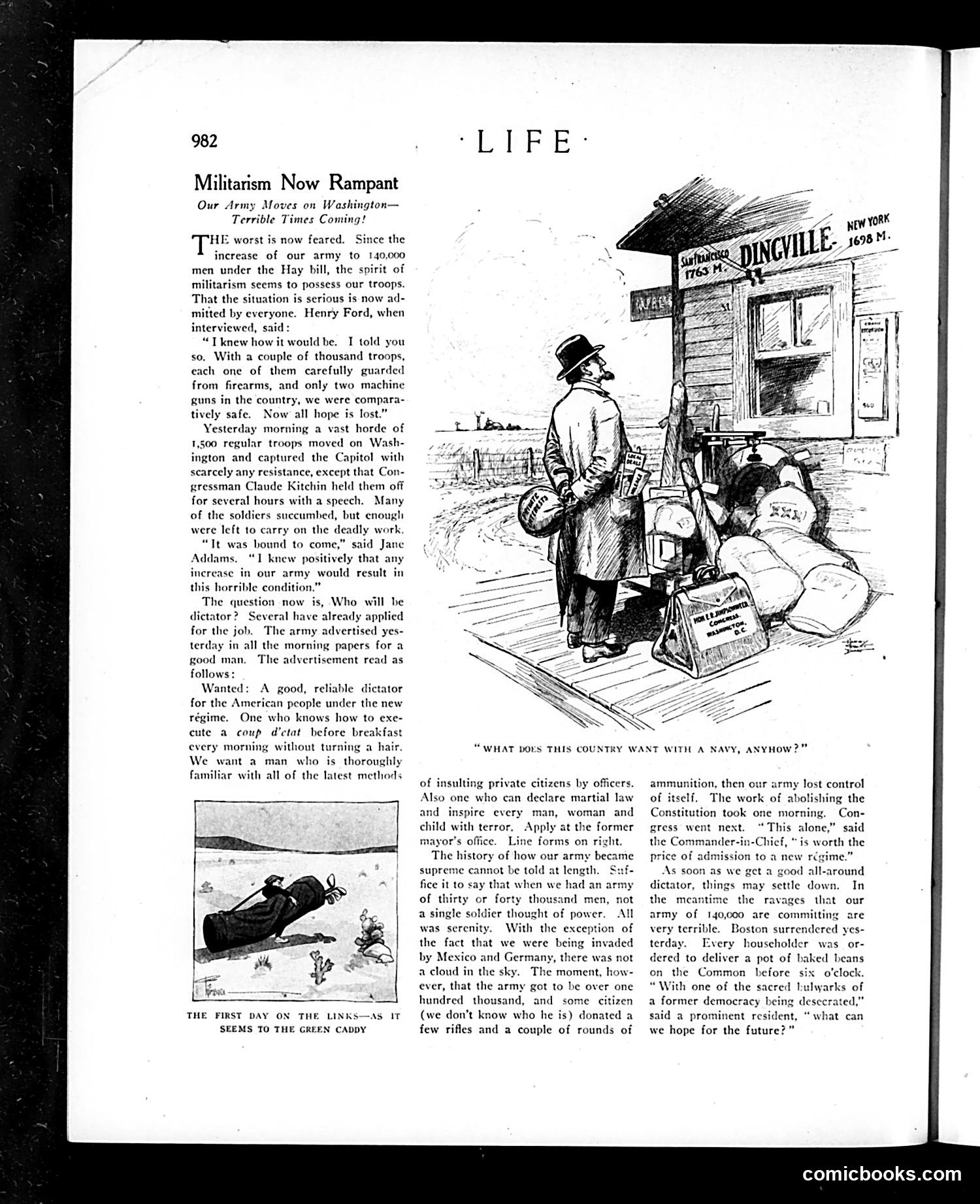
This article and accompanying illustration satirize American militarism following the army's expansion to 149,000 men. The cartoon depicts a man in civilian clothes standing outside a "Dincville" store, surrounded by soldiers and military equipment, asking "What does this country want with a Navy, anyhow?" The satire mocks concerns that military expansion threatens civilian life and democracy. Referenced figures—Henry Ford and Jane Addams—express fears that a large standing army corrupts civilian values. The piece humorously advertises for an "American dictator" to manage the military state, suggesting that militarization logically leads to authoritarian rule. The smaller illustration shows soldiers on ground maneuvers, emphasizing the physical military presence invading American civilian spaces.
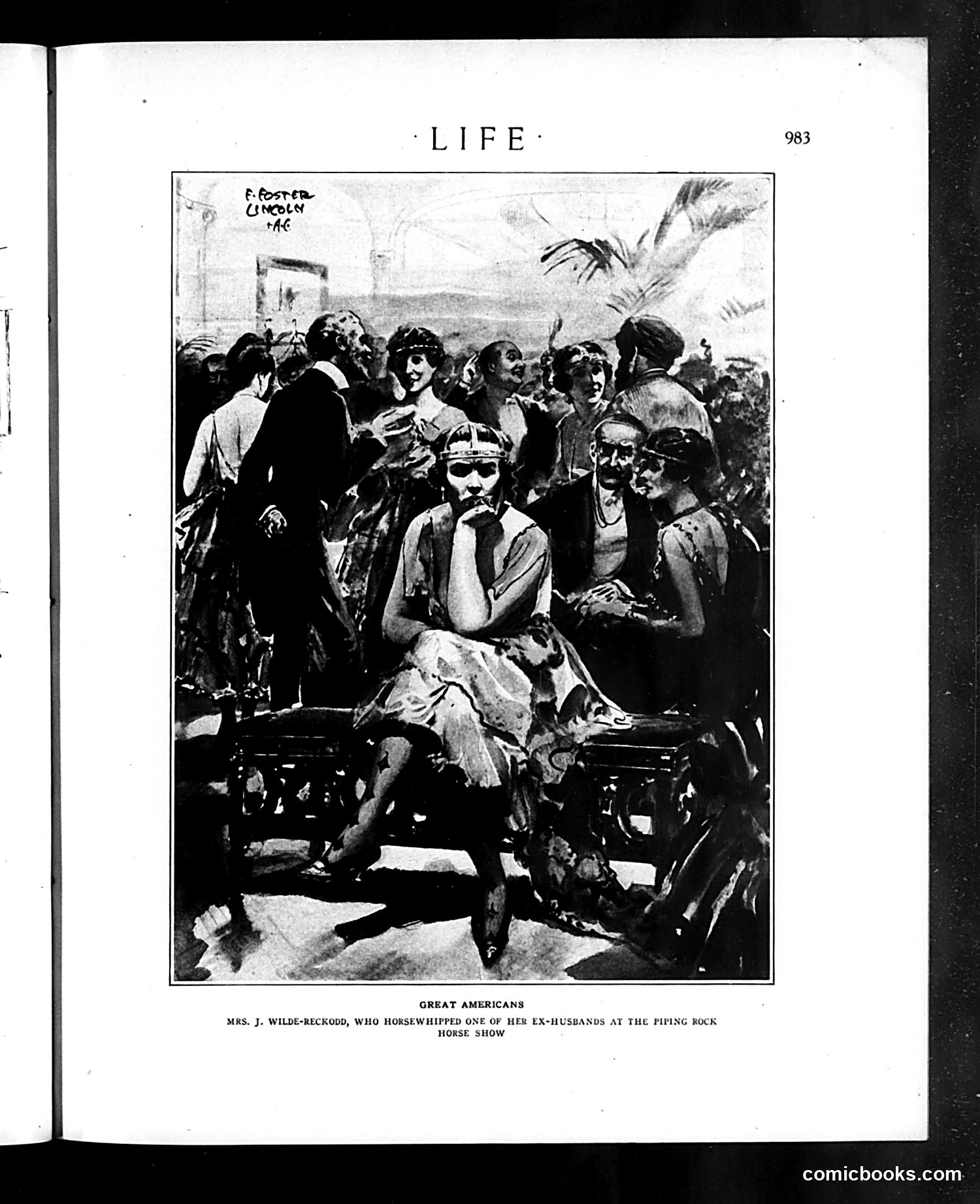
This page from *Life* magazine (page 983) presents a photograph rather than a cartoon, labeled "Great Americans." It shows Mrs. J. Wilde-Reckord at what appears to be a horse show, seated among a crowd of spectators. The caption states she "horsewhipped one of her ex-husbands at the piping rock horse show." The satire appears to target upper-class social scandal and sensationalism. The "Great Americans" heading is ironic—the photograph documents a woman committing what would be considered a shocking act of public violence, which apparently was notable enough for *Life* to feature as entertainment. The image captures early 20th-century attitudes toward wealth, divorce, and scandalous behavior as fodder for public amusement and ridicule.
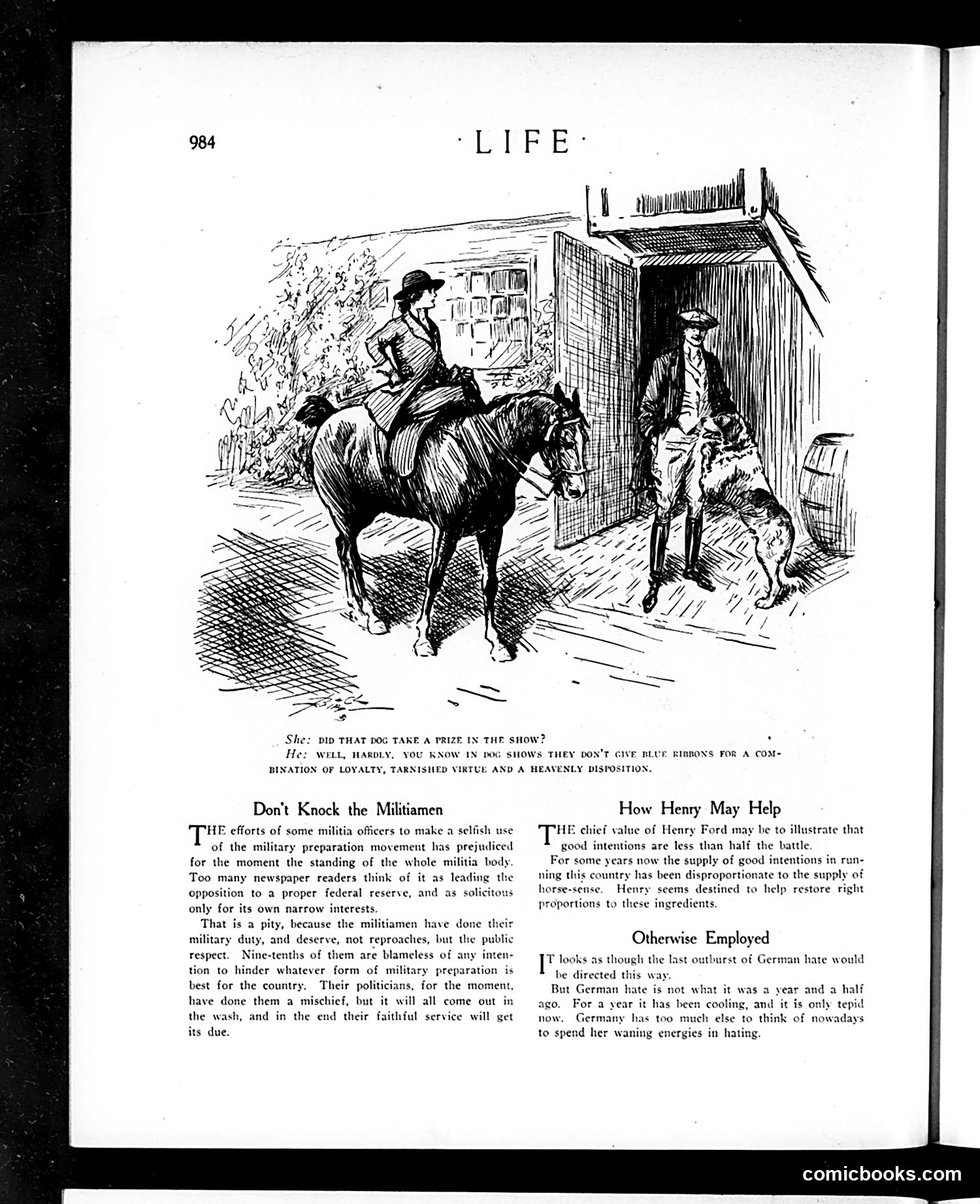
The page contains a sketch-based cartoon showing a woman on horseback speaking with a man standing near a doorway, with a dog present. She asks if his dog won a prize in a show; he responds that dog shows don't award blue ribbons for "a combination of loyalty, tarnished virtue and a heavenly disposition." The joke plays on the contradiction between superficial show standards and actual character—the implication being the man is commenting ironically on human society rather than dogs. The cartoon likely satirizes how society judges by appearances rather than true merit. Below are three short opinion pieces: "Don't Knock the Militiamen" defends militia preparedness against newspaper criticism; "How Henry May Help" discusses Henry Ford's potential economic contributions; and "Otherwise Employed" suggests Germany's war efforts are waning.
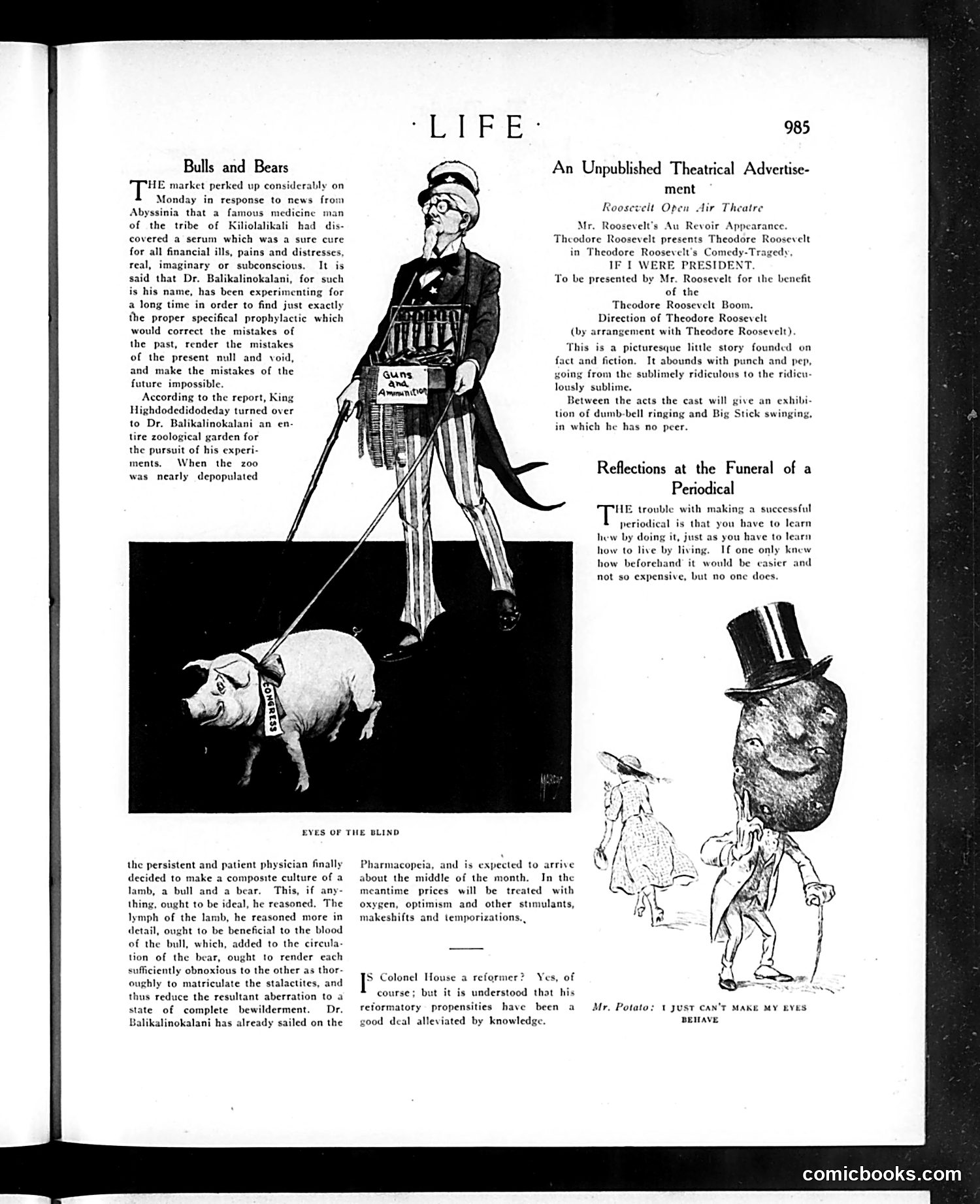
The main cartoon depicts Uncle Sam (recognizable by his striped pants and top hat) controlling a bear and bull on leashes—standard symbols for market downturns and upturns respectively. The text explains that the stock market "perked up considerably" on Monday following medical news from Abyssinia (Ethiopia) about a tribe discovering a cure for financial ailments. This is political satire mocking how markets react to trivial foreign news. The joke suggests investors are so desperate and irrational that they'll chase any rumor, however absurd or geographically irrelevant, as a market cure. The bottom section includes an unrelated piece about periodic publishing challenges and a separate cartoon labeled "Mr. Potato," making this a typical magazine miscellany page.
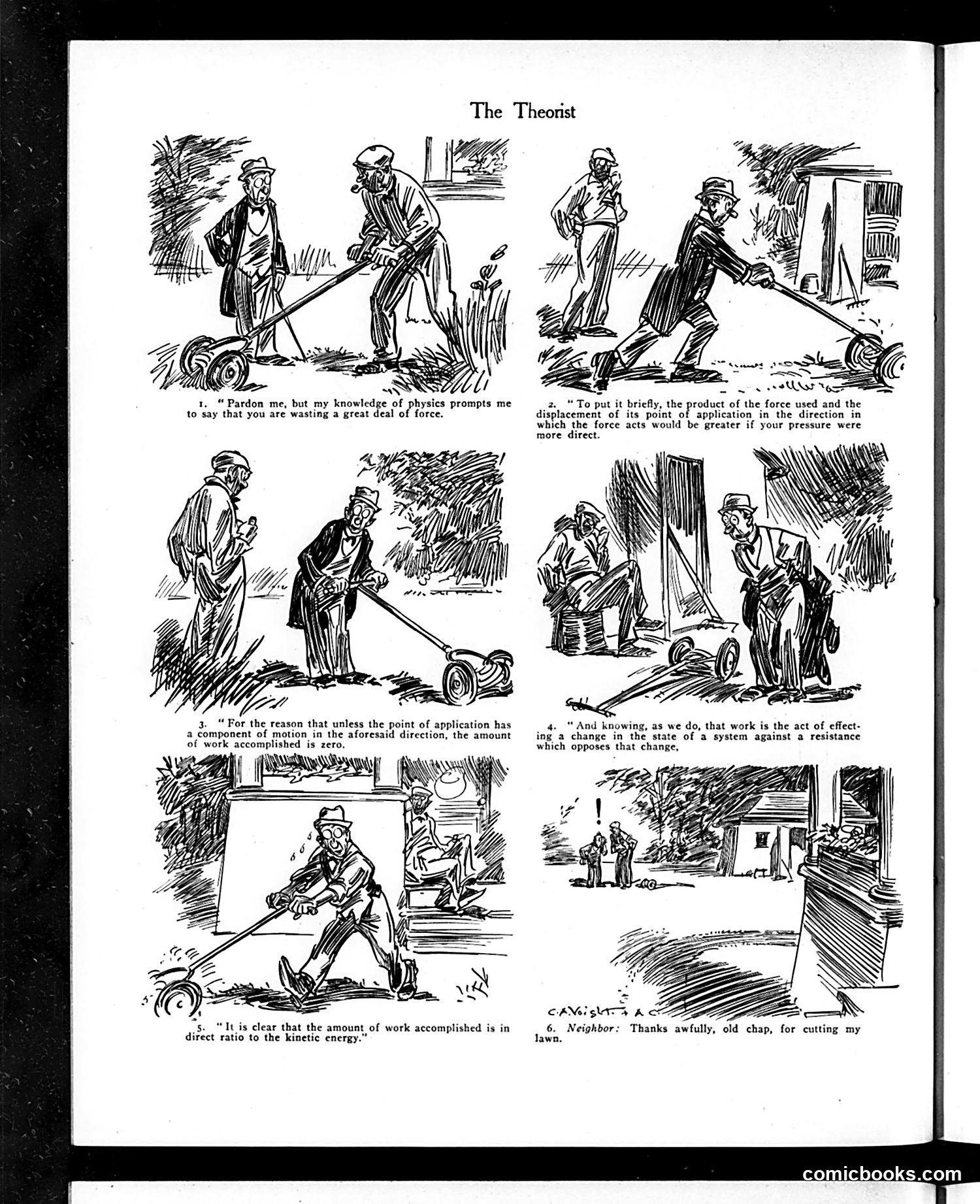
This satirical comic page mocks someone who applies abstract physics theory to practical manual labor. The six panels show a man repeatedly explaining physics principles while trying to use a push-mower or similar garden tools, each time stopping his work to lecture about force, displacement, kinetic energy, and mechanical advantage. The humor lies in the contrast between theoretical knowledge and practical efficiency. The "theorist" wastes time with lengthy explanations rather than simply completing the task. The final panel shows an exasperated neighbor thanking him "awfully" for cutting the lawn—implying the theorist finally finished, presumably after exhausting lectures. The satire targets intellectual pretension: knowledge without action, or abstract theory divorced from real-world application.
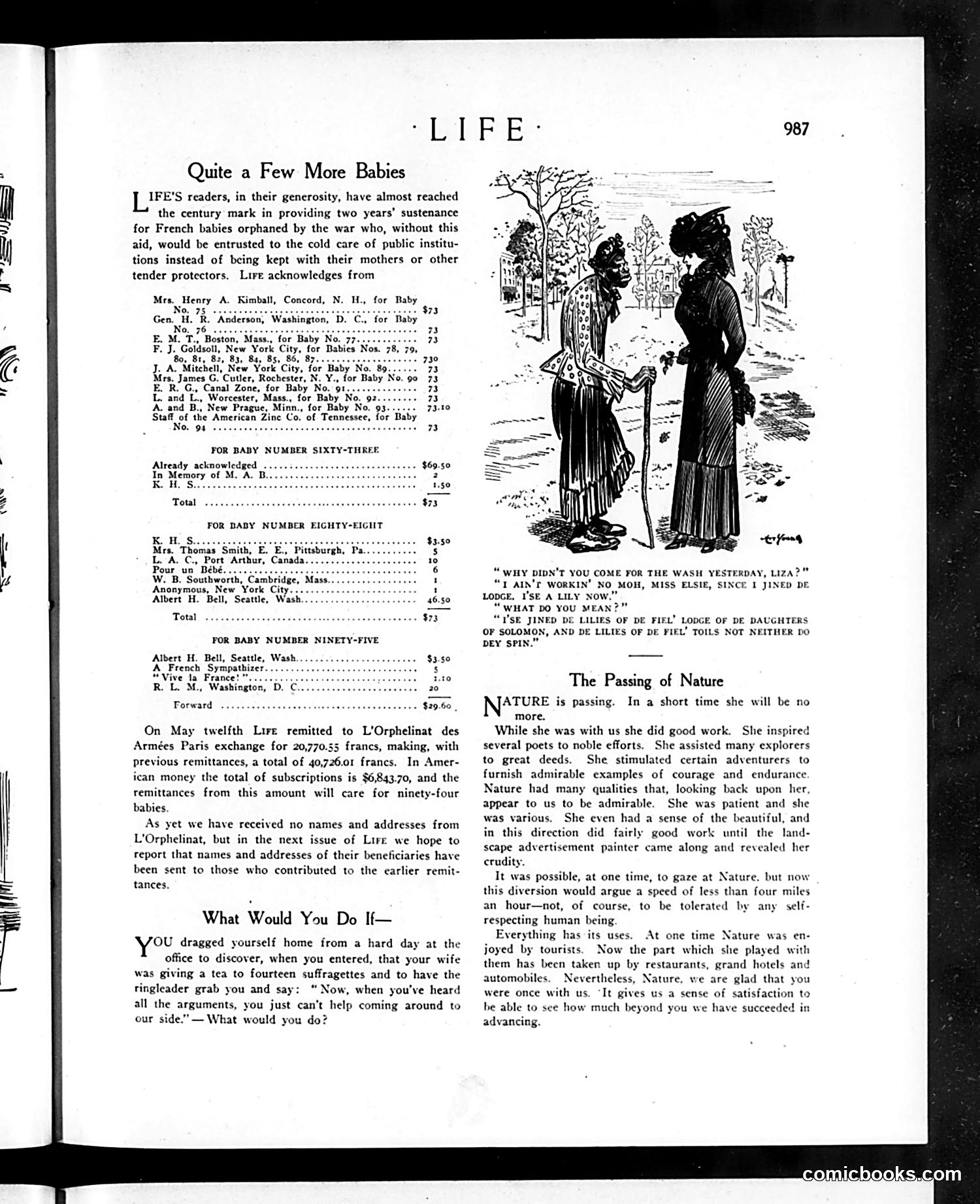
This page contains three distinct sections: **"Quite a Few More Babies"** lists charitable donations for French war orphans, with contributors' names and amounts ($73 total mentioned). The text references Life's fundraising campaign for babies orphaned by World War I who would otherwise face institutional care. **The cartoon** depicts two women in period dress (early 1900s) on a country path. One asks why the other didn't come for laundry yesterday, referencing joining a "lily lodge" since marrying. The satire mocks exclusive women's social clubs that presumably prioritize leisure over domestic duties. **"The Passing of Nature"** is a short essay lamenting Nature's decline due to commercialization—tourism, restaurants, and automobiles have diminished its appeal and integrity, a common Progressive-era complaint about industrialization and development.
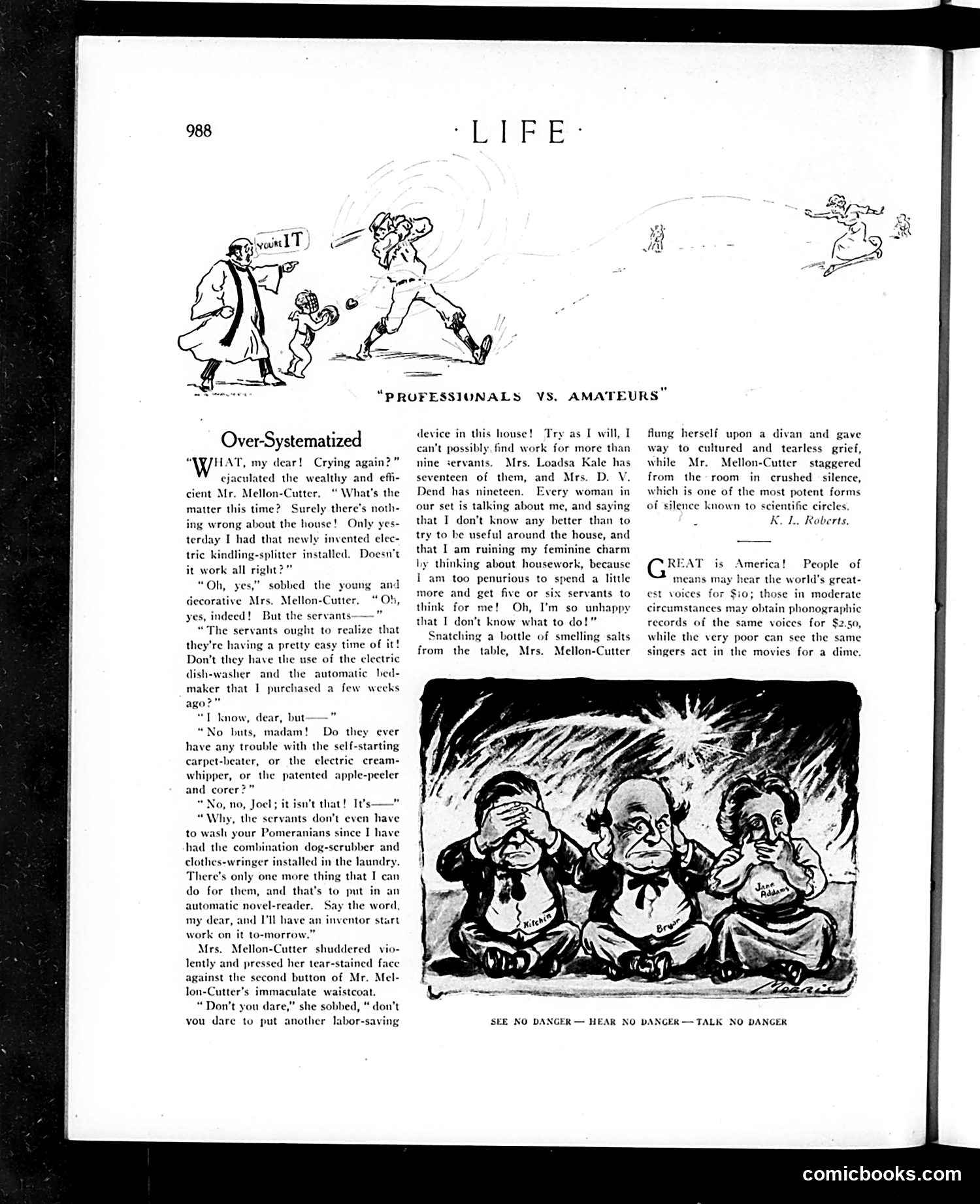
This satirical story mocks wealthy early-20th-century households obsessed with modern labor-saving technology. Mr. Mellon-Cutter has purchased numerous electric appliances (dish-washer, bed-maker, carpet-beater, dog-scrubber, apple-peeler) to reduce servant work. The irony: his wife is distraught because she now has *too few* servants—only nine, while wealthy peers boast seventeen or nineteen. The appliances have reduced her need for household staff, which embarrasses her socially and removes her identity as a society hostess managing a large domestic staff. The story satirizes the paradox of wealthy women whose status depends entirely on conspicuous consumption and idle leisure. Technology meant to ease labor instead becomes a status liability, exposing the absurdity of upper-class values: the machines work perfectly, but the family cannot maintain social standing without enough servants to employ. The bottom cartoon caption—"See no danger, hear no danger, talk no danger"—appears unrelated to the main story.
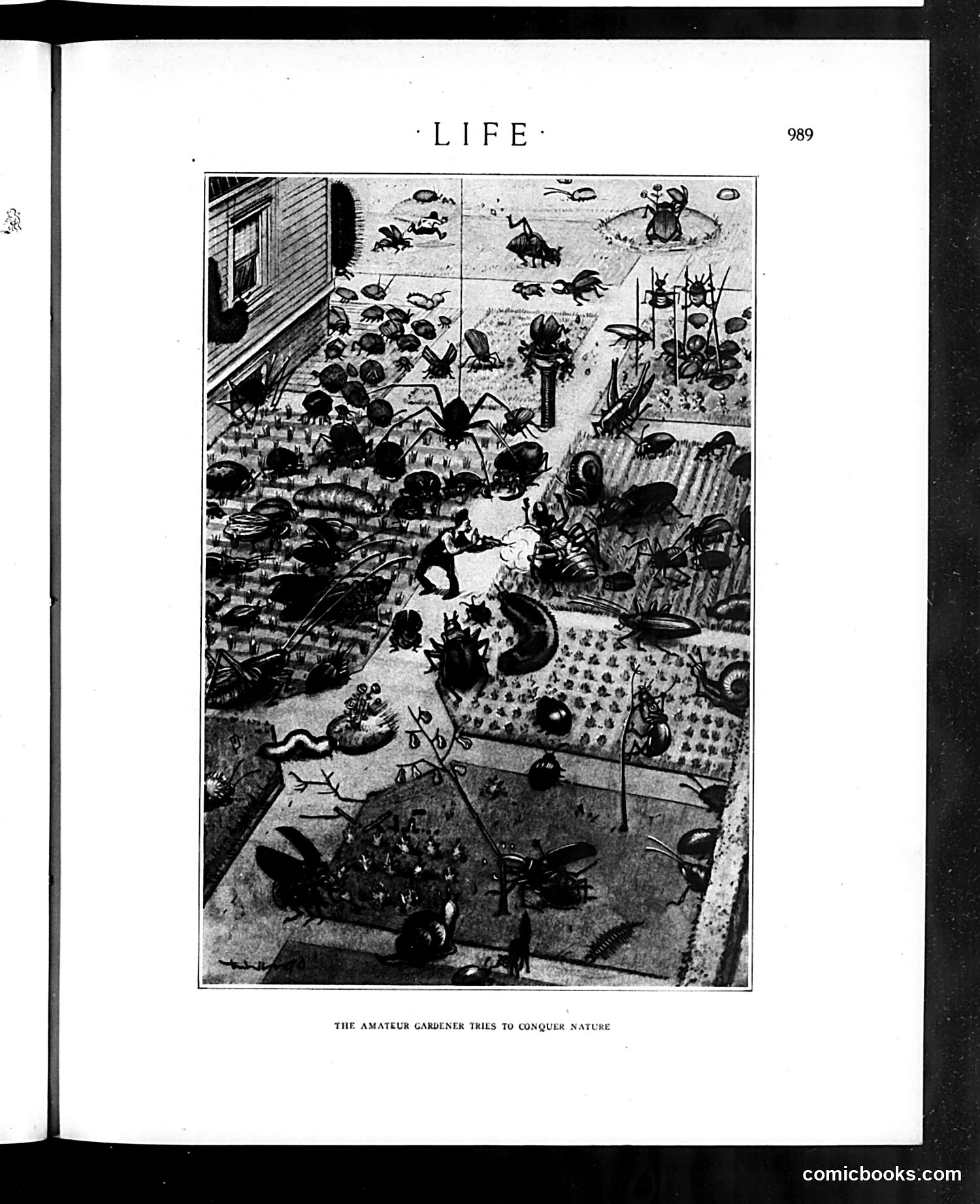
This is a humorous illustration showing an amateur gardener's backyard garden under siege by insects and pests. The caption "The Amateur Gardener Tries to Conquer Nature" presents the satire: despite the gardener's efforts (visible fencing, organized garden plots, and what appears to be pest-control attempts), nature overwhelmingly wins through sheer numbers of bugs, beetles, and other creatures. The joke targets gardening ambitions—the gardener's orderly arrangements and defenses prove futile against nature's chaos and abundance. This satirizes the human impulse to control and organize the natural world, suggesting that amateur efforts to impose order inevitably fail. The detailed, crowded rendering emphasizes nature's unstoppable force versus the individual's limited power.
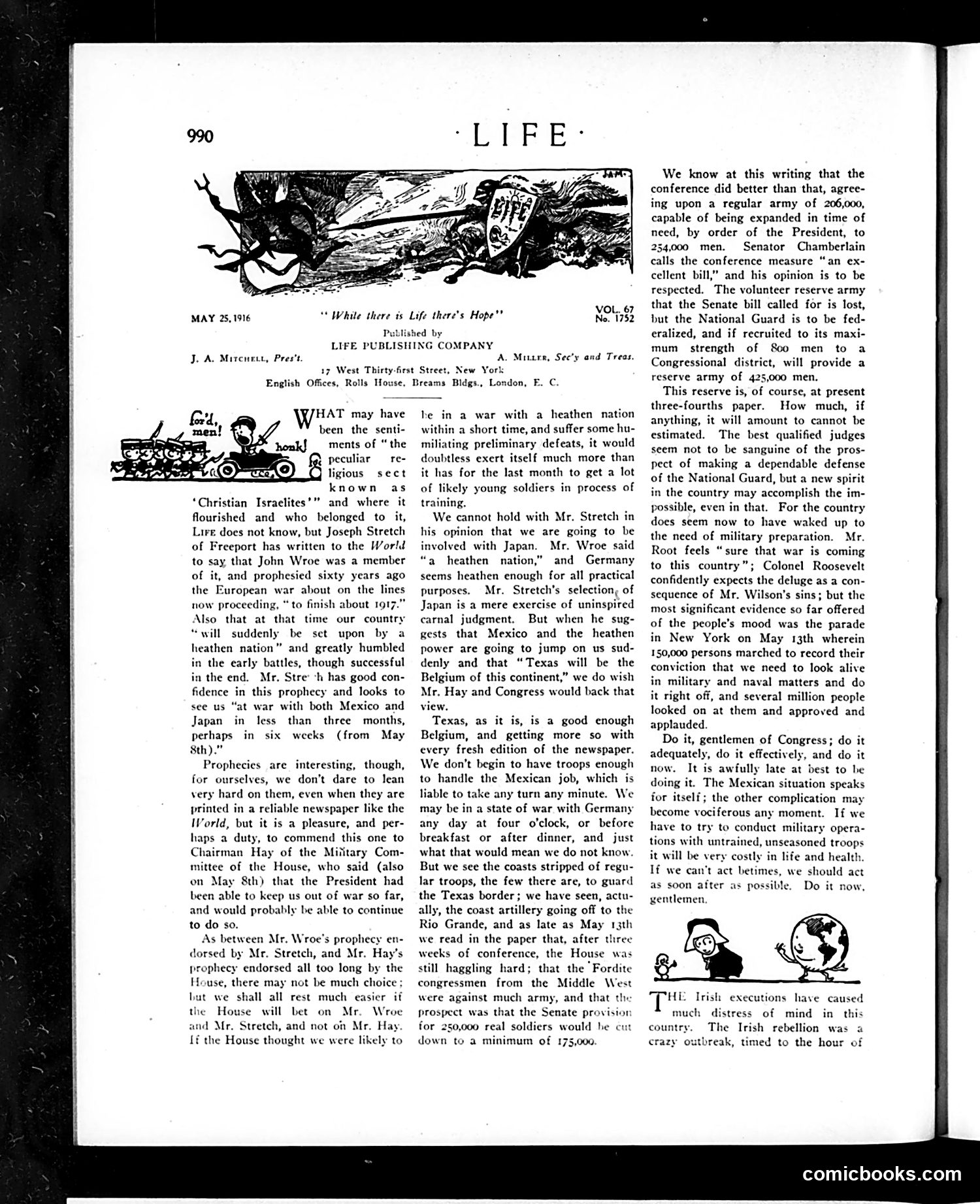
This page satirizes American military preparedness debates during a period of heightened international tension (before U.S. entry into World War I). The cartoon depicts a car labeled with military/political figures, likely representing competing views on defense spending. The text mocks a prophecy by "John Wroe" of the "Christian Israelites" sect, claiming America would soon face war with Mexico and Japan ("Texas will be the Belgium of this continent"). Life uses this absurd prophecy to ridicule Chairman Hay of the House Military Committee, who claimed President Wilson had successfully kept America out of war. The magazine sarcastically suggests Congress trust the 60-year-old prophecy over Hay's assurances—implying Congress should act urgently to strengthen military readiness. The piece criticizes congressional reluctance to approve adequate military appropriations, particularly opposition from "Fordite congressmen from the Middle West." Life advocates for robust military preparation given threats from Mexico and Germany.
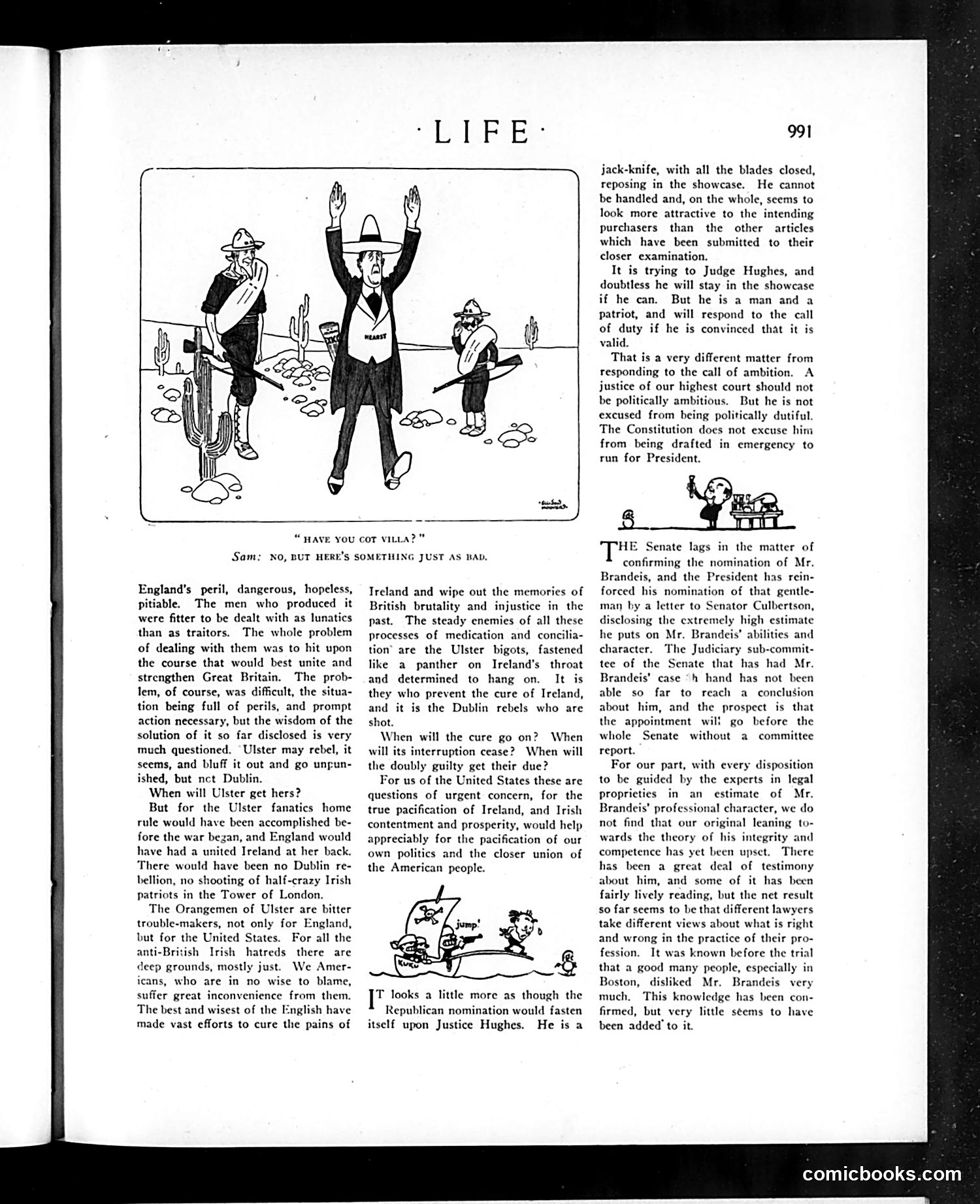
## The Main Cartoon The top cartoon depicts three armed Western figures in a desert with cacti, captioned "Have you got Villa?" Sam replies, "No, but here's something just as bad." This satirizes **Pancho Villa**, the Mexican revolutionary general. During this era (appears to be WWI period), Villa was a notorious figure in American politics—his raids into U.S. territory made him a symbol of Mexican instability and American military concerns. ## The Text Commentary The page discusses two major political issues: 1. **Irish Independence**: The article criticizes Ulster Protestants for obstructing Irish home rule, while Dublin rebels (likely referencing the 1916 Easter Rising) face execution. It argues this double standard undermines Irish-American relations. 2. **U.S. Politics**: It discusses Supreme Court Justice Hughes potentially becoming the Republican presidential nominee—using metaphors suggesting he's an attractive but untested "product." It also mentions pending confirmation of Justice **Brandeis**, whose appointment faced considerable controversy. The cartoon and text together reflect pre-WWI American anxieties about international instability and domestic political uncertainty.
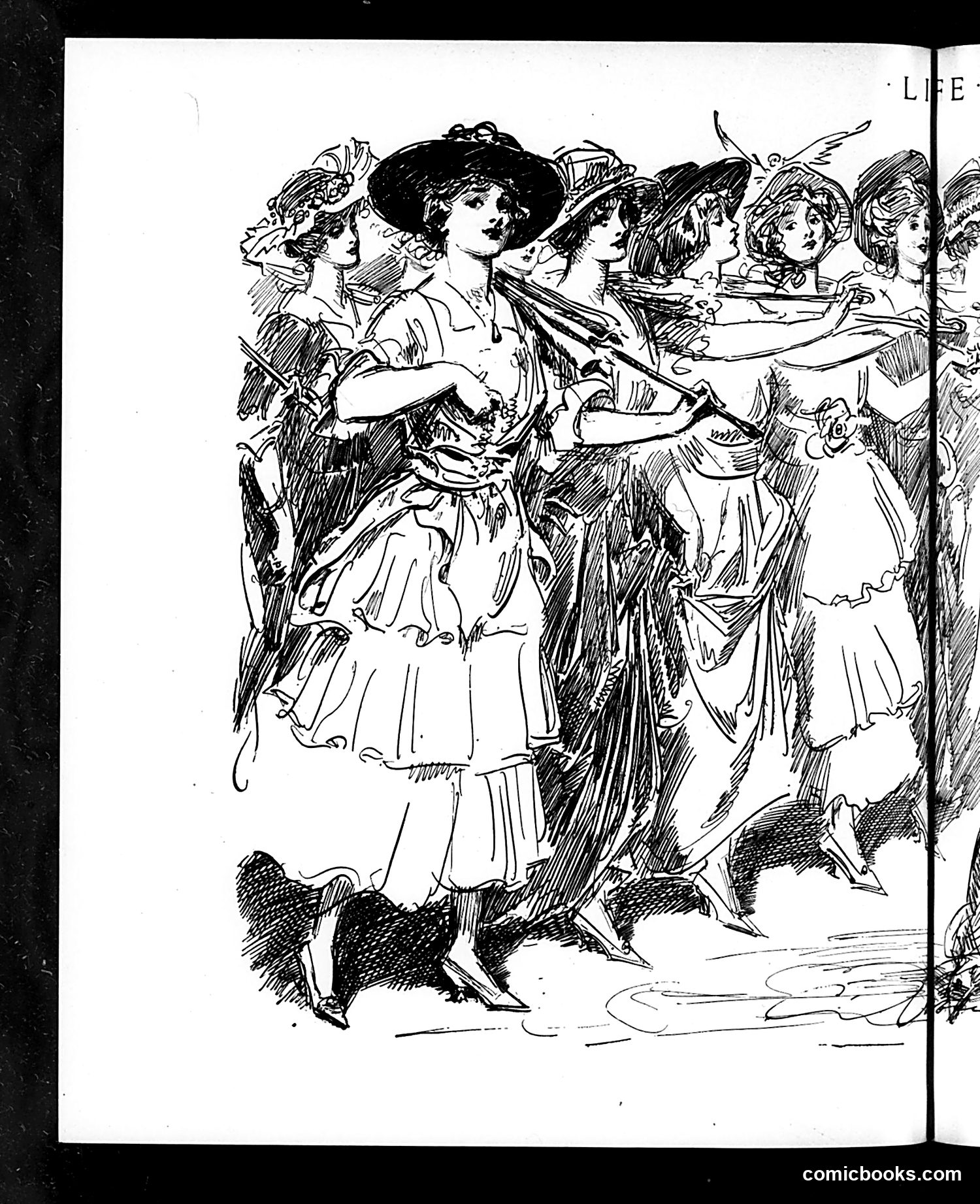
This appears to be a satirical illustration from *Life* magazine showing a group of elegantly dressed women in early 20th-century fashion. The central figure wears an elaborate wide-brimmed hat and flows in animated conversation with companions around her. Some figures sport wings or halo-like accessories, suggesting angelic or idealized imagery. The style suggests social satire about women's fashion, social gatherings, or women's roles of the era. Without visible OCR text content beyond the source attribution, the specific satirical point remains unclear—it may mock fashionable society women, vanity in dress, or contemporary attitudes toward women. The deliberate caricature style indicates social commentary, though the exact target or reference requires additional context.
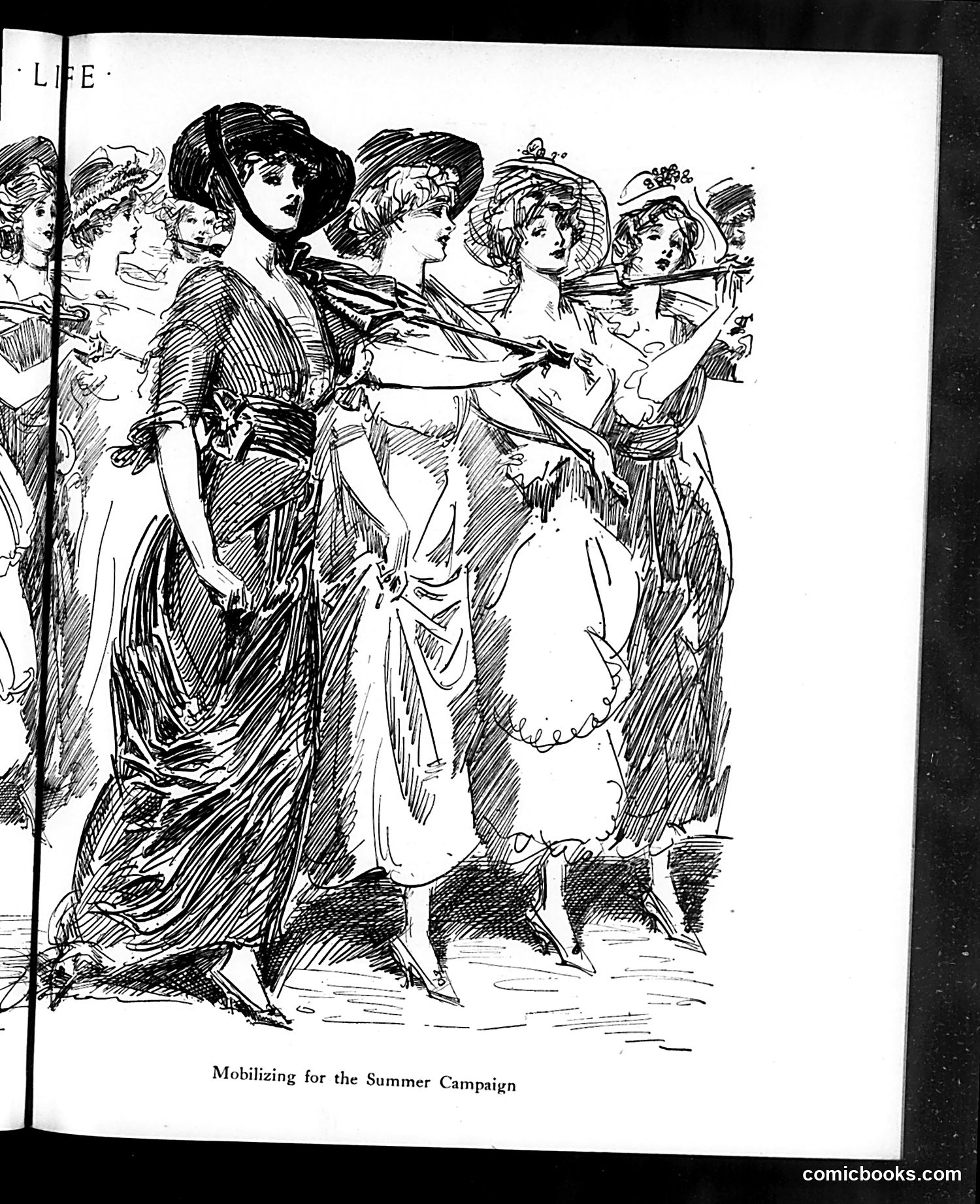
This satirical illustration depicts a group of fashionably dressed women preparing for what the caption calls a "summer campaign." The drawing style and clothing suggest early 20th-century fashion. The women appear to be gathering their resources—one holds what looks like a fan or parasol—in a manner that humorously parallels military mobilization. The satire likely mocks women's social activities during summer season, treating leisure activities and social engagements with mock-military language. This reflects Life magazine's characteristic humor in treating everyday upper-class social life as if it were military strategy or political maneuvering. The elaborate hats, dresses, and accessories emphasize the conspicuous consumption and social competitiveness among fashionable women of the era.
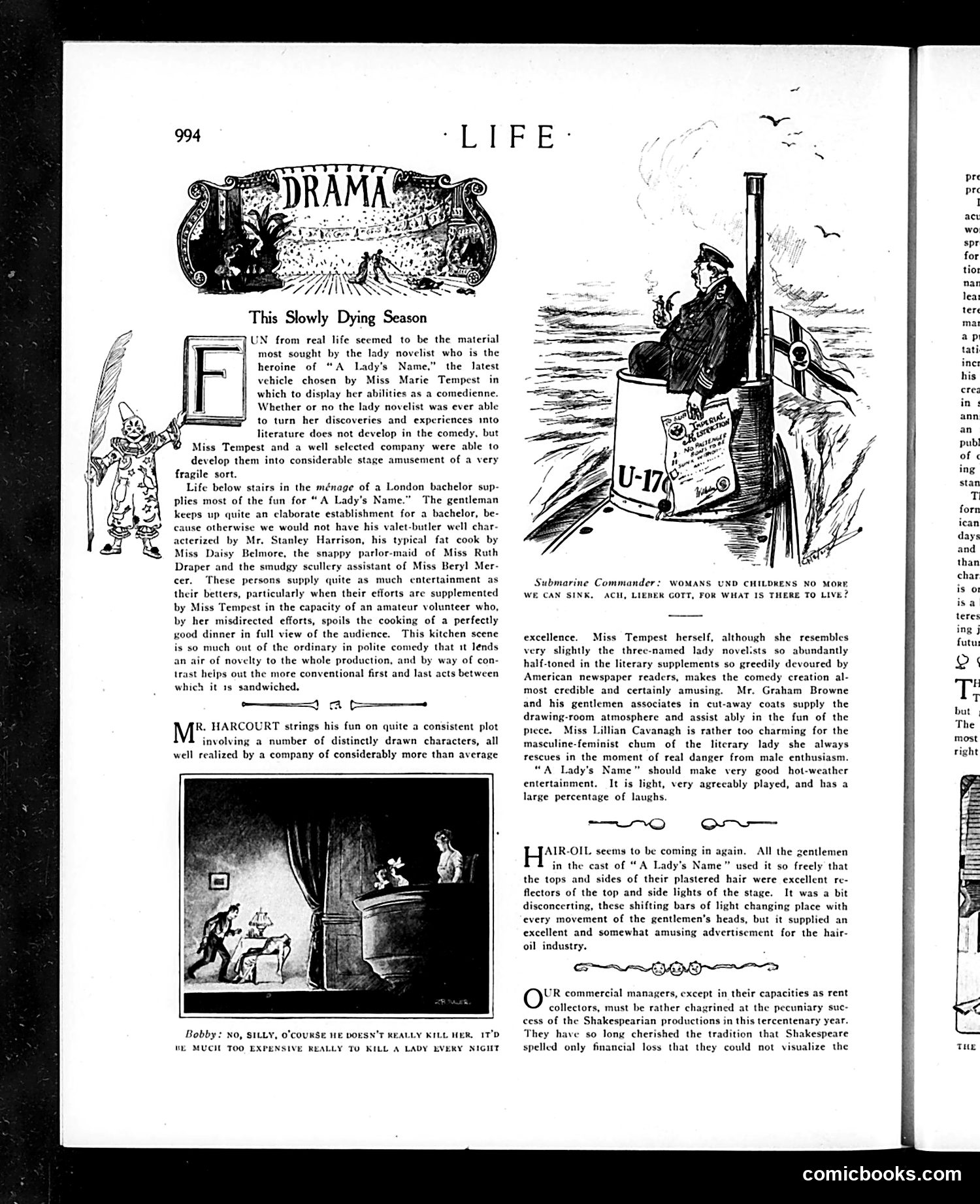
This is a theater review page from Life magazine critiquing the play "A Lady's Name," starring Marie Tempest. The page includes two cartoons satirizing aspects of the production and contemporary life. **The main cartoon** (bottom left) shows a domestic scene where "Bobby" reassures someone that the male character doesn't actually kill the female lead nightly—it would be "too expensive." This satirizes the play's plot involving attempted murder, poking fun at both the melodramatic storyline and the economic absurdity of repeating such an expensive action. **The submarine cartoon** (right) depicts a German U-boat commander expressing despair that there's nothing left worth living for—"womans und childrens no more we can sink." This references WWI submarine warfare and German U-boat attacks on civilian vessels, using dark humor to satirize German military mentality and the brutality of modern warfare. The text reviews the play as light summer entertainment featuring an elaborate household staff and a novelist character, praising the cast while noting the excessive use of hair-oil by male actors.
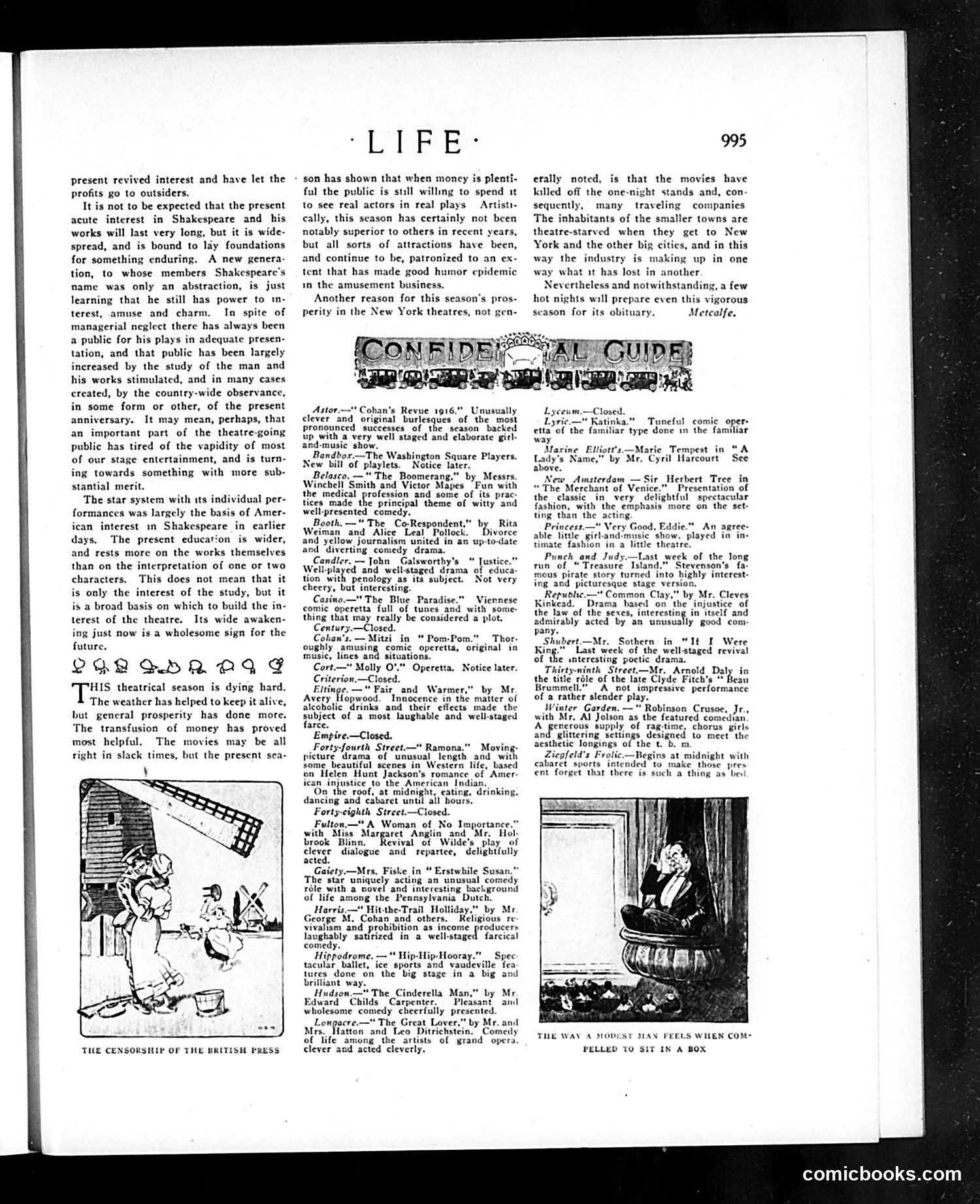
This political cartoon depicts British press censorship during World War I. The image shows a figure operating what appears to be a printing press or censorship apparatus, with content being controlled or suppressed—symbolized by mechanical constraint. The surrounding text discusses Broadway's 1916 theatrical season, noting its financial success despite artistic mediocrity. Life magazine argues that money—not artistic merit—drives entertainment consumption. The juxtaposition is ironic: while discussing American theatrical freedom and audience choice, the magazine runs a cartoon condemning British wartime censorship. The cartoon critiques Britain's suppression of news and information flow during the war, contrasting with America's relatively open press. This reflects Life's position as a publication defending free speech and editorial independence against government control—a significant concern during WWI's propaganda wars.
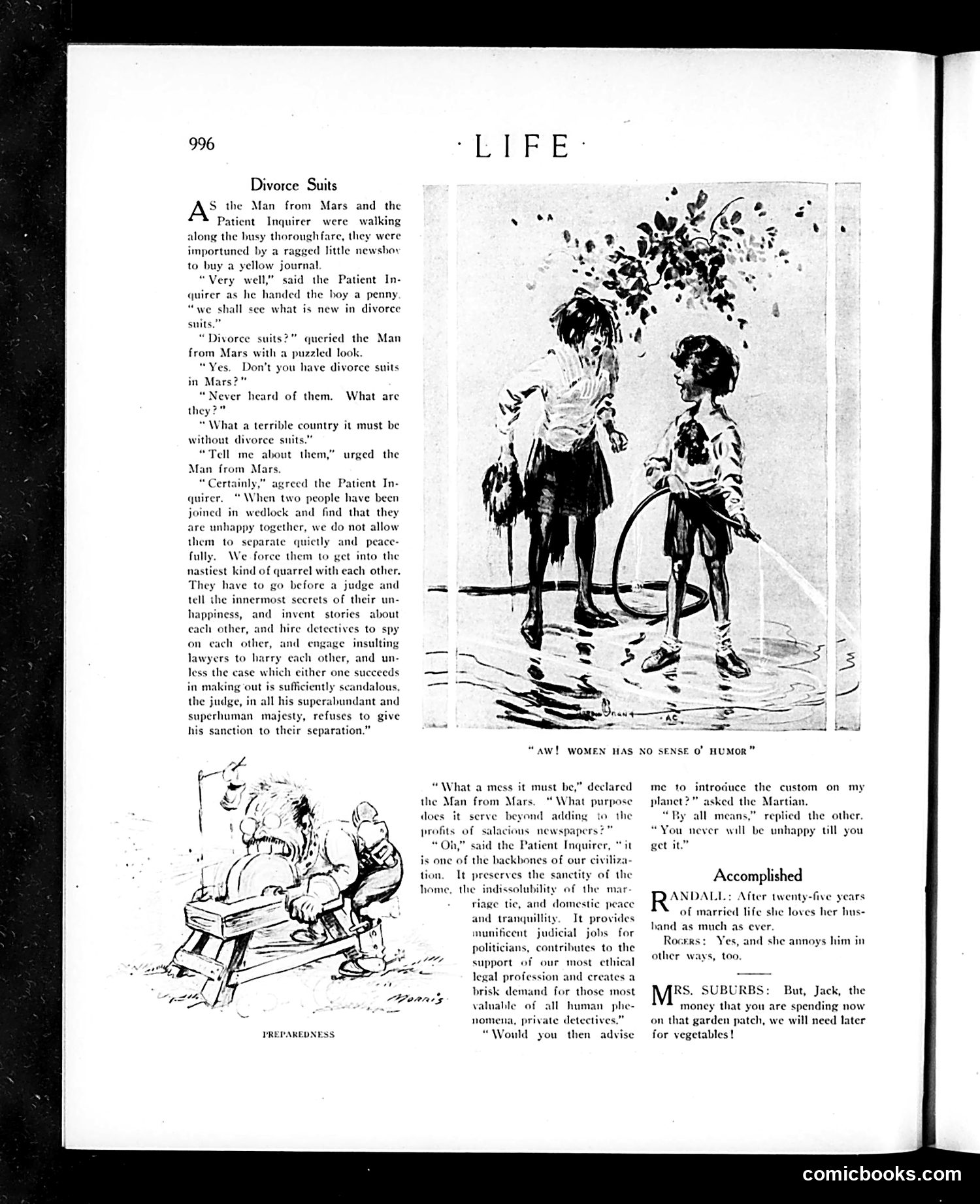
This page satirizes America's adversarial divorce system through a dialogue between a "Man from Mars" and a "Patient Inquirer." The Martian, unfamiliar with divorce suits, asks naive questions that expose the system's absurdity. The satire's targets: divorce requires public scandal-mongering, hiring detectives to spy on spouses, inventing damaging stories, and engaging lawyers in bitter courtroom battles—all purportedly to "preserve the sanctity of the home." The Patient Inquirer notes the system also enriches newspapers (through salacious reporting), politicians (judicial positions), lawyers, and private detectives. The accompanying cartoons reinforce these critiques. One shows "Preparedness"—suggesting society prepares for divorce litigation like military warfare. Another depicts marital discord. The "Accomplished" section adds lighter domestic humor about marriage's mundane frustrations, contrasting with the legal system's melodrama above. The satire argues American divorce law creates unnecessary human misery while enriching professionals—a pointed critique of early 20th-century legal culture.
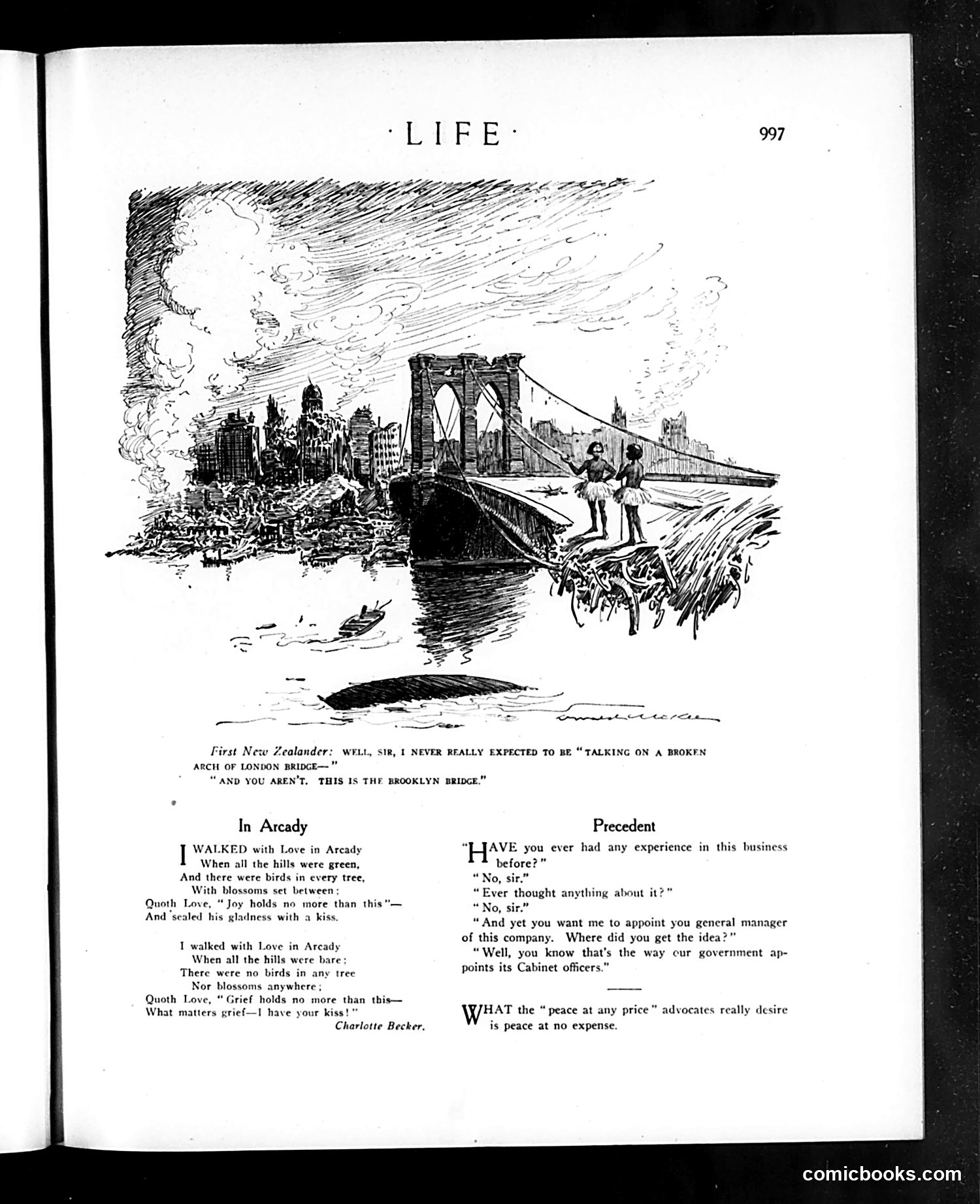
This page from *Life* magazine contains three distinct satirical pieces: **Top cartoon**: A "First New Zealander" tourist stands on the Brooklyn Bridge, mistakenly believing it's London Bridge. The joke mocks both the visitor's geographical confusion and American pride—implying Americans exaggerate their monuments' importance, or that foreign visitors are ignorant of American landmarks. **"In Arcady" poem**: A sentimental romantic verse by Charlotte Becker contrasting love in spring versus winter, emphasizing emotional constancy regardless of circumstance. **"Precedent" dialogue**: Satirizes government incompetence by showing a job applicant admit he has zero qualifications or experience, yet expects appointment as general manager. His punchline—that this mirrors how the government appoints Cabinet officers—attacks the political patronage system, suggesting Cabinet positions go to unqualified cronies rather than merit-based candidates. **"Peace at any price"**: A brief jab at pacifists, implying their advocacy for peace is really about avoiding financial expense rather than genuine principle.
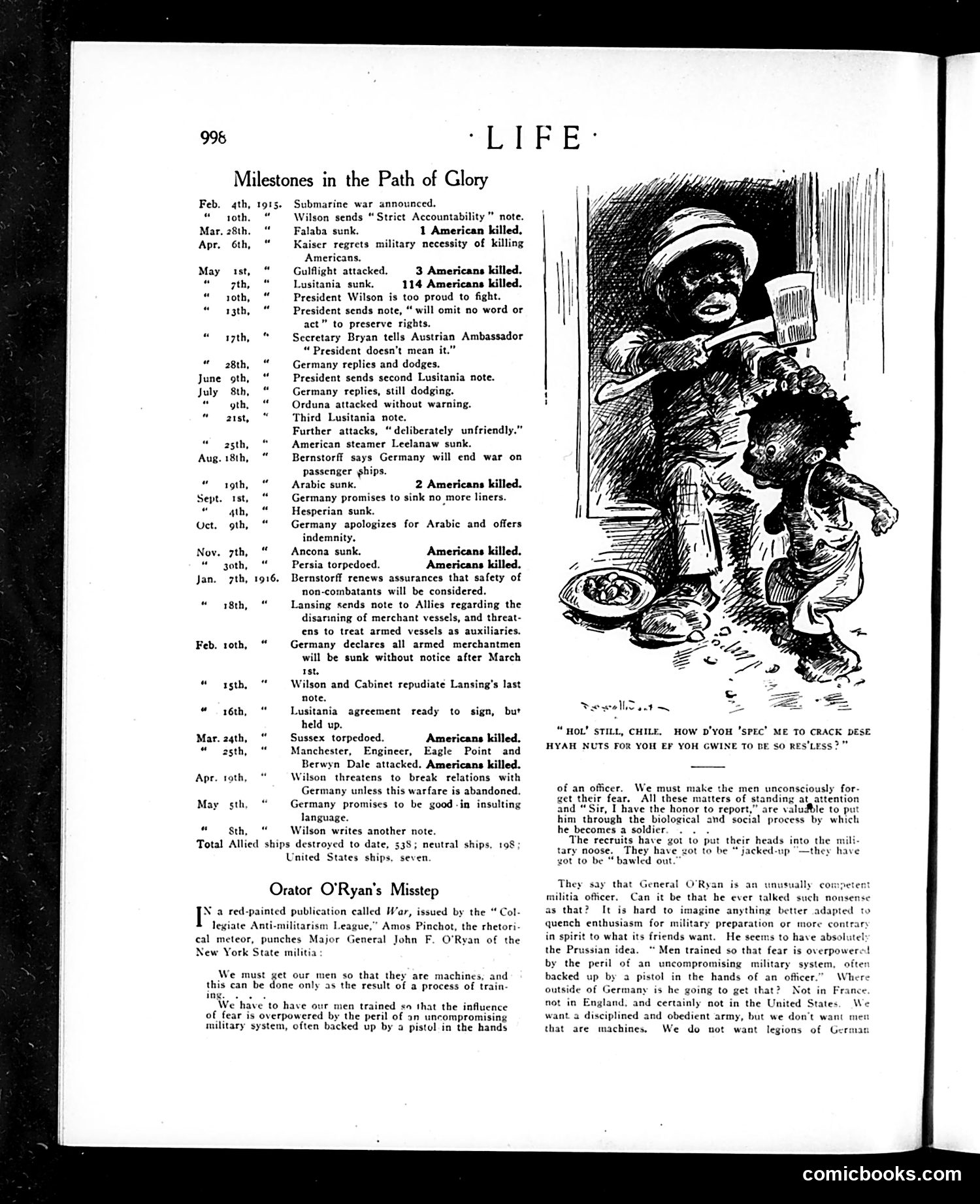
## "Milestones in the Path of Glory" This chronological list satirizes President Wilson's ineffectual response to German submarine warfare. It catalogs ship sinkings, American deaths, and Wilson's repeated diplomatic protests ("notes") without action—mocking his famous statement that he was "too proud to fight." The list's grim humor lies in the escalating casualties paired with Germany's empty apologies and continued attacks, showing diplomacy failing repeatedly. ## Political Cartoon The cartoon depicts a caricatured figure (likely representing General O'Ryan or militaristic thinking) as a crude stereotype struggling with "nuts" (representing military discipline/training). The caption sardonically suggests forcing soldiers into blind obedience through psychological breaking-down. ## Context The page critiques both German aggression and American unpreparedness/diplomatic weakness in 1915, before U.S. entry into WWI (1917). It also attacks the militarism advocated by figures like General O'Ryan, whose statements about training soldiers through fear and rigid discipline the magazine presents as Prussian authoritarianism incompatible with American values.
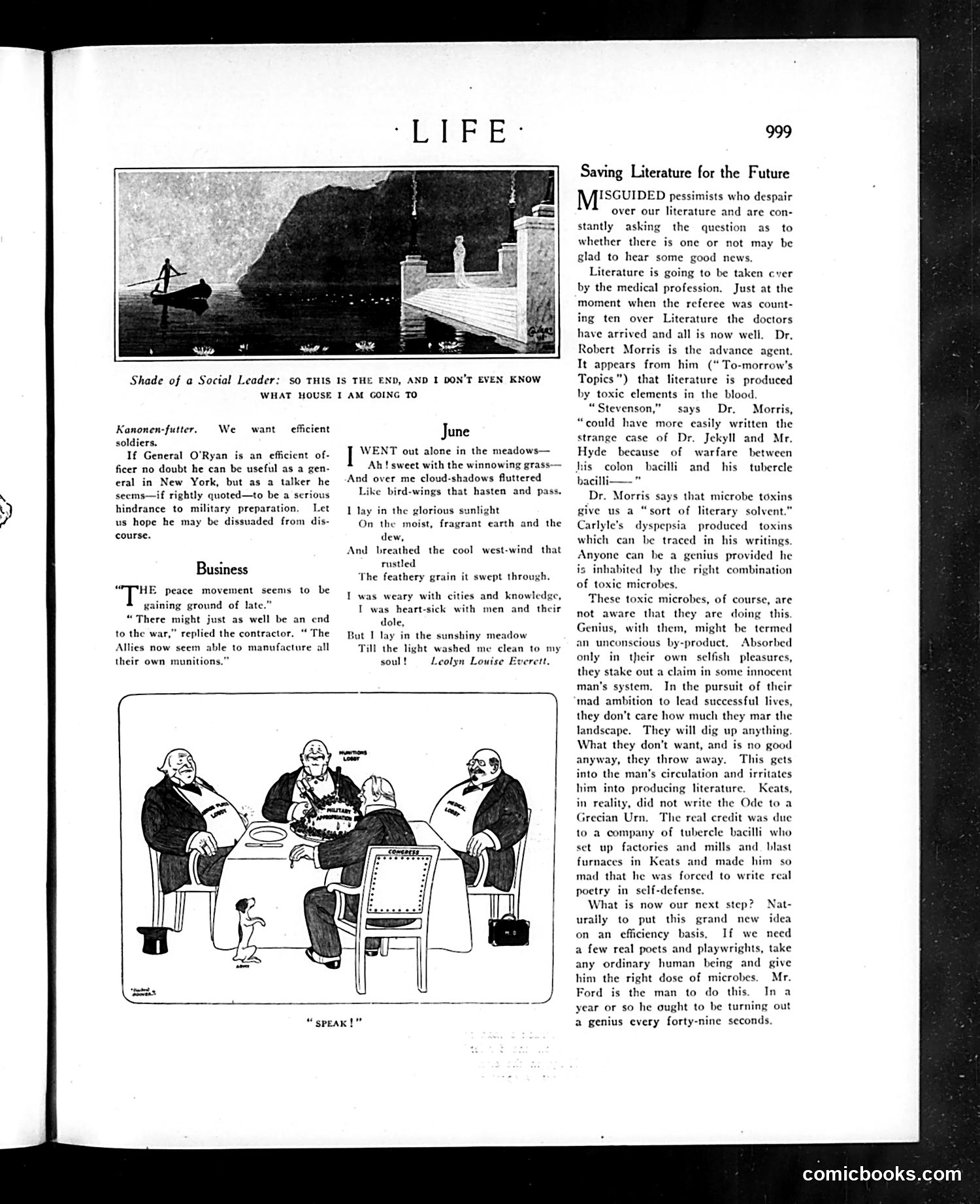
This page contains three satirical pieces mocking early 20th-century concerns: **"Shade of a Social Leader"** critiques General O'Ryan (appears to be a military figure), suggesting his public speaking undermines military preparation—a jab at ineffective military leadership during the WWI era. **"Business" cartoon** depicts a contractor dismissing peace efforts because the war is profitable for munitions manufacturing. The satire exposes how business interests profit from prolonged conflict. **"Saving Literature for the Future"** mocks pseudo-scientific medical theories claiming great literature results from toxic microbes in writers' blood (citing Stevenson, Carlyle, Keats as examples). The piece absurdly suggests mass-producing genius by infecting ordinary people with microbes—a dig at both dubious medical theories and industrial efficiency obsessions. The final jab at Henry Ford implies manufacturing genius like factory products, satirizing era obsessions with mechanization and "scientific" approaches to human creativity.
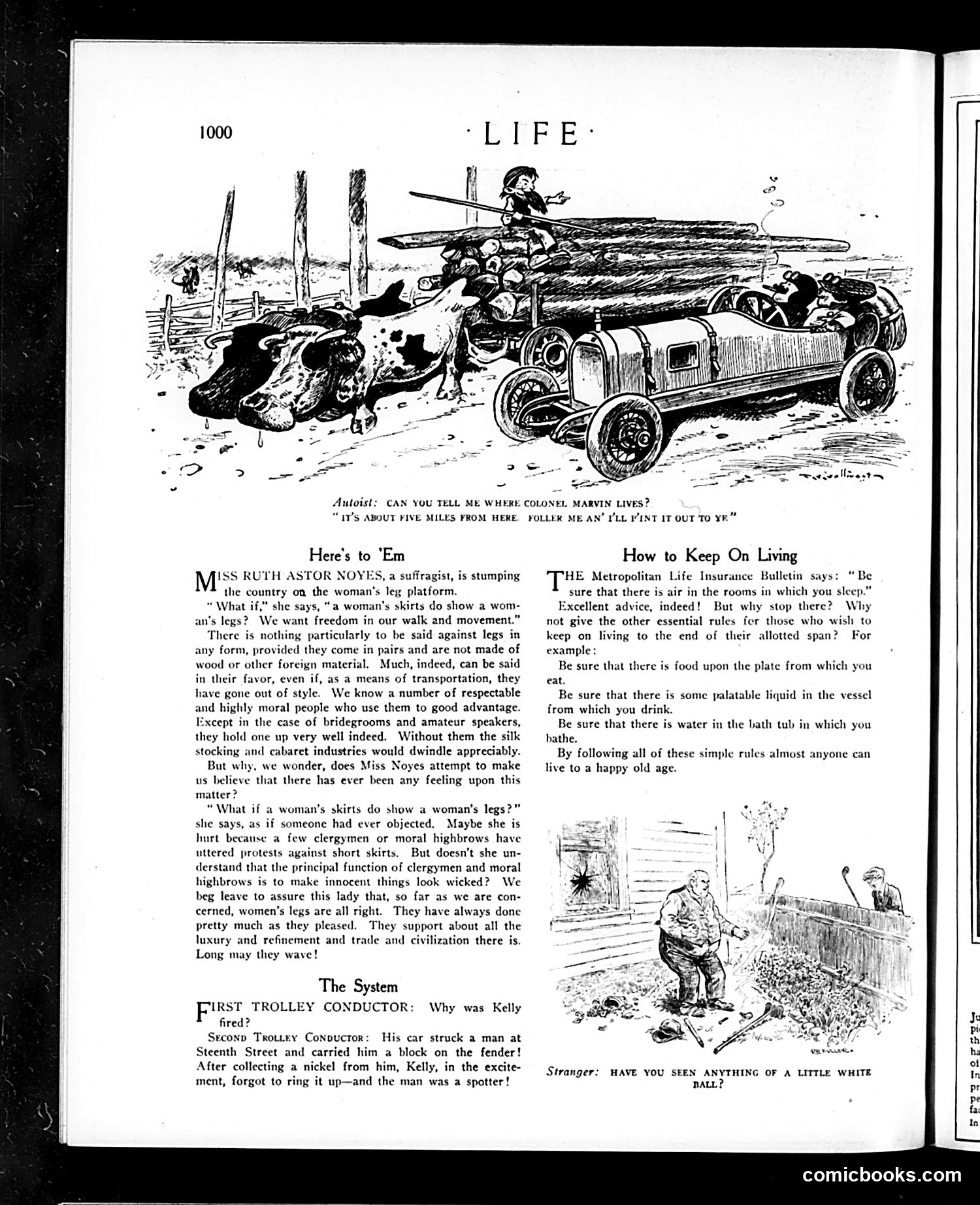
This page contains three separate satirical pieces mocking early 20th-century American concerns: **"Here's to 'Em"**: Mocks suffragist Ruth Astor Noyes's platform advocating women showing their legs (shorter skirts). The author sarcastically pretends shock that anyone would object to women's legs, then praises legs for their economic and social importance—undercutting Noyes's earnest argument through exaggeration. **"The System"**: A dark joke about a trolley conductor fired not for hitting a pedestrian with his car, but for forgetting to ring up the victim's nickel fare. It satirizes corporate bureaucracy's priorities: collecting money matters more than passenger safety. **"How to Keep On Living"**: Mocks Metropolitan Life Insurance's obvious health advice (ensure air in bedrooms) by extending the logic absurdly—be sure food is on your plate, water in your bath. It's satire through literalism, highlighting corporate platitudes. The automobile cartoon at top appears to reference Colonel Marvin (unclear who), showing early-automobile-era humor about getting lost.
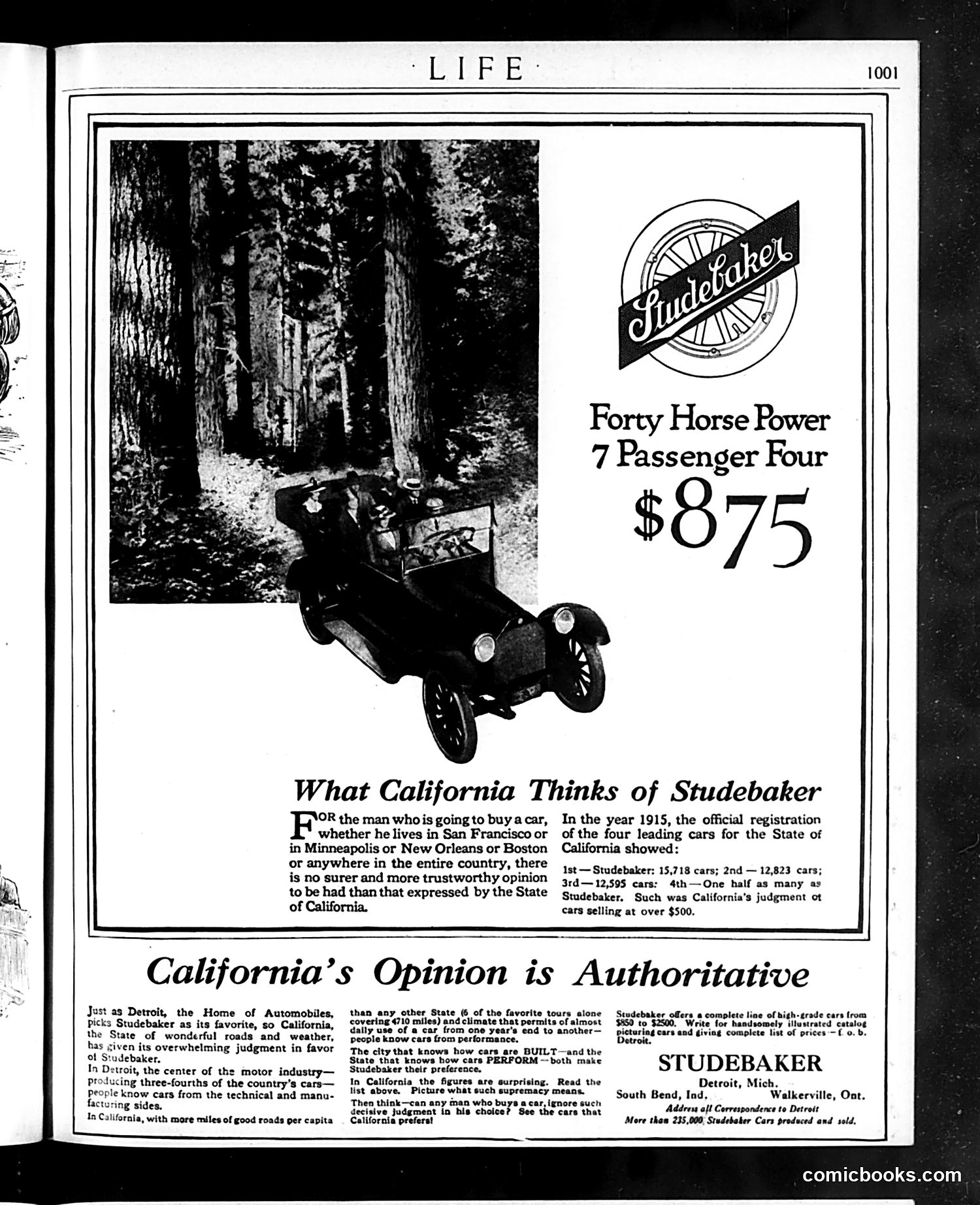
This is primarily a **car advertisement**, not satire or political cartoon. It promotes the Studebaker automobile by leveraging California's 1915 vehicle registration data as endorsement. The "joke" or persuasive angle: California—a state with excellent roads and year-round driving weather—supposedly validates cars through actual performance rather than theory. Since Californians could test cars constantly, their preference for Studebaker (15,718 registrations, significantly outselling competitors) proves the vehicle's superiority. The advertisement appeals to authority by comparing California's judgment to Detroit's manufacturing expertise, arguing that combined knowledge endorses Studebaker. The logic: if practical users in ideal conditions prefer this car, shouldn't buyers elsewhere trust that preference? The modest satire lies in treating state vehicle registration statistics as definitive consumer judgment—personifying California as a rational judge whose "opinion is Authoritative." The early automobile industry heavily relied on such comparative sales figures for credibility.
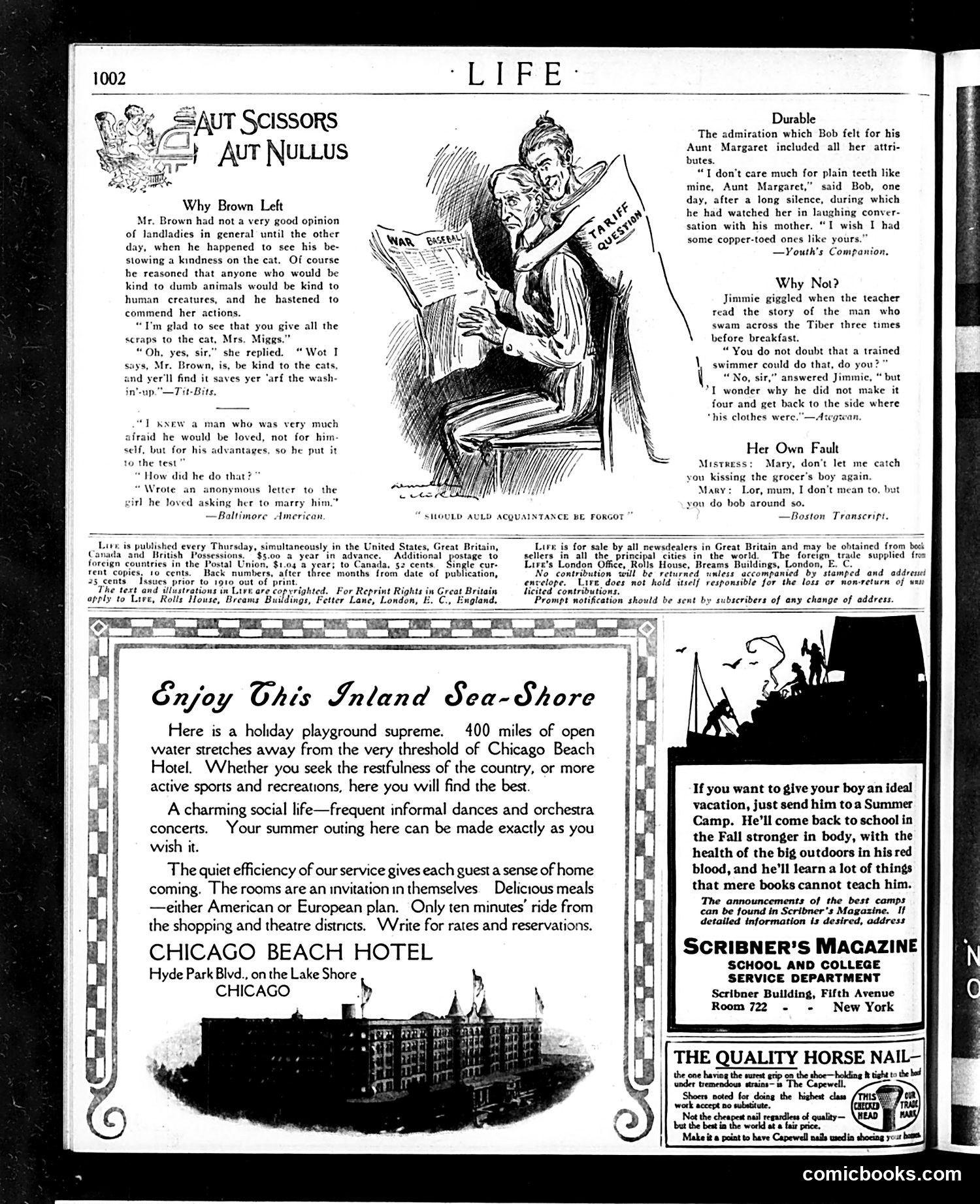
This page from Life magazine contains several short humorous anecdotes typical of early 20th-century American satire, plus advertisements. The cartoon "Should Auld Acquaintance Be Forgot" (center) depicts two figures reading a newspaper together—likely referencing wartime news, based on the visible "WAR" text. The satire appears to critique how people selectively forget past grievances or associations during times of conflict. The other content consists of brief comic stories with moral lessons: "Why Brown Left" satirizes class prejudice (a man judges a landlady kindly only after seeing her treat animals well); "Why Not?" mocks a student's literal-mindedness about ancient Roman swimming feats; "Her Own Fault" presents domestic humor about a young woman's unwanted romantic attention. The advertisements—particularly the Chicago Beach Hotel and Scribner's Magazine—occupy significant space, reflecting Life's revenue model. Overall, this page demonstrates Life's formula: gentle social satire targeting human nature and class dynamics, interspersed with period advertising.
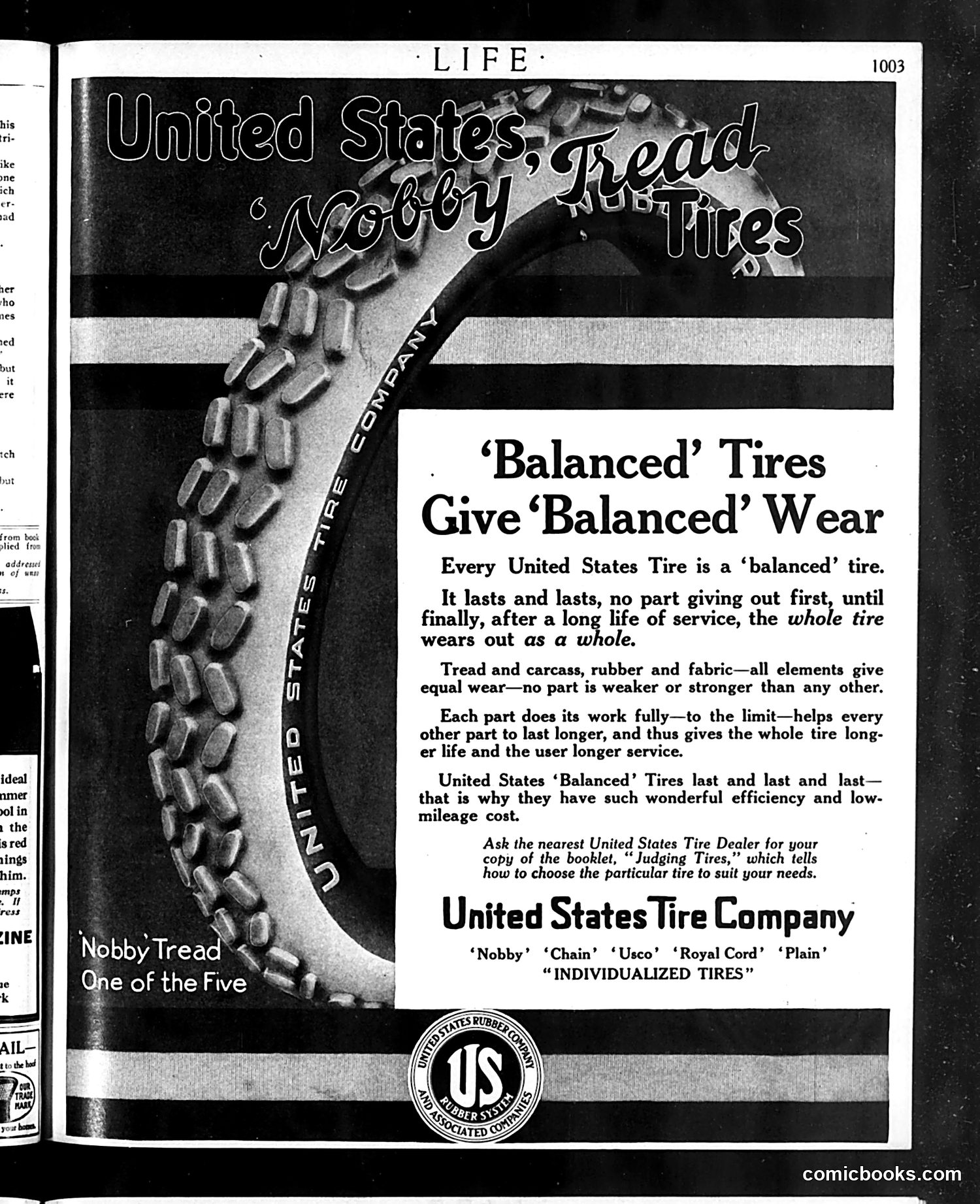
This page is a **United States Tire Company advertisement** from Life magazine. It promotes "Balanced" tires by explaining their engineering concept: all components (tread, carcass, rubber, fabric) wear equally, so the entire tire lasts longer rather than failing in one weak spot first. The image shows a close-up of tire tread labeled "Nobby Tread—One of the Five," referring to five tire models the company offered: Nobby, Chain, Usco, Royal Cord, and Plain. There is **no political cartoon or satire here**—this is straightforward product marketing using technical claims about tire durability and efficiency to appeal to cost-conscious consumers. The "balanced wear" concept is presented as a practical engineering advantage distinguishing U.S. tires from competitors.
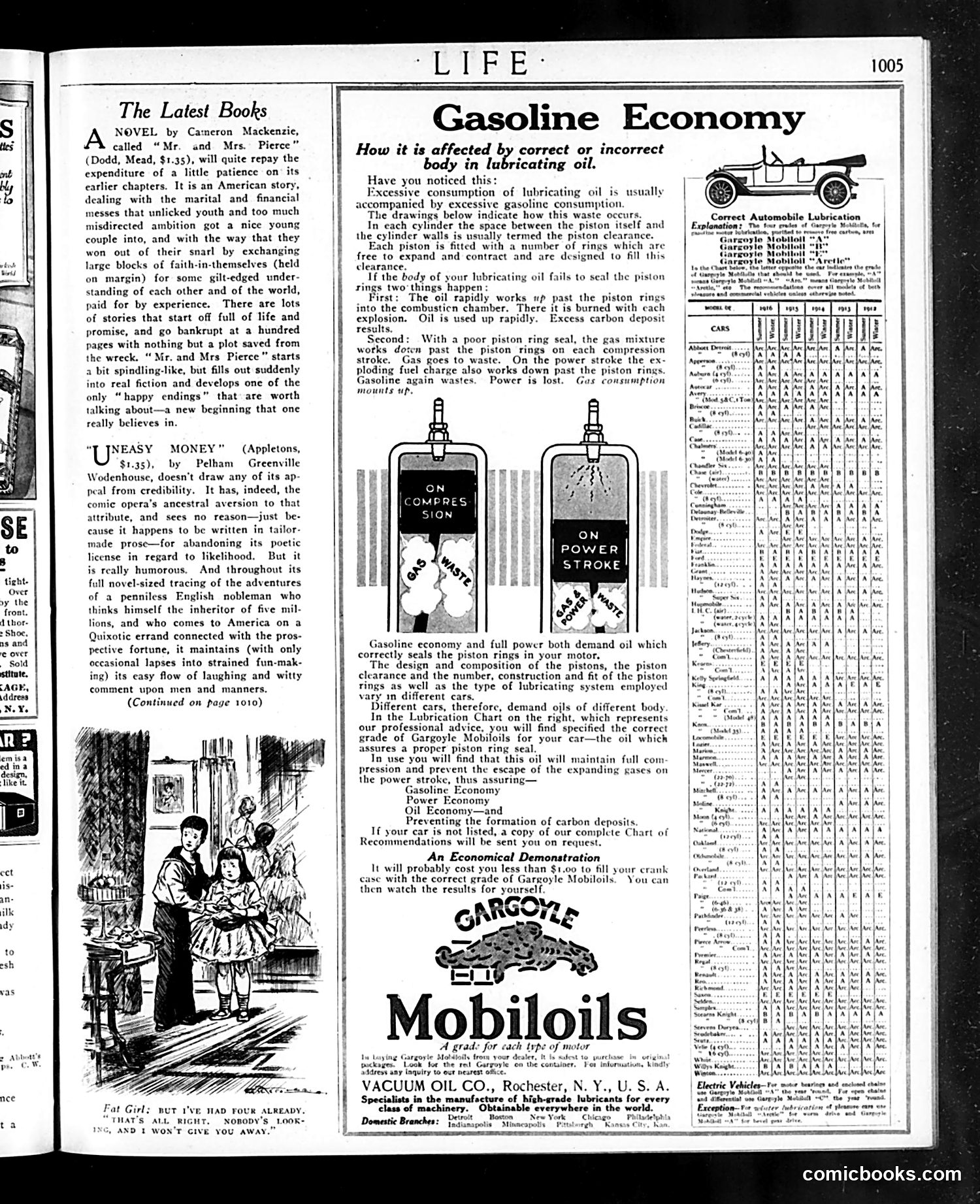
This page contains **primarily advertising** rather than satirical content. The main feature is a Gargoyle Mobiloils advertisement explaining gasoline economy through proper motor oil selection. ## The Advertisement The ad uses technical diagrams showing piston rings "on compression" versus "on power stroke" to educate readers about how incorrect motor oil body allows gas to escape past piston rings, wasting fuel. This was a genuine concern in early automotive engines. ## The Book Reviews The left column briefly reviews two novels: Cameron Mackenzie's "Mr. and Mrs. Pierce" (about marital/financial troubles) and P.G. Wodehouse's "Easy Money" (a comic novel about a penniless English nobleman in America). ## The Cartoon A small illustration at bottom left shows a rotund woman being offered desserts, with the caption about refusing food—a mild joke about gluttony and self-deception. **Overall**: This is a standard Life magazine page mixing book criticism with period advertising. The humor is minimal; the Mobiloils ad dominates by taking up roughly half the page.
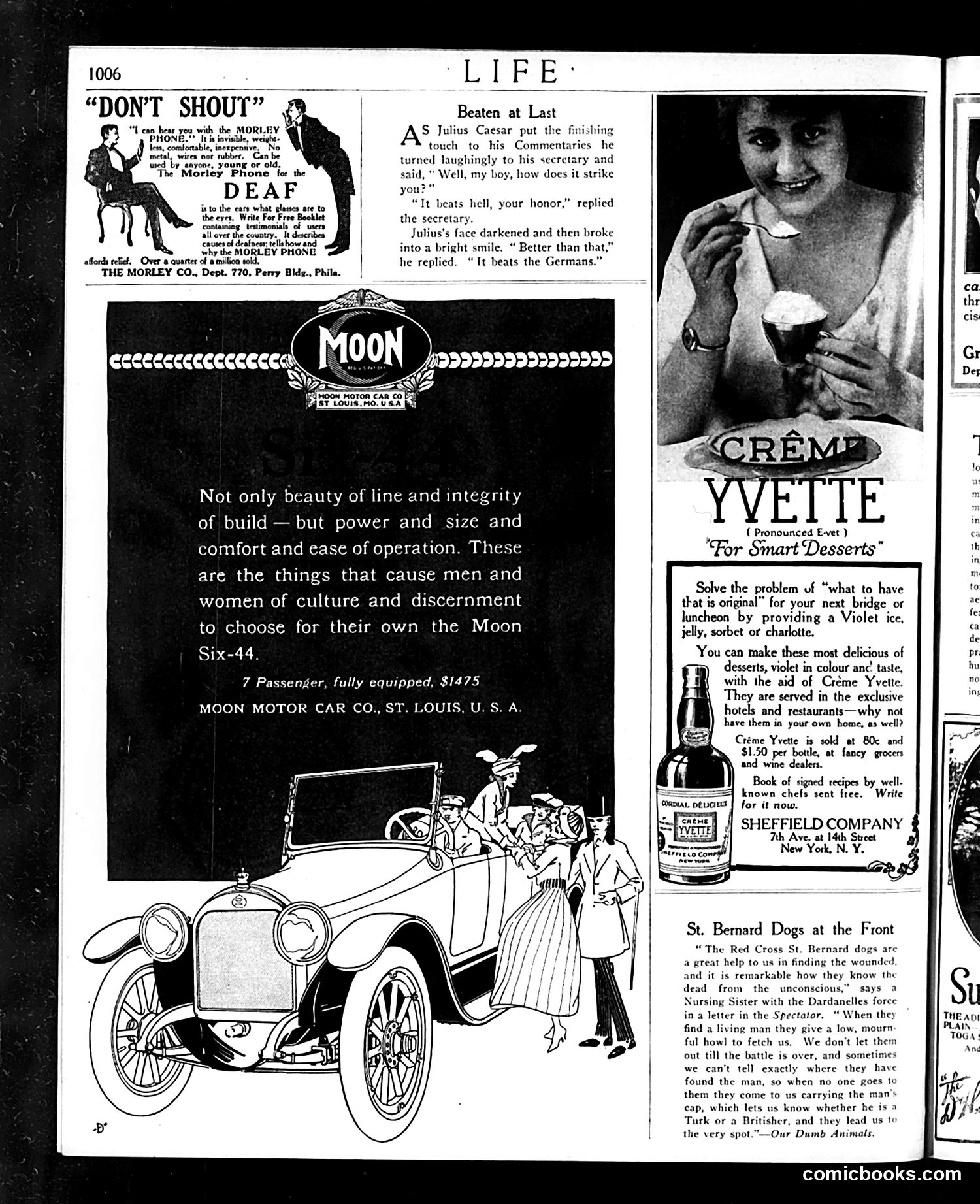
This page contains **advertisements and brief anecdotes** rather than political cartoons. The main content includes: 1. **Morley Phone ad** — a device for the deaf, presented as a modern convenience ("what glasses are to the eyes") 2. **"Beaten at Last" anecdote** — A joke about Julius Caesar's secretary, where Caesar learns that something "beats the Germans." This appears to reference WWI (ongoing when this was published), with the humor being that even ancient Rome's greatest military leader would appreciate beating Germany in the current war. 3. **Moon Motor Car advertisement** — promoting a luxury automobile with appeals to cultured buyers 4. **Crème Yvette ad** — a liqueur for fashionable desserts 5. **St. Bernard dogs anecdote** — describing Red Cross dogs locating wounded soldiers at the Dardanelles front (also a WWI reference), with dogs distinguishing Turks from British soldiers by retrieving caps The page reflects **WWI-era American optimism** about modern conveniences while casually incorporating warfront references.
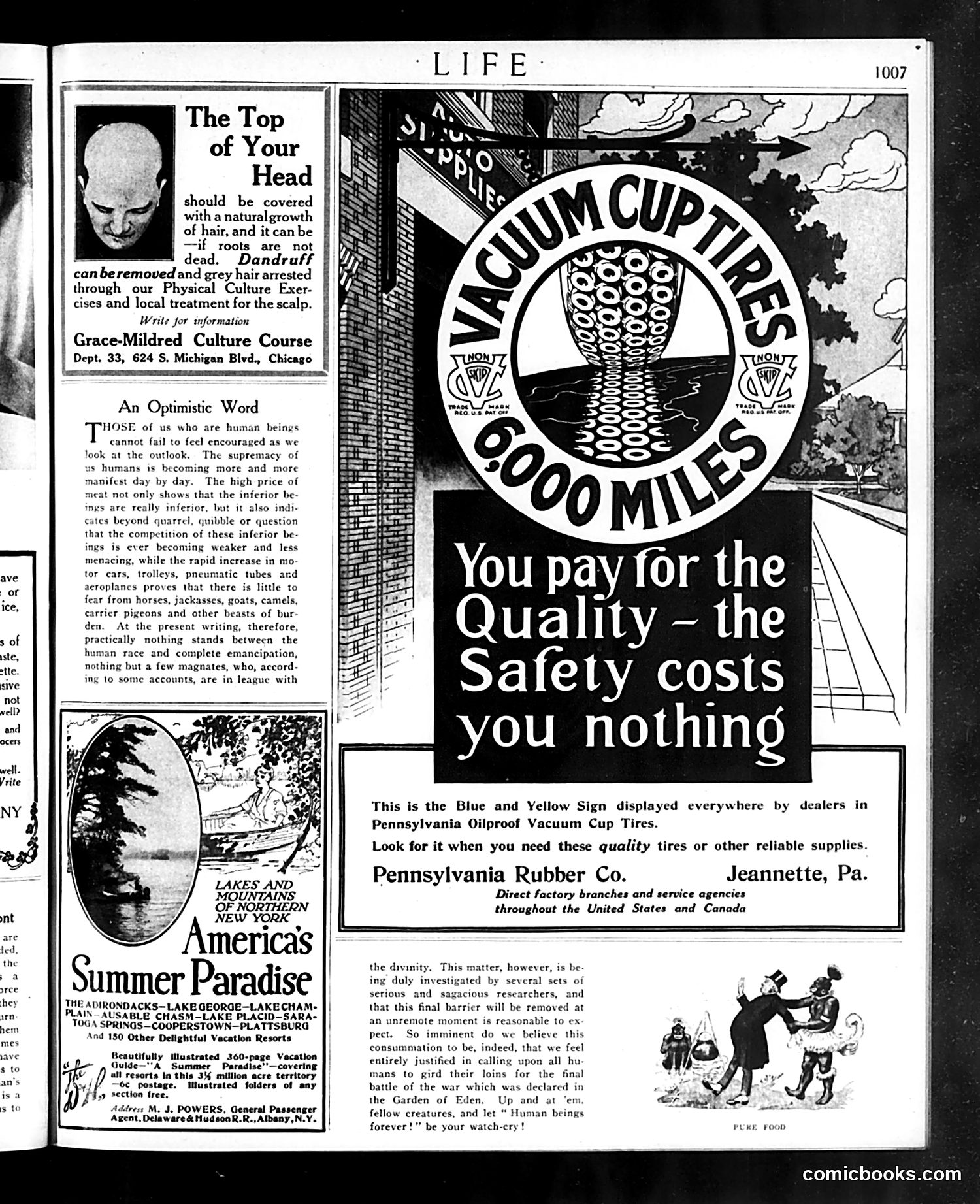
This page contains early 20th-century advertisements and editorial content, not political satire. **Left column:** An ad for the "Grace-Mildred Culture Course" offers treatments for hair loss and dandruff through "Physical Culture Exercises"—reflecting period pseudoscientific wellness claims. **Center:** "An Optimistic Word" is a satirical editorial expressing smug human superiority. It mocks contemporary anxieties by arguing humans clearly dominate nature (citing high meat prices as proof animals are "inferior") and that technology (airplanes) proves human advancement. The piece sarcastically celebrates humanity's coming "complete emancipation" from animal competition—likely lampooning both social Darwinism and early 20th-century technological triumphalism. **Right:** A Vacuum Cup Tire advertisement from Pennsylvania Rubber Co. promoting quality and safety. **Bottom left:** A travel ad for Adirondack resorts. The page reflects early 1900s attitudes: unbridled faith in progress, dubious health products, and casual assertions of human superiority.
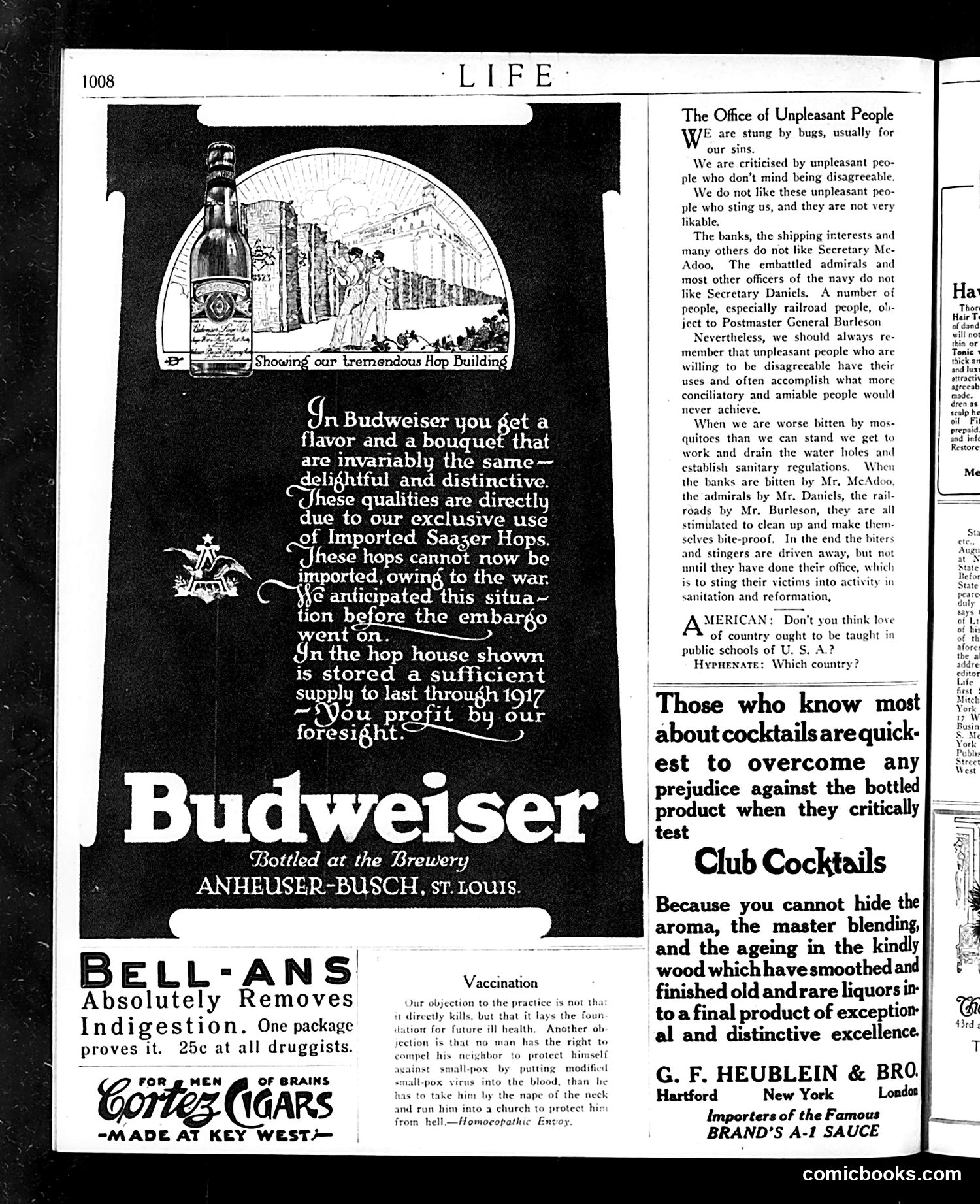
This is a satirical essay (not a cartoon) defending controversial government officials of the Wilson administration—Secretary of Treasury McAdoo, Secretary of Navy Daniels, and Postmaster General Burleson. These figures faced criticism from banks, shipping interests, railroad companies, and the military establishment. The author argues that "unpleasant people who are willing to be disagreeable" serve a useful social function, like mosquitoes forcing us to drain swamps and establish sanitation. Similarly, these unpopular officials, by antagonizing powerful interests, compel them toward reform and accountability. The piece uses the metaphor of pest control to justify their controversial policies and unpopularity. A brief dialogue at bottom mocks hyphenated Americans (immigrants with divided loyalties), reflecting period xenophobia. The page is primarily advertisements for Budweiser, Bell-Ans antacid, cigars, and cocktails.
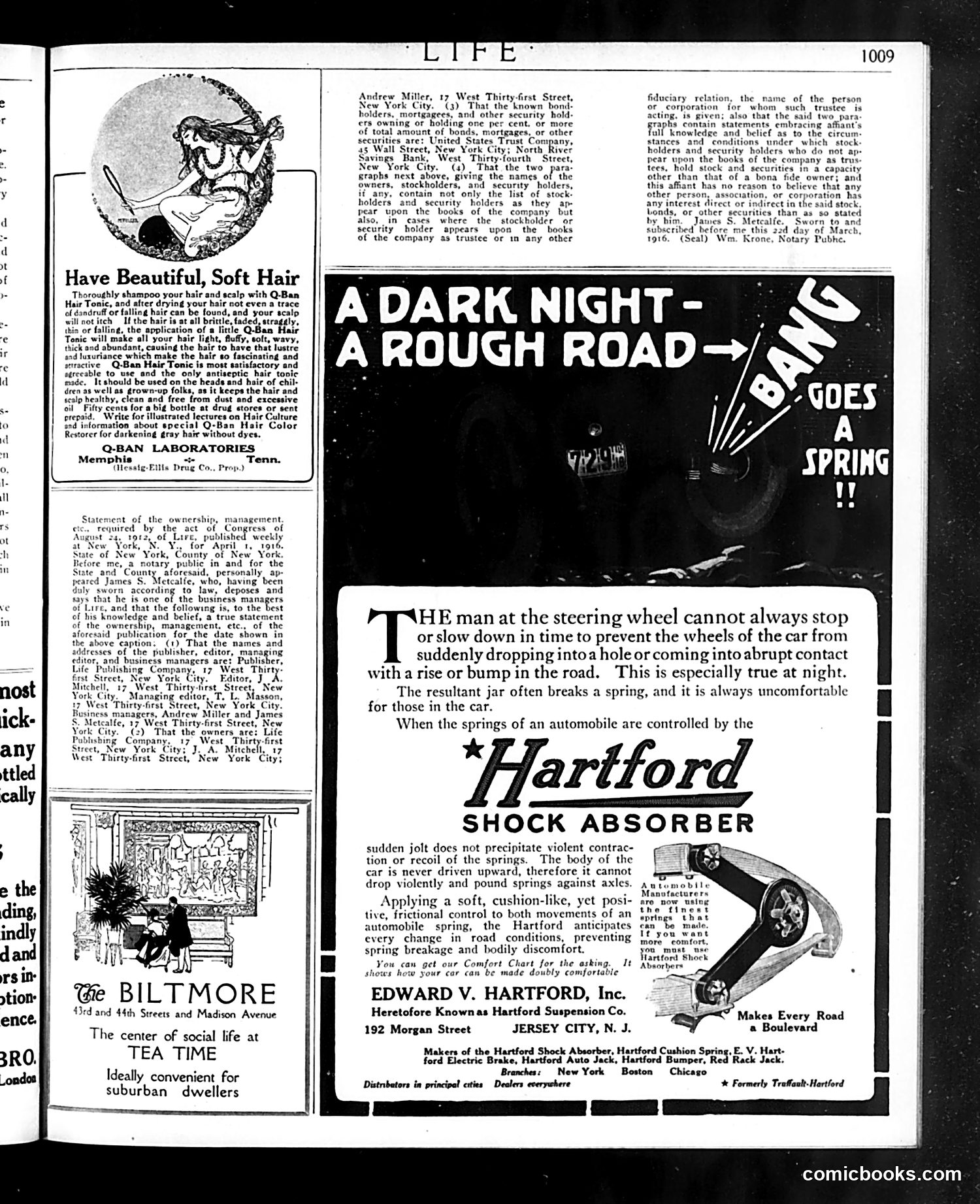
This page is primarily **advertising**, not political satire. The dominant content is a Hartford Shock Absorber ad targeting automobile owners concerned about rough roads. **The Advertisement's Pitch:** The ad addresses a genuine automotive problem of the era: early automobiles lacked effective suspension systems. Drivers couldn't reliably stop or slow down to avoid road hazards—potholes, bumps, rises—especially at night. The resulting jolts broke springs and caused discomfort to passengers. **The Solution Being Sold:** Hartford Shock Absorbers supposedly provided "soft, cushion-like" control, preventing violent spring reactions. The ad emphasizes safety and comfort, claiming the device "makes every road a boulevard." **Historical Context:** This reflects early 1900s automotive technology limitations and the marketing strategy of positioning new engineering solutions as essential safety features. The dramatic imagery ("A Dark Night—A Rough Road") appeals to common driver anxieties. The page also includes period advertisements for Q-Ban Hair Tonic and The Biltmore hotel, plus standard Life magazine ownership statements.
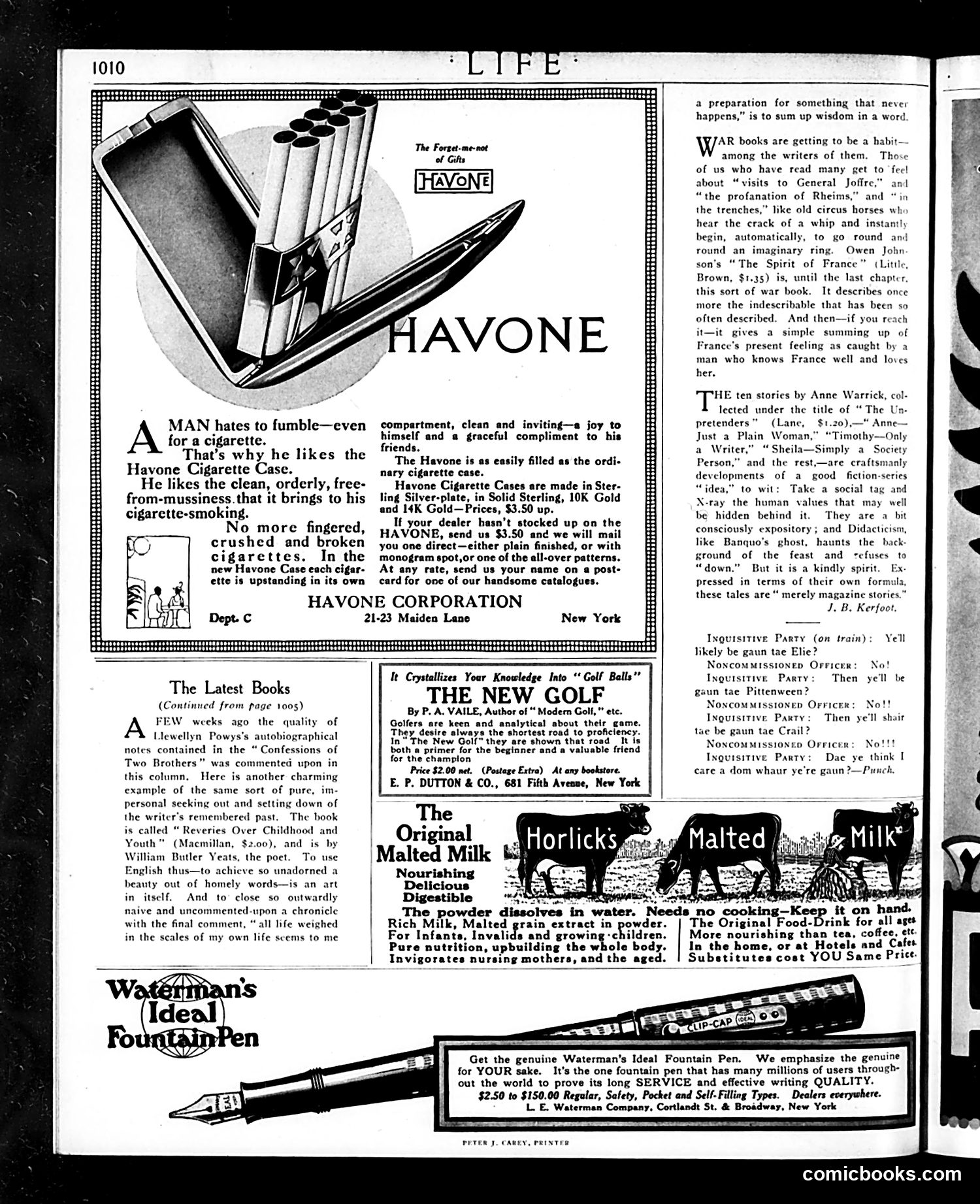
This is primarily an **advertising and book review page** from Life magazine, with minimal editorial cartooning. The page features: 1. **Havone Cigarette Case advertisement** (top): A product ad emphasizing masculine orderliness—a man appreciates a cigarette case that keeps smokes organized and prevents fumbling or damage. This reflects early 20th-century marketing targeting male consumers through appeals to efficiency and neat appearance. 2. **Book reviews** (right side): Discussions of war literature becoming fashionable, particularly books about France and WWI (referenced: General Joffre, Rheims, trenches). The reviewer notes sardonically that war books are becoming clichéd. 3. **Small dialect joke** (bottom right): A "Punch" magazine excerpt about Scottish place names (Elie, Pittenween, Crail)—regional humor. 4. **Other product advertisements**: Horlick's Malted Milk and Waterman's Ideal Fountain Pen. The page reflects **1910s consumer culture** and the era's fascination with WWI literature. There is no significant political satire present.
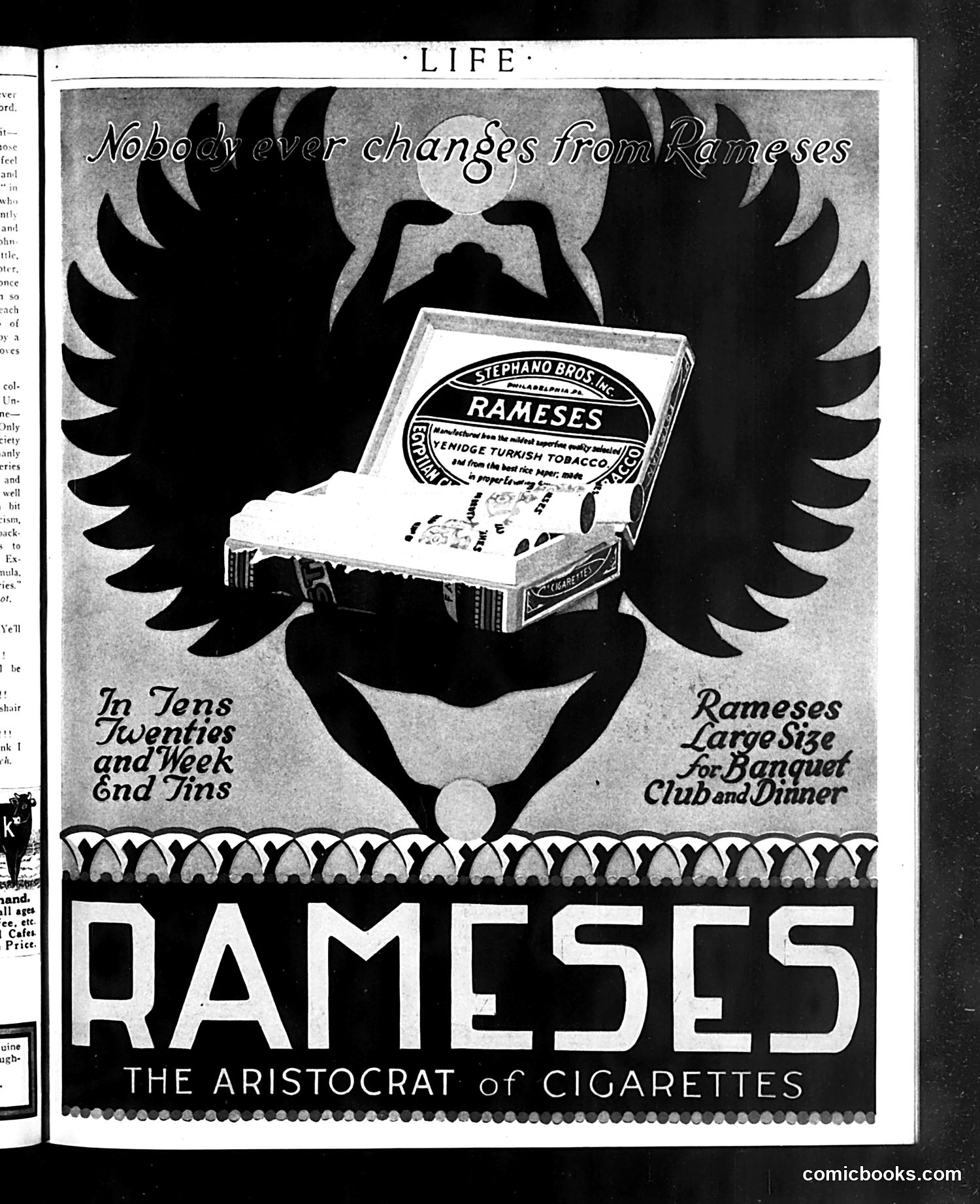
This is a **cigarette advertisement**, not political satire. It's a Rameses brand cigarette ad from an era (likely 1920s-30s based on styling) when such promotions appeared regularly in magazines like *Life*. The imagery features an Egyptian pharaoh figure (Rameses II, the historical reference) with large wings, holding a box of Rameses cigarettes. The headline "Nobody ever changes from Rameses" claims brand loyalty. The ad emphasizes product sizes: "In Tens Twenties and Week 6nd Tins" and "Rameses Large Size for Banquet Club and Dinner." The tagline describes Rameses as "THE ARISTOCRAT of CIGARETTES"—a common marketing strategy positioning cigarettes as luxury goods for the wealthy and sophisticated. By modern standards, this represents an era of unregulated tobacco advertising using grandiose imagery and claims that would be illegal today.
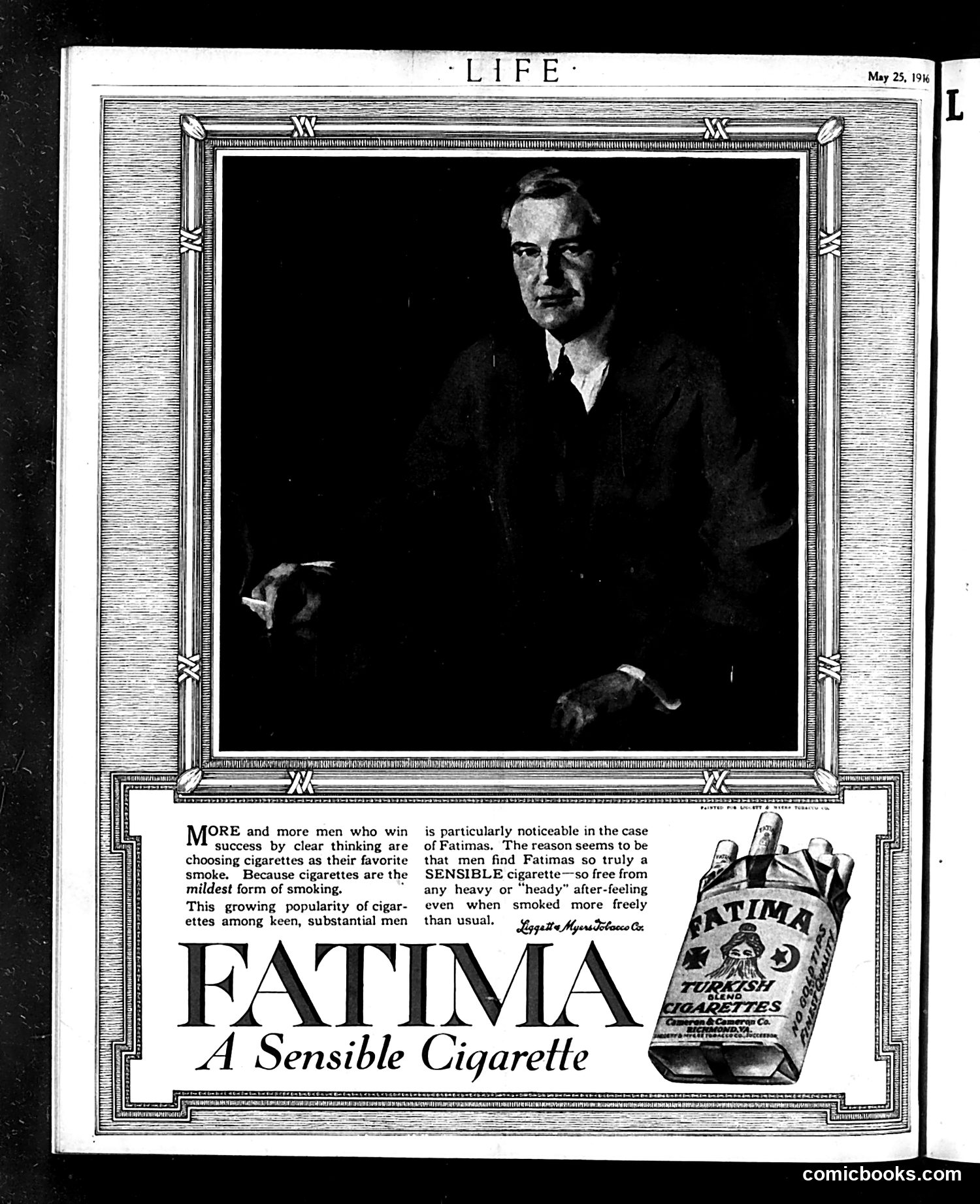
This is a **cigarette advertisement**, not satire. The page features a formal portrait photograph of an unidentified man in business attire, presented as evidence that successful, intelligent men prefer Fatima cigarettes. The ad's central claim—that cigarettes are "the mildest form of smoking" and that Fatimas are "sensible" because they lack "heavy or 'heady' after-feeling"—represents early 20th-century marketing tactics that exploited the then-widespread belief that cigarettes were safer than other tobacco products. For modern readers, this starkly illustrates how tobacco companies once marketed cigarettes as health-conscious choices for serious professionals, a claim now recognized as deliberately deceptive.