
Life, 1916-05-25 · page 19 of 40
Life — May 25, 1916 — page 19: what you’re looking at
What you’re looking at
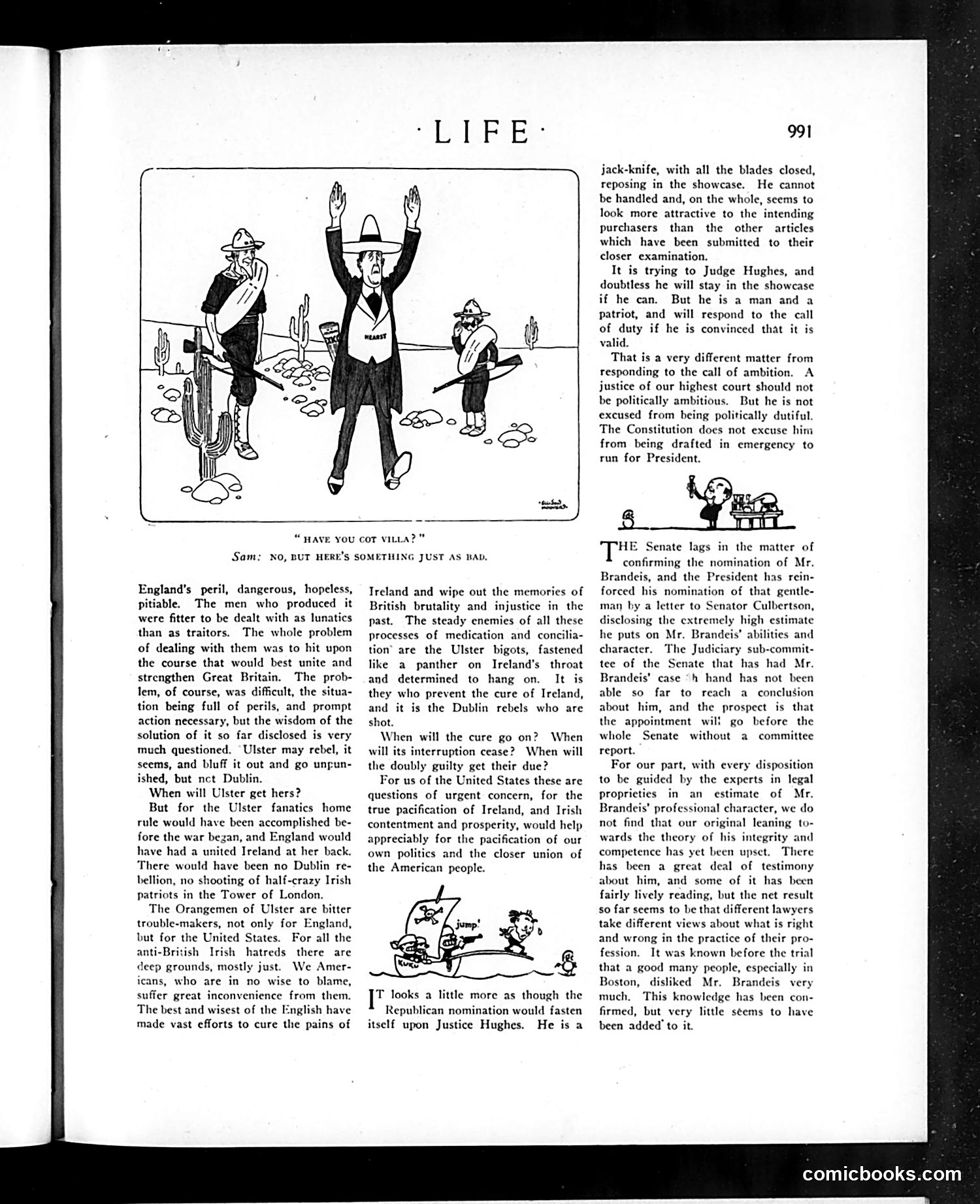
## The Main Cartoon The top cartoon depicts three armed Western figures in a desert with cacti, captioned "Have you got Villa?" Sam replies, "No, but here's something just as bad." This satirizes **Pancho Villa**, the Mexican revolutionary general. During this era (appears to be WWI period), Villa was a notorious figure in American politics—his raids into U.S. territory made him a symbol of Mexican instability and American military concerns. ## The Text Commentary The page discusses two major political issues: 1. **Irish Independence**: The article criticizes Ulster Protestants for obstructing Irish home rule, while Dublin rebels (likely referencing the 1916 Easter Rising) face execution. It argues this double standard undermines Irish-American relations. 2. **U.S. Politics**: It discusses Supreme Court Justice Hughes potentially becoming the Republican presidential nominee—using metaphors suggesting he's an attractive but untested "product." It also mentions pending confirmation of Justice **Brandeis**, whose appointment faced considerable controversy. The cartoon and text together reflect pre-WWI American anxieties about international instability and domestic political uncertainty.
📄 Transcribed text from this page (OCR, searchable)
Machine-transcribed from the original scan — historical spelling and the odd misread are preserved.
“HAVE Sam: England’s peril, dangerous, hopeless, pitiable. The men who produced it were fitter to be dealt with as lunatics than as traitors. The whole problem of dealing with them was to hit upon the course that would best unite and strengthen Great Britain. The prob- lem, of course, was difficult, the situa- tion being full of perils, and prompt action necessary, but the wisdom of the solution of it so far disclosed is very much questioned. Ulster may rebel, it seems, and bluff it out and go unpun- ished, but nct Dublin. When will Ulster get hers? But for the Ulster fanatics home rule would have been accomplished be- fore the war began, and England would have had a united Ireland at her back. There would have been no Dublin re- bellion, no shooting of half-crazy Irish patriots in the Tower of London. The Orangemen of Ulster are bitter trouble-makers, not only for England, but for the United States. For all the anti-British Irish hatreds there are deep grounds, mostly just. We Amer- icans, who are in no wise to blame, suffer great inconvenience from them. The best and wisest of the English have made vast efforts to cure the pains of NO, BUT HERE'S SOMETHIN YOU COT VILLA?" G JUST AS BAD, Ireland and wipe out the memories of British brutality and injustice in the past. The steady enemies of all these processes of medication and concilia- tion’ are the Ulster bigots, fastened like a panther on Ireland's throat and determined to hang on. It is they who prevent the cure of Ireland, and it is the Dublin rebels who are shot. When will the cure go on? When will its interruption cease? When will the doubly guilty get their due? For us of the United States these are questions of urgent concern, for the true pacification of Ireland, and Irish contentment and prosperity, would help appreciably for the pacification of our own politics and the closer union of the American people. " looks a little more as though the Republican nomination would fasten itself upon Justice Hughes. He is a 991 jack-knife, with all the blades closed, reposing in the showcase. He cannot be handled and, on the whole, seems to look more attractive to the intending purchasers than the other articles which have been submitted to their closer examination. It is trying to Judge Hughes, and doubtless he will stay in the showcase if he can. But he is a man and a patriot, and will respond to the call of duty if he is convinced that it is valid. That is a very different matter from responding to the call of ambition. A justice of our highest court should not be politically ambitious. But he is not excused from being politically dutiful. The Constitution does not excuse him from being drafted in emergency to run for President. HE Senate lags in the matter of confirming the nomination of Mr. Brandeis, and the President has rein- forced his nomination of that gentle- man by a letter to Senator Culbertson, disclosing the extremely high estimate he puts on Mr. Brand abilities and character. The Judiciary sub-commit- tee of the Senate that has had Mr. Brandeis’ case “h hand has not been able so far to reach a conclusion about him, and the prospect is that the appointment wil! go before the whole Senate without a committee report. For our part, with every disposition to be guided by the experts in legal i in an estimate of Mr. professional character, we do not find that our original leaning to- wards the theory of his integrity and competence has yet been upset. There has been a great deal of testimony about him, and some of it has been fairly lively reading, but the net result so far seems to be that different lawyers take different views about what is right and wrong in the practice of their pro- fession. It was known before the trial that a good many people, especially in Boston, disliked Mr. Brandeis very much. This knowledge has been con- firmed, but very little stems to have been added’ to it. comicbooks.com