
Life, 1916-05-25 · page 27 of 40
Life — May 25, 1916 — page 27: what you’re looking at
What you’re looking at
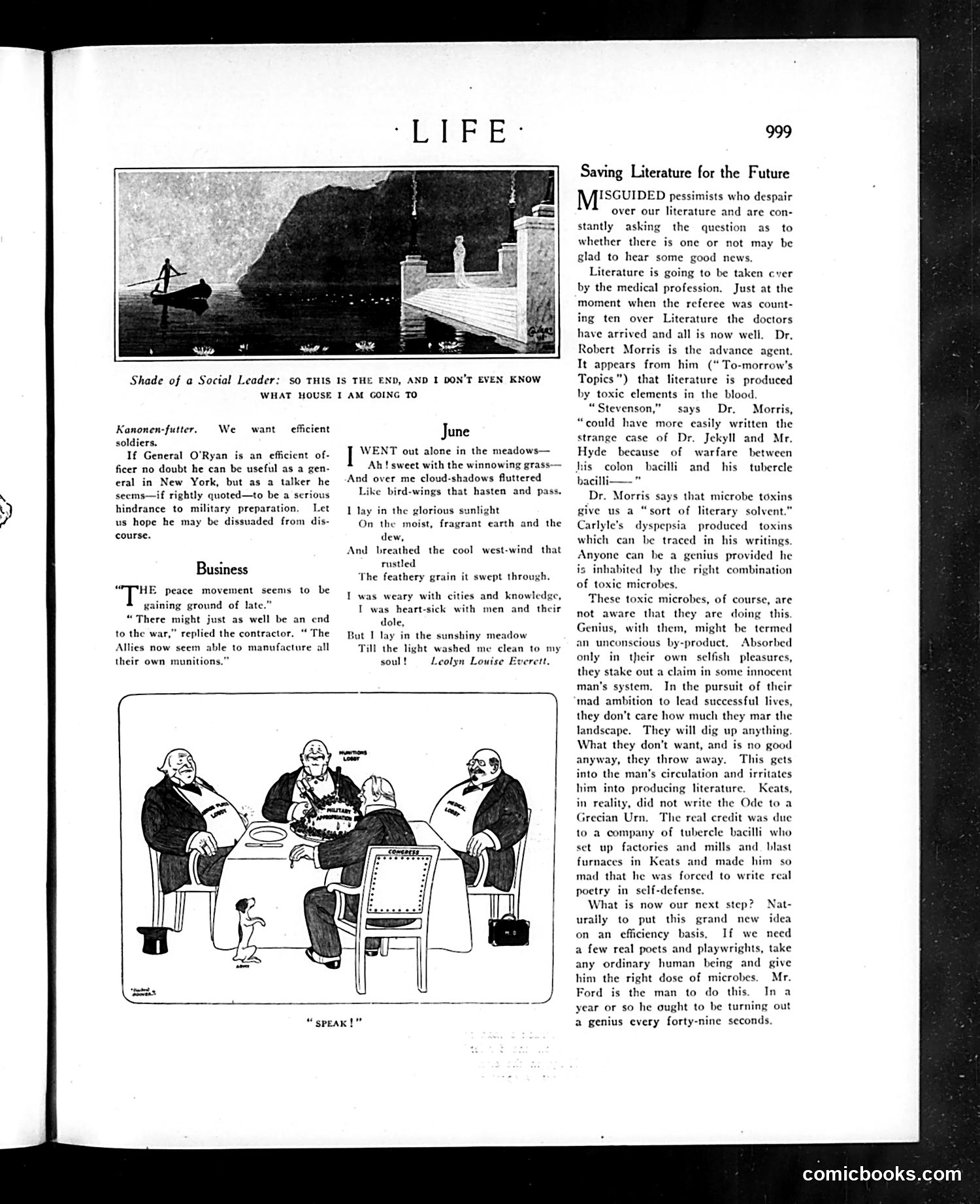
This page contains three satirical pieces mocking early 20th-century concerns: **"Shade of a Social Leader"** critiques General O'Ryan (appears to be a military figure), suggesting his public speaking undermines military preparation—a jab at ineffective military leadership during the WWI era. **"Business" cartoon** depicts a contractor dismissing peace efforts because the war is profitable for munitions manufacturing. The satire exposes how business interests profit from prolonged conflict. **"Saving Literature for the Future"** mocks pseudo-scientific medical theories claiming great literature results from toxic microbes in writers' blood (citing Stevenson, Carlyle, Keats as examples). The piece absurdly suggests mass-producing genius by infecting ordinary people with microbes—a dig at both dubious medical theories and industrial efficiency obsessions. The final jab at Henry Ford implies manufacturing genius like factory products, satirizing era obsessions with mechanization and "scientific" approaches to human creativity.
📄 Transcribed text from this page (OCR, searchable)
Machine-transcribed from the original scan — historical spelling and the odd misread are preserved.
Shade of a Social Leader: so tH1s WHAT HOUSE Kanonen-futter. We want efficient soldiers. If General O'Ryan is an efficient of- ficer no doubt he can be useful as a gen- eral in New York, but as a talker he secms—if rightly quoted—to be a serious hindrance to military preparation. Let us hope he may be dissuaded from dis- course. Business “THE peace movement seems to be gaining ground of late. “There might just as well be an end to the war,” replied the contractor. “ The Allies now seem able to manufacture all their own munitions.” 1s THE END, AND I DON’T EVEN KNOW I AM GOING TO June WENT out alone in the meadows— Ah ! sweet with the winnowing grass- And over me cloud-shadows fluttered Like bird-wings that hasten and pass. 1 lay in the glorious sunlight On the moist, fragrant earth and the dew, breathed rustled And the cool west-wind that pt through. I was weary with cities and knowledg I was heart-sick with men and their dole, at I lay in the sunshiny meadow Till the light washed me clean to my soul! — Leolyn Louise Everett. “ speak!" 999 Saving Literature for the Future MISGUIDED pessimists who despair over our literature and are con- stantly asking the whether there is one or not may be glad to hear some good news, Literature is going to be taken cver by the medical profession. Just at the moment when the referee was count- ing ten over Literature the doctors have arrived and all is now well. Dr. Robert Morris is the advance agent. It appears from him (“ To-morrow's Topics”) that literature is produced by toxic elements in the blood. Stevenson,” says Dr. Morris, “could have more easily written the strange case of Dr. Jekyll and Mr. Hyde because of warfare between s colon bacilli and his tubercle bacillim— Dr. Morris says that microbe toxins give us a “sort of literary solvent.” Carlyle’s dyspepsia produced toxins which can be traced in his writings. Anyone can be a genius provided he is inhabited hy the right combination of toxic microbes. These toxic microbes, of course, are not aware that they are doing this. Genius, with them, might be termed an unconscious by-product, Absorbed only in their own. selfish pleasures, they stake out a claim in some innocent man's system. In the pursuit of their mad ambition to lead successful lives, they don’t care how much they mar the landscape. They will dig up anything What they don’t want, and is no good anyway, they throw away. This gets into the man’s circulation and irritates him into producing literature. Keats, in reality, did not write the Ode to a Grecian Urn, The real credit was due to a company of tubercle bacilli who set up factories and mills and. blast furnaces in Keats and made him so mad that he was forced to write real poetry in self-defense. What is now our next step? urally to put this grand new idea on an efficiency basis, If we need a few real poets and playwrights, take any ordinary human being and give him the right dose of microbes. Mr. Ford is the man to do this. In a year or so he ought to be turning out a genius every forty-nine seconds. question as to Nat- comicbooks.com