
Life, 1916-05-25 · page 22 of 40
Life — May 25, 1916 — page 22: what you’re looking at
What you’re looking at
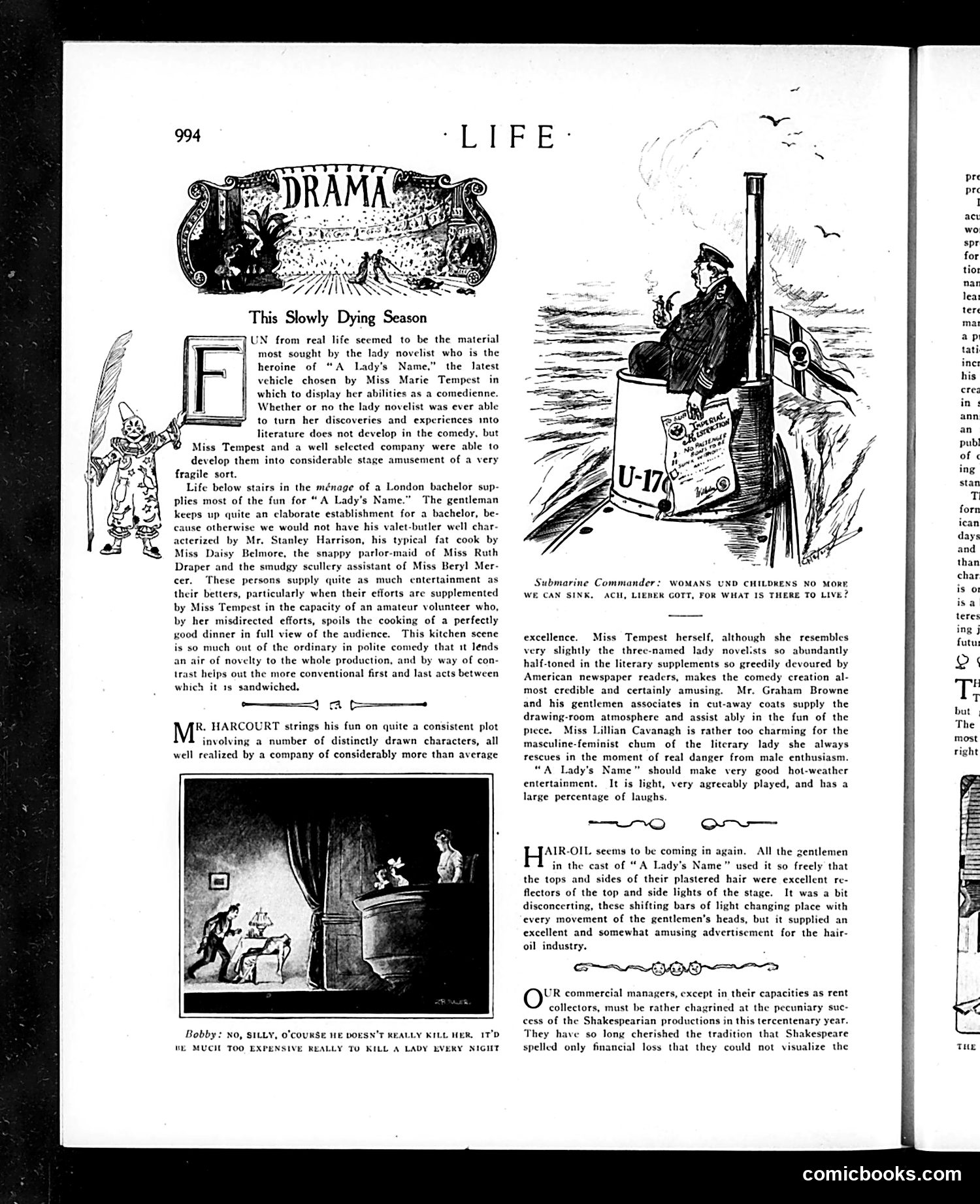
This is a theater review page from Life magazine critiquing the play "A Lady's Name," starring Marie Tempest. The page includes two cartoons satirizing aspects of the production and contemporary life. **The main cartoon** (bottom left) shows a domestic scene where "Bobby" reassures someone that the male character doesn't actually kill the female lead nightly—it would be "too expensive." This satirizes the play's plot involving attempted murder, poking fun at both the melodramatic storyline and the economic absurdity of repeating such an expensive action. **The submarine cartoon** (right) depicts a German U-boat commander expressing despair that there's nothing left worth living for—"womans und childrens no more we can sink." This references WWI submarine warfare and German U-boat attacks on civilian vessels, using dark humor to satirize German military mentality and the brutality of modern warfare. The text reviews the play as light summer entertainment featuring an elaborate household staff and a novelist character, praising the cast while noting the excessive use of hair-oil by male actors.
📄 Transcribed text from this page (OCR, searchable)
Machine-transcribed from the original scan — historical spelling and the odd misread are preserved.
This Slowly Dying Season UN from real life seemed to be the material most sought by the lady novelist who is the heroine of “A Lady's Name,” the latest vehicle chosen by Miss Marie Tempest in which to display her abilities as a comedienne. Whether or no the lady novelist was ever able to turn her discoveries and experiences into literature does not develop in the comedy, but Miss Tempest and a well selected company were able to develop them into considerable stage amusement of a very fragile sort. Life below stairs in the ménage of a London bachelor sup- plies most of the fun for “A Lady's Name.” The gentleman Keeps up quite an claborate establishment for a bachelor, be- cause otherwise we would not have his valet-butler well char- acterized by Mr. Stanley Harrison, his typical fat cook by Miss Daisy Belmore, the snappy parlor-maid of Miss Ruth Draper and the smudgy scullery assistant of Miss Beryl Mer- cer. These persons supply quite as much entertainment as their betters, particularly when their efforts are supplemented by Miss Tempest in the capacity of an amateur volunteer who, by her misdirected efforts, spoils the cooking of a perfectly good dinner in full view of the audience. This kitchen scene is so much out of the ordinary in polite comedy that it lends an air of novelty to the whole production, and by way of con- trast helps out the more conventional first and last acts between which it 18 sandwiched. —_ a R. HARCOURT strings his fun on quite a consistent plot involving a number of distinctly drawn characters, all well realized by a company of considerably more than average L Bobby: No, SILLY, O'COURSE 11E DOESN'T REALLY KILL MER, IT'D WE MUCH TOO EXPENSIVE REALLY TO KILL A LADY EVERY NIGIIT Submarine Commander: WOMANS UND CHILDRENS NO MOR! WE CAN SINK, ACH, LIEMER GOTT, FOR WHAT IS THERE TO LIVE? excellence. Miss Tempest herself, although she resembles very slightly the three-named lady novelists so abundantly half-toned in the literary supplements so greedily devoured by American newspaper readers, makes the comedy creation al- most credible and certainly amusing. Mr. Graham Browne and his gentlemen associates in cut-away coats supply the drawing-room atmosphere and assist ably in the fun of the piece. Miss Lillian Cavanagh is rather too charming for the masculine-feminist chum of the literary lady she always rescues in the moment of real danger from male enthusiasm. “A Lady's Name” should make very good hot-weather entertainment. It is light, very agreeably played, and has a large percentage of laughs. ——O OO AIR-OIL seems to be coming in again. All the gentlemen in the cast of “A Lady's Name” used it so freely that the tops and sides of their plastered hair were excellent re- flectors of the top and side lights of the stage. It was a bit disconcerting, these shifting bars of light changing place with every movement of the gentlemen’s heads, but it supplied an excellent and somewhat amusing advertisement for the hair- oil industry. UR commercial managers, except in their capacities as rent collectors, must be rather chagrined at the pecuniary suc- cess of the Shakespearian productions in this tercentenary year. They have so long cherished the tradition that Shakespeare spelled only financial loss that they could not visualize the comicbooks.com