
Life, 1916-05-25 · page 23 of 40
Life — May 25, 1916 — page 23: what you’re looking at
What you’re looking at
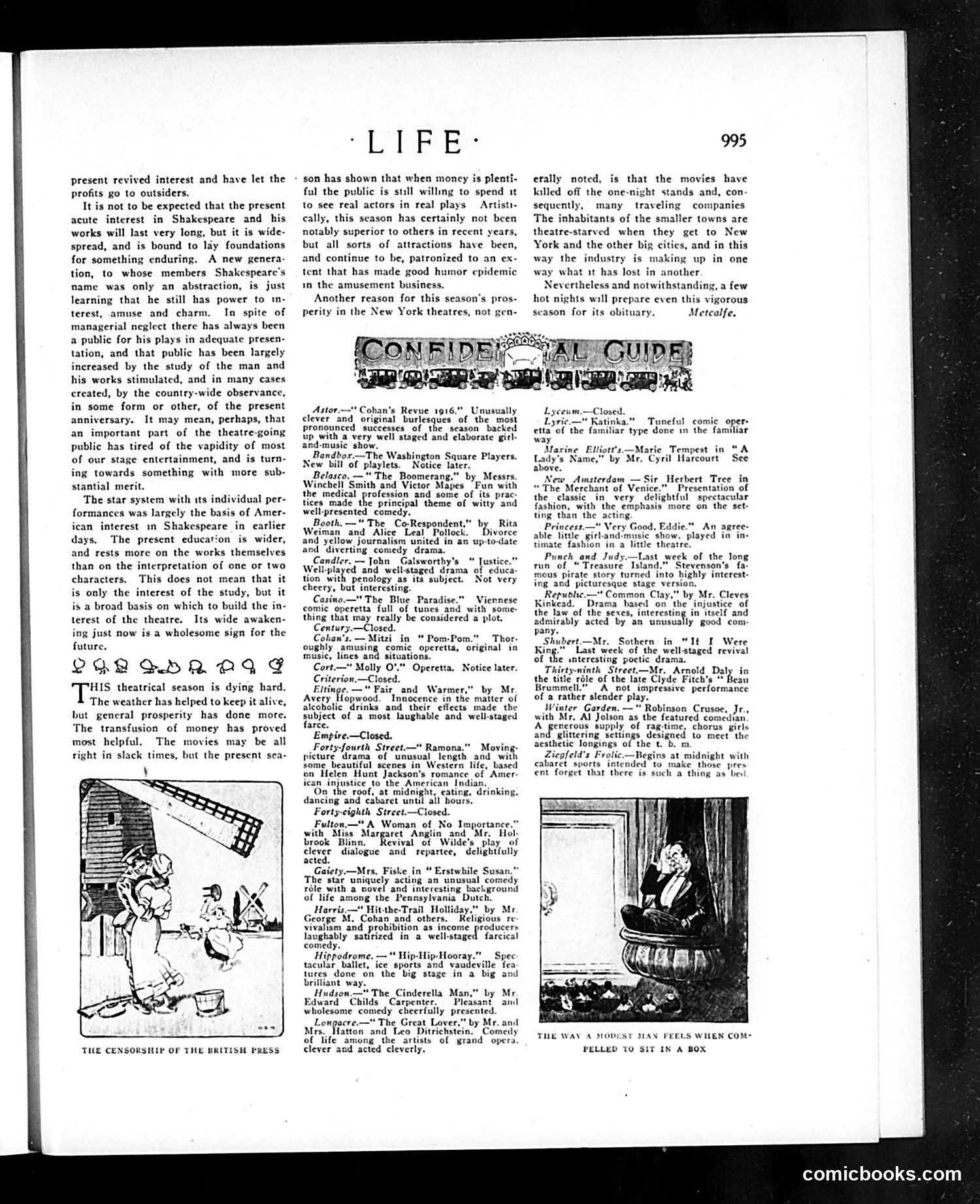
This political cartoon depicts British press censorship during World War I. The image shows a figure operating what appears to be a printing press or censorship apparatus, with content being controlled or suppressed—symbolized by mechanical constraint. The surrounding text discusses Broadway's 1916 theatrical season, noting its financial success despite artistic mediocrity. Life magazine argues that money—not artistic merit—drives entertainment consumption. The juxtaposition is ironic: while discussing American theatrical freedom and audience choice, the magazine runs a cartoon condemning British wartime censorship. The cartoon critiques Britain's suppression of news and information flow during the war, contrasting with America's relatively open press. This reflects Life's position as a publication defending free speech and editorial independence against government control—a significant concern during WWI's propaganda wars.
📄 Transcribed text from this page (OCR, searchable)
Machine-transcribed from the original scan — historical spelling and the odd misread are preserved.
present revived interest and have let the profits go to outsiders. It is not to be expected that the present acute interest in Shakespeare and his works will last very long, but it is wide- spread, and is bound to lay foundations for something enduring. A new genera- jon, to whose members Shakespeare's name was only an abstraction, is just learning that he still has power to in- terest, amuse and charm. In spite of managerial neglect there has always been a public for his plays in adequate presen- tation, and that public has been largely increased by the study of the man and his works stimulated, and in many cases created, by the country-wide observance, in some form or other, of the present anniversary. It may mean, perhaps, that an important part of the theatre-going public has tired of the vapidity of most of our stage entertainment, and is turn- ing towards something with more sub- stantial merit. The star system with its individual per- formances was largely the basis of Amer- ican interest in Shakespeare in earlier days. The present education is wider, and rests more on the works themselves than on the interpretation of one or two characters. This does not mean that it is only the interest of the study, but it is a broad basis on which to build the in- terest of the theatre. Its wide awaken- ing just now is a wholesome sign for the future, PGR AbRAAG HIS theatrical season is dying hard. The weather has helped to keep it alive, but general prosperity has done more. The transfusion of money has proved most helpful. The movies may be all right in slack times, but the present sea- TUE CENSORSHIP OF THE BRITISH PRESS ao be + son has shown that when money is plenti- ful the public is still willing to spend it to see real actors in real plays Artisti- cally, this season has certainly not been notably superior to others in recent years, but all sorts of attractions have been, and continue to be, patronized to an ex- tent that has made good humor epidemic in the amusement business. Another reason for this season's pros- perity in the New York theatres, not gen- Astor — Cohan’s Revue 1916." Unusually clever and original burlesques of the most pronounced successes of the season backed up with a very well staged and elaborate girl- and-music show. . Bandbor.—The Washington Square Players. New bill of playlets. Notice later. Belasco. —" The Boomerang,” by Messrs. Winchell Smith and Victor Mapes Fun with the medical profession and some of its prac: tices made the principal theme of witty and well-presented comedy. Booth. —" The Co-Respondent." by. Rita Weiman and Alice Pollock. Divorce and yellow journalism united in an up-to-date and diverting comedy drama. Candler. — John Galsworthy’s " Justice.” Weltplayed and well-staged drama of educa- tion with penology as its subject. Not very cheery, but interesting. Casino.— The Blue Paradise.” Viennese comic operetta full of tunes and some- thing that may really be considered a plot. Century.—Closed Cohan’s. — Mit “Pom-Pom.” Thor- oughly amusing comic operetta, original in music, lines and situations. Cort.—" Molly O°." Operetta. Notice later. Criterion, —Closed. Eltinge. —" Fair and Warmer,” by Mr Avery Hopwood. Innocence in the matter of alcoholic drinks and their effects made the subject of a most laughable and well-staged farce. Empire—Closed. _Forty-fourth Street.—" Ramona.” Moving- picture drama ‘of unusual length and with some beautiful scenes in Western life, based on Helen Hunt Jackson’s romance of Amer- ican injustice to the American Indian. On the roof, at midnight, eating, drinking, dancing and cabaret until all hours. Forty-eighth Street—Closed. Fulton.— A Woman of No Importance, with Miss Margaret Anglin and Mr. Hol- brook Blinn, Revival of Wilde's play of clever dialogue and repartee, delightfully acted. Gaiety.—Mrs, Fiske in “ Erstwhile Susan.” The star uniquely acting an unusual comedy réle with a novel and interesting background of life among the Pennsylvania Dutch. Harris.—" Hit-the-Trail Holliday,” by Mr George M. Cohan and others. Religious rc vivalism and prohibition as income producers laughably satirized in a well-staged farcical comedy. Hippodrome. —* Wip-Hip-Hooray.”" Spec tacular ballet, ice sports and vaudeville fea tures done on the big stage in a big and brilliant way Hudson.—" The Cinderella Man,” by Mr Edward Childs Carpenter. Pleasant and wholesome comedy cheerfully presented. Longacre.—" The Great Lover,” by Mr. and Mrs. Hatton and Leo Ditrichstein. Comedy of life among the artists of grand opera, clever and acted cleverly. 995 erally noted, is that the movies have killed off the one-night stands and, con- sequently, many traveling companies The inhabitants of the smaller towns are theatre-starved when they get to New York and the other big cities, and in this way the industry is making up in one y what it has lost in another Nevertheless and notwithstanding, a few hot nights will prepare even this vigorous season for its obituary. Metcalfe. ‘GUIDE Lyceum.—Closed. Lyric.—" Katinka.” Tuneful comic oper+ etta of the familiar type done in the familiar way Marine Lady's Name above. iott's.—Marie Tempest in “A by Mr. Cyril Harcourt See » Amsterdam —Sir Herbert Tree in “The Merchant of Venice.” Presentation of the classic in. very delightful spectacular fashion, with the emphasis more on the set: ting than the acting. Princess.— Very Good, Eddie.” An agree: able little. girl-and-music ‘show, played in in- timate fashion in a little theatre. Punch and Judy.—Last week of the long run of “Treasure Island,” Stevenson's { mous pirate story turned into highly interes ing and picturesque stage version, Repuolic.—* Common Clay,” by Mr, Cleves Kinkead. “Drama based on ‘the injustice of the law of the sexes, interesting in itself and admirably acted by an unusually good com- pany. Shubert—Mr. Sothern in “It I Were King.” Last week of the well-staged revival of the anteresting poctic drama. Thirty-ninth Street—Mr. Arnold, Daly in the title role of the late Clyde Fitch's * eau Brummell.” A_ not impressive performance of a rather slender play. Winter Garden. —" Robinson Crusoe, Jr., with Mr. Al Jolson as the featured comedia A generous supply of rag:time, chorus girls and glittering settings designed to meet’ the aesthetic longings of the t. b. m. Zieofeld's Frolic.—Regins at midnight with cabaret sports intended to make those pres ent forget that there is such a thing as bed THE WAY 4 Moo PELLED TO SIT IN A BOX ST MAN FEELS WHEN CoM comicbooks.com