
A complete issue · 52 pages · 1915
Life — June 3, 1915
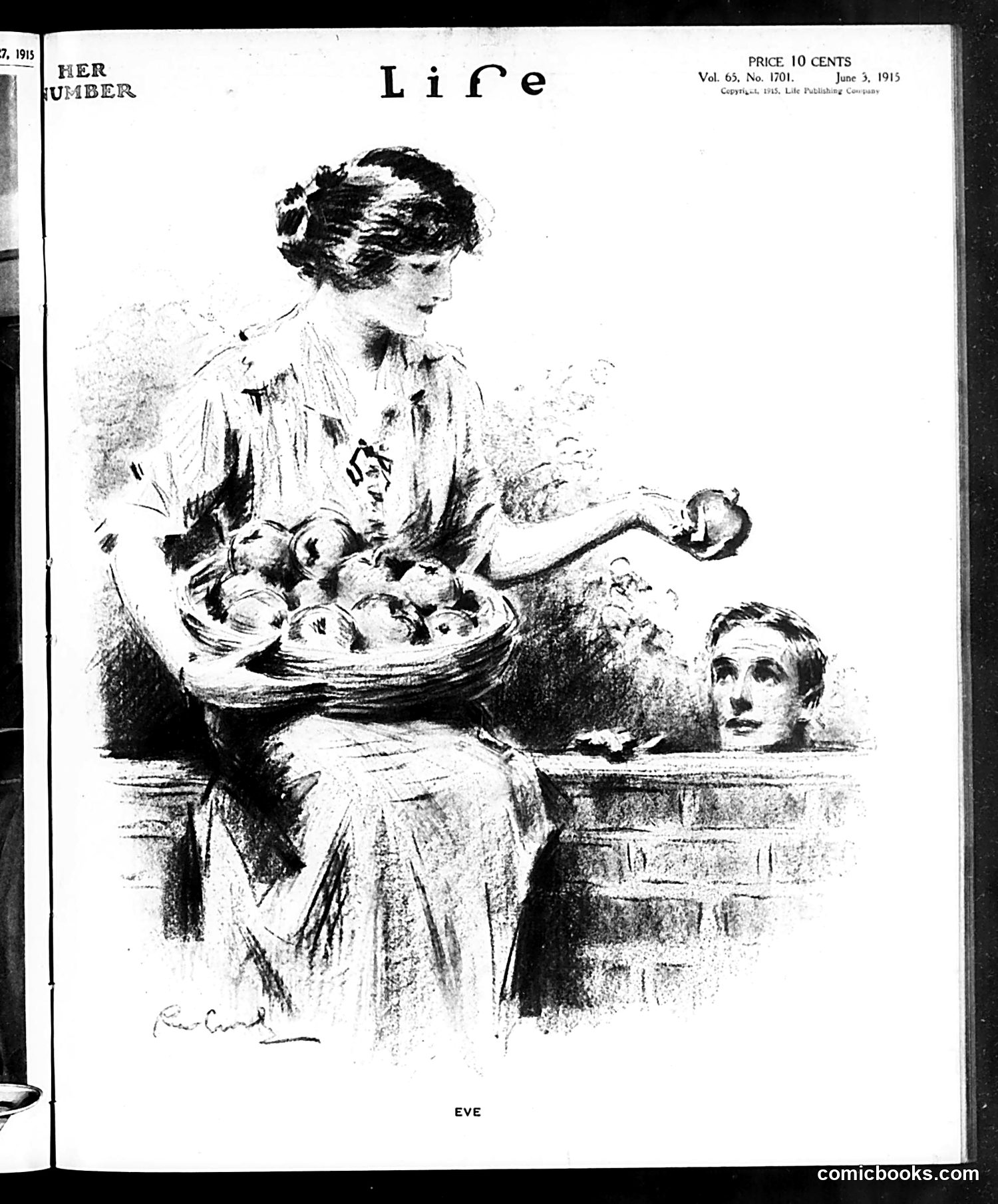
This cover illustration titled "EVE" depicts a woman holding a basket of apples while a man peers over a wall behind her. The composition references the Biblical story of Adam and Eve, specifically the moment before or after Eve offers the forbidden fruit. The satire likely comments on **temptation, seduction, or female influence**—common themes in early 20th-century satirical magazines. The man's expression suggests desire or covetousness. Without additional context from the magazine's interior, the specific social or political target remains unclear, though it may reference contemporary attitudes about women's roles, morality, or gender relations during this period. The artist's signature appears at lower left.
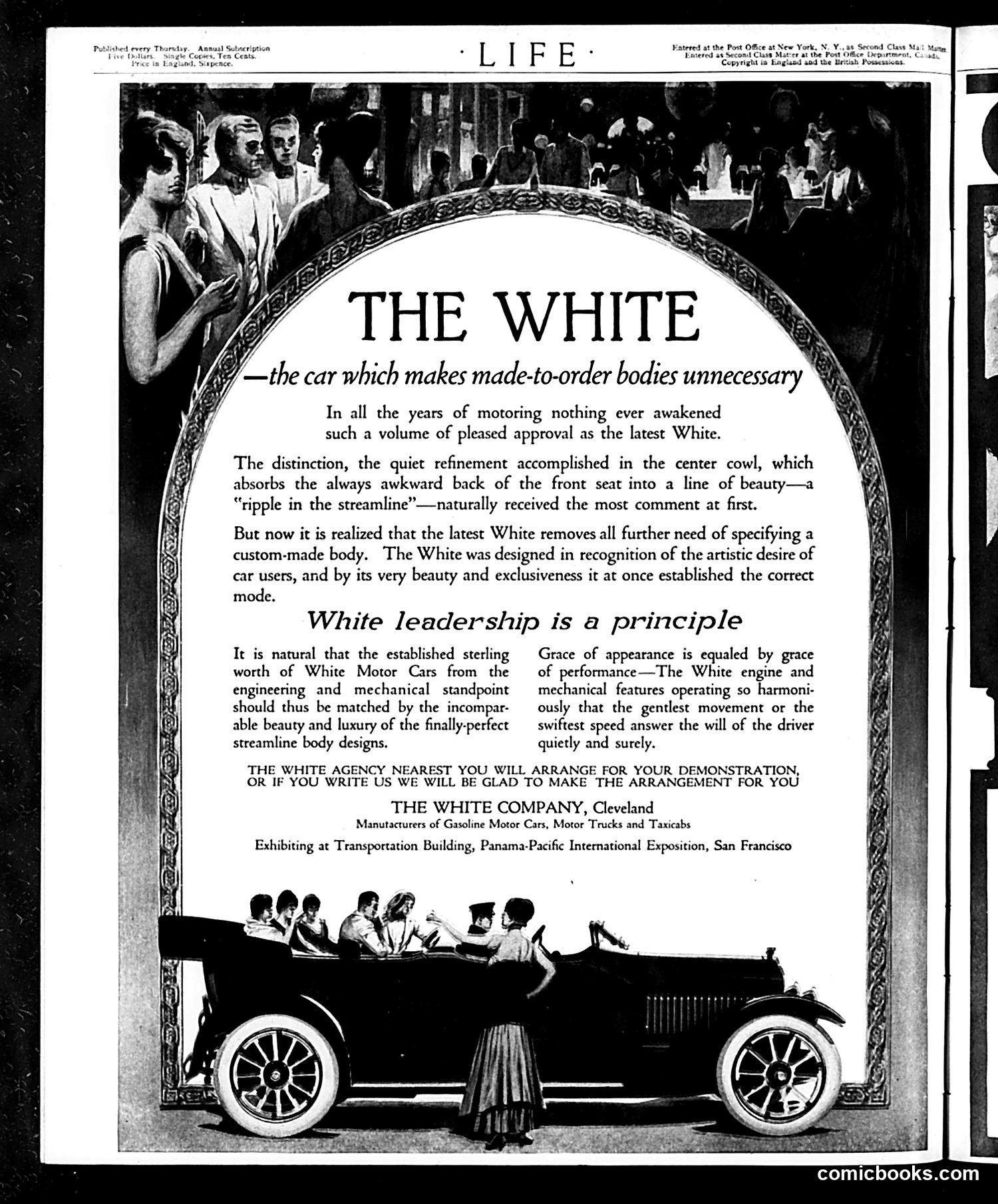
This is **not a political cartoon** but rather a **full-page advertisement** for the White Motor Company's "White" automobile, appearing in *Life* magazine. The ad promotes the White car as a luxury vehicle with refined design, particularly highlighting its "center cowl" design element described as a "ripple in the streamline." The advertisement emphasizes that the White's beauty and exclusivity make custom-ordered bodies unnecessary—essentially claiming the standard model achieves sufficient aesthetic perfection. The imagery shows well-dressed passengers enjoying the vehicle, appealing to aspirational consumers. The ad was placed during the Panama-Pacific International Exposition in San Francisco, suggesting upscale targeting. This represents early automotive advertising's focus on design, luxury, and status rather than mechanical specifications.
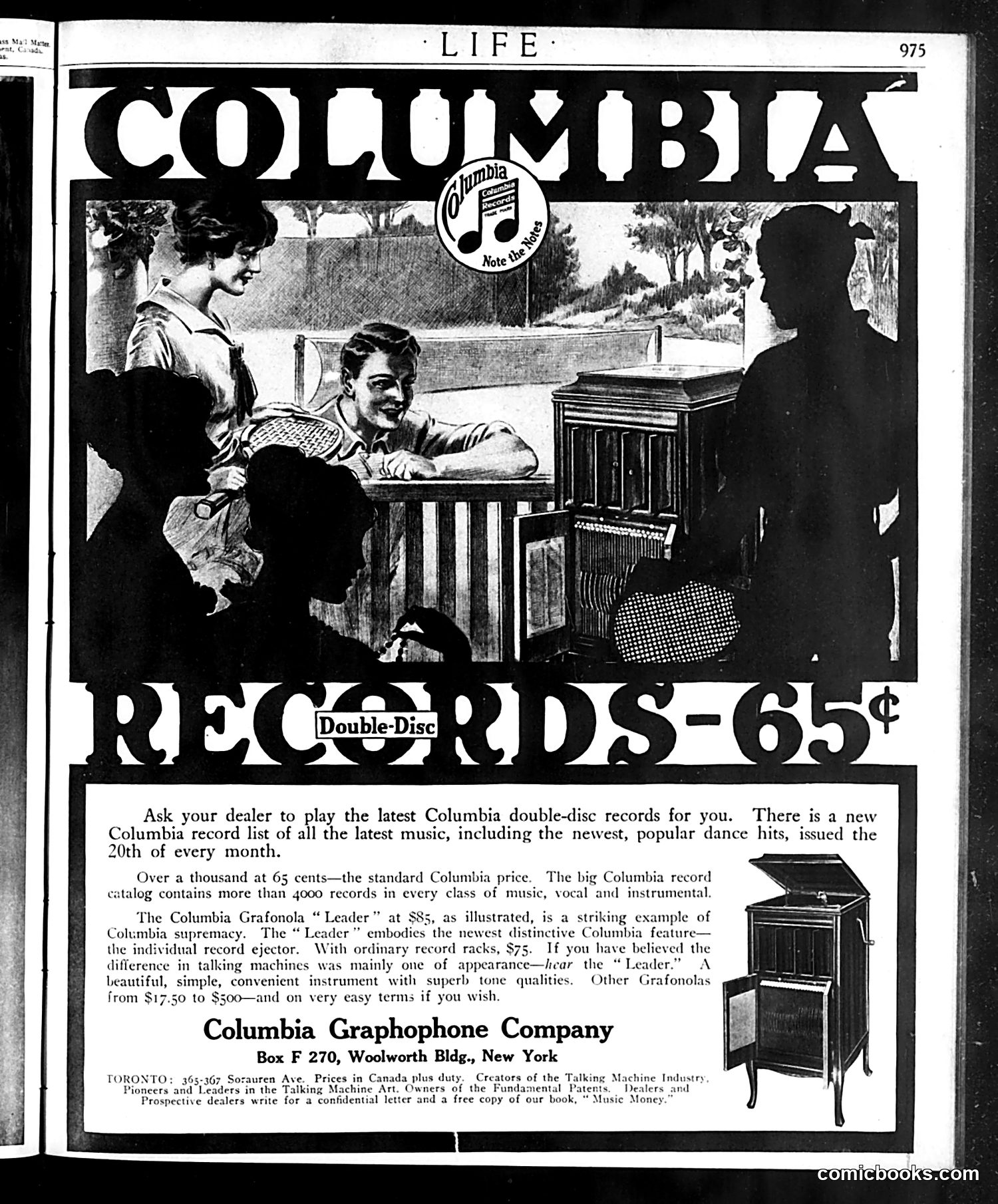
This page is primarily an **advertisement**, not a political cartoon. It advertises Columbia Records' double-disc records priced at 65 cents, promoting their new monthly catalog and the "Leader" Grafonola phonograph model. The illustration depicts a domestic scene: a man operates a phonograph while a woman holds a child and another figure listens. This represents the **target market—middle-class families enjoying home entertainment**. The ad emphasizes convenience and affordability ("over a thousand at 65 cents") and highlights the Grafonola's distinctive "individual record ejector" feature. The phonograph itself is pictured as a substantial furniture piece, reflecting early 20th-century status symbols. The Columbia Graphophone Company's Toronto address indicates this targeted both American and Canadian consumers.
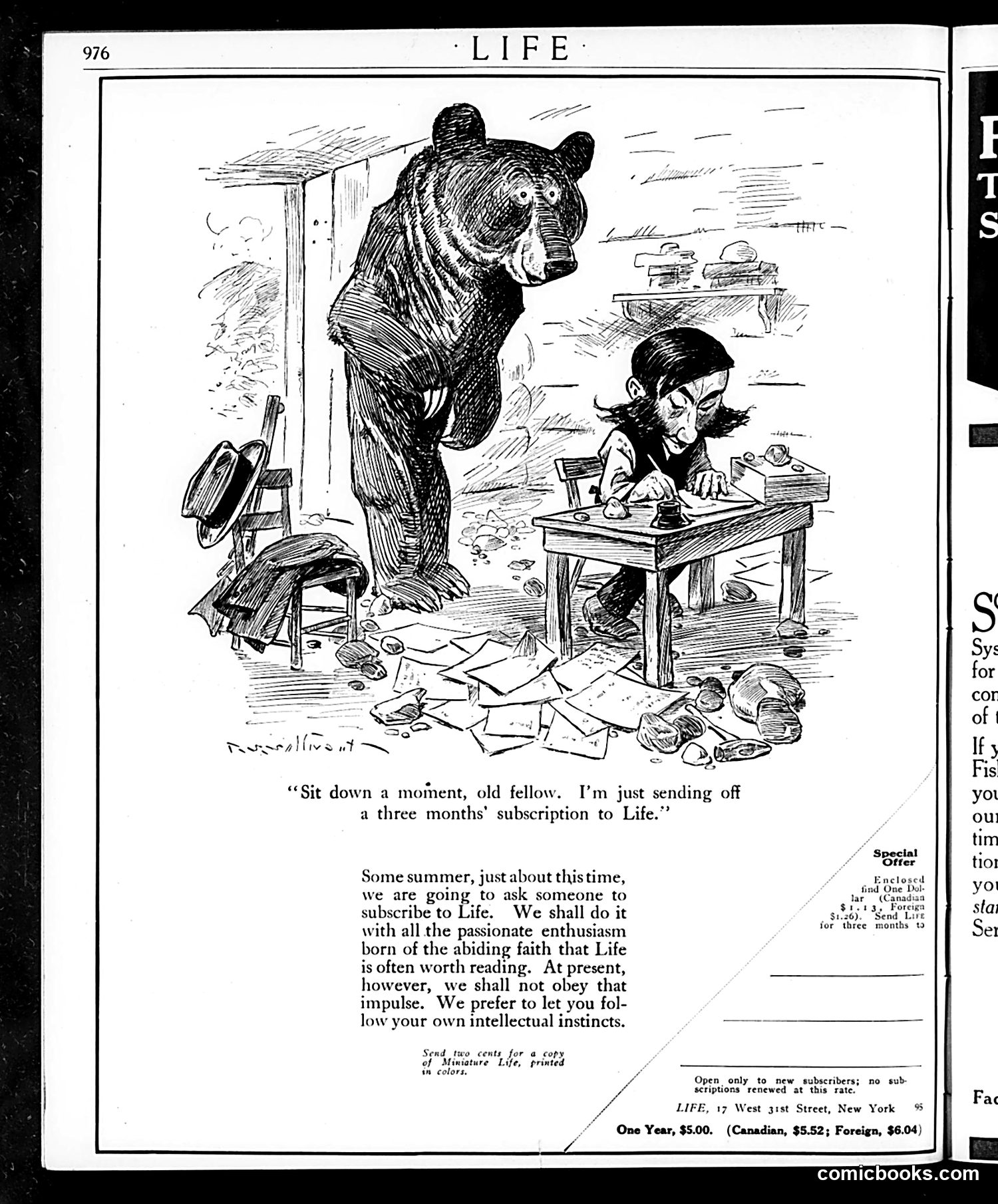
This page features a cartoon advertisement for Life magazine subscriptions. The main image shows a large bear looming over a small, worried figure at a desk surrounded by scattered papers and debris. The bear says, "Sit down a moment, old fellow. I'm just sending off a three months' subscription to Life." The cartoon likely uses the bear as a metaphor for financial hardship or economic pressure (bears were common symbols for market downturns). The satirical joke suggests that even during difficult times, one should invest in Life magazine as a valuable subscription. The accompanying text reinforces this, noting that while they'll eventually urge subscriptions enthusiastically, they currently "prefer to let you follow your own intellectual instincts." The advertisement emphasizes Life's worth as reading material worth prioritizing financially.
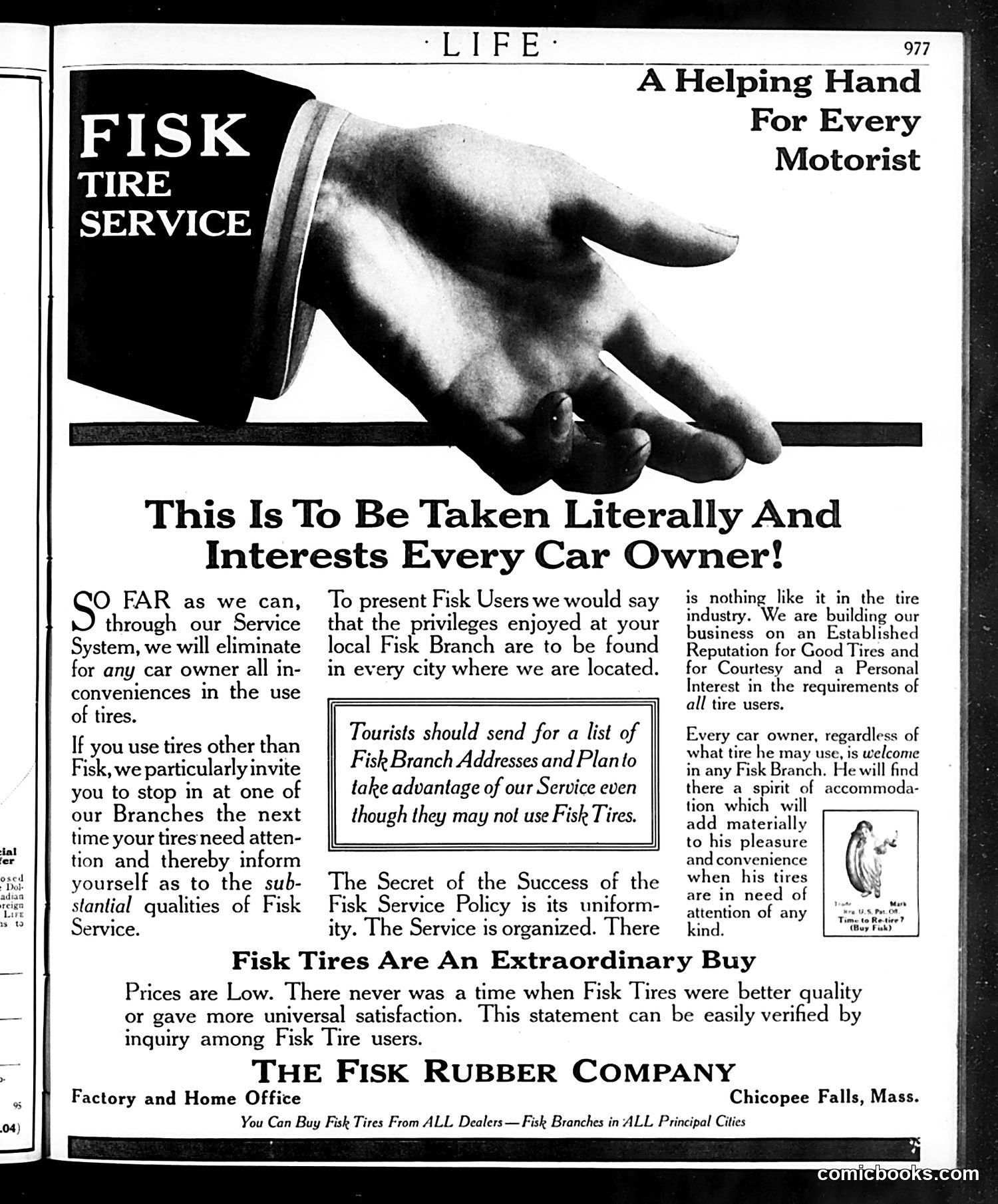
This page is primarily a **commercial advertisement**, not political satire. It promotes Fisk Tire Service and Fisk Rubber Company (based in Chicopee Falls, Massachusetts). The central image shows a **helping hand** extended to motorists—the company's service philosophy. The advertisement emphasizes that Fisk offers tire services and assistance to all car owners, regardless of tire brand used. The small illustration in the lower right appears to show Fisk's mascot or brand character—a figure that helped distinguish the company's advertising. The key sales pitch: Fisk provides uniform, organized service across multiple branches nationwide, with low prices and quality products. The text invites even non-Fisk tire users to visit branches to experience their service standards. This reflects early 20th-century automotive culture and tire industry competition.
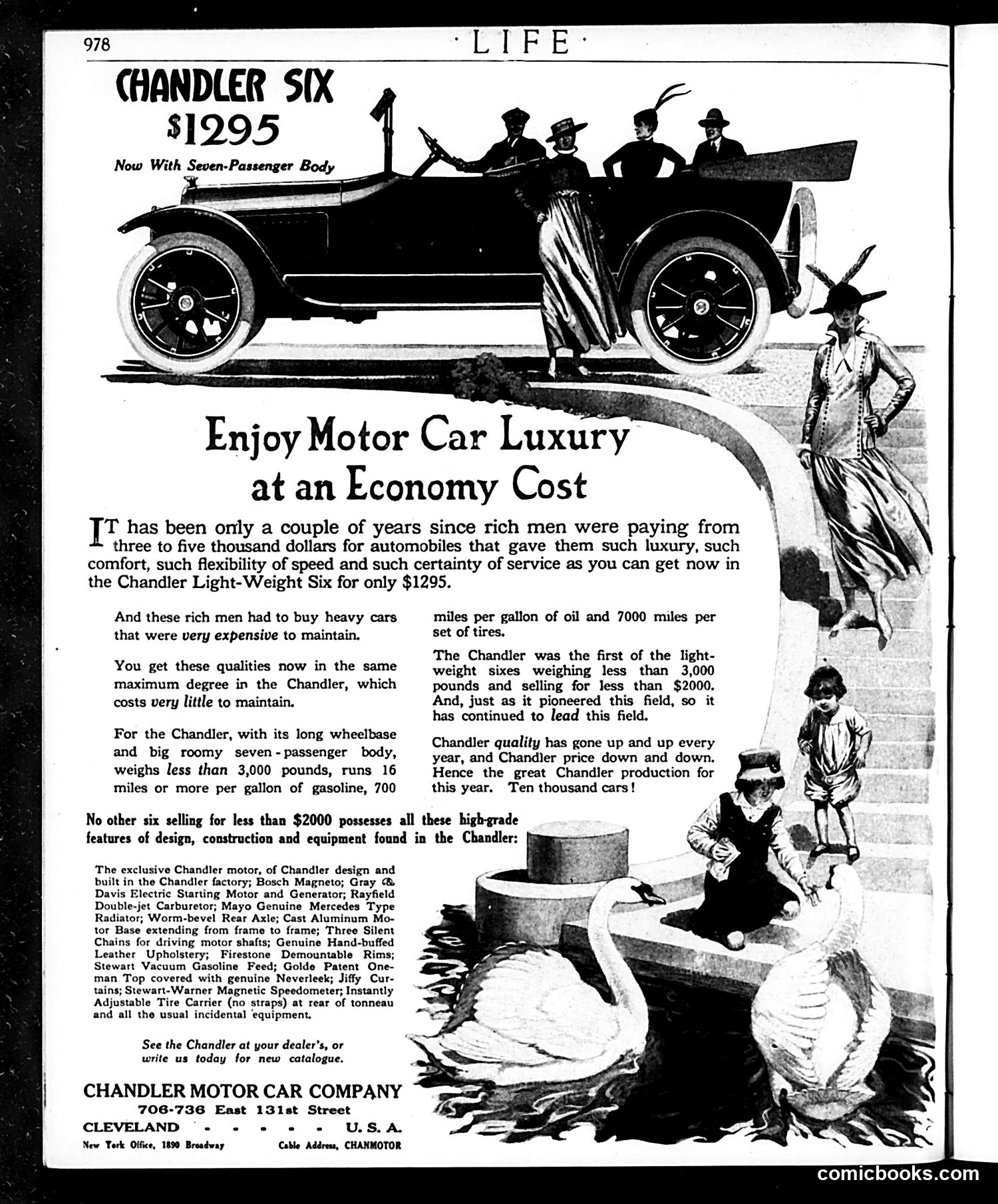
This is primarily a **Chandler Motor Car Company advertisement**, not satirical content. It appeared in Life magazine around the 1920s (based on styling and typography). The ad promotes the Chandler Six automobile at $1,295, emphasizing "luxury at economy cost." The illustrated figures—well-dressed men in the car and fashionably dressed women beside it—represent aspirational wealthy consumers. This reflects 1920s marketing strategy: depicting affluent lifestyles to appeal to middle-class buyers who could now afford automobiles. The ad's central claim—that a $1,295 car offers features previously available only in expensive luxury vehicles—reflects genuine automotive democratization of this era. The detailed technical specifications listed aim to establish credibility and quality despite the competitive price point.
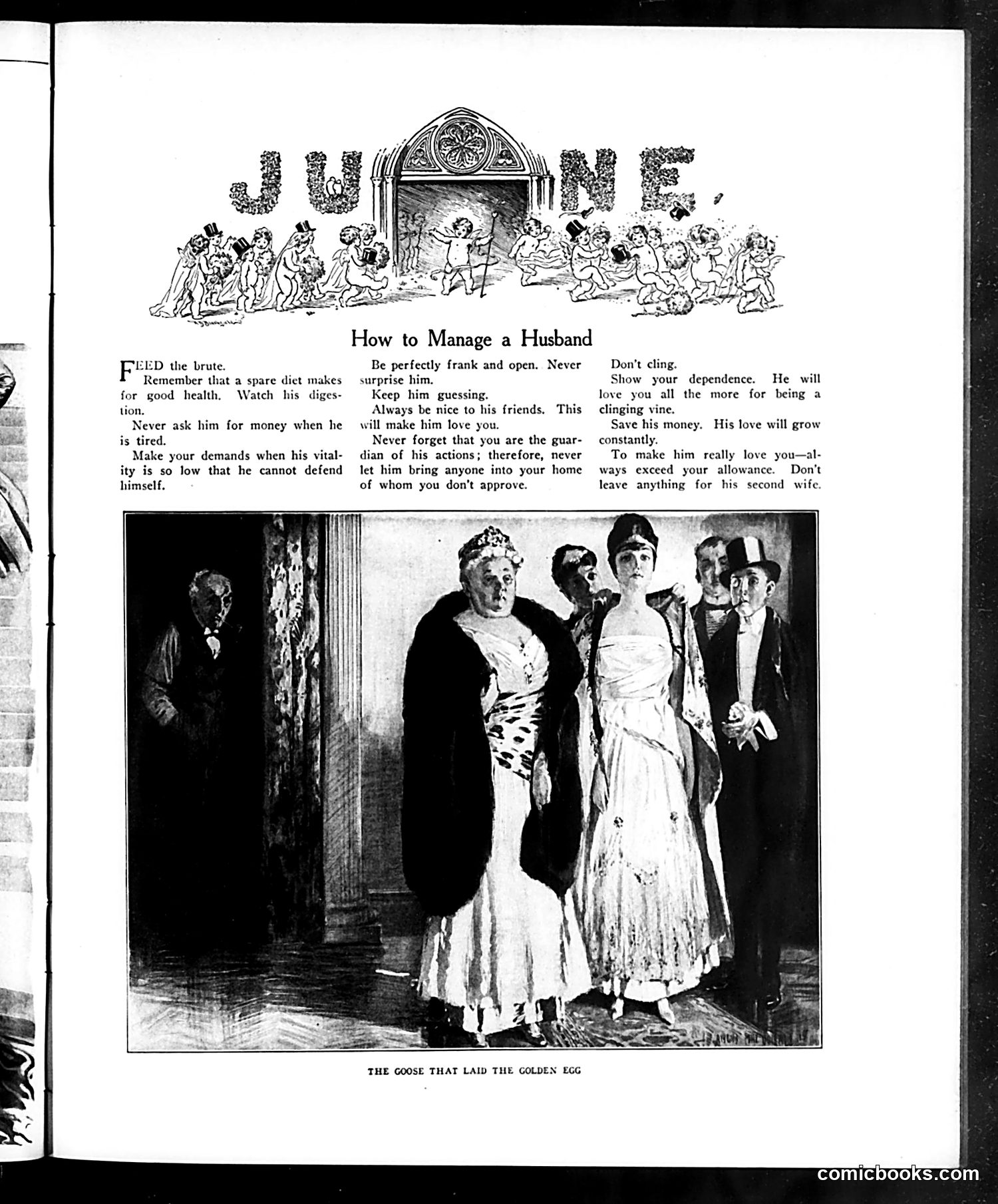
This page satirizes early 20th-century marital advice through ironic "tips" for wives. The text offers absurdly manipulative strategies: feed him poorly for "health," never ask for money, be dishonest ("perfectly frank and open"), suppress independence, and save money secretly. The final warning—"Don't leave anything for his second wife"—reveals the satire's dark edge. The photograph below, captioned "The Goose That Laid the Golden Egg," depicts a woman displayed among well-dressed men examining her like property, visualizing the economic transaction marriage represented. Together, the text and image mock both the period's controlling marital dynamics and the patronizing advice literature aimed at women, exposing how wives were expected to manipulate husbands while surrendering autonomy and rights.
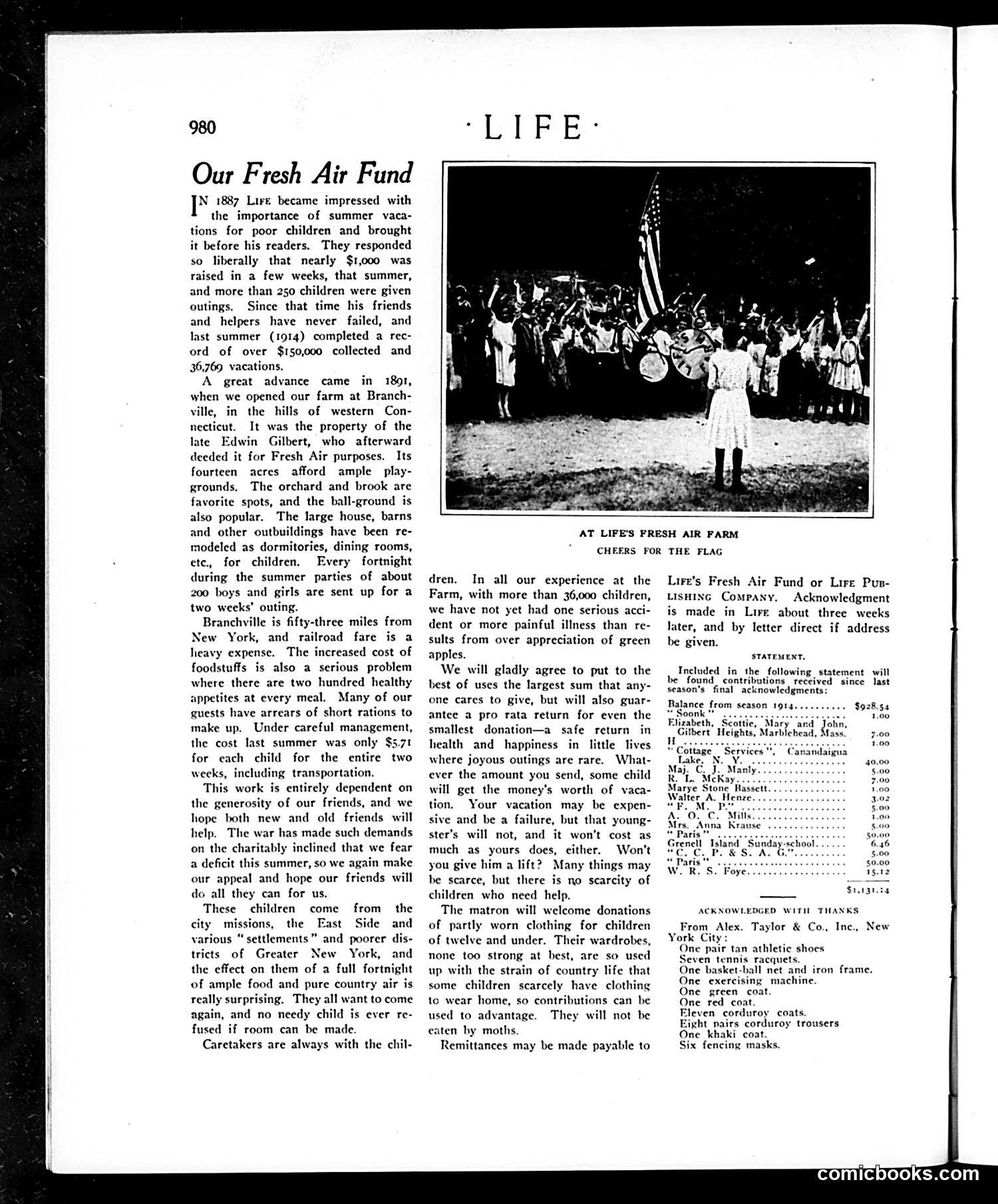
This page is **not a political cartoon** but rather a fundraising appeal and report for Life magazine's "Fresh Air Fund" — a charitable program providing summer vacations for poor urban children. The photograph shows a nighttime outdoor gathering at Life's Fresh Air Farm in Branchville, Connecticut, with children and adults celebrating around an American flag. The text describes the fund's history since 1887, its expansion to a farm property in 1891, and operational details. It emphasizes the program's safety record ("not yet had one serious accident") and solicits donations of money and used clothing. The "Statement" section lists financial contributions received, while "Acknowledged with Thanks" credits in-kind donations from Alex. Taylor & Co., including sports equipment and clothing. This is **philanthropic content**, not satire.
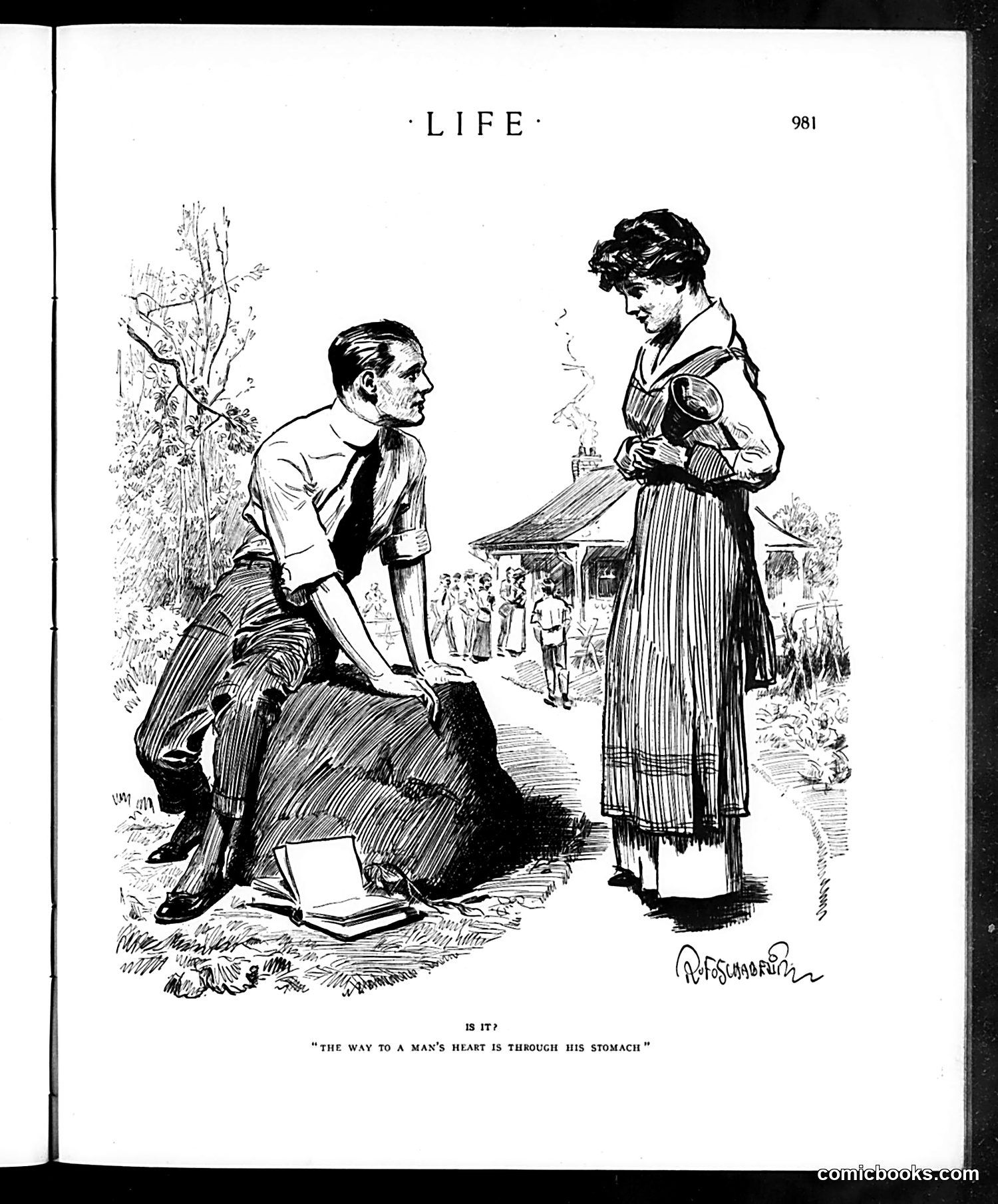
This is a satirical cartoon from *Life* magazine addressing gender relations and courtship. The illustration shows a woman holding a frying pan confronting a seated man, with the caption "'THE WAY TO A MAN'S HEART IS THROUGH HIS STOMACH.'" The cartoon satirizes this period proverb—suggesting that women could win male affection through cooking. The woman's prominent display of the frying pan and her direct stance toward the man appears to mock or question this notion. The cartoon likely critiques either: (1) the oversimplification of male-female relationships to culinary duty, or (2) the irony that domestic skills alone cannot guarantee romantic success. The setting appears to be outdoors at a social gathering, adding context to what seems commentary on courtship practices of the early 1900s.
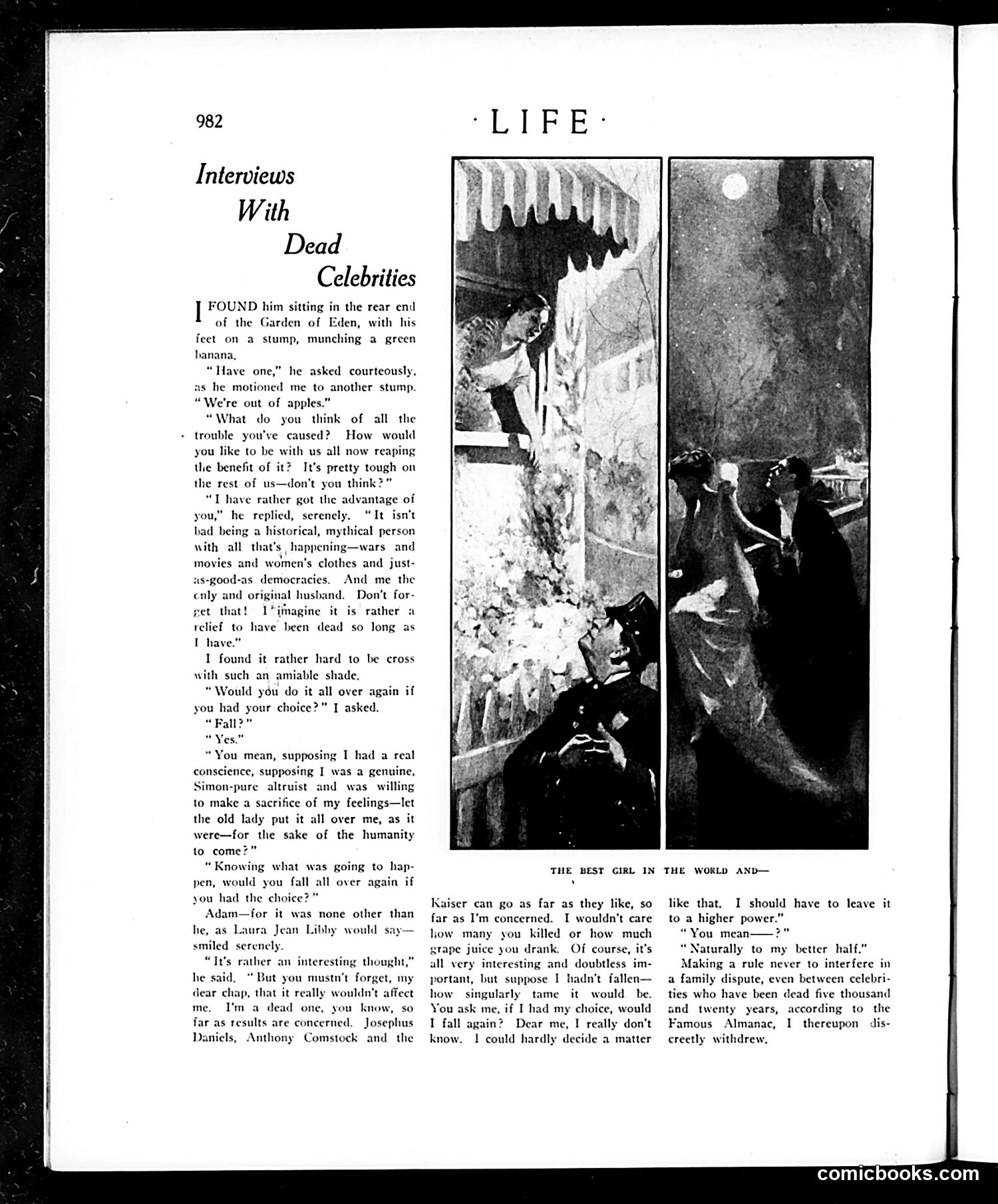
This satirical piece imagines an interview with Adam (the biblical first man) in the Garden of Eden. The text presents Adam complaining about his historical burden—being blamed for humanity's fall through Eve, suffering from endless artistic depictions, and enduring centuries of theological debate about his culpability. The satire mocks how historical and mythological figures become trapped by their legacies, weaponized in social arguments, and stripped of individual agency. Adam ironically notes relief at being "dead so long" to escape the endless uses made of his story—wars, fashion debates, and moral arguments. The joke targets how societies project contemporary concerns onto ancient myths, making dead figures serve modern agendas while denying them any rest from interpretation.
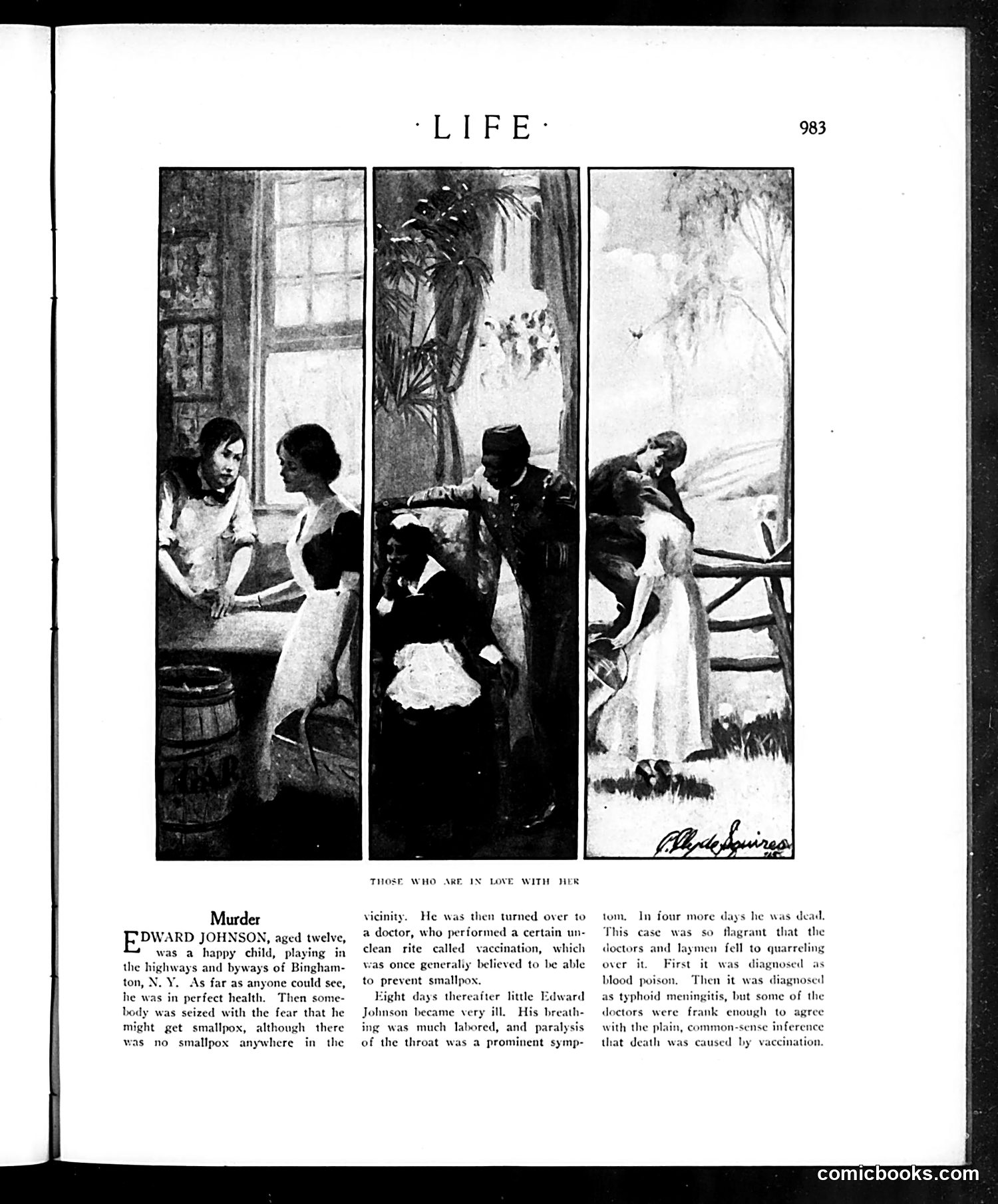
This page illustrates a grim narrative about Edward Johnson, a twelve-year-old boy from Washington, N.Y. The three panels depict different scenarios involving romantic or social encounters with a young woman, captioned "Those Who Are in Love with Her." The accompanying text reveals the dark purpose: Johnson contracted smallpox and died within four days. The article documents that doctors initially misdiagnosed his illness as blood poisoning, then typhoid meningitis, before concluding vaccination caused his death. This appears to be a cautionary editorial piece about vaccination dangers and misdiagnosis, using the illustration's ambiguous title and romantic framing ironically—the "love" potentially refers to careless medical attention rather than romance.
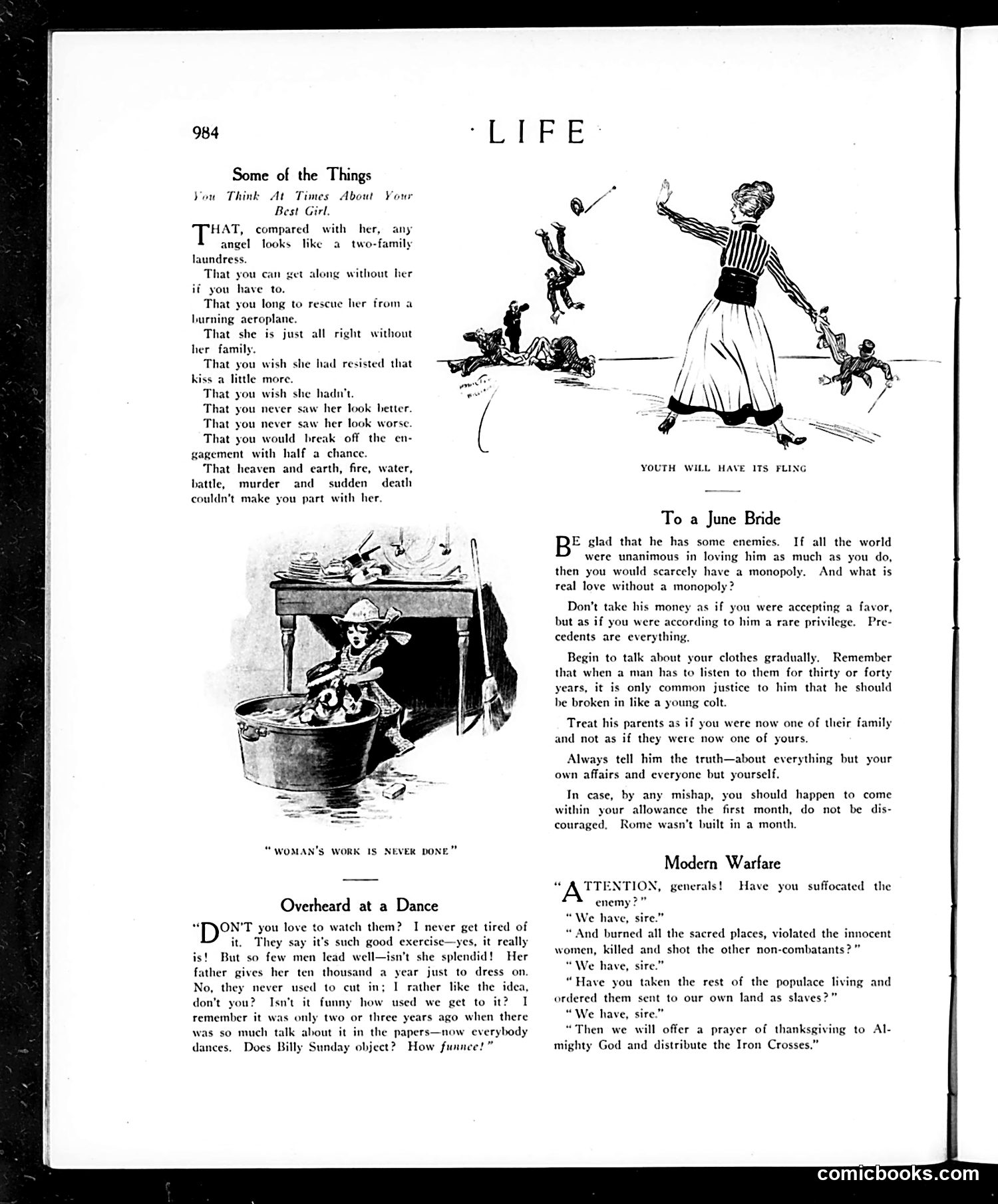
This page contains three distinct sections of satirical commentary on early 20th-century social life: 1. **"Some of the Things You Think About Your Best Girl"** - A humorous list of contradictory thoughts men have about their romantic interests, accompanied by an illustration of a woman juggling children, satirizing the domestic expectations placed on women. 2. **"Overheard at a Dance"** - A dialogue mocking the superficiality of social dancing culture, where a woman's father gives her an expensive coat, yet she complains about fashion and questions Billy Sunday's attendance—likely referencing the famous evangelist. 3. **"To a June Bride"** and **"Modern Warfare"** - Cynical advice columns satirizing marriage expectations and what appears to be WWI-era military conduct, with the latter depicting soldiers discussing conquered territories and enslaved populations. The overall tone criticizes social hypocrisy, gender dynamics, and war's brutality.
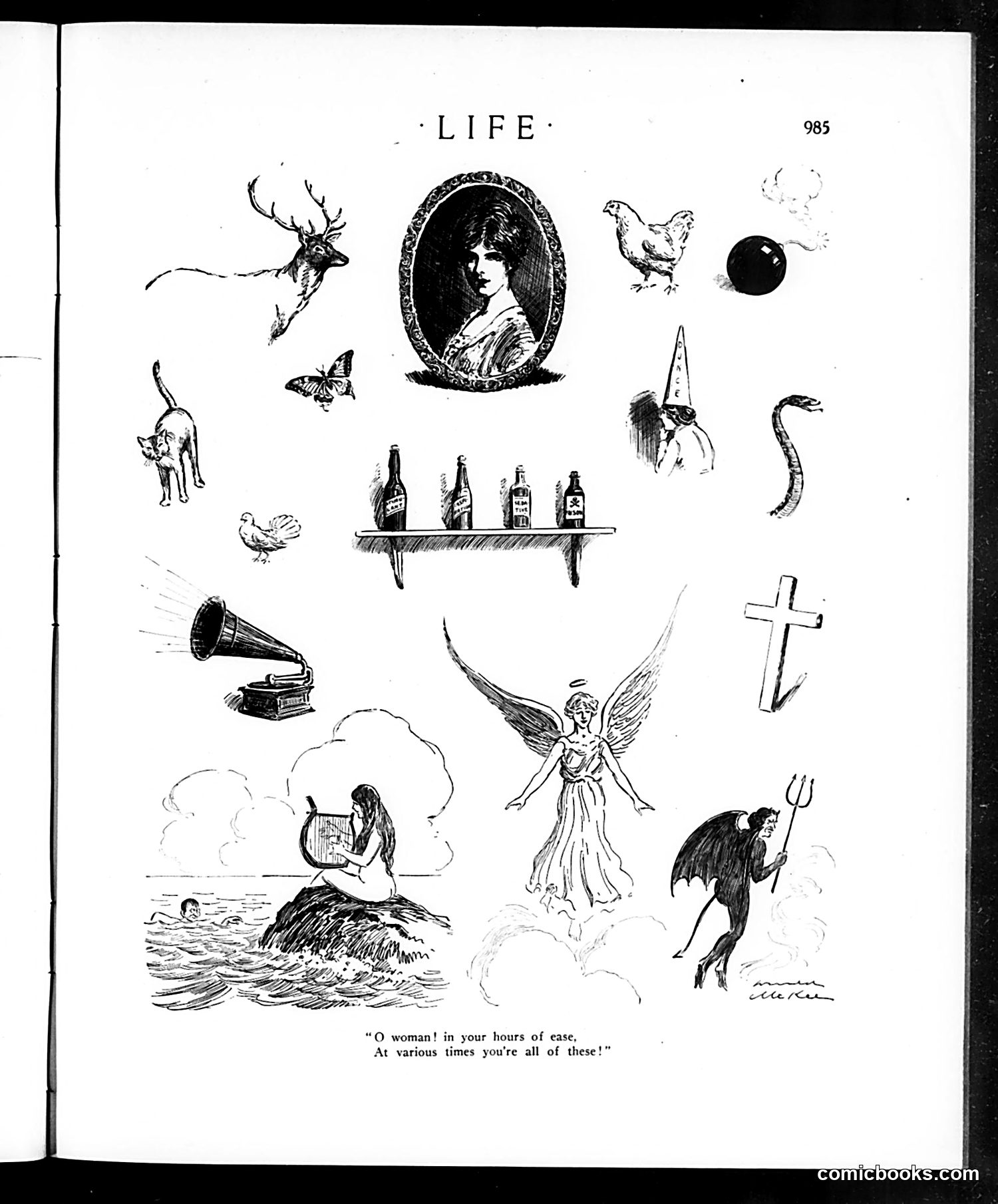
This is a satirical illustration commenting on women's multiple roles and conflicting identities. The central portrait of a woman is surrounded by various symbolic images representing different aspects of female life: religious icons (angel, cross, devil with trident), domestic items (bottles, phonograph), nature (mermaid, deer, animals), and leisure activities. The caption reads: "O woman! in your hours of ease, / At various times you're all of these!" The satire suggests that women are expected to embody contradictory personas simultaneously—simultaneously virtuous and tempting, maternal and frivolous, angelic and devilish. This appears to critique either the unrealistic expectations placed on women or perhaps mock women for their perceived inconsistency. The illustration reflects early-20th-century gender commentary typical of *Life* magazine's satirical approach.
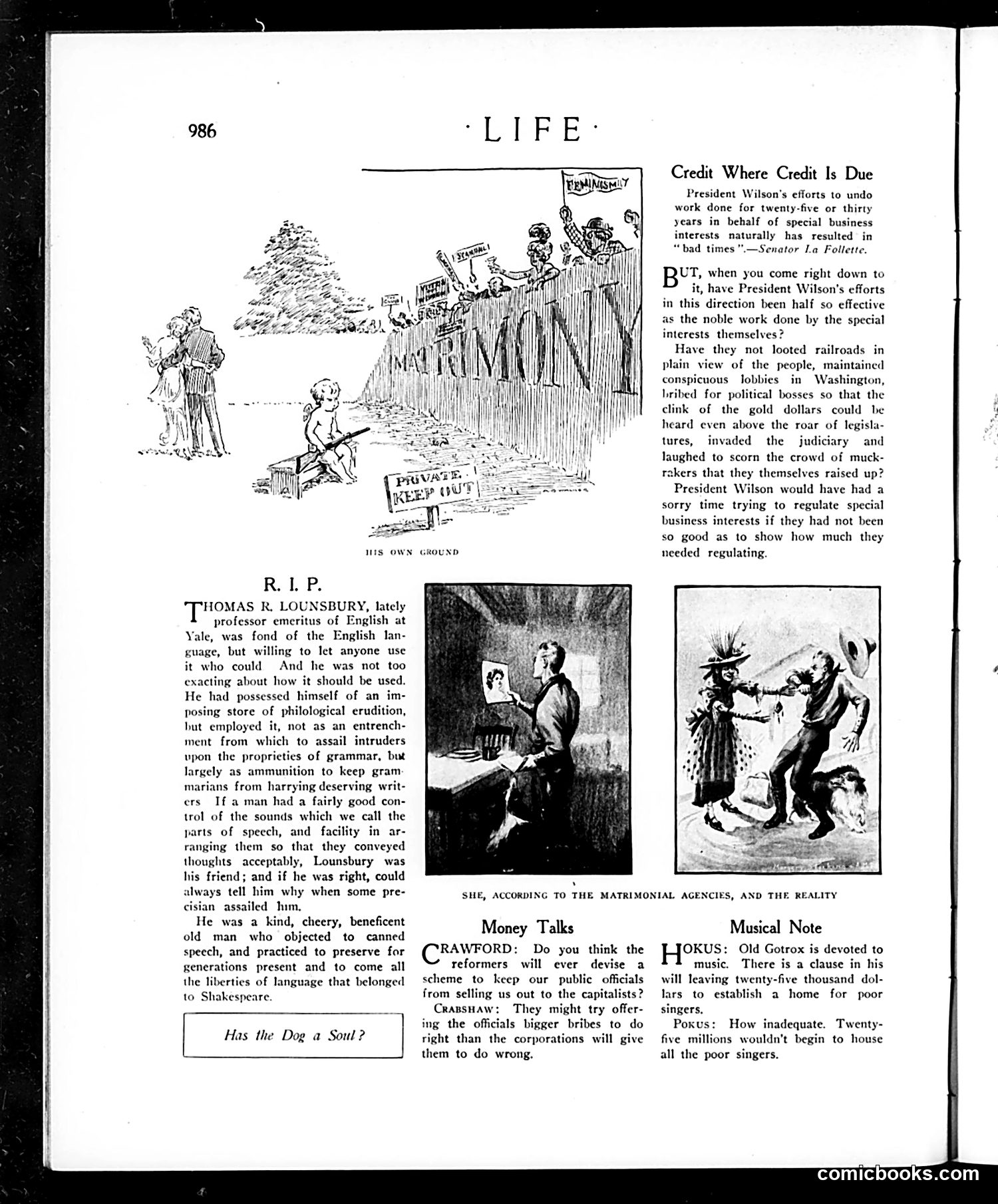
The main cartoon "His Own Ground" satirizes President Wilson's efforts to regulate special business interests. A small figure labeled "Private Keep Out" stands on ground marked by a fence, while larger figures representing business interests ("Matrimony") loom behind it—suggesting that despite Wilson's regulatory attempts, powerful corporations maintain control. The accompanying article "Credit Where Credit Is Due" argues Wilson's regulation efforts were insufficient. It suggests railroads and other special interests escaped meaningful oversight through political maneuvering and bribery, while Wilson received undeserved credit for weak reforms. The two smaller illustrations below depict matrimonial/social scenarios, accompanying the "Money Talks" dialogue section about corruption and reform. Overall, the page criticizes Wilson's anti-monopoly campaign as largely ineffective theater.
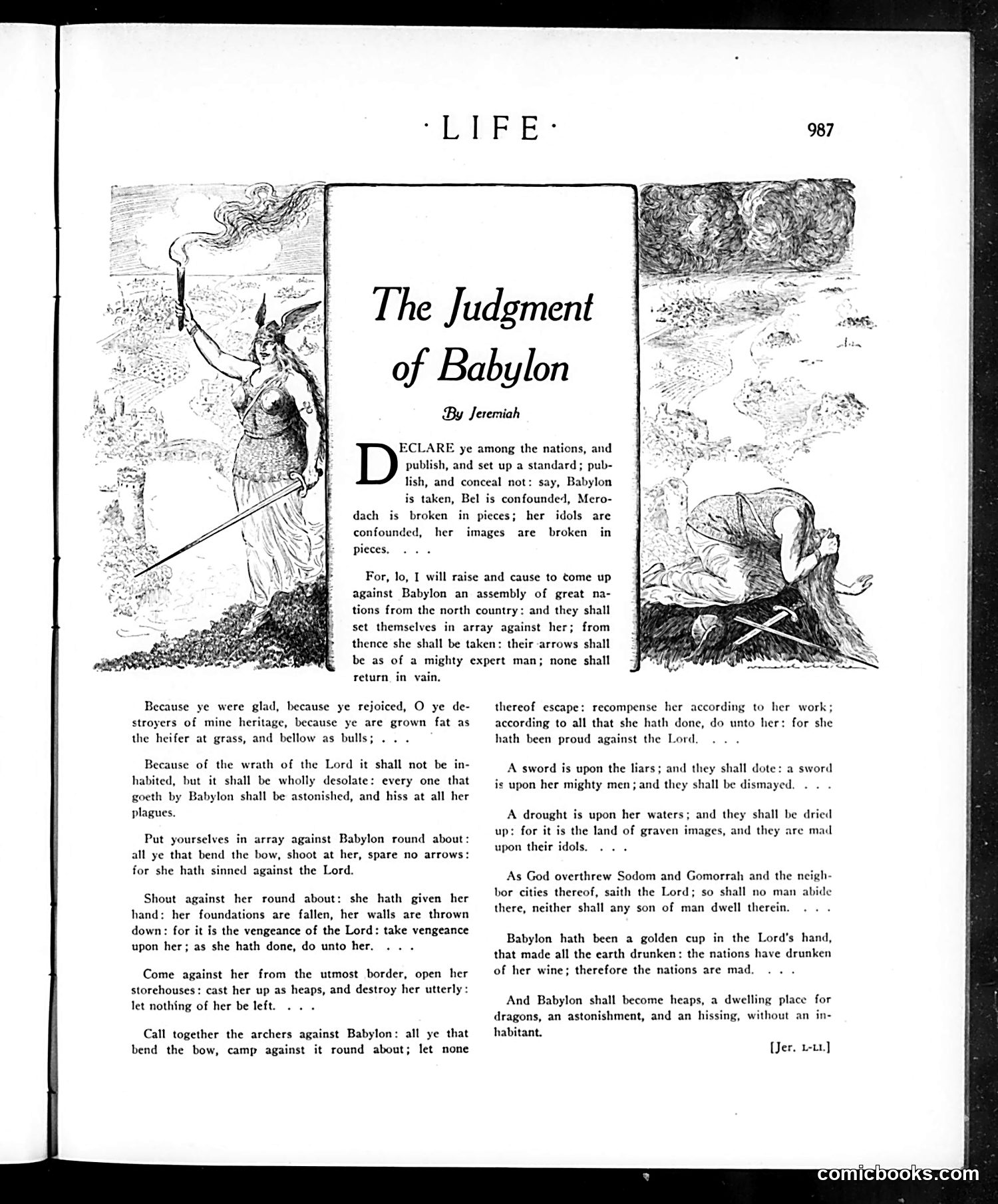
This page presents Jeremiah's biblical prophecy against Babylon as a political allegory. The illustrations show a warrior-woman (representing Babylon) and a figure in submission, visualizing the text's themes of military conquest and divine judgment. Published in Life (a satirical magazine), this piece uses biblical language to comment on contemporary geopolitical conflict. "Babylon" likely represents Germany or another enemy power, with the prophecy of destruction serving as commentary on World War I or its aftermath. The repeated invocations of divine judgment—swords, drought, conquest by "great nations from the north"—frame military victory as righteous punishment for pride and idolatry. The cartoons reinforce this moralizing narrative: Babylon's fall becomes inevitable, divinely ordained justice rather than mere military defeat. This rhetorical strategy was common in American satirical magazines, using classical/biblical language to dignify contemporary political positions.
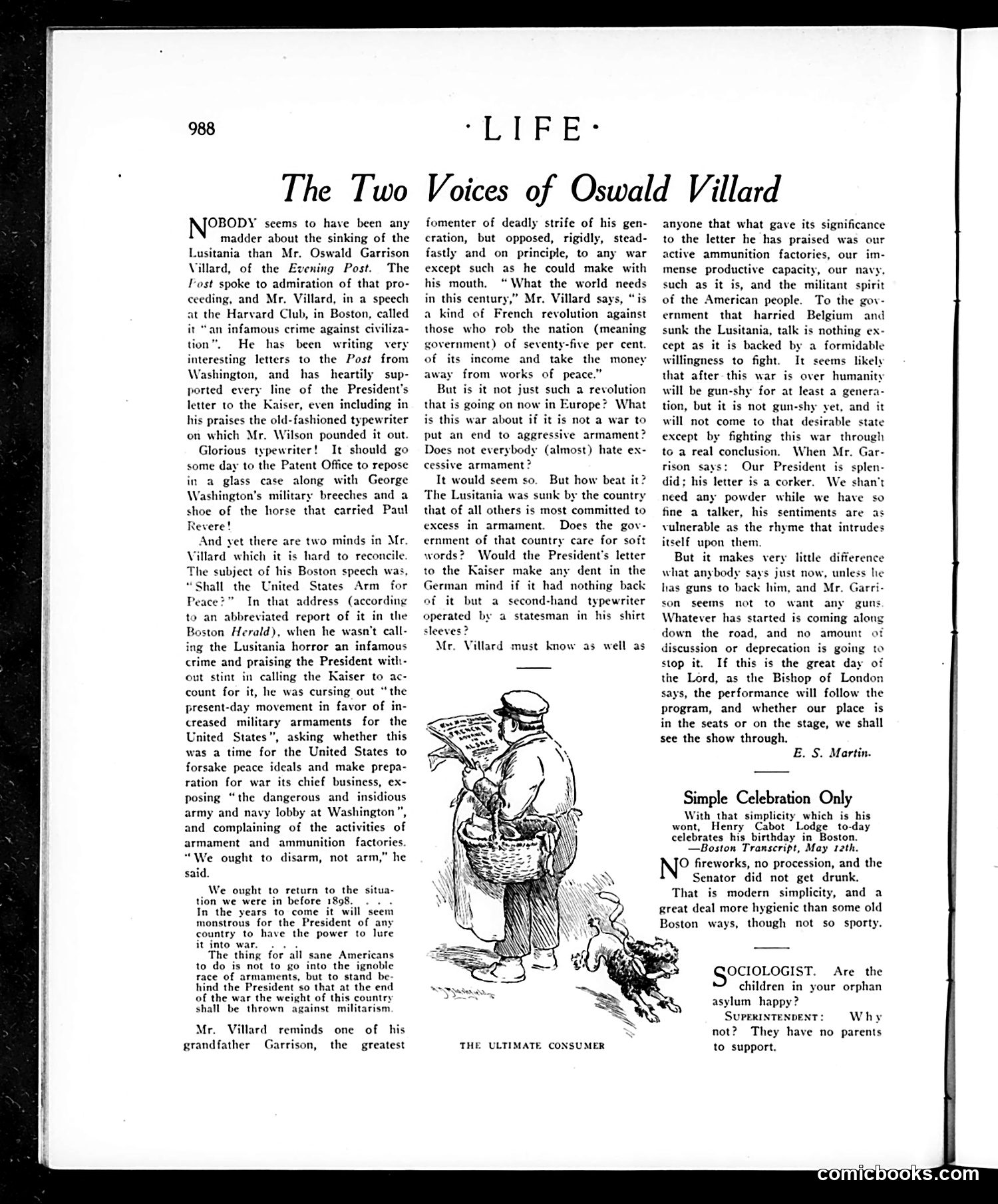
This satirical piece critiques *The Evening Post* editor Oswald Garrison Villard's apparent contradiction regarding American military preparedness during World War I. The text identifies Villard's "two minds": he publicly condemned the Lusitania sinking (1915) and praised President Wilson's strong letter to Germany, yet simultaneously campaigned against increased military armaments, called disarmament essential, and denounced the "army and navy lobby." The accompanying cartoon, captioned "The Ultimate Consumer," depicts a poor man carrying a basket—likely representing ordinary citizens who bear the burden of military spending and war. Life's argument: Villard naively believed diplomatic words alone could restrain Germany's militarism, ignoring that American military capacity gave those words credibility. The magazine suggests that Germany—which committed atrocities in Belgium and sank the Lusitania—respected only force, not pacifist rhetoric. This represents the broader American debate of 1915 between pacifists and interventionists regarding preparedness for potential war entry.
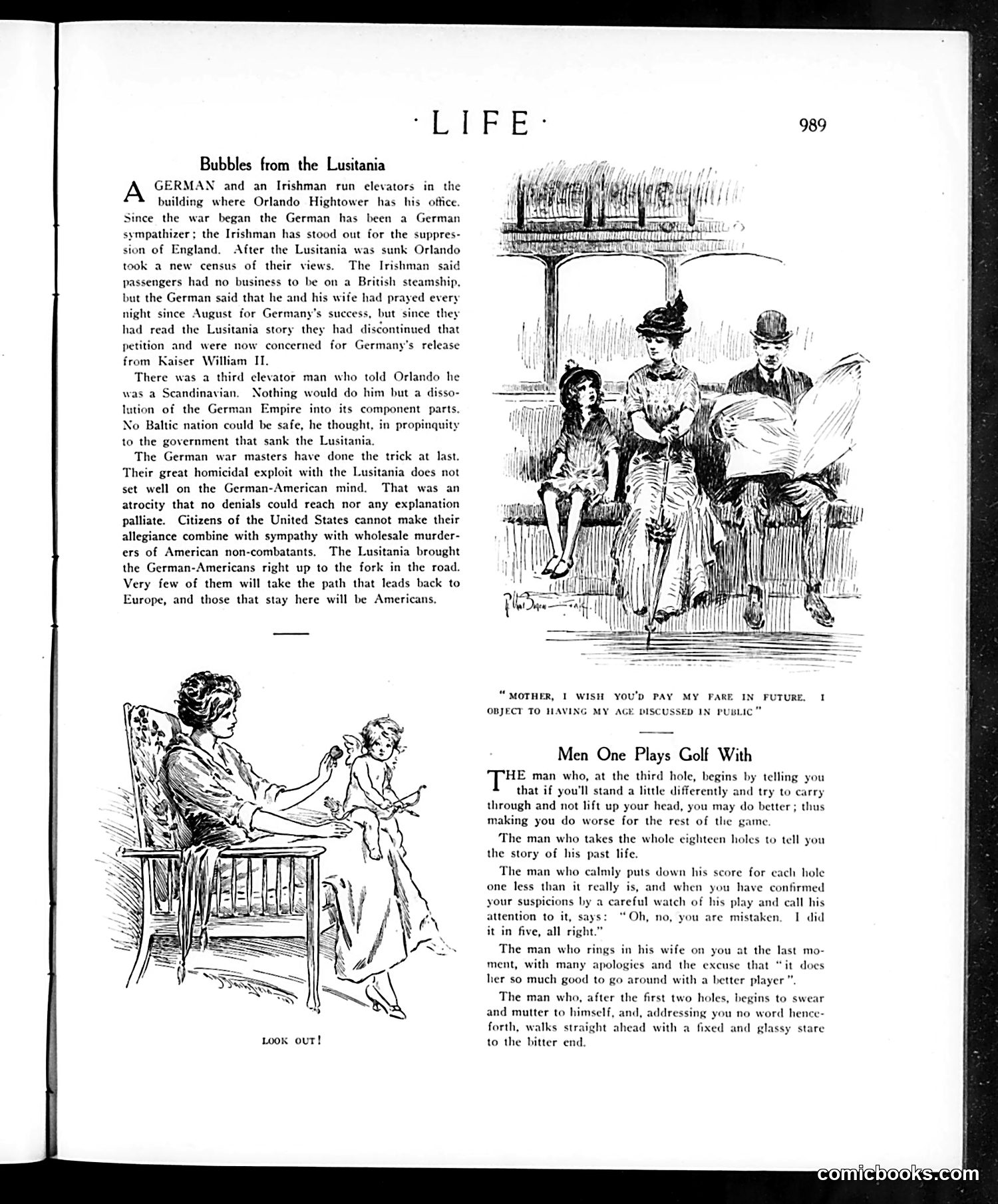
**"Bubbles from the Lusitania"** (top article): This satirizes German-American attitudes following the 1915 sinking of the RMS Lusitania by a German U-boat, which killed 128 American passengers. The text describes three elevator operators with different immigrant backgrounds—a German sympathizer, an Irish anti-British man, and a Scandinavian—and how the Lusitania disaster specifically shocked German-Americans into reconsidering their loyalties. The piece argues that this atrocity forced German-Americans to choose: either abandon sympathy for Germany or fully commit to American identity. It's wartime propaganda questioning immigrant allegiances. **"Men One Plays Golf With"** (bottom): A humorous social commentary cataloging annoying golf partners—the backseat coach, the bore, the cheater, the man who brings his wife uninvited, and the silent sulker. This has no political content; it's purely satirical observations about golf etiquette and male social behavior. The top cartoon illustration shows people reading newspapers, likely reacting to Lusitania news.
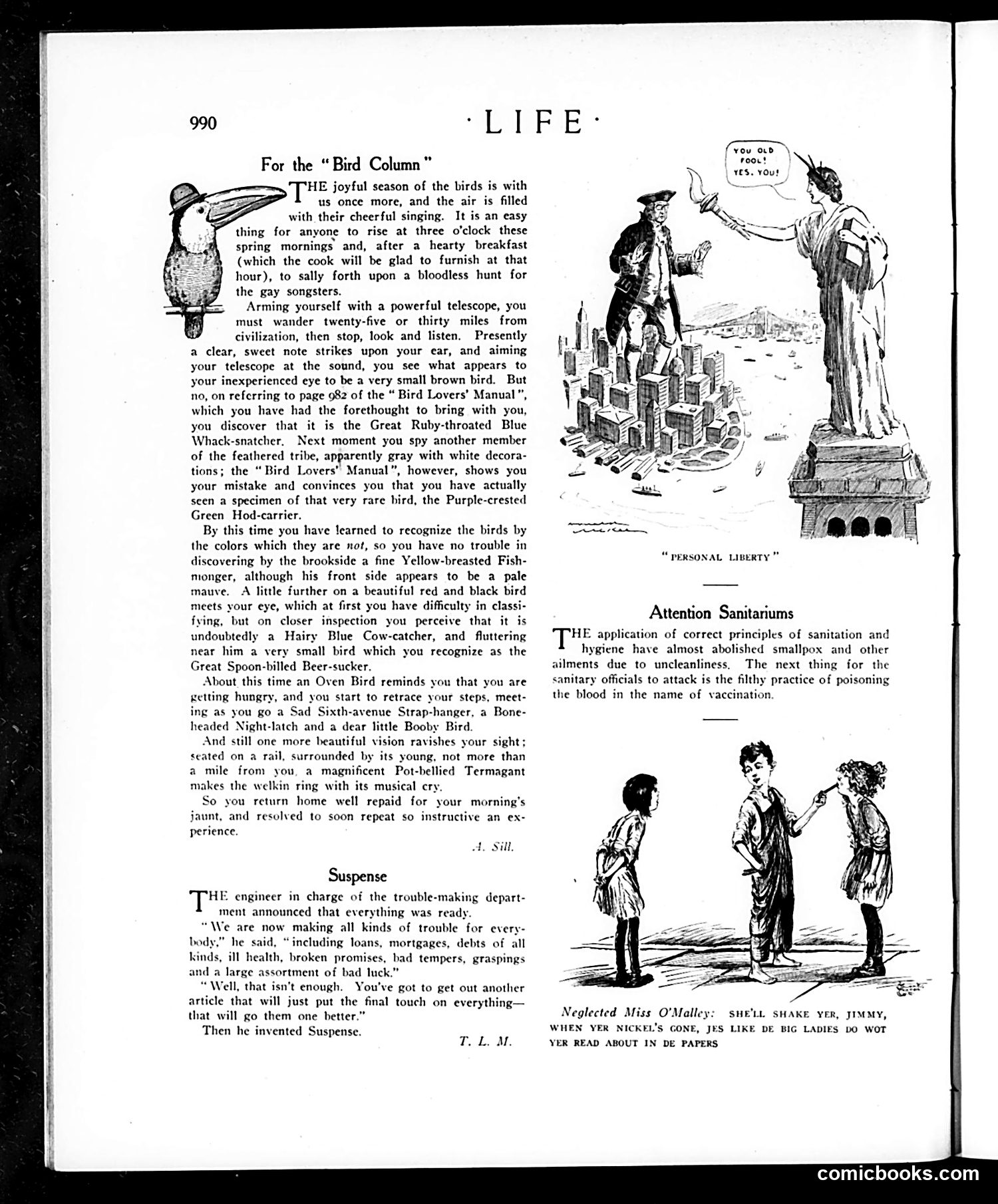
This page contains three separate satirical pieces: **"For the Bird Column"** mocks amateur ornithologists who overcomplicate bird identification. The humor lies in absurdist bird names (Great Ruby-throated Blue Whack-snatcher, Purple-crested Green Hod-carrier) that satirize how obscure field guides make simple observation needlessly complex. The joke: novices cannot identify what they actually see because they're consulting unreliable manuals. **"Suspense"** is a brief satirical dialogue about a "trouble-making department" manufacturing human miseries (loans, debts, illness). The punchline—that "suspense" is the final touch of trouble—suggests anxiety itself is a manufactured social ill, perhaps critiquing modern life's psychological burdens. **"Attention Sanitariums"** anti-vaccination propaganda claiming vaccination "poisons the blood." This reflects early 20th-century vaccine skepticism. The accompanying cartoon mocks a neglected working-class child ("Miss O'Malley"), using dialect humor common to period Life satire. The page reflects Life's mixed editorial voice: witty social satire alongside period prejudices and pseudoscientific health claims.
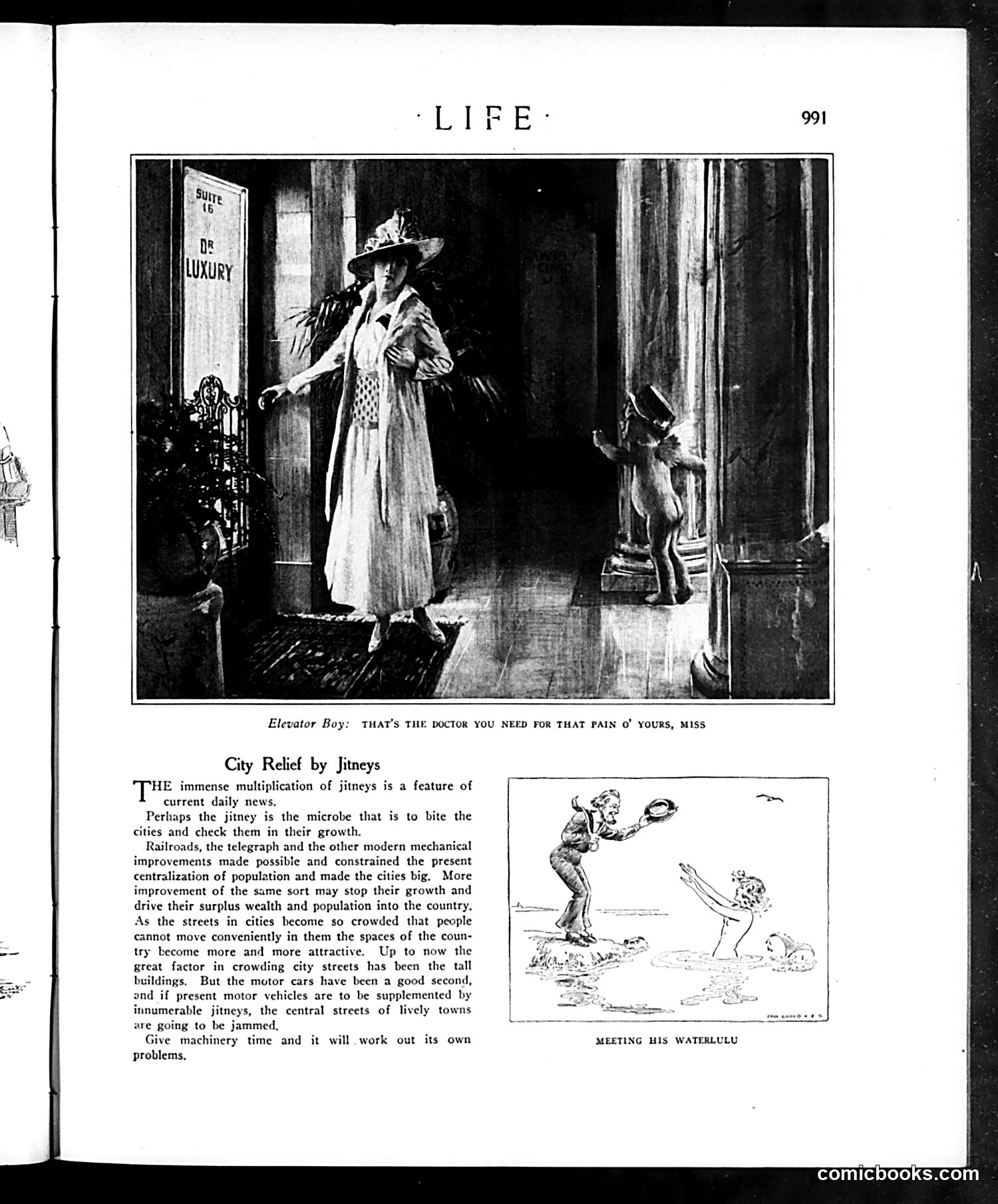
**Main Image ("Elevator Boy"):** A humorous scene showing a woman in a luxury hotel suite with a small dog, while an elevator boy gestures toward a doctor entering. The caption suggests the "doctor" (likely a quack or charlatan) is a remedy for her ailment. This appears to be satirizing either incompetent medical practitioners or the gullibility of wealthy hotel guests. **"City Relief by Jitneys" Article & Cartoon:** The piece discusses jitneys—shared-ride vehicles that were becoming popular in the 1910s-1920s. The author argues these cheap transportation alternatives will paradoxically solve urban crowding by making country living more attractive, thus decentralizing cities. The cartoon shows someone "meeting his waterlulu" (an obscure reference, possibly to a romantic encounter or mishap in nature). The satire mocks the notion that jitneys, rather than solving traffic, would worsen street congestion by proliferating endlessly.
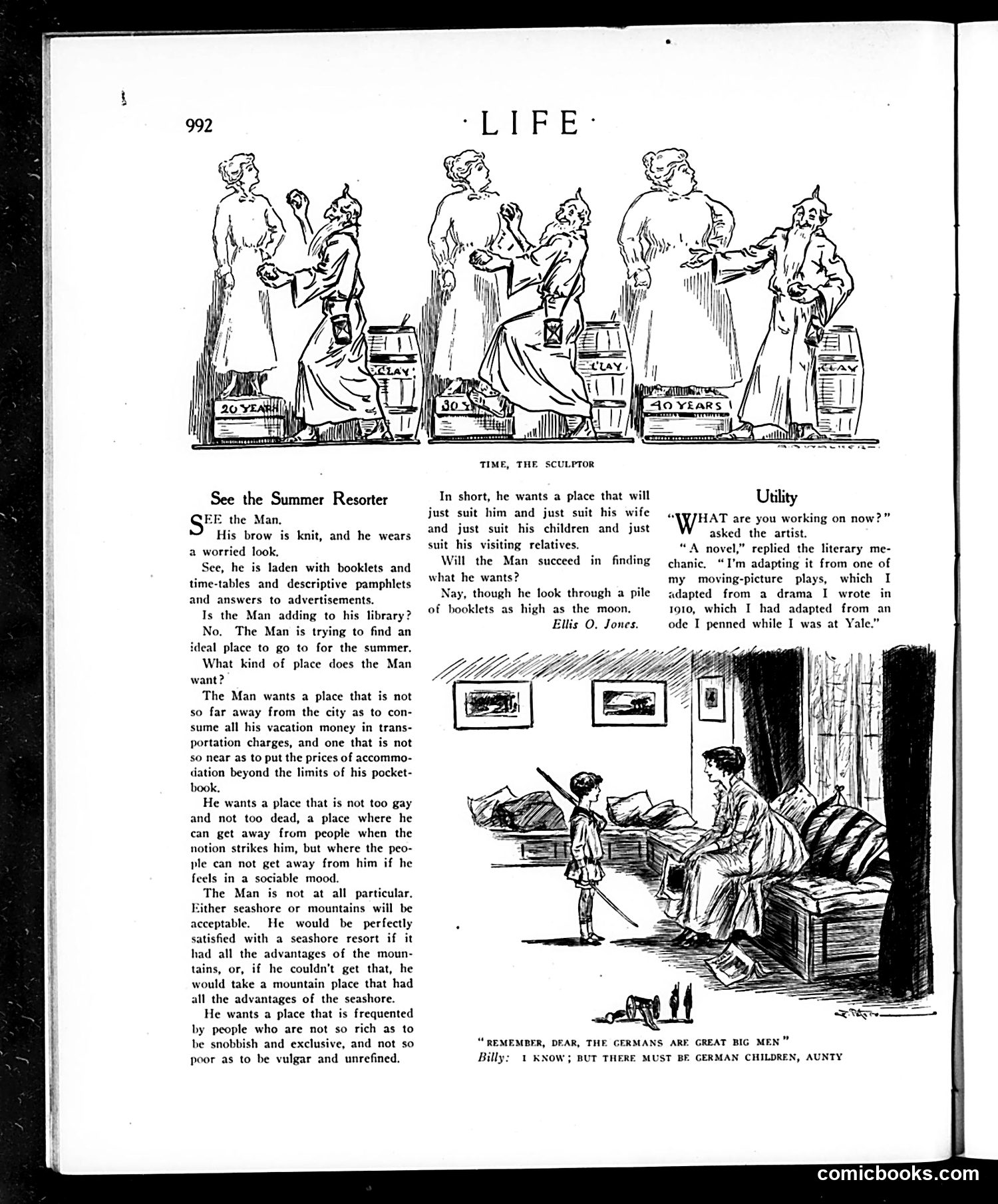
The top illustration satirizes the impossibly contradictory desires of the middle-class vacationer. "The Man" seeks a summer resort that is simultaneously: affordable yet not remote, social yet private, elegant yet unpretentious, seaside yet mountainous. The three panels show Time literally sculpting away his options as years pass (20, 30, and 40 years marked on clay blocks), suggesting that by the time he finds a place meeting all criteria, he'll be too old to enjoy it. The page mocks the American consumer's unrealistic expectations and the proliferation of resort advertising. Ellis O. Jones's accompanying text sarcastically confirms: the Man will never succeed, no matter how many brochures he reads. A secondary cartoon about literary adaptation jokes that modern writers merely recycle existing work through different media, ultimately tracing back to college-era poetry.
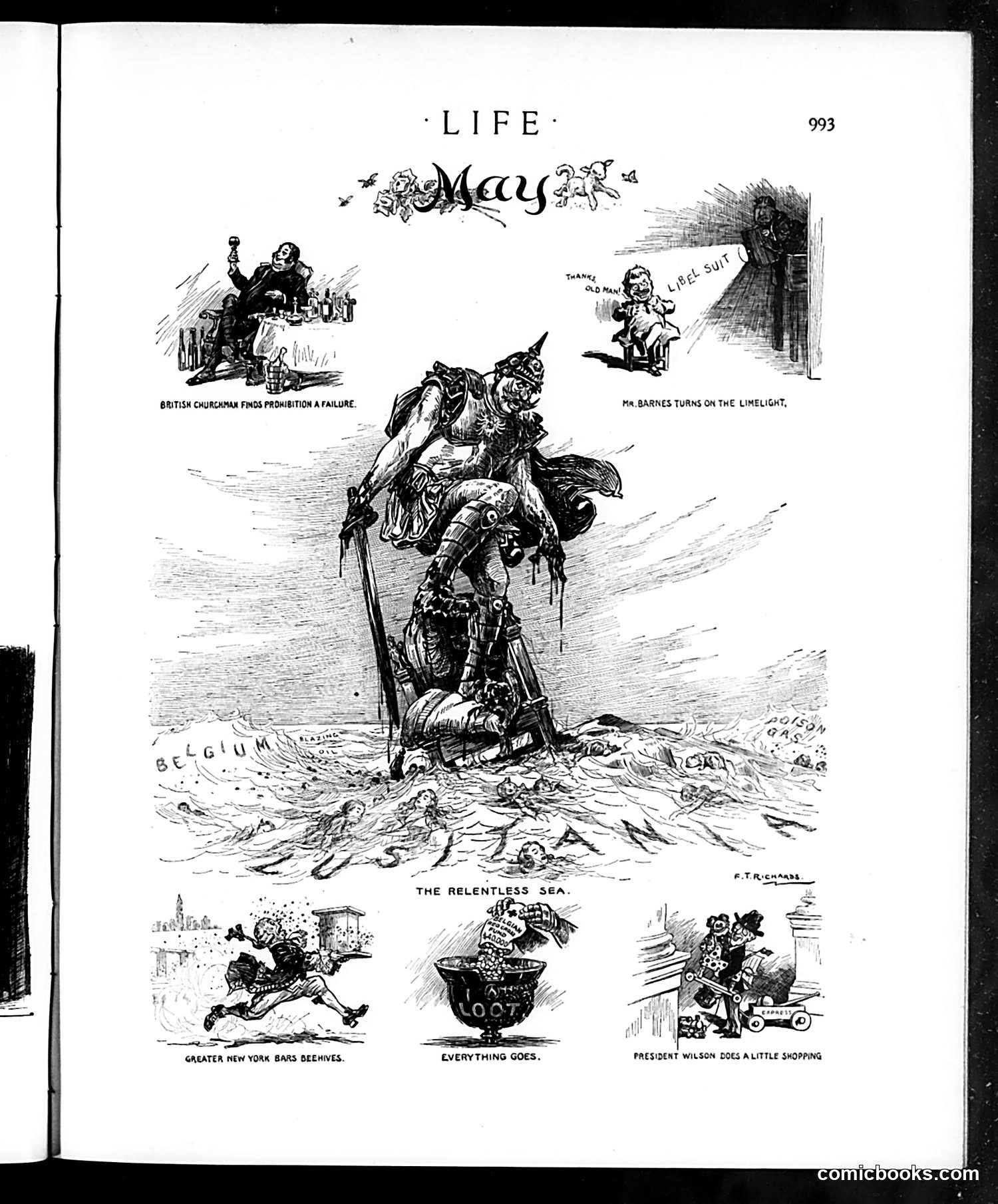
This page presents political satire from Life magazine's May issue. The central image, "The Relentless Sea," depicts a grotesque figure (likely representing chaos or destruction) emerging from turbulent waters labeled "Belgium" and "Poison Gas," symbolizing the horrors of World War I. The smaller cartoons mock contemporary figures and events: "British Churchman Finds Prohibition a Failure" critiques religious hypocrisy; "Mr. Barnes Turns on the Limelight" appears to target a specific public figure (unclear which); "Greater New York Bans Beehives" references a fashionable hairstyle ban; "Everything Goes" satirizes wartime profligacy; and "President Wilson Does a Little Shopping" likely mocks Wilson's domestic policies during the war period. The overall theme combines anti-war sentiment with domestic social criticism.
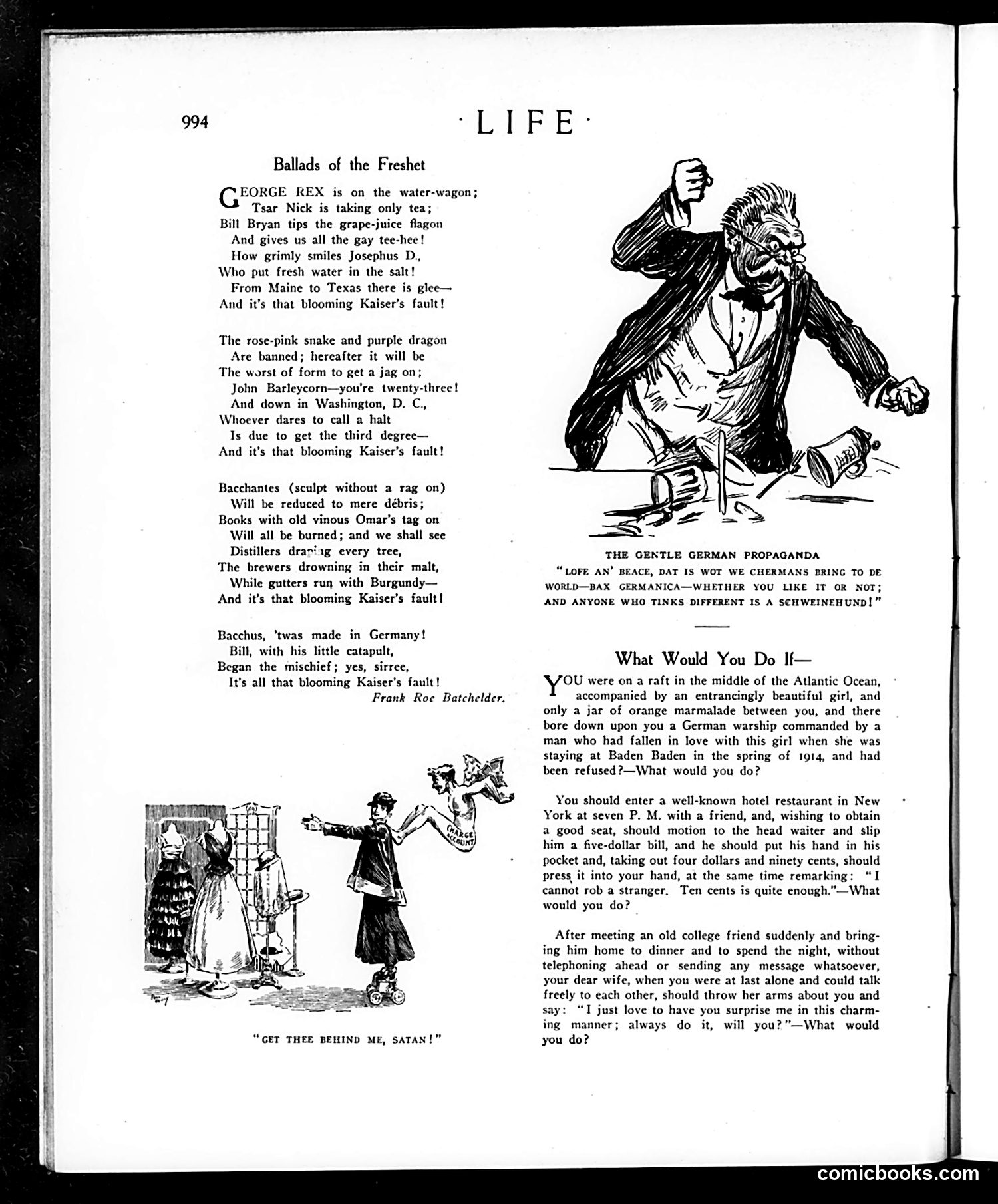
This page satirizes American Prohibition and wartime anti-German sentiment (WWI era). **"Ballads of the Freshet"** mocks Prohibition's recent passage by blaming Germany's Kaiser for America's alcohol ban—a darkly humorous inversion suggesting the Kaiser caused it as sabotage. The poem lists prominent figures (George Rex, Tsar Nick, William Jennings Bryan, Josephus Daniels) adopting temperance, and fantasizes about destroyed vineyards and breweries. **The cartoon** depicts a grotesque German propagandist spreading "peace" messaging ("Lobe an' beace"), satirizing German peace propaganda as hypocritical and menacing. **"What Would You Do If"** offers absurd hypothetical scenarios testing readers' moral character—ranging from wartime romance to bribery to spousal surprises. This appears unrelated to the political content, serving as generic humor filler. The page's core message: blaming Germany for unwanted domestic policies, while mocking both German propaganda and American gullibility.
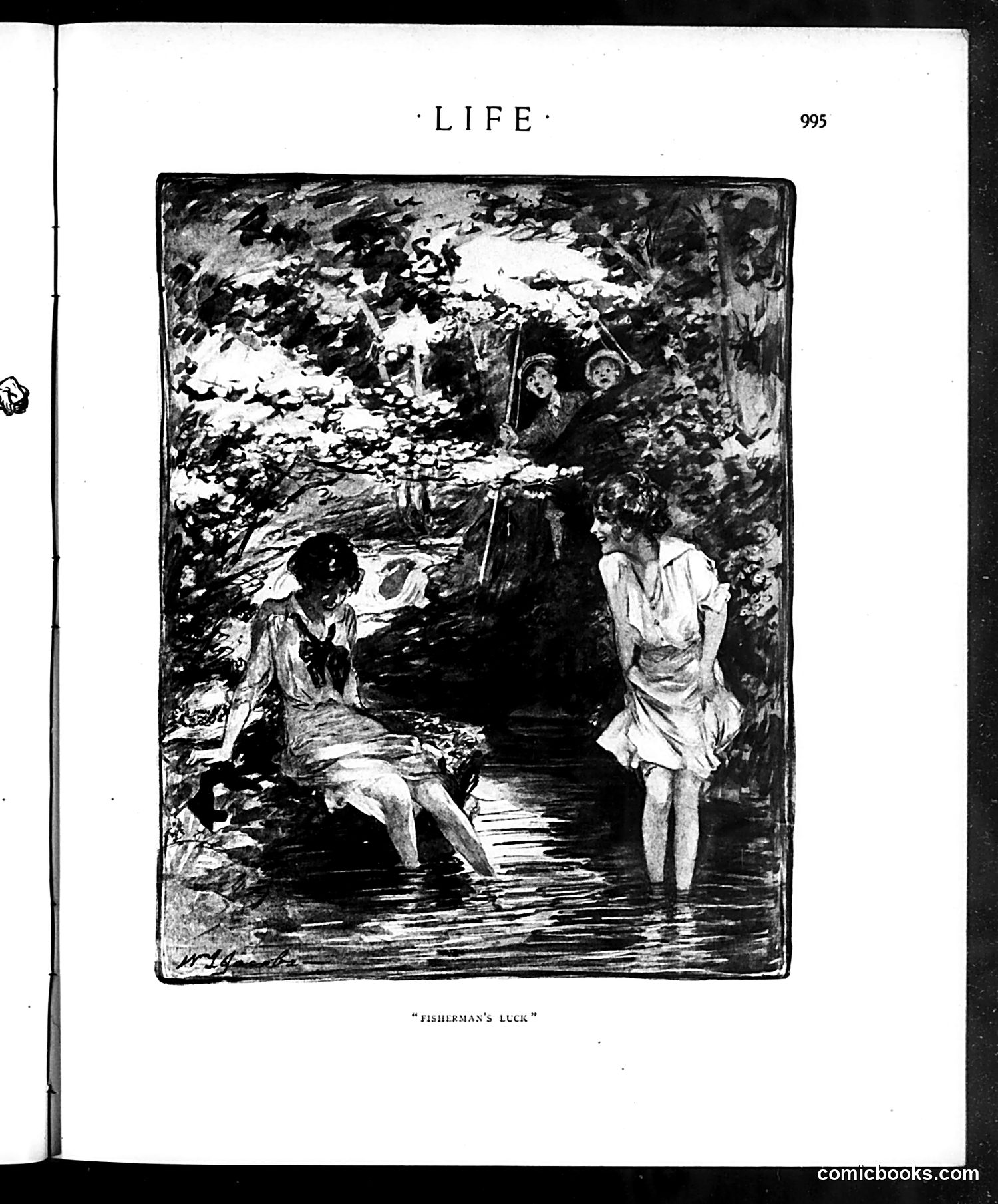
This illustration depicts two young women in a stream or shallow water, surrounded by lush foliage. The title "Fisherman's Luck" uses a double entendre: while ostensibly about fishing, the image suggests the satirical meaning refers to "catching" or encountering attractive women—a common innuendo in early 20th-century humor. The cartoon plays on traditional gender dynamics and courtship themes popular in Life's satirical content. The women's positioning in natural water settings, their light summer clothing, and the voyeuristic perspective suggest romantic or flirtatious encounters. This reflects period attitudes where women were humorously portrayed as desirable "catches" or prizes. The artwork style and subject matter are typical of Life magazine's lighthearted social commentary on courtship and leisure activities.
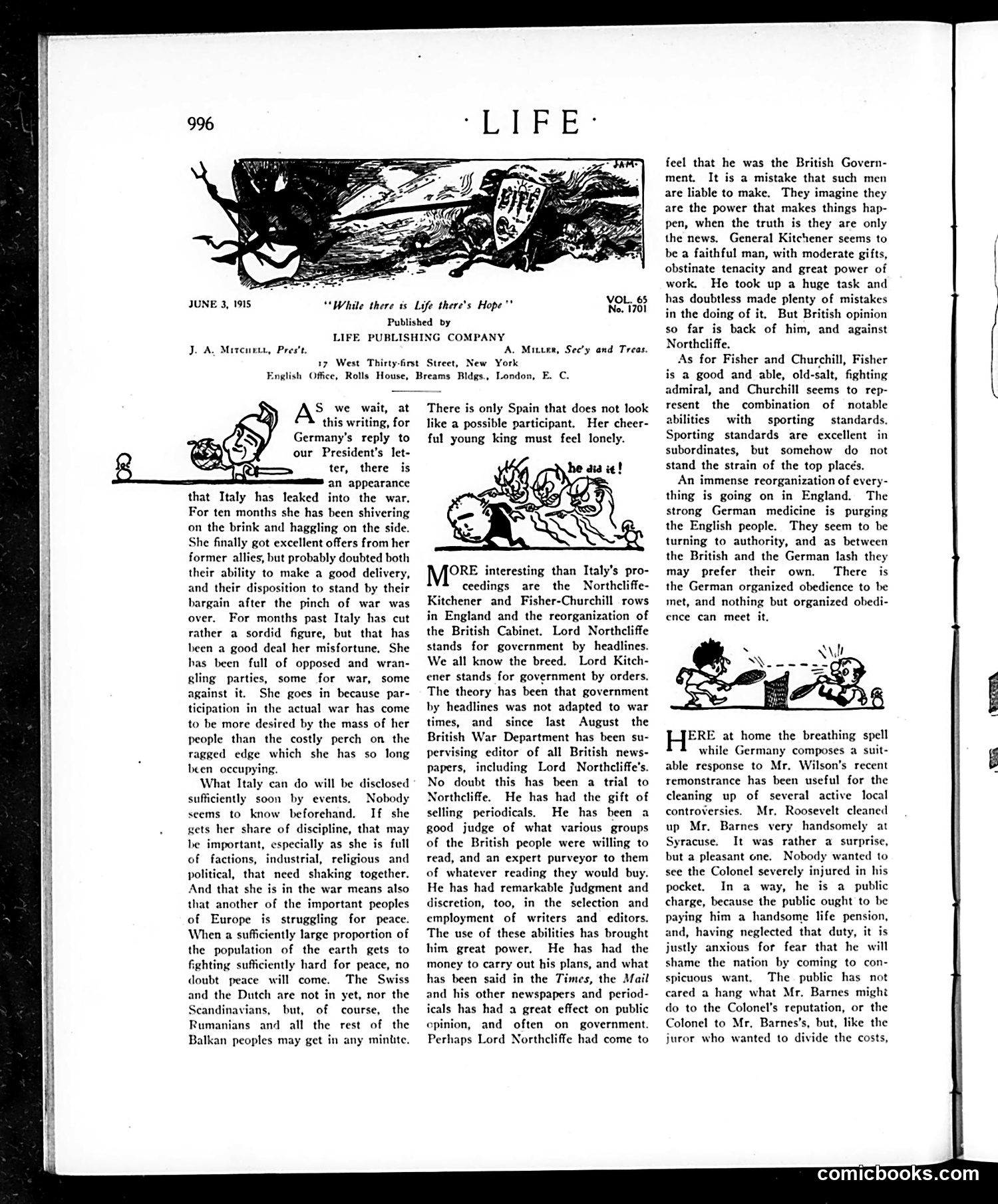
This page discusses European developments during World War I. The cartoons and text address: **Italy's Entry**: The article explains Italy finally joined the war after months of hesitation, motivated by mass public desire for participation over continued neutrality. **British Government Conflict**: The main satire targets a power struggle between **Lord Northcliffe** (newspaper magnate controlling major British papers including the *Times* and *Mail*) and **General Kitchener** (War Secretary). Northcliffe represents "government by headlines"—using media influence to shape policy—while Kitchener represents military authority based on direct orders. The text suggests Northcliffe mistakenly believed he *was* the government, when he merely reported news. The piece also mentions **Fisher** and **Churchill** in a reorganizing British Cabinet, though details are cut off. The satirical point: powerful media figures may confuse their influence over public opinion with actual governing power, particularly problematic during wartime when military leadership should prevail.
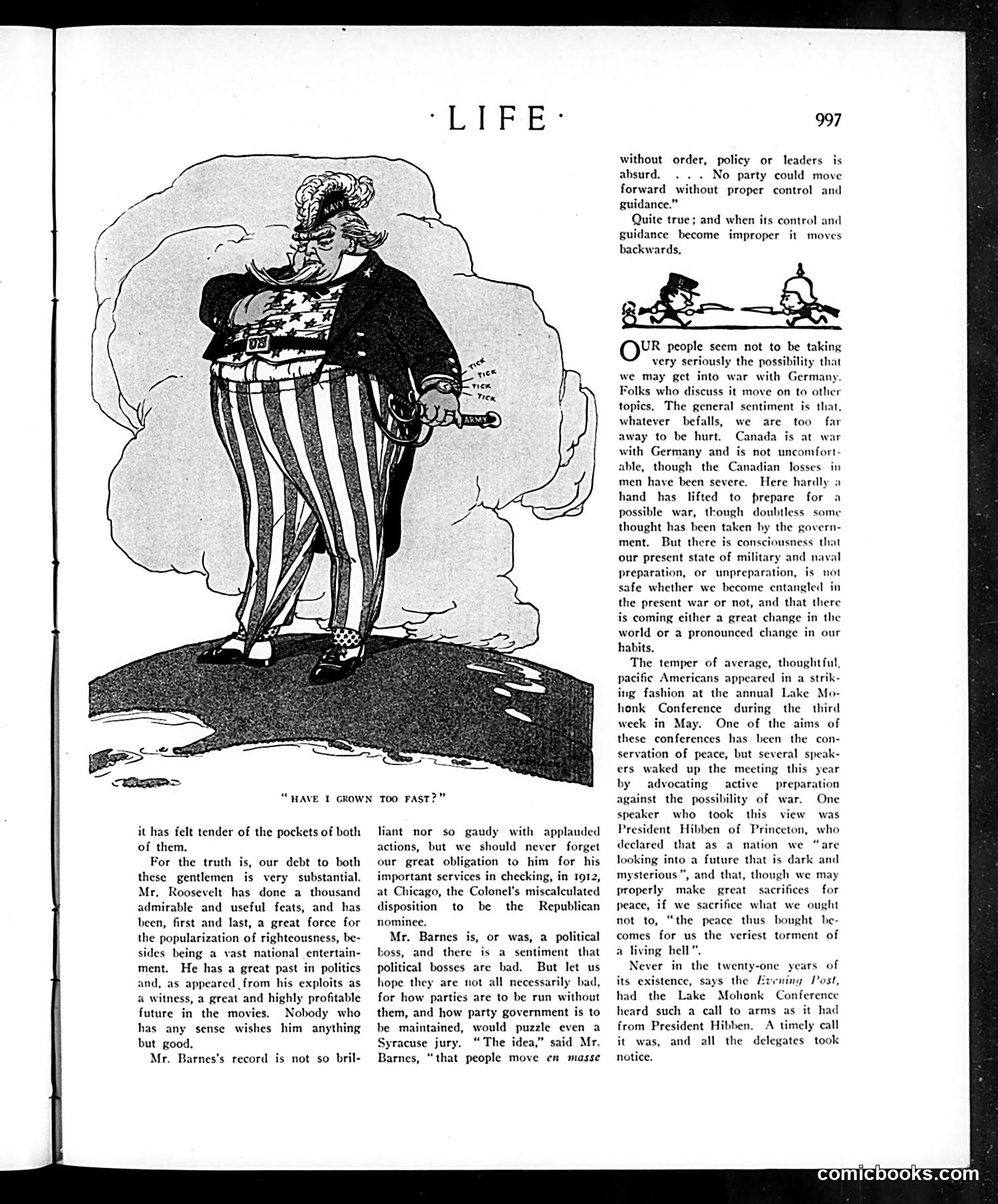
The cartoon depicts **Uncle Sam** as an overgrown figure bursting from his clothes, symbolizing America's rapid expansion and growth. The caption asks whether this expansion has exceeded healthy limits. The accompanying text discusses **Theodore Roosevelt** and **William Barnes** (a political boss), crediting Barnes with preventing Roosevelt's return as the Republican nominee in 1912. The article defends political party structure and leadership as necessary, while questioning whether such control becomes "improper." The broader editorial addresses American complacency about potential war with Germany. It references the **Lake Mohonk Conference** (a peace advocacy organization) and notes that **President Hibben of Princeton** unusually called for military preparedness, warning of a "dark and mysterious future" if America doesn't sacrifice for peace. The satire suggests America has grown powerful but may be dangerously unprepared and overconfident about distant threats—particularly relevant given Canada's active involvement in WWI.
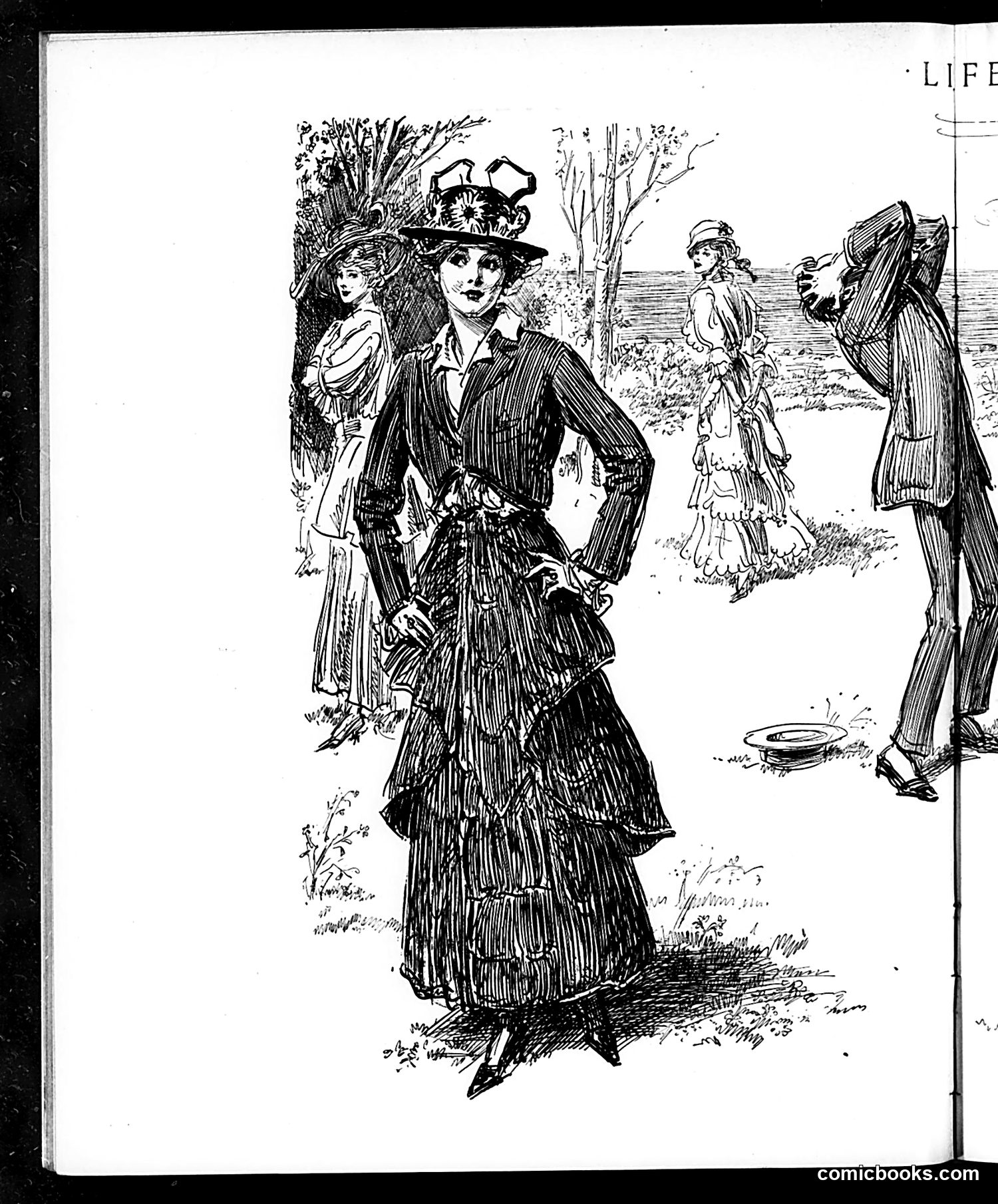
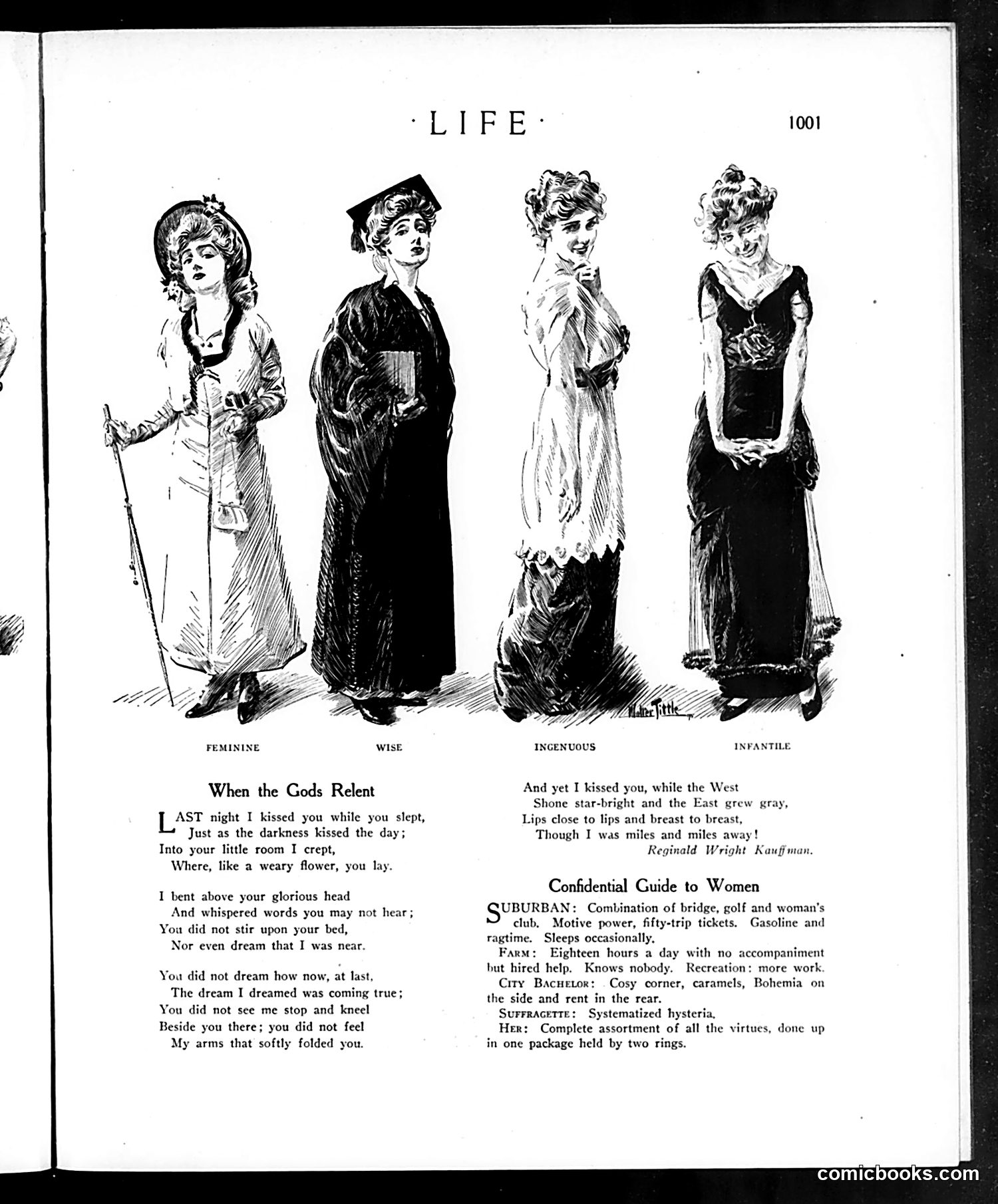
This appears to be a fashion illustration from *Life* magazine rather than political satire. The image depicts an elegant woman in early 20th-century dress as the central figure, wearing a pinstriped jacket suit and a tiered skirt with decorative details—fashionable attire of the period. She's positioned prominently in the foreground. In the background, several other figures in period clothing are shown in a social scene, suggesting an outdoor gathering or promenade. The illustration style is characteristic of *Life*'s fashion and society coverage from this era. Without accompanying text or captions visible, the specific satirical point—if one exists—cannot be determined from the image alone. This appears primarily to be documenting contemporary women's fashion for the magazine's readership rather than commentary on politics or social issues.
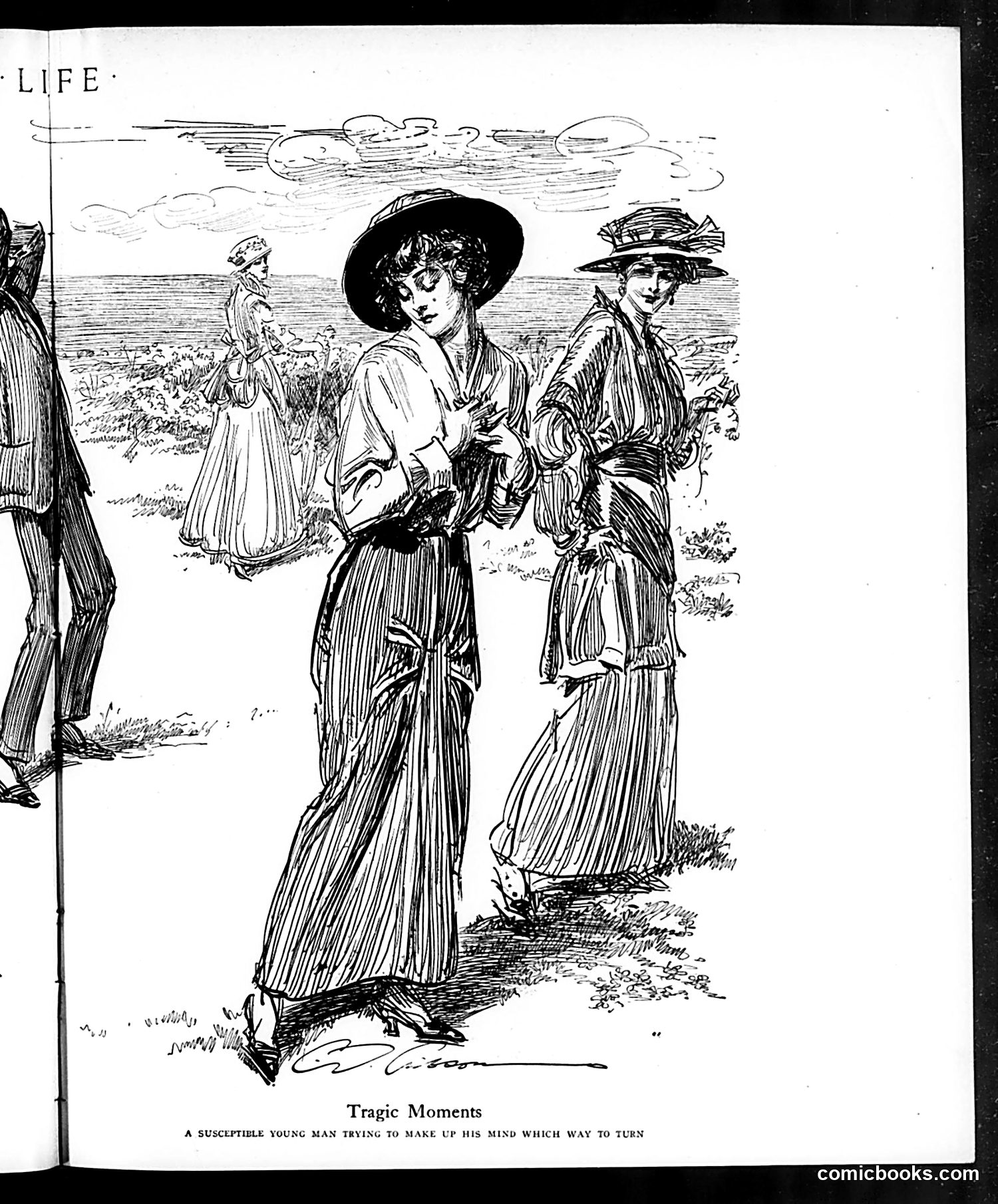
This illustration from *Life* magazine depicts a social scenario titled "Tragic Moments: A Susceptible Young Man Trying to Make Up His Mind Which Way to Turn." The cartoon shows a well-dressed young man in the center, flanked by two women in long Edwardian-era dresses and hats. Additional figures appear in the background. The satire targets the common social predicament of a young gentleman faced with romantic or social choices between eligible women. The humor relies on the period's conventions around courtship and masculine indecision—a "tragic" dilemma being which woman to favor. The illustration's style and composition suggest this addresses contemporary anxieties about modern dating dynamics and the uncertainty faced by young men navigating female attention in early 20th-century society.
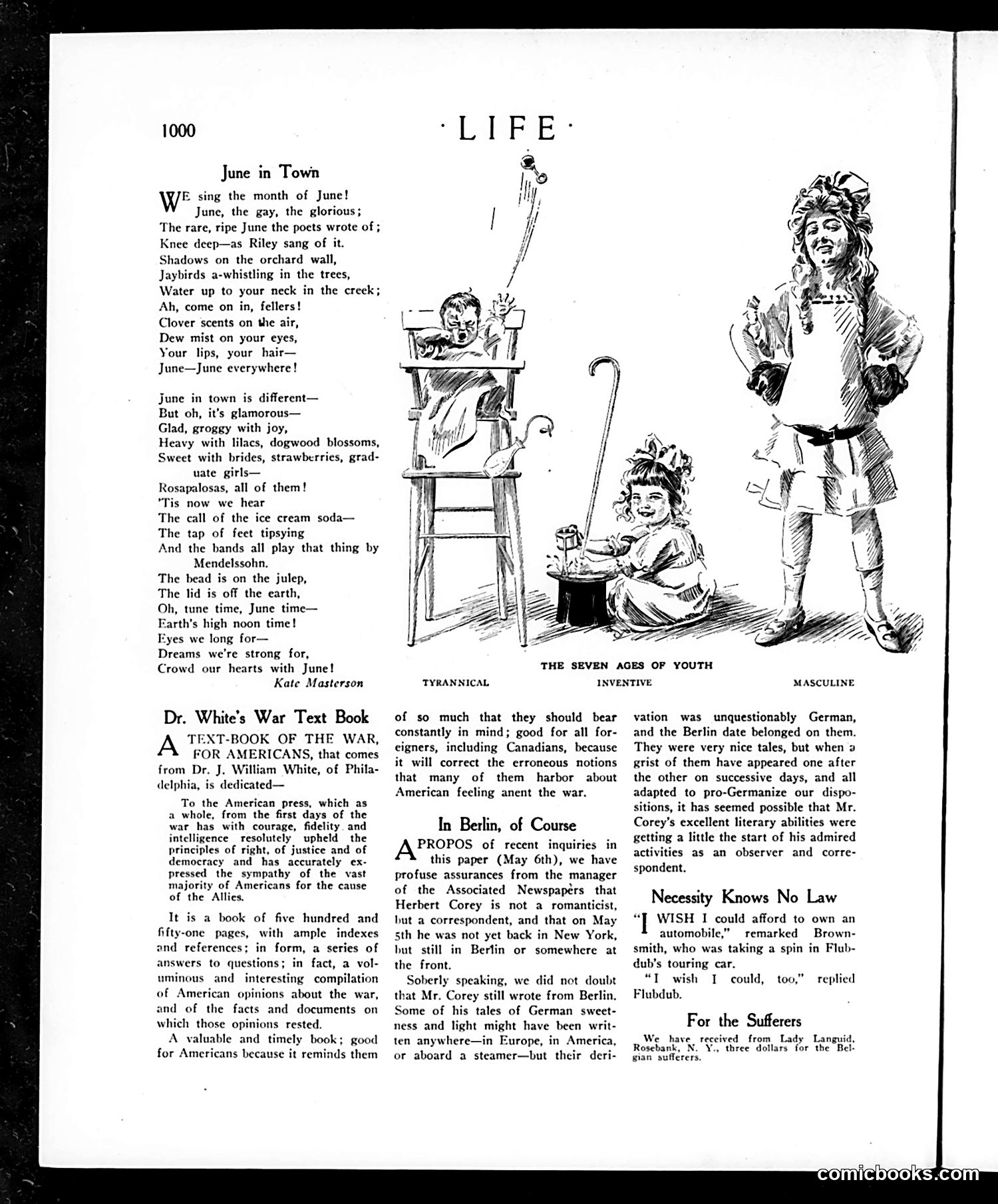
This page contains a poem celebrating June ("June in Town") and three separate articles/features. The cartoon titled "The Seven Ages of Youth" shows three figures labeled "Tyrannical," "Inventive," and "Masculine"—appearing to illustrate stages of male development from childhood through adulthood. The main articles include a book review of Dr. White's WWI text supporting the Allied cause, and notably, a satirical piece titled "In Berlin, of Course" that mocks war correspondent Herbert Corey. Life accuses Corey of writing pro-German propaganda pieces from Berlin, suggesting his literary talent is being used to romanticize German positions rather than report objectively. The phrase "pro-Germanize our dispositions" indicates American concern about German propaganda influence during WWI. A final humor piece jokes about affording automobiles, and a charitable notice mentions donations for Belgian war victims—reflecting wartime humanitarian concerns of the era.
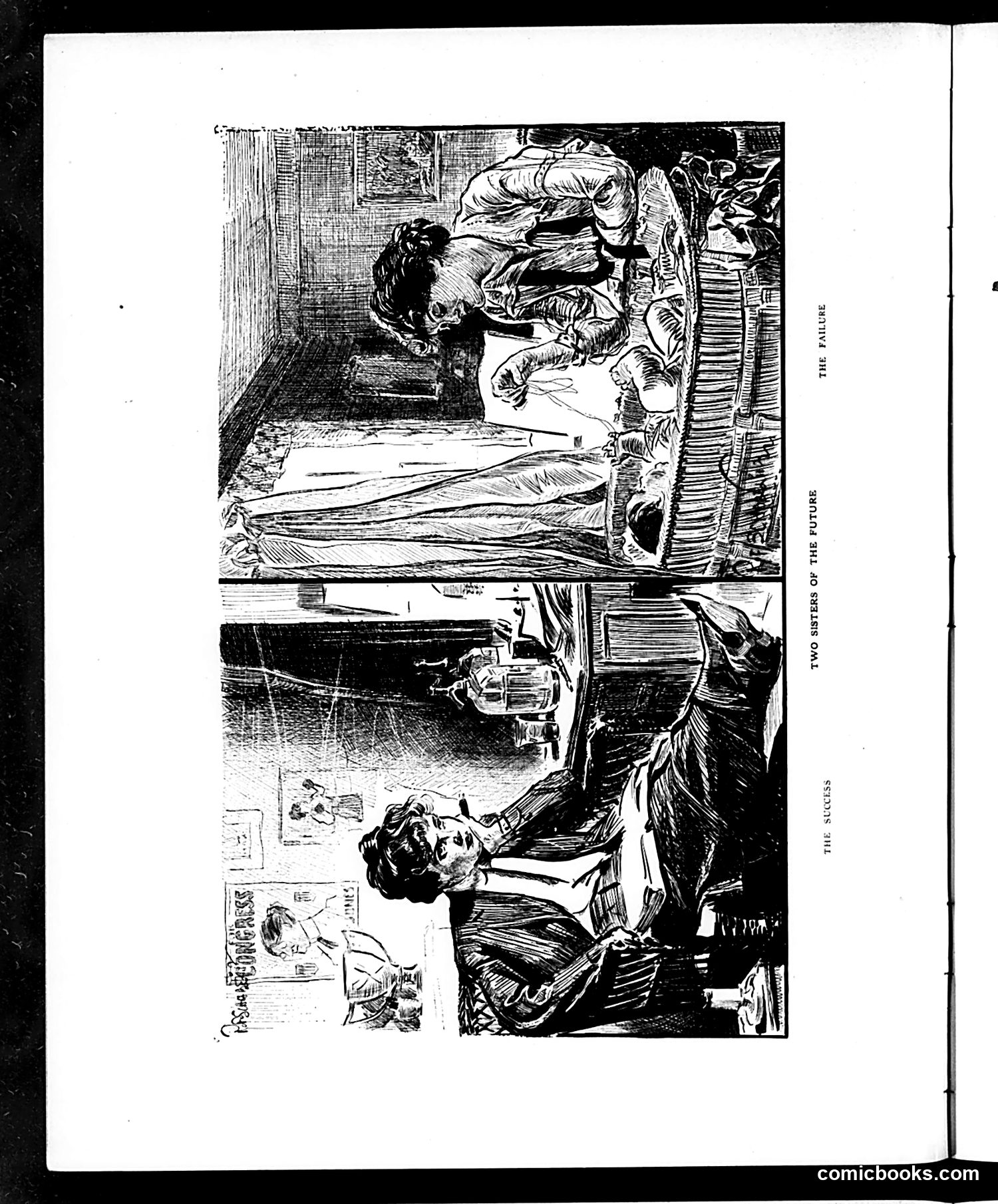
This page contains two black-and-white illustrations printed upside-down relative to each other. The text visible is largely illegible OCR error or reversed text. The images appear to be satirical sketches in a Victorian or early 20th-century style, depicting domestic or social scenes with multiple figures. The artistic technique uses cross-hatching and line work typical of period engravings. Without legible accompanying text identifying the specific figures, events, or political references, I cannot reliably explain what satire or social commentary these cartoons intended. The page quality and OCR errors prevent accurate identification of any caricatured individuals or specific topical references. To properly interpret these cartoons' meaning, the original publication date, issue number, and readable caption text would be essential context.
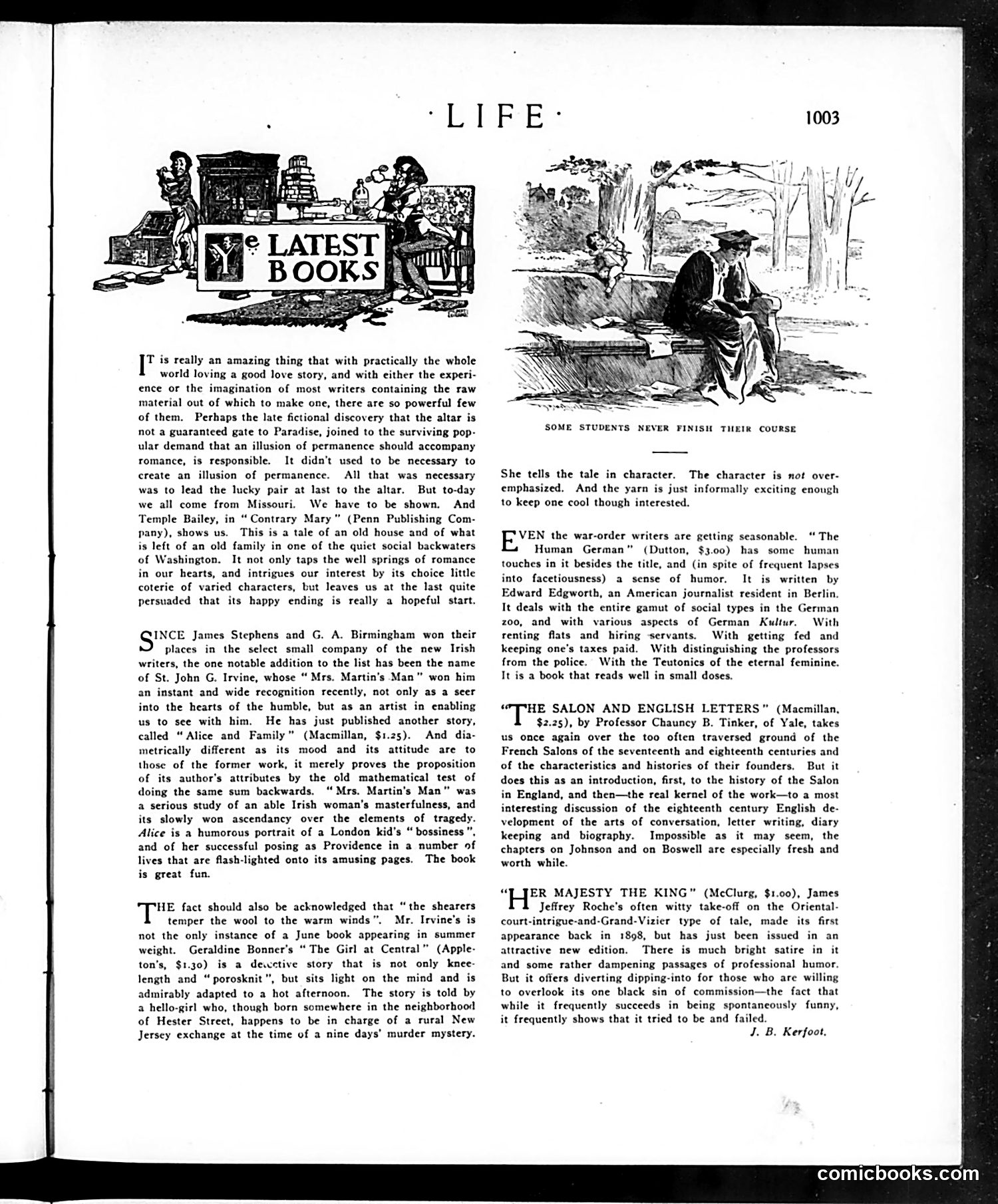
This page is a **book review section** titled "The Latest Books," not a political cartoon. It discusses several contemporary novels and their merit as summer reading. The main illustration shows two students by a riverside with the caption "Some Students Never Finish Their Course"—likely a humorous reference to how light summer reading can distract from serious study. The reviews discuss Irish writer St. John G. Irvine's works, Temple Bailey's "Contrary Mary," and notably **"The Human German" by Edward Edgworth**, an American journalist in Berlin. This last review is significant given its 1915 publication date—during World War I. The reviewer describes it as treating German society with humor and humanity despite "frequent lapses into facetiousness," suggesting an attempt at fair-minded observation of the enemy nation during wartime. The page reflects literary culture of the Progressive Era, when magazines like *Life* positioned themselves as arbiters of taste for educated readers.
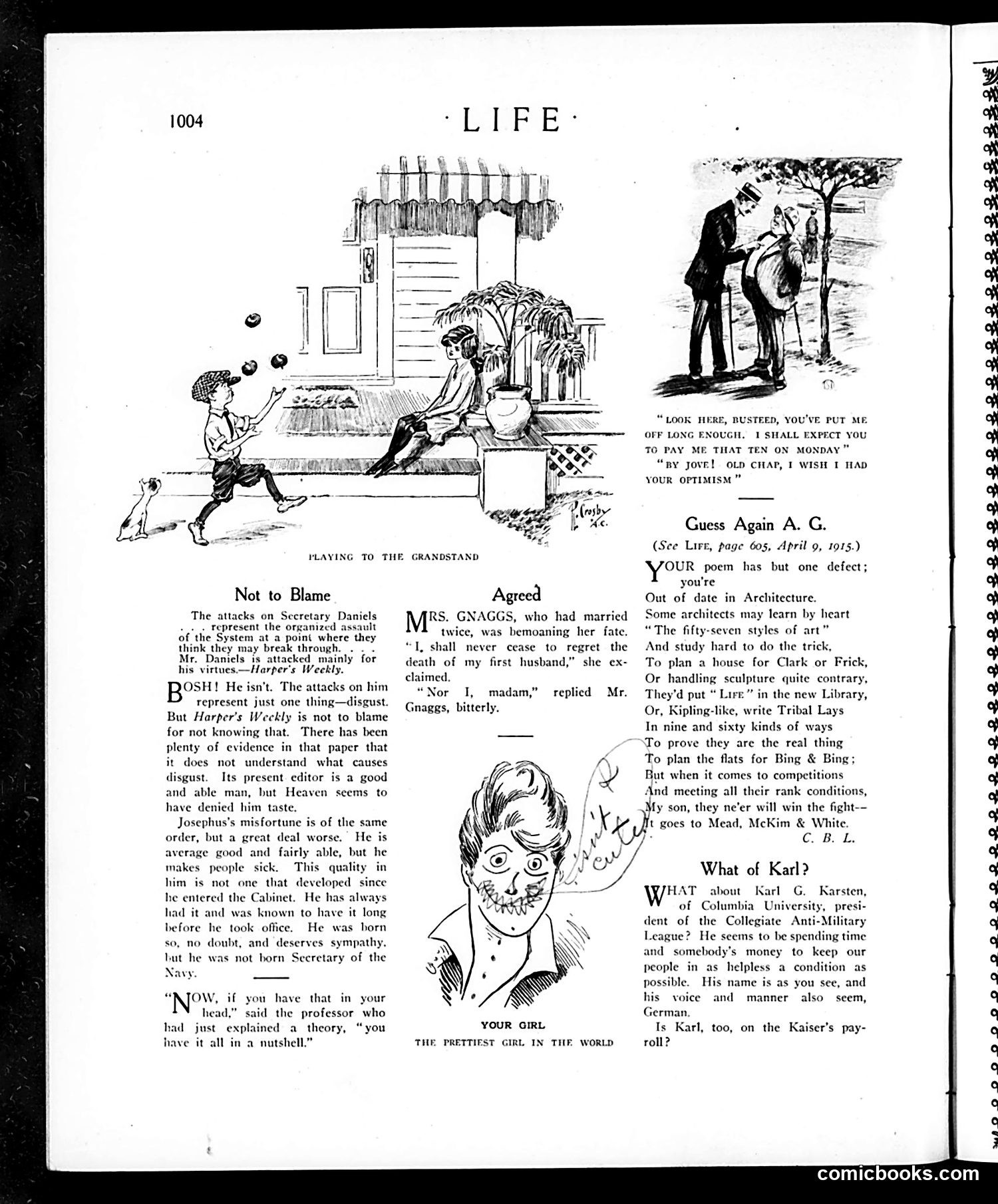
This page contains three separate satirical pieces: 1. **"Playing to the Grandstand"** (left): A child juggling while adults watch from a porch, illustrating the article "Not to Blame"—which criticizes how people blame political figures (specifically referencing Mr. Daniels) for society's problems without understanding root causes. 2. **"Agreed"** (center): A domestic scene where Mrs. Gnaggs regrets her first marriage while her current husband replies bitterly—a marital humor cartoon. 3. **"Your Girl: The Prettiest Girl in the World"** (right): A caricatured woman's face, accompanying text about Karl G. Karsten of Columbia University's Anti-Military League. The page is typical Life magazine satirical commentary mixing domestic humor with gentle political and social criticism from the 1915 era.
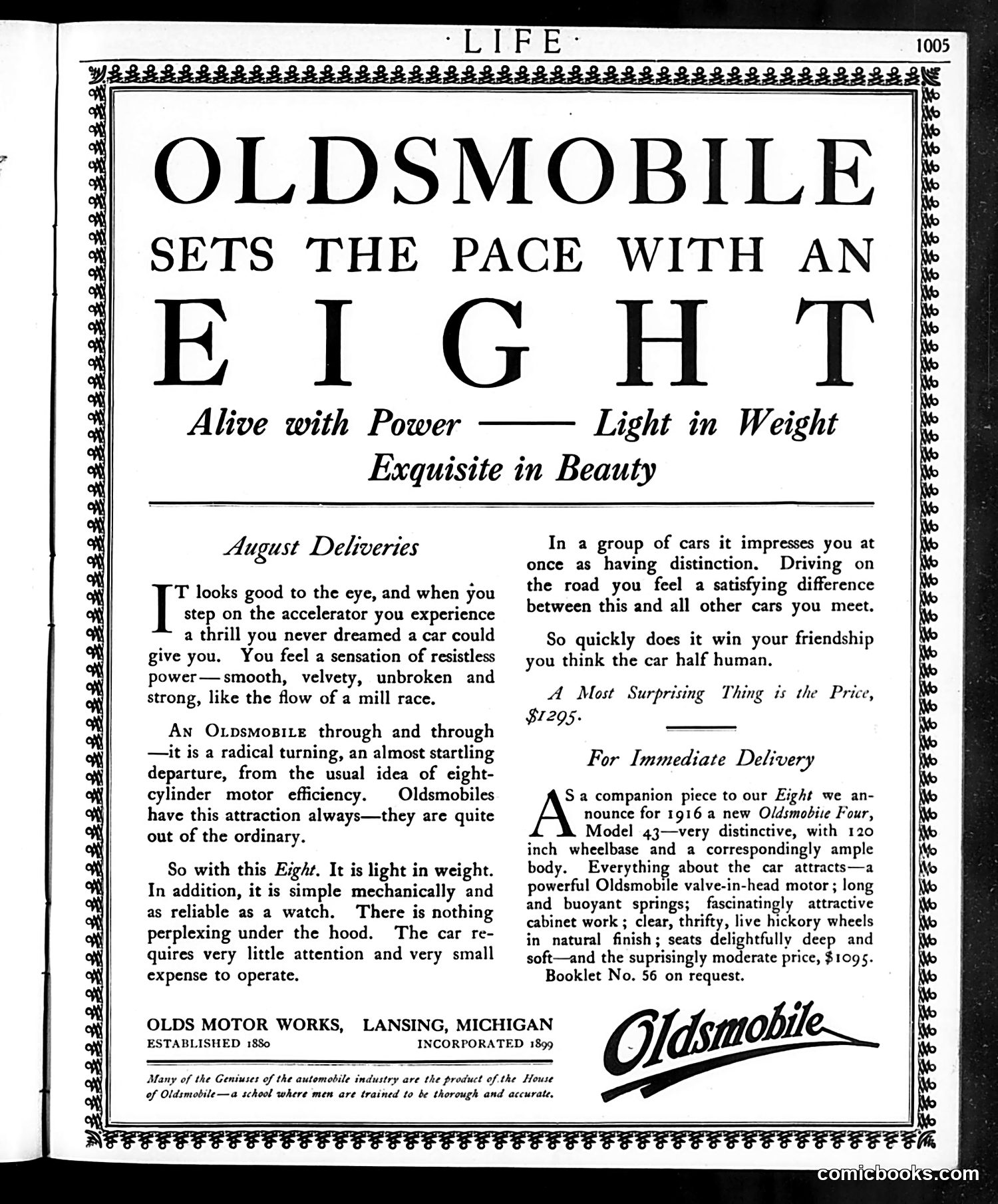
This is **not a satirical cartoon page**—it's a straightforward advertisement for Oldsmobile automobiles, appearing in *Life* magazine around 1915-1916. The page promotes two Oldsmobile models: the "Eight" (an eight-cylinder car priced at $1,295) and the "Four" (a four-cylinder model at $1,095). The ad uses typical early automotive marketing language, emphasizing power, reliability, and surprisingly low prices for the era. Key claims include the car's mechanical simplicity ("There is nothing perplexing under the hood"), smooth performance, and emotional appeal ("you think the car half human"). The only humor is mild—describing the car's attraction as almost human-like—but this is genuine marketing copy, not satire. *Life* magazine, while known for satirical cartoons, also carried paid advertisements. This page exemplifies how early 20th-century car manufacturers marketed automobiles as revolutionary consumer goods combining power, luxury, and affordability.
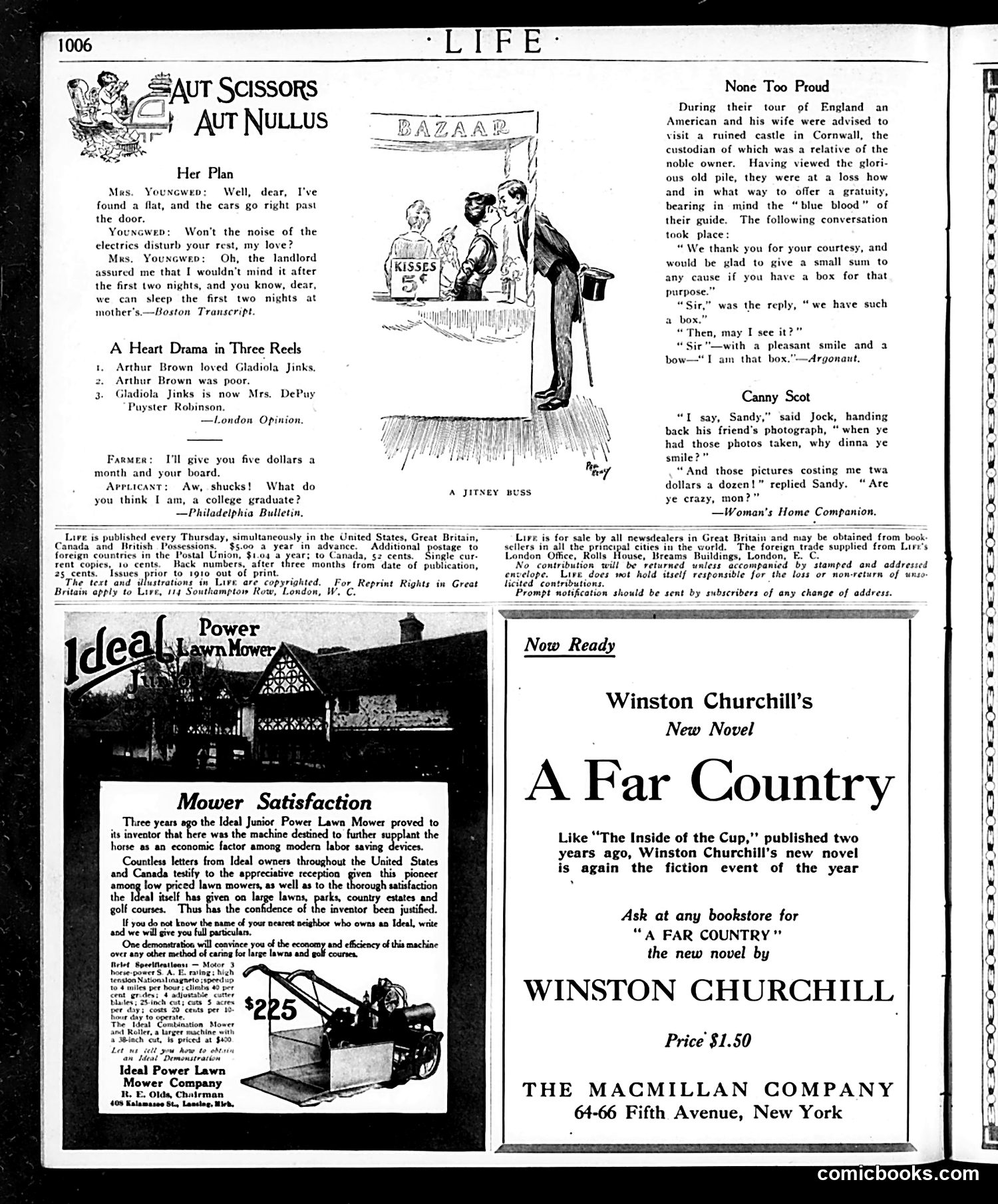
This page from *Life* magazine contains several brief humorous anecdotes and advertisements typical of early 20th-century satire. The cartoons mock social pretensions and class anxieties. "Her Plan" jokes about a couple prioritizing a flat's convenience over noise. "A Heart Drama" sardonically notes that poor Arthur Brown lost his love to a wealthier man. "None Too Proud" depicts an American tourist embarrassed offering money to an English aristocrat's poor relative—the guide's witty response ("I am that box") suggests genteel poverty masquerading as dignity. "Canny Scot" mocks Scottish thriftiness: a man won't smile in his photograph because smiling wouldn't justify the two-dollar cost. The page also advertises Winston Churchill's novel *A Far Country* and an "Ideal Power Lawn Mower"—reflecting the magazine's mixed audience of middle-class readers interested in literature and new labor-saving technology. The humor relies on class consciousness, national stereotypes (Scottish frugality, American naïveté), and gentle mockery of social climbing—concerns that defined genteel American humor of this era.
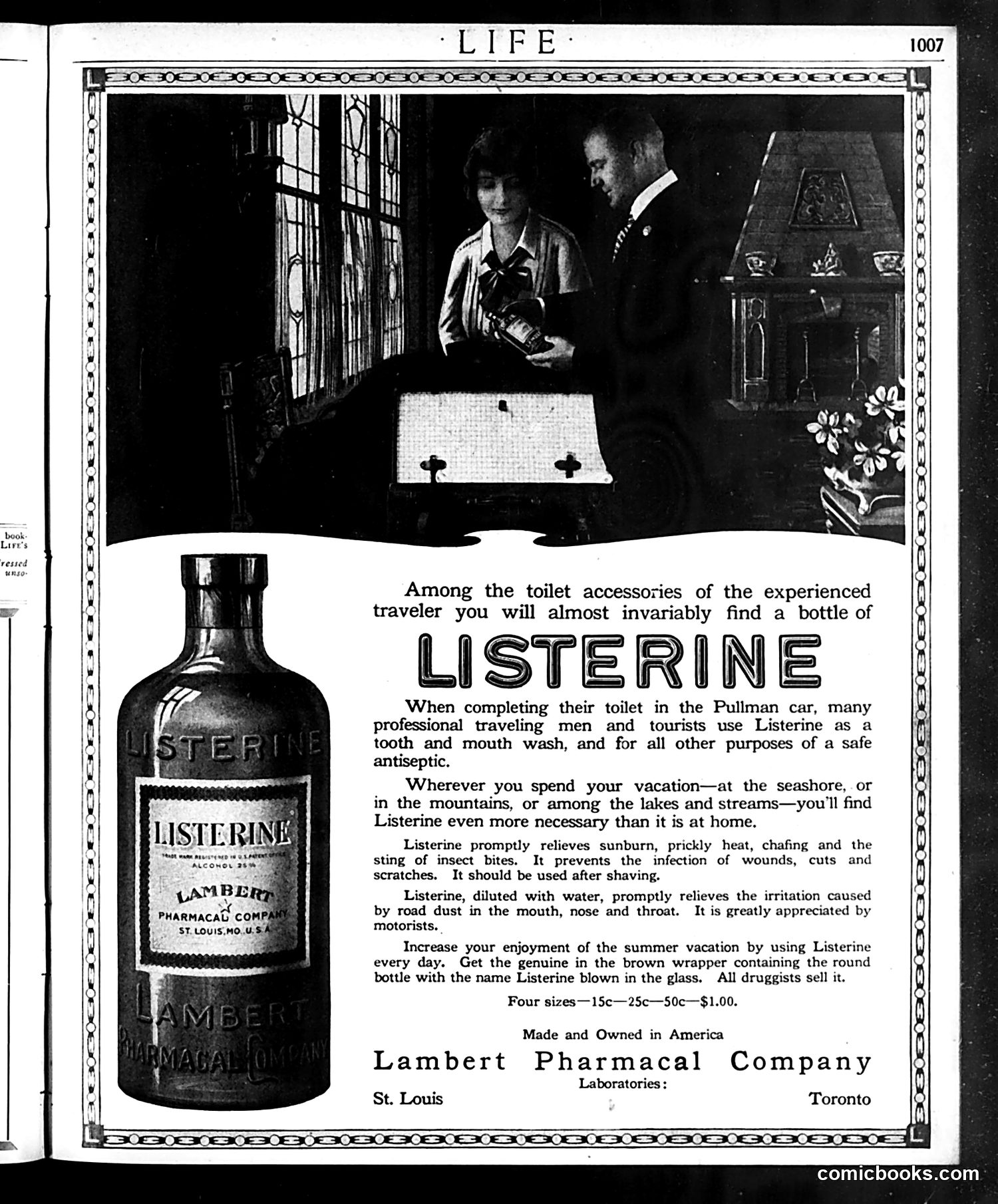
This page is primarily a **product advertisement** for Listerine antiseptic mouthwash by Lambert Pharmacal Company, not political satire. The image shows two men and a woman in what appears to be a Pullman railroad car examining a bottle of Listerine. The ad targets middle-class travelers, positioning the product as an essential vacation accessory for wealthy tourists visiting seaside and mountain resorts. The pitch emphasizes Listerine's versatility: mouth wash, antiseptic for cuts and sunburn relief, treatment for "prickly heat" and insect bites—ailments common to early 20th-century vacationers. The advertisement exploits anxieties about hygiene and the discomforts of travel while suggesting that using Listerine signals sophistication and proper grooming among "experienced travelers." The four price points ($0.15–$1.00) indicate varying bottle sizes for different budgets.
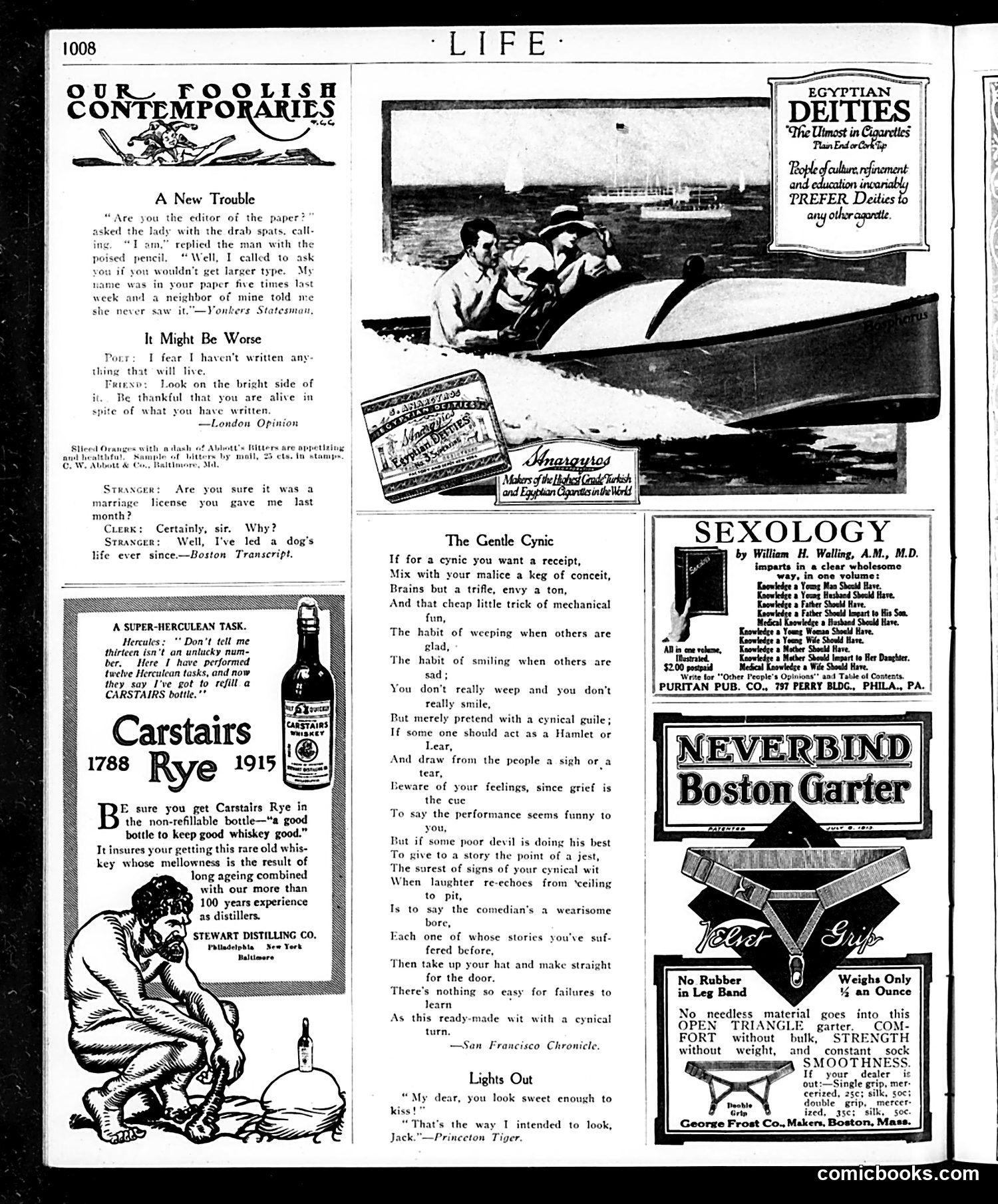
This page contains several short humorous anecdotes and advertisements typical of *Life* magazine's satirical humor circa 1915. **The cartoons/jokes:** - "A New Trouble" mocks vanity—a woman complains her name appeared in the paper five times but wasn't noticed due to small type size - "It Might Be Worse" offers dark comfort: a pessimist fears nothing he writes will endure; a friend responds he should be grateful to be alive despite his writing - "A Super-Herculean Task" jokes that refilling a whiskey bottle is harder than Hercules's legendary twelve tasks - "The Gentle Cynic" defines cynicism as fake emotion and contrarianism—pretending to weep at tragedy, calling comedians boring, leaving early to seem superior **Context:** These reflect early 20th-century anxieties about modern life, vanity, and performative attitudes. The advertisements (whiskey, garters, books on Egyptian deities and "sexology") show period consumer goods. The humor relies on wordplay and social observation rather than visual cartooning.
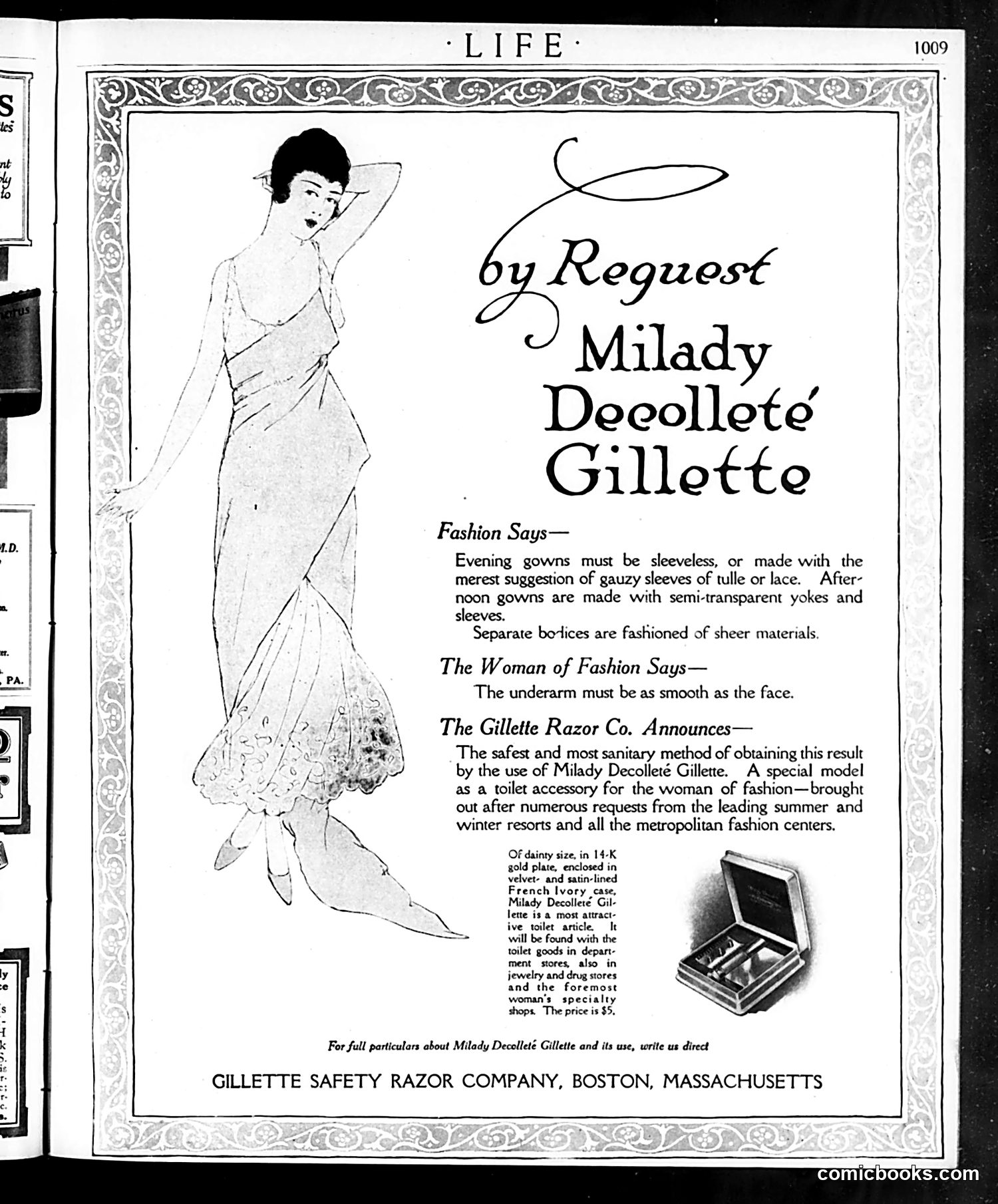
This is primarily a **Gillette Safety Razor advertisement**, not satire. It targets fashionable women by exploiting fashion anxiety. The ad links two things: (1) current fashion trends requiring sleeveless and sheer-sleeved evening gowns that expose the underarm, and (2) a supposed beauty requirement that underarms "must be as smooth as the face." By framing underarm hair removal as a fashion necessity rather than optional grooming, Gillette created demand for their new "Milady Decolleté" razor—a luxury item ($5, in a gold-plated French ivory case) marketed as essential for fashionable women. The illustration shows an elegant woman in the sleeveless gowns the ad describes, visually demonstrating why the product is supposedly "needed." This represents early **consumer marketing that manufactured desire** by connecting products to social status and fashion compliance—a technique still used today.
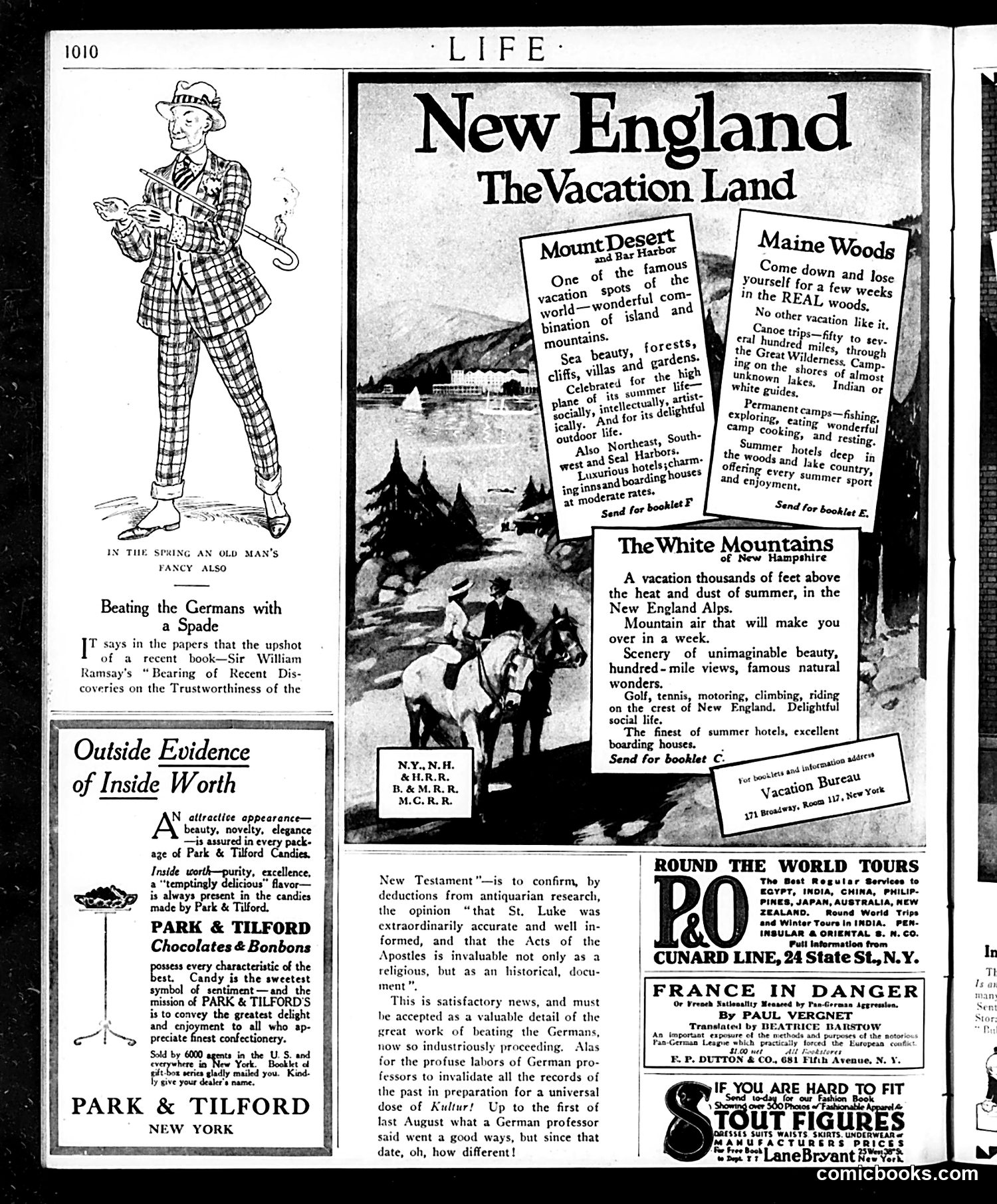
This page mixes travel advertising with satirical commentary on World War I. **Main Cartoon:** "Beating the Germans with a Spade" references the recent book by Sir William Ramsay about the historical accuracy of the New Testament's Acts of the Apostles. The satire is subtle: the author argues that validating ancient historical texts is now part of the war effort against Germany—a pointed jab at how thoroughly WWI had penetrated all aspects of culture and intellectual discourse. **The Punchline:** German professors previously held authority through scholarly work, but "since that date" (apparently August 1914, when WWI began), their academic credibility has collapsed. Everything—even biblical scholarship—has become weaponized in the conflict. **Context:** This reflects American attitudes during WWI, when German intellectual and scientific authority was being systematically discredited as part of anti-German propaganda. The surrounding vacation advertisements for New England destinations appear unrelated to the satire.
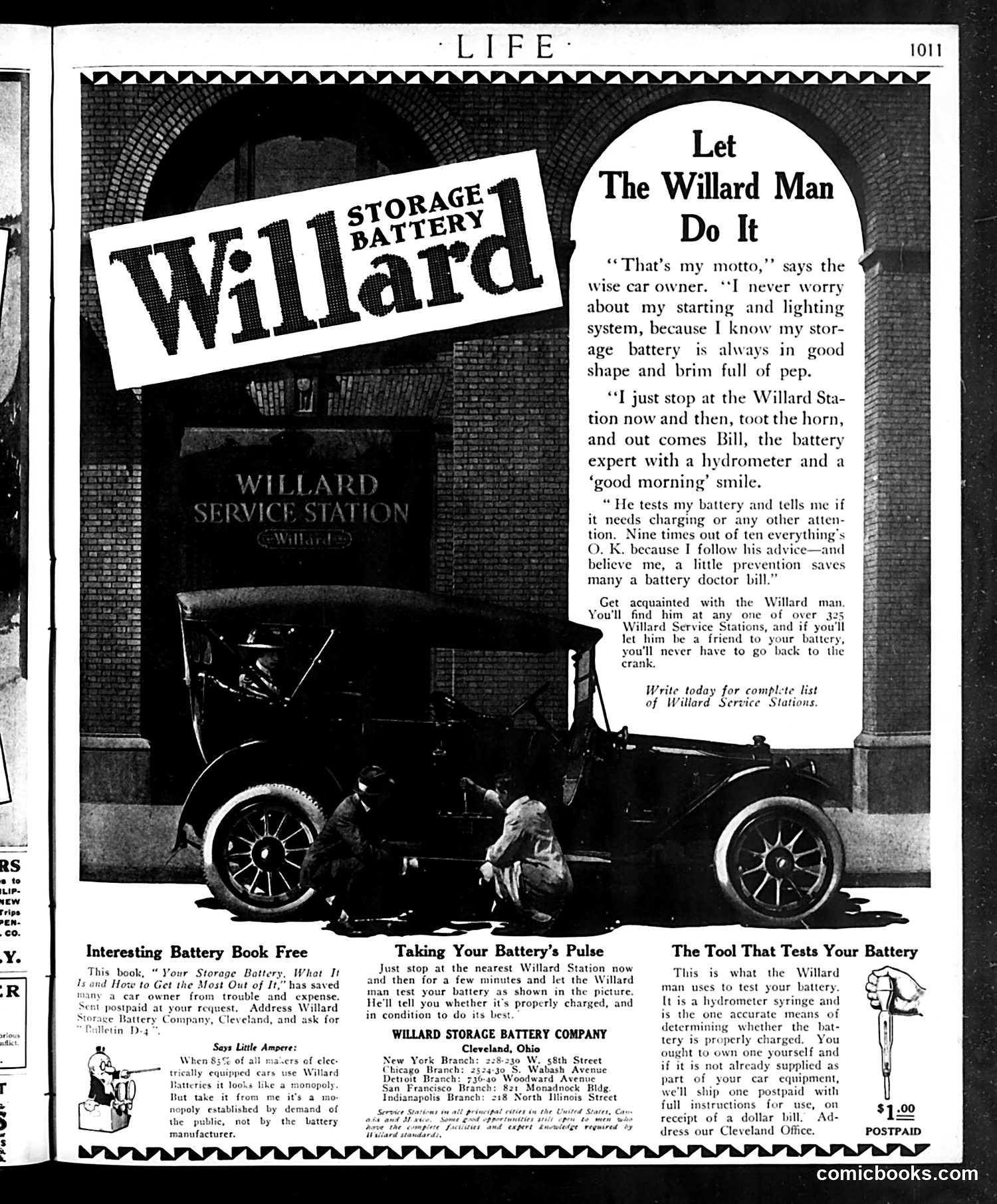
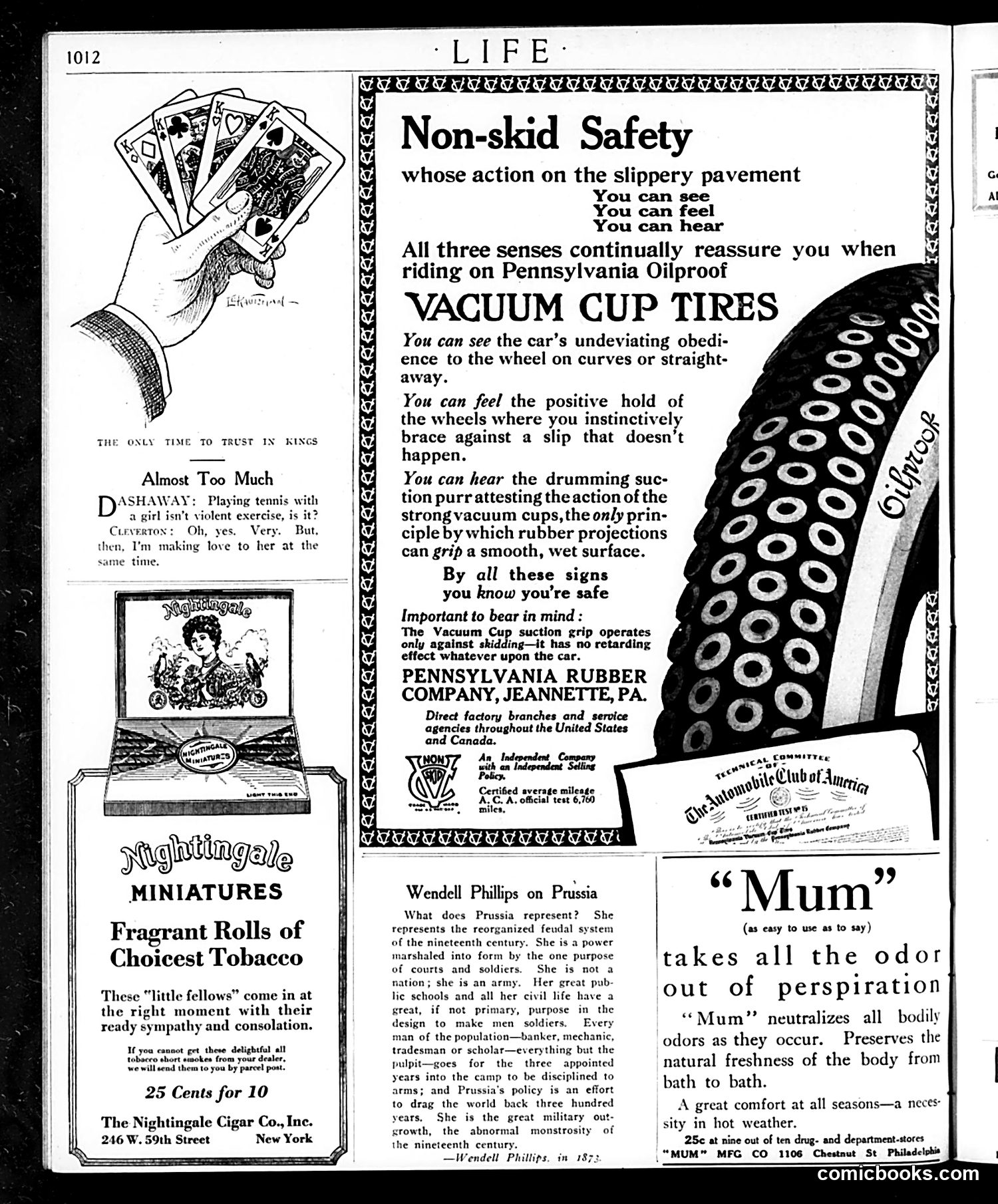
This page is primarily **advertisements and filler content** with minimal satirical cartooning. The opening cartoon, "The Only Time to Trust in Kings," is a brief joke: a man claims playing tennis with a girl isn't violent exercise because he's simultaneously making love to her—a mild double entendre about romantic distraction. The bulk of the page consists of **product advertisements**: Pennsylvania Rubber Company's "Vacuum Cup Tires" (emphasizing safety on wet roads), Nightingale cigars, and "Mum" deodorant. The only substantive editorial content is a **Wendell Phillips quote from 1873** criticizing Prussia as a militaristic state designed to turn citizens into soldiers—likely included because this magazine circulated during or near World War I, making commentary on Prussian militarism topically relevant to American readers. The page reflects early 20th-century *Life* magazine's mixed format of light humor, advertising, and occasional serious commentary.
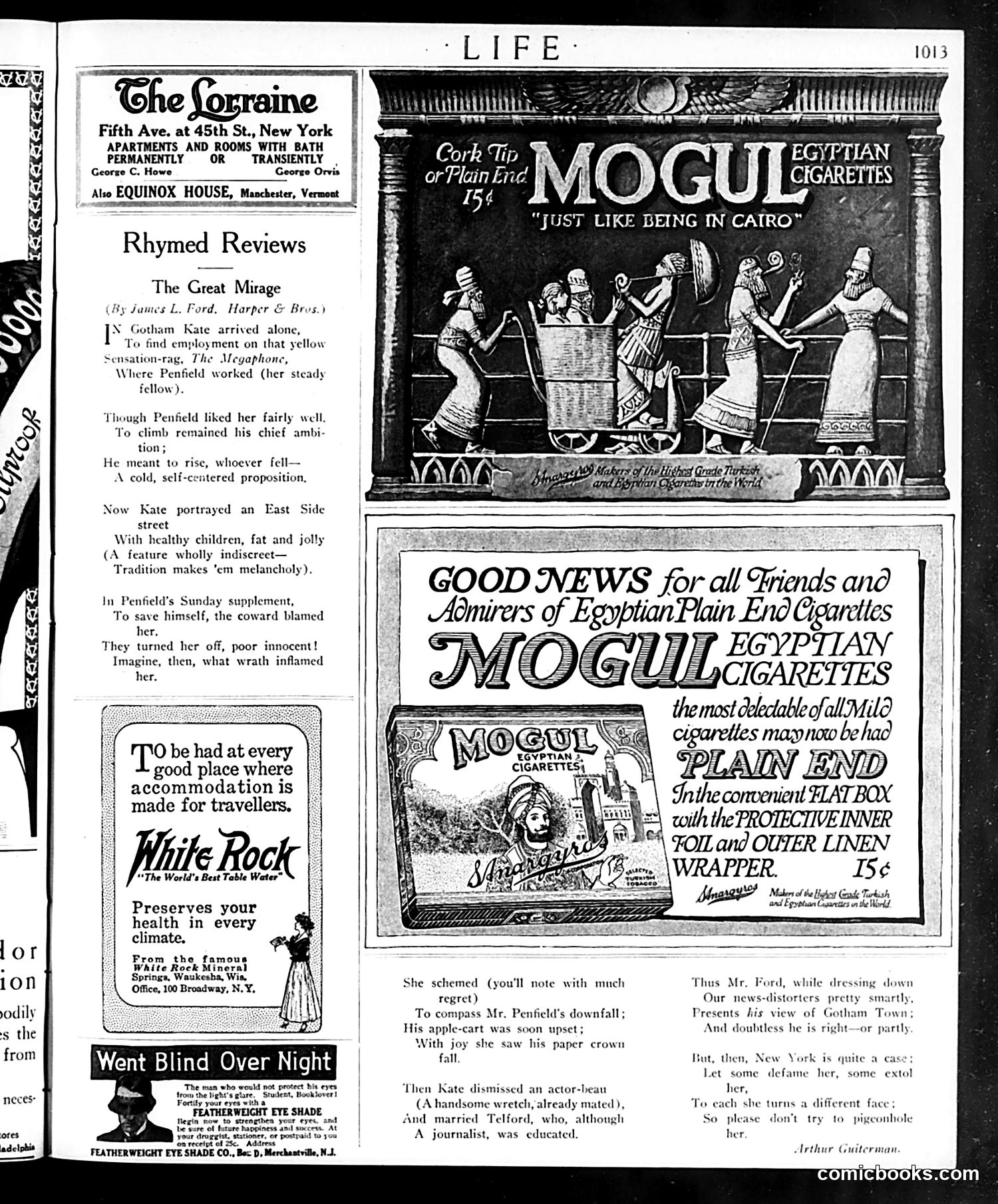
This page features a serialized poem reviewing James L. Ford's novel *The Great Mirage*. The narrative satirizes yellow journalism and workplace ethics in early 1900s New York. **The Story:** Kate, a young woman seeking employment at a sensationalist newspaper called *The Megaphone*, falls for her coworker Penfield. When Kate writes a sympathetic feature about East Side children (considered unrealistic for the cynical press), Penfield—a self-serving climber—blames her in his Sunday supplement to protect himself. She's fired. **The Satire's Point:** The poem mocks both the ruthlessness of ambitious newspapermen and the hypocrisy of yellow journalism, which exploited human interest stories while employing morally bankrupt editors. Kate ultimately marries a *properly educated* journalist (not merely ambitious), suggesting virtue lies in ethical journalism, not sensationalism. The surrounding advertisements (cigarettes, water, eyeshades) are typical period clutter; not integral to the satire.
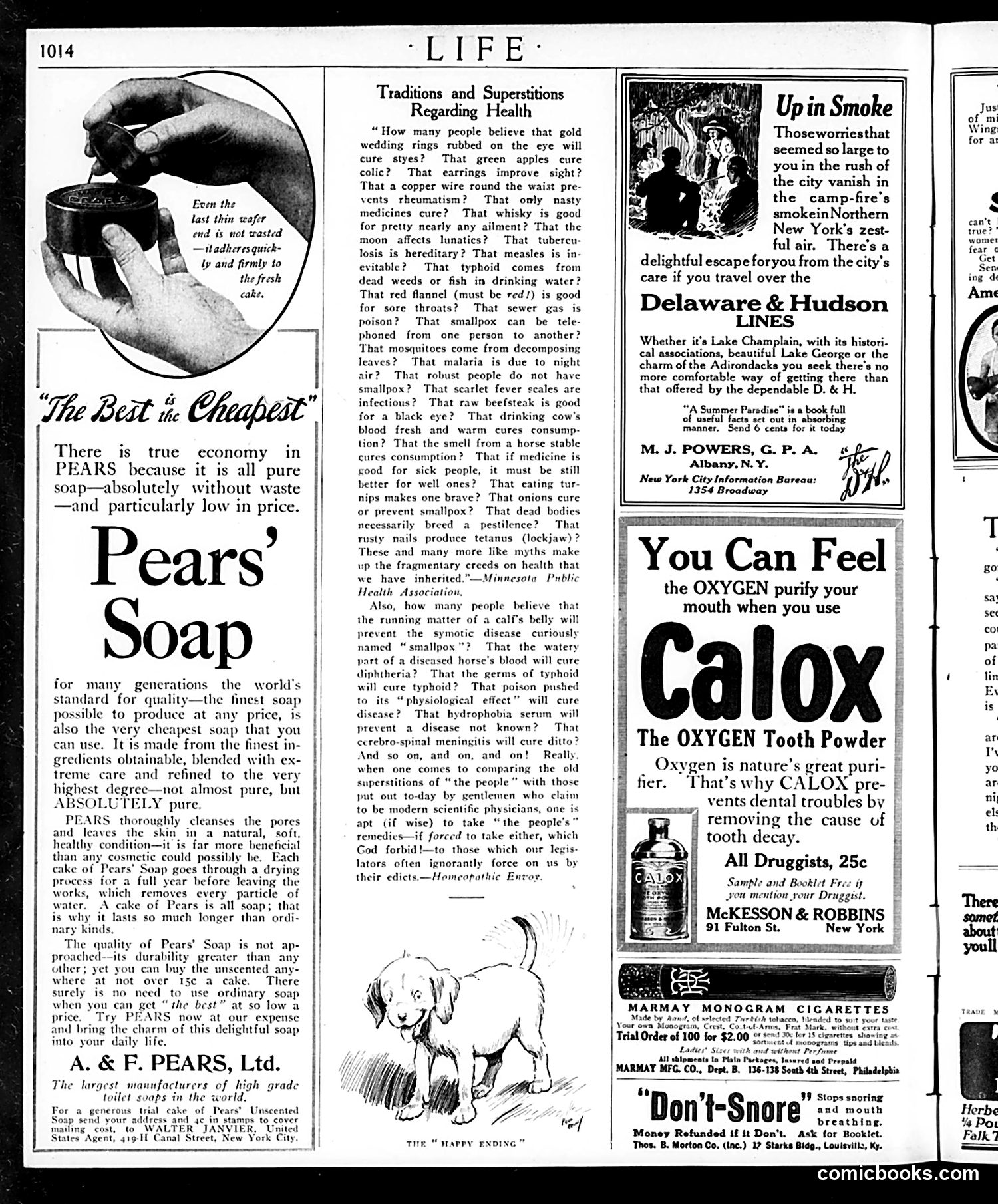
This page is primarily **advertising**, dominated by a Pears' Soap advertisement featuring a hand holding soap and claims of economy and purity ("absolutely pure"). The satirical content appears in the center column under "Traditions and Superstitions Regarding Health." This is a **critique of folk medicine and quack remedies**—both historical superstitions (copper wire for rheumatism, red flannel for sore throats) and contemporary medical claims made by early 20th-century doctors. The piece's point: modern physicians' dubious treatments (hydrophobia serum for unknown diseases, poison as medicine) are essentially **no better than old wives' tales**. The author suggests that if forced to choose between traditional folk remedies and contemporary "scientific" medicine, one might reasonably prefer the former. This reflects period skepticism toward early medical pseudoscience and the tension between folk wisdom and emerging medical establishment authority—a notably modern debate dressed in early 1900s language.
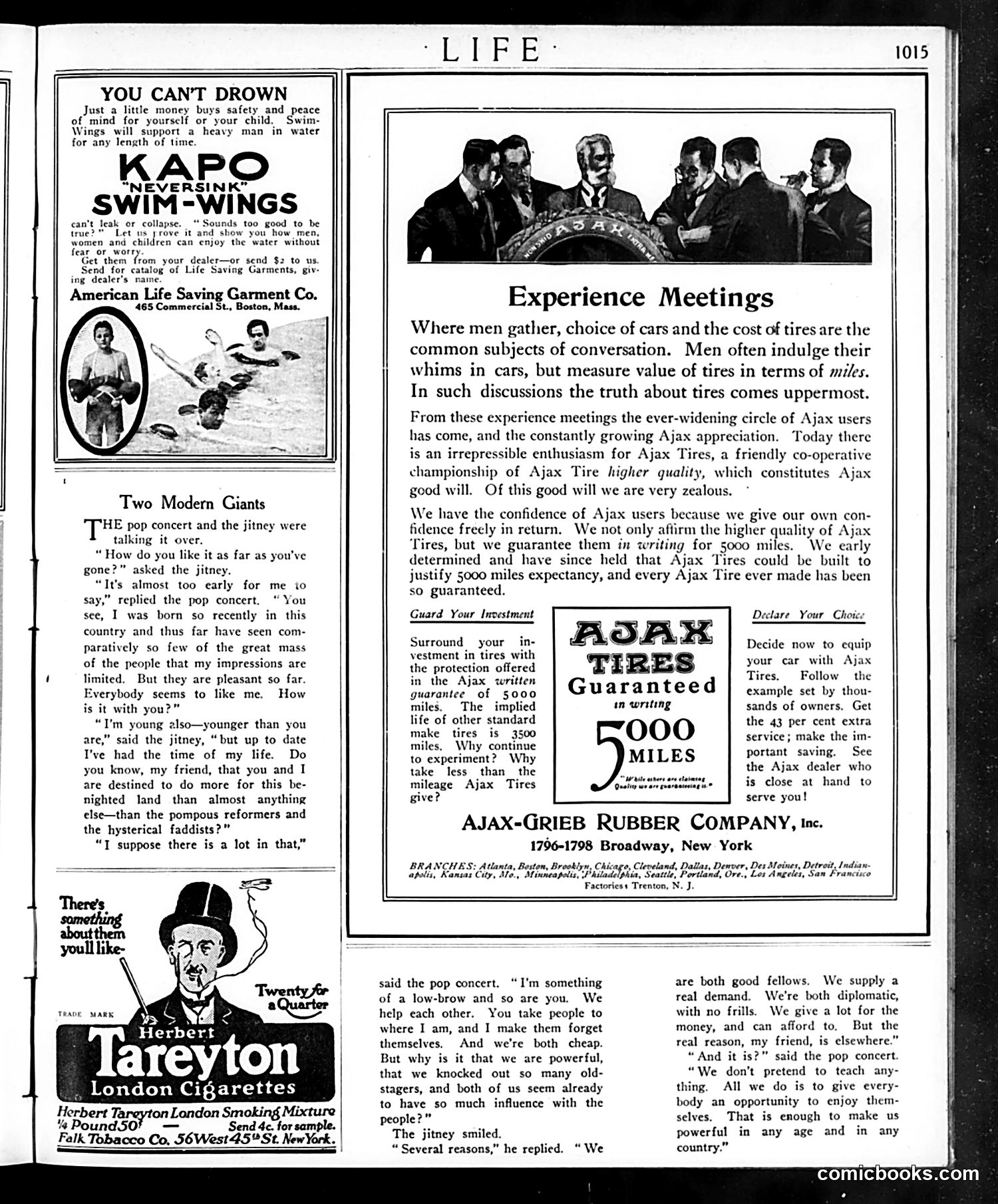
This satirical dialogue personifies two recent American innovations—the "pop concert" and the "jitney" (an inexpensive shared taxi)—as self-satisfied newcomers boasting of their social impact. The joke targets the cultural anxiety of the era: both phenomena were genuinely disrupting established society. Jitneys undercut streetcar monopolies, while popular concerts democratized entertainment previously confined to elite venues. The cartoon captures reformers' and establishment figures' alarm at these "cheap" mass-market forces. The figures aren't specific people but rather represent types—the smug upstarts congratulating themselves on their power to displace "old-stagers" (established institutions and values). Their self-awareness about being "low-brow" and cheap, yet influential, mocks their popularity while reflecting genuine contemporary concern that mass culture and affordable transportation were reshaping American society in unpredictable ways. The satire is directed at both the innovations themselves and at anxieties about modernity.
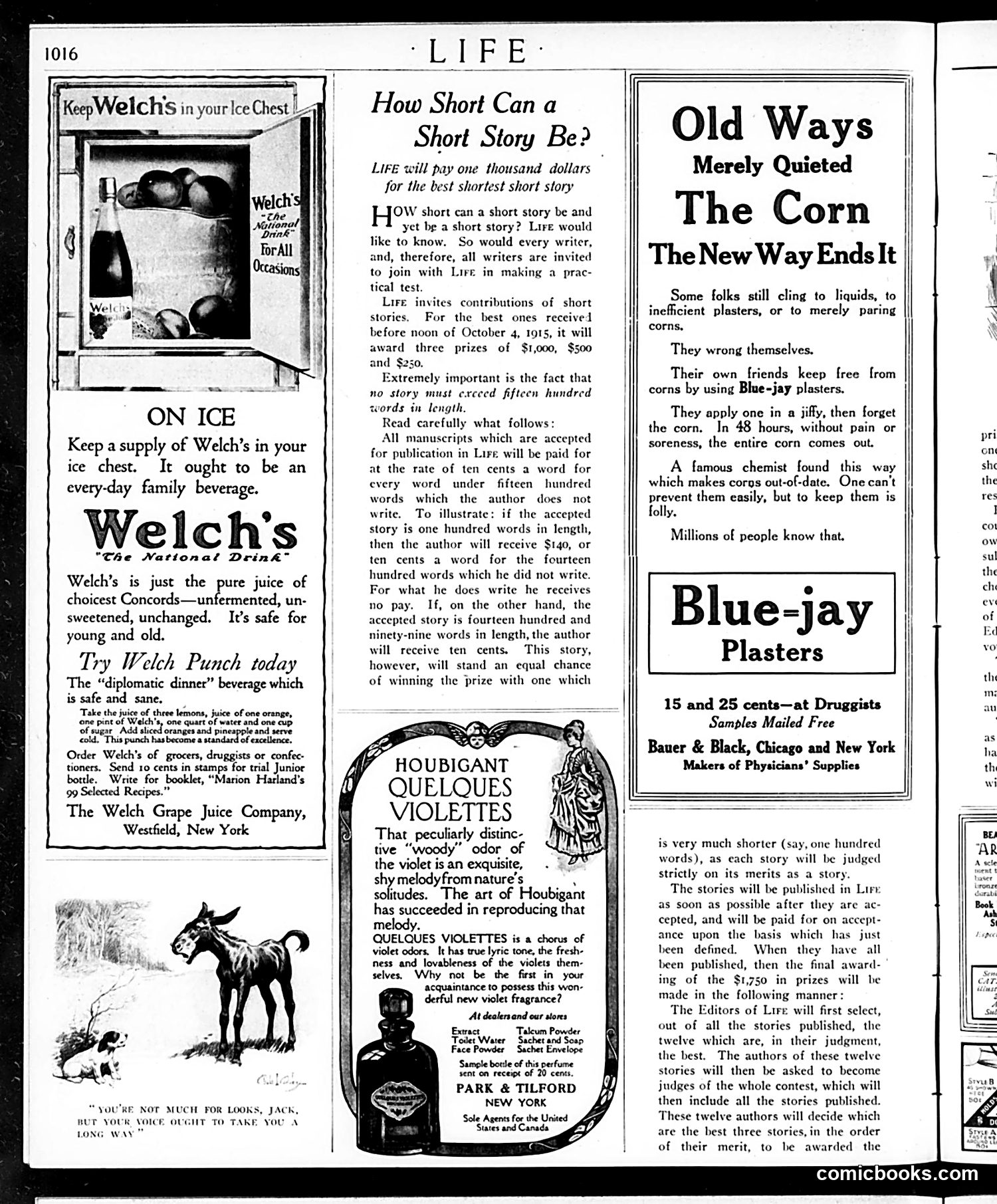
This page mixes advertisements with editorial content. The main feature is Life's short-story contest announcement: they're offering $1,000 for the shortest viable short story, with an unusual payment structure—authors earn ten cents per word *not* written (up to 1,500 words). This creates satire on literary economics: a 100-word story pays $140 for words the author *didn't* write, while a 1,499-word story earns only ten cents. The joke satirizes both publishers' cost-cutting and writers' struggles. The cartoon at bottom left shows a voice teacher telling an unpromising student: "YOU'RE NOT MUCH FOR LOOKS, JACK, BUT YOUR VOICE OUGHT TO TAKE YOU A LONG WAY"—darkly humorous commentary on limited opportunities for the unattractive. Surrounding ads (Welch's grape juice, Blue-Jay corn plasters, Houbigant perfume) are typical period advertising, not satirical.
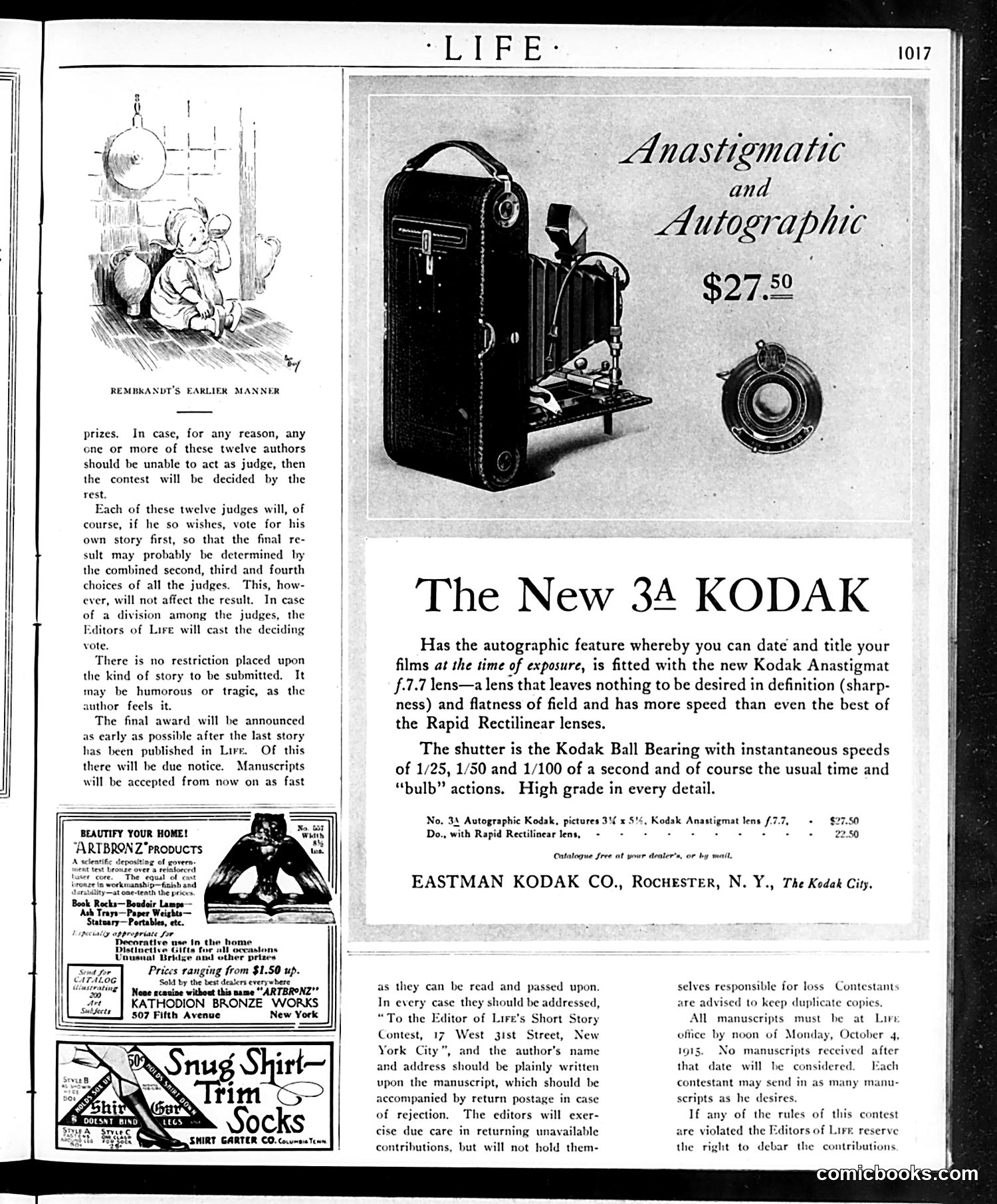
This page is primarily **advertising and contest announcements**, not political satire. The small sketch titled "Rembrandt's Earlier Manner" (upper left) appears to be a humorous drawing in the style of old master paintings—likely satirizing overly serious or pretentious art by depicting a cherub-like figure in classical composition. The dominant content is a **Life magazine short-story contest announcement** and a **Kodak camera advertisement**. The contest invites submissions judged by twelve unnamed authors, with detailed rules about submissions, deadlines (October 4, 1913), and judging procedures. The Kodak 3A advertisement promotes a camera with autographic and anastigmatic features—technical innovations allowing photographers to date/title films and achieve superior lens quality. The other advertisements (Artbronz products, Snug Shirt Trim Socks) are standard period merchandise pitches. **There is no significant political or social satire on this page**—it's a commercial/administrative page typical of early 20th-century magazines mixing editorials with advertisements.
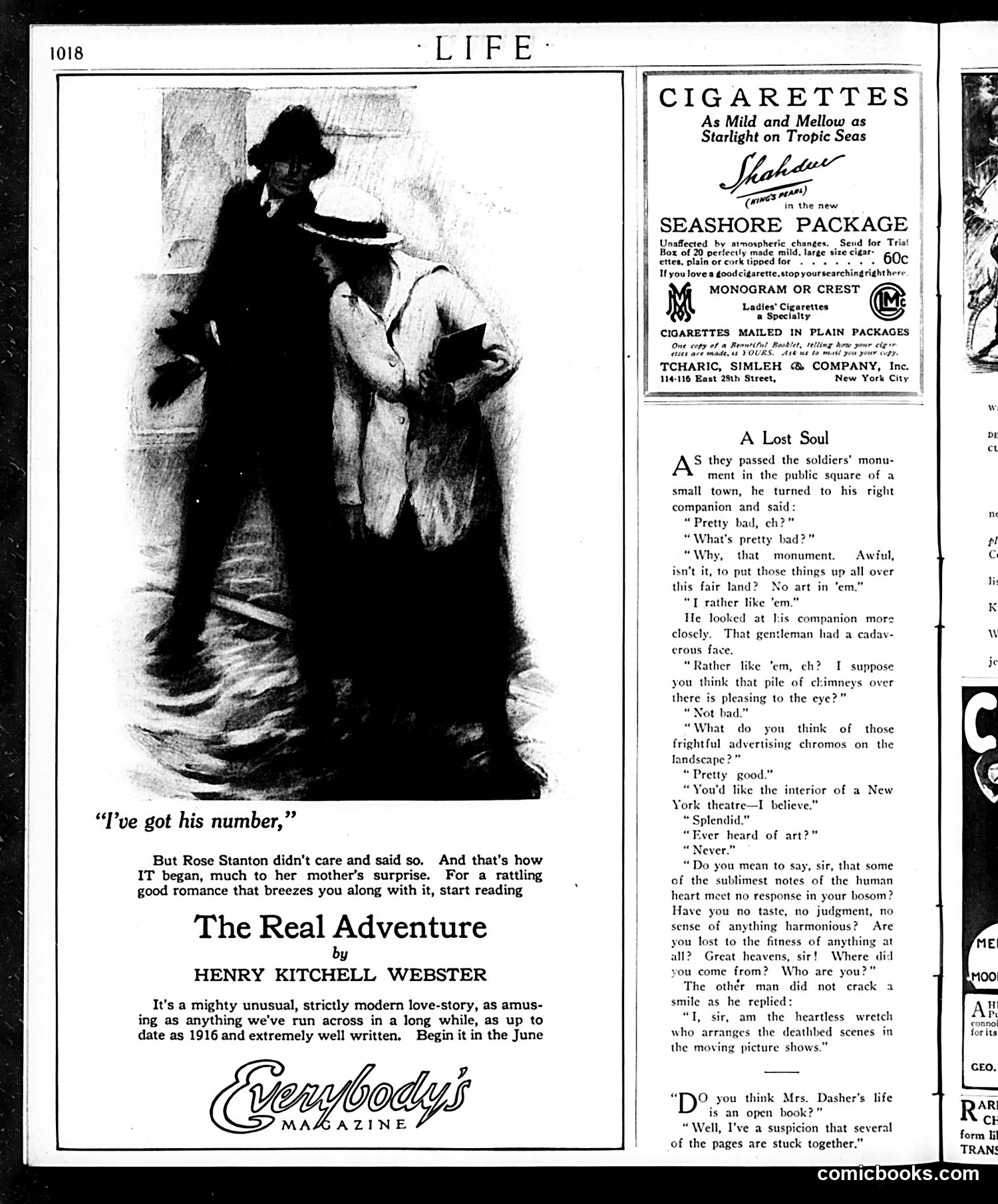
This short comic piece satirizes pretentious artistic criticism. Two men pass a soldiers' monument in a town square. One character—appearing to be an aesthete or art snob—dismisses the monument as lacking artistic merit, then criticizes various aspects of the landscape: factory chimneys, advertisements, even a theater interior. His companion agrees with everything, responding positively to what the snob condemns. The joke's punchline reveals the second man works arranging "deathbed scenes" for moving pictures—he has no genuine taste; he simply accepts whatever is presented. The satire mocks those who adopt contrarian artistic positions as markers of sophistication, suggesting such criticism is hollow and performative rather than grounded in actual aesthetic judgment. The piece appears in *Life* magazine (1916), which frequently published social commentary through humor.
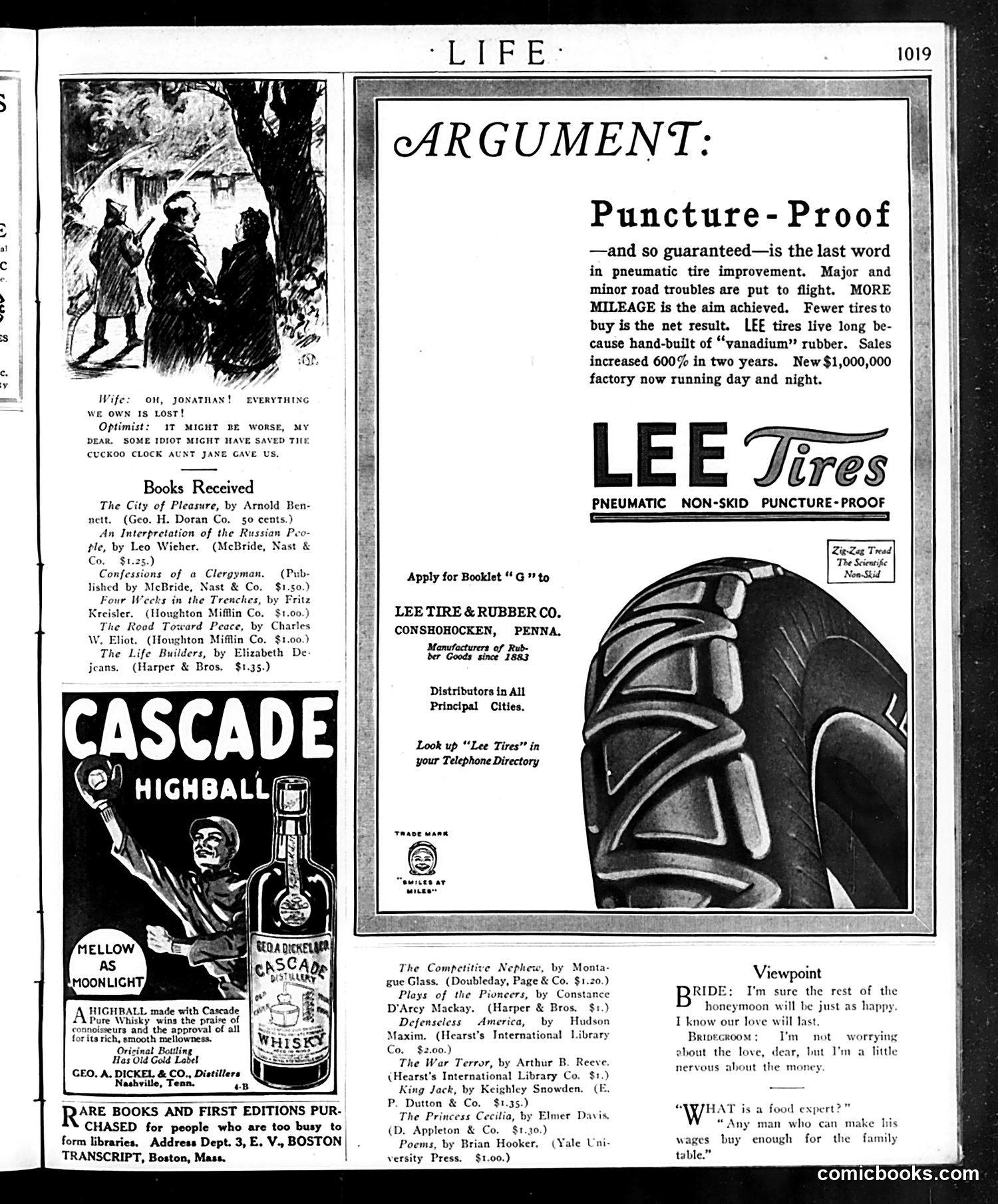
The main cartoon depicts a domestic disaster: a wife tells her husband Jonathan that "everything we own is lost!" The husband, labeled "Optimist," responds that it could be worse—some fool might have saved Aunt Jane's cuckoo clock (a wedding gift universally understood as ugly and worthless). The joke satirizes forced optimism during hardship, a common wartime attitude. The cuckoo clock represents unwanted familial obligations and tasteless heirlooms—suggesting that losing everything might be preferable to keeping such burdens. The page also includes a honeymoon dialogue mocking newlyweds' romantic ideals: the bride promises love will last forever, while the groom admits he's not worried about love—only money. This reflects post-WWI economic anxiety, where practical financial concerns overshadow romantic sentiment. The advertisements (Lee Tires, Cascade Whisky) fill remaining space, typical for this era's magazine layout.
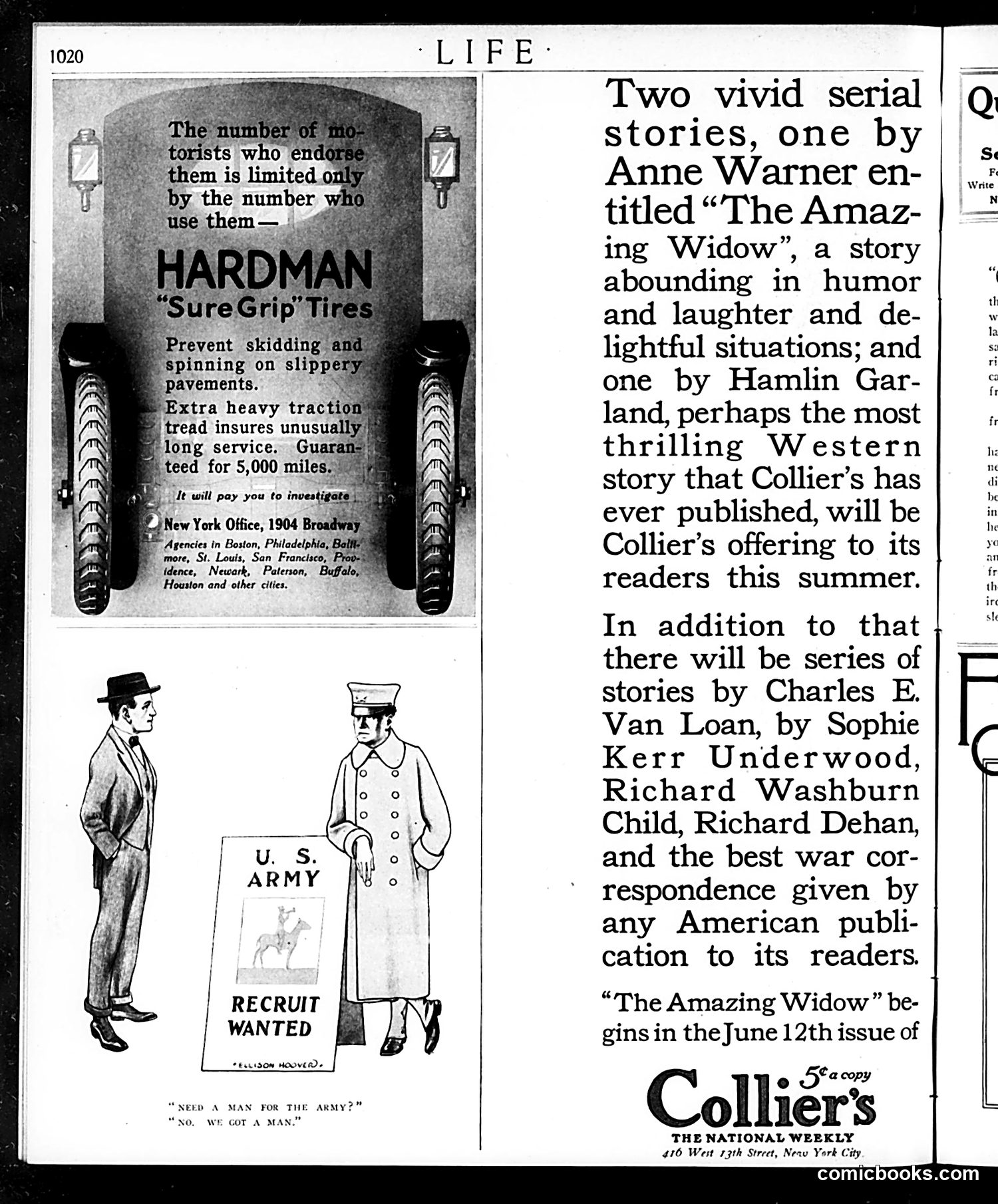
This page mixes advertising with magazine promotion, circa 1910s (based on the Army recruitment context and "war correspondence" reference, likely WWI-era). **The Army Recruitment Cartoon:** A civilian man in a suit stands opposite a U.S. Army soldier. The caption "Need a man for the Army?" / "No, we got a man" is a joke about the civilian's obvious unsuitability—he appears soft, untrained, and the soldier's response implies they've already recruited this incompetent fellow, so they're set. It satirizes either reluctant recruitment or the quality of draftees. **The Hardman Tires Ad:** A standard product advertisement claiming superior traction and 5,000-mile durability. **Collier's Magazine Promotion:** Announces upcoming serialized fiction by notable authors (Anne Warner, Hamlin Garland, Charles Van Loan, etc.) and emphasizes "the best war correspondence given by any American publication"—indicating this is wartime, when readers valued battlefield reporting.
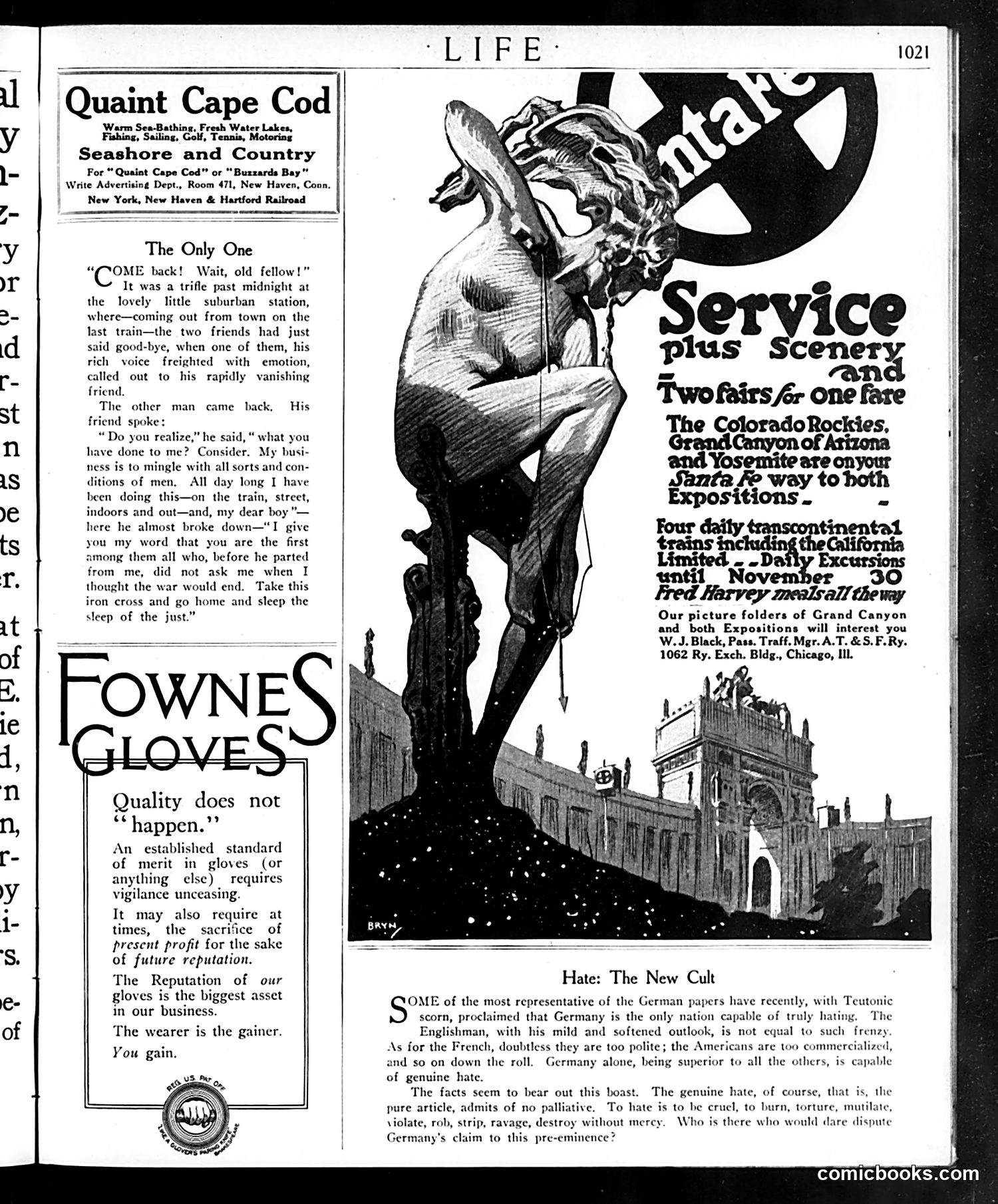
This page contains several distinct elements from a WWI-era Life magazine: **"The Only One" Story**: A satirical anecdote mocking wartime conversation obsession. A businessman thanks his friend for being the only person all day who didn't ask him "when the war would end"—a common preoccupation. The "iron cross" reference is ironic praise for this relief. **"Hate: The New Cult" Article**: A biting critique of German propaganda claims that Germany alone is capable of "genuine hate." Life sarcastically lists German boasts of superiority, then grimly catalogs what "genuine hate" actually means—cruelty, torture, destruction without mercy. The piece implies Germany's claims reveal their brutality rather than validate their strength. The other content is period advertising (Fownes Gloves, Cape Cod tourism, Santa Fe Railway). The overall tone reflects American WWI-era skepticism toward German nationalism and propaganda.
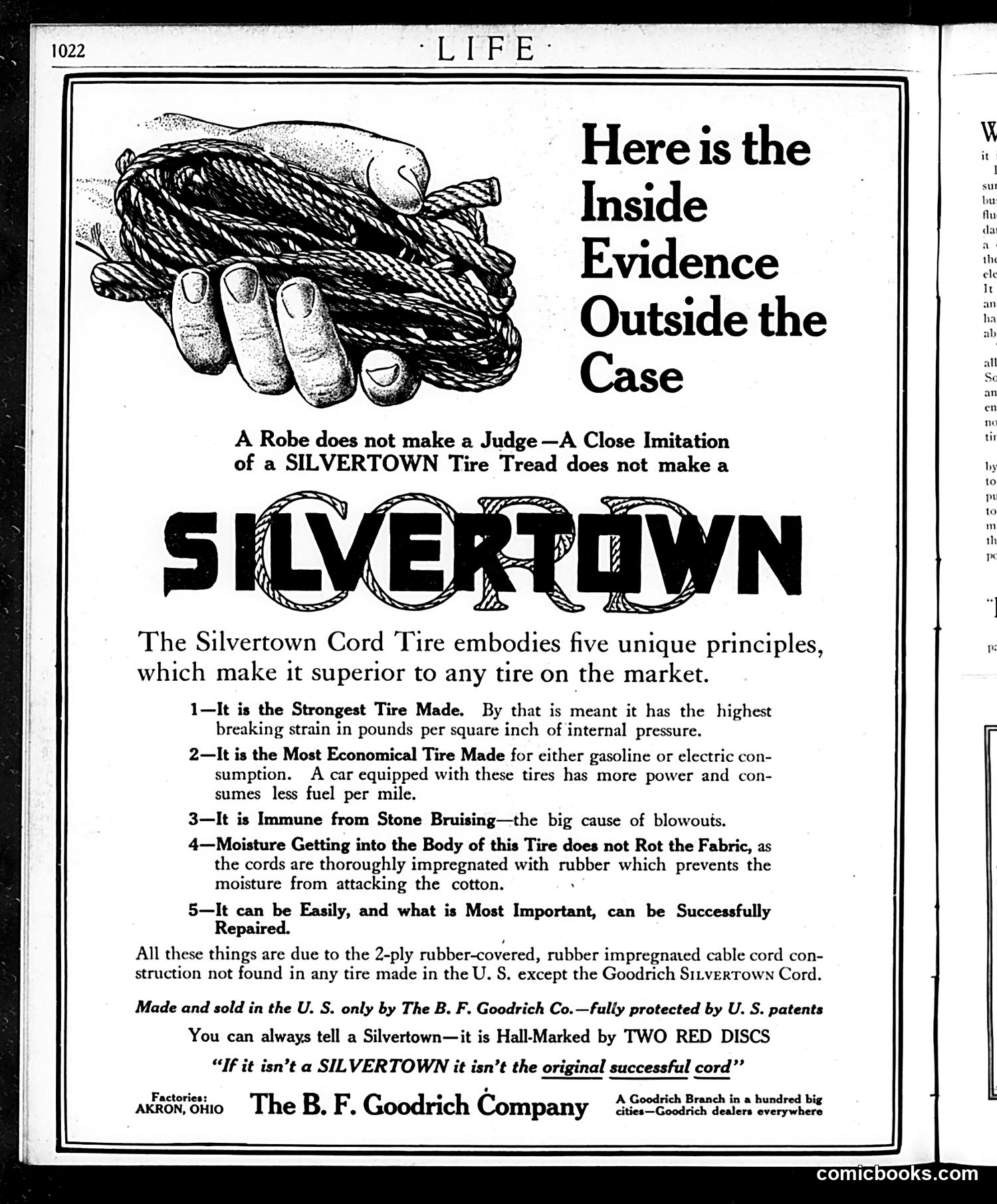
This is primarily a **tire advertisement**, not political satire. The B.F. Goodrich Company is advertising Silvertown Cord Tires in *Life* magazine. The opening analogy—"A Robe does not make a Judge—A Close Imitation of a SILVERTOWN Tire Tread does not make a [Silvertown]"—uses a legal metaphor to warn consumers against counterfeit tires. The message: external appearance alone doesn't guarantee authenticity or quality. The illustration shows a hand holding tire tread, visually emphasizing the product's construction. The ad's five numbered claims highlight technical superiority: strength, fuel efficiency, durability, moisture resistance, and repairability. The warning at bottom—"If it isn't a SILVERTOWN it isn't the original successful cord"—and the mention of "TWO RED DISCS" as identifying markers suggest the company faced significant competition from imitators, making brand authentication crucial to consumers in this era of early automobile manufacturing.
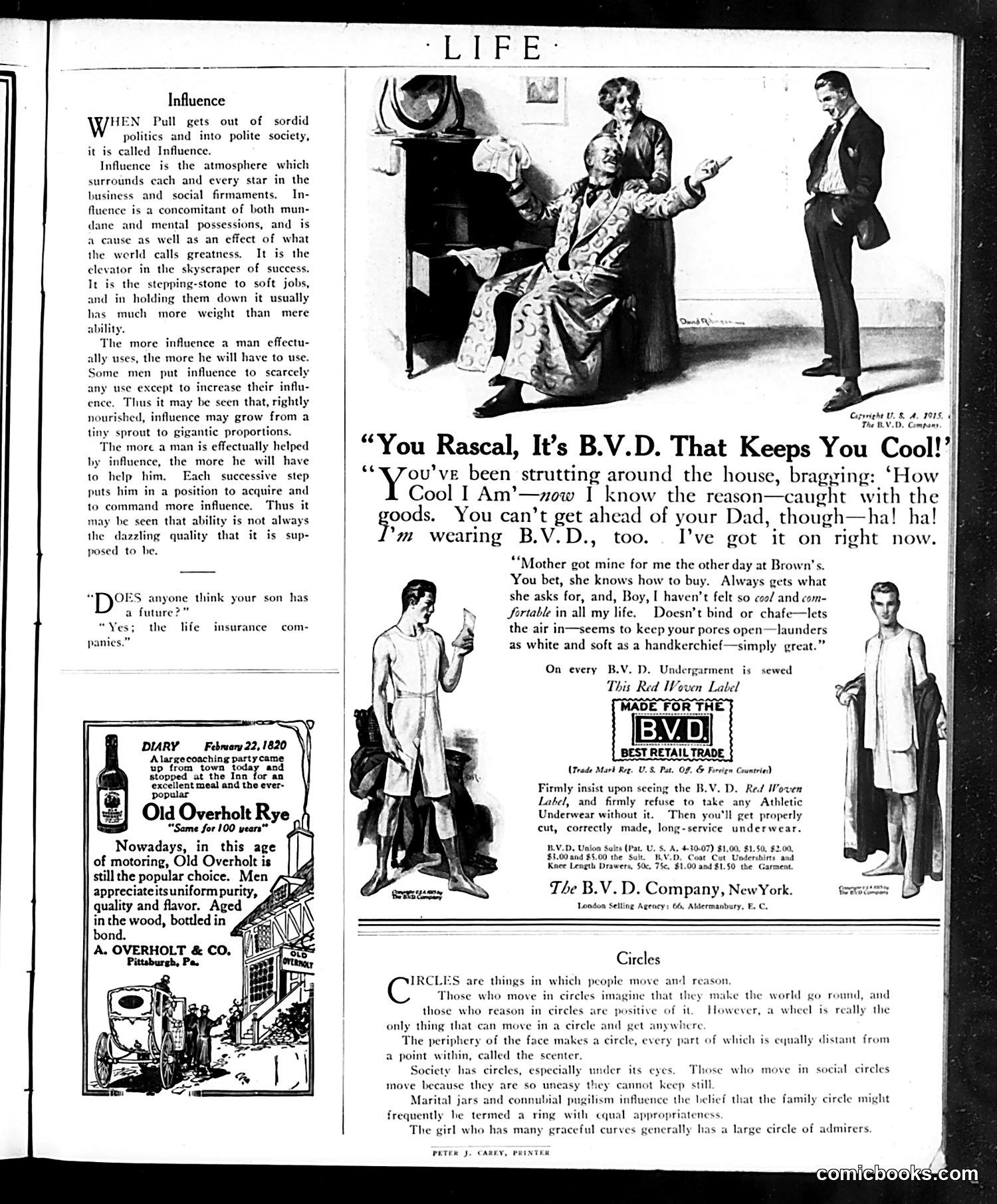
This page mixes editorial content with period advertising. The top essay "Influence" discusses how social/business connections matter more than ability for advancement—a timeless satirical jab at nepotism and networking. The main cartoon depicts a son bragging about being "cool" (fashionable) until his father reveals he wears **B.V.D. underwear** too—the actual reason. This is a straightforward advertisement disguised as humor: the joke is that B.V.D.'s cooling, breathable design explains the boy's confidence. The family dialog emphasizes the product's breathability and laundering quality. The "Circles" section is philosophical wordplay about social hierarchies and relationship dynamics, touching on gossip ("society circles under its eyes") and marriage. The page is primarily **advertising-driven content**—Life magazine published such branded editorial to promote products while maintaining entertainment value. The B.V.D. ad is the page's commercial centerpiece.
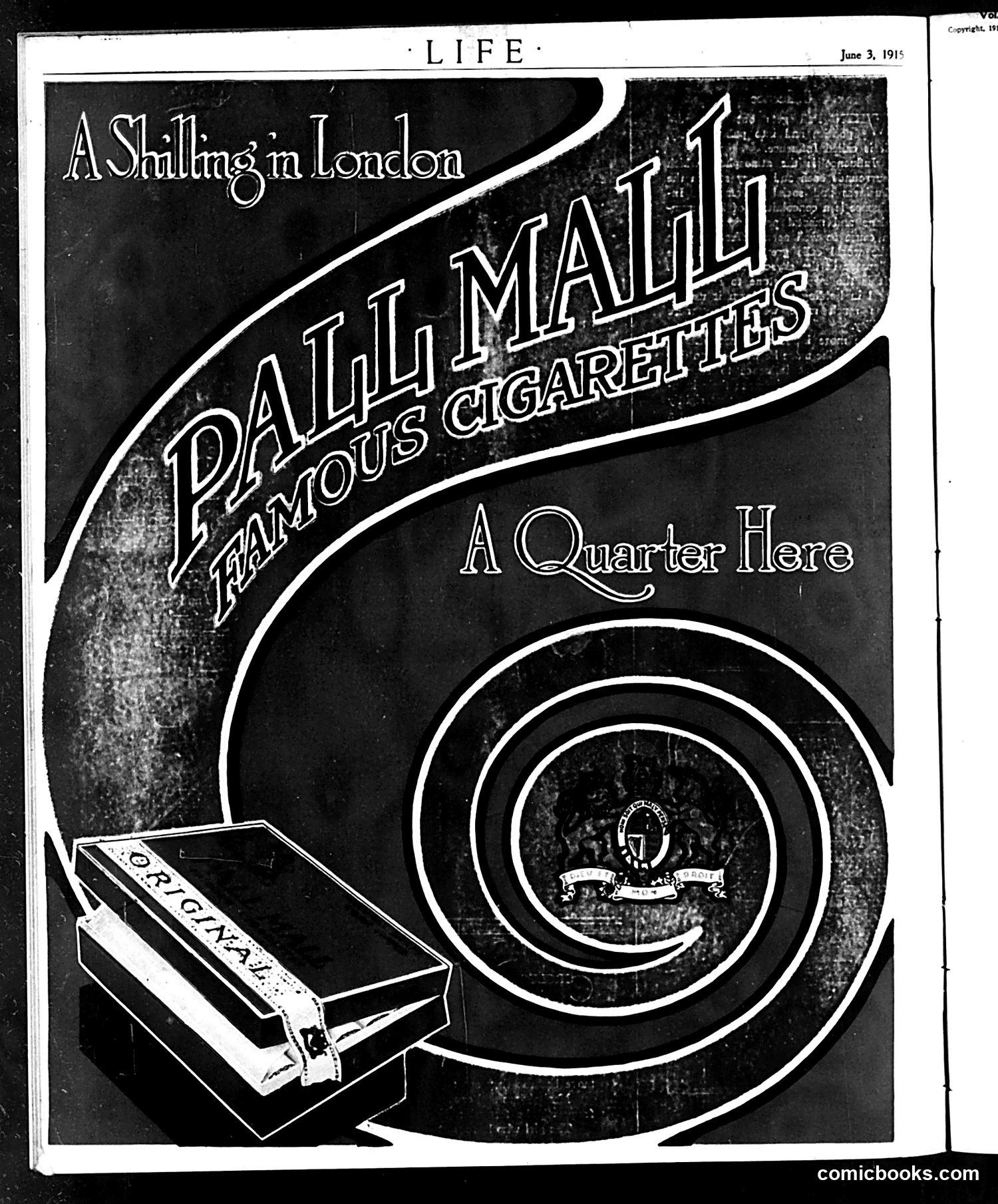
This is a June 1915 LIFE magazine advertisement for Pall Mall Famous Cigarettes. The ad uses a visual pun: "A Shilling in London" appears at top left, while the main image shows a large coin (the concentric circles design) with what appears to be a small figure in the center, playing on the phrase "A Quarter Here" (referring to a U.S. quarter's value). The ad compares British and American currency values—a shilling versus a quarter—to humorously suggest Pall Mall cigarettes offer excellent value in both markets. A cigarette package sits in the lower left corner. This is straightforward commercial advertising using wordplay about international currency rather than political satire.