
Life, 1915-06-03 · page 17 of 52
Life — June 3, 1915 — page 17: what you’re looking at
What you’re looking at
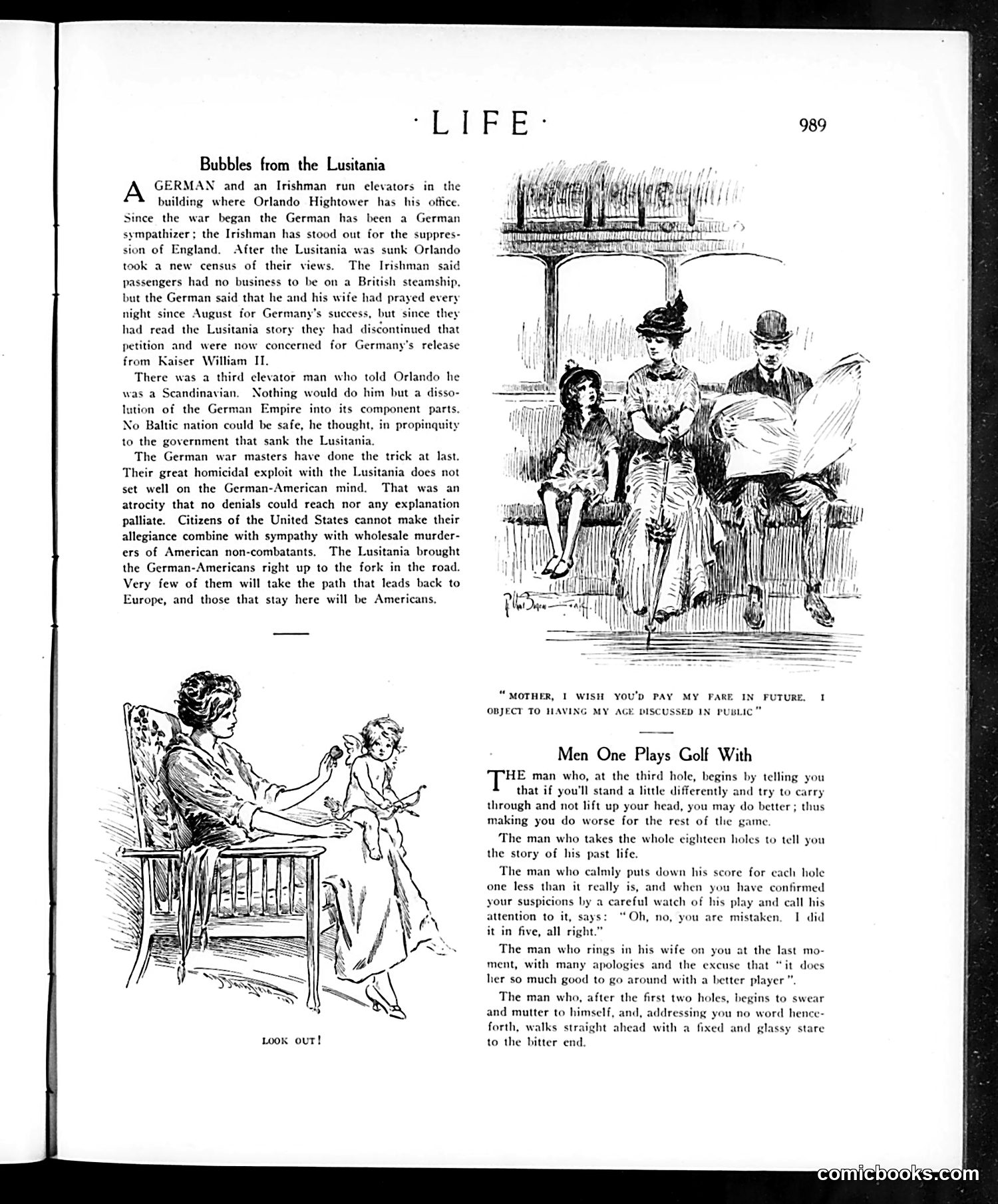
**"Bubbles from the Lusitania"** (top article): This satirizes German-American attitudes following the 1915 sinking of the RMS Lusitania by a German U-boat, which killed 128 American passengers. The text describes three elevator operators with different immigrant backgrounds—a German sympathizer, an Irish anti-British man, and a Scandinavian—and how the Lusitania disaster specifically shocked German-Americans into reconsidering their loyalties. The piece argues that this atrocity forced German-Americans to choose: either abandon sympathy for Germany or fully commit to American identity. It's wartime propaganda questioning immigrant allegiances. **"Men One Plays Golf With"** (bottom): A humorous social commentary cataloging annoying golf partners—the backseat coach, the bore, the cheater, the man who brings his wife uninvited, and the silent sulker. This has no political content; it's purely satirical observations about golf etiquette and male social behavior. The top cartoon illustration shows people reading newspapers, likely reacting to Lusitania news.
📄 Transcribed text from this page (OCR, searchable)
Machine-transcribed from the original scan — historical spelling and the odd misread are preserved.
Bubbles from the Lusitania GERMAN and an Irishman run elevators in the building where Orlando Hightower has his office. Since the war began the German has been a German sympathizer ; the Irishman has stood out for the suppres- sion of England. After the Lusitania was sunk Orlando took a new census of their views. The Irishman said passengers had no business to be on a British steamship, but the German said that he and his wife had prayed every night since August for Germany's success, but since they had read the Lusitania story they had discontinued that petition and were now concerned for Germany's release from Kaiser William IT. There was a third clevator man who told Orlando he was a Scandinavian. Nothing would do him but a disso- lution of the German Empire into its component parts. No Baltic nation could be safe, he thought, in propinquity to the government that sank the Lusitania. The German war masters have done the trick at last. Their great homicidal exploit with the Lusitania does not set well on the German-American mind. That was an atrocity that no denials could reach nor any explanation palliate. Citizens of the United States cannot make their allegiance combine with sympathy with wholesale murder- ers of American non-combatants. The Lusitania brought the German-Americans right up to the fork in the road. Very few of them will take the path that leads back to Europe, and those that stay here will be Americans, “MOTHER, I WISH YOU'D PAY MY FARE IN FUTURE. OBJECT TO HAVING MY AGE DISCUSSED IN PUBLIC” Men One Plays Golf With HE man who, at the third hole, begins by telling you that if you'll stand a little differently and try to carry through and not lift up your head, you may do better; thus making you do worse for the rest of the game. The man who takes the whole eighteen holes to tell you the story of his past life. The man who calmly puts down his score for cach hole one less than it really is, and when you have confirmed your suspicions by a careful watch of his play and call his attention to it, “Oh, no, you are mistaken, 1 did it in five, all ri The man who rings in his wife on you at the last mo- ment, with many apologies and the excuse that “it does her so much good to go around with a better player". The man who, after the first two holes, begins to swear and mutter to himself, and, addressing you no word hen forth, walks straight ahead with a fixed and glassy stare to the bitter end.