
Life, 1915-06-03 · page 25 of 52
Life — June 3, 1915 — page 25: what you’re looking at
What you’re looking at
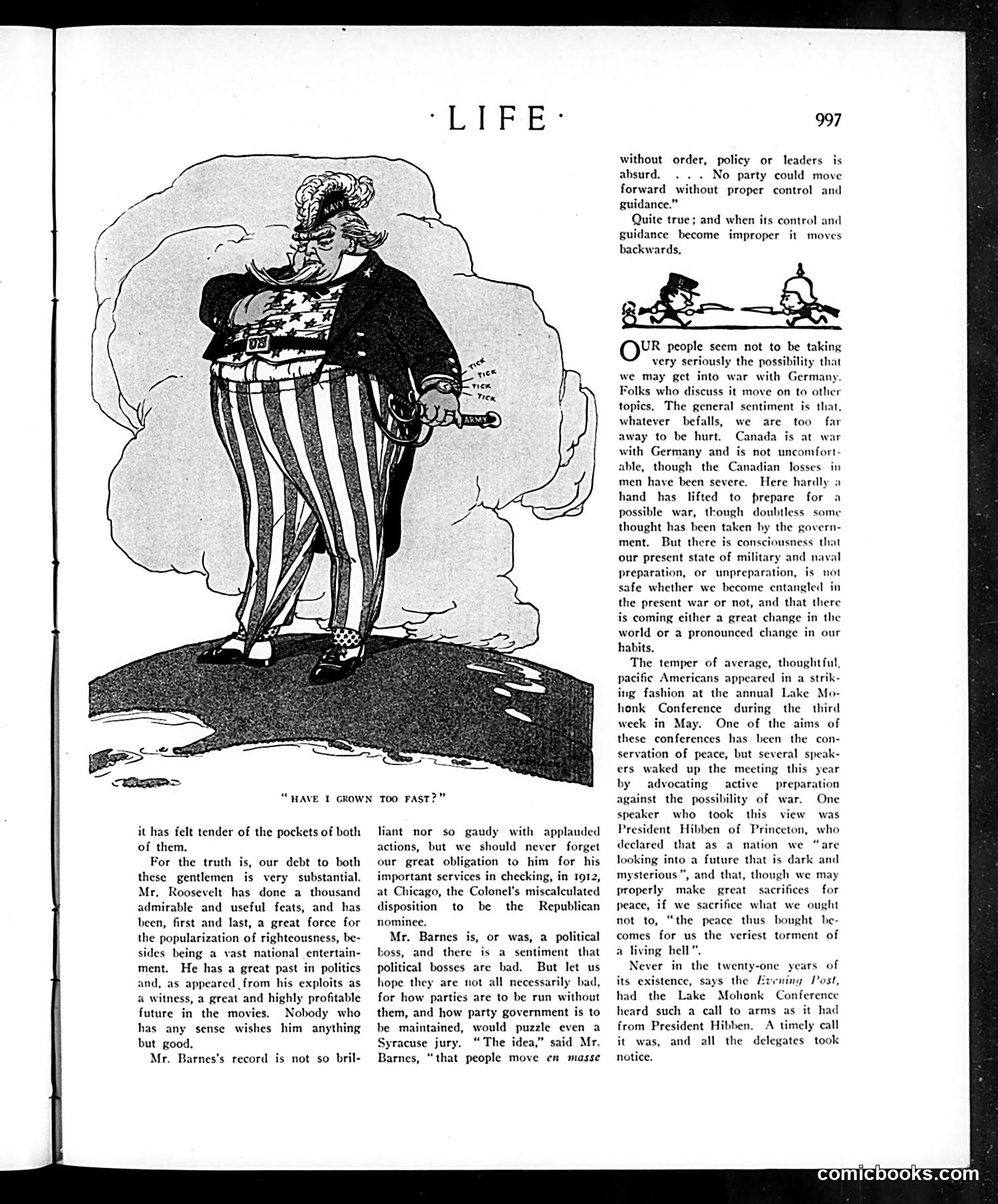
The cartoon depicts **Uncle Sam** as an overgrown figure bursting from his clothes, symbolizing America's rapid expansion and growth. The caption asks whether this expansion has exceeded healthy limits. The accompanying text discusses **Theodore Roosevelt** and **William Barnes** (a political boss), crediting Barnes with preventing Roosevelt's return as the Republican nominee in 1912. The article defends political party structure and leadership as necessary, while questioning whether such control becomes "improper." The broader editorial addresses American complacency about potential war with Germany. It references the **Lake Mohonk Conference** (a peace advocacy organization) and notes that **President Hibben of Princeton** unusually called for military preparedness, warning of a "dark and mysterious future" if America doesn't sacrifice for peace. The satire suggests America has grown powerful but may be dangerously unprepared and overconfident about distant threats—particularly relevant given Canada's active involvement in WWI.
📄 Transcribed text from this page (OCR, searchable)
Machine-transcribed from the original scan — historical spelling and the odd misread are preserved.
“HAVE I GROWN it has felt tender of the pockets of both of them. For the truth is, our debt to both these gentlemen is very substantial. Mr, Roosevelt has done a thousand admirable and useful feats, and has been, first and last, a great force for the popularization of righteousness, be- sides being a vast national entertain- ment. He has a great past in politics and, as appeared from his exploits as a witness, a great and highly profitable future in the movies. Nobody who has any sense wishes him anything but good. Mr. Barnes's record is not so bril- Too FAST?” liant nor so gaudy with applauded actions, but we should never forget our great obligation to him for his important services in checking, in 1912, at Chicago, the Colonel's miscalculated disposition to be the Republican nominee. Mr. Barnes is, or was, a political boss, and there is a sentiment that political bosses are bad. But let us hope they are not all necessarily bad, for how parties are to be run without them, and how party government is to be maintained, would puzzle even a Syracuse jury. “The idea,” said Mr. Barnes, “that people move en masse 997 without order, policy or leaders is absurd. .. . No party could move forward without proper control and guidance.” Quite true; and when its control and guidance become improper it moves backwards, UR people seem not to be taking very seriously the possibility that we may get into war with Germany. Folks who discuss it move on to oth topics, The general sentiment is that, whatever befalls, we are too far away to be hurt. Canada is at war with Germany and is not uncomfort- able, though the Canadian losses in men have been severe. Here hardly hand has lifted to prepare for a possible war, though doubtless some thought has been taken by the govern- ment. But there is consciousness that our present state of mil and naval preparation, or unpreparation, is not safe whether we become entangled in the present war or not, and that there is coming either a great change in the world or a pronounced change in our habits. The temper of average, thoughtful, pacific Americans appeared in a strik- ing fashion at the annual Lake Mo- honk Conference during the third week in May. One of the aims of these conferences has been the con- servation of peace, but several spe ers waked up the meeting this year by advocating active aration against the possibility of war. speaker who took this view President Hibben of Princeton, who declared that as a nation we “are looking into a future that is dark and mysterious”, and that, though we may properly make great sacrifices for peace, if we sacrifice what we ought not to, “the peace thus bought be- comes for us the veriest torment of a living hell”. Never in the twenty-one of its existence, says the Evening Post, had the Lake Mohonk Conference heard such a call to arms as it had from President Hibben, A timely call it was, and all the delegates took notice. was years comicbooks.com