
Life, 1915-06-03 · page 31 of 52
Life — June 3, 1915 — page 31: what you’re looking at
What you’re looking at
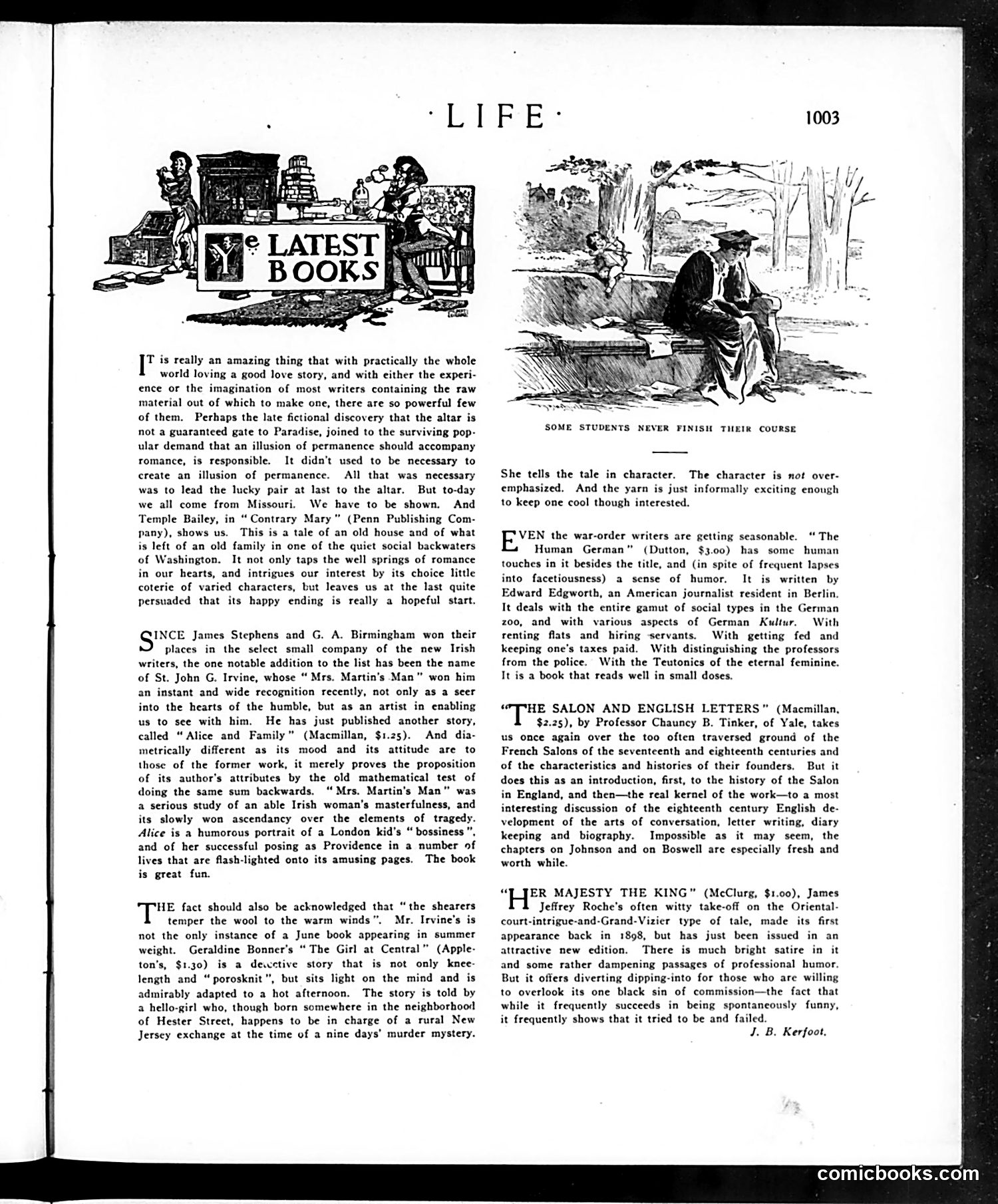
This page is a **book review section** titled "The Latest Books," not a political cartoon. It discusses several contemporary novels and their merit as summer reading. The main illustration shows two students by a riverside with the caption "Some Students Never Finish Their Course"—likely a humorous reference to how light summer reading can distract from serious study. The reviews discuss Irish writer St. John G. Irvine's works, Temple Bailey's "Contrary Mary," and notably **"The Human German" by Edward Edgworth**, an American journalist in Berlin. This last review is significant given its 1915 publication date—during World War I. The reviewer describes it as treating German society with humor and humanity despite "frequent lapses into facetiousness," suggesting an attempt at fair-minded observation of the enemy nation during wartime. The page reflects literary culture of the Progressive Era, when magazines like *Life* positioned themselves as arbiters of taste for educated readers.
📄 Transcribed text from this page (OCR, searchable)
Machine-transcribed from the original scan — historical spelling and the odd misread are preserved.
T is really an amazing thing that with practically the whole world loving a good love story, and with either the experi- ence or the imagination of most writers containing the raw material out of which to make one, there are so powerful few of them. Perhaps the late fictional discovery that the altar is not a guaranteed gate to Paradise, joined to the surviving pop- ular demand that an illusion of permanence should accompany romance, is responsible. It didn’t used to be necessary to create an illusion of permanence. All that was necessary was to lead the lucky pair at last to the altar. But to-day we all come from Missouri. We have to be shown, And Temple Bailey, in “ Contrary Mary” (Penn Publishing Com- pany), shows us. This is a tale of an old house and of what is left of an old family in one of the quiet social backwaters of Washington. It not only taps the well springs of romance in our hearts, and intrigues our interest by its choice little coterie of varied characters, but leaves us at the last quite persuaded that its happy ending is really a hopeful start. INCE James Stephens and G. A. Birmingham won their places in the select small company of the new Irish writers, the one notable addition to the list has been the name of St. John G. Irvine, whose “ Mrs. Martin's Man" won him an instant and wide recognition recently, not only as a seer into the hearts of the humble, but as an artist in enabling us to see with him. He has just published another story, called “Alice and Family" (Macmillan, $1.25). And dia- metrically different as its mood and its attitude are to those of the former work, it merely proves the proposition of its author's attributes by the old mathematical test of doing the same sum backwards. “ Mrs. Martin's Man” was a serious study of an able Irish woman's masterfulness, and its slowly won ascendancy over the elements of tragedy. Alice is a humorous portrait of a London kid's “ bossiness ", and of her successful posing as Providence in a number of lives that are flash-lighted onto its amusing pages. The book is great fun. HE fact should also be acknowledged that “the shearers temper the wool to the warm winds”. Mr. Irvine's is not the only instance of a June book appearing in summer weight. Geraldine Bonner’s “ The Girl at Central” (Apple- ton’s, $1.30) is a dewctive story that is not only knee- length and “ porosknit”, but sits light on the mind and is admirably adapted to a hot afternoon. The story is told by a hello-girl who, though born somewhere in the neighborhood of Hester Street, happens to be in charge of a rural New Jersey exchange at the time of a nine days’ murder mystery. SOME STUDENTS NEVER FINISH THEIR COURSE She tells the tale in character. The character is not over- emphasized. And the yarn is just informally exciting enough to keep one cool though interested. VEN the war-order writers are getting seasonable. “ The Human German" (Dutton, $3.00) has some human touches in it besides the title, and (in spite of frequent lapses into facetiousness) a sense of humor. It is written by Edward Edgworth, an American journalist resident in Berlin. It deals with the entire gamut of social types in the German zoo, and with various aspects of German Kultur. With renting flats and hiring servants. With getting fed and keeping one’s taxes paid. With distinguishing the professors from the police. With the Teutonics of the eternal feminine. It is a book that reads well in small doses. 'HE SALON AND ENGLISH LETTERS” (Macmillan, $2.25), by Professor Chauncy B. Tinker, of Yale, takes us once again over the too often traversed ground of the French Salons of the seventeenth and eighteenth centuries and of the characteristics and historics of their founders. But it does this as an introduction, first, to the history of the Salon in England, and then—the real kernel of the work—to a most interesting discussion of the eighteenth century English de- velopment of the arts of conversation, letter writing, diary keeping and biography. Impossible as it may seem, the chapters on Johnson and on Boswell are especially fresh and worth while. “_JER MAJESTY THE KING” (McClurg, $1.00), James Jeffrey Roche's often witty take-off on the Oriental- court-intrigue-and-Grand-Vizier type of tale, made its first appearance back in 1898, but has just been issued in an attractive new edition. There is much bright satire in it and some rather dampening passages of professional humor. But it offers diverting dipping-into for those who are willing to overlook its one black sin of commission—the fact that while it frequently succeeds in being spontaneously funny, it frequently shows that it tried to be and failed. J.B. Kerfoot. comicbooks.com