
Life, 1915-06-03 · page 16 of 52
Life — June 3, 1915 — page 16: what you’re looking at
What you’re looking at
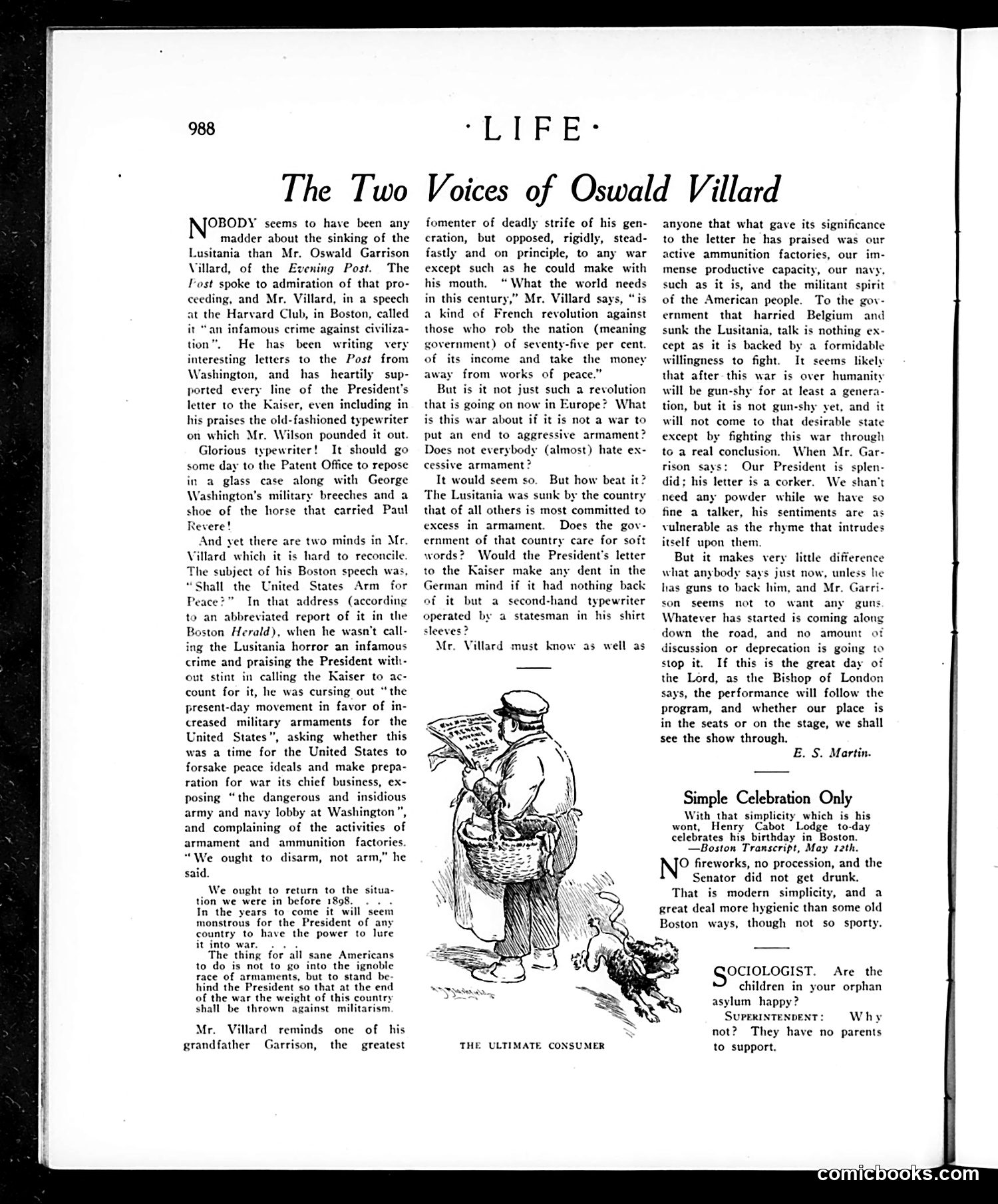
This satirical piece critiques *The Evening Post* editor Oswald Garrison Villard's apparent contradiction regarding American military preparedness during World War I. The text identifies Villard's "two minds": he publicly condemned the Lusitania sinking (1915) and praised President Wilson's strong letter to Germany, yet simultaneously campaigned against increased military armaments, called disarmament essential, and denounced the "army and navy lobby." The accompanying cartoon, captioned "The Ultimate Consumer," depicts a poor man carrying a basket—likely representing ordinary citizens who bear the burden of military spending and war. Life's argument: Villard naively believed diplomatic words alone could restrain Germany's militarism, ignoring that American military capacity gave those words credibility. The magazine suggests that Germany—which committed atrocities in Belgium and sank the Lusitania—respected only force, not pacifist rhetoric. This represents the broader American debate of 1915 between pacifists and interventionists regarding preparedness for potential war entry.
📄 Transcribed text from this page (OCR, searchable)
Machine-transcribed from the original scan — historical spelling and the odd misread are preserved.
The Two 'OBODY scems to have been any madder about the sinking of the Lusitania than Mr. Oswald Garrison Villard, of the Evening Post. The Fost spoke to admiration of that pro- ceeding, and Mr. Villard, in a speech at the Harvard Club, in Boston, called it “an infamous crime against civiliza- tion”, He has been writing very interesting letters to the Post from Washington, and has heartily sup- ported every line of the President's letter to the Kaiser, even including in his praises the old-fashioned typewriter on which Mr. Wilson pounded it out. Glorious typewriter! It should go some day to the Patent Office to repose in a glass case along with George Washington’s military breeches and a shoe of the horse that carried Paul Revere! And yet there are two minds in Mr. Villard which it is hard to reconcile. The subject of his Boston speech wa: “Shall the United States Arm for Peace?” In that address (according to an abbreviated report of it in the Boston Herald), when he wasn’t call- ing the Lusitania horror an infamous crime and praising the President with- out stint in calling the Kaiser to ac- count for it, he was cursing out “the present-day movement in favor of in- creased military armaments for the United States”, asking whether this was a time for the United States to forsake peace ideals and make prepa- ration for war its chief business, ex- posing “the dangerous and insidious army and navy lobby at Washington”, and complaining of the acti s of armament and ammunition factories. “We ought to disarm, not arm,” he said. We ought to return to the situa- tion we were in before 1898... . In the years to come it will seem monstrous for the President of any country to have the power to lure it into war... The thing for ail sane Americans to do is not to go into the ignoble race of armaments, but to stand be- hind the President so that at the end of the war the weight of this country shall be thrown against militarism Mr. Villard grandfather Garrison, reminds one of his the greatest “CPE Voices of Oswald Villard fomenter of deadly strife of his gen- cration, but opposed, rigidly, stead- fastly and on principle, to any war except such as he could make with his mouth. “What the world needs in this century,” Mr, Villard says, “is a kind of French revolution against those who rob the nation (meaning government) of seventy-five per cent. of its income and take the money away from works of peace.” But is it not just such a revolution that is going on now in Europe? What is this war about if it is not a war to put an end to aggressive armament? Does not everybody (almost) hate ex- cessive armament? It would seem so. But how beat it? The Lusitania was sunk by the country that of all others is most committed to excess in armament. Does the gov- ernment of that country care for soft words? Would the President's letter to the Kaiser make any dent in the German mind if it had nothing back of it but a second-hand typewriter operated by a statesman in his shirt sleeves? Mr. Villard must know as well as E ULTIMATE CONSUMER anyone that what gave its significance to the letter he has praised was our active ammunition factories, our im- mense productive capacity, our navy such as it is, and the militant spirit of the American people. To the gov- ernment that harried Belgium and sunk the Lusitania, talk is nothing ex- cept as it is backed by a formidable willingness to fight. It seems likely that after this war is over humanity will be gun-shy for at least a geners tion, but it is not gun-shy yet, and it will not come to that desirable state except by fighting this war through to a real conclusion. When Mr. Gar- rison says: Our President is splen- did; his letter is a corker. We shan’t need any powder while we have so fine a talker, his sentiments are as vulnerable as the rhyme that intrudes itself upon them. But it makes very little difference what anybody says just now, unless le has guns to back him, and Mr. Garri- son seems not to want any guns. Whatever has started is coming along down the road, and no amount of discussion or deprecation is going to stop it. If this is the great day of the Lord, as the Bishop of London says, the performance will follow the program, and whether our place is in the seats or on the stage, we shall see the show through. E. S. Martin. Simple Celebration Only With that simplicity which is his wont, Henry Cabot Lodge to-day celebrates his birthday in Boston. —Boston Transcript, May 12th. O fireworks, no procession, and the Senator did not get drunk, That is modern simplicity, and a great deal more hygienic than some old Boston ways, though not so sporty. OCIOLOGIST. Are the children in your orphan asylum happy? Superintenvent: = Why not?) They have no parents to support.