
Life, 1915-06-03 · page 24 of 52
Life — June 3, 1915 — page 24: what you’re looking at
What you’re looking at
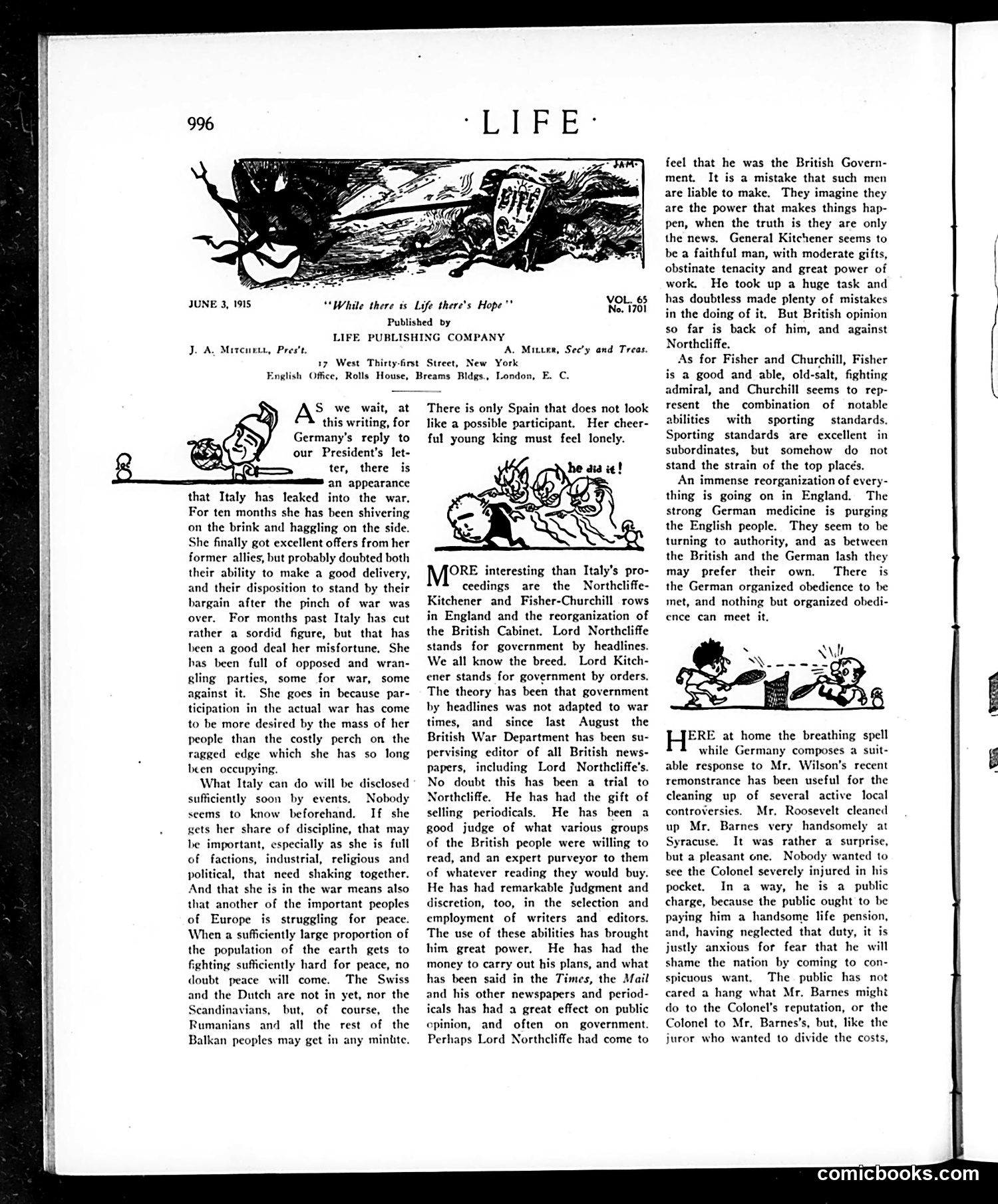
This page discusses European developments during World War I. The cartoons and text address: **Italy's Entry**: The article explains Italy finally joined the war after months of hesitation, motivated by mass public desire for participation over continued neutrality. **British Government Conflict**: The main satire targets a power struggle between **Lord Northcliffe** (newspaper magnate controlling major British papers including the *Times* and *Mail*) and **General Kitchener** (War Secretary). Northcliffe represents "government by headlines"—using media influence to shape policy—while Kitchener represents military authority based on direct orders. The text suggests Northcliffe mistakenly believed he *was* the government, when he merely reported news. The piece also mentions **Fisher** and **Churchill** in a reorganizing British Cabinet, though details are cut off. The satirical point: powerful media figures may confuse their influence over public opinion with actual governing power, particularly problematic during wartime when military leadership should prevail.
📄 Transcribed text from this page (OCR, searchable)
Machine-transcribed from the original scan — historical spelling and the odd misread are preserved.
JUNE 3, 1915 “While there ts Life there's Hope’ Published by LIFE PUBLISHING COMPANY J. A, Mircuntt, Pres’t, A. Mitre, Sec’y and Treas. 17 West Thirty-first Street, New York English Office, Rolls House, Breams Bldgs., London, E. C. S we wait, at this writing, for Germany's reply to our President's let- ter, there is = an appearance that Italy has leaked into the war. For ten months she has been shivering on the brink and haggling on the side. She finally got excellent offers from her former allies, but probably doubted both their ability to make a good delivery, and their disposition to stand by their bargain after the pinch of war was over. For months past Italy has cut rather a sordid figure, but that has been a good deal her misfortune. She has been full of opposed and wran- gling parties, some for war, some against it. She goes in because par- ticipation in the actual war has come to be more desired by the mass of her people than the costly perch on the ragged edge which she has so long heen occupying. What Italy can do will be disclosed sufficiently soon by events. Nobody seems to know beforehand. If she gets her share of discipline, that may he important, especially as she is full of factions, industrial, political, that need shaking together. And that she is in the war means also that another of the important peoples of Europe is struggling for peace. When a sufficiently large proportion of the population of the earth gets to fighting sufficiently hard for peace, no doubt peace come. The Swiss and the Dutch are not in yet, nor the Scandinavians, but, of course, the Rumanians and all the rest of the Balkan peoples may get in any mintte. There is only Spain that does not look like a possible participant. Her cheer- ful young king must feel lonely. he aia ie! cx. ASO MORE interesting than Italy’s pro- ceedings are the Northcliffe- Kitchener and Fisher-Churchill rows in England and the reorganization of the British Cabinet. Lord Northcliffe stands for government by headlines. We all know the breed. Lord Kitch- ener stands for government by orders. The theory has been that government by headlines was not adapted to war times, and since last August the British War Department has been su- pervising editor of all British news- papers, including Lord Northcliffe's. No doubt this has been a trial to Northcliffe. He has had the gift of selling periodicals. He has been a good judge of what various groups of the British people were willing to read, and an expert purveyor to them of whatever reading they would buy. He has had remarkable judgment and discretion, too, in the selection and employment of writers and editors. The use of these abilities has brought him great power, He has had the money to carry out his plans, and what has been said in the Times, the Mail and his other newspapers and period- icals has had a great effect on public cpinion, and often on government. Perhaps Lord Northcliffe had come to feel that he was the British Govern- ment. It is a mistake that such men are liable to make. They imagine they are the power that makes things hap- pen, when the truth is they are only the news. General Kitchener seems to be a faithful man, with moderate gifts, obstinate tenacity and great power of work. He took up a huge task and has doubtless made plenty of mistakes in the doing of it, But British opinion so far is back of him, and against Northcliffe. As for Fisher and Churchill, Fisher is a good and able, old-salt, fighting admiral, and Churchill seems to rep- resent the combination of notable abilities with sporting standards. Sporting standards are excellent in subordinates, but somehow do not stand the strain of the top placés. An immense reorganization of every- thing is going on in England. The strong German medicine is purging the English people. They seem to be turning to authority, and as between the British and the German lash they may prefer their own. There is the German organized obedience to be met, and nothing but organized obedi- ence can meet it. ERE at home the breathing spell while Germany composes a suit- able response to Mr. Wilson’s recent remonstrance has been useful for the cleaning up of several active local controversies. Mr, Roosevelt cleaned up Mr. Barnes very handsomely at Syracuse. It was rather a surprise, but a pleasant one. Nobody wanted to see the Colonel severely injured in his pocket. In a way, he is a public charge, because the public ought to be paying him a handsome life pension, and, having neglected that duty, it justly anxious for fear that he will shame the nation by coming to con- spicuous want. The public has not cared a hang what Mr. Barnes might do to the Colonel’s reputation, or the Colonel to Mr, Barnes’s, but, like the juror who wanted to divide the costs, comicbooks.com eee