
A complete issue · 40 pages · 1915
Life — March 18, 1915
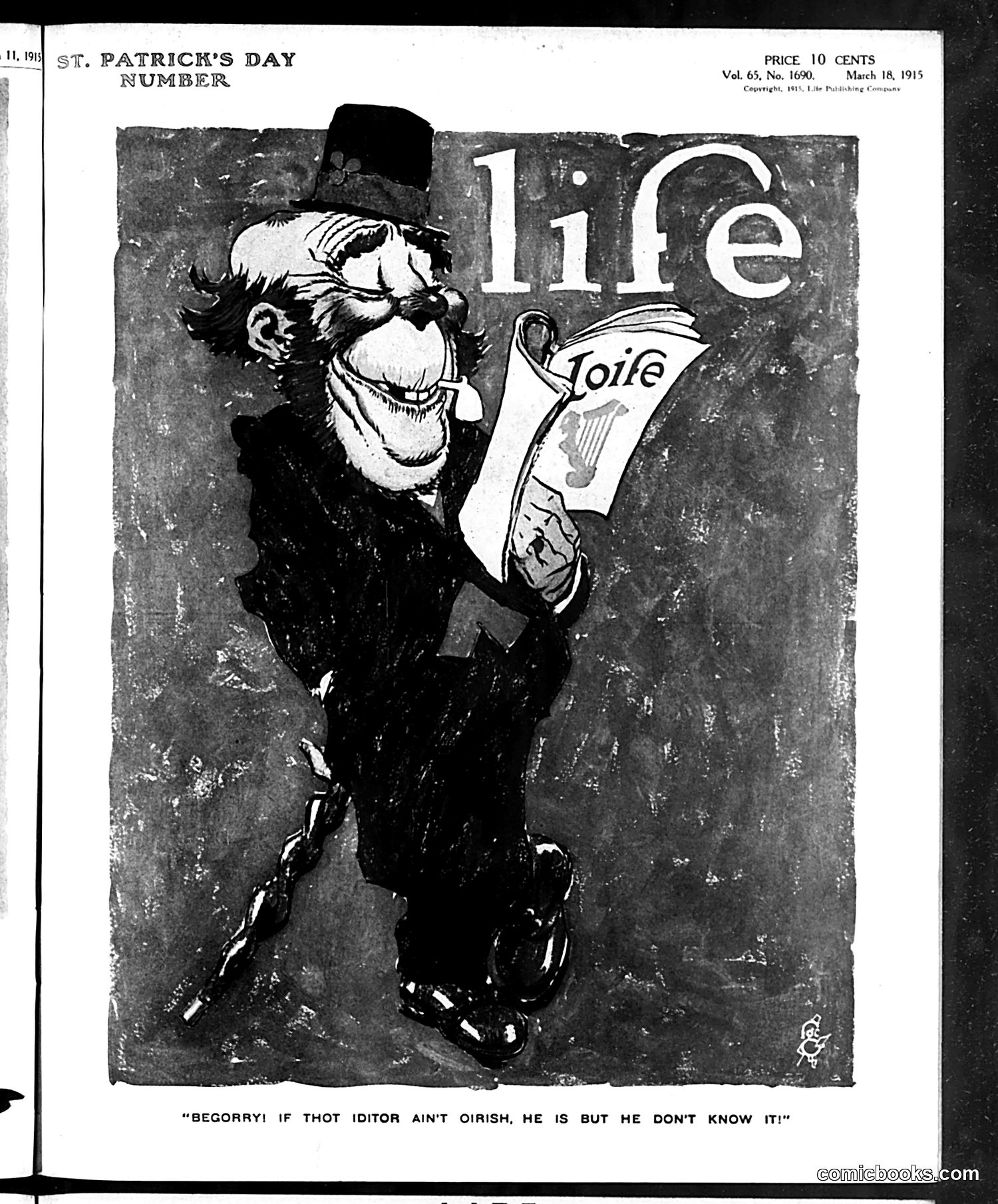
This is a St. Patrick's Day-themed satirical cover. A caricatured Irish figure (identifiable by exaggerated features common to period Irish stereotypes) wearing a top hat holds a newspaper labeled "Étoile" (likely *L'Étoile*, a French publication). The figure appears gleeful or mischievous. The caption reads: "Begorry! If that iditor ain't Oirish, he is but he don't know it!" The joke appears to reference the newspaper's editor, suggesting either he has Irish heritage unknowingly, or that his recent editorial decisions reflect Irish sensibilities. The "*Étoile*" reference and the date (1915, during WWI) suggest this may relate to French-Irish political or cultural matters, though the specific editor referenced is unclear without additional context.
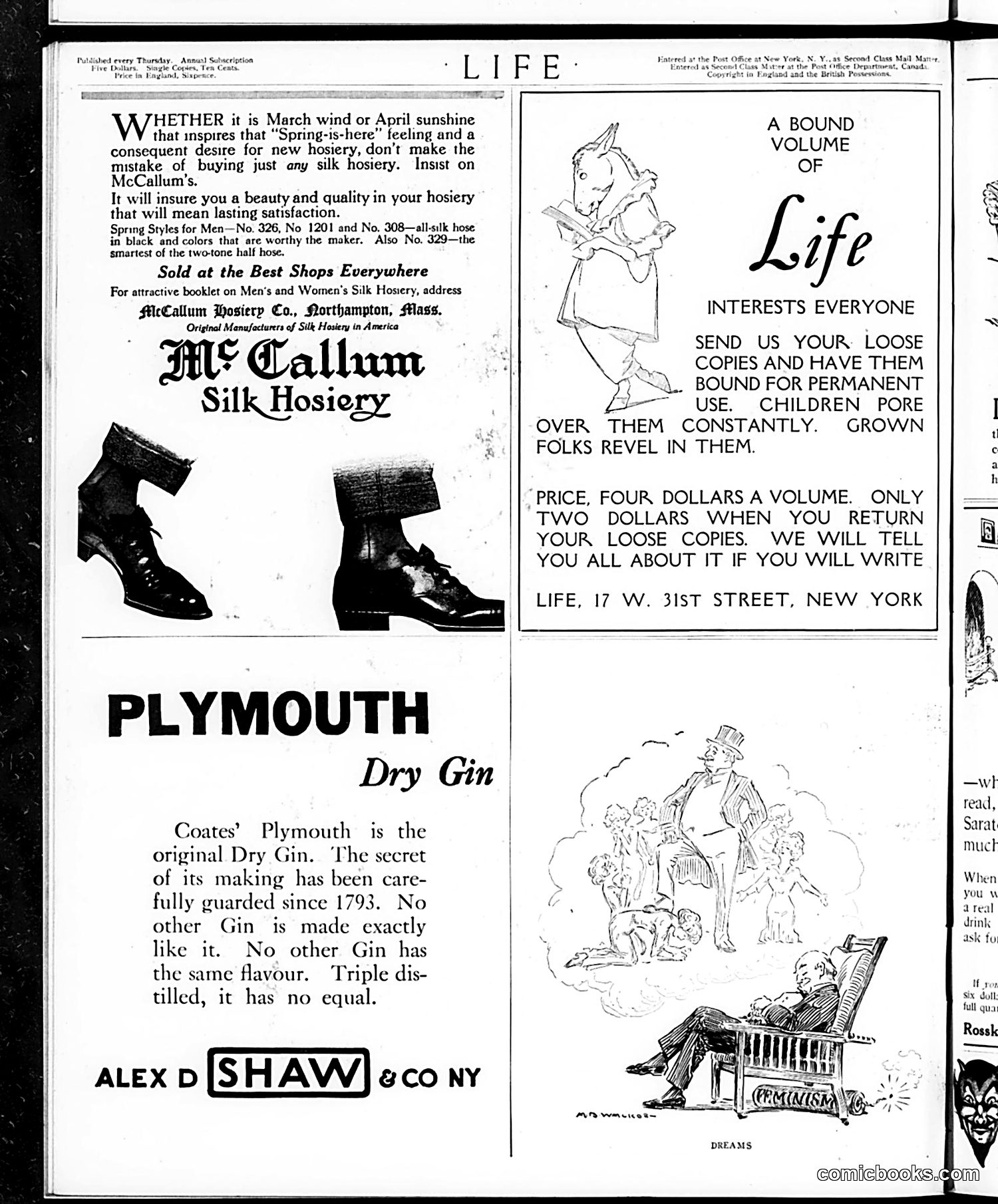
This page is primarily **commercial advertising** rather than editorial content or political satire. It contains three distinct ads: 1. **McCallum Silk Hosiery** - promoting quality men's and women's stockings with spring styles 2. **Life Magazine binding service** - offering to bind loose copies of *Life* magazine into permanent volumes for $4 (or $2 if returning loose copies) 3. **Plymouth Dry Gin** - claiming originality since 1793 with a footnote illustration labeled "DREAMS" showing a man relaxing while children play The only potentially satirical element is the gin advertisement's "DREAMS" illustration, which appears to humorously contrast leisure fantasies with reality, though the intent remains unclear without additional context.
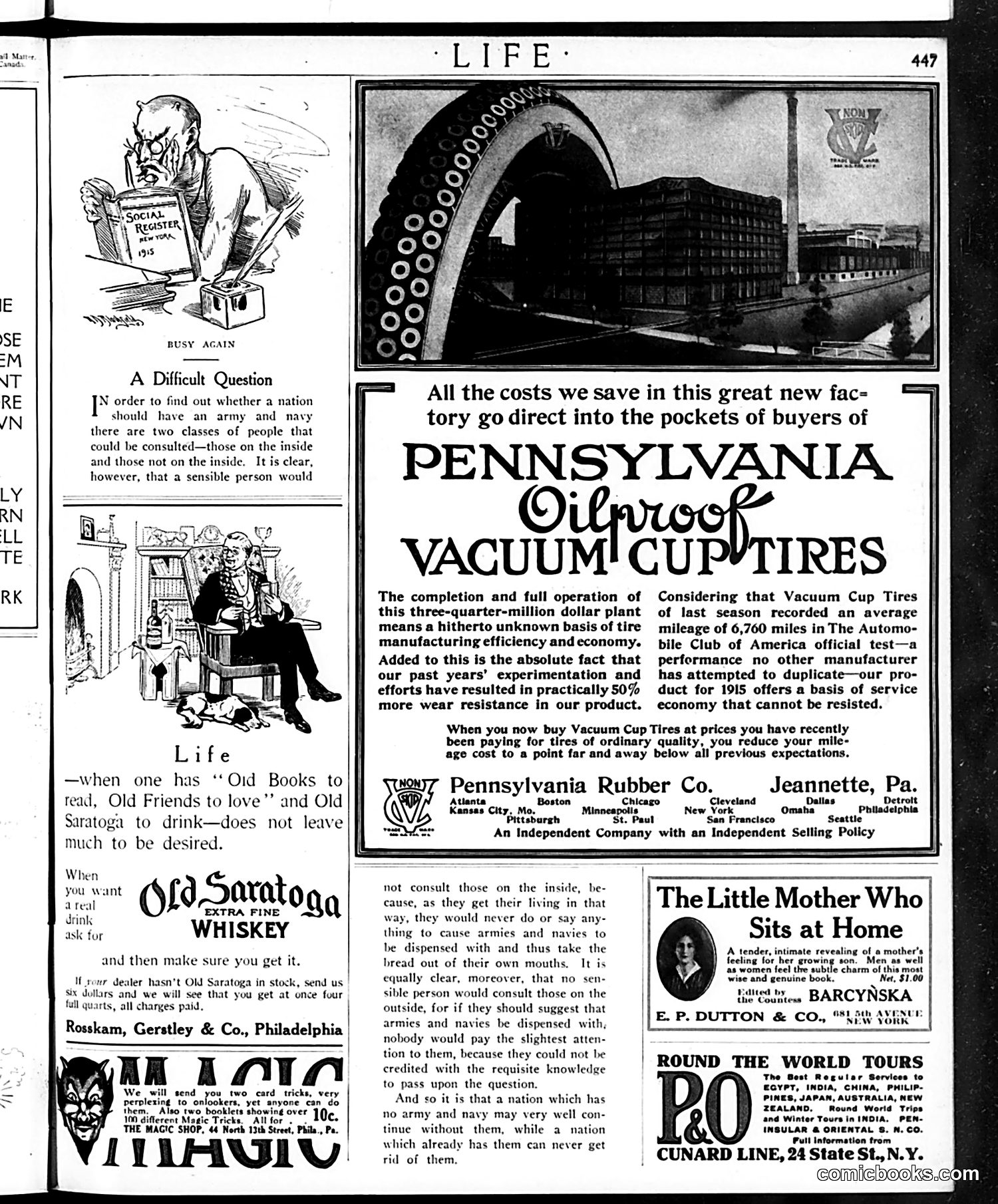
**"A Difficult Question" Cartoon:** The left cartoon depicts a disheveled figure labeled "SOCIAL REGISTER 1919" frantically writing. The satire addresses whether a nation should consult its military leadership or social elites regarding national defense. The joke critiques the "Social Register"—a directory of wealthy, prominent families—suggesting they're unqualified for military/policy decisions despite their status. The accompanying text argues that sensible people would consult those with actual expertise ("inside") rather than wealthy outsiders who benefit financially from government spending without bearing consequences. **Other Content:** The page is dominated by a Pennsylvania Oilproof Vacuum Cup Tires advertisement and period whiskey/product ads. The satirical "Life" commentary mocks consulting society elites on serious matters.
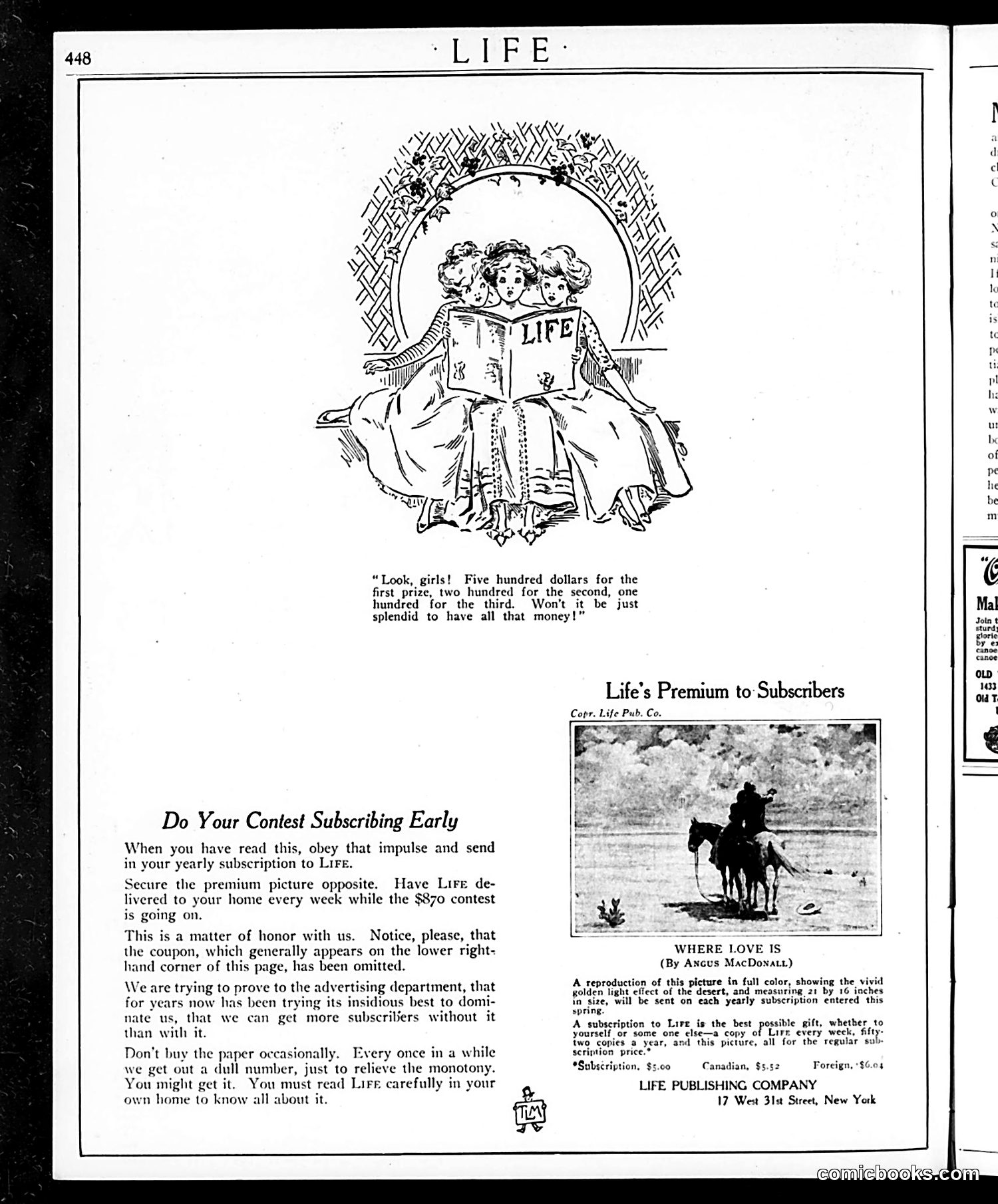
This page is primarily **advertising** for Life magazine's subscription contest rather than political satire. The top illustration shows three young women reading a Life magazine, with a caption about prize money ($500, $200, $100) available to contest winners—framed as an incentive to subscribe early. The text "Do Your Contest Subscribing Early" encourages readers to subscribe to Life to enter the $870 contest, emphasizing this as "a matter of honor" for the magazine's advertising department. Below is an advertisement for a premium picture titled "Where Love Is" by Angus MacDonald, offered as a subscription bonus—a color reproduction of a romantic desert scene with a horseman. The page reflects early 20th-century magazine marketing tactics: using contests and premium gifts to build subscription bases.
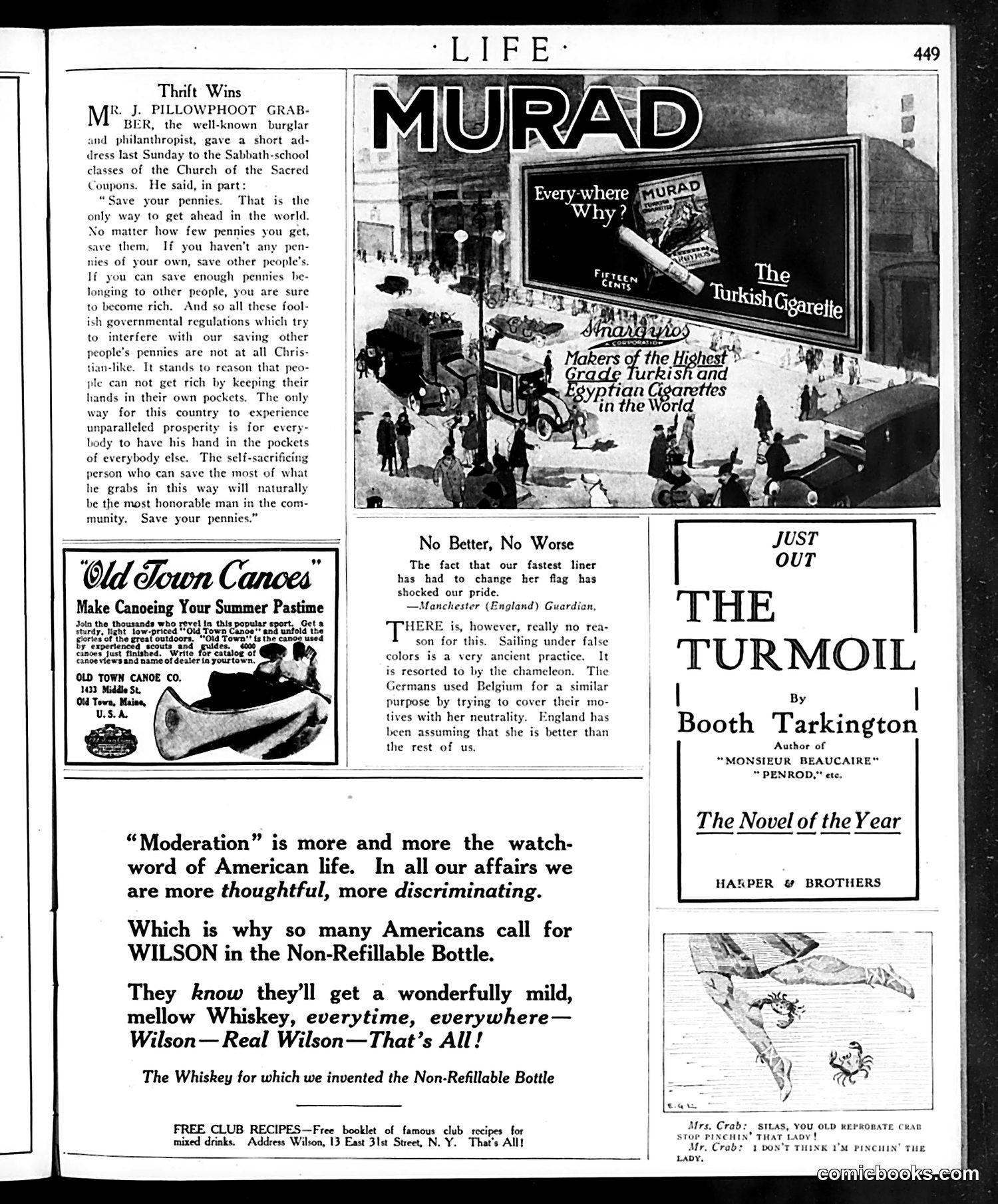
This page is primarily **advertising and editorial content** rather than political satire. The top portion features a **Murad cigarette advertisement** showing a large billboard in what appears to be a city street scene, promoting Turkish cigarettes as "Makers of the Highest Grade Turkish and Egyptian Cigarettes in the World." Below that is a brief editorial note titled "No Better, No Worse" discussing a ship changing its flag, referencing naval practices and neutrality during what appears to be a wartime context. The page includes advertisements for **Old Town Canoes** and **Wilson Whiskey** (emphasizing their "Non-Refillable Bottle"), plus a book advertisement for Booth Tarkington's "The Turmoil." There is a small cartoon illustration of crabs in the lower right, appearing to be humorous rather than political. The overall page reflects early 20th-century American consumer advertising and lifestyle content.
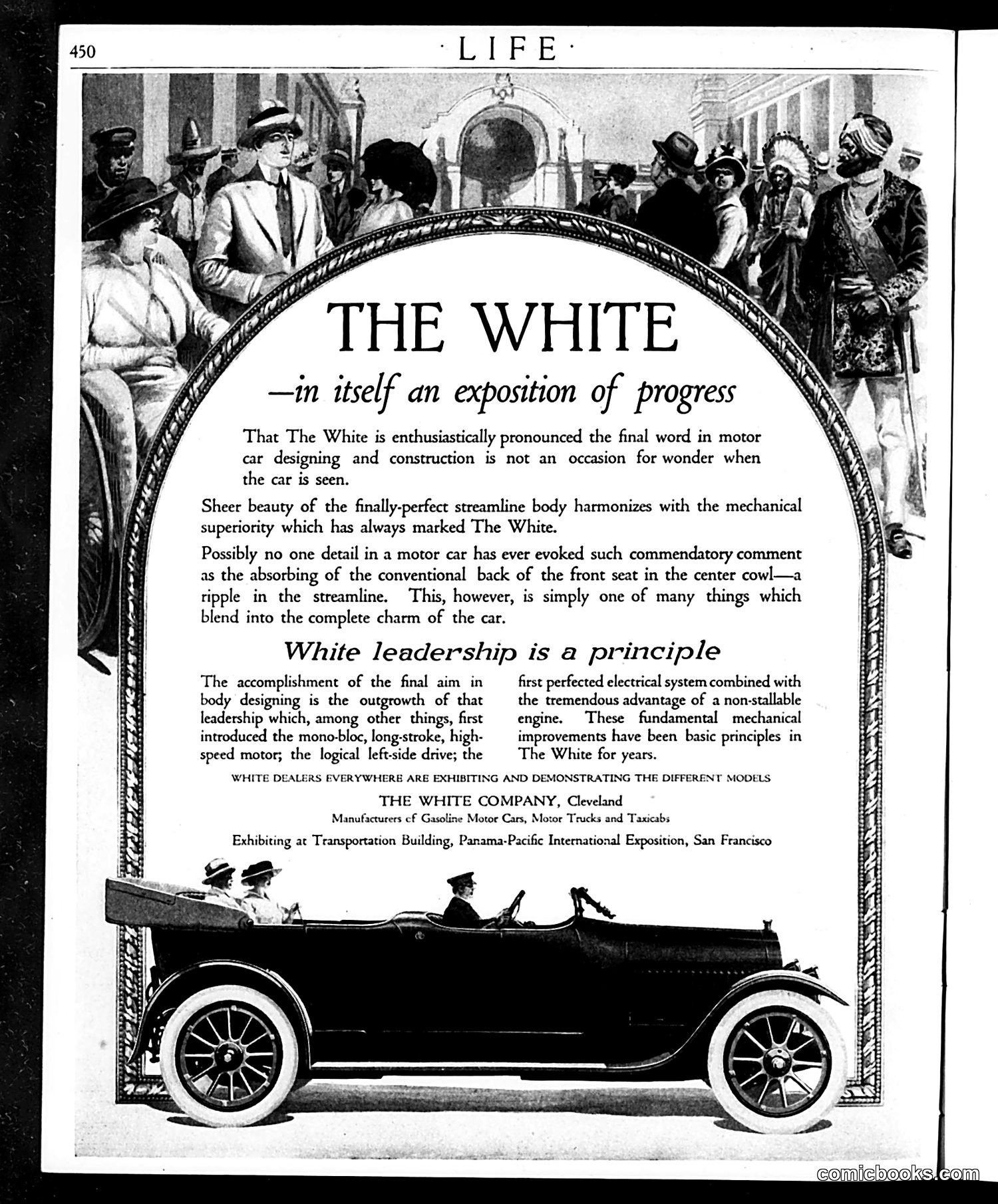
This is **advertising, not satire or political commentary**. It's a full-page promotional piece for The White automobile company of Cleveland, appearing in *Life* magazine. The ad claims The White represents "progress" in motor car design and construction. It emphasizes technical innovations: a "mono-bloc, long-stroke, high-speed motor," left-side drive, and an advanced electrical system with a "non-stallable engine." The decorative border showing well-dressed figures at what appears to be an exposition references The White's exhibition at the Panama-Pacific International Exposition in San Francisco—a major 1915 world's fair showcasing technological achievement. The vehicle illustrated is a contemporary open touring car. The ad's message: buying a White demonstrates sophistication and access to cutting-edge automotive engineering.
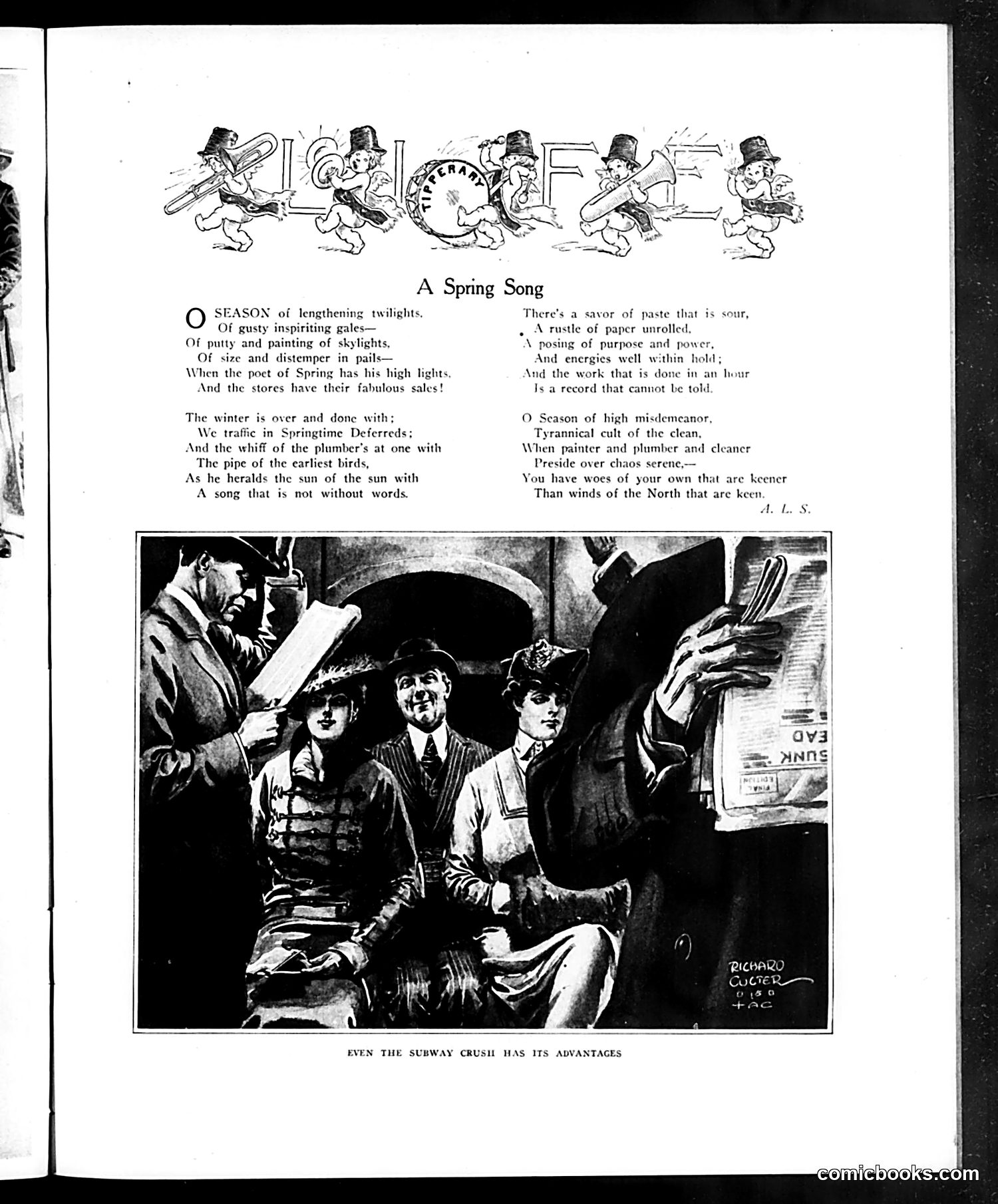
This page combines a poem about spring with an illustration titled "Even the Subway Crush Has Its Advantages." The poem celebrates spring's arrival—lengthening days, painting and putty work, plumbers and stores bustling—while humorously acknowledging the seasonal chaos ("high mislemenor," typos for "misdemeanor," suggesting spring's disruptive nature). The illustration depicts a crowded subway scene where people are pressed together uncomfortably. The caption's joke is that even unpleasant situations have silver linings: the subway crush (crowded conditions) offers "advantages," likely meaning romantic or flirtatious proximity to strangers. This reflects early 20th-century urban humor about metropolitan life's simultaneous inconveniences and unexpected social opportunities.
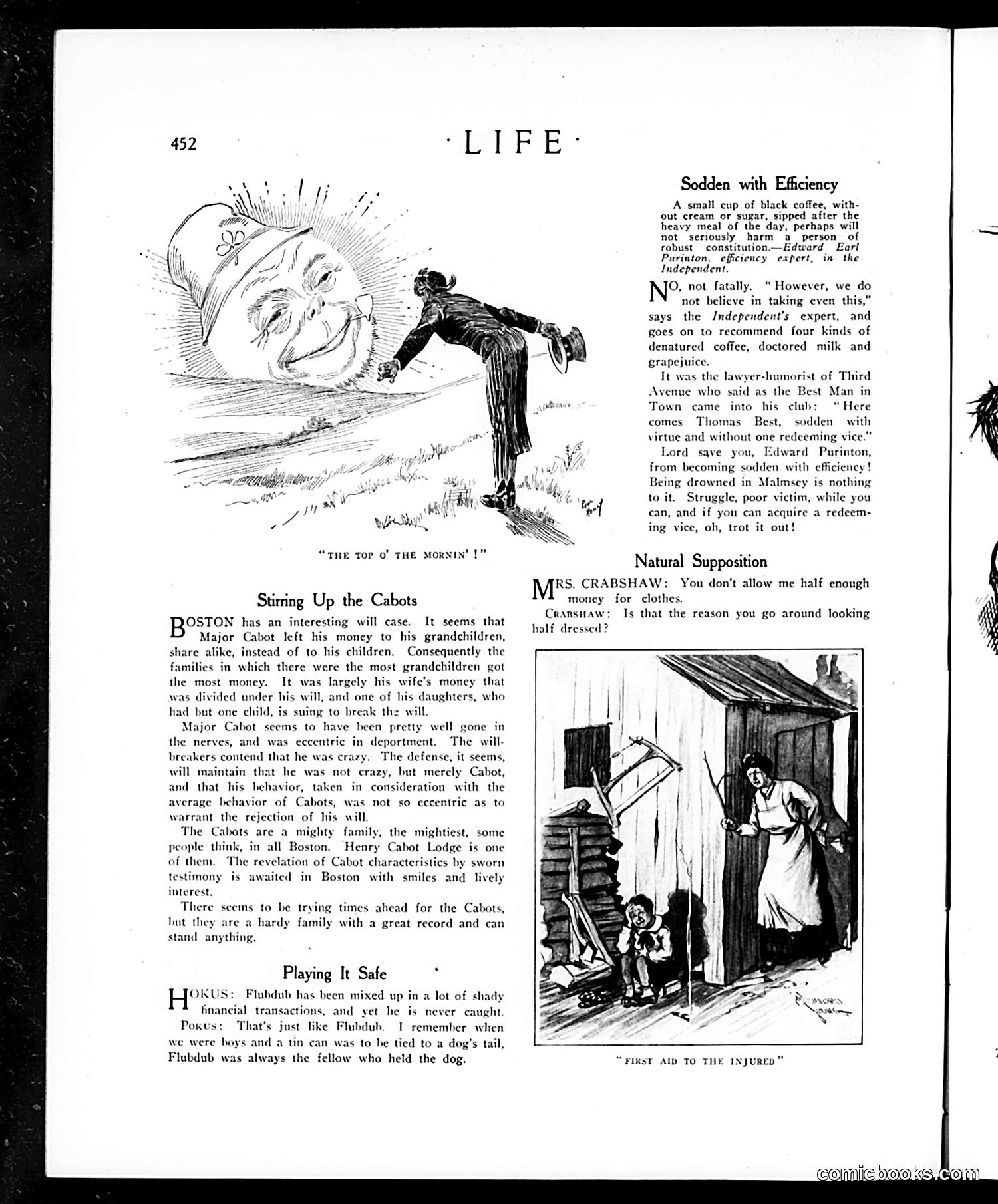
This page contains three separate satirical pieces: **"The Top o' the Mornin'!"** (top illustration) depicts a man encountering what appears to be Death or a skeletal figure on a path—likely mocking excessive coffee consumption and its supposed health effects. **"Stirring Up the Cabots"** discusses a Boston will case involving Major Cabot, commenting on the eccentric behavior of this prominent Brahmin family and their inheritance disputes. The piece suggests Cabot's actions, while unusual, were rational rather than genuinely crazy. **"Playing It Safe"** features dialogue between characters named Hokus and Pokus about someone named Fluhdub involved in "shady financial transactions," using a childhood anecdote as commentary on his slippery nature. **"Natural Supposition"** and its accompanying illustration show a domestic exchange about financial hardship and shabby dress. The page satirizes Boston society, financial impropriety, and eccentric wealthy families.
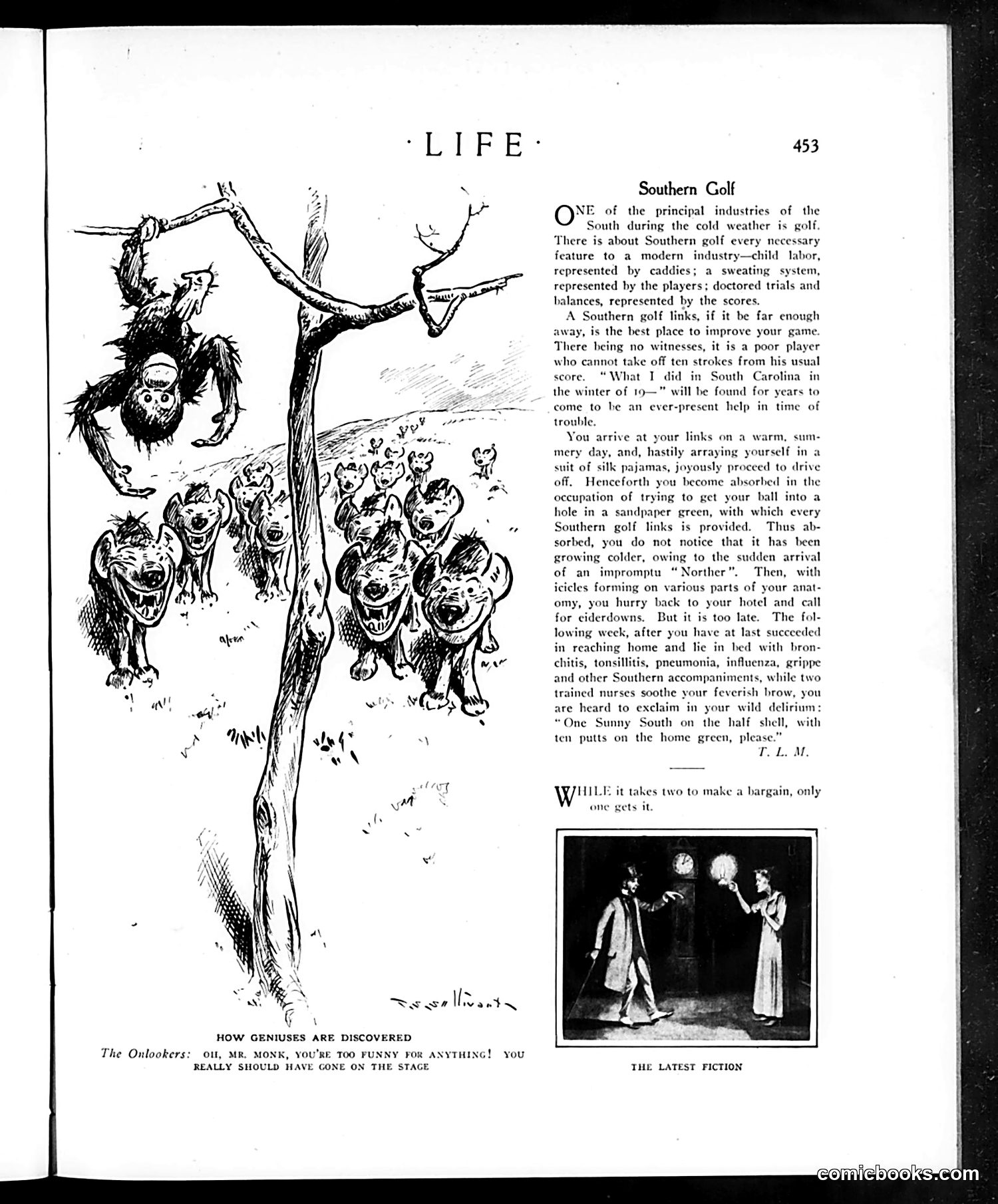
**Main Cartoon: "How Geniuses Are Discovered"** This satirical cartoon depicts a monkey hanging from a tree branch above a group of gleeful monkeys below. The caption reads: "OH, MR. MONK, YOU'RE TOO FUNNY FOR ANYTHING! YOU REALLY SHOULD HAVE GONE ON THE STAGE." The joke mocks the entertainment industry's talent-discovery process. It suggests that performing ability (or lack thereof) is so subjective that even a monkey could be "discovered" and praised as comic material. This ridicules both theatrical talent scouts who make questionable casting choices and the audience's gullible appreciation of mediocre performers. **"Southern Golf" Article** The accompanying article humorously describes the miseries of golfing in the American South during winter—featuring unexpected weather changes, tropical diseases, and other southern-specific hardships that plague visiting golfers.
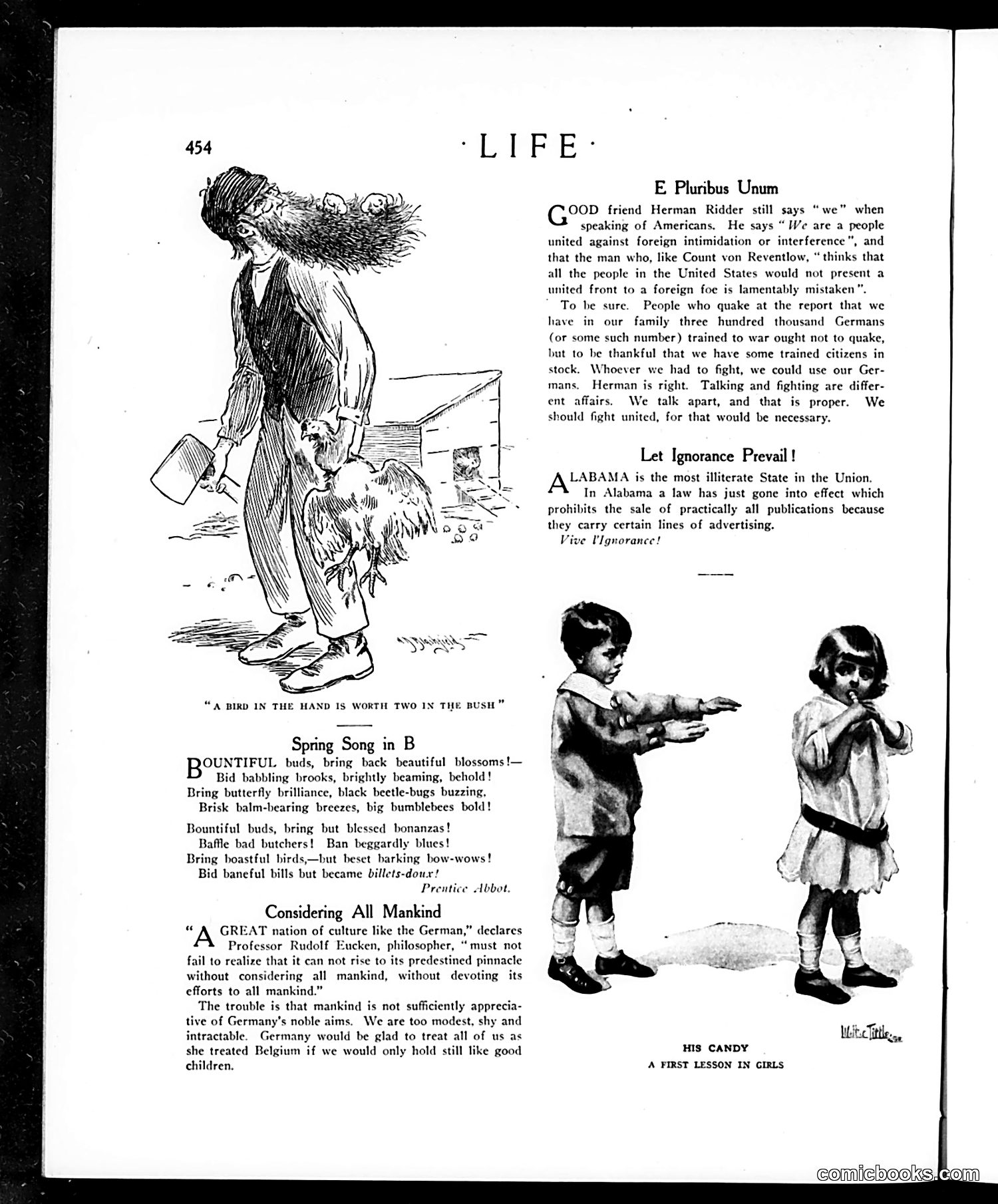
This satirical page from *Life* magazine addresses American unity during what appears to be World War I. The top sketch depicts an elderly German (identifiable by the Prussian-style helmet and exaggerated features) clutching money and dead birds—likely symbolizing Germany's predatory conduct and economic exploitation. The text discusses Herman Ridder's argument that Americans should present a united front against foreign threats, specifically Germany. The "Let Ignorance Prevail!" section satirizes Alabama's censorship laws prohibiting publication sales based on advertising content. The bottom illustration titled "His Candy: A First Lesson in Girls" shows a boy offering candy to a girl—likely an ironic commentary on German attempts to win American sympathy or support through manipulation, depicted as seduction of the naive.
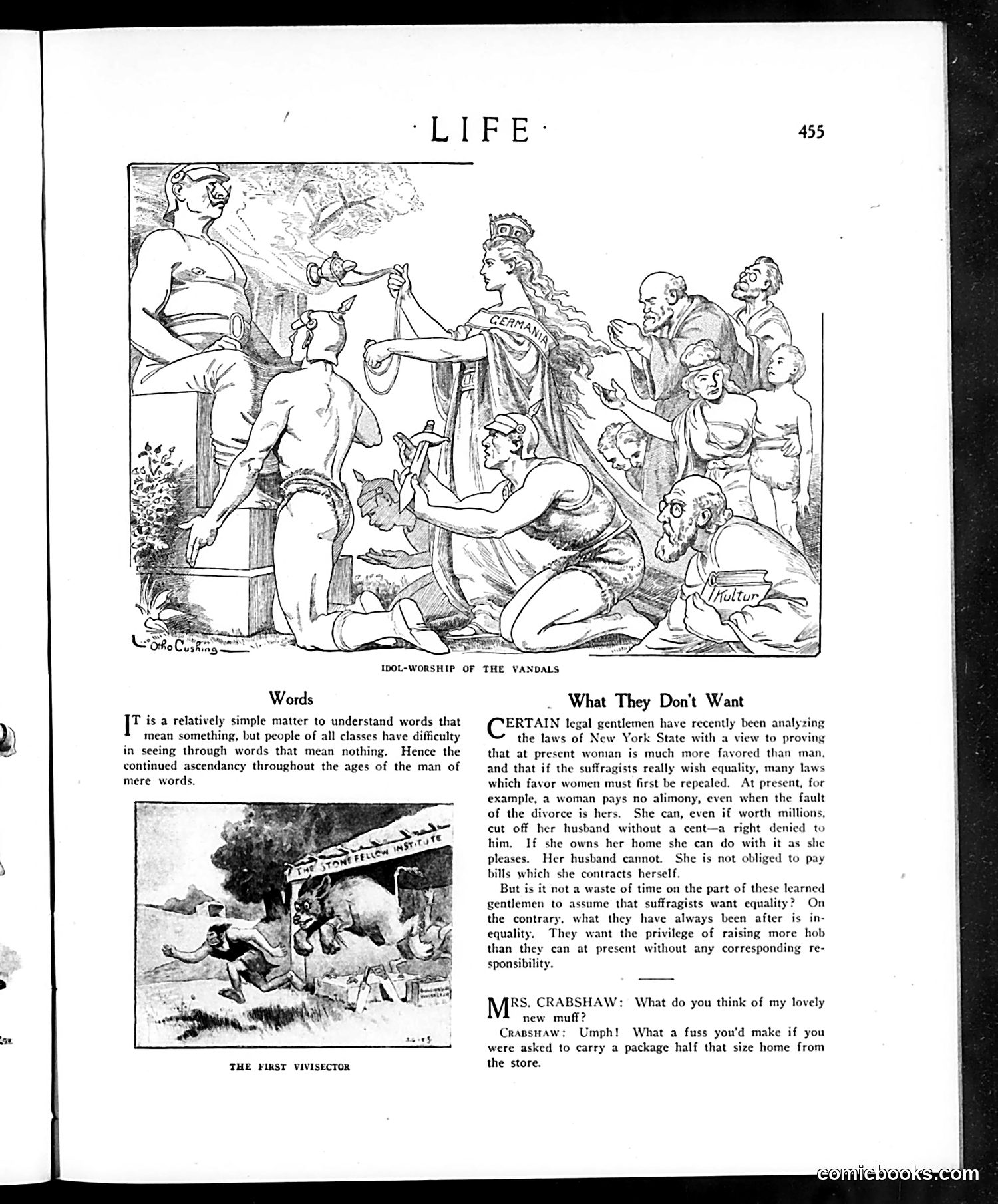
The top cartoon, titled "Idol-Worship of the Vandals," depicts a classical female figure (Germania, representing Germany) being worshipped by multiple figures in various states of undress or poverty. This appears to be satirizing German nationalism and militarism during the early 20th century, likely referencing World War I-era Germany's ideology. The text sections below address women's suffrage and legal inequality. "What They Don't Want" argues that suffragists seek only equality, not special privileges—contrary to opponents' claims. The Mrs. Crabshaw dialogue satirizes anti-suffrage sentiment by mocking a woman's complaints about practical inconveniences, suggesting such objections are trivial compared to demands for equal rights. The small cartoon "The First Vivivisector" appears to depict vivisection (animal experimentation).
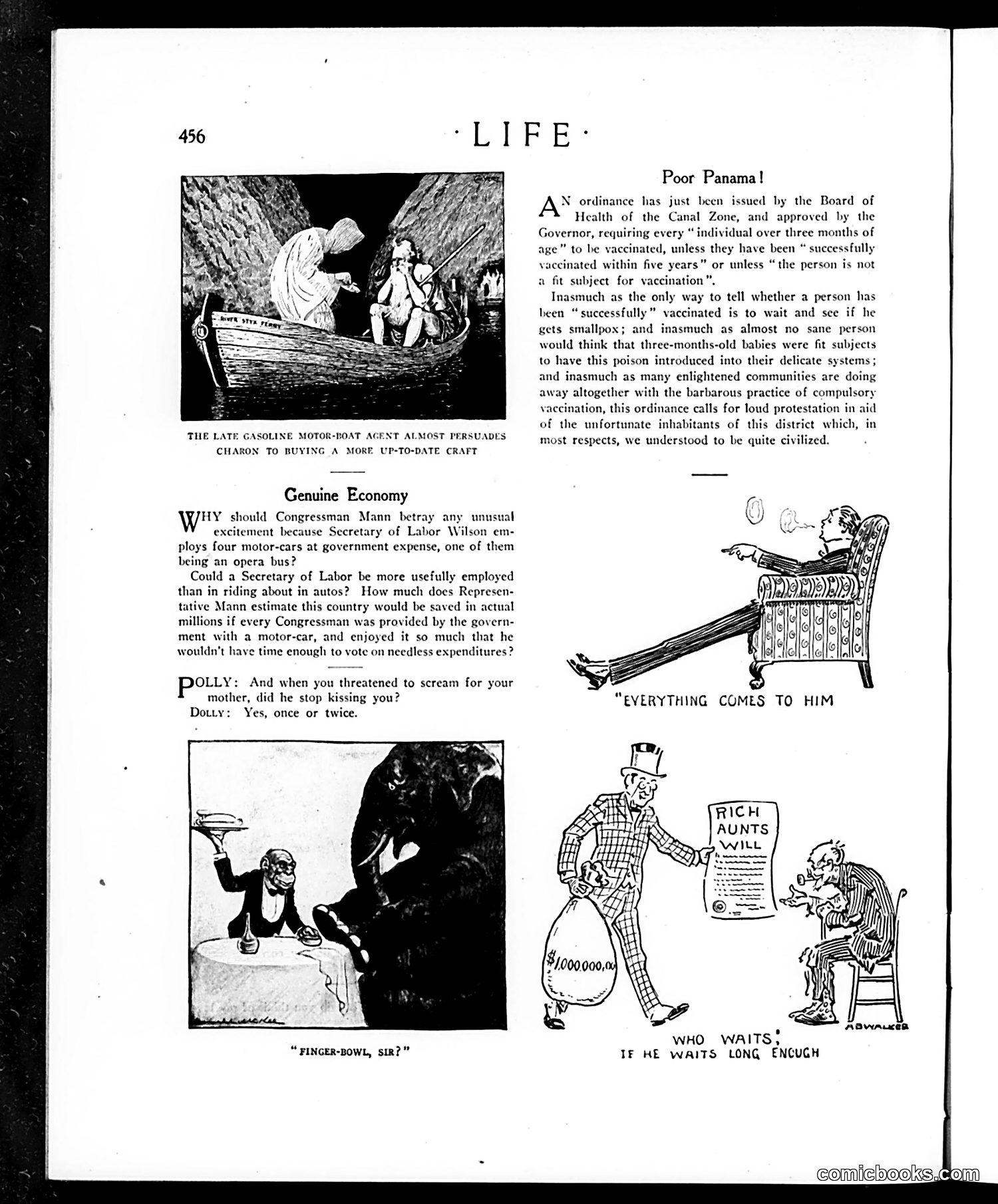
This page contains three distinct satirical pieces: **"Poor Panama!"** criticizes a Canal Zone health ordinance requiring vaccination. The text mocks the policy as barbarous and unsuited for "civilized" communities, sarcastically suggesting three-month-old babies shouldn't be forcibly vaccinated. **"Genuine Economy"** attacks Secretary of Labor Wilson for using government motor-cars, questioning why Congressmen need cars when they could save money by reducing unnecessary expenditures—a dig at government waste. The **cartoons** include social satire: "Everything Comes to Him" mocks idle wealth; "Who Waits; If He Waits Long Enough" suggests inheritance seekers; and "Finger-Bowl, Sir?" depicts servant humor. These target class divisions and wealth inequality common to pre-WWI American satire. The gasoline motor-boat illustration at top appears unrelated commentary on technology.
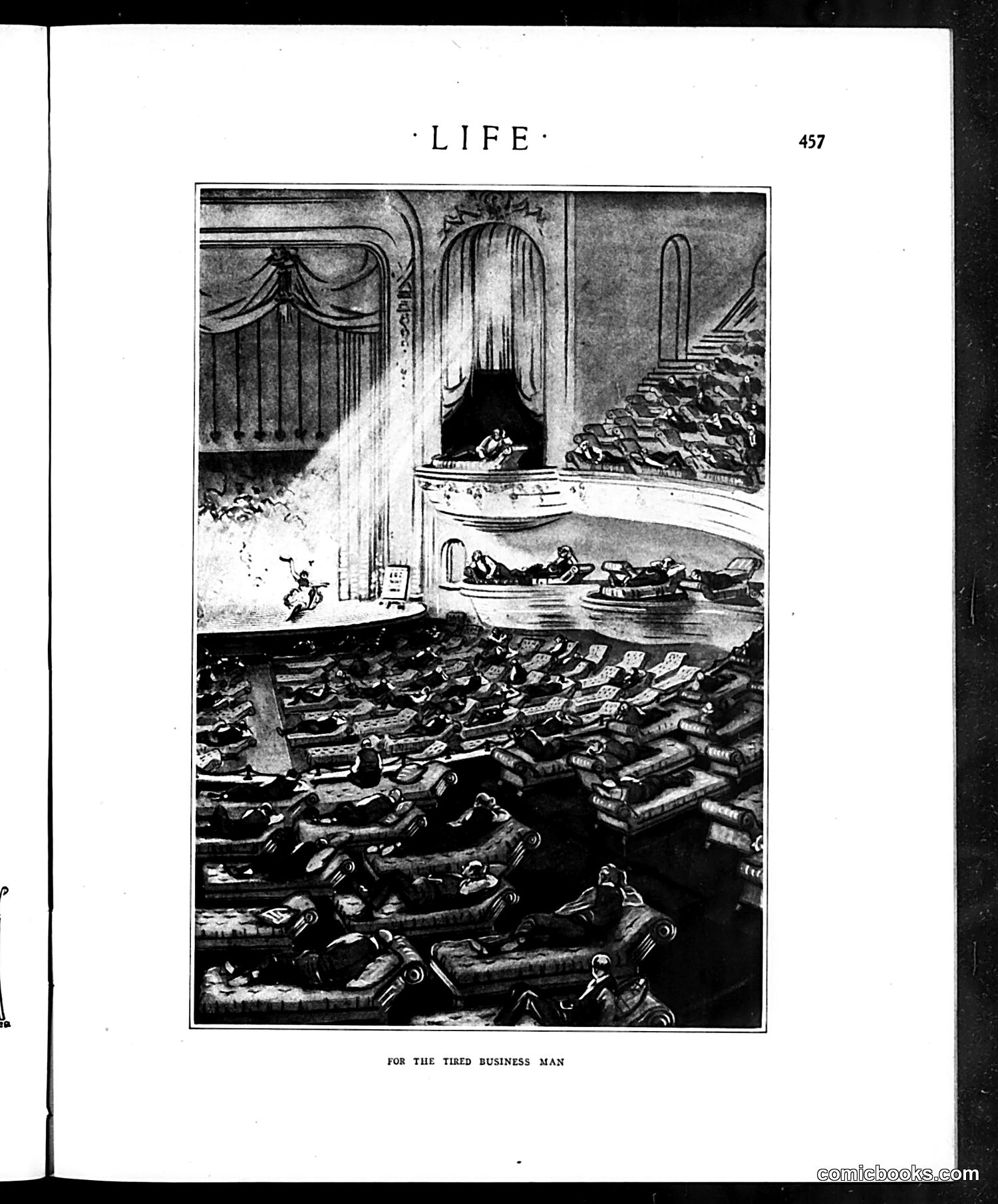
This satirical cartoon depicts a luxurious spa or bathhouse scene designed as an escape fantasy for exhausted businessmen. The image shows an elaborate underground grotto with: - Ornate classical architecture (columns, arched doorways) - A bathing pool with attendants - Multiple figures lounging and being served - Stacks of what appear to be currency or financial documents in the foreground The satire critiques the wealthy businessman's lifestyle, suggesting that despite their material success and elaborate leisure facilities, they remain overwhelmed by financial obligations and business concerns (represented by the towering stacks of documents/money). The joke is that even in paradise-like surroundings designed for relaxation, the tired businessman cannot escape the weight of his commercial responsibilities.
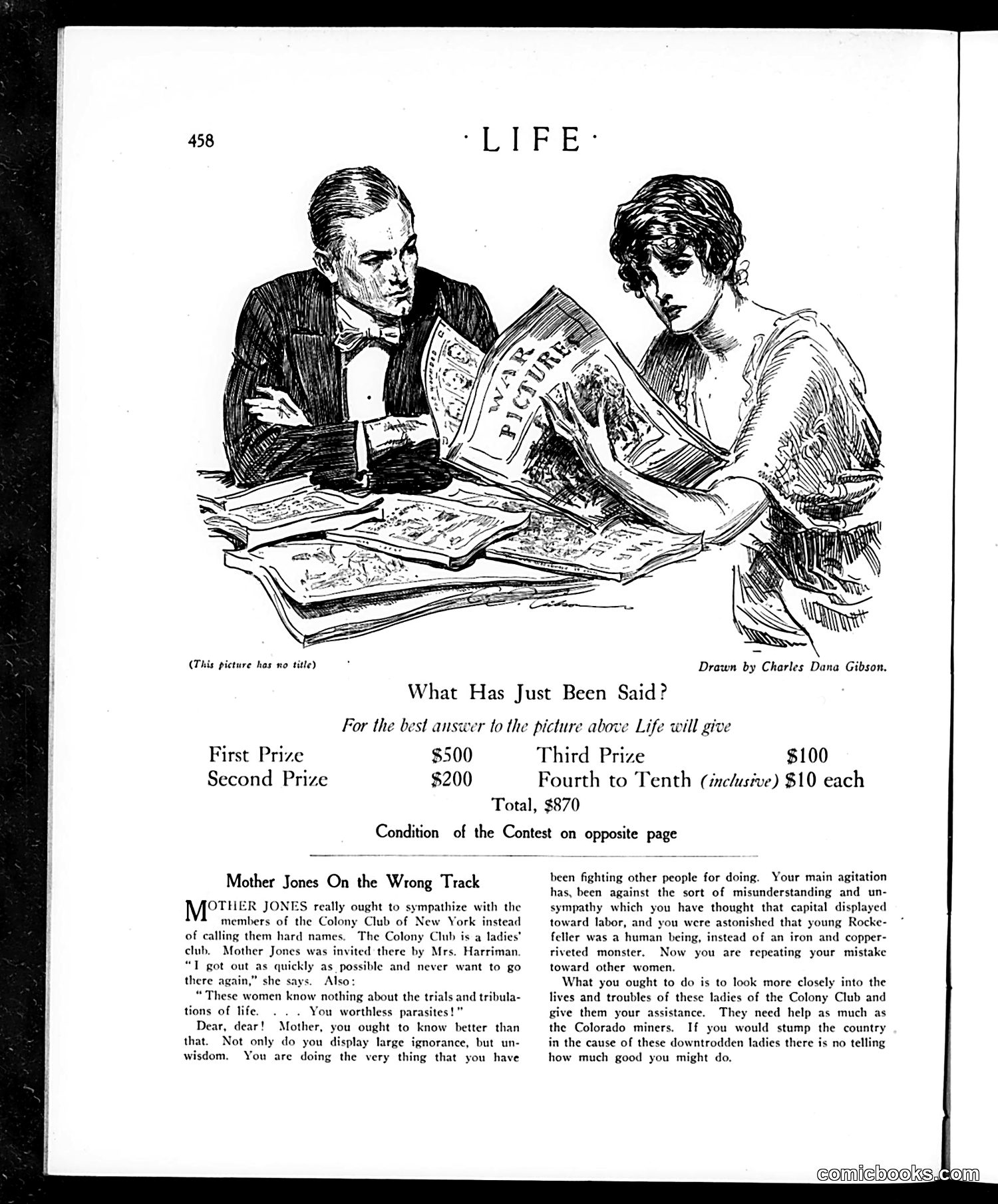
This page contains a contest and advice column rather than political satire. **The Contest:** "What Has Just Been Said?" invites readers to caption an illustration by Charles Dana Gibson showing a well-dressed man and woman examining magazines and publications together. The drawing itself provides no title, leaving readers to imagine their conversation. Prizes totaling $870 are offered. **The Advice Column:** "Mother Jones On the Wrong Track" critiques "Mother Jones" (likely the labor activist) for her sympathetic comments toward the Colony Club of New York, calling her approach misguided. The columnist argues she should instead focus on helping working women and supporting labor causes like the Colorado miners' struggles, rather than showing sympathy toward wealthy women's clubs.
This page is **not a political cartoon** but rather a **contest announcement and editorial commentary**. The main content announces Life magazine's picture-captioning contest, offering prizes ($500, $200, $100, and seven $10 prizes) to readers who submit winning titles for an accompanying illustration related to the Panama Exhibition in San Francisco. The page includes three separate editorial pieces: 1. **Contest Rules** - Detailed submission guidelines emphasizing fairness and preventing duplicate titles 2. **"The Industrial Problem"** - A brief editorial discussing industrial labor issues, with a reference to Germany's recent upheaval (likely WWI-related, mentioning they "blew up") 3. **"For the Sufferers"** - An acknowledgment of charitable donations for Belgian war relief The satirical tone typical of Life appears primarily in the editorial sections rather than visual humor. The contest itself represents the magazine's engagement with its readership through interactive participation.
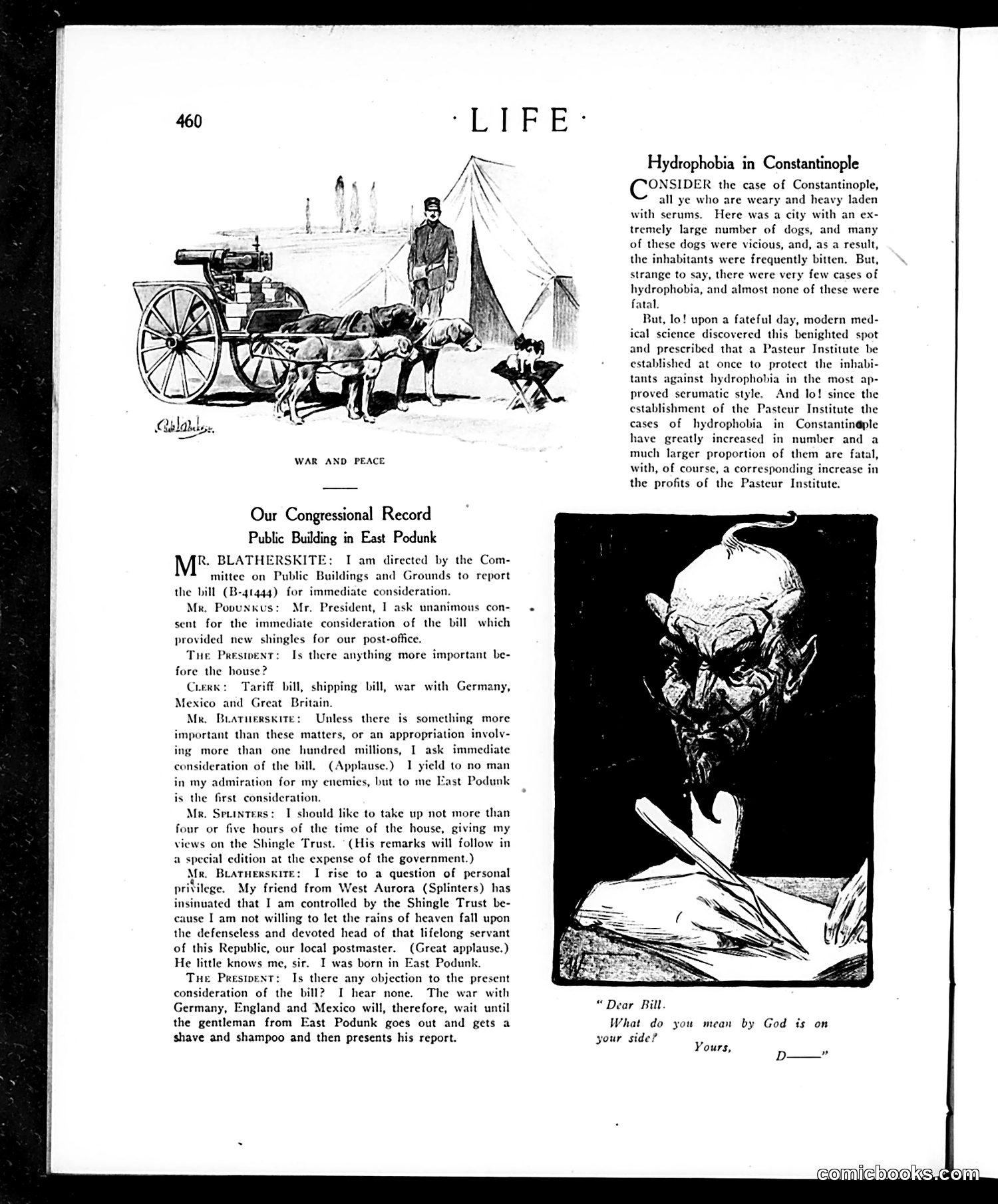
**"Our Congressional Record"** satirizes Congressional priorities. The dialogue mocks politicians obsessing over trivial local matters—a post office's new shingles in "East Podunk"—while wars with Germany, England, and Mexico await consideration. The congressman's absurd justification ("I was born in East Podunk") and the President's casual dismissal of major conflicts highlight legislative dysfunction and misplaced priorities during the pre-WWI era. **"Hydrophobia in Constantinople"** uses dark irony to critique medical intervention. It argues that before the Pasteur Institute arrived, Constantinople had few rabies deaths despite many dog bites. Since the institute's establishment, cases and fatalities increased—suggesting the "cure" worsened outcomes, or that modern medicine's profit motive drove unnecessary treatment. The piece satirizes faith in scientific institutions and their commercial incentives. **The bottom illustration** shows a devil-like figure; the caption "What do you mean by God is on your side?" implies commentary on invoked divine authority—likely about war or political claims.
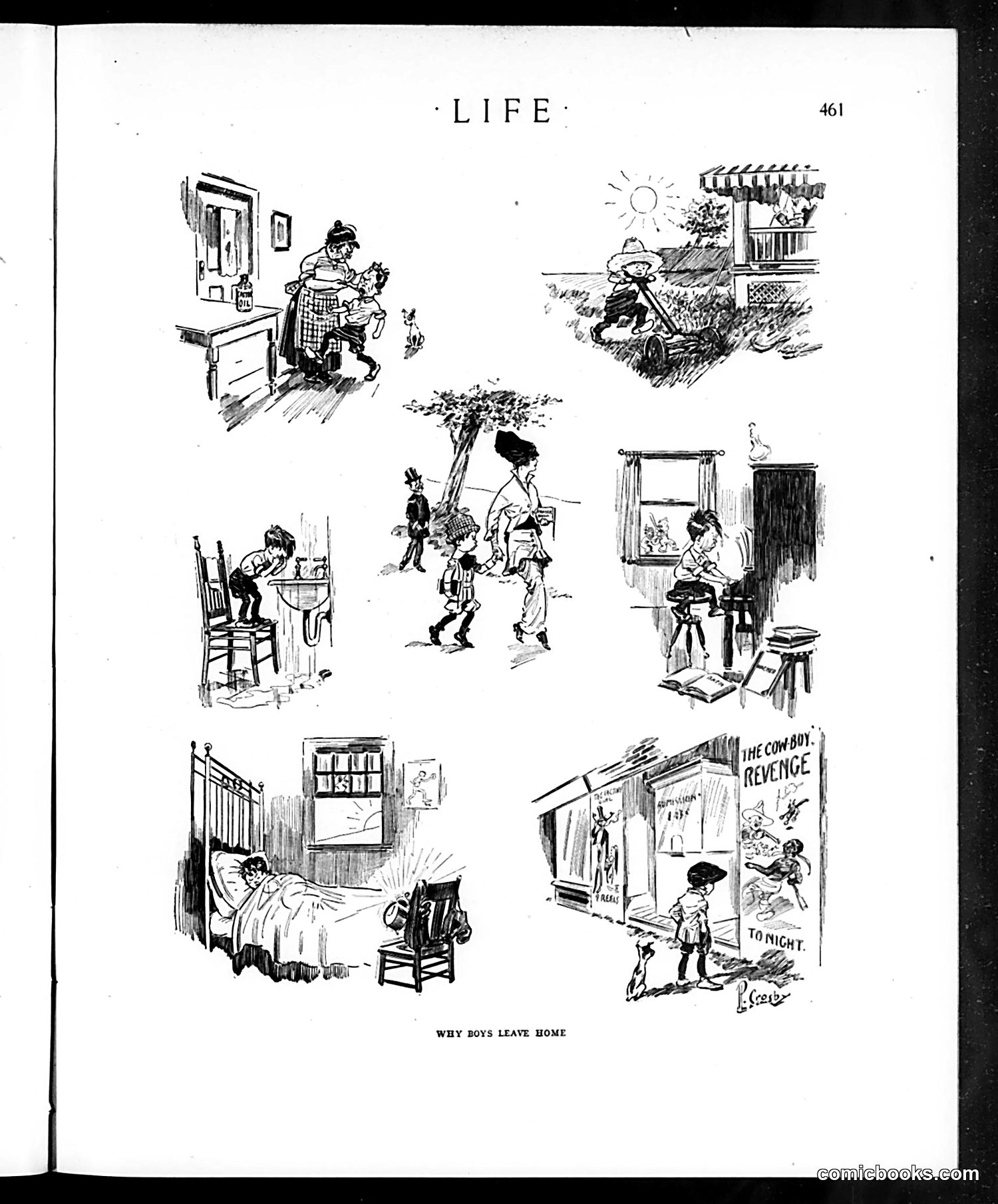
This page from *Life* magazine presents a satirical comic strip sequence depicting reasons boys abandon their households. The six panels show domestic scenarios: a mother figure managing children at a doorway, children playing outdoors near a store, a boy washing dishes indoors, children gathered under a tree, a boy at a desk or table doing chores, and finally a boy viewing a movie poster ("The Cow Boy's Revenge—To Night"). The satire critiques domestic life's tedium and parental demands—dishwashing, indoor confinement, and work—contrasting sharply with outdoor adventures and entertainment like Western films. The final panel suggests cinema provides irresistible escape from household responsibilities. This reflects early 20th-century anxieties about boys' restlessness and cinema's cultural influence on youth behavior.
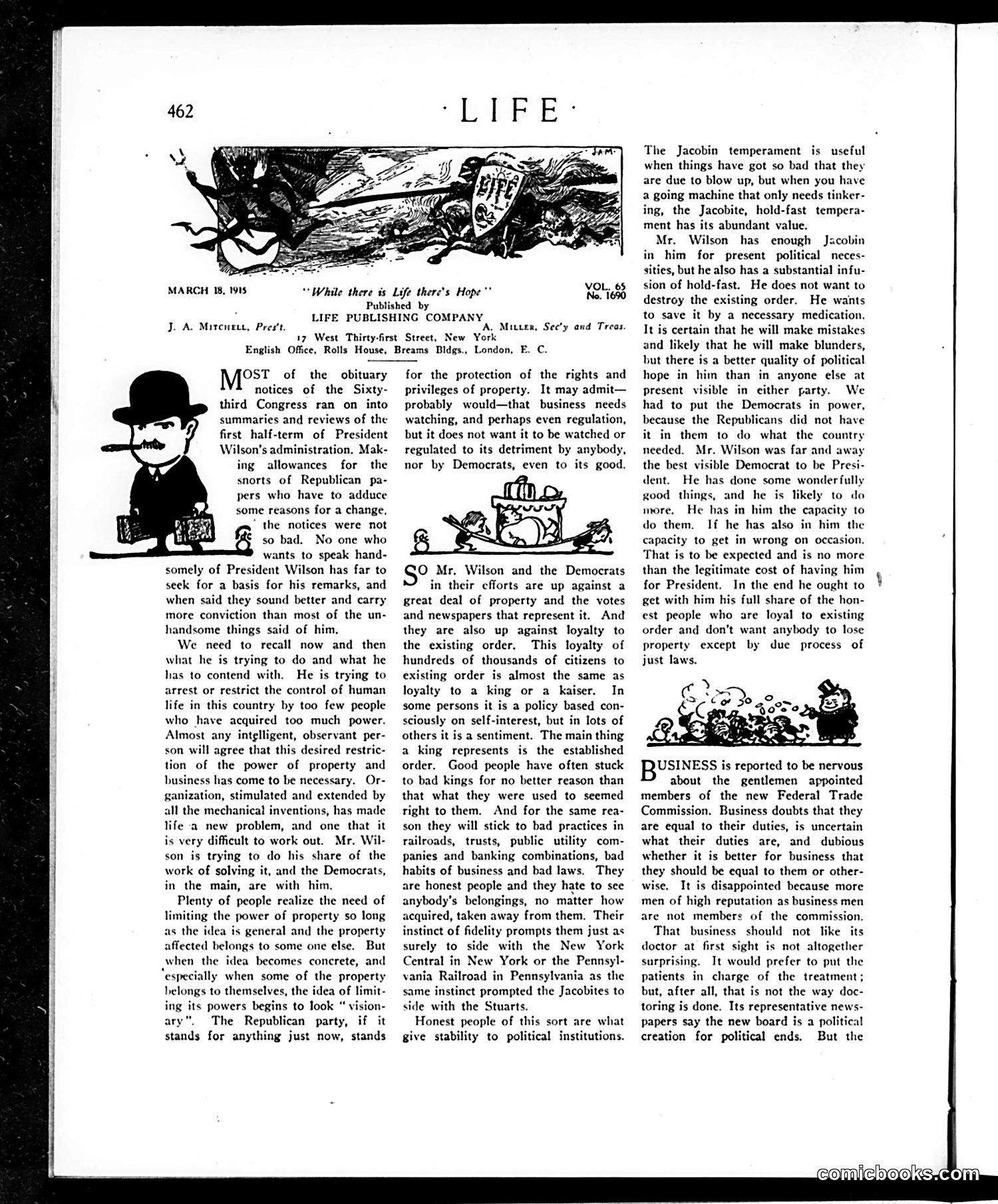
This March 1915 Life editorial uses the caricatured portrait of President Wilson (shown with distinctive features in the sidebar) to discuss his first-term efforts to regulate corporate power and property rights. The article argues that Wilson is attempting to limit control of American life by wealthy industrialists—a necessary reform given how organizational consolidation has concentrated power. However, Wilson faces opposition from two sources: the Republican Party, which defends property rights, and ordinary citizens whose traditional loyalty to the "existing order" (compared to loyalty subjects showed kings or the Stuarts) makes them resist change. The piece distinguishes between "Jacobin" temperament (revolutionary, destructive) and "Jacobite" temperament (preservationist, loyal), suggesting Wilson needs both—enough revolutionary spirit to fix systemic problems, but also restraint to avoid destroying functional institutions. The satire targets not Wilson but the conservative forces opposing reform.
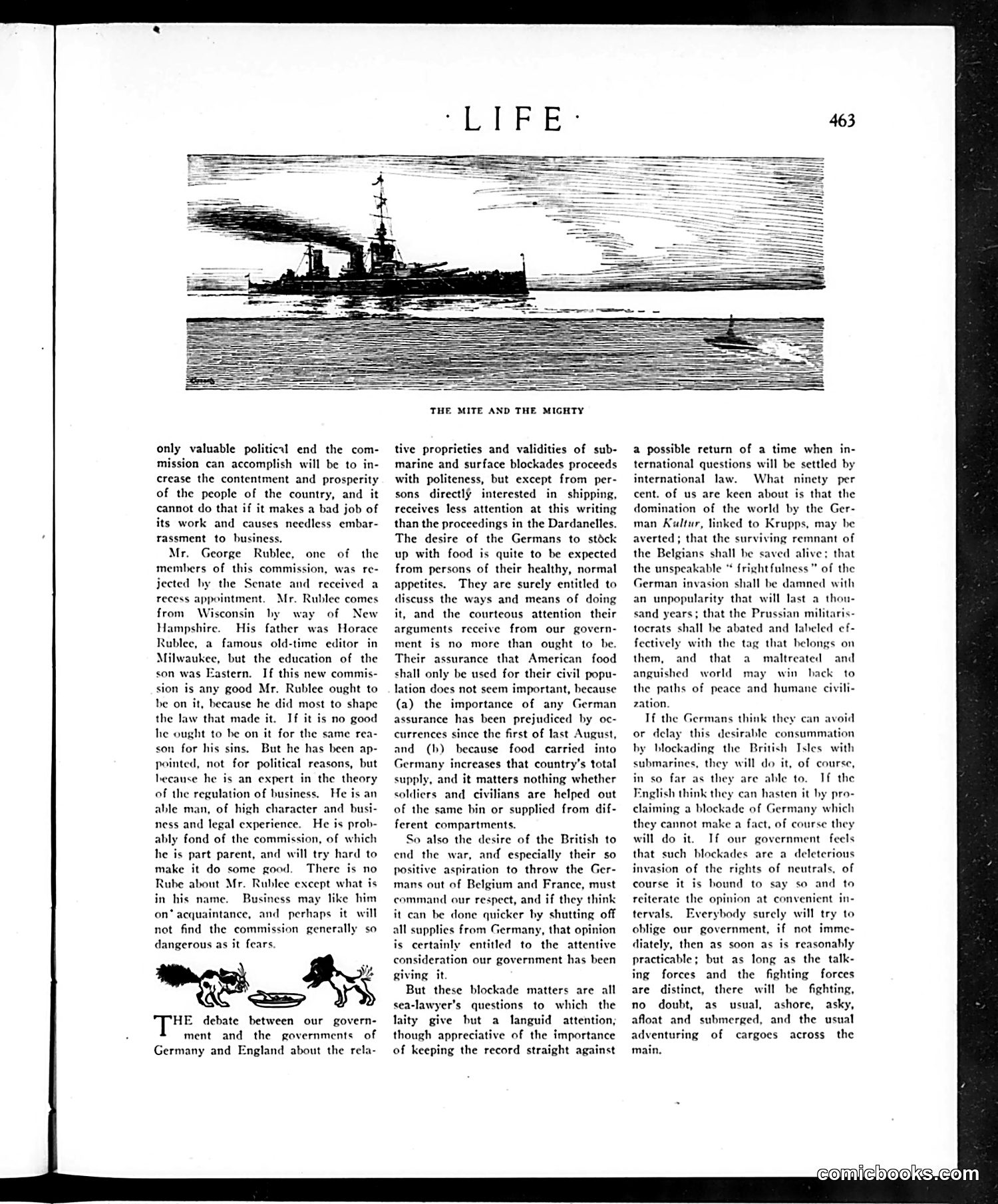
This page discusses WWI-era debates between American, German, and British governments over submarine and surface blockades. The article criticizes Germany's food blockade justifications while acknowledging Britain's similar tactics, but argues most Americans care less about technical "sea-lawyer's questions" than about preventing German military dominance and the brutality of their invasion of Belgium. The top illustration shows a warship (likely representing British naval power) dwarfing a smaller vessel, visualizing the title's contrast between mighty and insignificant forces. The text defends George Rublee's appointment to a regulatory commission despite Senate rejection, praising his qualifications. The satire targets both German and British diplomatic posturing about blockades while expressing strong anti-German sentiment—condemning "Prussian militarism," German "frightfulness," and the Krupps munitions empire. For modern readers: this reflects American public opinion circa 1915, before U.S. entry into WWI, when sympathies clearly favored the Allies.
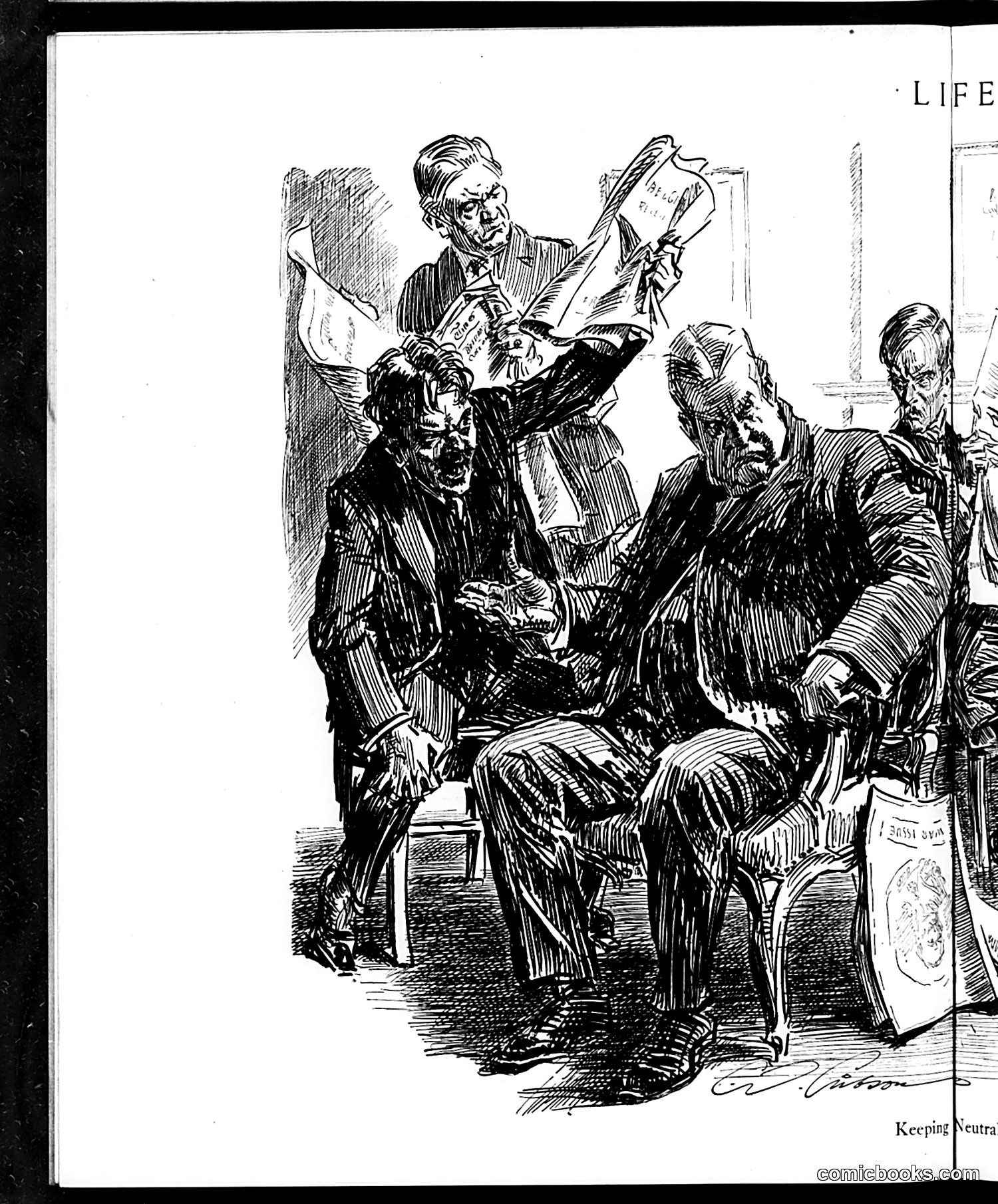
This political cartoon depicts what appears to be a diplomatic or political negotiation scene. A standing figure (center-back) holds up documents while gesturing at seated men in suits, suggesting he's presenting terms or arguments to them. The men seated appear skeptical or resistant to what's being proposed. The caption "Keeping Neutra" likely references maintaining neutrality, probably during a period of international tension (possibly WWI or WWII era, given Life magazine's historical context). The cartoon satirizes diplomatic attempts to convince other nations or factions to remain neutral, depicting the difficulty of persuading resistant parties through documents and arguments. The body language suggests the negotiators are unconvinced or unmoved by the proposal being presented.
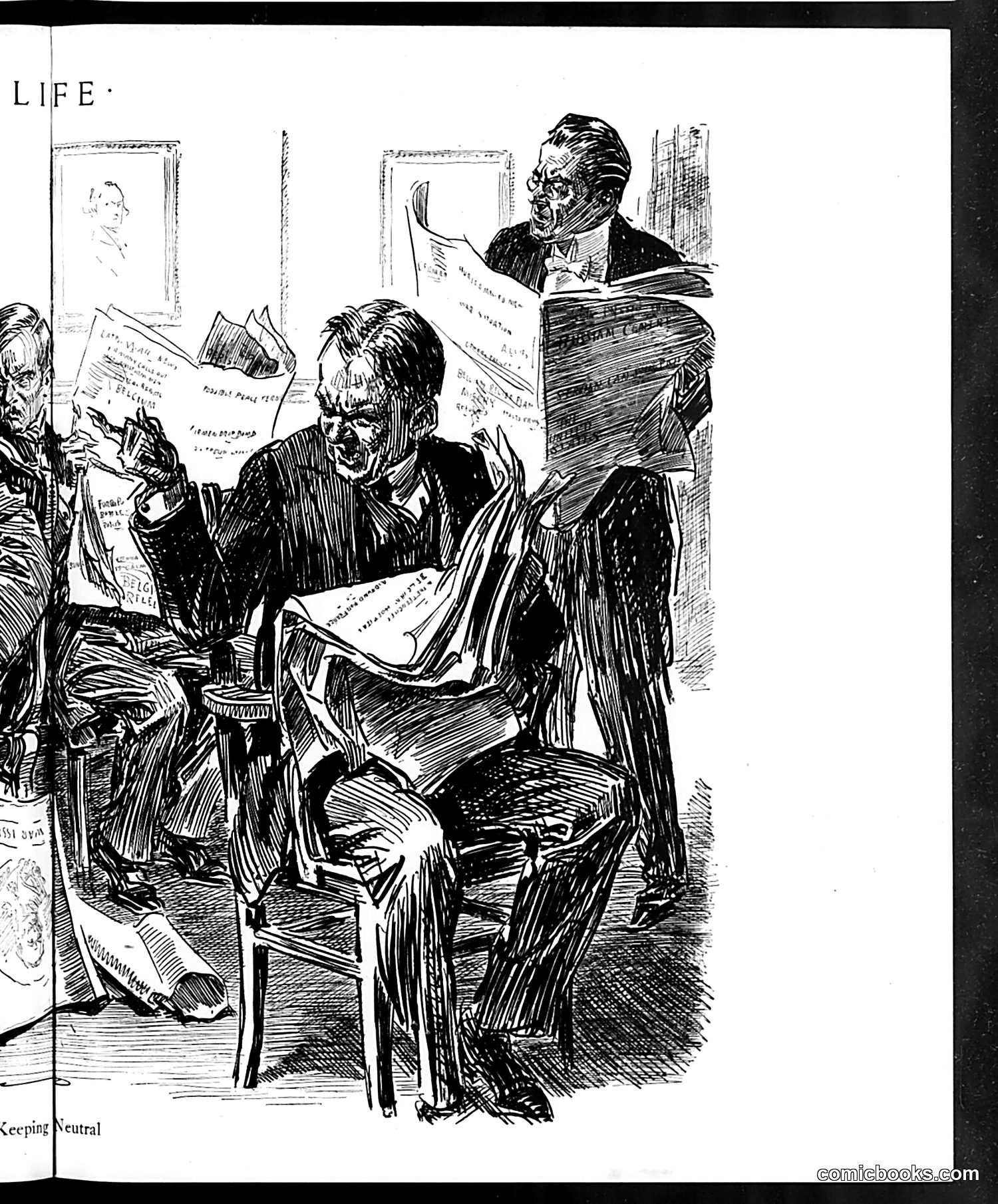
This appears to be a satirical political cartoon from Life magazine showing men in formal attire examining or exchanging documents. The caption "Keeping Neutral" suggests commentary on neutrality—likely during a period of international tension or conflict when neutrality was a contested political position. The central seated figure appears to be reviewing papers while others around him present documents, possibly depicting someone (perhaps a political figure or nation) claiming neutrality while actually engaging in selective dealings or transactions. The detailed examination of documents and the knowing expressions suggest ironic commentary on the difficulty or impossibility of maintaining true neutrality in practice. Without clearer identification of the specific figures or date, the exact historical context remains uncertain, but the satire targets hypocrisy in claims of political neutrality.
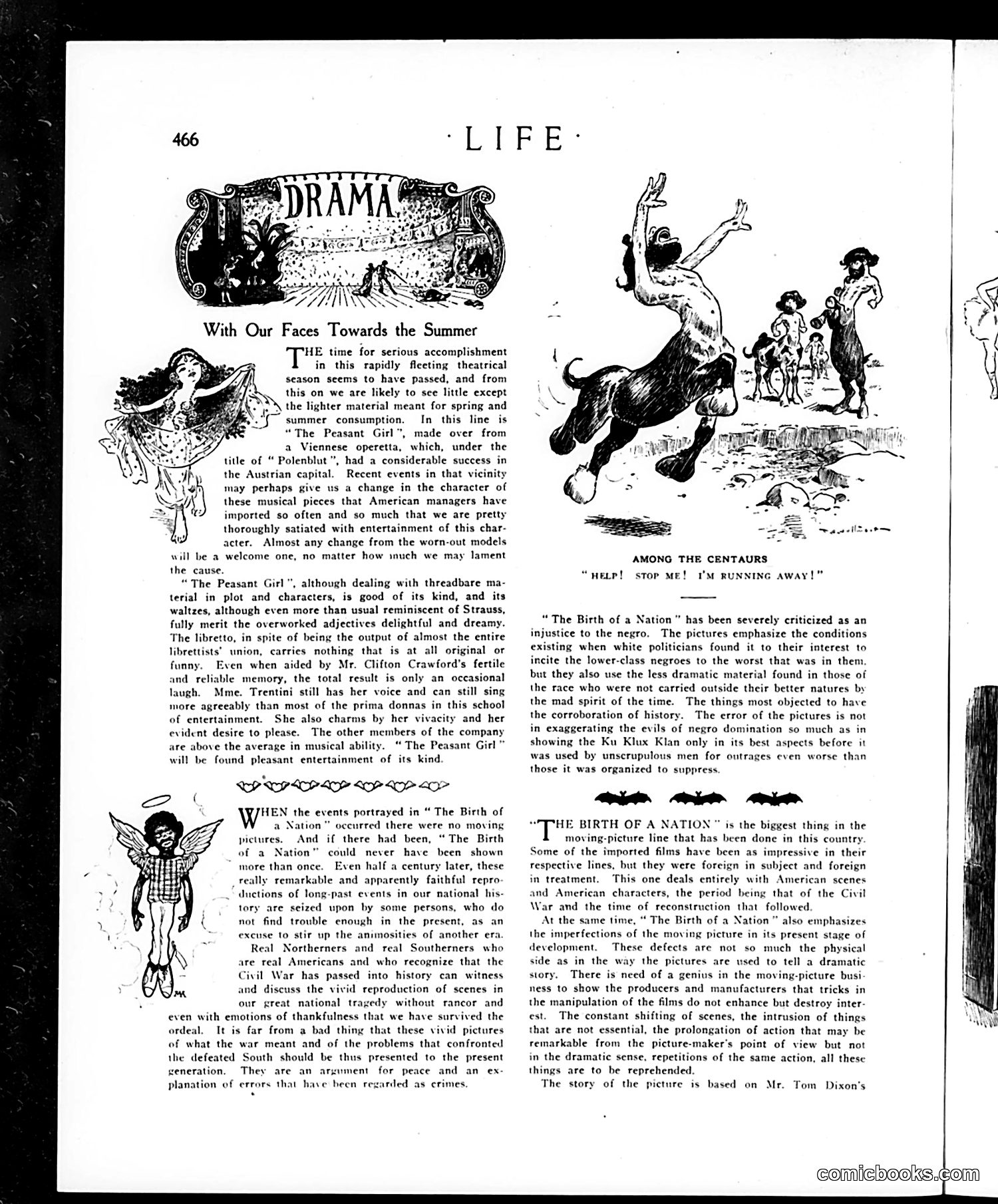
This page contains two distinct sections: **"The Peasant Girl" Review (top-left):** A theater critique of a Viennese operetta adaptation, dismissing it as pleasant but formulaic entertainment for summer audiences. The reviewer notes the lead actress Mme. Trentini has charm despite the uninspired libretto. **"Among the Centaurs" Cartoon (right):** A simple humorous illustration showing a centaur fleeing from humans and children on a beach, with the centaur shouting "Help! Stop me! I'm running away!"—apparently a joke about loss of control or panic. **"The Birth of a Nation" Essay (bottom):** A defense of D.W. Griffith's controversial 1915 film. The writer argues the film appropriately documents Reconstruction-era conditions and justifies showing it despite its controversial depictions of African Americans and the Ku Klux Klan. The essay claims the film's main flaw is portraying the Klan *too favorably* rather than exaggerating its evils—a remarkable statement by modern standards reflecting the era's deeply problematic racial attitudes.
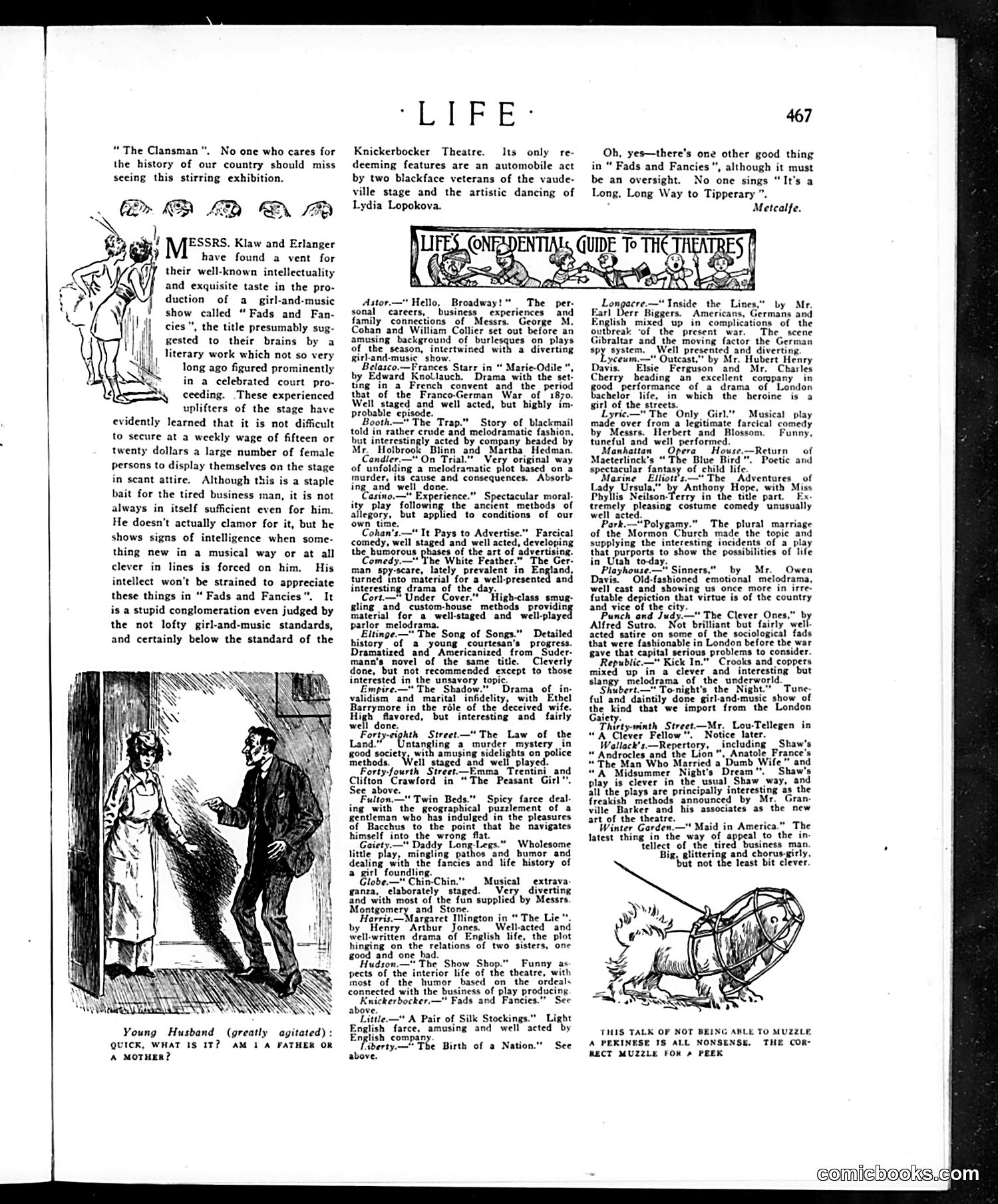
This page reviews Broadway theatrical productions, offering satirical commentary on commercial theater. The main cartoon depicts a confused young husband asking his wife "Quick, what is it? Am I a father or a mother?"—a joke about modern gender confusion or domestic bewilderment. The text mocks producer Klaw and Erlanger's show "Fads and Fancies," criticizing it as intellectually vapid—merely exploiting scantily-clad chorus girls without genuine artistic merit. The reviewer sarcastically notes the only redeeming features are a vaudeville act and dancing by Lydia Lopokova. The reviews of other shows reference wartime tensions: "The White Feather" exploits contemporary German spy-scare anxieties prevalent in England, while one review notably excludes "It's a Long, Long Way to Tipperary"—a popular WWI song—suggesting dated patriotic sentiment. The overall tone criticizes commercialized theater prioritizing spectacle and female display over artistic substance.
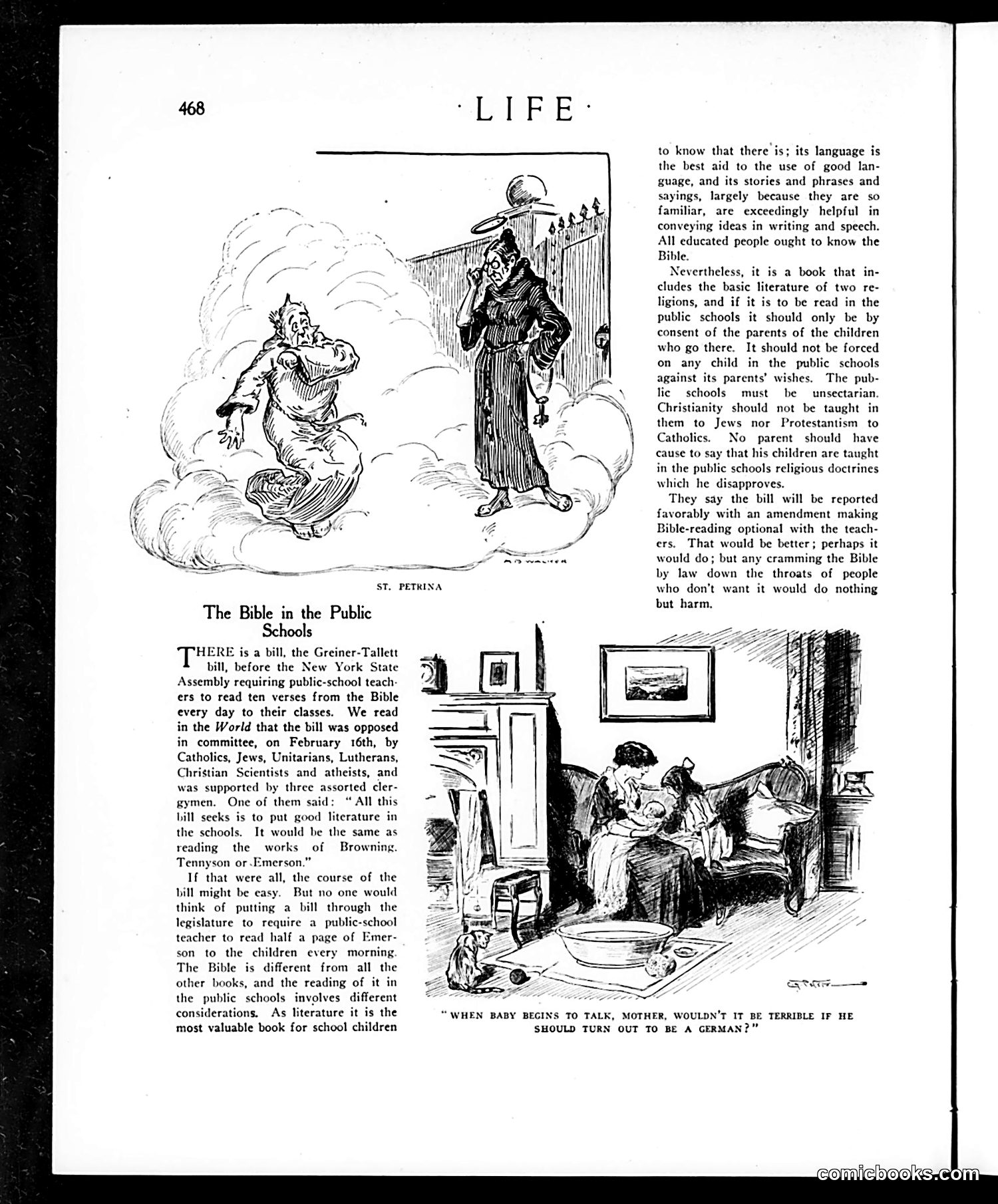
This page discusses the Greiner-Tallett bill requiring New York public-school teachers to read ten Bible verses daily. The article opposes mandatory Bible reading while acknowledging the Bible's literary value. **The cartoons illustrate the satirical argument:** The top cartoon (St. Petrina) depicts religious figures in clouds, mocking clergy who claim the bill merely introduces "good literature"—the satire suggests their true motive is religious instruction, not literary merit. The bottom cartoon shows a mother and child, with the caption: "When baby begins to talk, mother, wouldn't it be terrible if he should turn out to be a German?" This appears to mock nativist anxieties, sarcastically implying that forced Bible-reading reflects xenophobic concerns about controlling immigrant children's religious/cultural identity. **The satire's point:** Mandatory Bible reading in public schools violates religious neutrality and parental rights, regardless of literary justification. The cartoons suggest this impulse stems from religious proselytizing and ethnic anxiety, not educational principle.
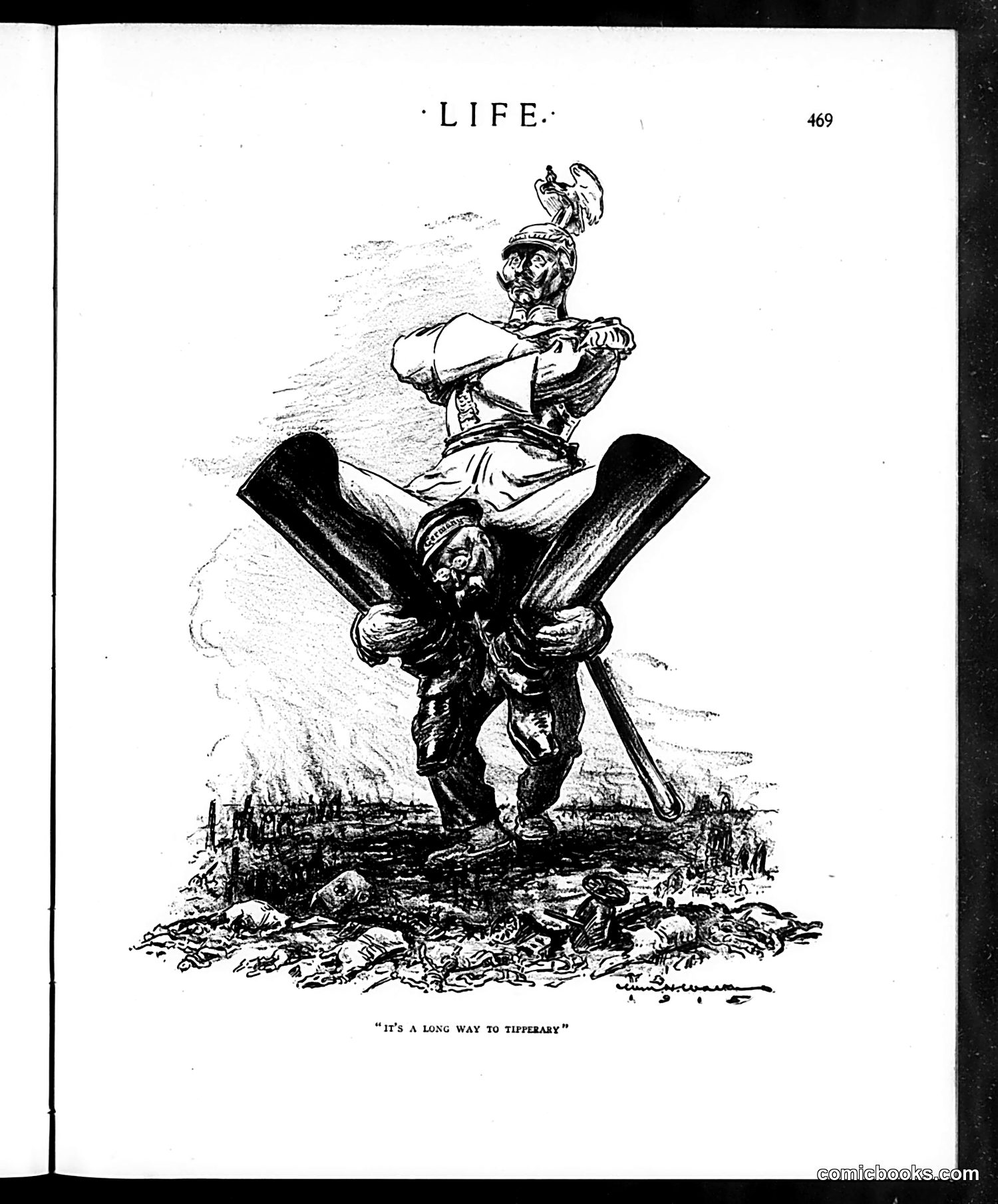
This is a political cartoon from Life magazine (page 469) depicting a military figure carrying another soldier on his shoulders, standing atop a pile of corpses and rubble. The caption reads "It's a Long Way to Tipperary"—referencing the famous WWI marching song. The cartoon appears to be **anti-war commentary on World War I**, satirizing the enormous human cost and distance between war's promises and brutal reality. The soldier being carried likely represents the wounded or dying, while the lower figure struggles under the literal weight of casualties beneath them. The "long way to Tipperary" transforms the upbeat military song into bitter commentary: the journey to victory demands an enormous price in lives. This reflects American attitudes toward the conflict during or shortly after WWI.
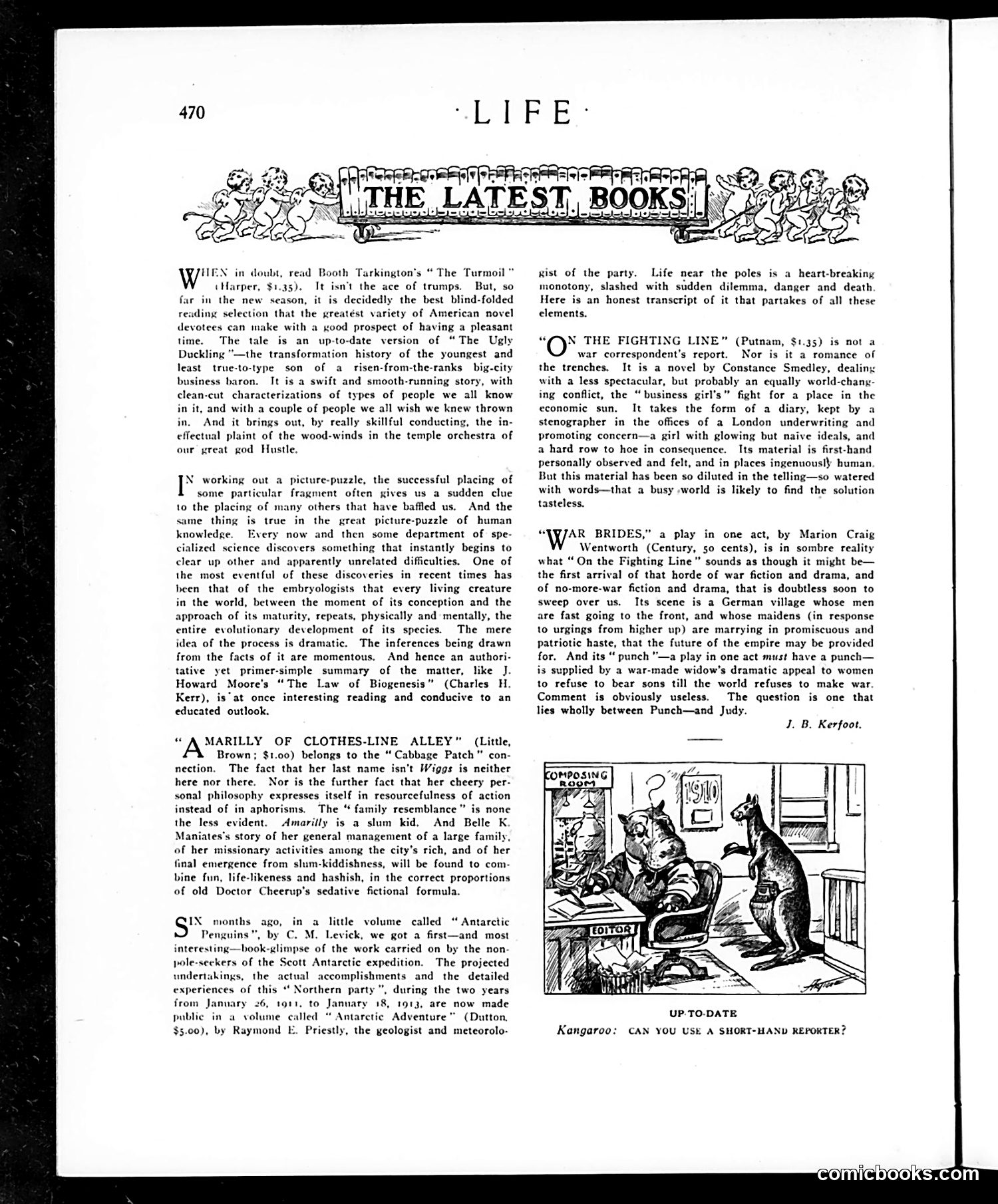
This is a **book review page** from *Life* magazine, not primarily a political cartoon. The page discusses several new publications, including works by Booth Tarkington and others. The single **cartoon illustration** (bottom right) appears to be a humorous sketch labeled "UP TO DATE" with the caption "Kangaroo: CAN YOU USE A SHORT-HAND REPORTER?" It depicts what seems to be a kangaroo in an office setting, likely satirizing modern business efficiency and the adoption of shorthand stenography as a new workplace technology. The reviews themselves critique contemporary American literature—novels about urban life, slum children, evolutionary science, and the "business girl's" economic struggles. The tone is somewhat condescending, referencing formulaic sentimental fiction ("Cabbage Patch" style stories) while praising works exploring modern industrial society and gender economics. The page reflects early 1910s concerns: urbanization, women's workplace participation, and scientific advancement.
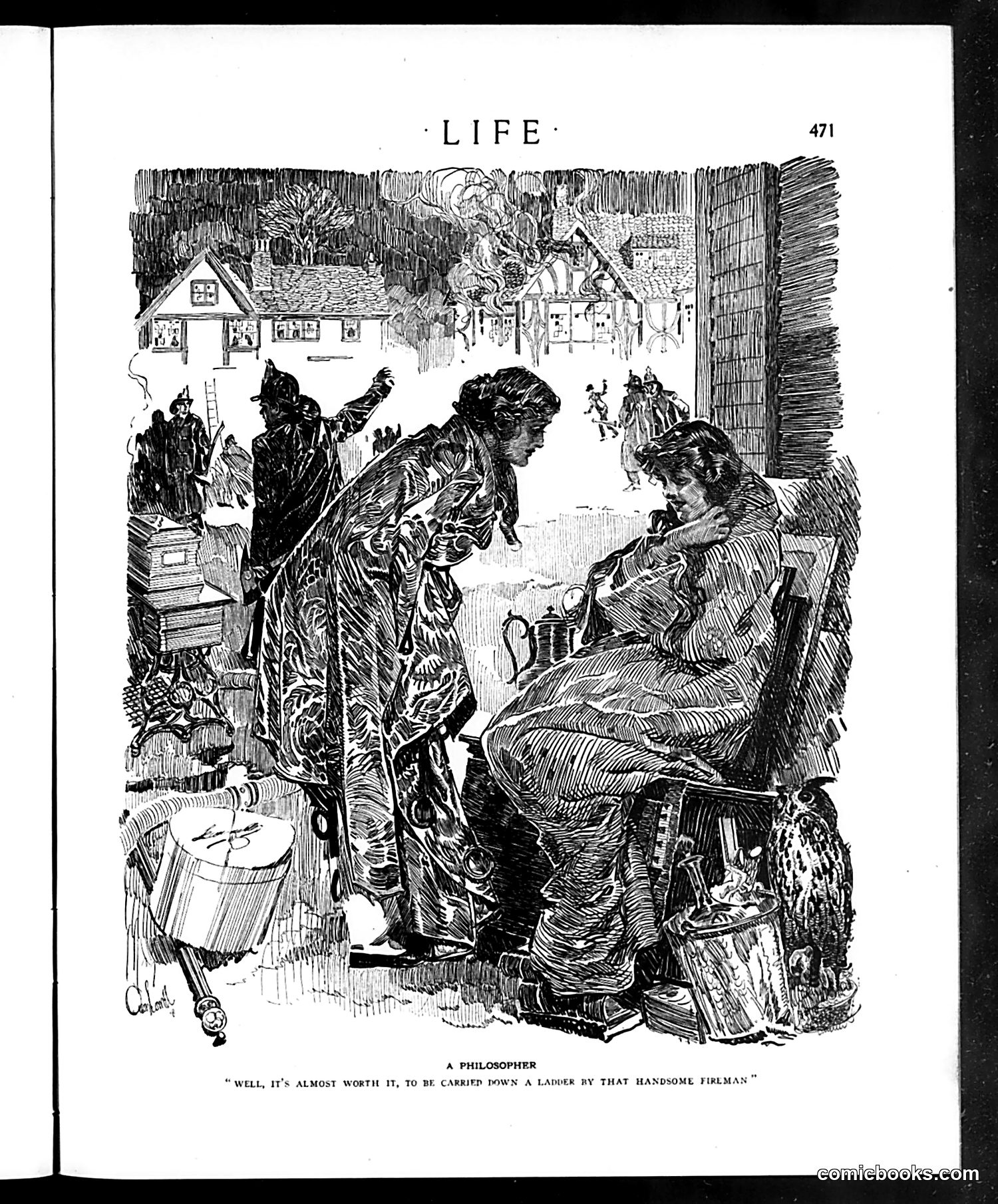
This single-panel cartoon depicts a domestic scene where a woman sits contentedly while a fireman carries her down a ladder during what appears to be a building evacuation. The caption has her philosophizing that the danger and inconvenience of the fire is "almost worth it" for the pleasure of being rescued by an attractive fireman. The satire targets romantic idealism and female vanity—suggesting women might romanticize perilous situations if they involve handsome men. It's also likely poking fun at the melodramatic "damsel in distress" trope, with the woman's priorities comically misplaced (safety over attraction). The cartoon reflects early 20th-century attitudes about women's supposed frivolousness and their tendency toward romantic fantasy over practical concerns.
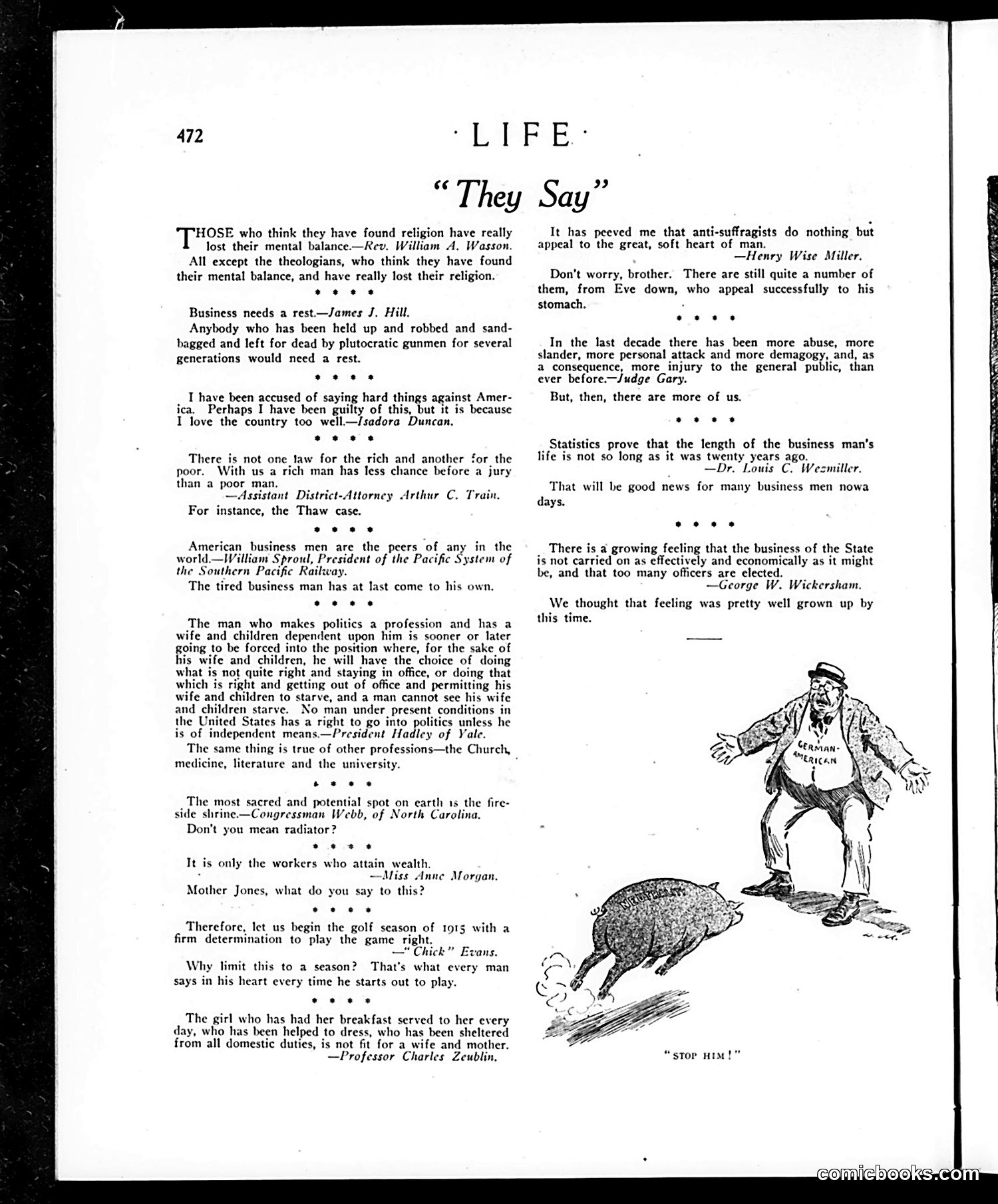
This page from Life presents a series of witty, contradictory quote pairings that mock contemporary public figures and social attitudes. The format juxtaposes earnest statements from politicians, businessmen, and reformers with sharp rejoinders that expose hypocrisy or absurdity. The cartoon depicts an elderly "German" immigrant (labeled on his jacket) being chased by or reacting to a wild boar, with the caption "STOP HIM!" This likely satirizes anti-German sentiment or hysteria, possibly related to World War I tensions. The textual satire targets: business tycoons' exhaustion (attributed to exploitation), the wealthy's supposed legal impartiality (contradicted by the notorious Thaw case involving a wealthy defendant), politicians' compromised integrity due to financial need, women's suffrage arguments, and business leaders' declining lifespans (presented as welcome news for business rivals). The overall tone is skeptical of authority figures making self-serving or hypocritical pronouncements.
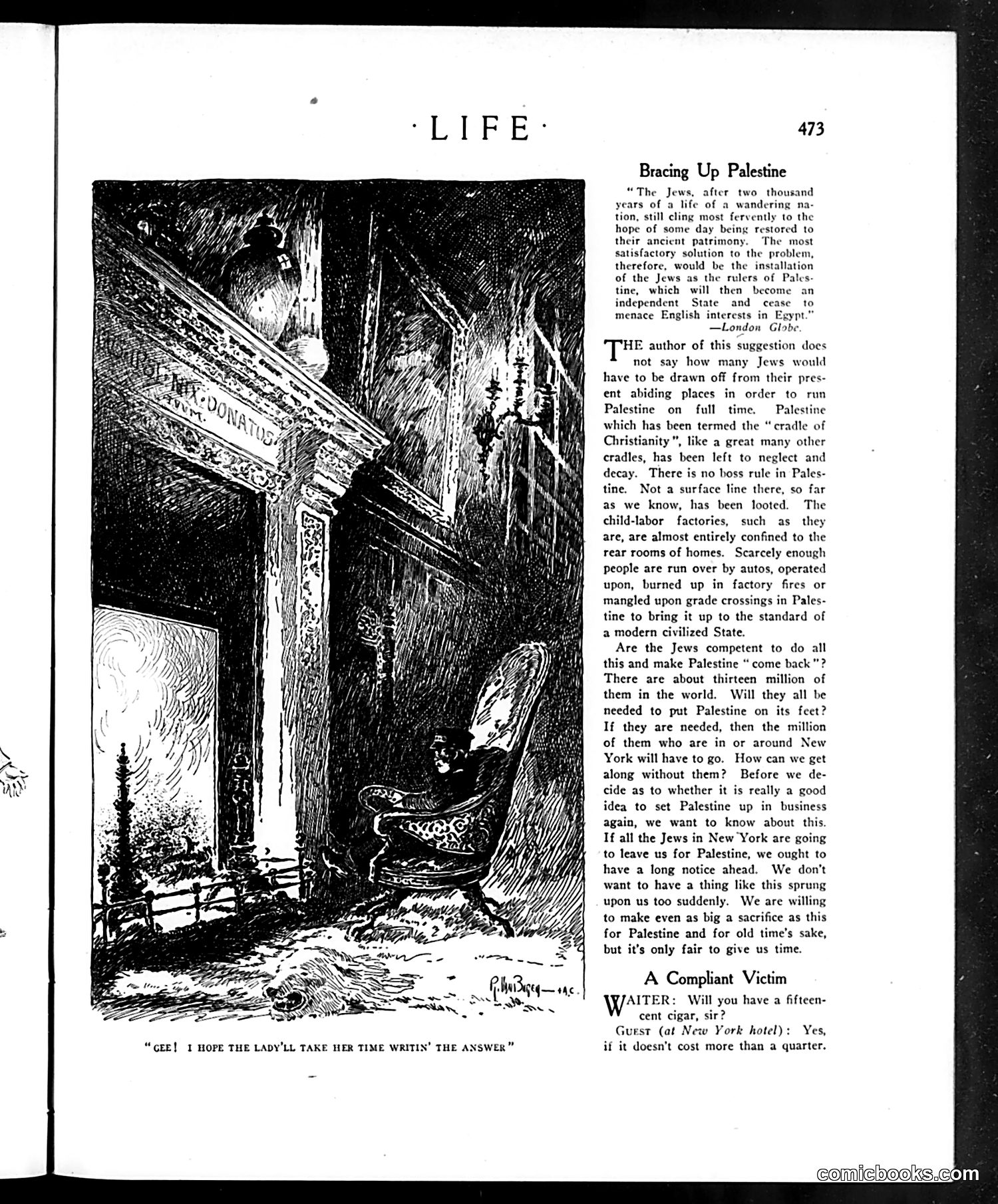
This page contains two distinct pieces of satire from Life magazine (page 473). **"Bracing Up Palestine"** (main article with illustration): Life sarcastically critiques the proposal to establish a Jewish state in Palestine. The illustration shows a figure writing at a desk, captioned "Gee! I hope the lady'll take her time writin' the answer"—suggesting the matter requires careful deliberation. The article mockingly questions whether Palestine truly needs "development" (implying colonial/modernization rhetoric), then satirizes American anxieties about Jewish emigration: if Jews left New York en masse for Palestine, how would America function? Life sardonically claims to support the idea but demands "fair notice" so New Yorkers can prepare—mocking both the emigration proposal and American self-interest. **"A Compliant Victim"**: A brief joke about a hotel guest accepting an expensive cigar while pretending it costs less—satirizing self-deception or rationalization. The overall tone treats Zionism with skeptical humor while highlighting American indifference masked as concern.
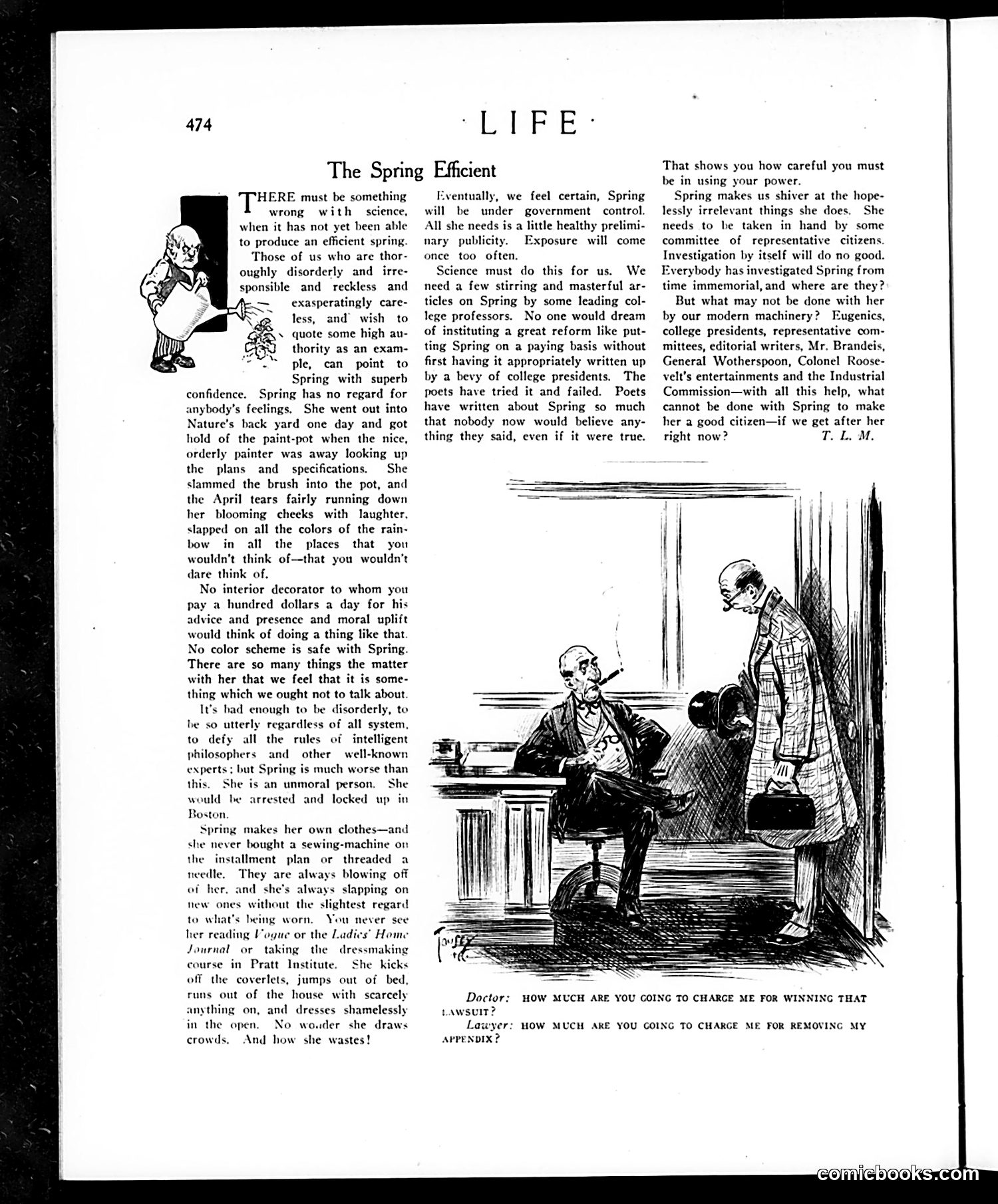
This article satirizes Progressive Era obsession with scientific management and bureaucratic control. The author mocks the impulse to apply "efficiency" and government regulation to everything—even nature itself. **The Satire:** Spring is personified as a chaotic, irresponsible woman who violates every rule of order: she dresses immodestly, wastes resources, ignores fashion magazines and proper procedures. The author suggests that society's solution would be typical of the era: appoint college professors, government committees, and notable figures (including "Mr. Brandeis" and "General Wotherspoon") to study, regulate, and "reform" Spring itself. **The Joke:** It's absurd to imagine controlling natural forces through committees and publications—yet this reflects real Progressive confidence that expert management and publicity could solve any problem, even seasonal weather. **The Bottom Cartoon:** Wordplay on fees: a doctor and lawyer argue about charges—one for winning a lawsuit, one for removing an appendix—illustrating how professionals exploit situations for payment.
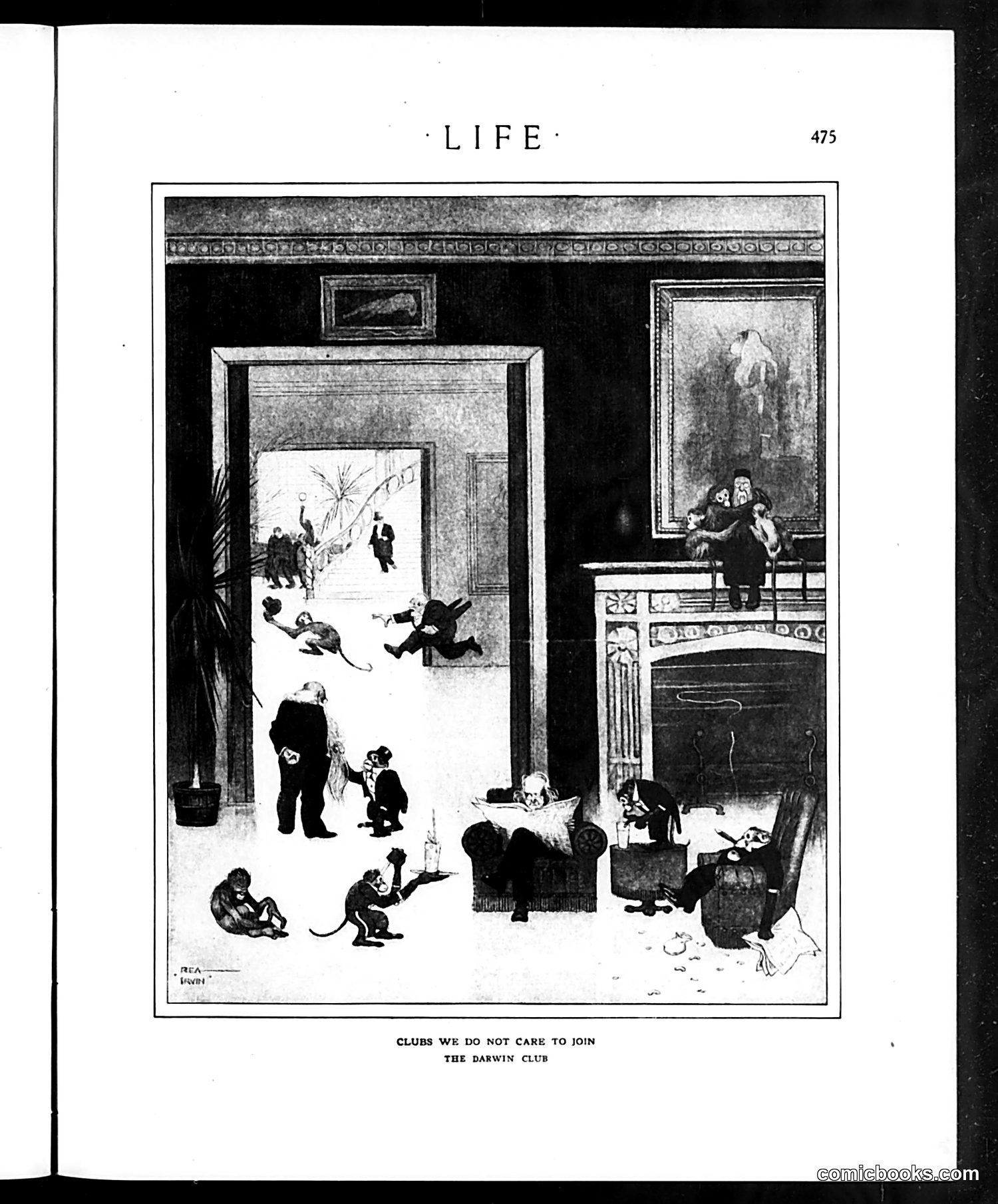
This is a satirical cartoon titled "The Darwin Club," mocking membership in a club that apparently attracts undesirable people. The image depicts a chaotic interior scene filled with apes and monkeys alongside human figures in formal dress, all mingling together in what appears to be an elegant room. The satire references Darwin's theory of evolution, particularly the controversial idea that humans descended from apes. By showing apes as club members alongside humans, the cartoonist sarcastically suggests that joining "The Darwin Club" means accepting kinship with primates—a notion that was socially and religiously offensive to many early 20th-century readers who rejected evolutionary theory. The joke's punch line: the title declares Life magazine would "not care to join" such a club, expressing the publication's skepticism toward Darwinian evolution.
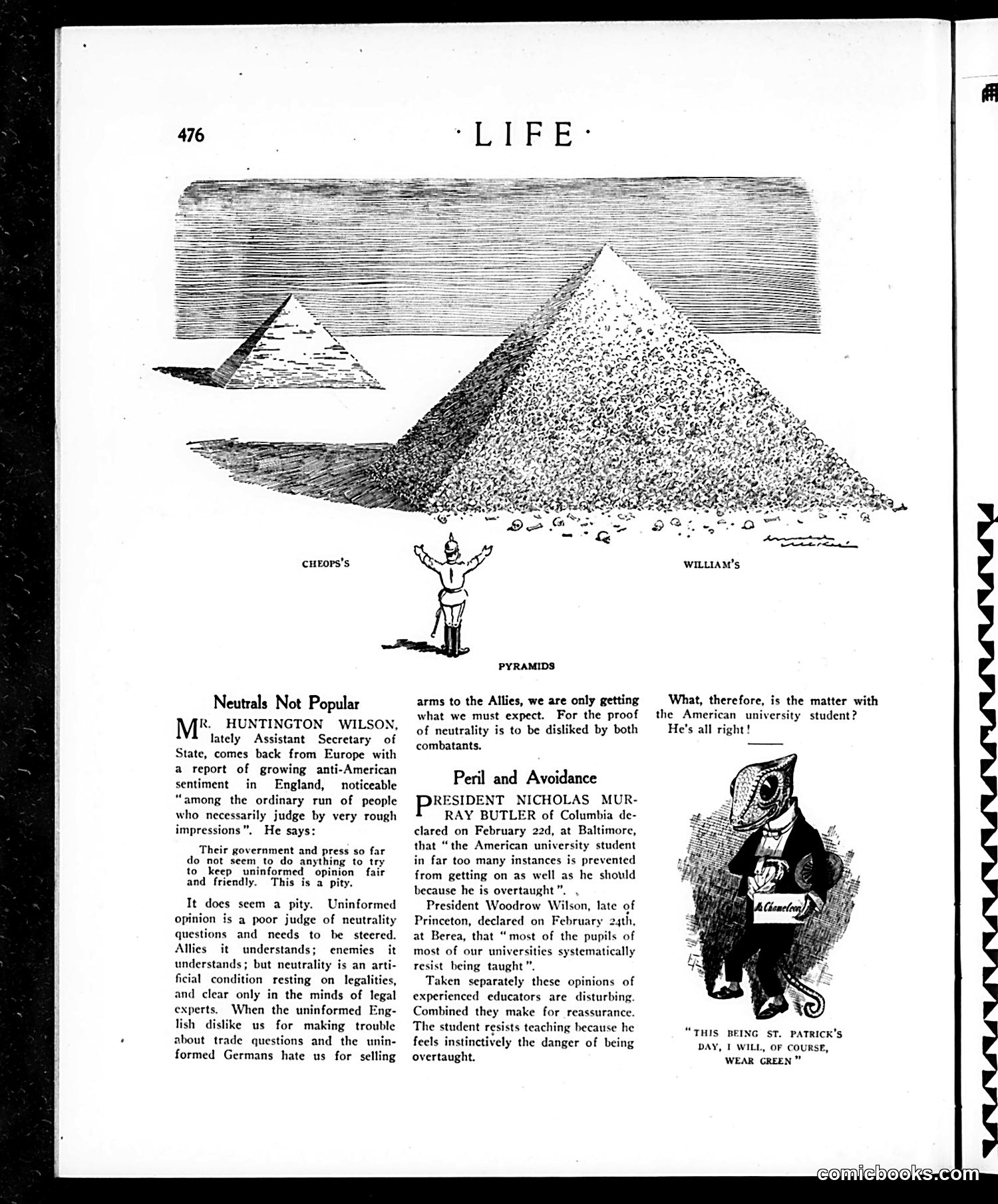
This page satirizes American neutrality during World War I (before U.S. entry in 1917). The top cartoon compares three pyramids labeled "Cheops's," "William's," and "Pyramids"—likely representing ancient Egypt, German Kaiser Wilhelm II, and monumental ambition generally—with a figure beneath asking what's wrong with American universities. The text mocks former Assistant Secretary of State Huntington Wilson's complaint that uninformed British public opinion opposes American neutrality. The satire's point: neutrality is inherently suspect to both sides—if *both* combatants dislike you equally, you're actually neutral correctly. The second section presents a clever paradox: Columbia's Nicholas Murray Butler says students are "overtaught," while Wilson says students "resist being taught." The article resolves this humorously: students instinctively resist excessive teaching—so they're managing the problem themselves. The right-side cartoon depicts an Irishman planning to wear green on St. Patrick's Day, a topical ethnic reference typical of the era's cartooning. The overall tone is satirical commentary on American policy and education debates circa 1917.
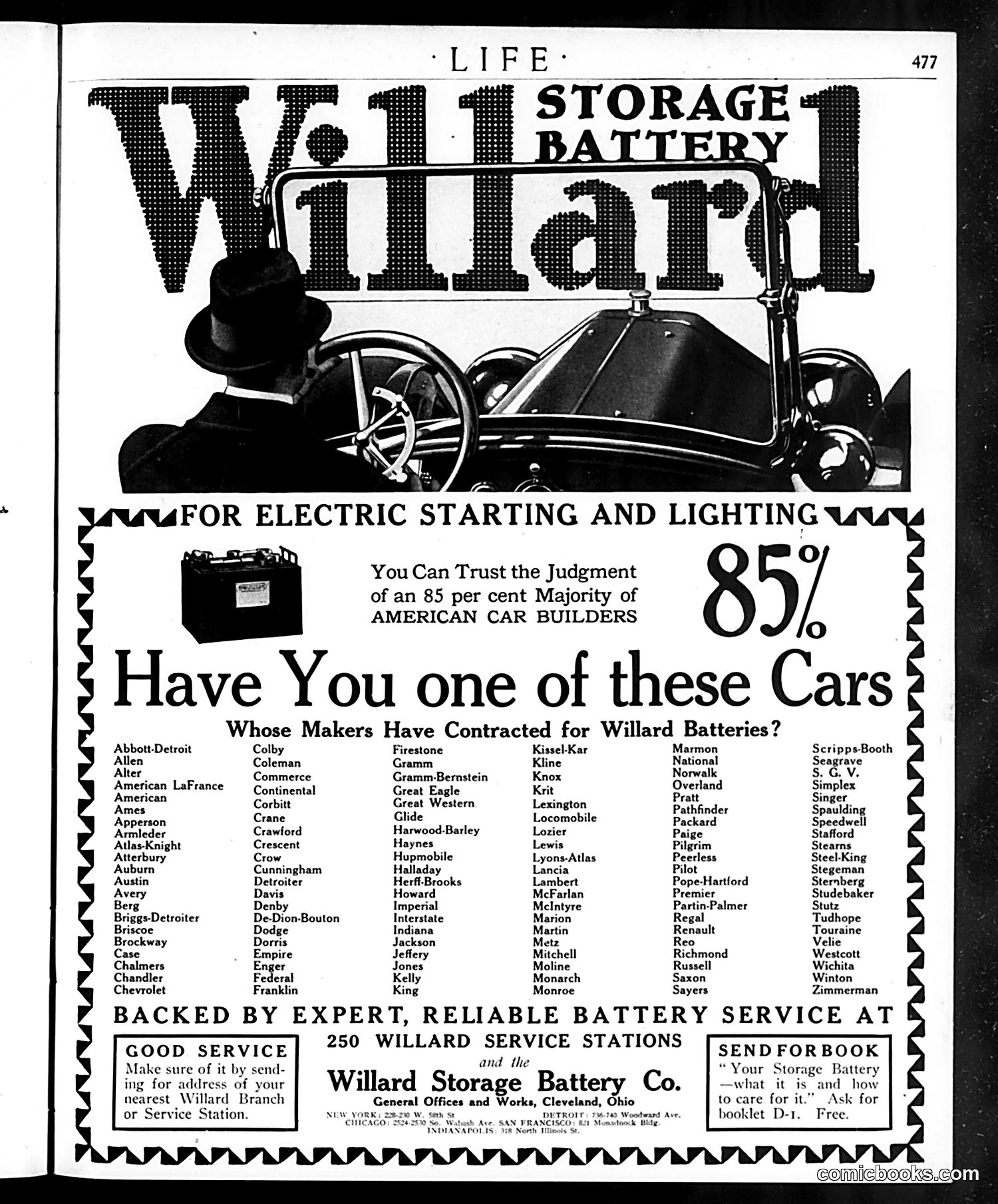
This is primarily a **Willard Storage Battery advertisement**, not satire or political cartoon. The page advertises car batteries by listing approximately 85 car manufacturers who allegedly use Willard batteries—a sales strategy exploiting brand endorsements. The text claims "85 per cent [of] American car builders" trust Willard, making it an appeal to authority and majority consensus. The imagery shows a well-dressed man in a car, representing the aspirational automobile owner. The extensive list of car brands (Abbott-Detroit, Auburn, Chevrolet, etc.) documents early American automobile manufacturers, many now defunct. The advertisement emphasizes reliability through "250 Willard Service Stations" and offers a free instructional booklet. For modern readers, this reveals the era when automobiles were still luxury goods, battery technology was critical to operation, and brand competition was intense among dozens of competing car manufacturers—most of which disappeared within decades.
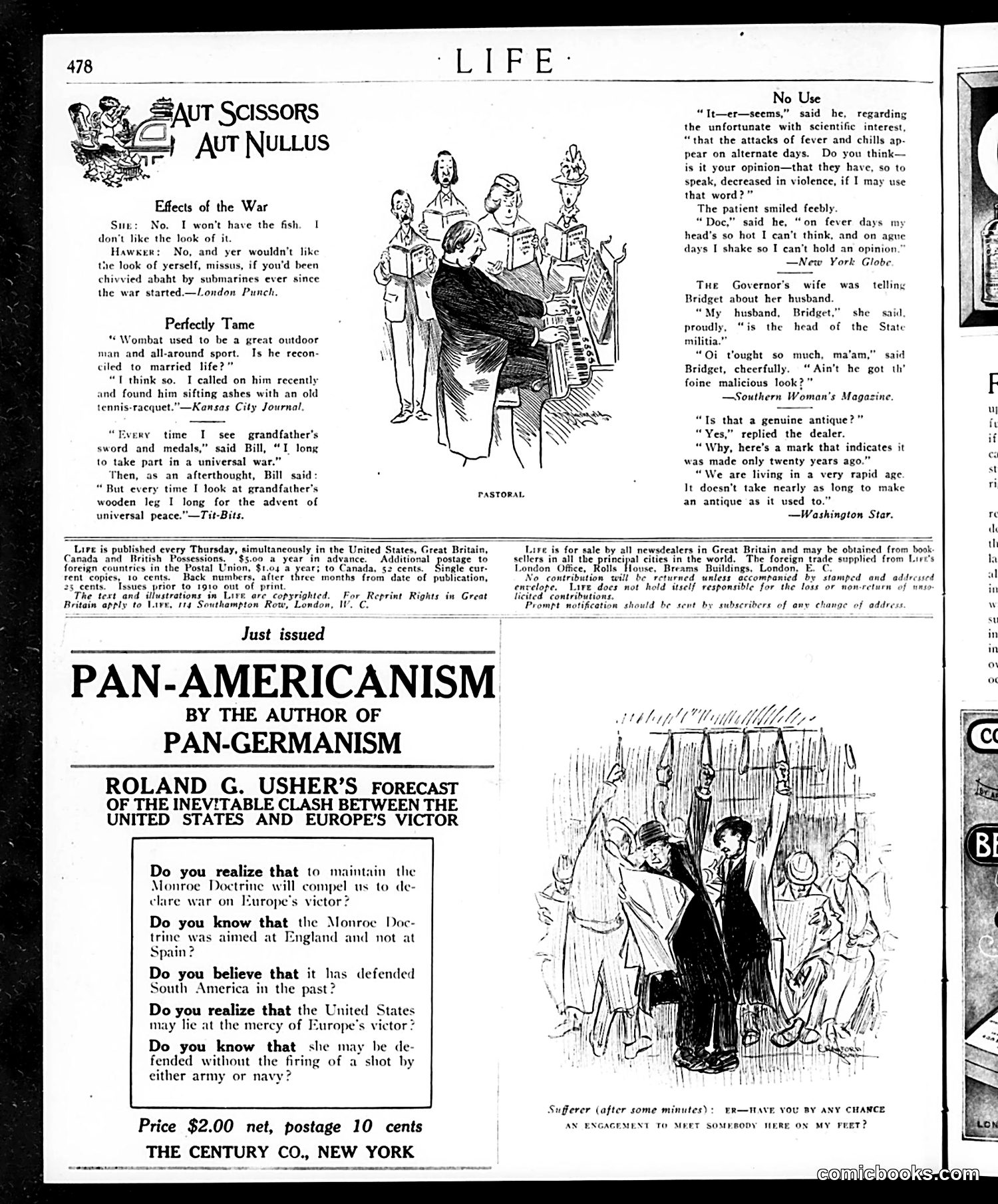
This page contains several brief humorous anecdotes and advertisements typical of wartime-era Life magazine (likely WWI period, given submarine and war references). **The Cartoons/Jokes:** The small items satirize various wartime and social situations: a fishmonger references submarine attacks affecting food supply; a man reduced to domestic ash-sifting after marriage; conflicting attitudes about war (a boy romanticizes grandfather's military medals but fears his wooden leg—symbol of war's real cost); a doctor's clinical detachment versus a patient's inability to form opinions due to illness; an Irish maid's irreverent assessment of the Governor. **The Main Advertisement:** The large lower section advertises Roland G. Usher's book *Pan-Americanism*, positioning it as a sequel to *Pan-Germanism*. The promotional questions warn Americans about potential conflict with post-WWI Europe, invoking the Monroe Doctrine—suggesting geopolitical anxieties about American isolation versus European power. **Overall Context:** The page reflects wartime humor mixed with serious contemporary concerns about America's post-war role.
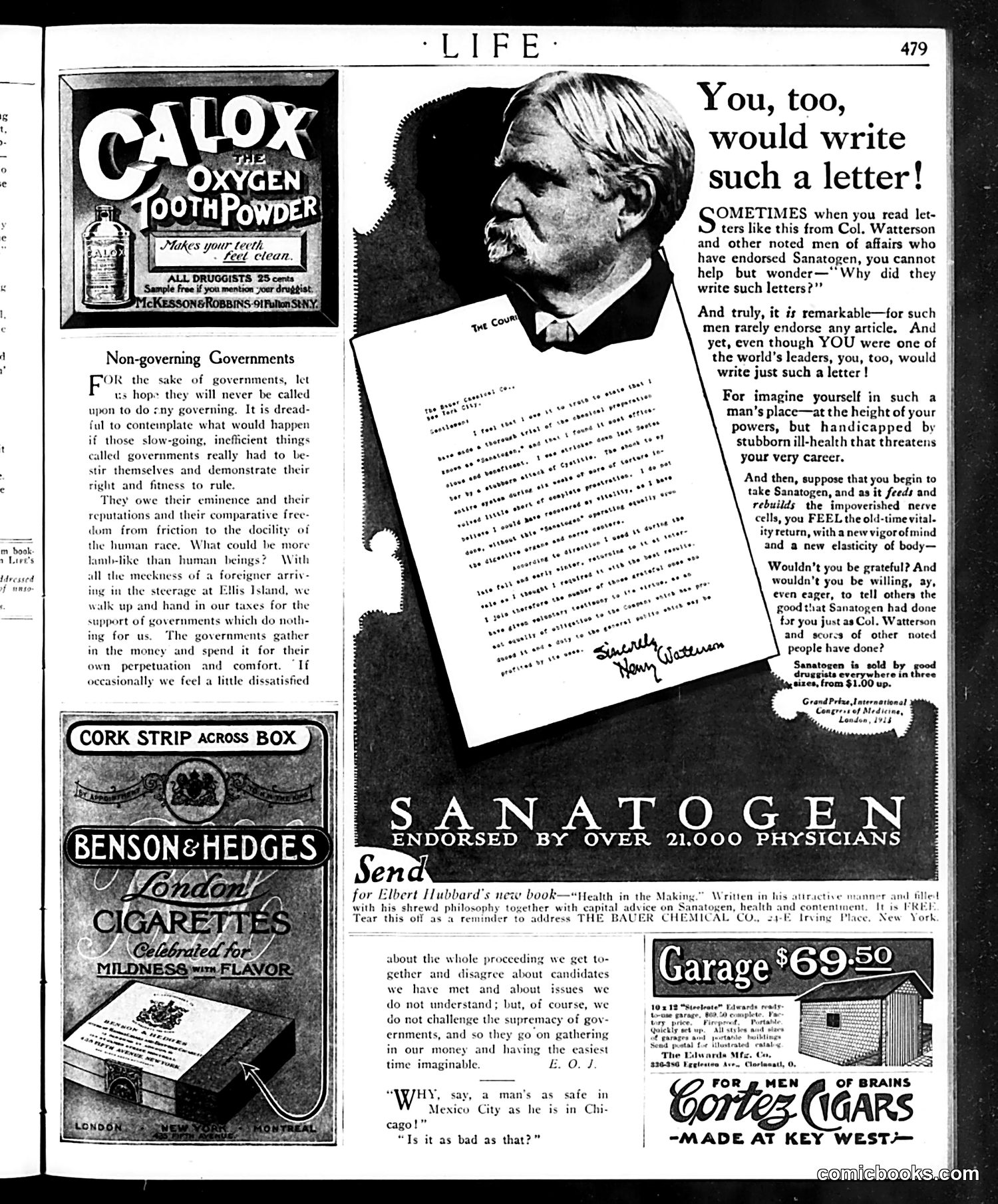
This page combines a **Sanatogen health tonic advertisement** (center-right) with a satirical **editorial essay on government inefficiency** (left column). ## The Advertisement The Sanatogen ad features what appears to be **Colonel Watterson** (a noted public figure of the era), shown holding a testimonial letter endorsing the product. The ad appeals to readers by suggesting that if prominent, powerful men endorse Sanatogen, ordinary people should too—implying the tonic restores vitality and energy to overcome career-threatening health problems. ## The Editorial Satire The left column satirizes **passive citizenship**. It argues that governments remain inefficient and self-serving because citizens docilely accept them without demanding accountability. The piece uses caustic humor: governments are so incompetent that we should be grateful they do *nothing*—if they actually tried to govern, things would be worse. Citizens pay taxes without protest, occasionally grumble, but never challenge governmental supremacy. The satire suggests Americans tolerate lazy, self-perpetuating bureaucracies because confronting them requires effort citizens won't expend.
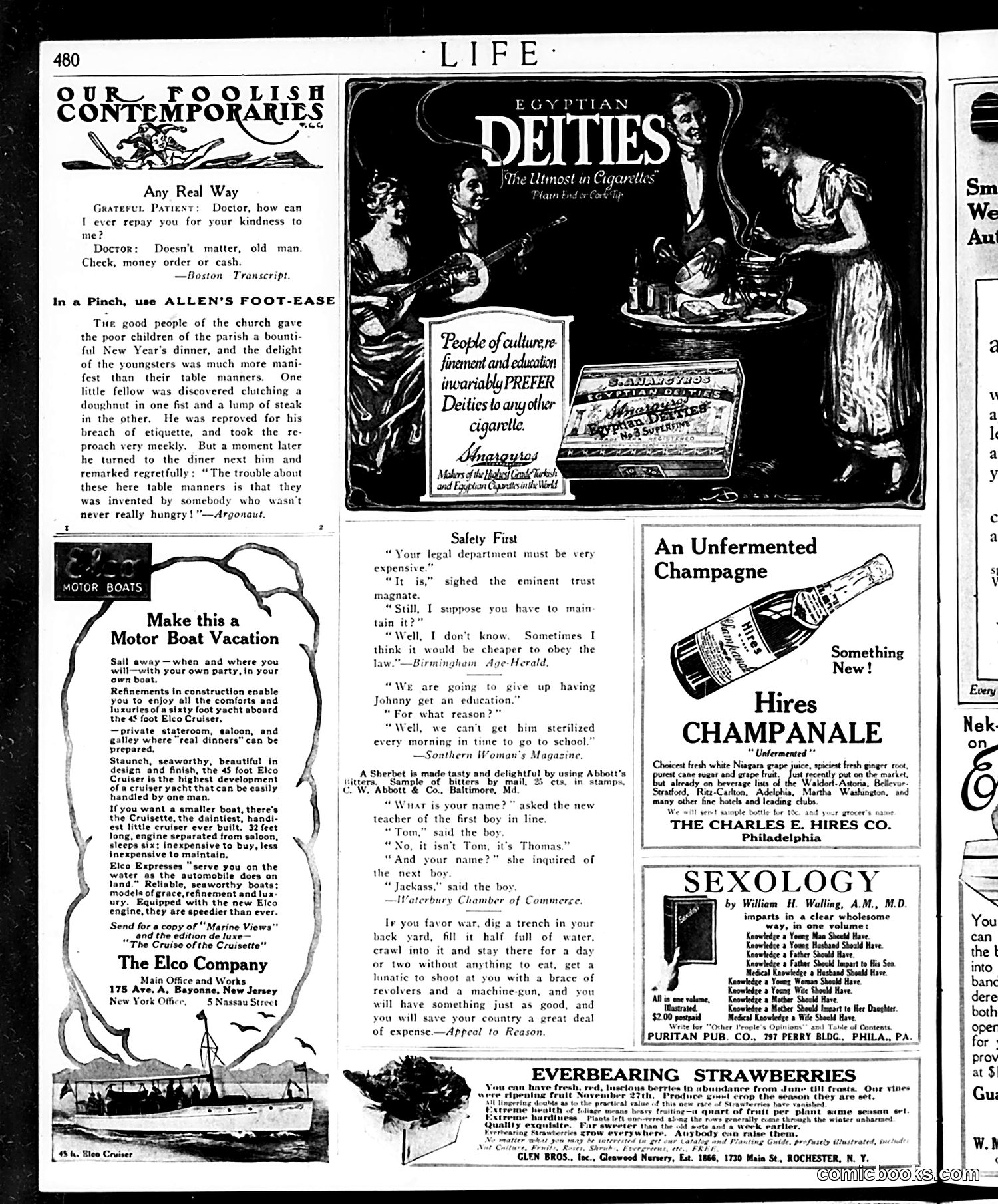
This page is primarily **advertisements and humor columns** rather than political cartoons. The content reflects early 20th-century American attitudes: **Humor pieces** mock social pretension and changing mores. One joke satirizes a poor child's practical wisdom about table manners being invented by the non-hungry. Another jokes about sterilization—likely referencing the eugenics movement popular among progressive Americans at this time, presented here as absurdly preventing education. **Advertisements** include luxury motor boats (the Elco), cigarettes ("Egyptian Deities"), and notably an "unfermented champagne" called Champanale—almost certainly a Prohibition-era product circumventing alcohol bans. A "Sexology" book advertisement promises frank discussion of sexual matters in clinical language, reflecting early 20th-century pseudo-scientific approaches to sexuality as educational rather than taboo. The overall tone treats modernity, consumer goods, and social progress with gentle satire typical of Life magazine's sophisticated humor for middle-class readers.
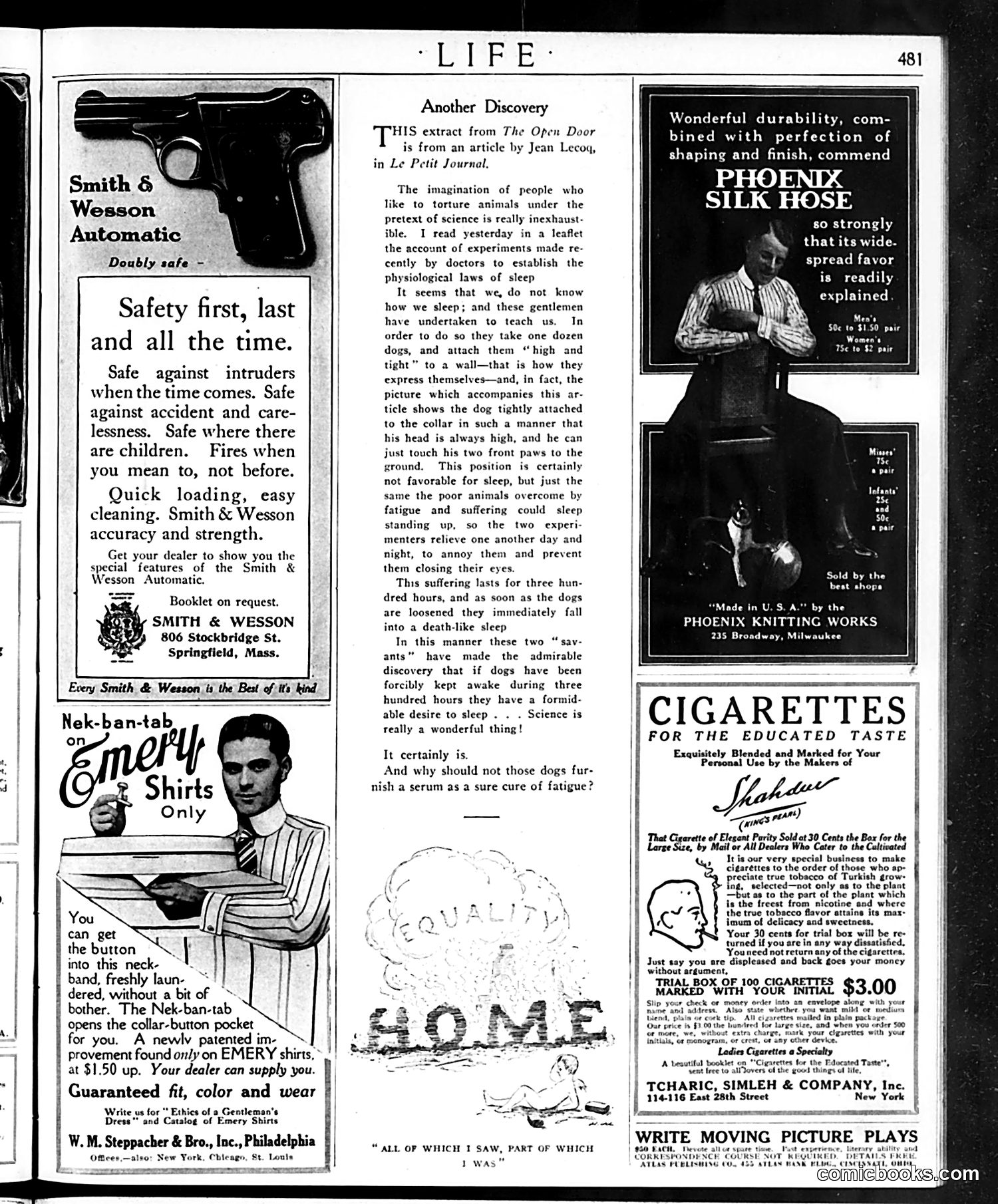
This page is primarily **advertisements with one satirical article**. The central editorial content is a translation of a French piece by Jean Lecoq criticizing cruel animal experimentation. **The Satire:** Lecoq mocks scientists who suspended twelve dogs from a wall for 300 hours to prevent sleep, then proclaimed the "discovery" that sleep-deprived animals desperately want to sleep. The author's sarcasm—"Science is really a wonderful thing!"—ridicules the pseudo-scientific cruelty and the absurdity of claiming novel findings from obvious suffering. **The Cartoon:** A simple sketch labeled "ALL OF WHICH I SAW, PART OF WHICH I WAS" illustrates the article's subject: a dog suspended by collar, barely touching ground with front paws. **The Advertisements:** Smith & Wesson (firearms), Emery shirts (Nek-ban-tab collar feature), Phoenix silk hose, and Shahdur cigarettes—typical early 20th-century consumer products marketed with appeals to safety, quality, and genteel taste. No political content; purely commercial.
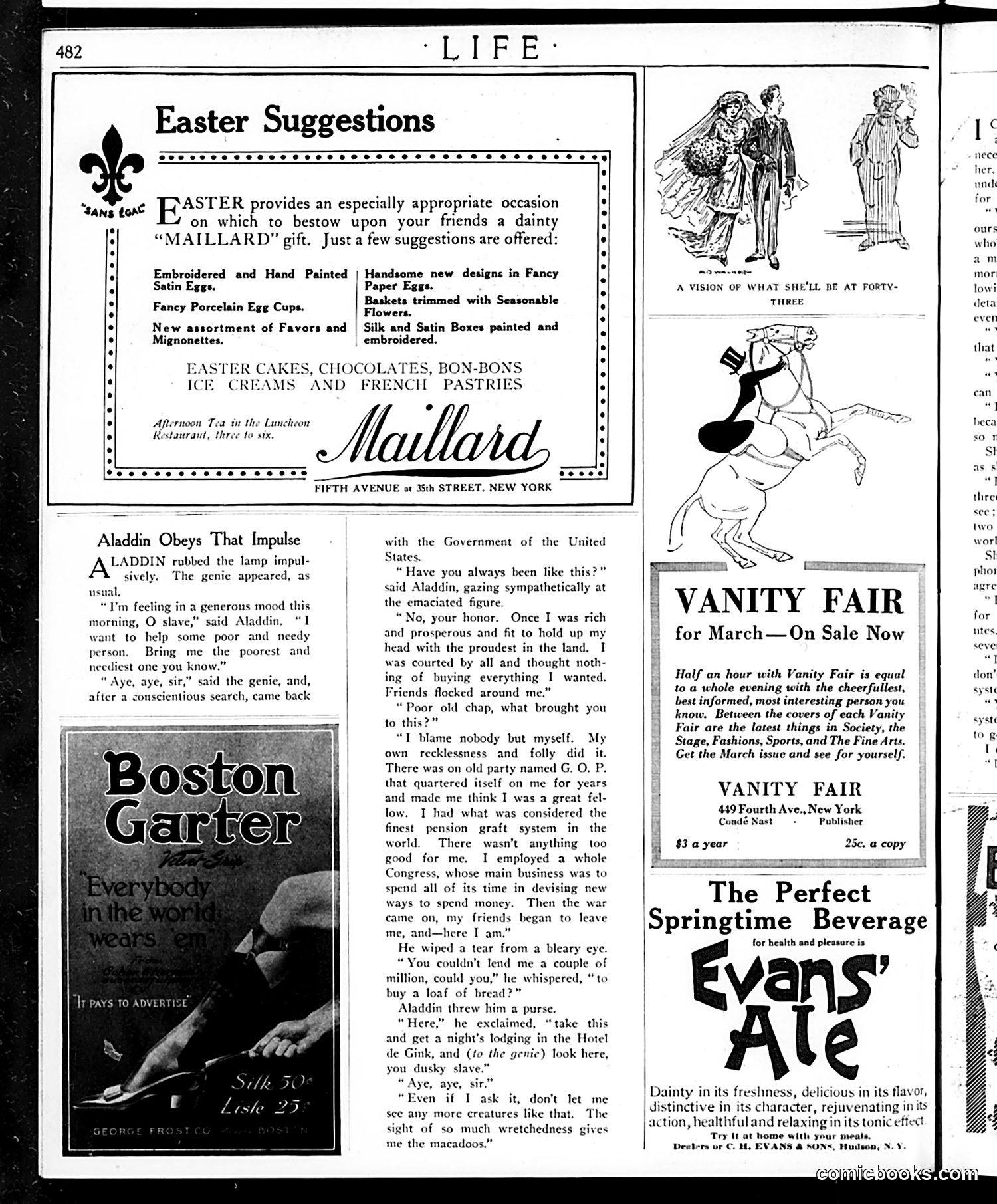
This short story is a satirical critique of U.S. government fiscal policy, likely from the World War I era or shortly after. The "poor and needy" figure Aladdin encounters represents America itself, which has been financially ruined by the "G.O.P." (Republican Party). The genie finds the nation impoverished despite once being prosperous. The satire targets the Republican administration's "pension graft system" and a corrupt Congress that spent extravagantly "devising new ways to spend money." The war accelerated this decline—friends (presumably allies or economic partners) abandoned the country. For modern readers: this reflects contemporary progressive criticism of Republican fiscal management and wartime spending as wasteful and corrupt. The magical-lamp framework satirizes how citizens expected government to solve problems it had created through mismanagement.
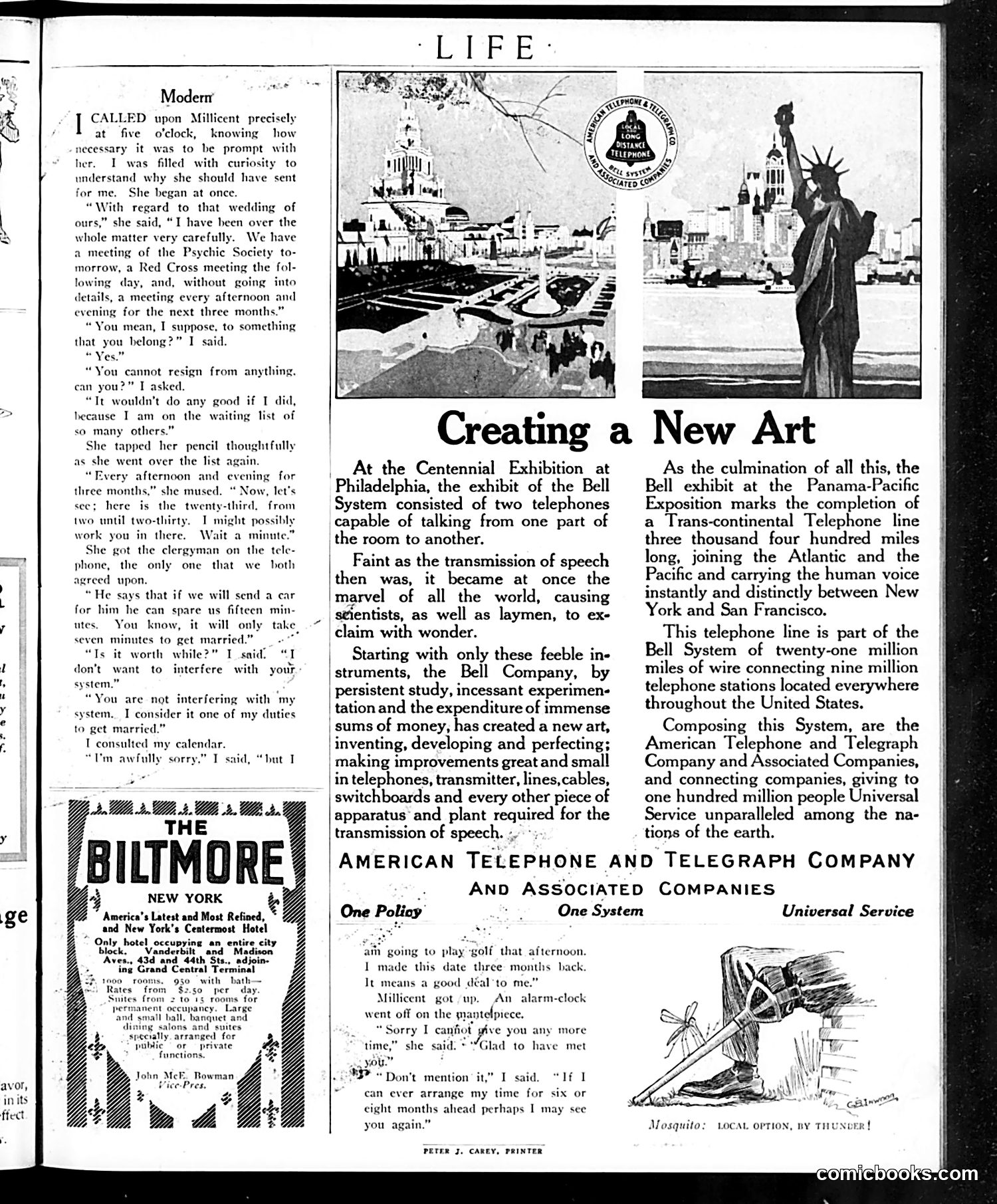
This page contains two distinct elements: **The Story ("Modern"):** A satirical narrative about a woman so overscheduled with social obligations (Psychic Society meetings, Red Cross, etc.) that arranging her own wedding becomes merely another appointment to squeeze into her calendar. The humor lies in the absurdity of modern life's busyness—she can only offer the clergyman 15 minutes, though marriage takes just 7 minutes. The protagonist's golf game and her engagement are treated with equal indifference, skewering both the obsessive scheduling culture and women's involvement in multiple civic/social organizations. **The Advertisement:** The bulk of the page promotes the Bell Telephone System's transcontinental line (completed for the Panama-Pacific Exposition), celebrating technological progress. It contrasts primitive early telephone demonstrations with the sophisticated modern network spanning 3,400 miles. The juxtaposition is ironic: while Bell's advertising celebrates connecting people across vast distances, the story depicts someone too disconnected and scheduled to prioritize her own wedding—technology enables communication but doesn't solve modern life's fractured priorities.
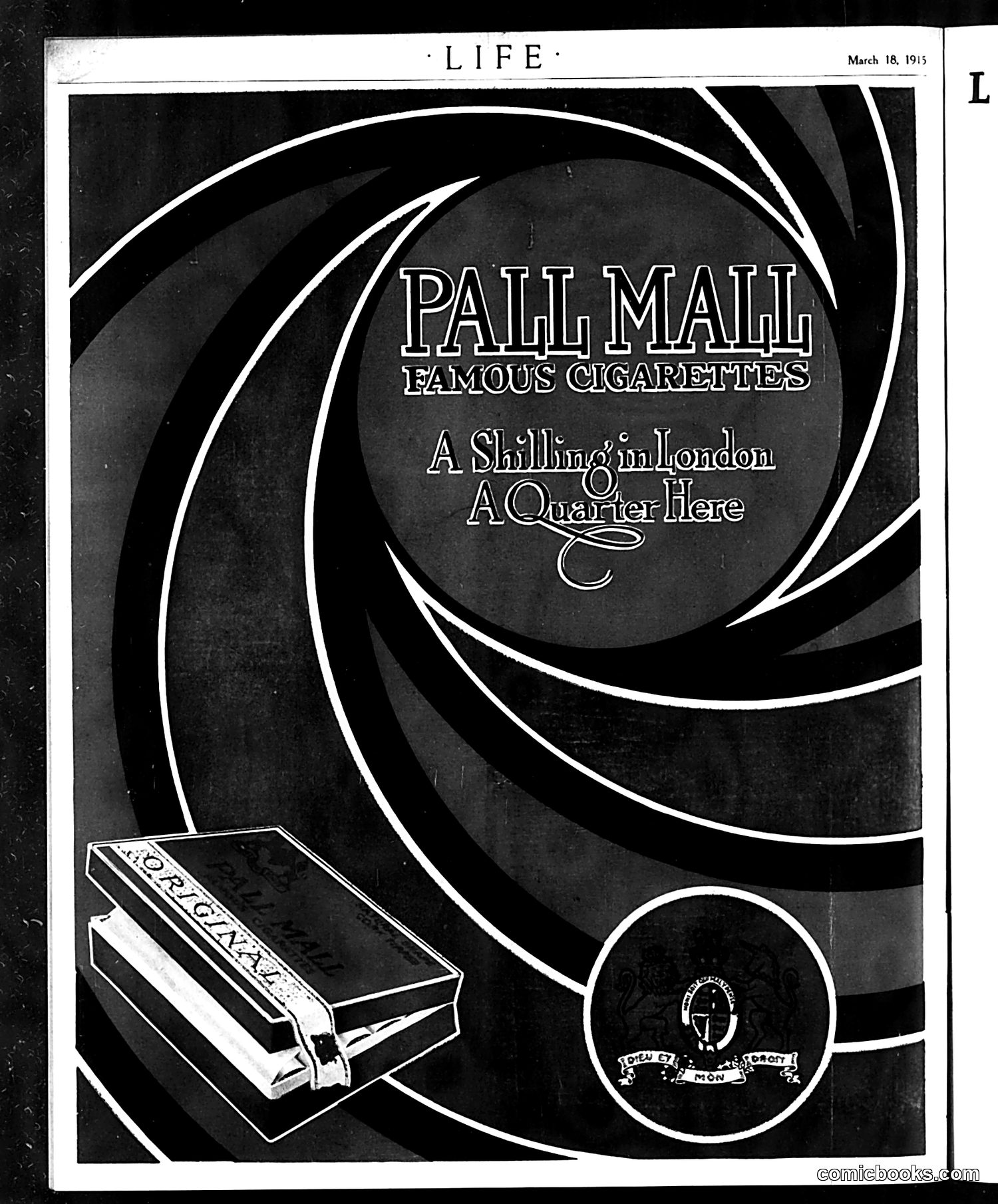
This is primarily an **advertisement**, not a political cartoon. It promotes Pall Mall Famous Cigarettes with the tagline "A Shilling in London, A Quarter Here"—highlighting the product's affordability and international availability. The visual design features dramatic Art Deco styling with spiraling concentric circles in black and white, creating a modern, dynamic effect typical of 1915 advertising aesthetics. A cigarette package is shown in the lower left, along with what appears to be the Pall Mall logo (circular emblem, lower right). The advertisement emphasizes value: British smokers pay one shilling; American consumers pay only a quarter, suggesting Pall Mall offered good pricing in the U.S. market during this period.