
Life, 1915-03-18 · page 32 of 40
Life — March 18, 1915 — page 32: what you’re looking at
What you’re looking at
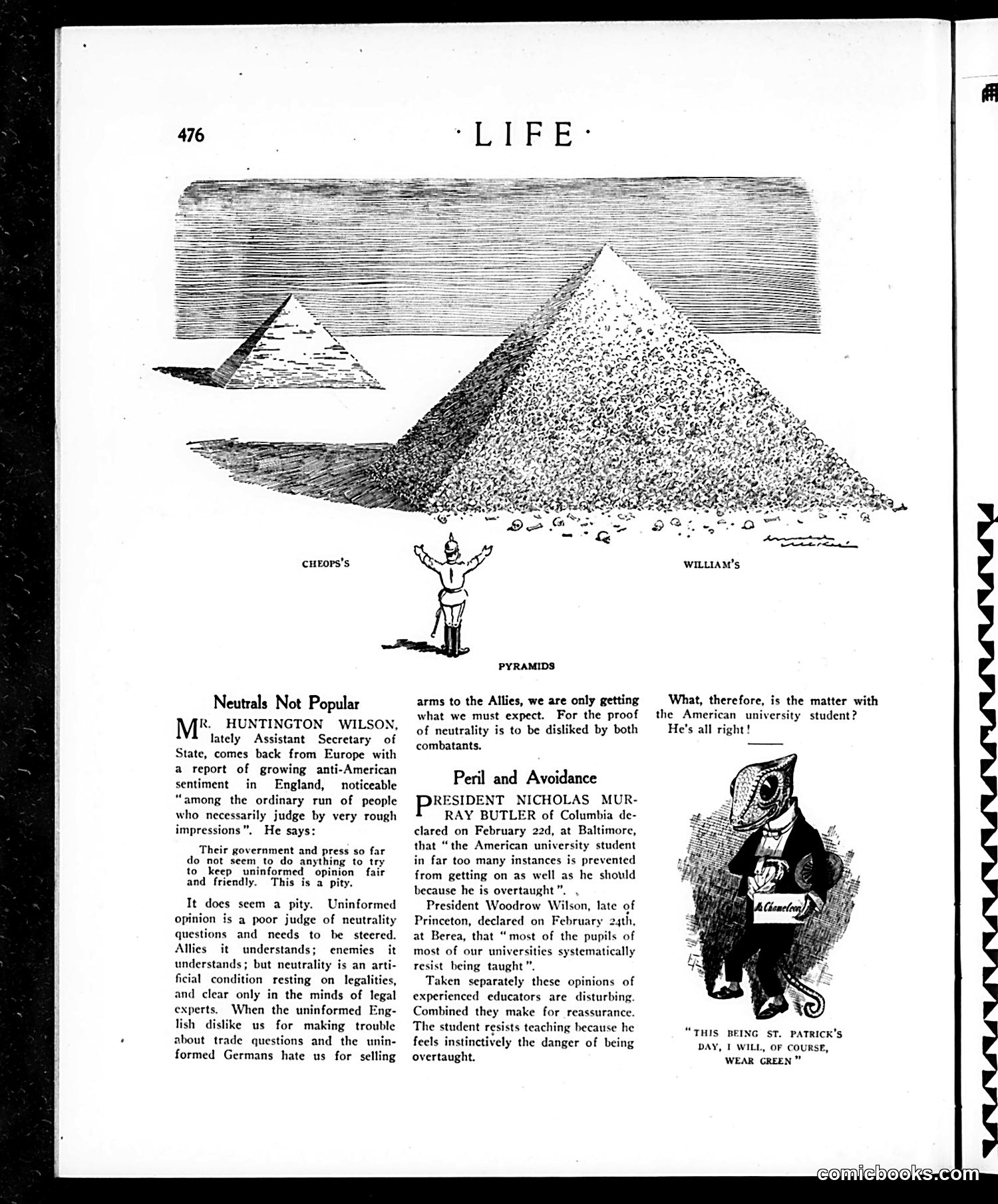
This page satirizes American neutrality during World War I (before U.S. entry in 1917). The top cartoon compares three pyramids labeled "Cheops's," "William's," and "Pyramids"—likely representing ancient Egypt, German Kaiser Wilhelm II, and monumental ambition generally—with a figure beneath asking what's wrong with American universities. The text mocks former Assistant Secretary of State Huntington Wilson's complaint that uninformed British public opinion opposes American neutrality. The satire's point: neutrality is inherently suspect to both sides—if *both* combatants dislike you equally, you're actually neutral correctly. The second section presents a clever paradox: Columbia's Nicholas Murray Butler says students are "overtaught," while Wilson says students "resist being taught." The article resolves this humorously: students instinctively resist excessive teaching—so they're managing the problem themselves. The right-side cartoon depicts an Irishman planning to wear green on St. Patrick's Day, a topical ethnic reference typical of the era's cartooning. The overall tone is satirical commentary on American policy and education debates circa 1917.
📄 Transcribed text from this page (OCR, searchable)
Machine-transcribed from the original scan — historical spelling and the odd misread are preserved.
CHEOPS'S Neutrals Not Popular M* HUNTINGTON WILSON, lately Assistant Secretary of State, comes back from Europe with a report of growing anti-American sentiment in England, noticeable “among the ordinary run of people who necessarily judge by very rough impressions”. He says: Their government and press so far do not seem to do anything to try to keep uninformed opinion fair and friendly. This is a pity. It does seem a pity. Uninformed opinion is a poor judge of neutrality questions and needs to be steered. Allies it understands; enemies it understands; but neutrality is an arti- ficial condition resting on legalities, and clear only in the minds of legal experts. When the uninformed Eng- lish dislike us for making trouble about trade questions and the unin- formed Germans hate us for selling PYRAMIDS arms to the Allies, we are only getting what we must expect. For the proof of neutrality is to be disliked by both combatants. Peril and Avoidance RESIDENT NICHOLAS MUR- RAY BUTLER of Columbia de- clared on February 22d, at Baltimore, that “the American university student in far too many instances is prevented from getting on as well as he should because he is overtaught”. , President Woodrow Wilson, late of Princeton, declared on February 24th, at Berea, that “most of the pupils of most of our universities systematically resist being taught”. Taken separately these opinions of experienced educators are disturbing. Combined they make for reassurance. The student resists teaching because he feels instinctively the danger of being overtaught. WILLIAM’s What, therefore, is the matter with the American university student? He's all right! “THIS BEING ST. PATRICK'S DAY, I WILL, OF COURSE, WEAR GREEN”