
Life, 1915-03-18 · page 19 of 40
Life — March 18, 1915 — page 19: what you’re looking at
What you’re looking at
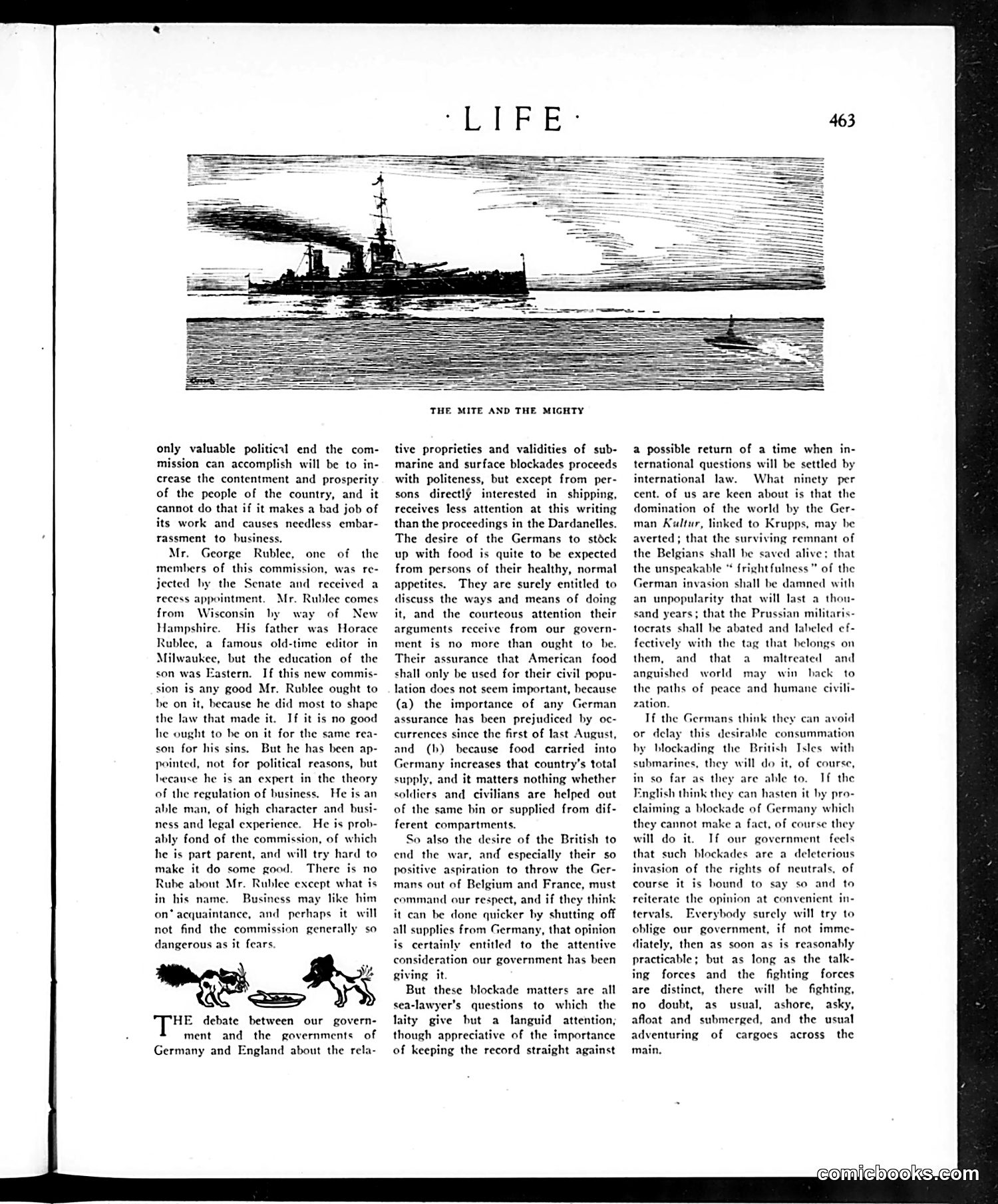
This page discusses WWI-era debates between American, German, and British governments over submarine and surface blockades. The article criticizes Germany's food blockade justifications while acknowledging Britain's similar tactics, but argues most Americans care less about technical "sea-lawyer's questions" than about preventing German military dominance and the brutality of their invasion of Belgium. The top illustration shows a warship (likely representing British naval power) dwarfing a smaller vessel, visualizing the title's contrast between mighty and insignificant forces. The text defends George Rublee's appointment to a regulatory commission despite Senate rejection, praising his qualifications. The satire targets both German and British diplomatic posturing about blockades while expressing strong anti-German sentiment—condemning "Prussian militarism," German "frightfulness," and the Krupps munitions empire. For modern readers: this reflects American public opinion circa 1915, before U.S. entry into WWI, when sympathies clearly favored the Allies.
📄 Transcribed text from this page (OCR, searchable)
Machine-transcribed from the original scan — historical spelling and the odd misread are preserved.
only valuable political end the com- mission can accomplish will be to in- crease the contentment and prosperity of the people of the country, and it cannot do that if it makes a bad job of its work and causes needless embar- Tassment to business. Mr. George Rublee, one of the members of this commission, was re- jected hy the Senate and received a recess appointment. Mr. Rublee comes from Wisconsin by way of New Hampshire. His father was Horace Rublee, a famous old-time editor in Milwaukee, but the education of the son was Eastern. If this new commis- sion is any good Mr. Rublee ought to be on it, because he did most to shape the law that made it. If it is no good he ought to be on it for the same rea- son for his sins, But he has been ap- pointed, not for political reasons, but hecause he is an expert in the theory of the regulation of business. He is an able man, of high character and busi- ness and legal experience. He is prob- ably fond of the commission, of which he is part parent, and will try hard to make it do some good. There is no Rube about Mr. Rublee except what is in his name. Business may like him on’ acquaintance, and perhaps it. will not find the commission generally so dangerous as it fears 8 HE debate between our govern- ment and the governments of Germany and England about the rela- THE MITE AND THE MIGHTY tive proprieties and validities of sub- marine and surface blockades proceeds with politeness, but except from per- sons directlf interested in shipping, receives less attention at this writing than the proceedings in the Dardanelles. The desire of the Germans to stdck up with food is quite to be expected from persons of their healthy, normal appetites. They are surely entitled to discuss the ways and means of doing it, and the courteous attention their arguments receive from our govern- ment is no more than ought to be. Their assurance that American food shall only be used for their civil popu- lation does not seem important, because (a) the importance of any German assurance has been prejudiced by oc- currences since the first of last August, and (hb) because food carried into Germany increases that country’s total supply, and it matters nothing whether soldiers and civilians are helped out of the same bin or supplied from dif- ferent compartments. So also the desire of the British to end the war, and especially their so positive aspiration to throw the Ger- mans out of Belgium and France, must command our respect, and if they think it can be done quicker by shutting off all supplies from Germany, that opinion is certainly entitled to the attentive consideration our government has been giving it But these blockade matters are all sea-lawyer’s questions to which the laity give but a languid attention; though appreciative of the importance of keeping the record straight against a possible return of a time when in- ternational questions will be settled by international law. What ninety per cent. of us are keen about is that the domination of the world by the Ger- man Kultur, linked to Krupps, may be hat the surviving remnant of the Belgians shall he saved alive; that the unspeakable “ frightfulness" of the German invasion shall be damned with an unpopularity that will last a thou- sand years; that the Prussian militaris- tocrats shall he abated and labeled ef- fectively with the tag that belongs on them, and that a maltreated and anguished world may win back to the paths of peace and humane civili- zation, Tf the Germans think they can avoid or delay this desirable consummation by blockading the British Isles with submarines, they will do it, of course, are able to. If the in so far as the English think they can hasten it by pro- claiming a blockade of Germany which they cannot make a fact, of course the: will do it. If our government feels that such blockades are a deleterious invasion of the rights of neutrals, of course it is hound to say so and to reiterate the opinion at convenient in- tervals. Everybody surely will try to oblige our government, if not imme- diately, then as soon as is reasonably practicable; but as long as the talk- ing forces and the fighting forces are distinct, there will be fighting, no doubt, as usual, ashore, asky, afloat and submerged, and the usual adventuring of cargoes across the main.