
Life, 1915-03-18 · page 22 of 40
Life — March 18, 1915 — page 22: what you’re looking at
What you’re looking at
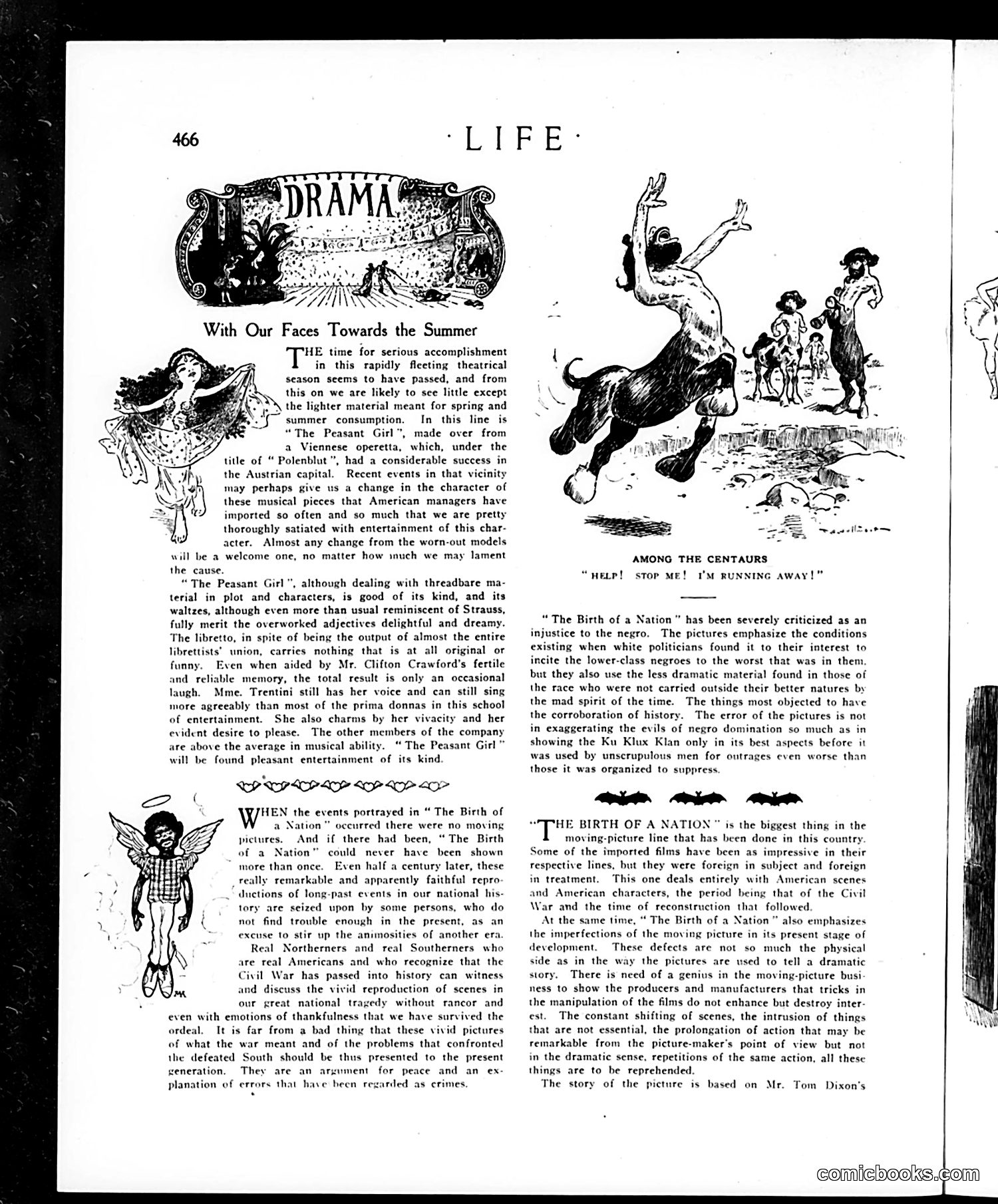
This page contains two distinct sections: **"The Peasant Girl" Review (top-left):** A theater critique of a Viennese operetta adaptation, dismissing it as pleasant but formulaic entertainment for summer audiences. The reviewer notes the lead actress Mme. Trentini has charm despite the uninspired libretto. **"Among the Centaurs" Cartoon (right):** A simple humorous illustration showing a centaur fleeing from humans and children on a beach, with the centaur shouting "Help! Stop me! I'm running away!"—apparently a joke about loss of control or panic. **"The Birth of a Nation" Essay (bottom):** A defense of D.W. Griffith's controversial 1915 film. The writer argues the film appropriately documents Reconstruction-era conditions and justifies showing it despite its controversial depictions of African Americans and the Ku Klux Klan. The essay claims the film's main flaw is portraying the Klan *too favorably* rather than exaggerating its evils—a remarkable statement by modern standards reflecting the era's deeply problematic racial attitudes.
📄 Transcribed text from this page (OCR, searchable)
Machine-transcribed from the original scan — historical spelling and the odd misread are preserved.
With Our Faces Towards the Summer HE time for serious accomplishment in this rapidly fleeting theatrical season seems to have passed, and from this on we are likely to sce little except SS the lighter material meant for spring and =~ summer consumption. In this line is “The Peasant Girl”, made over from a Viennese operetta, which, under the title of “ Polenblut”, had a considerable success in the Austrian capital. Recent events in that vicinity may perhaps give us a change in the character of these musical pieces that American managers have imported so often and so much that we are pretty thoroughly satiated with entertainment of this char- acter. Almost any change from the worn-out models will be a welcome one, no matter how snuch we may lament the cause. “The Peasant Girl”, although dealing with threadbare ma- terial in plot and characters, is good of its kind, and its waltzes, although even more than usual reminiscent of Strauss, fully merit the overworked adjectives delightful and dreamy. The libretto, in spite of being the output of almost the entire librettists’ union, carries nothing that is at all original or funny. Even when aided by Mr. Clifton Crawford's fertile and reliable memory, the total result is only an occasional laugh. Mme. Trentini still has her voice and can still sing more agreeably than most of the prima donnas in this school of entertainment. She also charms by her vivacity and her evident desire to please. The other members of the company are above the average in musical ability. “The Peasant Girl” will be found pleasant entertainment of its kind LP LIAP LO SOP SOP AO HEN the events portrayed in “ The Birth of a Nation" occurred there were no moving pictures. And if there had been, “The Birth of a Nation” could never have been shown more than once. Even half a century later, these really remarkable and apparently faithful repro ductions of long-past events in our national his- tory are seized upon by some persons, who do not find trouble enough in the present, as excuse to stir up the animosities of another era. Real Northerners and real Southerners who are real Americans and who recognize that the Civil War has passed into history can witness and discuss the vivid reproduction of scenes in our great national tragedy without rancor and even with emotions of thankfulness that we have survived the ordeal. It is far from a bad thing that these vivid pictures of what the war meant and of the problems that confronted the defeated South should be thus presented to the present generation. They are an arzument for peace and an ex planation of errors that have been regarded as crimes. AMONG THE CENTAURS “werp! stop Me! I'M RUNNING AWAY “The Birth of a Nation” has been severely criticized as an injustice to the negro. The pictures emphasize the conditions existing when white politicians found it to their interest to incite the lower-class negroes to the worst that was in them. but they also use the less dramatic material found in those of the race who were not carried outside their better natures by the mad spirit of the time. The things most objected to have the corroboration of history. The error of the pictures is not in exaggerating the evils of negro domination so much as in showing the Ku Klux Klan only in its best aspects before it was used by unscrupulous men for outrages even worse than those it was organized to suppress. Re Oe aie “THE BIRTH OF A NATION ” is the biggest thing in the moving-picture line that has been done in this country Some of the imported films have been as impressive in their respective lines, but they were foreign in subject and foreign in treatment. This one deals entirely with American scenes and American characters, the period being that of the Civil War and the time of reconstruction that followed At the same time, “ The Birth of a Nation” also emphasizes the imperfections of the moving picture in its present stage of development. These defects are not so much the physical side as in the way the pictures are used to tell a dramatic story, There is need of a genius in the moving-picture busi ness to show the producers and manufacturers that tricks in the manipulation of the films do not enhance but destroy inter- est. The constant shifting of scenes, the intrusion of things that are not essential, the prolongation of action that may be remarkable from the picture-maker’s point of view but not in the dramatic sense, repetitions of the same action, all these things are to be reprehended. The story of the picture is based on Mr. Tom Dixon's comichooks.