
Life, 1915-03-18 · page 26 of 40
Life — March 18, 1915 — page 26: what you’re looking at
What you’re looking at
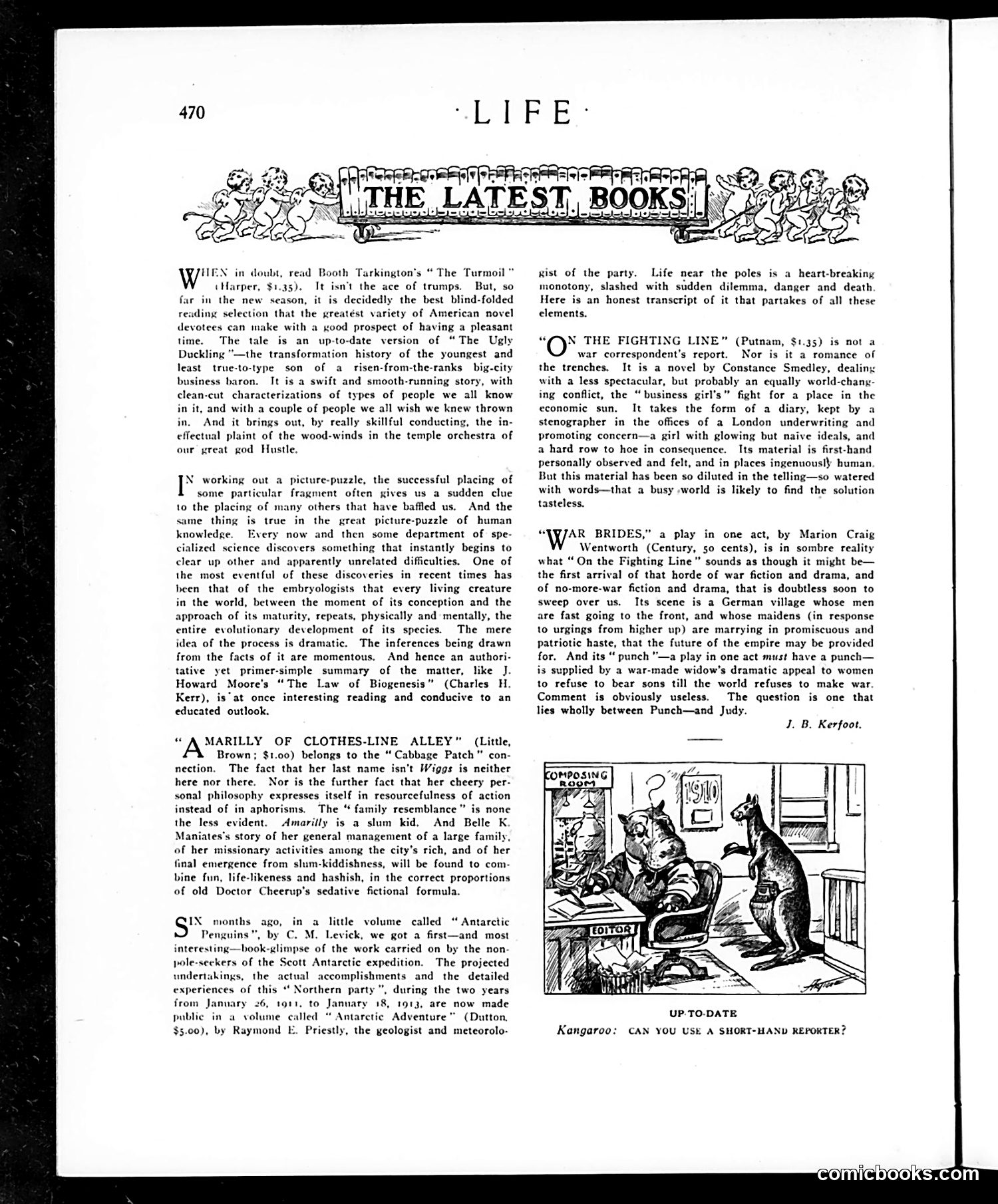
This is a **book review page** from *Life* magazine, not primarily a political cartoon. The page discusses several new publications, including works by Booth Tarkington and others. The single **cartoon illustration** (bottom right) appears to be a humorous sketch labeled "UP TO DATE" with the caption "Kangaroo: CAN YOU USE A SHORT-HAND REPORTER?" It depicts what seems to be a kangaroo in an office setting, likely satirizing modern business efficiency and the adoption of shorthand stenography as a new workplace technology. The reviews themselves critique contemporary American literature—novels about urban life, slum children, evolutionary science, and the "business girl's" economic struggles. The tone is somewhat condescending, referencing formulaic sentimental fiction ("Cabbage Patch" style stories) while praising works exploring modern industrial society and gender economics. The page reflects early 1910s concerns: urbanization, women's workplace participation, and scientific advancement.
📄 Transcribed text from this page (OCR, searchable)
Machine-transcribed from the original scan — historical spelling and the odd misread are preserved.
HEN in doubt, read Booth Tarkington's “ The Turmoil” ‘Harper, $1.35). It isn't the ace of trumps. But, so far in the new season, it is decidedly the best blind-folded reading selection that the greatést variety of American novel devotees can make with a good prospect of having a pleasant time. The tale is an up-to-date version of “The Ugly Duckling "—the transformation history of the youngest and least true-to-type son of a risen-from-the-ranks big-city business baron. It is a swift and smooth-running story, with clean-cut characterizations of types of people we all know in it, and with a couple of people we all wish we knew thrown in. And it brings out, by really skillful conducting, the in- effectual plaint of the wood-winds in the temple orchestra of our great god Hustle, Ik working out a picture-puzzle, the successful placing of some particular fragment often gives us a sudden clue to the placing of many others that have baffled us. And the same thing is true in the great picture-puzzle of human knowledg: Every now and then some department of spe- alized science discovers something that instantly begins to clear up other and apparently unrelated difficulties. One of the most eventful of these discoveries in recent times has heen that of the embryologists that every living creature in the world, between the moment of its conception and the approach of its maturity, repeats, physically and mentally, the entire evolutionary development of its species. The mere idea of the process is dramatic. The inferences being drawn from the facts of it are momentous. And hence an authori- tative yet primer-simple summary of the matter, like J. Howard Moore's “The Law of Biogenesis” (Charles H. Kerr), is’at once interesting reading and conducive to an educated outlook. “ A MARILLY OF CLOTHES-LINE ALLEY” (Little, Brown; $1.00) belongs to the “ Cabbage Patch” con- nection. The fact that her last name isn’t Wiggs is neither here nor there. Nor is the further fact that her cheery per- sonal philosophy expresses itself in resourcefulness of action instead of in aphorisms. The “ family resemblance” is none the less evident. Amarilly is a slum kid. And Belle K Maniates’s story of her general management of a large family, of her missionary activities among the city's rich, and of her final emergence from slum-kiddishness, will be found to com bine fun, life-likeness and hashish, in the correct proportions of old Doctor Cheerup’s sedative fictional formula. S months ago, in a little volume called “ Antarctic Penguins”, by C. M. Levick, we got a first—and most interesting—book-glimpse of the work carried on by the non pole-seckers of the Scott Antarctic expedition. The projected undertakings, the actual accomplishments and the detailed experiences of this “ Northern party, during the two years from January 26, 1911, to January 18, 1913, are now made public in a volume called “ Antarctic Adventure" (Dutton, $5.00), by Raymond E. Priestly, the geologist and meteorolo- gist of the party. Life near the poles is a heart-breaking monotony, slashed with sudden dilemma, danger and death Here is an honest transcript of it that partakes of all these elements. N THE FIGHTING LINE” (Putnam, $1.35) is not a war correspondent's report. Nor is it a romance of the trenches, It is a novel by Constance Smedley, dealing with a less spectacular, but probably an equally world-chang- ing conflict, the “business girl's” fight for a place in the economic sun, It takes the form of a diary, kept by a stenographer in the offices of a London underwriting and promoting concern—a girl with glowing but naive ideals, and a hard row to hoe in consequence. Its material is first-hand personally observed and felt, and in places ingenuousl} human But this material has been so diluted in the telling—so watered with words—that a busy world is likely to find the solution tasteless. bes ‘AR BRIDES,” a play in one act, by Marion Craig Wentworth (Century, 50 cents), is in sombre reality what “On the Fighting Line” sounds as though it might be— the first arrival of that horde of war fiction and drama, and of no-more-war fiction and drama, that is doubtless soon to sweep over us. Its scene is a German village whose men are fast going to the front, and whose maidens (in response to urgings from higher up) are marrying in promiscuous and patriotic haste, that the future of the empire may be provided for. And its “ punch "—a play in one act must have a punch— is supplied by a war-made widow's dramatic appeal to women to refuse to bear sons till the world refuses to make war. Comment is obviously useless. The question is one that lies wholly between Punch—and Judy. J.B. Kerfoot, UP.TO-DATE Kangaroo: CAN YOU USE A SHORT-HAND REPORTER?