
A complete issue · 41 pages · 1914
Life — December 31, 1914
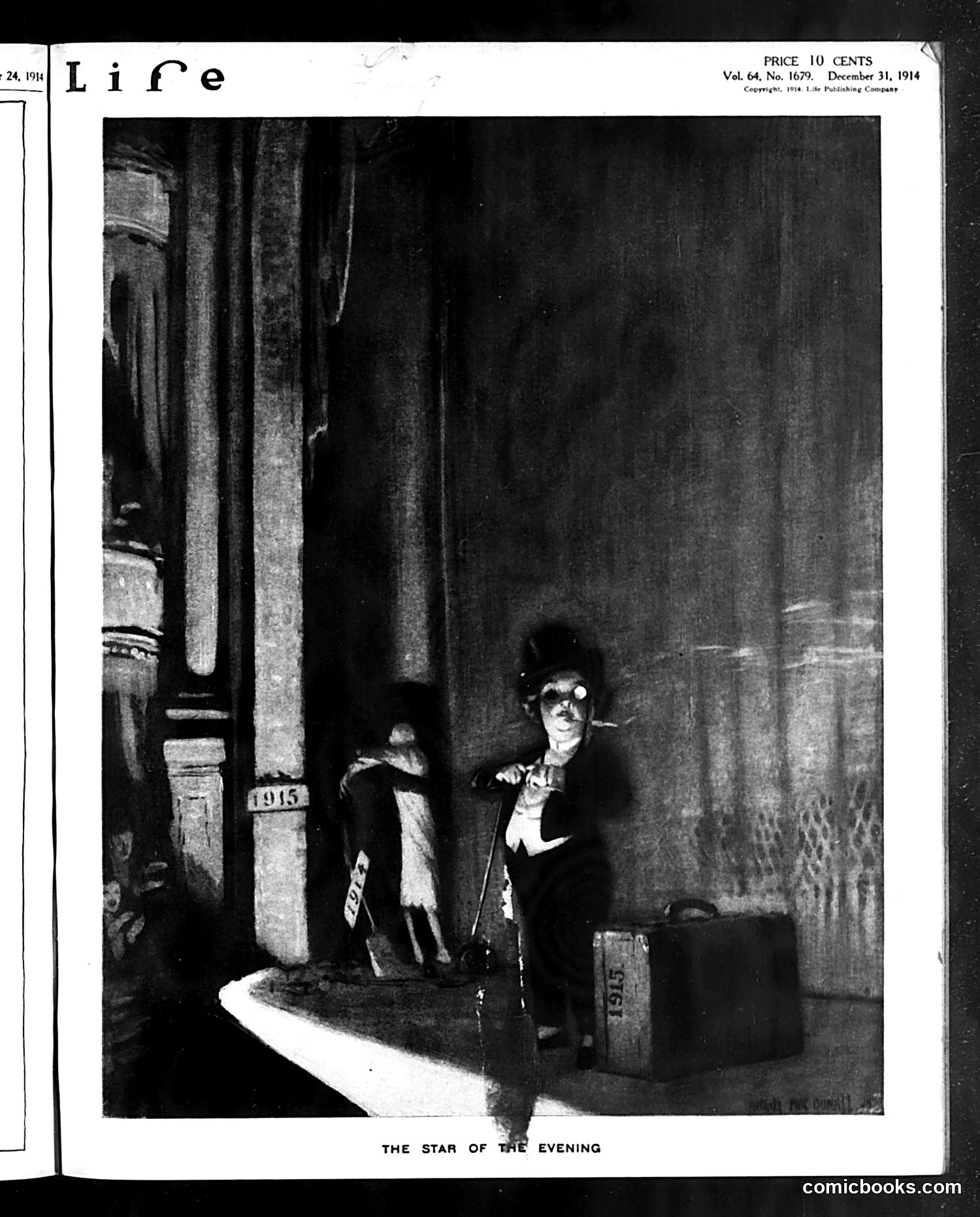
This Life magazine page from December 31, 1914 shows a dramatic theatrical scene with the caption "The Star of the Evening." The image depicts what appears to be a well-dressed man in formal attire and top hat in a dimly-lit interior space, with other figures visible in the background near pillars marked "1915." The scene suggests a satirical commentary on theatrical performance or public spectacle, likely referencing a contemporary political or cultural figure. The marking "1915" indicates anticipation of the coming year. However, without additional context or clearer identification of the specific figure, the exact subject of the satire remains unclear. The dramatic lighting and theatrical staging suggest this critiques someone viewed as performative or self-aggrandizing at year's end.
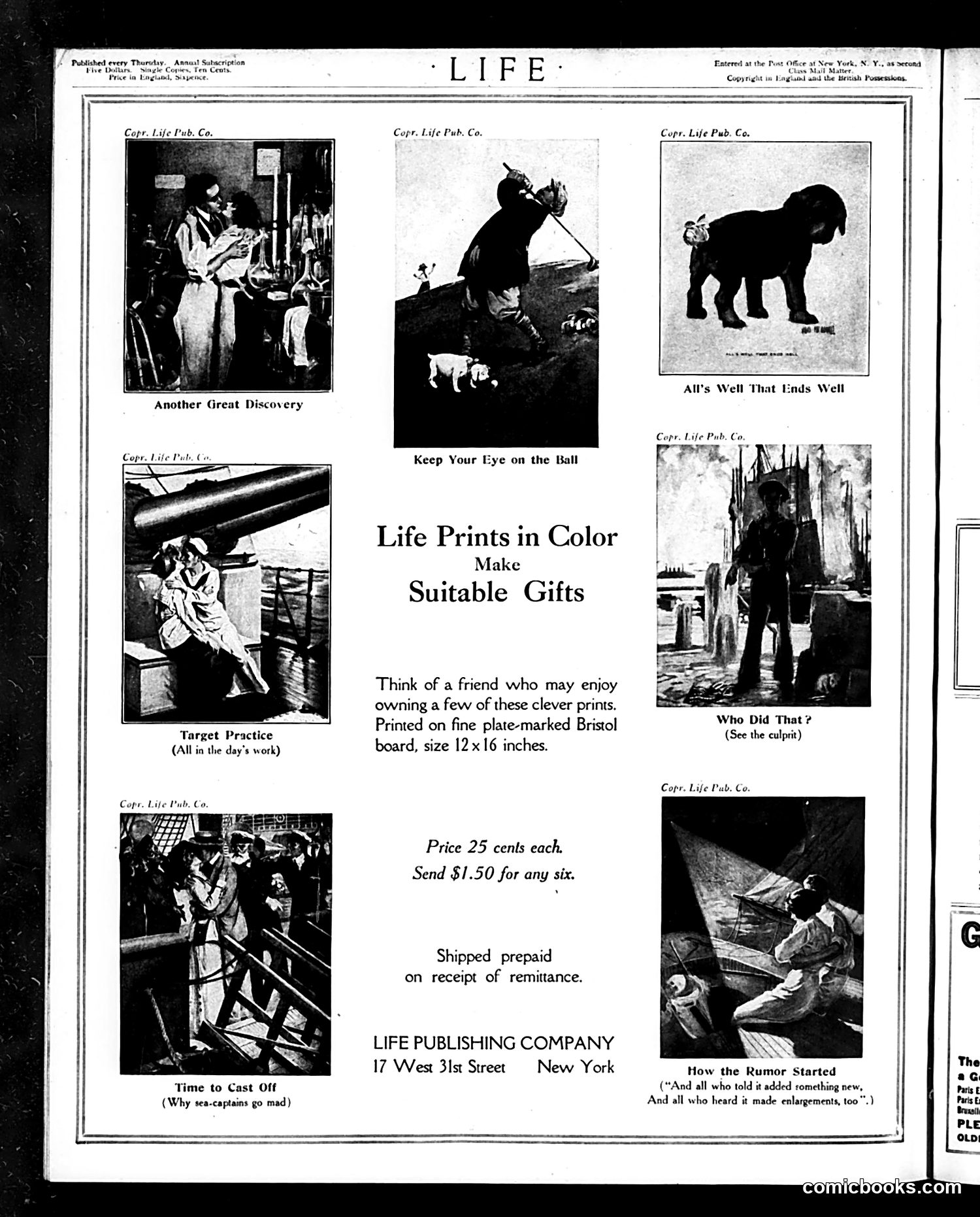
This page is primarily **advertising**, not political satire. It promotes "Life Prints in Color" — illustrated prints sold by Life Publishing Company for 25 cents each or $1.50 for six. The six prints shown feature humorous domestic and social scenes typical of early 20th-century Life magazine's comedic style: - "Another Great Discovery" (laboratory scene) - "Keep Your Eye on the Ball" (figure with telescope) - "All's Well That Ends Well" (dog with bow) - "Target Practice" (woman shooting) - "Who Did That?" (figure with child) - "How the Rumor Started" (hammock scene) Each caption plays on the image for comedic effect. These were marketed as affordable gift items, printed on Bristol board at 12×16 inches, shipped prepaid from the Life Publishing Company's New York office.
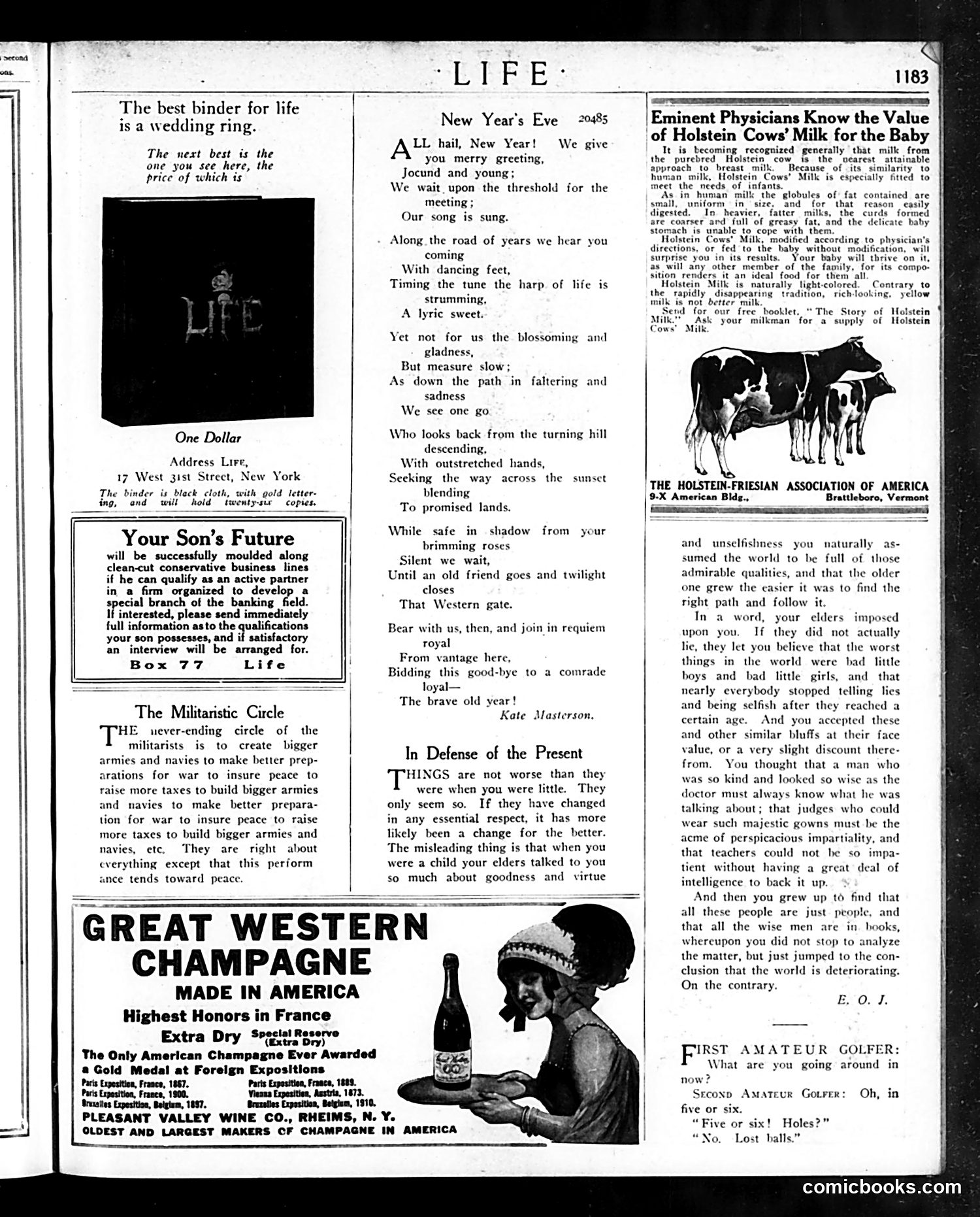
This page is predominantly **advertising and editorial content** rather than satirical cartoons. The visible ads include: - **Holstein-Friesian milk** promotion, emphasizing the breed's superiority for infant nutrition - **Great Western Champagne** advertisement claiming American-made superiority with French medals - A **Life magazine subscription pitch** ("Your Son's Future") The editorial content includes a **New Year's Eve poem** by Kate Masterson and an essay titled "In Defense of the Present" discussing generational wisdom and morality. A brief **humor section** at bottom features amateur golfers joking about lost balls. The page reflects **1920s consumer culture and American industrial pride** rather than political satire. It's primarily a vehicle for branded advertisements targeting middle-class readers.
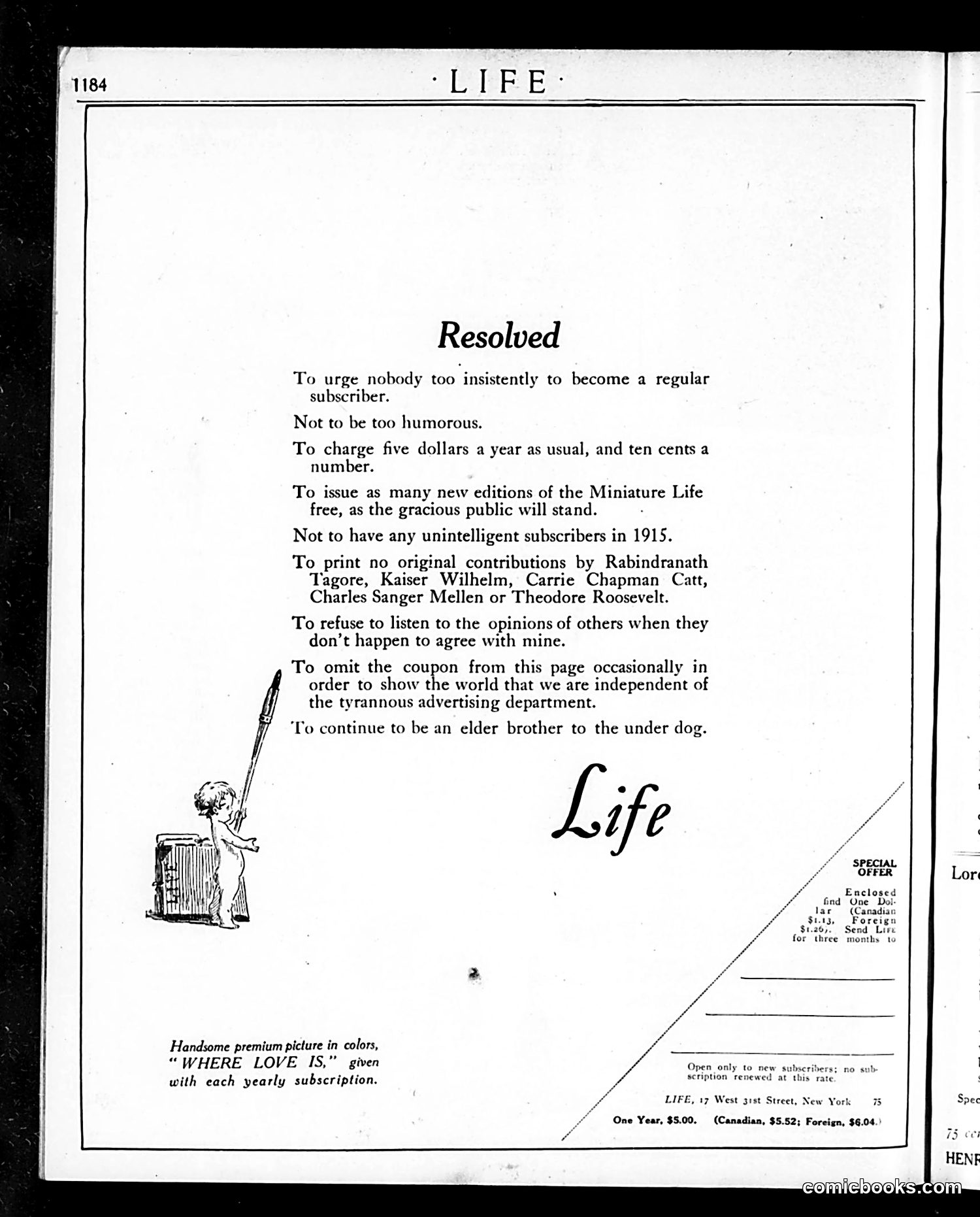
This page presents Life magazine's tongue-in-cheek "New Year's Resolutions" for 1915. The satire mocks the magazine's own editorial practices and independence: **Key satirical points:** - Promises not to pressure readers into subscriptions or be "too humorous" - Vows to refuse contributions from famous figures (Tagore, Kaiser Wilhelm, Carrie Chapman Catt, Mellen, Roosevelt)—likely poking fun at celebrity culture - Declares intent to "refuse to listen to opinions of others" when they disagree - Proudly announces omitting coupons to demonstrate independence from "tyrannous advertising" - Humorously claims to remain "an elder brother to the under dog" The cartoon character (a small figure with a rifle) reinforces the magazine's self-image as a scrappy, independent voice. The resolutions are deliberately contradictory and absurd, satirizing both the magazine itself and typical self-help resolutions.
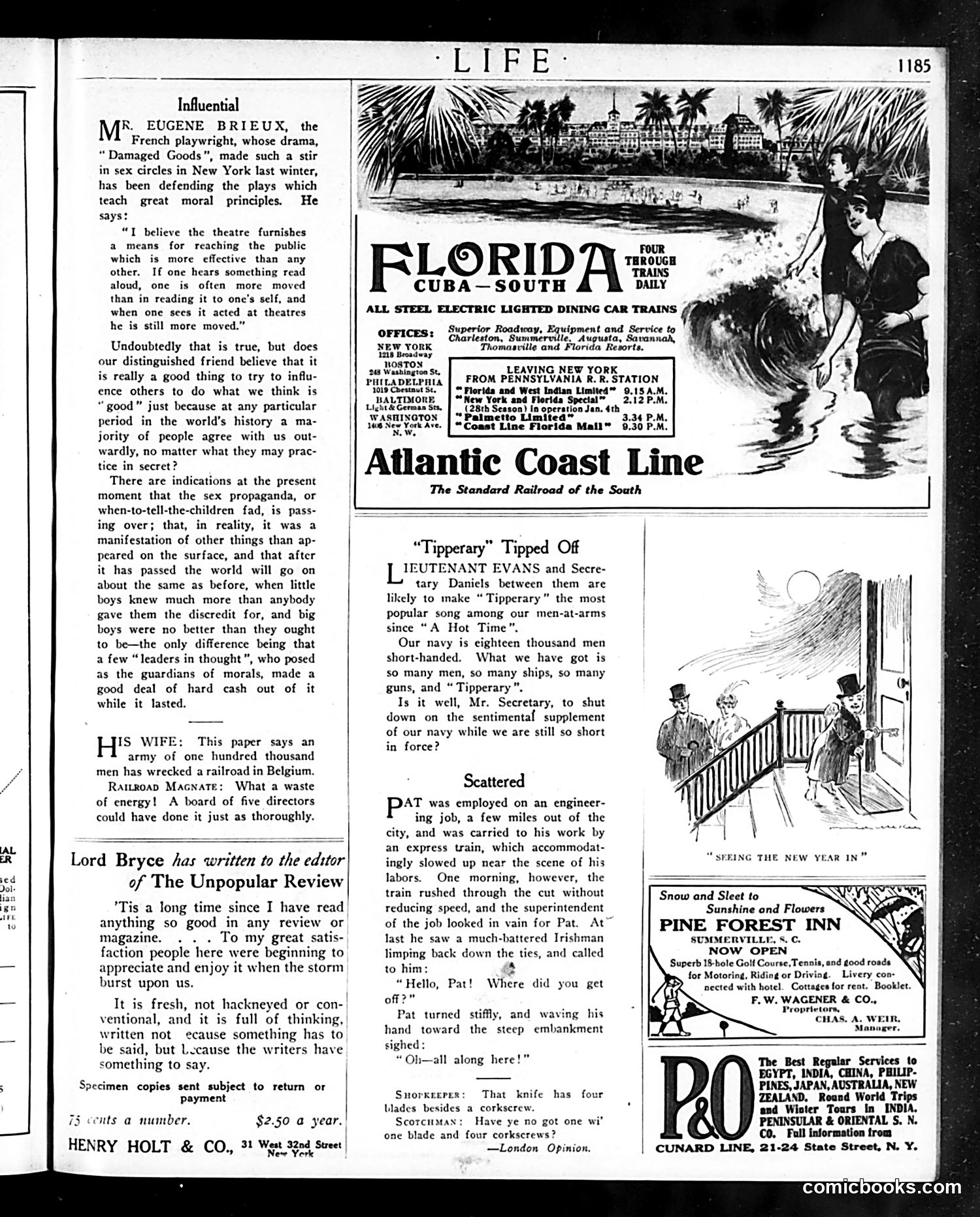
This cartoon depicts two figures in formal attire (top hats and coats) on what appears to be a ship's deck, watching the new year arrive. The caption "SEEING THE NEW YEAR IN" suggests a New Year's Eve celebration scene. The satire likely comments on how wealthy or privileged people celebrate major occasions in luxurious settings—here, apparently aboard a cruise or ocean liner. Given the page's surrounding advertisements for Florida travel and Atlantic Coast Line railroad services, this appears to satirize the leisure activities available to the affluent class during this era. The specific point of the humor is unclear from the image alone, though it may mock pretentious celebration customs or contrast lavish New Year traditions with ordinary people's experiences.
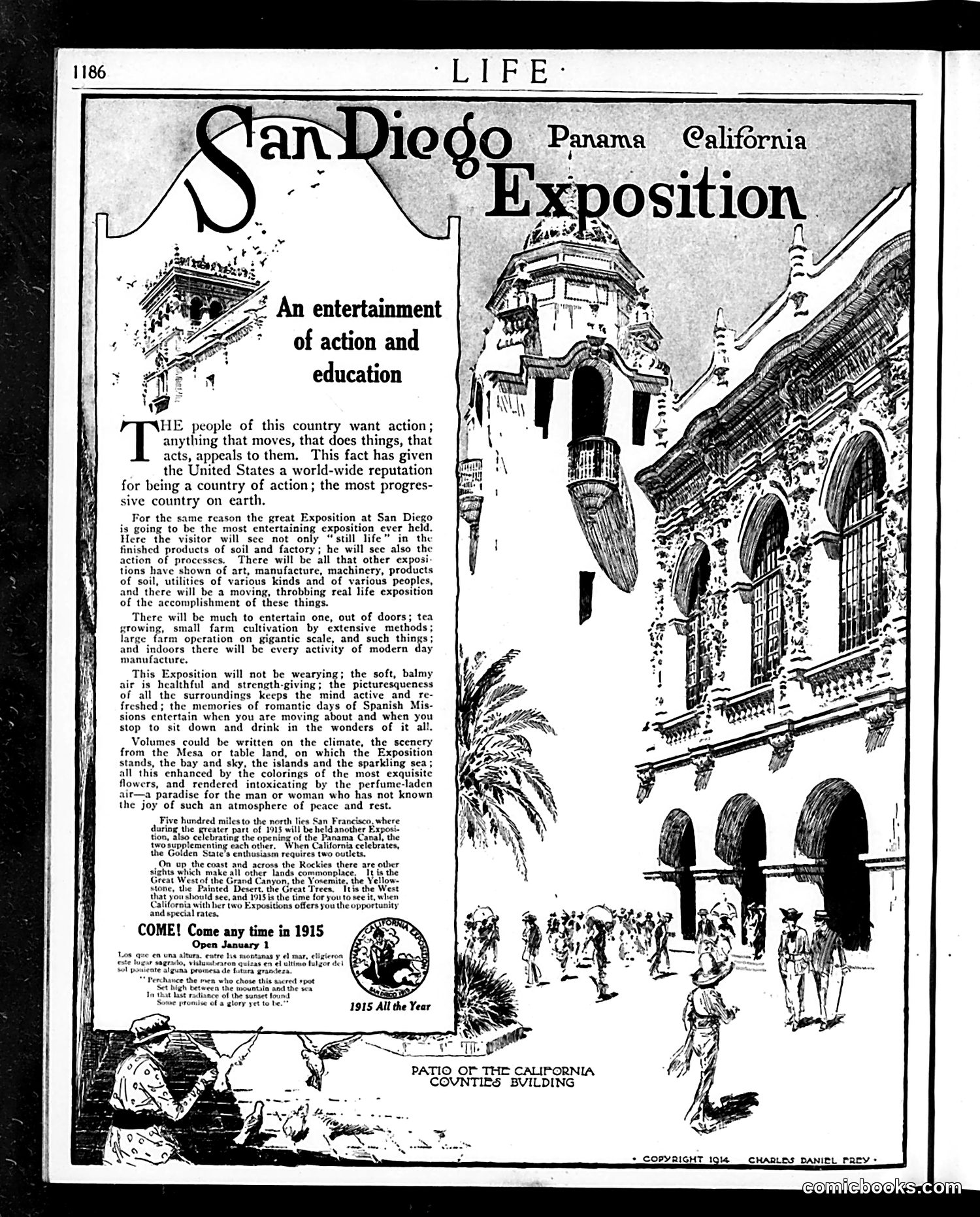
This is primarily **advertising copy** for the 1915 Panama-California Exposition in San Diego, not political satire. The text emphasizes the exposition as "an entertainment of action and education," appealing to Americans' supposed preference for dynamic, moving spectacles over static displays. The advertisement highlights the exposition's Spanish Colonial architecture and promises visitors both entertainment (outdoor tea gardens, farm cultivation demonstrations) and education (manufacturing, machinery displays). It frames the event as showcasing American progress while romanticizing California's Spanish mission heritage. The "COME!" call-to-action and note that it runs "1915 All the Year" suggest this was promotional material encouraging tourism to the West Coast exposition.
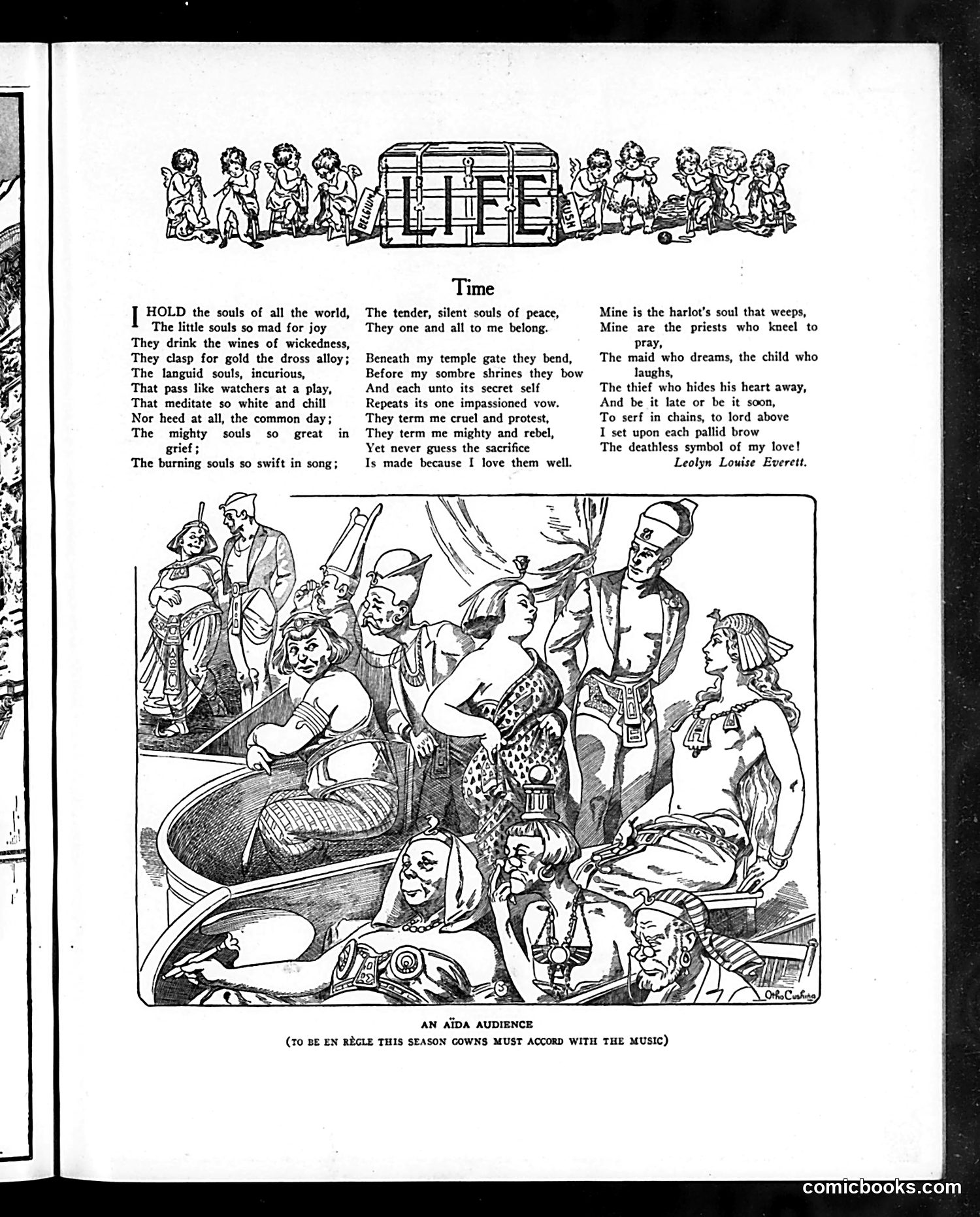
This page from *Life* magazine presents a poem titled "Time" by Evelyn Louise Everett, accompanied by an illustration labeled "An Aida Audience." The cartoon depicts an operatic scene referencing Verdi's *Aida*, a grand opera set in ancient Egypt. The illustration shows elaborately costumed performers and audience members in exaggerated, theatrical poses—nobles, soldiers, and attendants surrounding what appears to be a reclining figure (likely Aida herself). The satirical point appears to be mocking the pretension and spectacle of high opera culture. The caption's note that "gowns must accord with the music" suggests gentle ridicule of operagoers' obsession with matching elaborate costumes to the performance. The grotesque facial expressions and crowded composition humorously capture the melodramatic excess typical of grand opera productions and their audiences during this era.
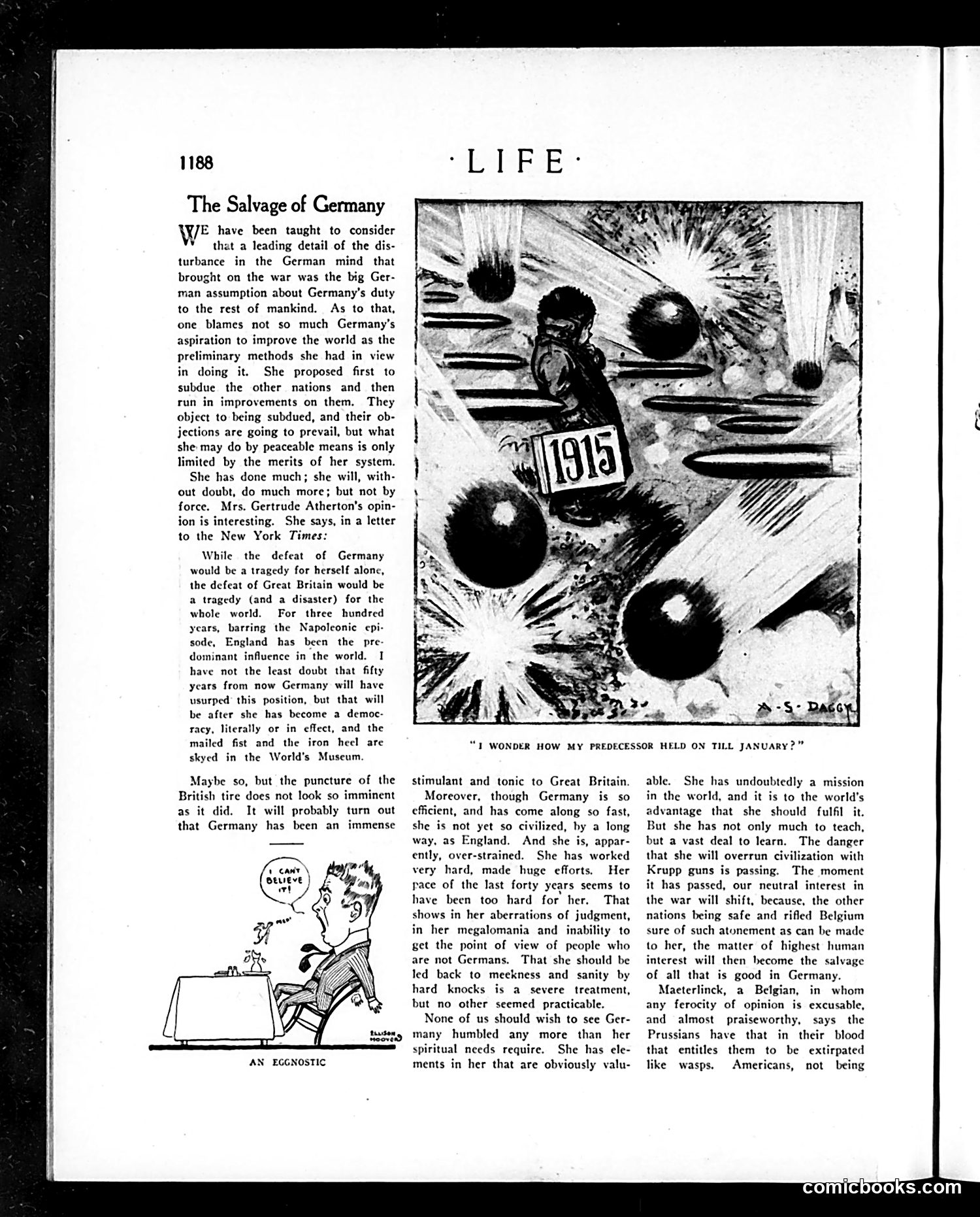
This 1915 satirical article criticizes German ambitions post-WWI. The main illustration shows a German figure amid destruction labeled "1915," asking "I wonder how my predecessor held on till January?" — suggesting Germany's leadership doubts their ability to sustain the war effort. The smaller cartoon titled "An Egnostic" depicts a figure at a table claiming "I CAN'T BELIEVE IT!" — likely mocking German denial about their military situation or war crimes. The text argues Germany has a "mission" to improve civilization but questions whether force can achieve this. It suggests Germany's military efficiency doesn't translate to moral superiority, and predicts Germany will eventually lose its dominant position, becoming merely historical salvage in a museum.
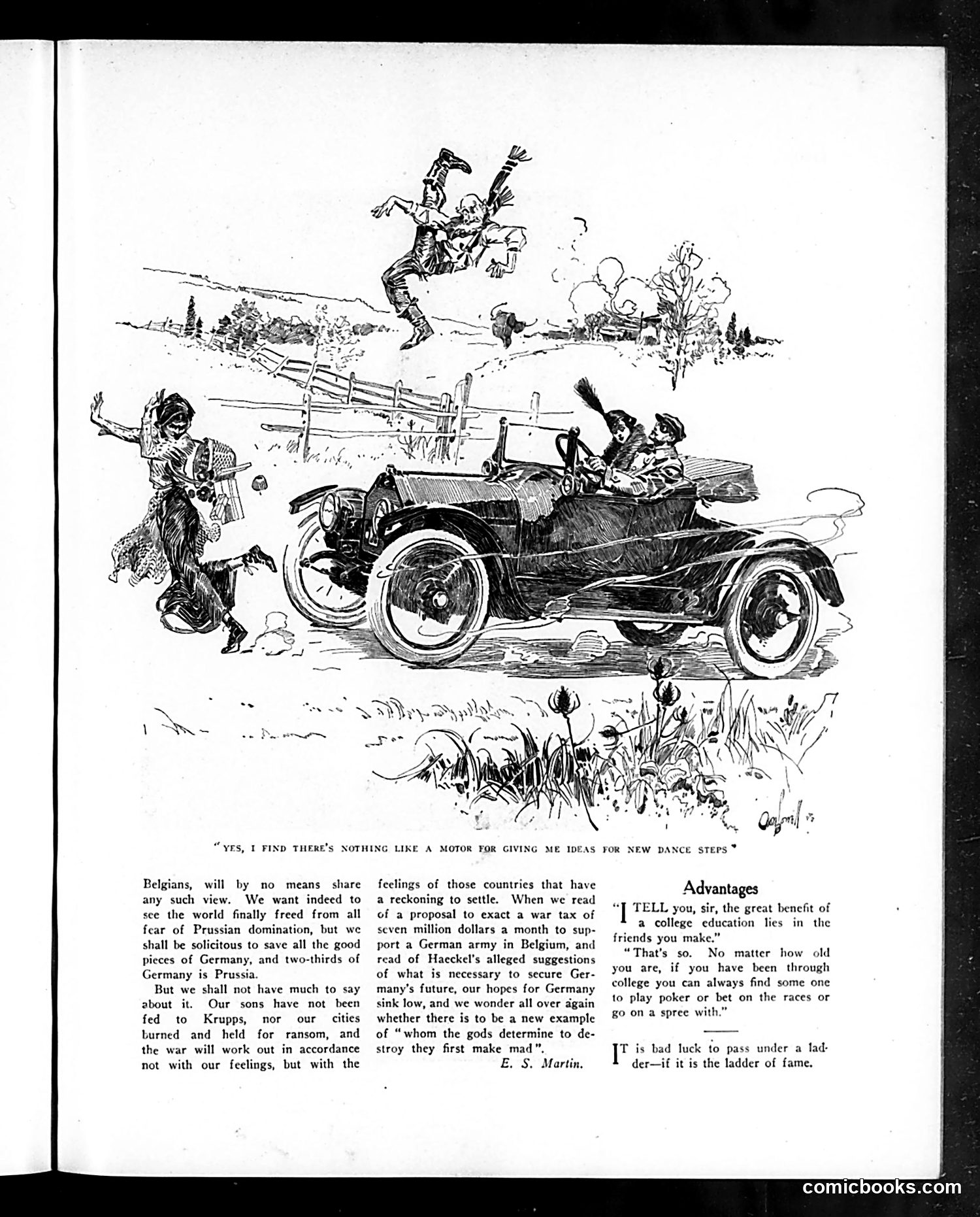
This satirical cartoon depicts a chaotic automobile scene captioned: "Yes, I find there's nothing like a motor for giving me ideas for new dance steps." The image shows passengers in an early-model car bouncing wildly as it traverses rough terrain, while a figure on the left appears startled or thrown about. The joke satirizes the novelty and unpredictability of early automobiles—their rough ride and mechanical jerking motion ironically inspire "dance steps." This reflects 1920s attitudes toward cars as both thrilling modern innovations and dangerously unpredictable machines that could cause violent, involuntary movement. The accompanying article text discusses Belgian and German post-WWI relations, unrelated to the cartoon's humor.
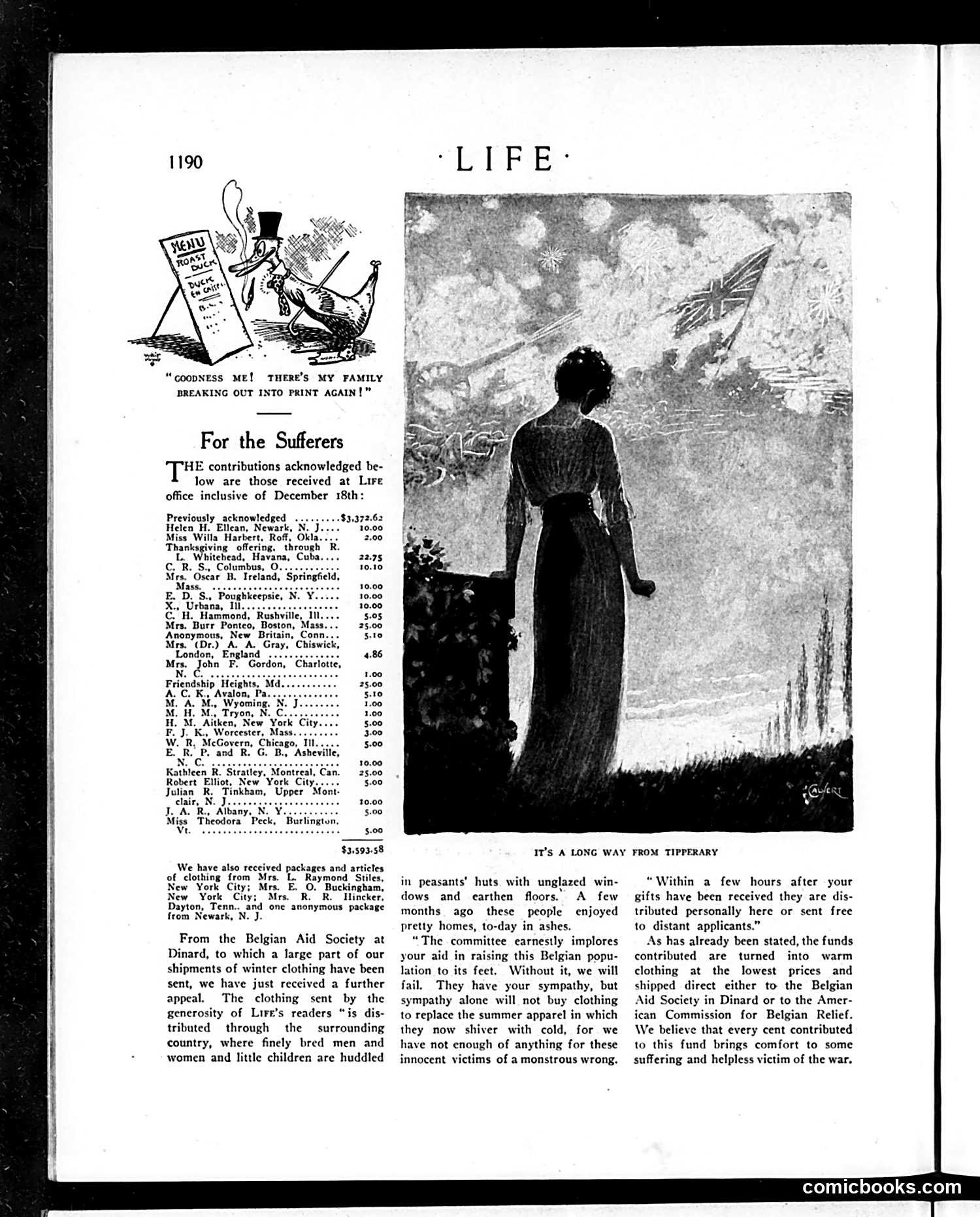
This page documents charitable contributions to aid Belgian civilians during World War I. The cartoon (upper left) shows a caricatured figure labeled "MENU" being knocked over, with text reading "GOODNESS ME! THERE'S MY FAMILY BREAKING OUT INTO PRINT AGAIN!"—a satirical jab at someone's relatives repeatedly appearing in print, possibly mocking vanity or self-promotion among donors. The main image illustrates the humanitarian crisis: a woman gazes toward a British flag amid destruction, captioned "IT'S A LONG WAY FROM TIPPERARY," referencing the famous WWI song. The accompanying text emphasizes Belgian civilians' desperate poverty and cold, soliciting clothing donations through Life magazine readers for the Belgian Aid Society, positioning charitable giving as a patriotic duty.
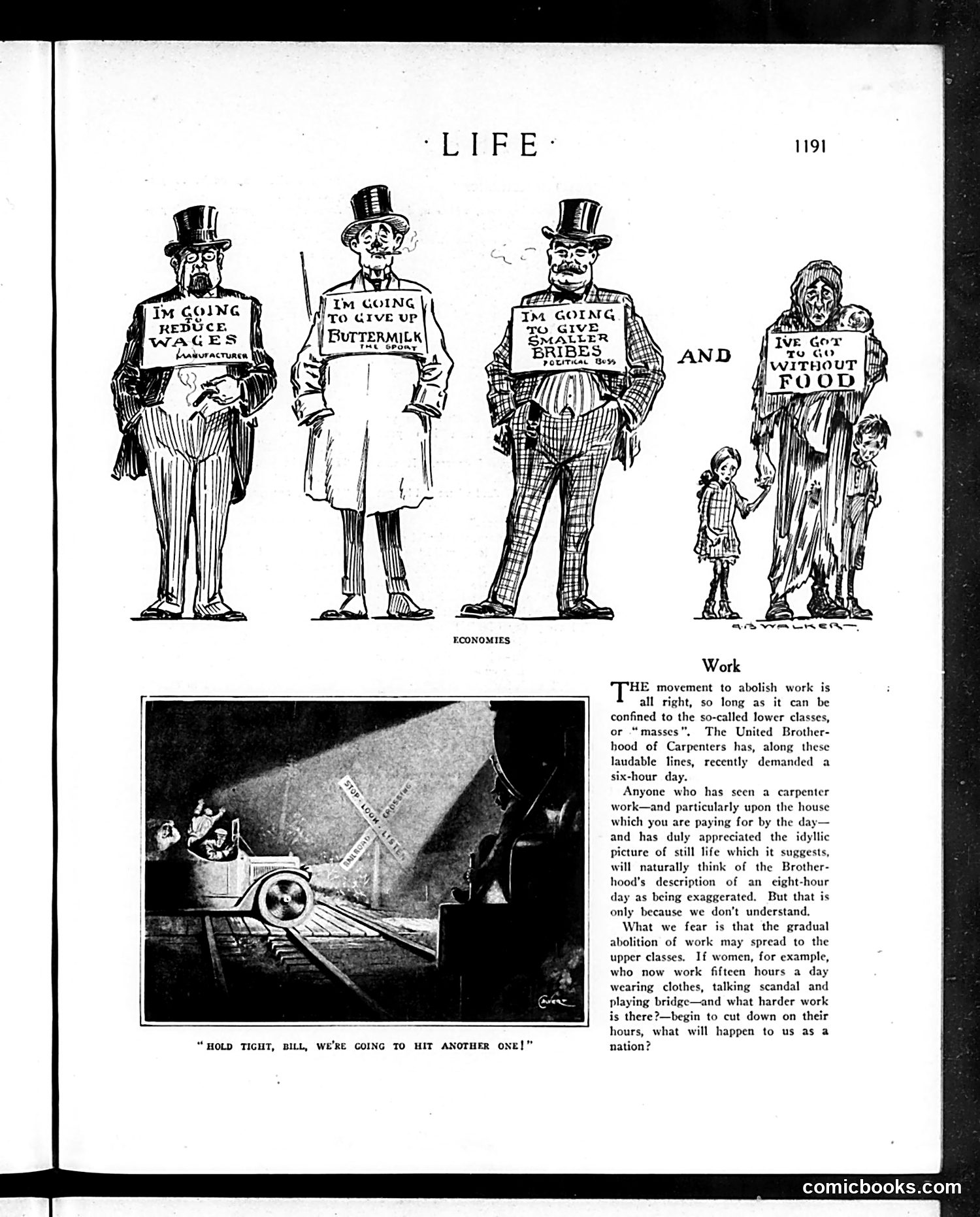
This page satirizes labor disputes and cost-of-living concerns, likely from the early 20th century. The top cartoon shows four figures representing different economic "solutions" to poverty: 1. A businessman claims he'll reduce wages 2. Someone will give up buttermilk (a cheap staple food) 3. Another will pay smaller bribes 4. A destitute woman with children has "got without food" The satire's point: the wealthy propose minor sacrifices while the poor starve. The accompanying text discusses labor movements demanding shorter workdays and expresses fear that work abolition might spread from "lower classes" to women, disrupting society. The bottom illustration shows workers in a mine or industrial setting with the caption "Hold tight, Bill, we're going to hit another one!"—suggesting dangerous working conditions.
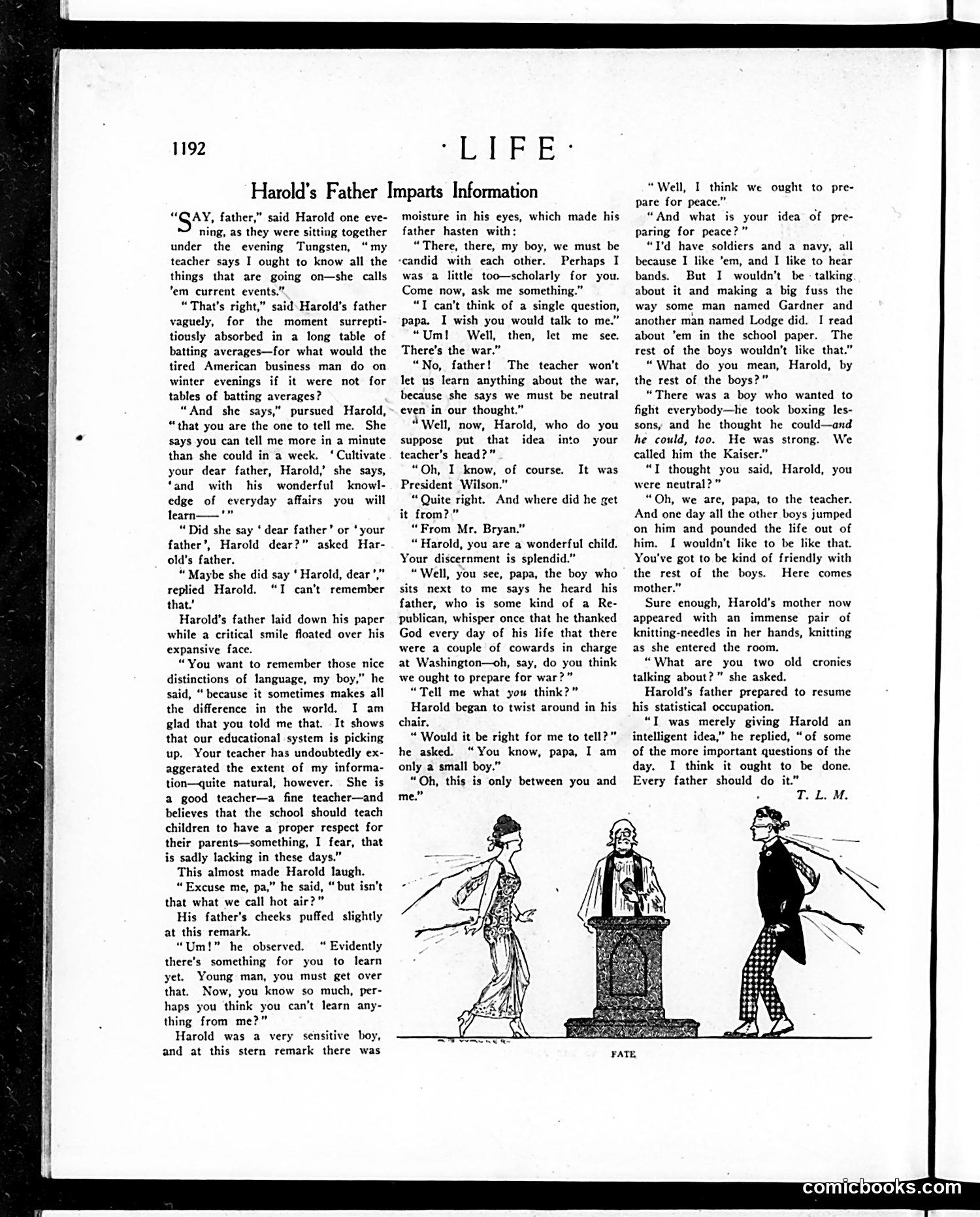
This satirical story critiques how fathers discuss current events with sons. Harold's father insists he should know about "all the things that are going on" and calls them "current events," but when Harold asks specific questions about the war and peace preparation, the father becomes evasive and defensive. The satire targets adult hypocrisy: fathers demand children stay informed while refusing to provide actual information or coherent answers themselves. Harold's teacher wants neutrality on war; his father contradicts this with bellicose rhetoric. The bottom illustration labeled "FATE" appears to show three figures in different poses, likely emphasizing life's uncertainties—thematically connected to the father-son dialogue about an uncertain future. The piece satirizes pre-WWI American confusion about preparedness and neutrality.
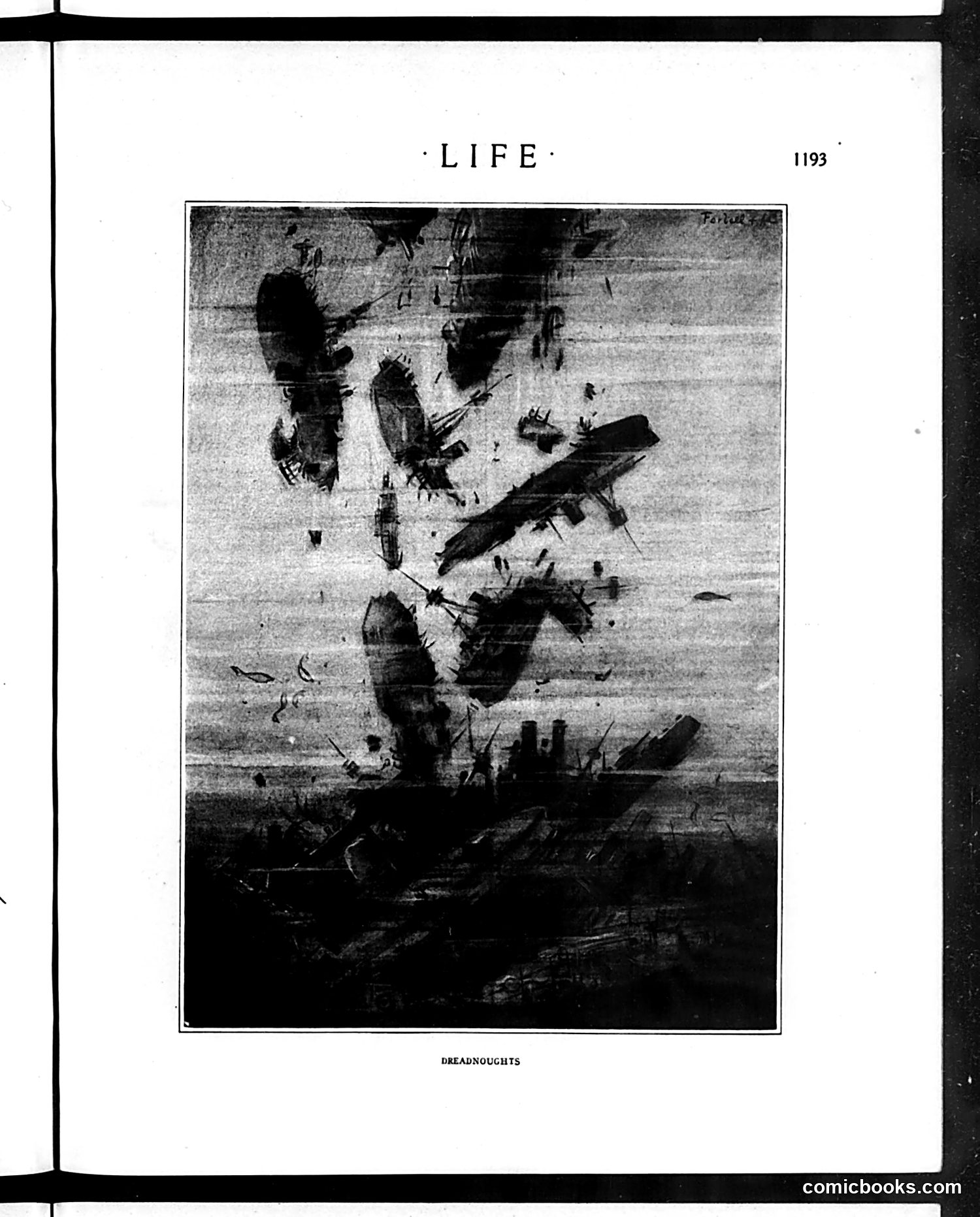
This political cartoon depicts naval warships—specifically **dreadnoughts** (the powerful battleships that dominated early 20th-century naval warfare)—in violent collision or explosion. The image shows multiple vessels destroyed or sinking, with debris and chaos scattered across the water. The satire likely comments on **naval arms races** and the destructive potential of modern warfare technology. The dreadnought battleship represented both technological advancement and escalating international tensions, particularly among European powers before World War I. By visualizing multiple dreadnoughts destroyed simultaneously, the cartoonist suggests the futility and mutual destruction inherent in competitive naval buildup—a warning about where such escalation could lead.
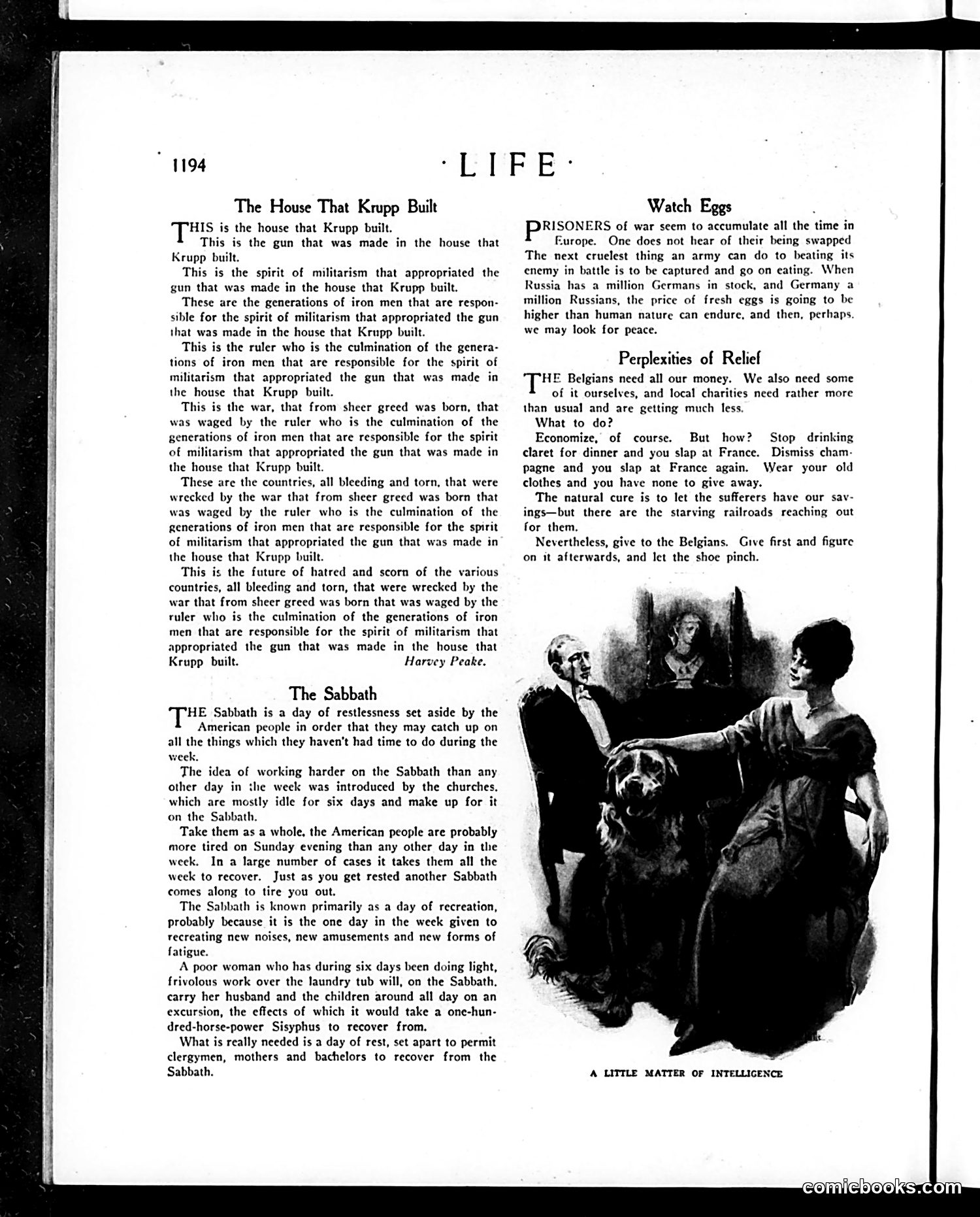
The page contains three distinct pieces: "The House That Krupp Built" (a satirical poem by Harvey Peake attacking German industrialist Alfred Krupp's role in militarism), "Watch Eggs" (commentary on war prisoners in Europe), and "Perplexities of Relief" (discussing Belgian aid). The cartoon titled "A Little Matter of Intelligence" depicts what appears to be soldiers or military figures in conversation, likely satirizing military intelligence operations or decision-making during World War I. The image quality makes specific identification difficult, but the caption suggests ironic commentary on strategic competence. The overall page critiques militarism, war profiteering, and relief efforts during the post-WWI period, reflecting American public debate about European reconstruction and military responsibility.
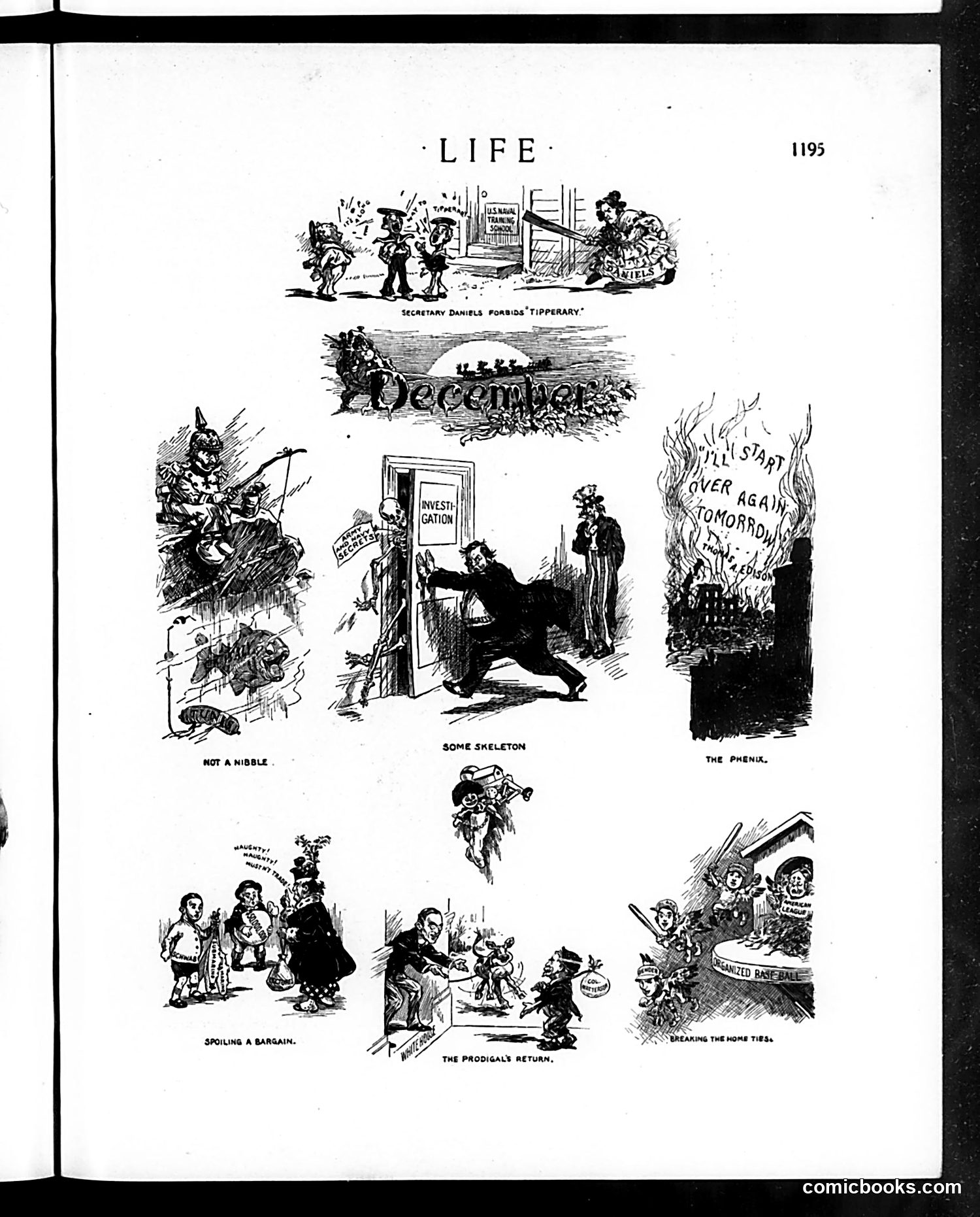
This page contains multiple satirical cartoons addressing early 20th-century social issues: **"Secretary Daniels Forbids 'Tipperary'"** - Appears to reference Secretary of the Navy Josephus Daniels restricting the popular Irish song, likely during WWI patriotism campaigns. **"Not a Nibble"** - Shows poverty/economic hardship. **"Some Skeleton"** - Depicts an "Investigation" door, suggesting governmental corruption scandals. **"The Phenix"** - References renewal after destruction, with text "I'll Start Over Again Tomorrow." **Lower cartoons** address domestic themes: "Spoiling a Bargain," "The Prodigal's Return," and "Breaking the Home Ties" depict family/marital scenarios common to satirical commentary on American home life. The overall theme explores national concerns during the WWI era—patriotism, corruption, economic struggle, and family stability.
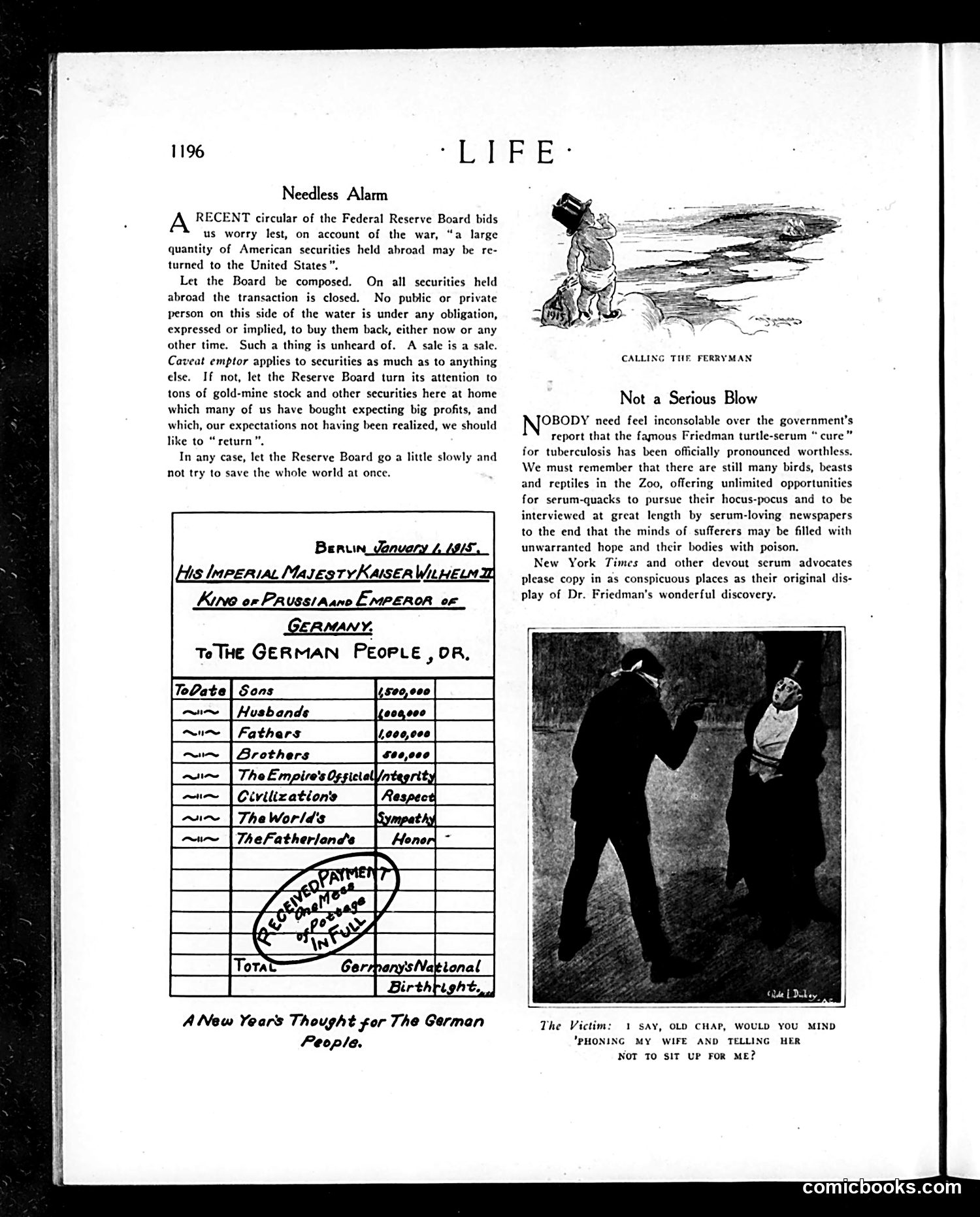
This page contains three satirical pieces from wartime America: **"Needless Alarm"** mocks the Federal Reserve Board's worry that American securities held abroad might be returned due to the war. The article argues such concerns are overblown—a sale is final; buyers have no obligation to resell back. **The Kaiser's "New Year's Thought"** is a biting political cartoon. It presents a mock ledger from Kaiser Wilhelm II to the German people, listing what Germany has "spent" on war: sons, husbands, fathers, brothers, civilization's respect, world sympathy, and the Fatherland's honor—with only "Germany's National Birthright" remaining. The satire condemns the massive human and moral cost of World War I. **"Not a Serious Blow"** sarcastically dismisses news that Dr. Friedman's tuberculosis "cure" using turtle serum was debunked, suggesting there are always more animals and desperate patients for medical charlatans to exploit. **"Calling the Ferryman"** (illustration) shows a figure asking someone to tell his wife not to wait up—an ominous reference to death.
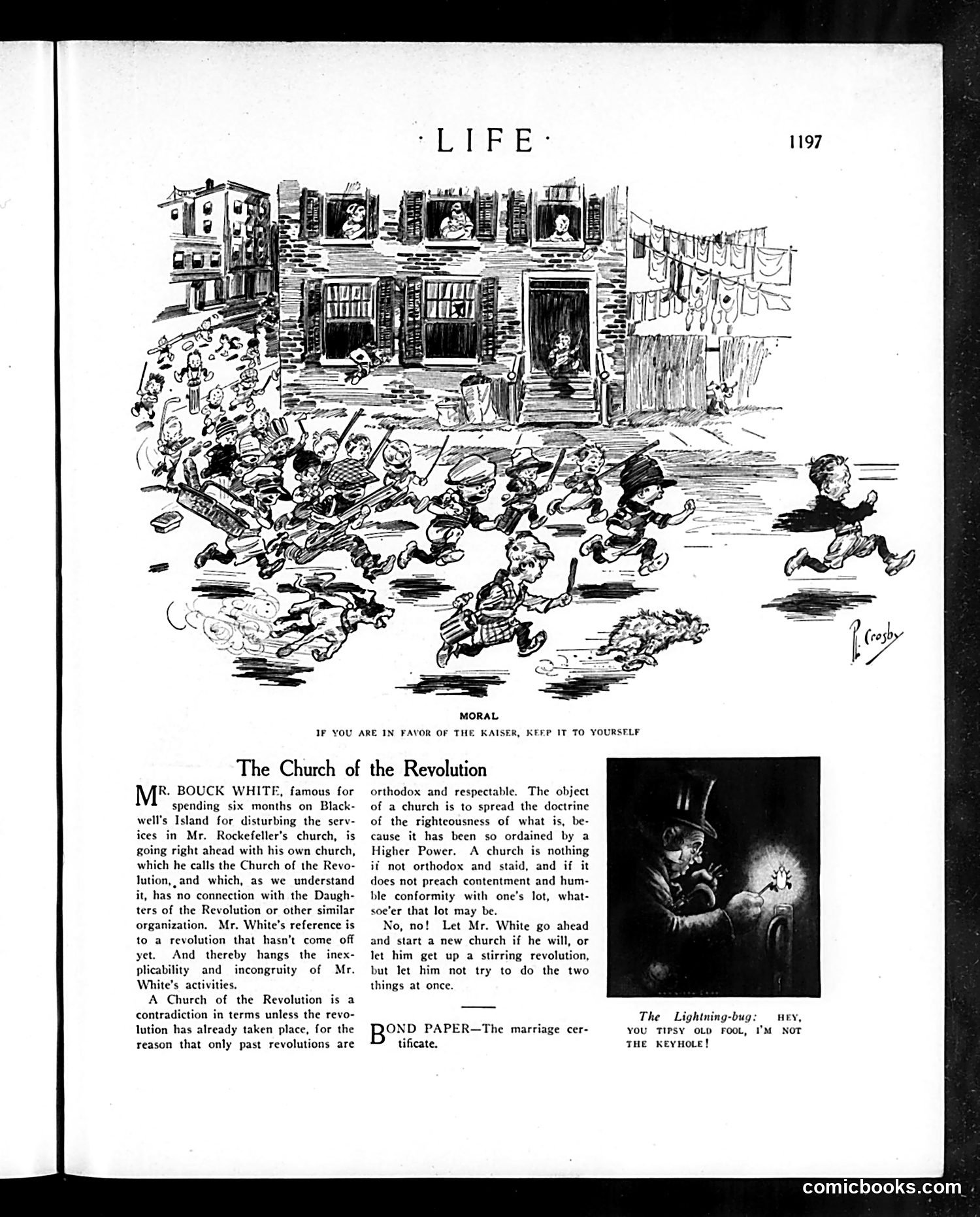
This satirical piece targets **Reverend Bouck White**, a real activist who had been jailed for disrupting services at John D. Rockefeller's church and was founding his own "Church of the Revolution." The article's central joke: White is attempting something logically impossible—a church dedicated to a revolution that hasn't happened yet. The writer argues churches exist to legitimize the *existing* status quo and promote acceptance of one's lot in life. A church promoting *future* revolutionary change is therefore a contradiction: churches are inherently conservative institutions defending what *is*, not what might be. The crude cartoon above depicts street chaos—children and adults in disarray outside tenement housing—illustrating the social disorder the establishment feared from revolutionary rhetoric. The moral caption sarcastically warns: "If you are in favor of the Kaiser, keep it to yourself"—a WWI-era reference suggesting radical speech is dangerous, even as the article ironically critiques White for trying to merge radical activism with religious respectability.
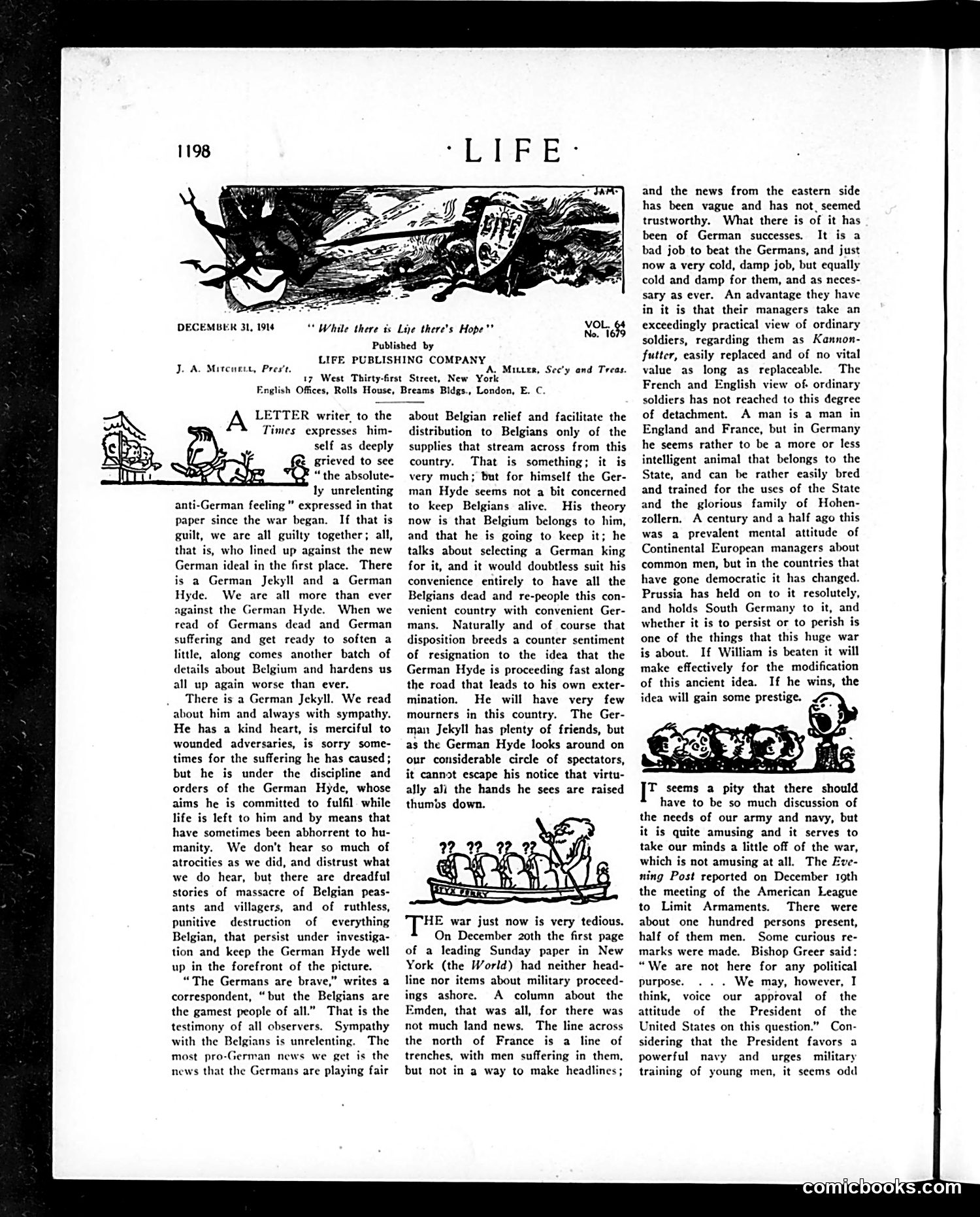
This editorial uses the Jekyll-and-Hyde metaphor to address wartime attitudes toward Germany during WWI. The writer distinguishes between "German Jekyll"—the compassionate, merciful individual German—and "German Hyde"—the brutal state apparatus committing atrocities in Belgium. The piece argues that while sympathizing with Belgian suffering and German soldiers' humanity is natural, the "German Hyde" (the military/imperial leadership) remains committed to Belgium's subjugation and depopulation. The author notes wryly that the only positive German war news Americans receive concerns humanitarian relief efforts—"something; it is very much." The accompanying illustration likely depicts this Jekyll-Hyde contrast visually, though details are unclear in this reproduction. The second section criticizes war coverage as tedious due to trench stalemate on the Western Front and unreliable Eastern Front reporting. This reflects frustration with static, unglamorous modern warfare lacking dramatic "headlines."
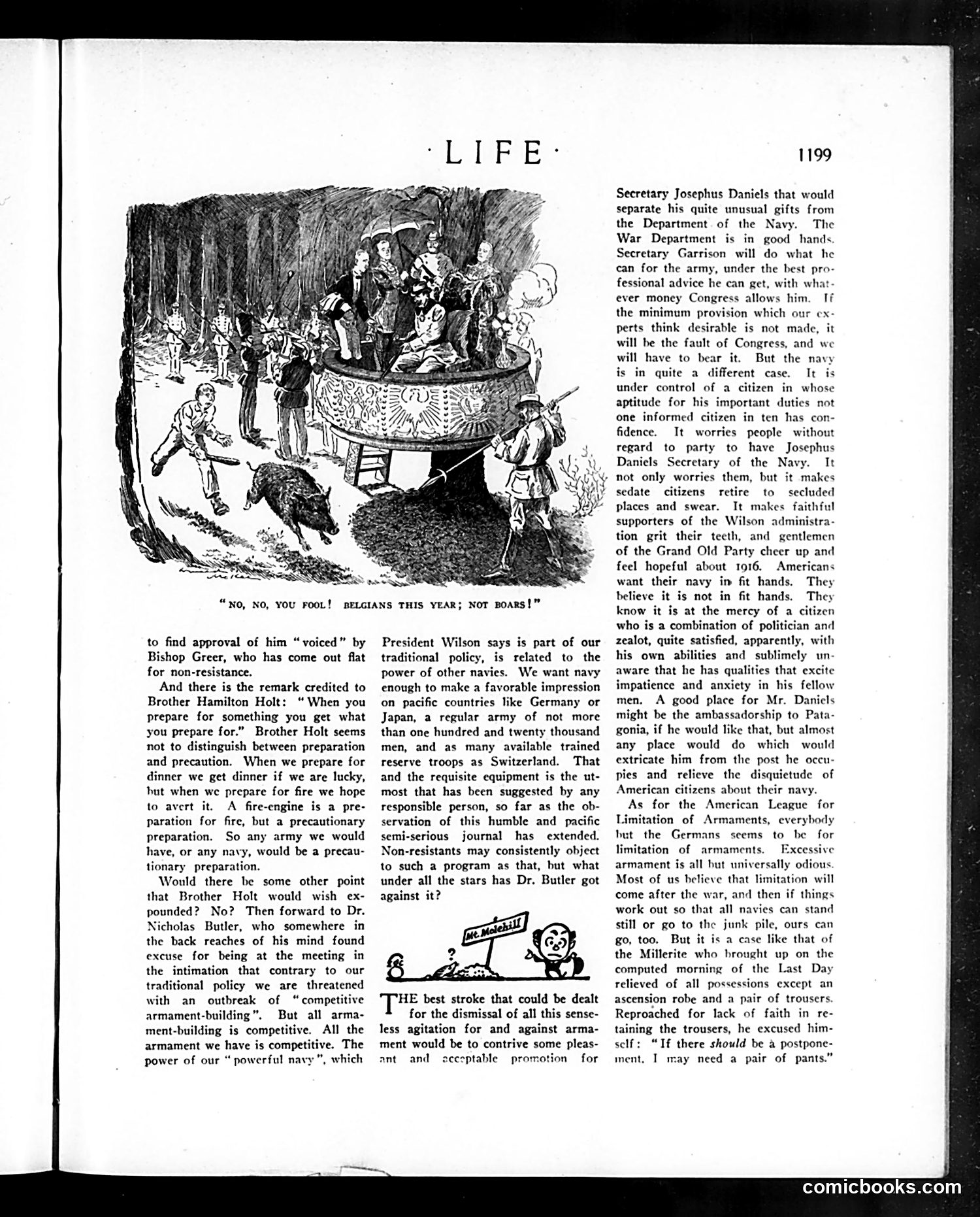
## The Cartoon The illustration depicts a chaotic scene with figures in and around an ornate vessel or platform labeled with the number 71, captioned "NO, NO, YOU FOOL! BELGIANS THIS YEAR; NOT BOARS!" The cartoon satirizes American pacifist and anti-armament advocates during the pre-WWI era. The reference to "Belgians" versus "boars" appears to mock pacifists' inconsistency—seemingly unconcerned about Belgian suffering in the ongoing European war (Belgium was invaded by Germany in 1914) while focusing on abstract anti-war principles. ## The Text's Political Context The article attacks Secretary of the Navy Josephus Daniels, criticizing him as unfit for office due to his pacifist leanings and political rather than military qualifications. It ridicules various peace advocates—Bishop Greer, Hamilton Holt, and Dr. Nicholas Butler—for their opposition to armament, while defending preparedness as prudent precaution rather than warmongering. The satire's core message: idealistic pacifism is impractical when real threats (the European war, German naval power) exist.
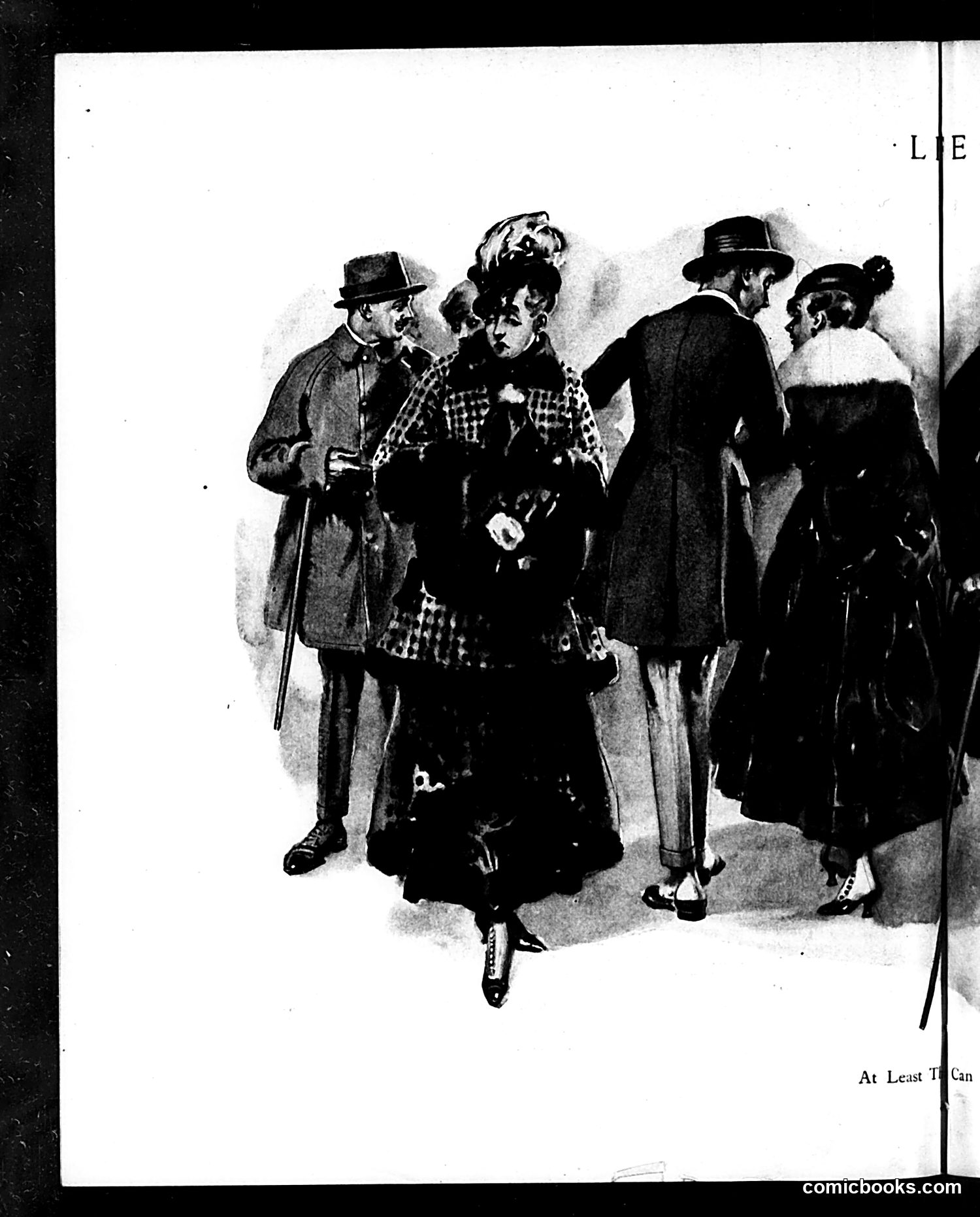
This is a satirical illustration from *Life* magazine showing five well-dressed figures in formal winter attire (coats, hats) gathered in conversation. The incomplete caption "At Least T[?] Can" suggests social commentary about what certain people can or cannot do. The style and clothing suggest early-to-mid 20th century. The figures appear to represent upper-class or wealthy individuals, likely satirizing social pretension or exclusivity. Without the complete caption, the specific joke is unclear—it may reference what wealthy people "can" do (perhaps socially acceptable behavior, access, or freedoms) that others cannot. The illustration's focus on formal dress and social positioning suggests commentary on class distinctions or social hierarchies of the era.
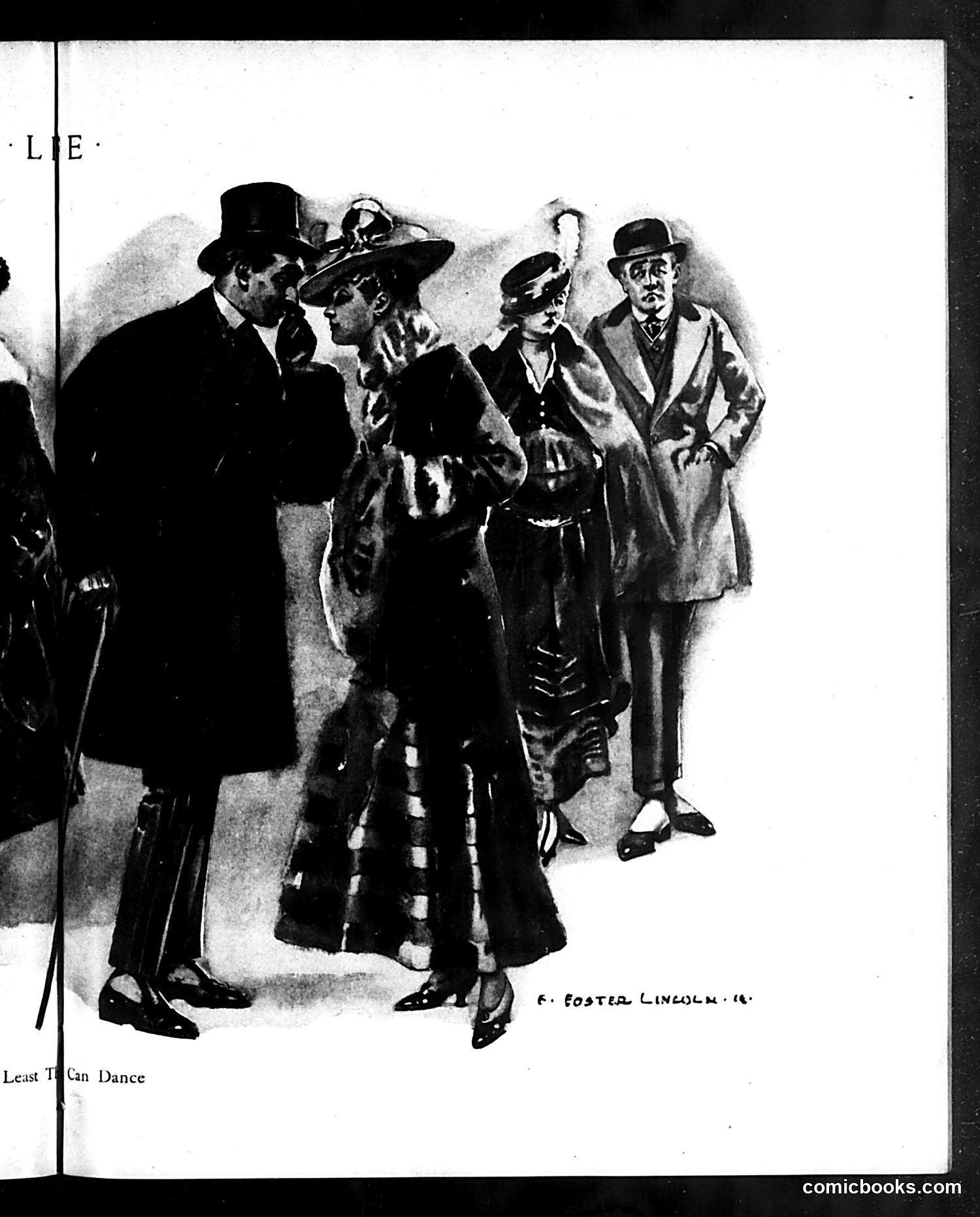
This cartoon by F. Foster Lincoln satirizes four formally dressed figures in what appears to be an early 20th-century social scene. The title "Least They Can Dance" suggests commentary on social mobility or pretension—that despite other deficiencies or shortcomings, these people possess at least basic social accomplishment. The figures' formal attire (top hats, fine coats) contrasts with the satirical tone, likely mocking the leisure class or newly wealthy individuals who adopt fancy dress and manners. Without clearer identification of the specific figures, the cartoon likely targets either wealthy pretenders, social climbers, or a particular group contemporary to Life magazine's publication period. The satire hinges on the gap between appearance and actual worth or ability.
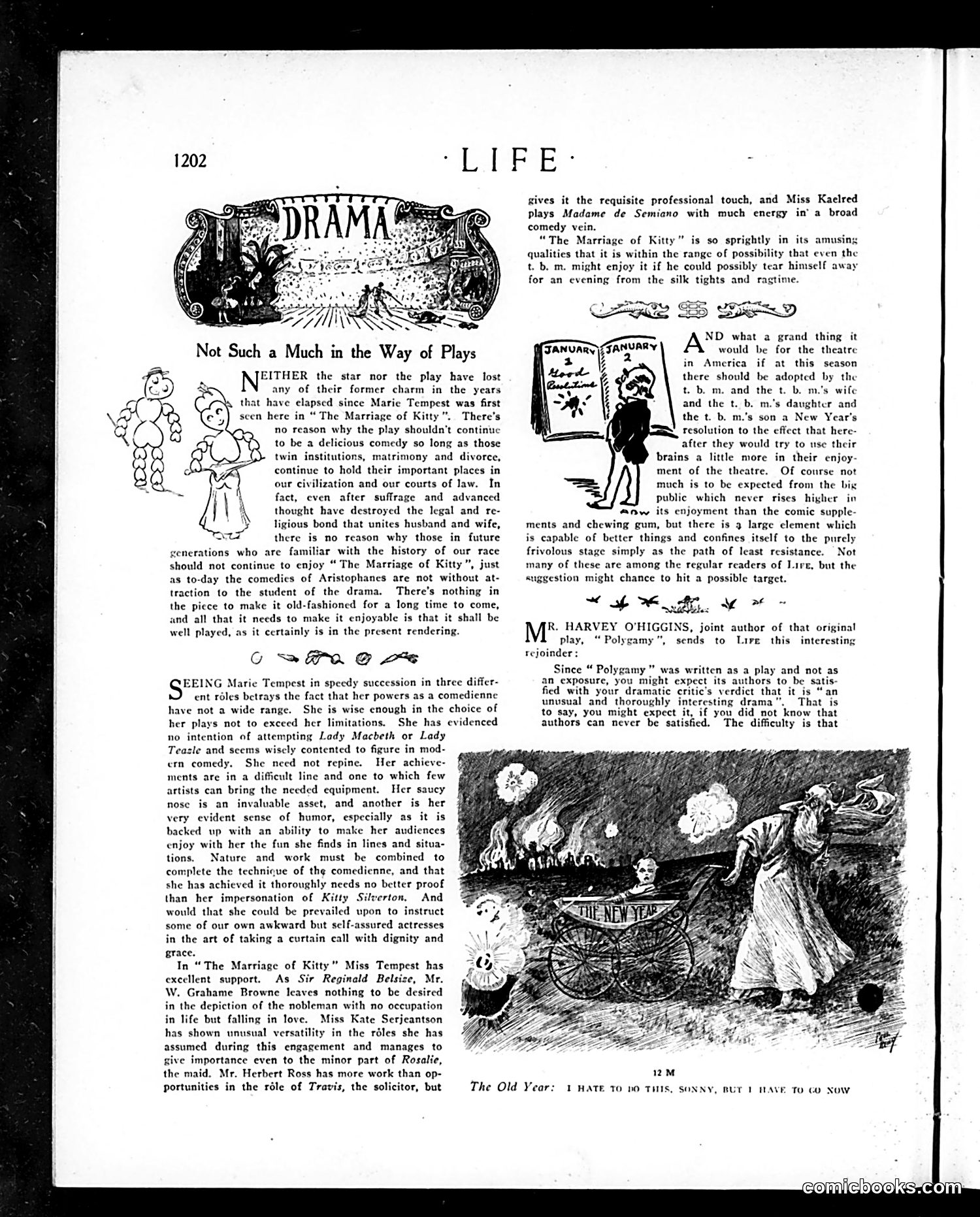
This page reviews "The Marriage of Kitty," a contemporary comedic play starring actress Marie Tempest. The critic argues the play remains timeless because its themes—marriage and divorce—are eternally relevant to society and law. The main satire targets the "t.b.m." (an abbreviation the text doesn't explain but appears to mean a type of theatergoer), criticized for preferring lowbrow entertainment like "comic supplements and chewing gum" over intelligent theatre. The accompanying illustration (bottom right) depicts a figure labeled "The Old Year" seemingly bidding farewell, likely accompanying a New Year's resolution theme the text promotes: that audiences should "use their brains a little more" in theatrical enjoyment rather than seeking only frivolous amusement. The critique reflects early 20th-century anxieties about mass culture and popular taste versus refined theatrical appreciation.
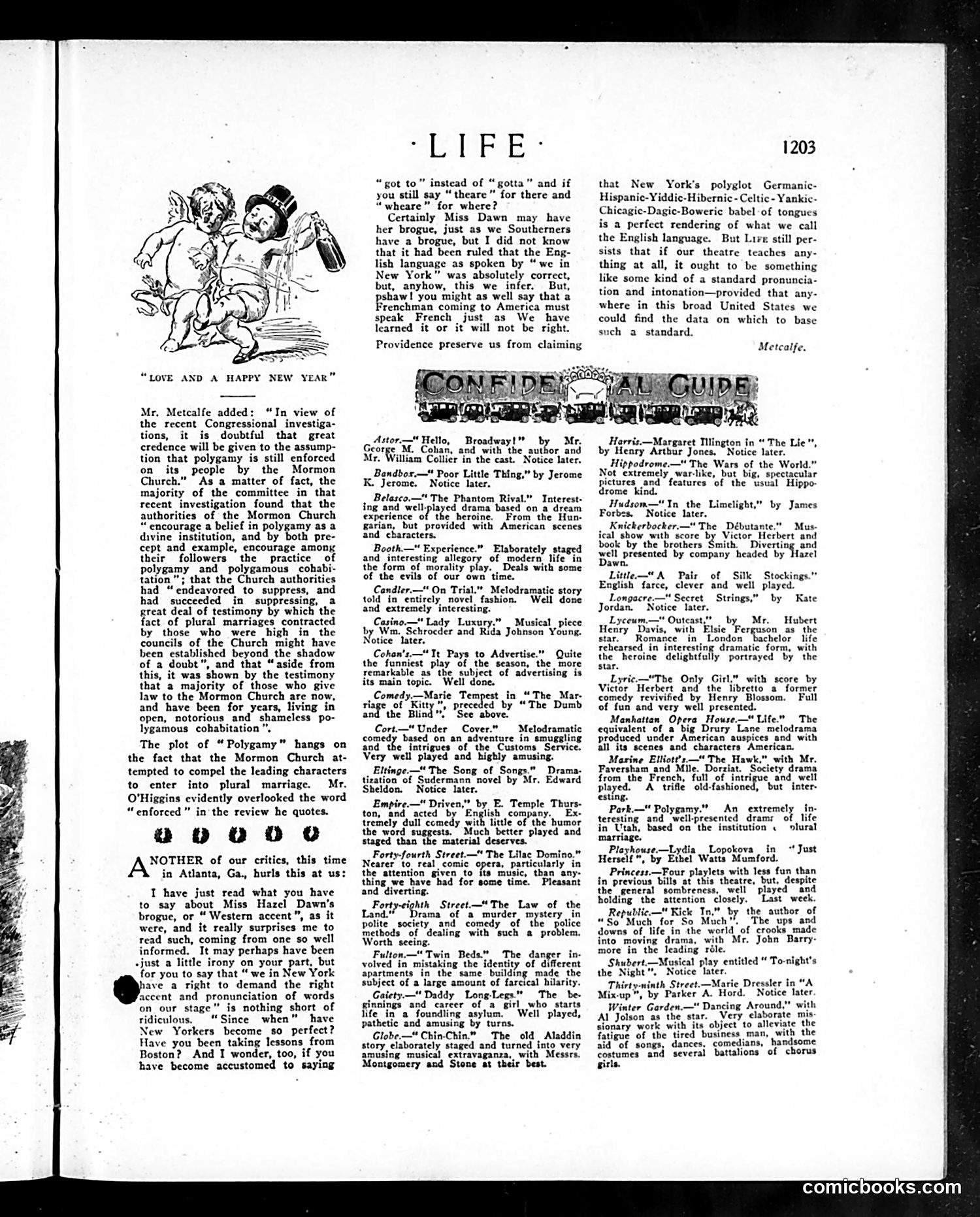
The page contains a satirical debate about the Mormon Church's practice of polygamy. The main cartoon shows cherubs or cupids labeled "Love and a Happy New Year," likely mocking the disconnect between romantic ideals and the controversial polygamous practices the Church allegedly enforced. The accompanying text discusses a play called "Polygamy" and critiques a reviewer (Mr. Metcalfe) for downplaying Congressional investigation findings that proved the Mormon Church actively encouraged and practiced polygamy despite denials. The satire highlights institutional hypocrisy—the Church's claims versus documented evidence of "open, notorious and shameless polygamous cohabitation" among Church leaders. A separate letter attacks Life's criticism of actress Hazel Dawn's accent, questioning New York's assumed linguistic superiority over regional American dialects. The response defends regional speech variation. The bottom section lists theatrical reviews from various Broadway venues.
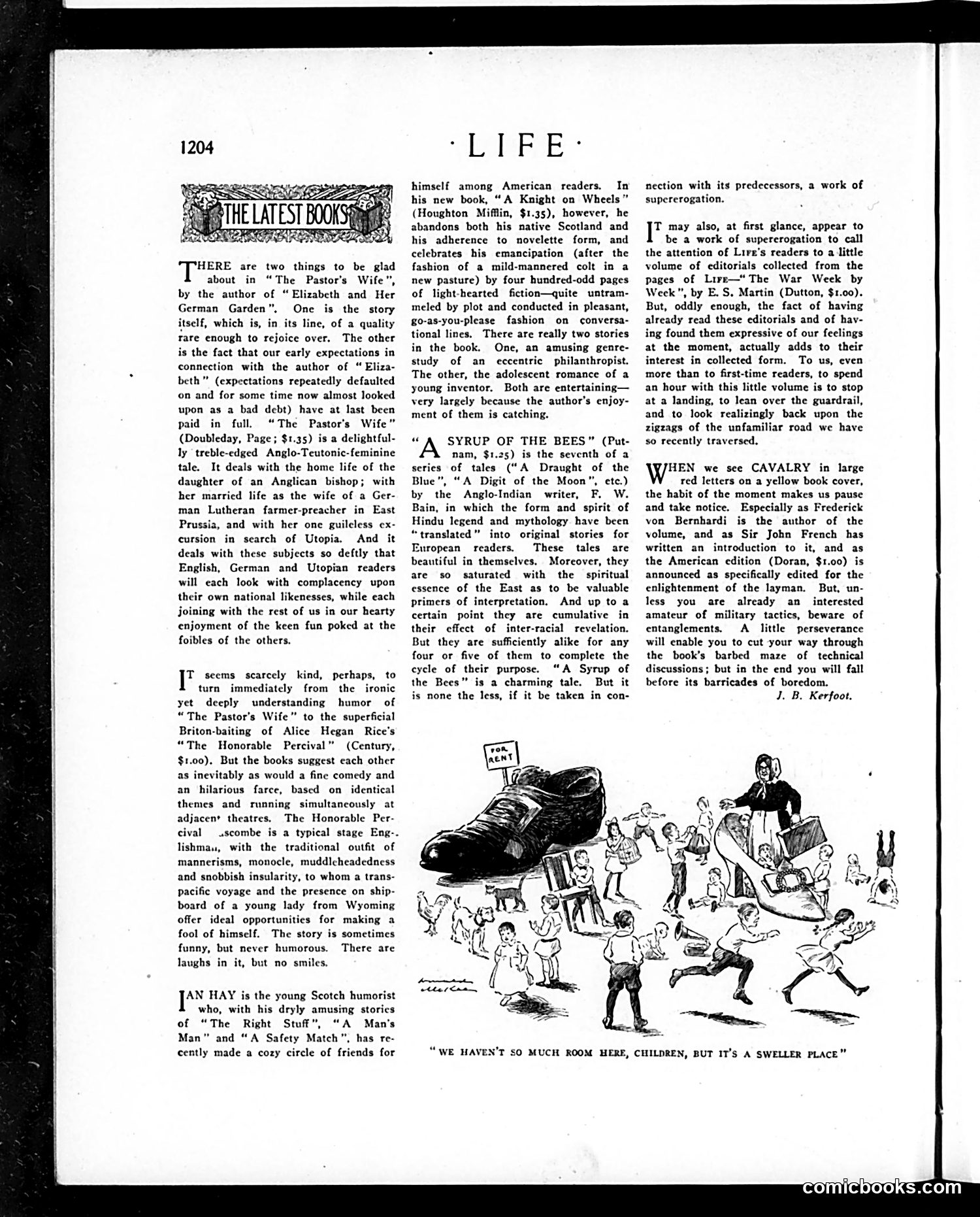
This is a book review page from *Life* magazine featuring literary criticism rather than political satire. The main content discusses contemporary novels, including works by authors now largely forgotten. The single cartoon at the bottom depicts a large shoe with children playing around it—an illustration of the nursery rhyme "There Was an Old Woman Who Lived in a Shoe." The caption reads: "We haven't so much room here, children, but it's a swell place." The cartoon likely comments on overcrowding or housing conditions of the era, using the familiar rhyme as a humorous reference point. The "swell place" suggests ironic acceptance of cramped circumstances—a gentle social observation typical of *Life*'s satirical style. The page itself is primarily a literary review discussing novels by various authors, evaluating their merits and comparing their styles.
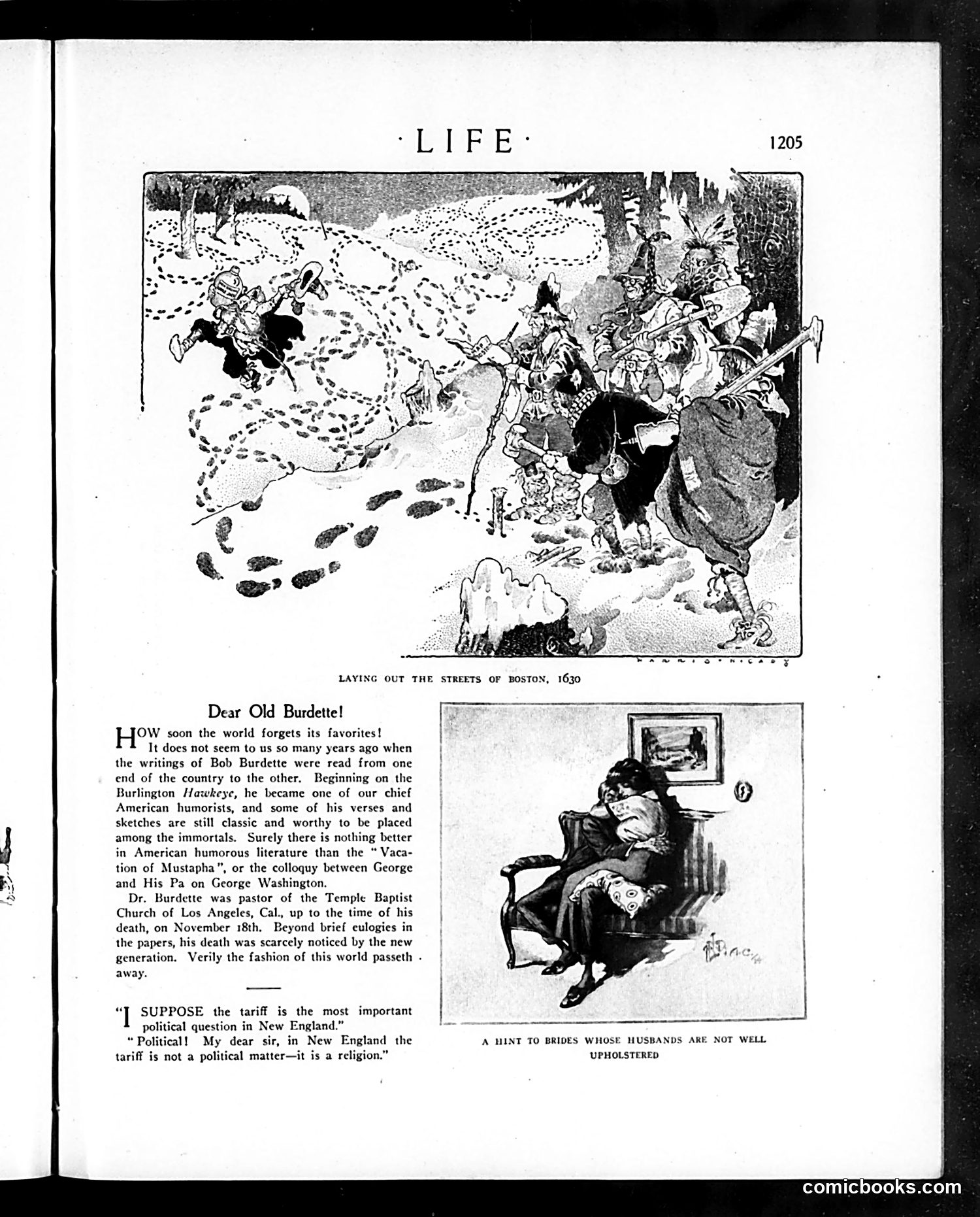
**Top Cartoon: "Laying Out the Streets of Boston, 1630"** This depicts early Puritan settlers planning Boston's street layout. The satirical point appears to be mocking the haphazard, winding nature of Boston's actual streets (shown by the dotted, irregular lines) compared to organized grid planning. It's gentle humor about colonial-era urban planning. **"Dear Old Burdette" Article:** An obituary/tribute to Bob Burdette, a once-famous American humorist from the Burlington Hawkeye newspaper, who died November 18th. The piece laments that his death went largely unnoticed by younger generations—a commentary on how quickly public figures fade from memory. **Bottom Cartoon: "A Hint to Brides"** Shows a woman examining her husband's chair cushioning, humorously suggesting thin husbands need extra padding for comfort. It's a domestic joke about marital practicality. **Tariff Dialogue:** A brief political joke contrasting New England's supposedly fervent protectionist stance on tariffs as near-religious conviction rather than mere policy.
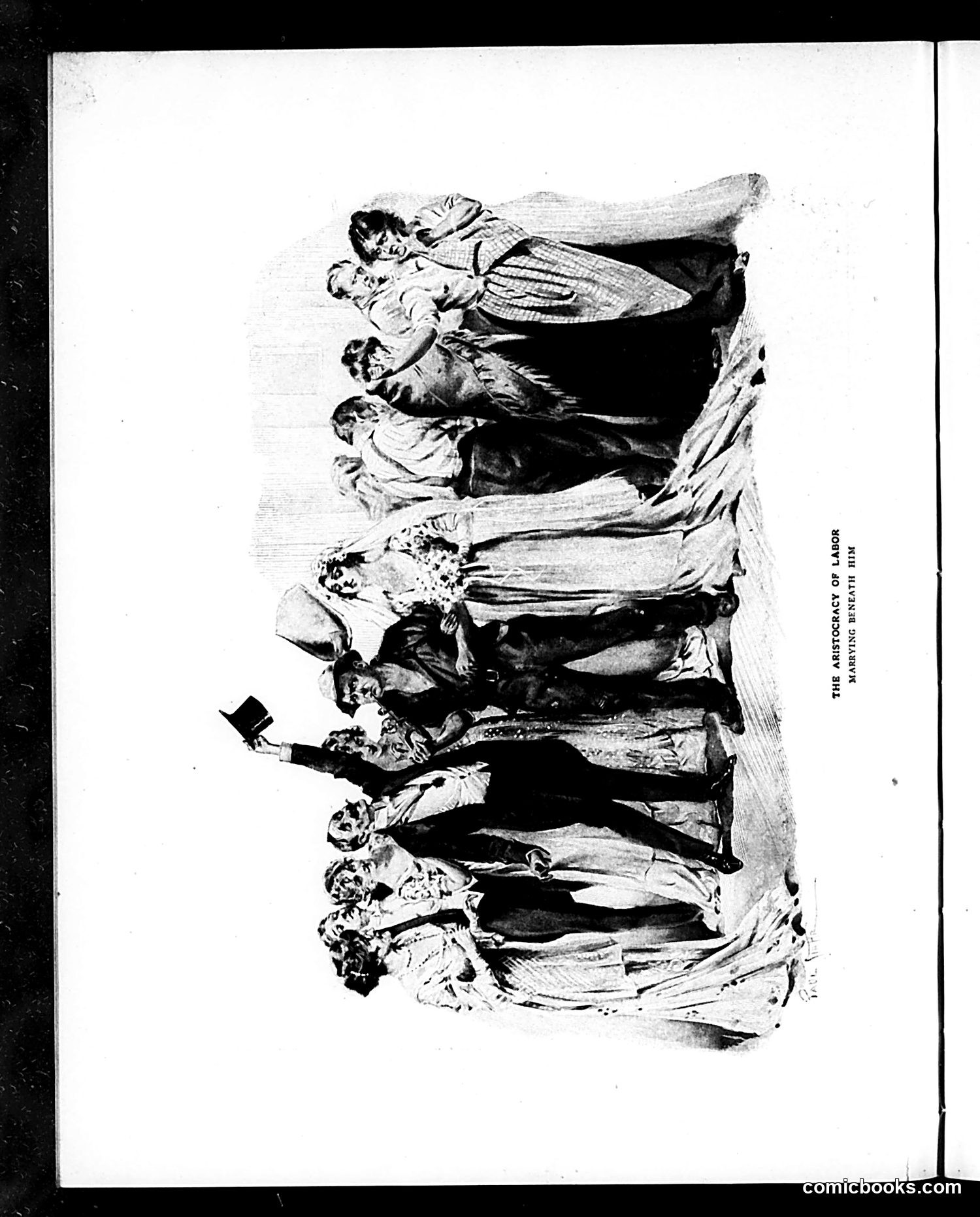
I can see this is a satirical illustration showing figures arranged vertically, appearing to depict some kind of social hierarchy or class structure. The OCR text is garbled and unreadable, making it impossible to confirm the cartoon's specific subject or message with certainty. The image shows well-dressed figures in what appears to be 19th-century clothing, with dramatic shading and positioning that suggests social commentary. The title visible on the page reads "THE ARISTOCRACY OF LABOR" and references "MARVELING BREWERY BEER," but without legible OCR text or clearer context, I cannot reliably identify which specific political figures or labor disputes this satirizes or explain the precise point of the satire to a modern reader.
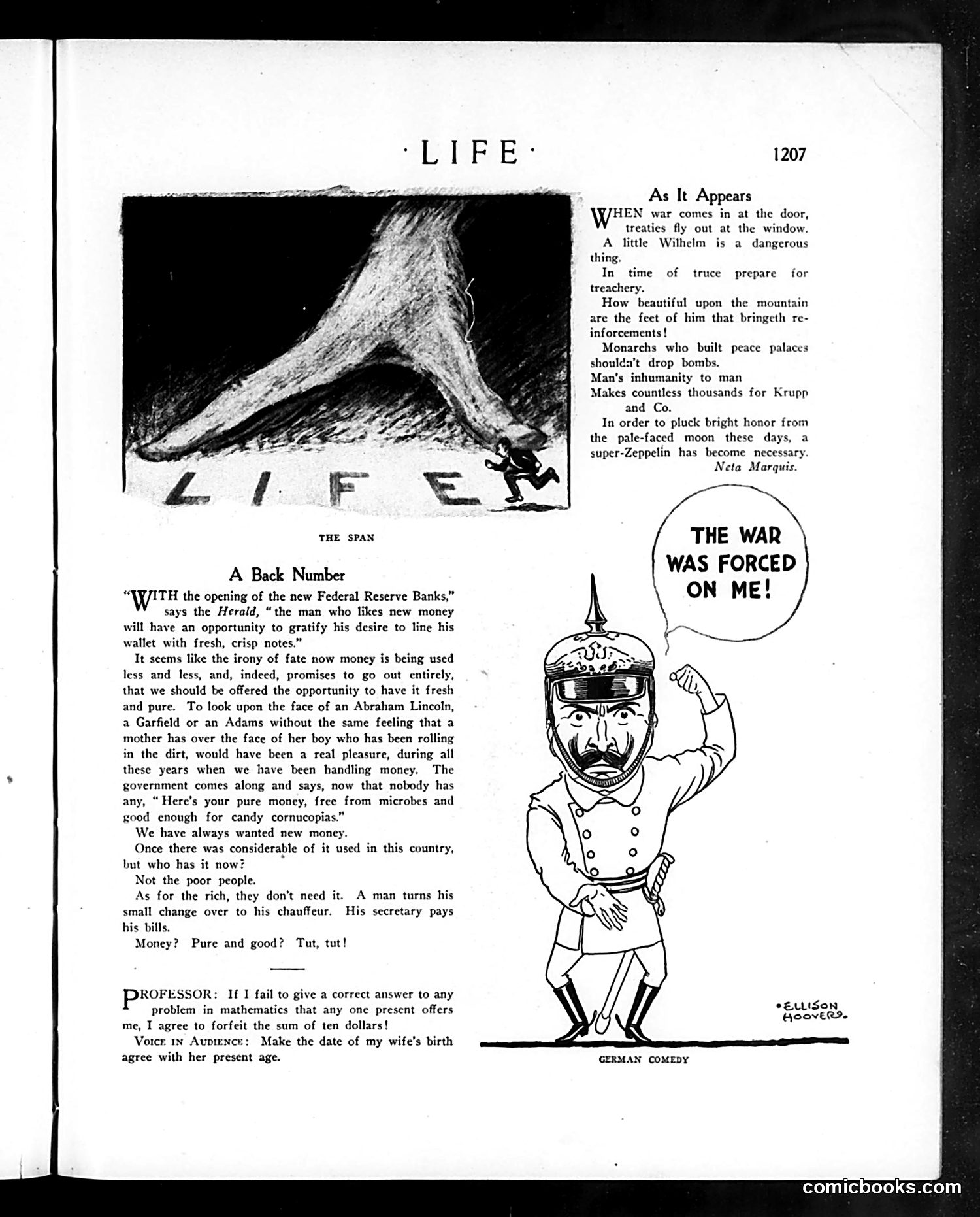
**"The Span" (top cartoon):** A satirical drawing of a bird with outstretched wings labeled "LIFE," accompanied by anti-war poetry. The verses mock German militarism and profiteering—"Wilhelm" refers to Kaiser Wilhelm II of Germany, and "Krupp and Co." references the German weapons manufacturer. References to "super-Zeppelin" and peace palaces being bombed reflect World War I concerns. The satire attacks both German aggression and those who profit from war. **"A Back Number":** Mocks the Federal Reserve Banks' promise of clean, fresh currency at a moment when money itself is becoming scarce. The irony: the government offers pristine bills when nobody has cash anymore—the poor lack funds entirely, while the wealthy delegate currency handling to servants. **"German Comedy":** A caricatured German military officer declares "The war was forced on me!"—satirizing German claims of defensive necessity during WWI, a common propaganda position then widely mocked by Allied media. All three pieces are anti-German wartime satire typical of American publications during World War I.
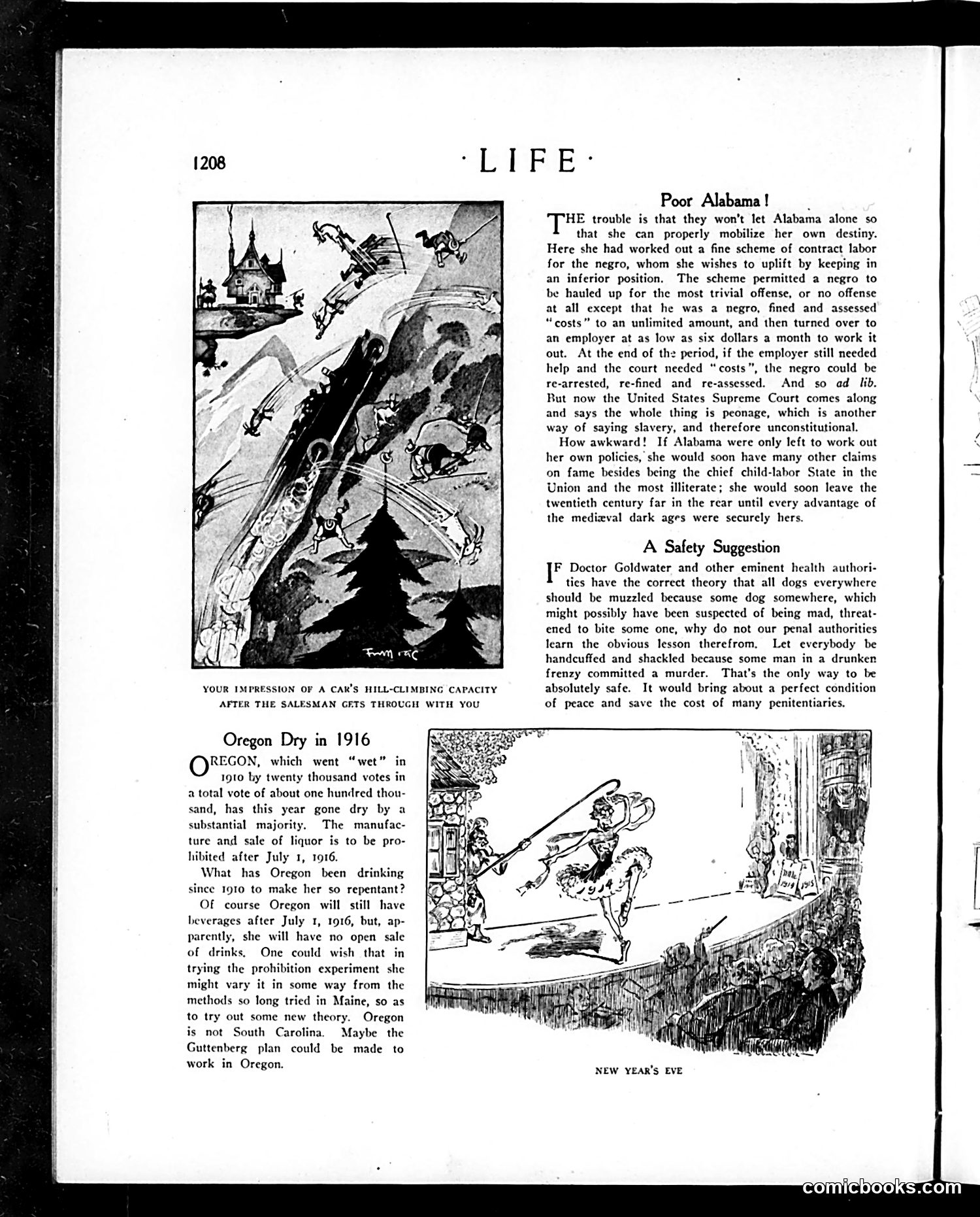
This page contains three satirical pieces: **"Poor Alabama"** mocks Alabama's system of convict leasing—arresting Black citizens on trivial or fabricated charges, fining them impossibly, then forcing them to work off debts for pittance wages. The text uses heavy sarcasm to critique this quasi-slavery scheme, presenting Alabama's outrage when the U.S. Supreme Court ruled it unconstitutional (peonage) as if the state were being unfairly restricted. **"A Safety Suggestion"** sardonically proposes that since one dangerous dog warrants muzzling all dogs, society should shackle everyone to prevent occasional murders—attacking the illogic of blanket punishment policies. **"Oregon Dry in 1916"** reports Oregon's surprising reversal from voting to legalize alcohol (1910) to prohibition (1916), questioning what caused this dramatic about-face in voter sentiment. The accompanying cartoons humorously illustrate exaggeration: a car salesman's inflated promises of hill-climbing ability, and New Year's Eve revelry likely connected to the prohibition debate.
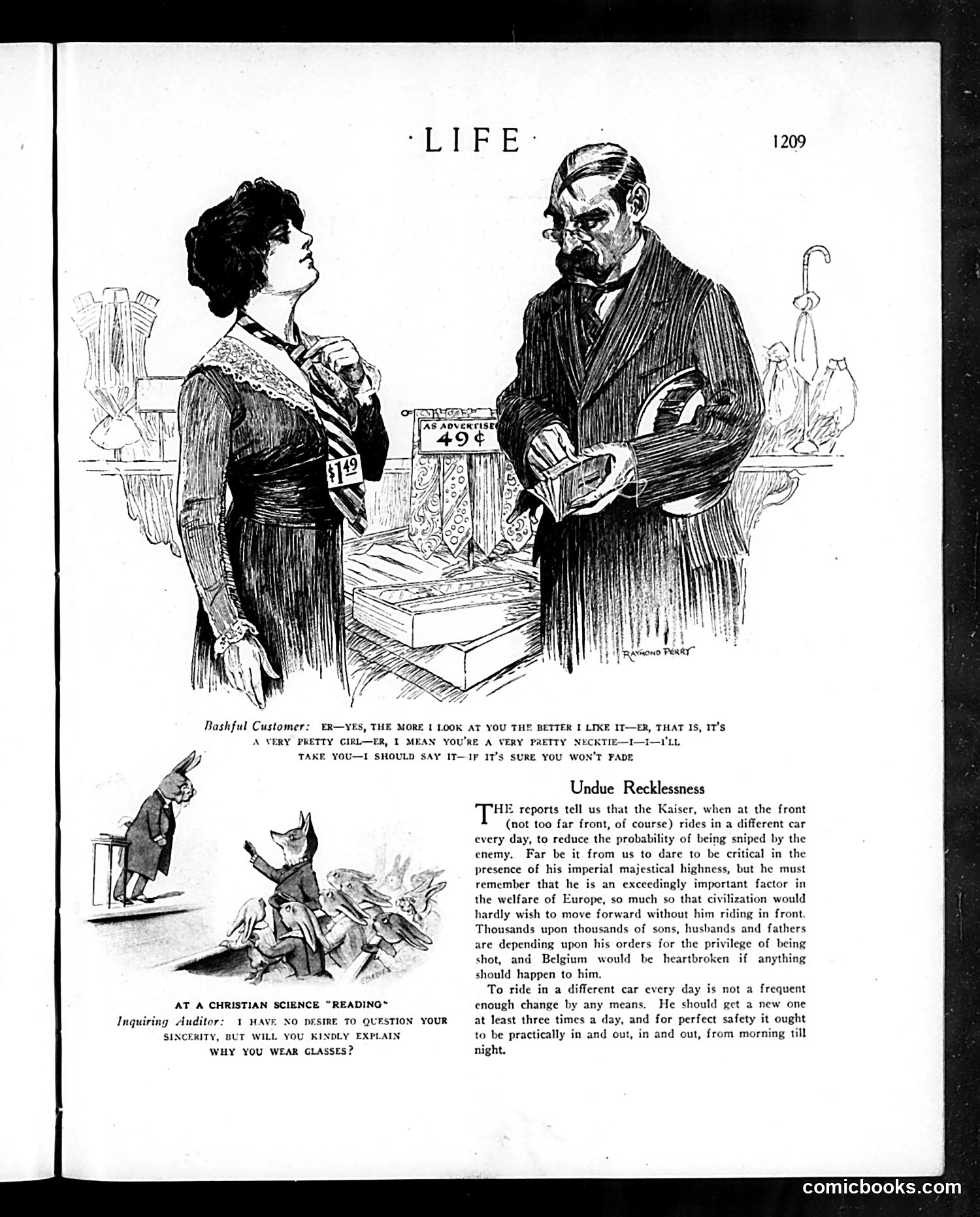
This page contains three satirical pieces from WWI-era Life magazine: **Top cartoon:** A bashful male customer awkwardly flirts with a saleswoman while purchasing a necktie, repeatedly misspeaking and conflating the woman with the product—a gentle joke about male social awkwardness. **Middle section ("Undue Recklessness"):** Heavy political satire targeting Kaiser Wilhelm II. Life sarcastically praises the Kaiser's daily car changes at the front as a safety precaution, then viciously mocks his self-importance by suggesting he change cars *three times daily* for "perfect safety." The passage drips with irony—Life portrays the Kaiser as so self-absorbed that thousands die following his orders while he obsesses over his own protection. This reflects American anti-German sentiment during WWI. **Bottom cartoon:** A Christian Science reading where an inquirer asks why the listener wears glasses—implying Christian Science believers claimed faith could replace medical aids, making the questioner's observation humorous. The page blends light humor with pointed wartime propaganda.
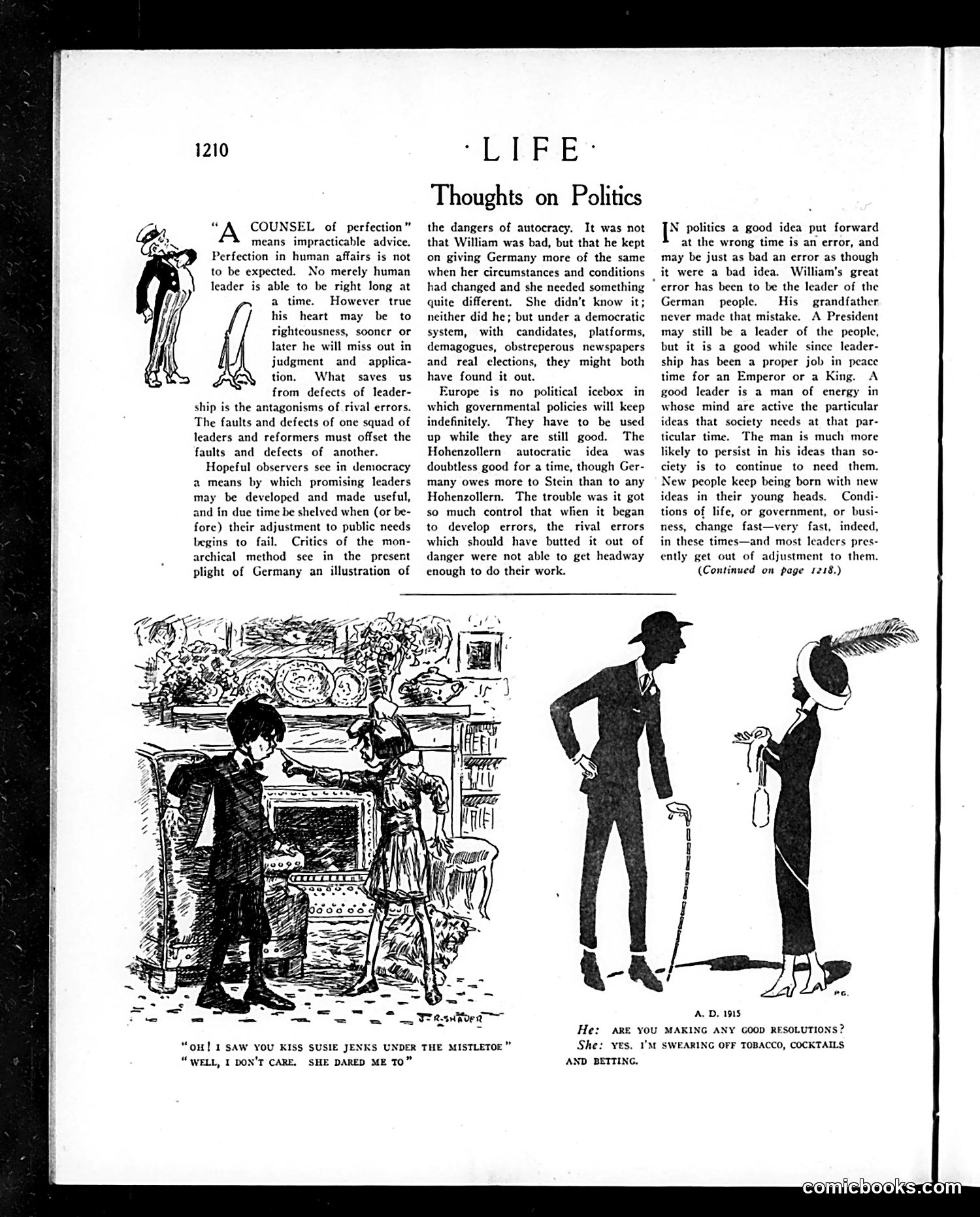
This page contains an essay titled "Thoughts on Politics" critiquing autocratic leadership, illustrated by three cartoons. **The Main Article** discusses Kaiser Wilhelm II of Germany as a cautionary example of autocratic failure. The author argues that while Wilhelm wasn't inherently bad, his system lacked the democratic checks (rival parties, elections, press criticism) that could have corrected his errors as circumstances changed. The piece advocates for democracy as self-correcting through competing viewpoints. **The Three Cartoons:** 1. **Top left**: A domestic scene under mistletoe—a young man dismisses his girlfriend's kiss, saying "she dared me to," illustrating youthful irresponsibility. 2. **Bottom left**: An earlier kiss scene with similar implications. 3. **Right cartoon (A.D. 1915)**: A New Year's resolution joke—a woman claims she's swearing off tobacco, cocktails, and betting, while her male companion appears skeptical of her sincerity. The cartoons humorously underscore the essay's theme: humans struggle with self-correction and sustained commitment to improvement, whether in leadership or personal behavior.
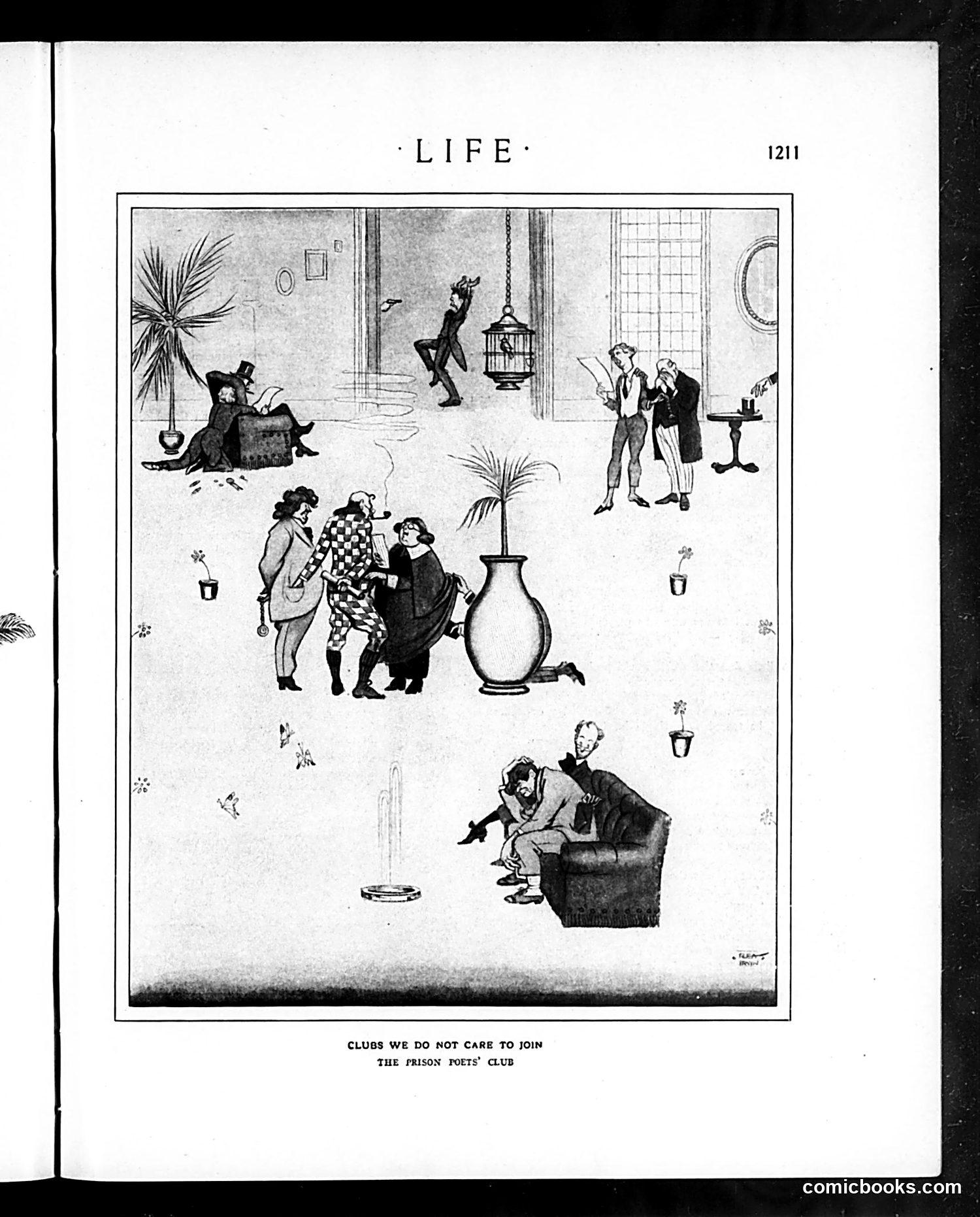
This satirical cartoon depicts an absurd social club with deliberately undesirable members and activities. The caption "The Prison Poets' Club" suggests membership consists of criminals or disreputable figures. The scene shows various chaotic activities: people swinging from cages, juggling with oversized vessels, playing chess, and lounging about—all rendered in an exaggerated, comedic style typical of early 20th-century Life magazine humor. The potted plants and formal furnishings mock attempts to legitimize this gathering as a proper "club." The satire appears to mock pretentious organizations or associations, suggesting some groups are so undesirable that respectable people would never want to join them. The specific reference to "Prison Poets" may target either a real contemporary club or simply the absurdity of criminals attempting cultured pursuits. The humor relies on visual chaos and incongruity rather than topical politics.
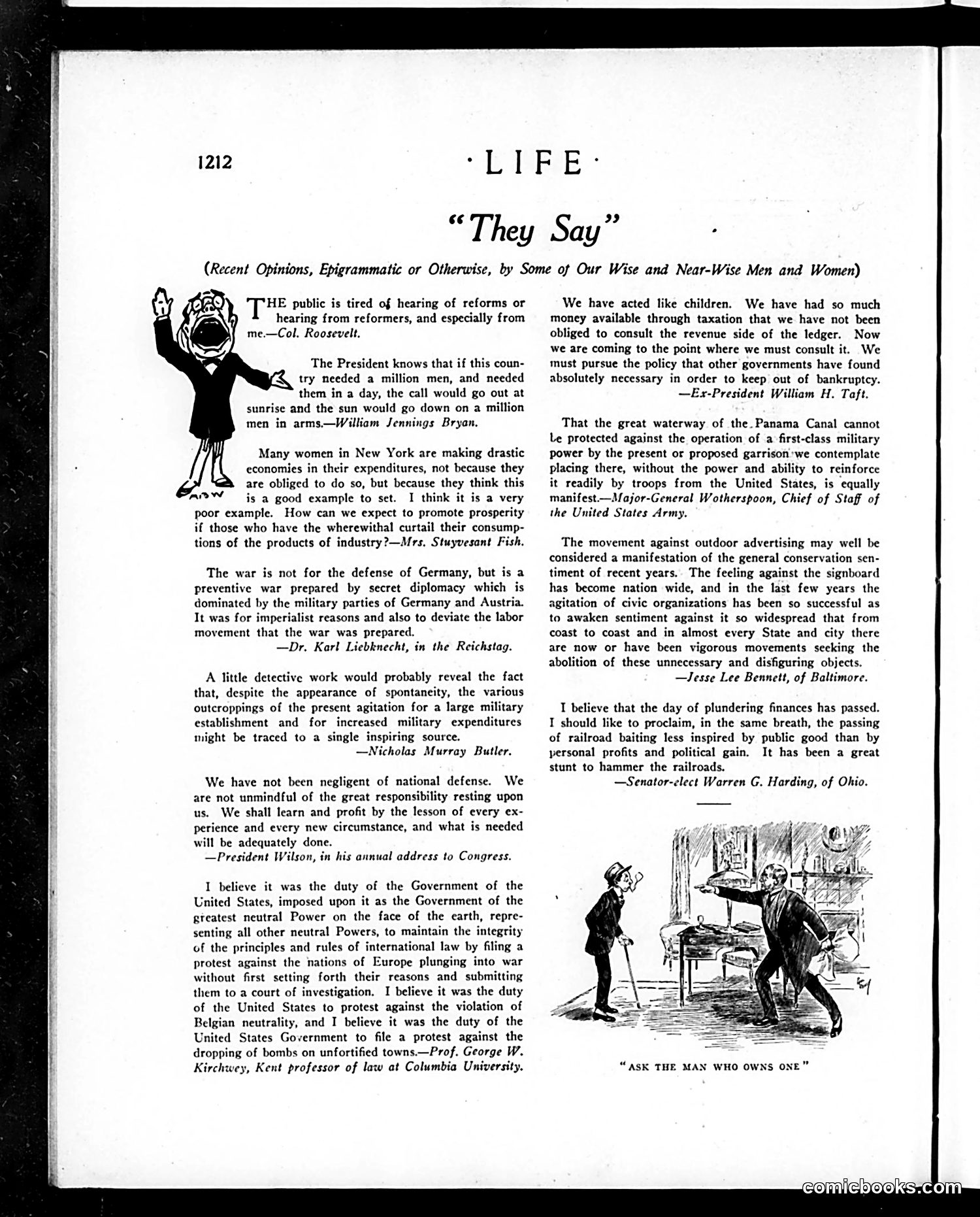
This page collects contemporary political opinions on World War I-era issues, presented as satire through the "They Say" column format. **Key figures and positions:** - **Col. Roosevelt** complains about reform talk - **William Jennings Bryan** expresses confidence in rapid military mobilization - **Mrs. Stuyvesant Fish** (wealthy socialite) argues against wealthy women's "economy" displays, which she sees as harmful to consumer spending and prosperity - **Dr. Karl Liebknecht** (German socialist) characterizes the war as imperialist aggression designed to suppress labor movements - **Nicholas Murray Butler** suggests military expansion agitation is orchestrated propaganda - **President Wilson** offers cautious platitudes about defense - **Ex-President Taft** warns of fiscal irresponsibility - **Prof. Kirchwey** argues the U.S. should have protested war violations **The satire:** By juxtaposing these contradictory statements—from interventionists, pacifists, socialists, capitalists, and politicians—the magazine mocks the confusion and self-interest driving public debate about American military preparedness and WWI involvement.
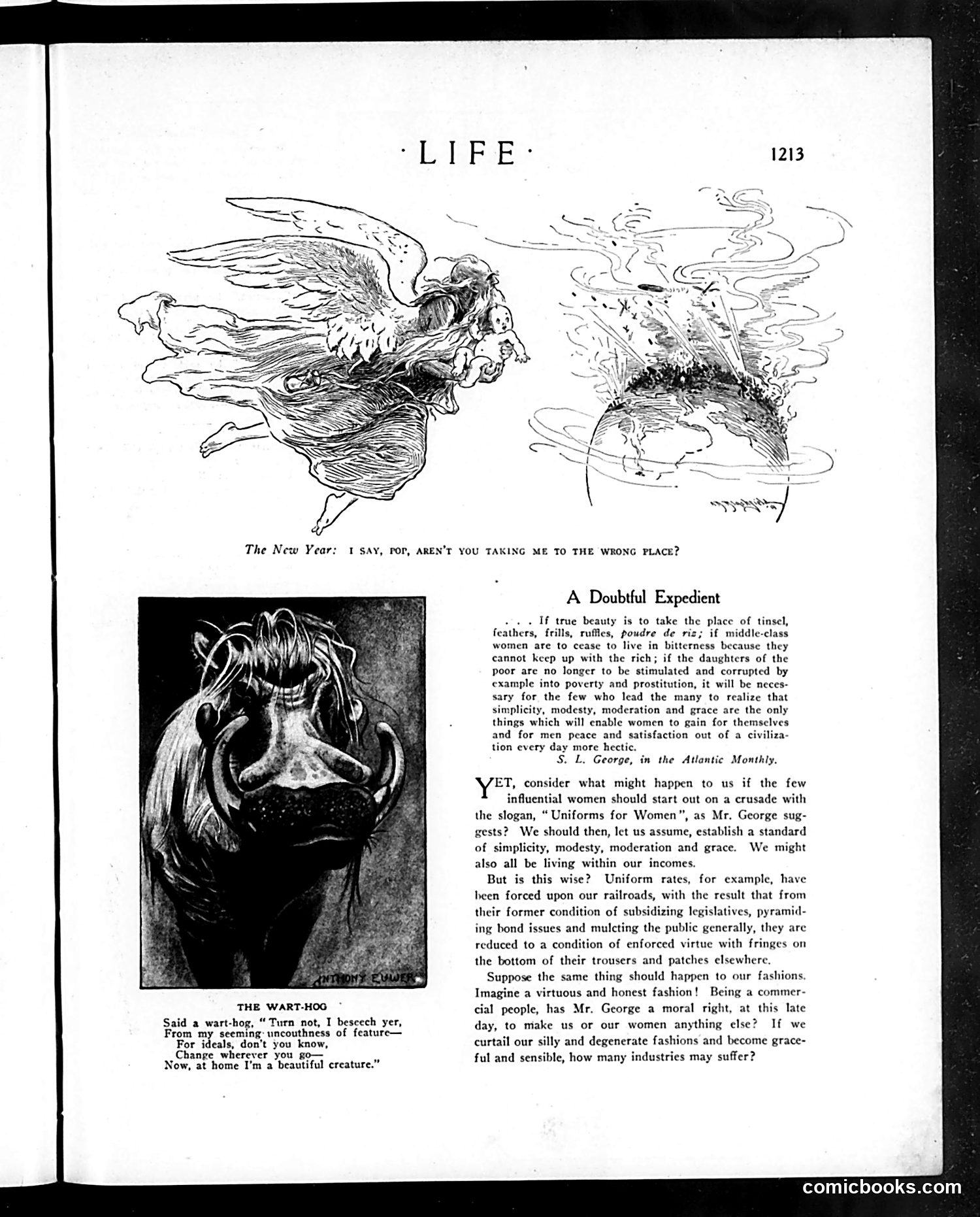
This 1913 *Life* page satirizes proposals to reform women's fashion through enforced simplicity and modesty. The top cartoon shows Father Time (the New Year) chaperoning a woman into chaos—suggesting fashion reform leads nowhere good. The main article mocks S.L. George's Atlantic Monthly proposal for "Uniforms for Women" to promote virtue and end class-based consumption anxiety. The author agrees it's theoretically appealing but argues it's economically dangerous: just as railroads forced into "virtue" through uniform rates became unprofitable, enforced modest fashion would devastate the fashion industry. The "Wart-Hog" cartoon reinforces this irony: the ugly creature claims that beneath its repellent exterior lies inner beauty—paralleling the argument that women don't need fashionable display. The satire suggests Americans won't accept such idealistic sacrifice; economic self-interest trumps moral reform.
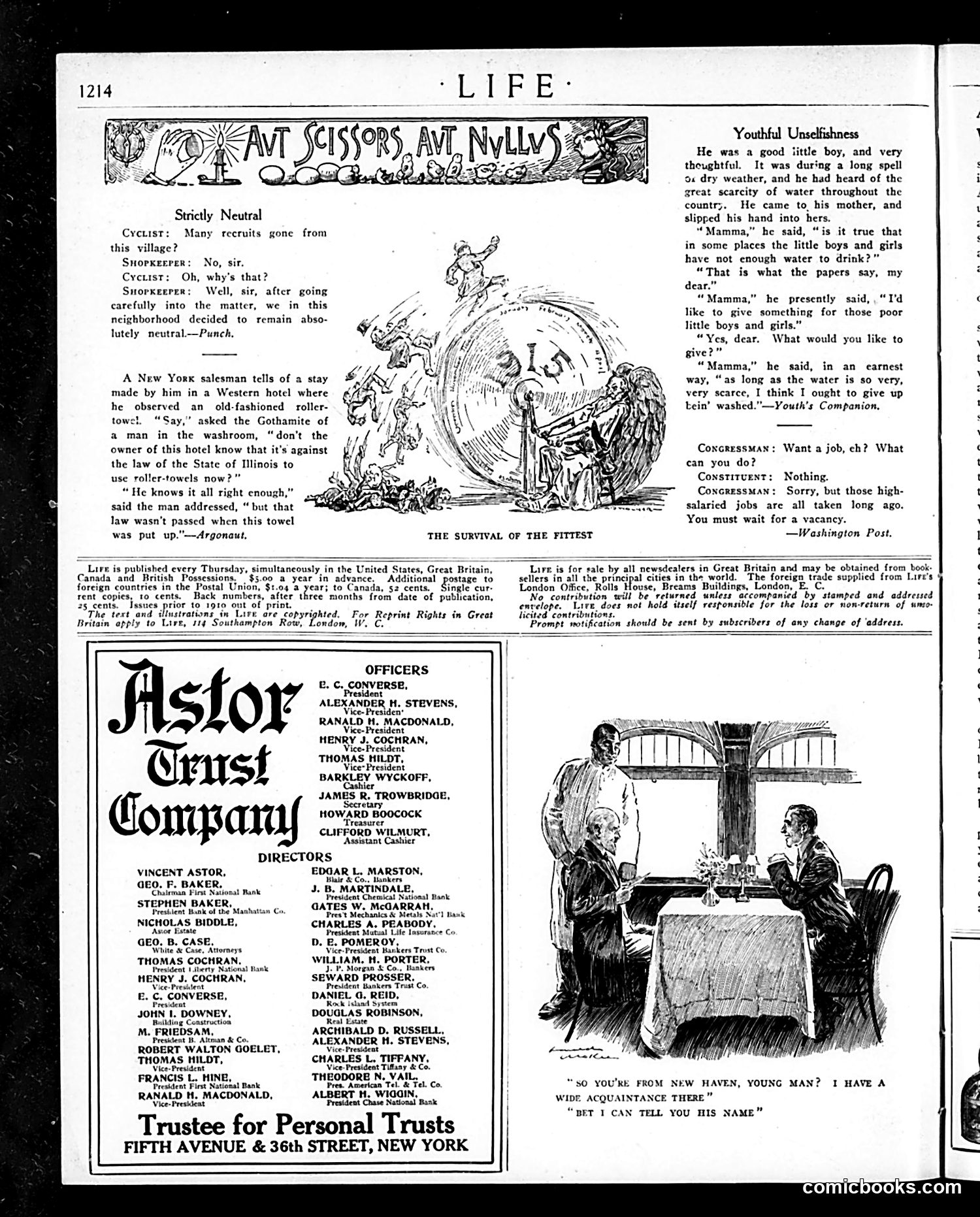
This page from *Life* magazine contains several brief satirical items: **"Strictly Neutral"** mocks a rural village's declared neutrality regarding military recruitment—a reference to localized resistance to conscription or war efforts (likely WWI-era). **The roller-towel anecdote** jokes about outdated equipment persisting in hotels despite legal prohibition—absurdist humor about institutions ignoring progressive regulations. **"Youthful Unselfishness"** is sentimental satire: a well-meaning boy offers to give up bathing to conserve water during a drought, but the punchline implies naive sacrifices won't solve systemic scarcity problems. **"Survival of the Fittest"** satirizes unemployment and job scarcity: a congressman essentially tells a jobless constituent there's nothing available and to wait indefinitely—commentary on economic inequality and limited opportunity. The page is otherwise filled with corporate advertisements for the Astor Christ Company, a trust firm.
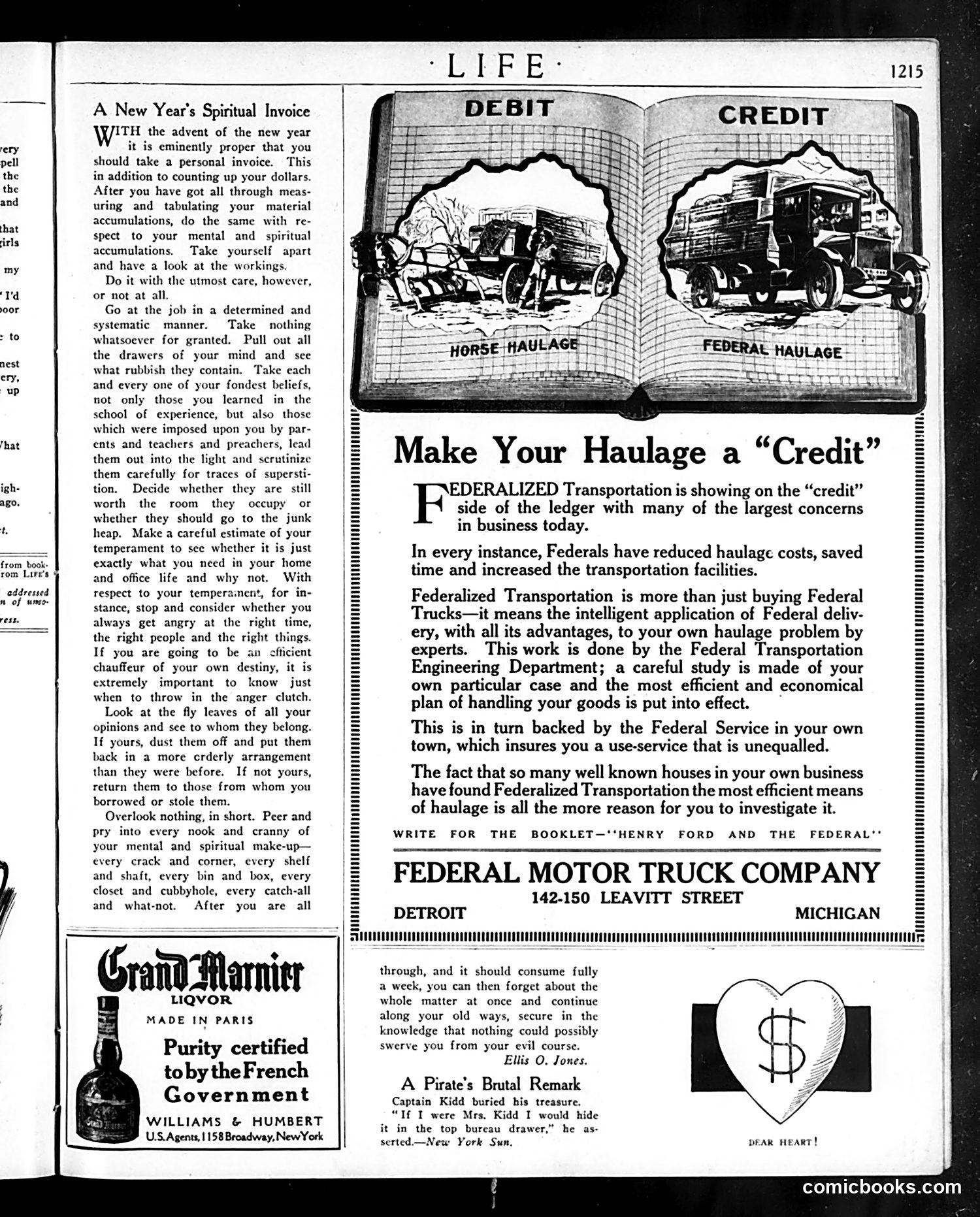
This page is primarily **advertising**, not satire. The main content is a Federal Motor Truck Company advertisement comparing "horse haulage" (debit) versus "federal haulage" (credit)—using accounting metaphors to argue that motorized trucks are more economical than horse-drawn wagons. The left sidebar contains an unrelated editorial essay urging New Year's self-reflection and spiritual inventory-taking. **Historical context**: This appears from the early automotive era when trucks were still novel enough to require marketing emphasis over traditional horse transport. The "debit/credit" visual pun treats business efficiency as a ledger entry, appealing to cost-conscious commercial readers. A smaller advertisement for Grand Marnier liqueur and a brief humorous quote about Captain Kidd's treasure complete the page. No political satire or caricature is present—this is straightforward early-20th-century product promotion dressed in Life magazine's typical witty framing.
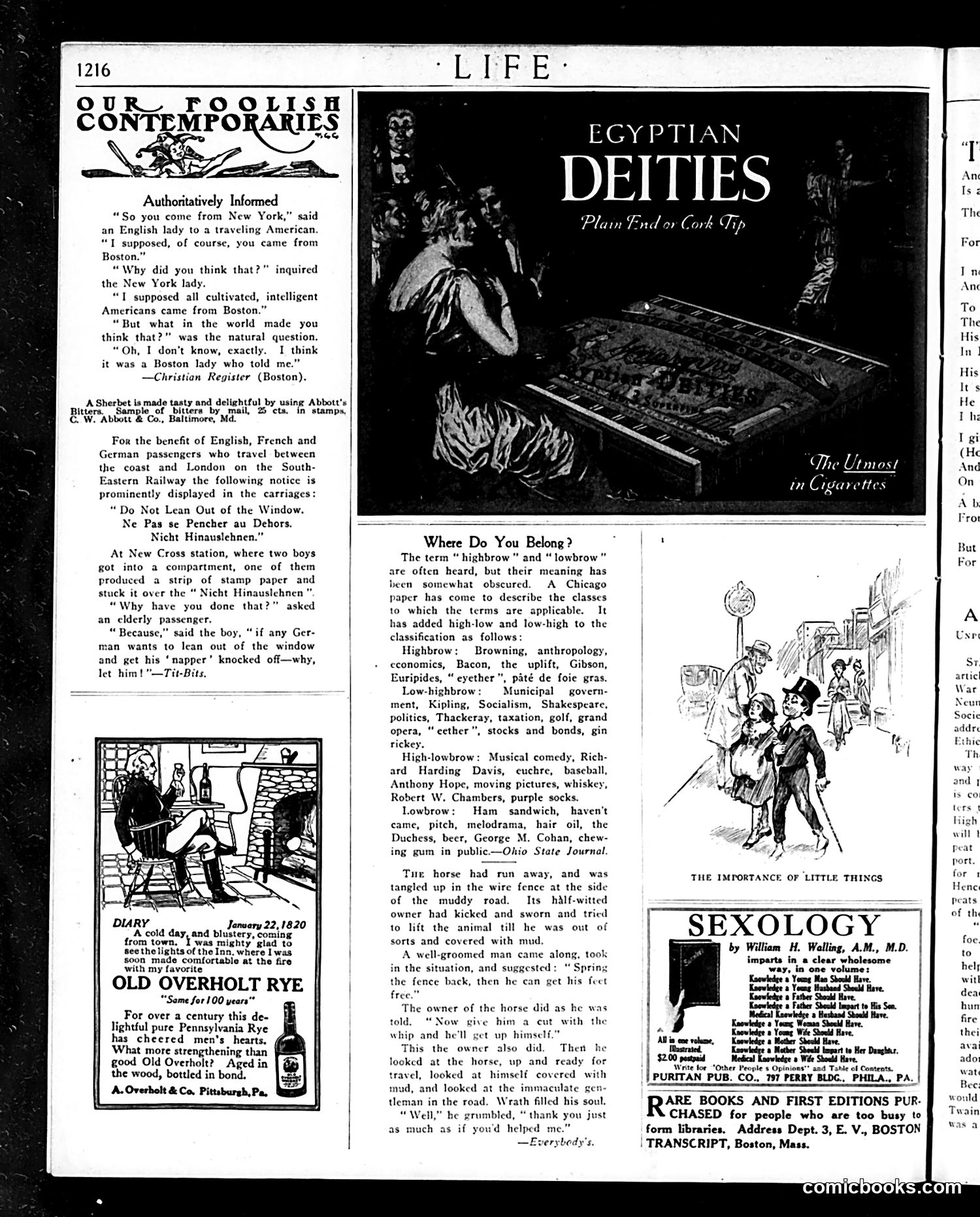
**"Our Foolish Contemporaries"** contains brief satirical anecdotes mocking American pretension and regional stereotypes. The opening joke ridicules the assumption that all "cultivated, intelligent Americans" come from Boston—a jab at Boston's self-regard as America's cultural center. The setup shows how such snobbery perpetuates itself through gossip. A second anecdote mocks German railway safety notices, then describes two boys placing stamp paper over a warning sign to trick German passengers into leaning out windows dangerously. **"Where Do You Belong?"** classifies Americans by social status—"highbrow" (Browning, anthropology), "low-highbrow" (Shakespeare, stocks), "high-lowbrow" (musical comedy, baseball), and "lowbrow" (ham sandwich, beer). This satirizes how arbitrary and overlapping such cultural classifications are. **"The Importance of Little Things"** tells a moral tale: a well-groomed stranger teaches a muddy farmer that gentle suggestion ("spring the fence back") succeeds where force fails—commenting on human nature and class differences.
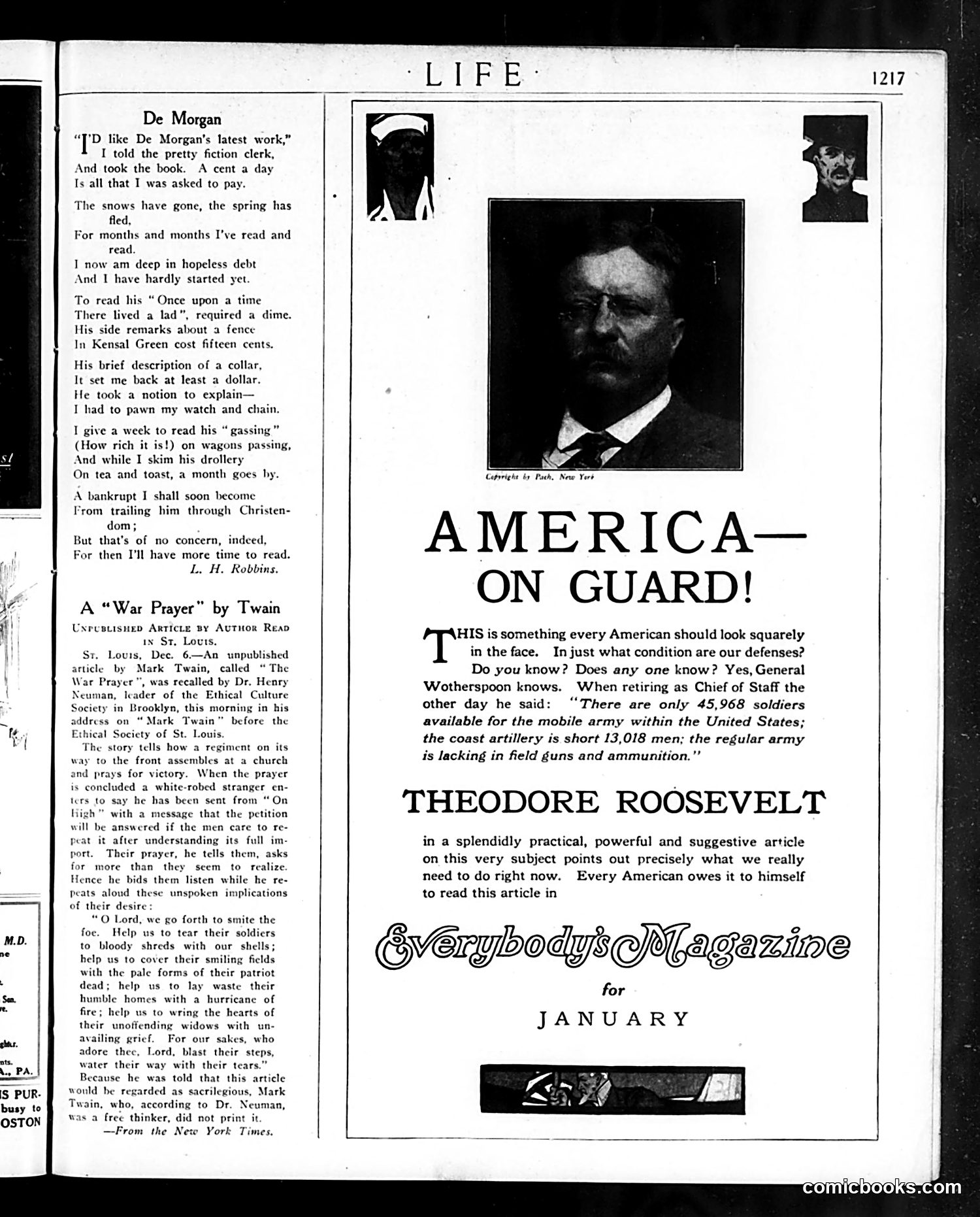
This 1911 *Life* magazine page contains satirical content and a patriotic advertisement. **Left side:** A humorous poem by L.H. Robbins mocks author De Morgan's prolixity—the narrator becomes financially ruined reading De Morgan's works because even minor descriptive passages require expensive rental fees. The joke: De Morgan's verbose writing style makes even brief reading prohibitively expensive. **Center/Right:** An advertisement warning of American military unpreparedness. General Wotherspoon (retiring Chief of Staff) is quoted citing alarming troop shortages and equipment deficiencies. The ad promotes Theodore Roosevelt's article in *Everybody's Magazine* (January issue) addressing national defense needs. The accompanying portrait appears to be a military or political figure relevant to this defense discussion. **Context:** This reflects pre-WWI American anxiety about military readiness and uses Roosevelt's credibility as a former president and Rough Rider to urge readers toward the magazine article.
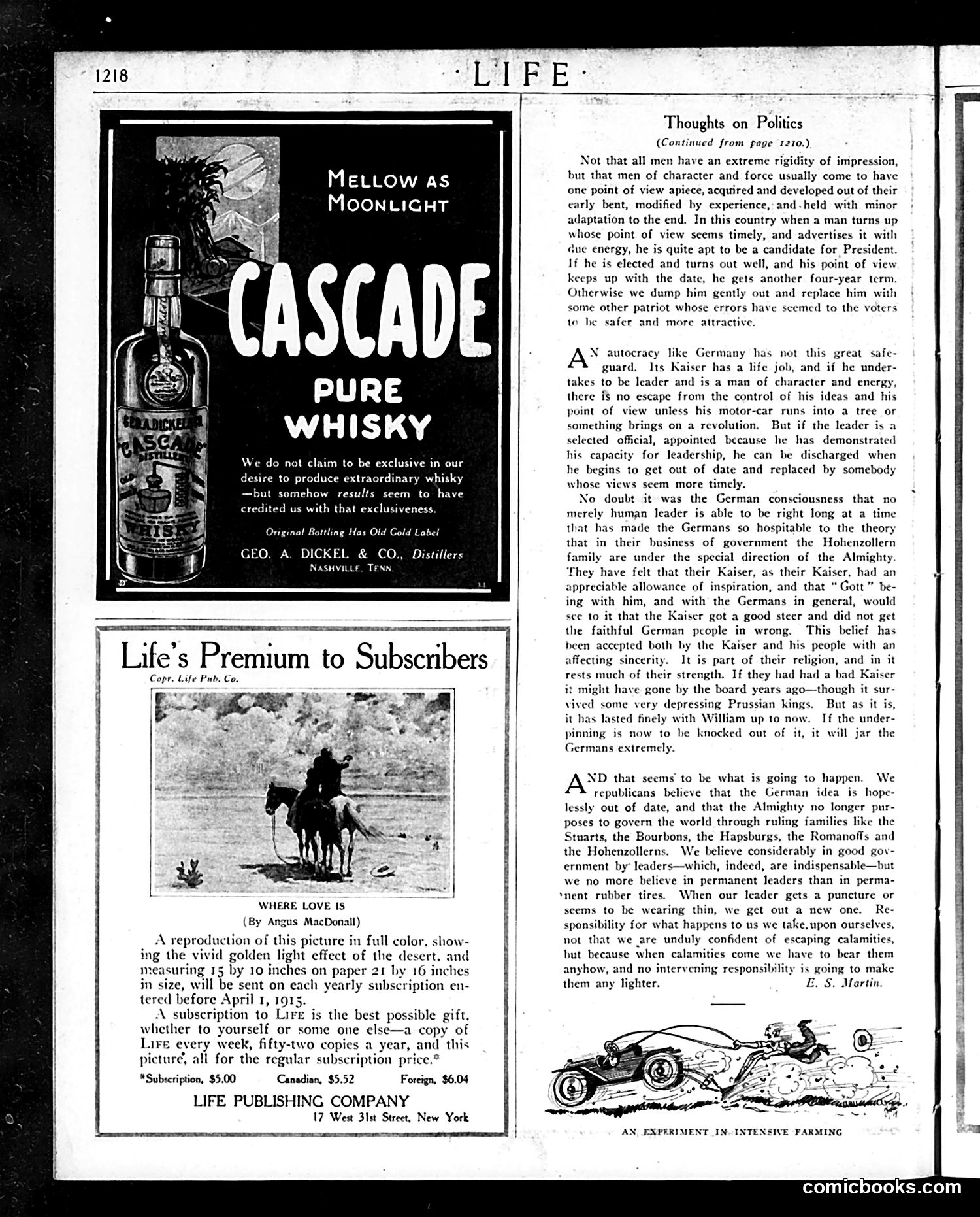
This page combines advertisements with political commentary on World War I-era governance. The **advertisements** (Cascade Whisky, Life subscription with desert landscape print) are standard commercial content from 1915. The substantive content is **"Thoughts on Politics,"** a column by E.S. Martin comparing American and German leadership systems. Martin argues that democracies like America can replace ineffective leaders every four years, while German autocracy under Kaiser Wilhelm II allows a single leader's ideas to dominate indefinitely—problematic if that leader becomes outdated. The piece reflects **pre-war American skepticism of German imperial rule**, suggesting Germany's reliance on the Kaiser's supposed divine inspiration makes it vulnerable. Martin implies the German system is inherently unstable and destined to fail, predicting the "underpinning" will be "knocked out of it." This represents typical American progressive-era criticism of European monarchies, written as Kaiser Wilhelm II's Germany faced growing international tension (two years before U.S. entry into WWI).
This page is primarily **advertising**, not political satire. It promotes a novel titled "Pandora's Box" written by John Ames Mitchell, who was the editor of *Life* magazine itself. The advertisement uses self-promotional language, quoting Mitchell's own description of the book as a story about "two honest lovers." The copy emphasizes the pleasure of reading it, matching Mitchell's stated pleasure in writing it. The small illustration shows the book's cover design. The publisher, Grosset & Dunlap, offers the book for fifty cents through bookstores or direct mail. This represents **early 20th-century magazine cross-promotion**—a magazine using its pages to advertise its own editor's published work. There is no apparent political cartoon or satirical commentary; it's straightforward commercial advertising placed within the magazine's editorial pages.
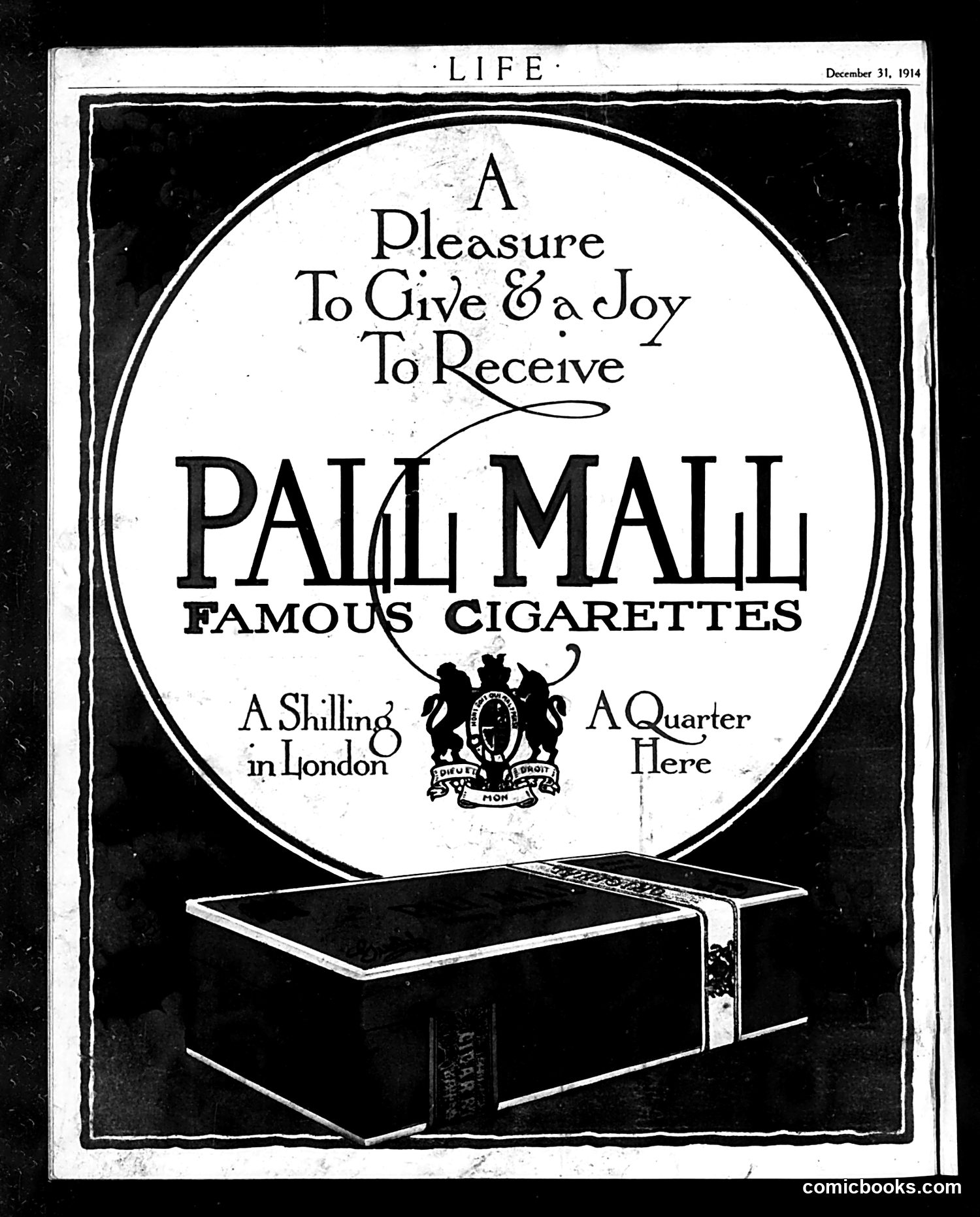
This is a straightforward advertisement from *Life* magazine (December 31, 1914), not satire or political commentary. It promotes Pall Mall cigarettes, marketed as "Famous Cigarettes" available in London for "A Shilling" or "A Quarter" (pricing for different markets). The ad's tagline—"A Pleasure To Give & a Joy To Receive"—frames cigarettes as an ideal gift. The circular design features a coat of arms, emphasizing the brand's prestige and British heritage. The accompanying cigarette box illustration suggests luxury packaging suitable for gift-giving. This reflects the era when cigarettes were considered sophisticated consumer goods, before widespread health warnings. The ad targets affluent readers of *Life* magazine.

I can see this is a page from Life magazine dated 1914 (visible in the upper left corner), but the image quality is extremely poor—almost entirely black with only the white binding/margin visible on the left side. The OCR text provides only "comicbooks.com," which appears to be a watermark rather than actual page content. I cannot reliably identify any cartoon figures, political references, or satirical content from this image. To provide accurate historical analysis as requested, I would need a clearer reproduction of the page that shows the actual illustrations and readable text.