
Life, 1914-12-31 · page 19 of 41
Life — December 31, 1914 — page 19: what you’re looking at
What you’re looking at
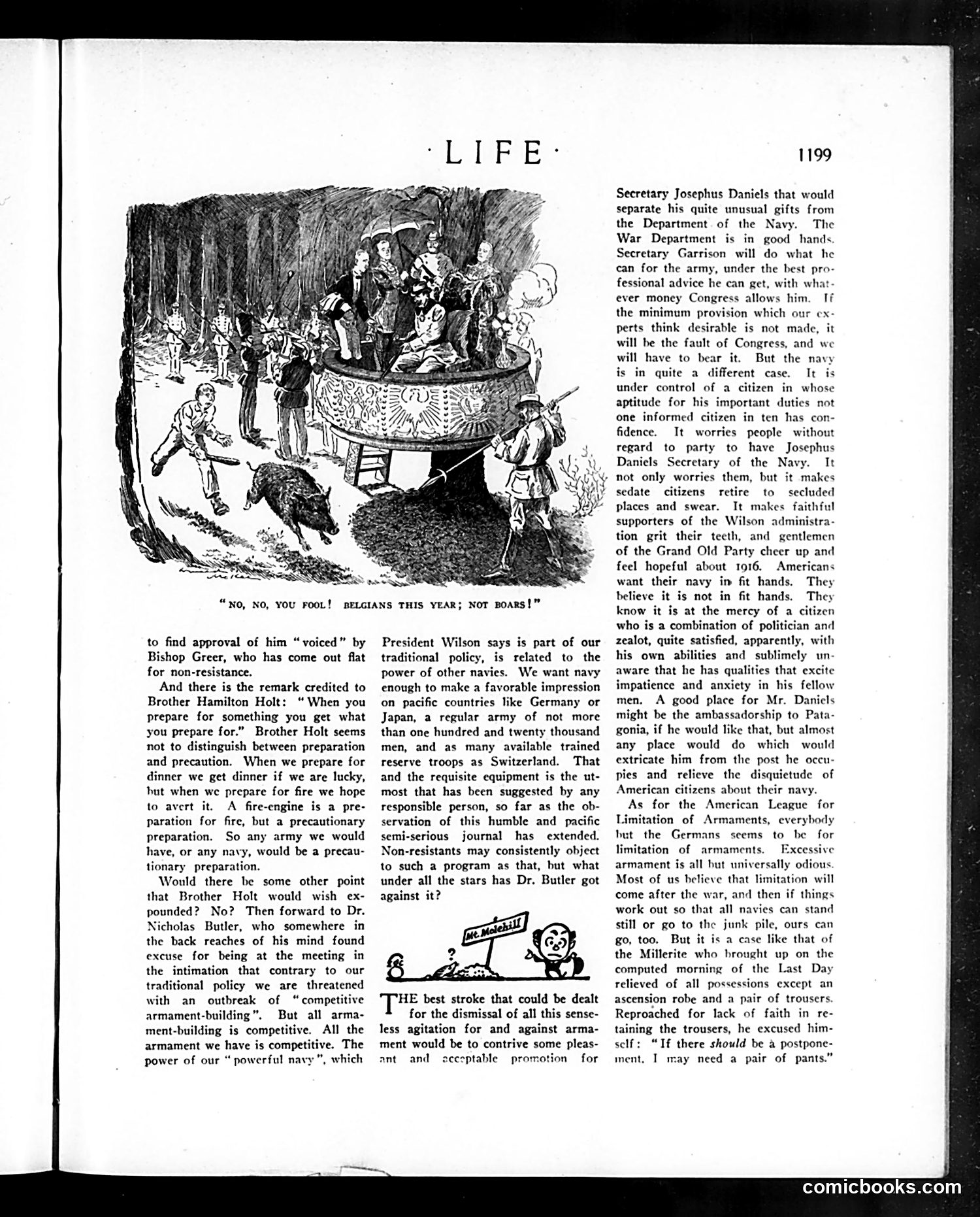
## The Cartoon The illustration depicts a chaotic scene with figures in and around an ornate vessel or platform labeled with the number 71, captioned "NO, NO, YOU FOOL! BELGIANS THIS YEAR; NOT BOARS!" The cartoon satirizes American pacifist and anti-armament advocates during the pre-WWI era. The reference to "Belgians" versus "boars" appears to mock pacifists' inconsistency—seemingly unconcerned about Belgian suffering in the ongoing European war (Belgium was invaded by Germany in 1914) while focusing on abstract anti-war principles. ## The Text's Political Context The article attacks Secretary of the Navy Josephus Daniels, criticizing him as unfit for office due to his pacifist leanings and political rather than military qualifications. It ridicules various peace advocates—Bishop Greer, Hamilton Holt, and Dr. Nicholas Butler—for their opposition to armament, while defending preparedness as prudent precaution rather than warmongering. The satire's core message: idealistic pacifism is impractical when real threats (the European war, German naval power) exist.
📄 Transcribed text from this page (OCR, searchable)
Machine-transcribed from the original scan — historical spelling and the odd misread are preserved.
“No, No, You Foot! to find approval of him “voiced” by Bishop Greer, who has come out flat for non-resistance. And there is the remark credited to Brother Hamilton Holt: “When you prepare for something you get what you prepare for.” Brother Holt seems not to distinguish between preparation and precaution. When we prepare for dinner we get dinner if we are lucky, but when we prepare for fire we hope to avert it. A fire-engine is a pre- paration for fire, but a precautionary preparation. So any army we would have, or any navy, would be a precau- tionary preparation. Would there be some other point that Brother Holt would wish ex- pounded? No? Then forward to Dr. Nicholas Butler, who somewhere in the back reaches of his mind found excuse for being at the meeting in the intimation that contrary to our traditional policy we are threatened with an outbreak of “competitive armament-building”. But all arma- ment-building is competitive. All the armament we have is competitive. The power of our “ powerful navy”, which 1199 Secretary Josephus Daniels that would separate his quite unusual gifts from the Department of the Navy. The War Department is in good hands. Secretary Garrison will do what he can for the army, under the best pro- fessional advice he can get, with what- ever money Congress allows him. If the minimum provision which our cx- perts think desirable is not made, i will be the fault of Congress, and we will have to bear it. But the navy is in quite a different case. It is under control of a citizen in whose aptitude for his important duties not one informed citizen in ten has con- fidence. It worries people without regard to party to have Josephus Daniels Secretary of the Navy. It L, » not only worries them, but it makes BELGIANS THIS YEAR; NoT BOARS!” President Wilson says is part of our traditional policy, is related to the power of other navies. We want navy enough to make a favorable impression on pacific countries like Germany or Japan, a regular army of not more than one hundred and twenty thousand men, and as many available trained reserve troops as Switzerland. That and the requisite equipment is the ut- most that has been suggested by any responsible person, so far as the ob- servation of this humble and_ pacific semi-serious journal has extended. Non-resistants may consistently object to such a program as that, but what under all the stars has Dr. Butler got against it? 'HE best stroke that could be dealt for the dismissal of all this sense- less agitation for and against arma- ment would be to contrive some pleas- ant and scesptable promotion for sedate citizens retire to secluded places and swear. It makes faithful supporters of the Wilson administra- tion grit their teeth, and gentlemen of the Grand Old Party cheer up and feel hopeful about 1916. Americans want their navy im fit hands. They believe it is not in fit hands. They know it is at the mercy of a citizen who is a combination of politician and zealot, quite satisfied, apparently, with his own abilities and sublimely un- aware that he has qualities that excite impatience and anxiety in his fellow men, A good place for Mr. Danicls might be the ambassadorship to Pata- gonia, if he would like that, but almost any place would do which would extricate him from the post he occu- pies and relieve the disquietude of American citizens about their navy. As for the American League for Limitation of Armaments, everybody but the Germans seems to be for limitation of armaments. Excessive armament is all but universally odious Most of us believe that limitation will come after the war, and then if things work out so that all navies can stand still or go to the junk pile, ours can go, too. But it is a case like that of the Millerite who brought up on the computed morning of the Last Day relieved of all possessions except an ascension robe and a pair of trousers. Reproached for lack of faith in re- taining the trousers, he excused him- self: “If there should be a postpone- ment, I may need a pair of pants.” comicbooks.com