
Life, 1914-12-31 · page 18 of 41
Life — December 31, 1914 — page 18: what you’re looking at
What you’re looking at
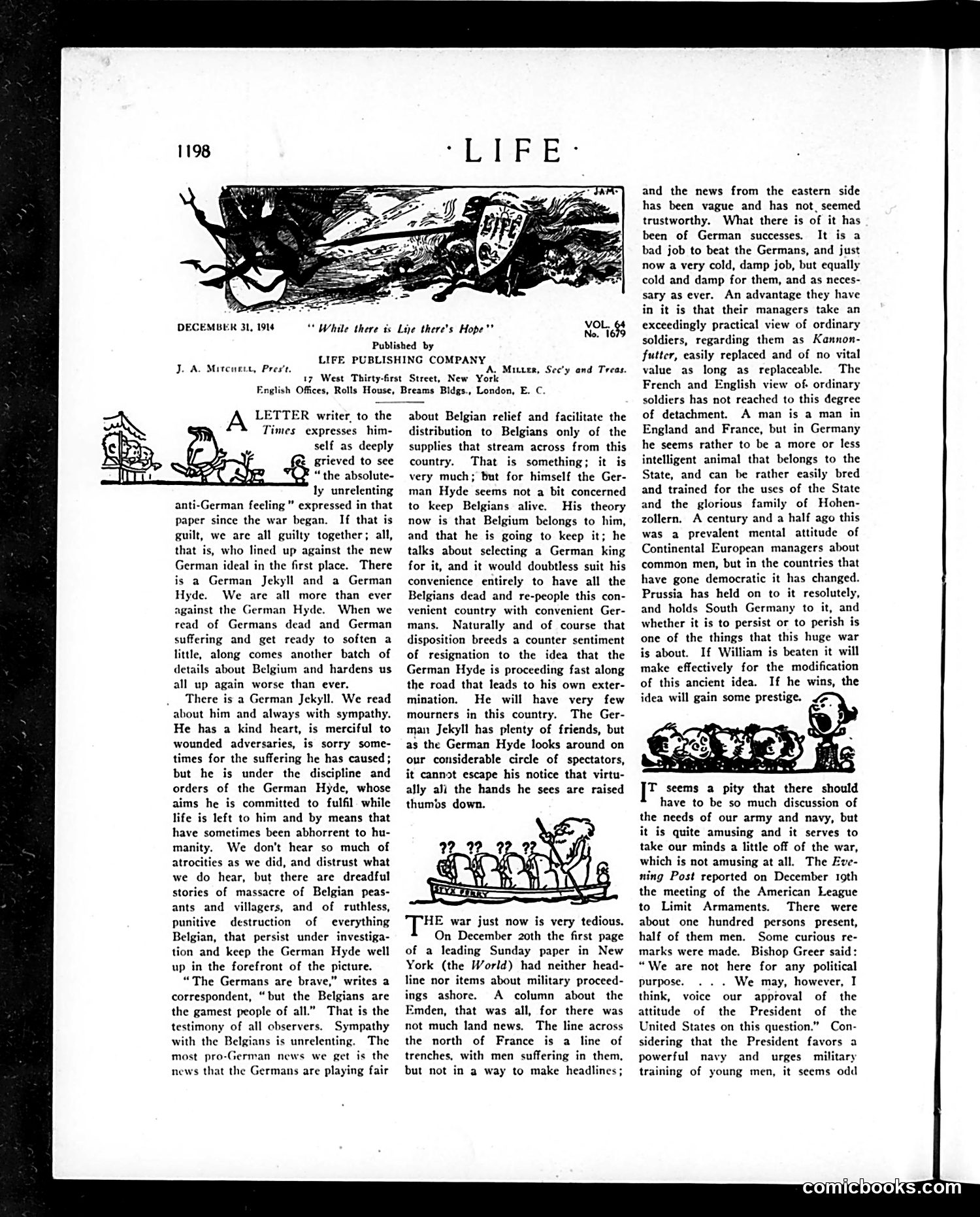
This editorial uses the Jekyll-and-Hyde metaphor to address wartime attitudes toward Germany during WWI. The writer distinguishes between "German Jekyll"—the compassionate, merciful individual German—and "German Hyde"—the brutal state apparatus committing atrocities in Belgium. The piece argues that while sympathizing with Belgian suffering and German soldiers' humanity is natural, the "German Hyde" (the military/imperial leadership) remains committed to Belgium's subjugation and depopulation. The author notes wryly that the only positive German war news Americans receive concerns humanitarian relief efforts—"something; it is very much." The accompanying illustration likely depicts this Jekyll-Hyde contrast visually, though details are unclear in this reproduction. The second section criticizes war coverage as tedious due to trench stalemate on the Western Front and unreliable Eastern Front reporting. This reflects frustration with static, unglamorous modern warfare lacking dramatic "headlines."
📄 Transcribed text from this page (OCR, searchable)
Machine-transcribed from the original scan — historical spelling and the odd misread are preserved.
DECEMBER 31, 1916 While there ts Liye there's Hope"’ Published by LIFE PUBLISHING COMPANY 17 West Thirty-first Street, New York English Offices, Rolls House, Breams Bidgs., London, E. C. J. A. Mercurie, Pres’t. LETTER writer, to the Times expresses him- self as deeply grieved to see “the absolute- ly unrelenting anti-German feeling" expressed in that paper since the war began. If that is guilt, we are all guilty together; all, that is, who lined up against the new German ideal in the first place. There is a German Jekyll and a German Hyde. We are all more than ever against the German Hyde. When we read of Germans dead and German suffering and get ready to soften a little, along comes another batch of det: about Belgium and hardens us all up again worse than ever. There is a German Jekyll. We read about him and always with sympathy. He has a kind heart, is merciful to wounded adversaries, is sorry some- times for the suffering he has caused; but he is under the discipline and orders of the German Hyde, whose aims he is committed to fulfil. while life is left to him and by means that have sometimes been abhorrent to hu- manity. We don't hear so much of atrocities as we did, and distrust what we do hear, but there are dreadful stories of massacre of Belgian peas- ants and villagers, and of ruthless, punitive destruction of everything Belgian, that persist under investiga- tion and keep the German Hyde well up in the forefront of the picture. “The Germans are brave,” writes a correspondent, “but the Belgians are the gamest people of all.” That is the testimony of all observers. Sympathy with the Belgians is unrelenting. The most pro-German news we get is the news that the Germans are playing fair A. Mutter, Sec’y and Treas. about Belgian relief and facilitate the distribution to Belgians only of the supplies that stream across from this country. That is something; it is very much; but for himself the Ger- man Hyde seems not a bit concerned to keep Belgians alive. His theory now is that Belgium belongs to him, and that he is going to keep it; he talks about selecting a German king for it, and it would doubtless suit his convenience entirely to have all the Belgians dead and re-people this con- venient country with convenient Ger- mans. Naturally and of course that disposition breeds a counter sentiment of resignation to the idea that the German Hyde is proceeding fast along the road that leads to his own exter- mination. He will have very few mourners in this country. The Ger- man Jekyll has plenty of friends, but as the German Hyde looks around on our considerable circle of spectators, it cannot escape his notice that virtu- ally ali the hands he sees are raised thumbs down. APE war just now is very tedious. On December 2oth the first page of a leading Sunday paper in New York (the World) had neither head- line nor items about military proceed- ings ashore. A column about the Emden, that was all, for there was not much land news, The line across the north of France is a line of trenches, with men suffering in them, but not in a way to make headlines; and the news from the eastern side has been vague and has not, seemed trustworthy. What there is of it has been of German successes. It is a bad job to beat the Germans, and just now a very cold, damp job, but equally cold and damp for them, and as neces- sary as ever. An advantage they have in it is that their managers take an exceedingly practical view of ordinary soldiers, regarding them as Kannon- futter, easily replaced and of no vital value as long as replaceable. The French and English view of. ordinary soldiers has not reached to this degree of detachment. A man is a man in England and France, but in Germany he seems rather to be a more or less intelligent animal that belongs to the State, and can be rather easily bred and trained for the uses of the State and the glorious family of Hohen- zollern. A century and a half ago this was a prevalent mental attitude of Continental European managers about common men, but in the countries that have gone democratic it has changed. Prussia has held on to it resolutely, and holds South Germany to it, and whether it is to persist or to perish is one of the things that this huge war is about. If William is beaten it will make effectively for the modification of this ancient idea. If he wins, the idea will gain some prestige. rc seems a pity that there should have to be so much discussion of the needs of our army and navy, but it is quite amusing and it serves to take our minds a little off of the war, which is not amusing at all. The ning Post reported on December 19th the meeting of the American League to Limit Armaments. There were about one hundred persons present, half of them men. Some curious re- marks were made. Bishop Greer said: “We are not here for any political purpose. . We may, however, I think, voice our approval of the attitude of the President of the United States on this question.” Con- sidering that the President favors a powerful navy and urges military training of young men, it seems odd