
Life, 1914-12-31 · page 23 of 41
Life — December 31, 1914 — page 23: what you’re looking at
What you’re looking at
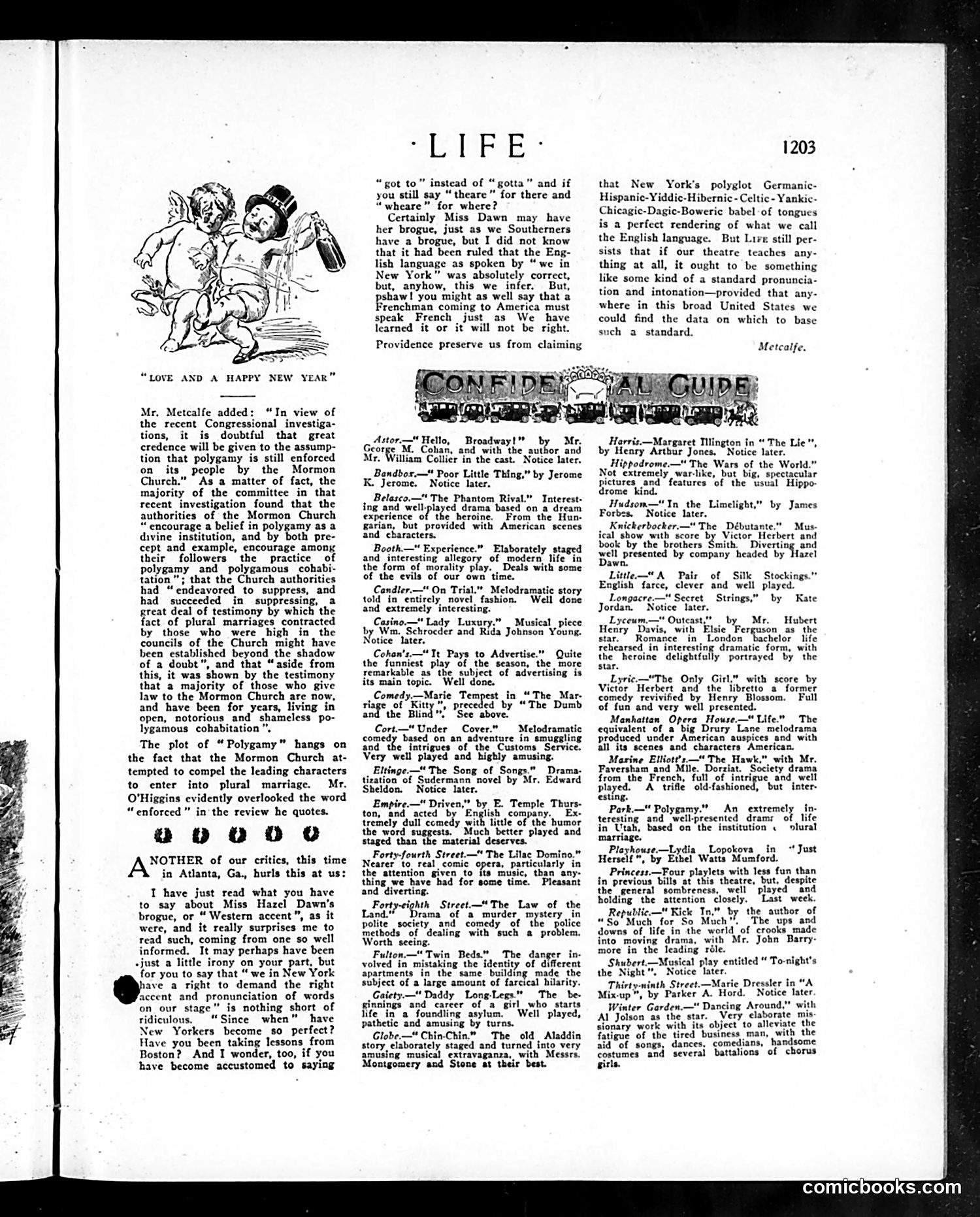
The page contains a satirical debate about the Mormon Church's practice of polygamy. The main cartoon shows cherubs or cupids labeled "Love and a Happy New Year," likely mocking the disconnect between romantic ideals and the controversial polygamous practices the Church allegedly enforced. The accompanying text discusses a play called "Polygamy" and critiques a reviewer (Mr. Metcalfe) for downplaying Congressional investigation findings that proved the Mormon Church actively encouraged and practiced polygamy despite denials. The satire highlights institutional hypocrisy—the Church's claims versus documented evidence of "open, notorious and shameless polygamous cohabitation" among Church leaders. A separate letter attacks Life's criticism of actress Hazel Dawn's accent, questioning New York's assumed linguistic superiority over regional American dialects. The response defends regional speech variation. The bottom section lists theatrical reviews from various Broadway venues.
📄 Transcribed text from this page (OCR, searchable)
Machine-transcribed from the original scan — historical spelling and the odd misread are preserved.
“LOVE AND A HAPPY NEW YEAR” Mr, Metcalfe added: “In view of the recent Congressional investiga- tions, it is doubtful that great credence will be given to the assump- tion that polygamy is still enforced on its people by the Mormon Church.” As a matter of fact, the majority of the committce in that recent investigation found that the authorities of the Mormon Church “encourage a belief in polygamy as a divine institution, and by both pre- cept and example, encourage amony their followers the practice of polygamy and polygamous cohabi- tation”; that the Church authorities had “endeavored to suppress, and had succeeded in suppressing, a great deal of testimony by which the fact of plural marriages contracted by those who were high in the councils of the Church might have been established beyond the shadow of a doubt”, and that “aside from this, it was shown by the testimony that a majority of those who give law to the Mormon Church are now, and have been for years, living in open, notorious and shameless po- lygamous cohabitation ”. The plot of “Polygamy” hangs on the fact that the Mormon Church at- tempted to compel the leading characters to enter into plural marriage. Mr. O'Higgins evidently overlooked the word “enforced” in the review he quotes. ooo o 0 NOTHER of our critics, this time in Atlanta, Ga., hurls this at us: T have just read what you have to say about Miss Hazel Dawn's brogue, or “ Western accent”, as it were, and it really surprises me to read such, coming from one so well informed. It may perhaps have been just a little irony on your part, but for you to say that “ we in New York have a right to demand the right cent and pronunciation of words on our stage” is nothing short of ridiculous. “Since when" have New Yorkers become so perfect? Have you been taking lessons from Boston? And I wonder, too, if you have become accustomed to saying “ae SR aE: - “got to” instead of “gotta” and if you still say “theare" for there and “wheare” for where? Certainly Miss Dawn may have her brogue, just as we Southerners have a brogue, but I did not know that it had been ruled that the Eng- lish language as spoken by “we in New York” was absolutely correct, but, anyhow, this we infer. But, shaw! you might as well say that a Frenchman coming to America must speak French just as We have learned it or it will not be right. Providence preserve us from claiming Astor.—" Hello, Broadway!" Mr. Georg NM Cobian. and with the author and Mr. William Collier in the cast. Notice later. Bandbox.—" Poor Little Thing,” by K. Jerome. Notice later. a br Seeoe Belasco.—" The Phantom Rival.” Interest- ing and well played drama based on a dream experience of the heroine. From the Hun- garian, but provided with American scenes and characters, Booth—" Experience.” Elaborately staged and interesting allego: of modern life in the form of morality play. Deals with some of the evils of our own time. On Trial.” Melodramatic story novel fashion. Well done and extremely interesting. Casino.—* Lady Luxury.” Musical piece by Wm. Schroeder and Rida Johnson Young. Notice later, Quite Cohan’s—“'Tt Pays to Advertise.” the funniest play of the season, the more remarkable as the subject of advertising is its main topic. Well done. Comedy.—Marie Tempest in “The Mar- riage of Kitty", preceded by “The Dumb and the Blind”! “See above. Cort.—" Under Cover." Melodramatic comedy based on an adventure in smuggling and the intrigues of the Customs Service. Very well played and highly amusing. __Eltinge.—" The Song of Songs." Drama- tization of Sudermann novel by Mr. Edward Sheldon. Notice later. Empire—" Driven,” by E. Temple Thurs- and acted by English company. Ex- little of the humor d suggests, Much better played and ye material deserves. Forty-fourth Street.—" The Lilac Domino.” Nearer to real comic opera, particularly in the attention given to its music, than any- thing we have had for some time. Pleasant and diverting. FeriyeieMa Stree “The Law of the Land.” Drama of a murder mystery in polite society and comedy of the police methods of dealing with such a problem. Worth seein, Fulton. ‘win Beds.” The danger in- volved in mistaking the identity of different apartments in the same building made the subject of a large amount of farcical hilarity. Gaicty.—" Daddy Long-Legs.” The be- ginnings and career of a girl who starts Ife in a foundling asylum. Well played, pathetic and amusing by turns. Globe.—" Chin-Chin.” The old Aladdin story elaborately staged and turned into very amusing musical extravaganza, with Messrs. Montgomery and Stone at their best. 1203 that New York's polyglot Germanic- Hispanic-Yiddic-Hibernic-Celtic- Yankic- Chicagic-Dagic-Boweric babel of tongues is a perfect rendering of what we call the English language. But Live still per- sists that if our theatre teaches any- thing at all, it ought to be something like some kind of a standard pronuncia- tion and intonation—provided that any- where in this broad United States we could find the data on which to base such a standard. Metcalfe. Harris.—Margaret Tington in“ The Lie”, by Henry Arthur Jones, “Notice later. Hippodrome-—"'The Wars of the World.” Not extremely war-like, but big, spectacular pictures and features of the usual Hippo Srome ‘kind. Hudiom—"In the Limelight,” by James Forbes. "Notice later. Knickerbocker.—" The Débutante.” Mus- ical show with score ty Victor Herbert and book by the brothers Smith. Diverting and well presented by company headed by Hazel Dawn. Little —"A Pair of Silk Stockings.” English farce, clever and well played. Longacre—" Secret Strings,” by Kate Jordan Notice later. Lyceum.—" Outcast.” by Henry Davis, with Elsie Ferguson as the star. Romance in London chelor life rehearsed in interesting dramatic form, with the heroine delightfully portrayed by the star. Lyric —“"The Only Girl," with score by Victor Herbert and’ the libretto. a. former comedy revivined by Henry Blossom. Full of fun and very well presented. Manhatten, Opera House.—" Life.” The equivalent of a big Drury Lane melodrama produced under American’ auspices and with Bil'its scenes and characters American. Marine Elliott's —"The Hawk.” with Mr. Faversham and Mile. Dorsiat. “Society drama from the French, full of intrigue and well played A trifle old-fashioned, but inter- esting. Park.—" Polygamy.” teresting and well-presented dramr in Utah, based” on the institution marriage. Playhouse—Lydia | Lopokova in Herself ", by Ethel Watts, Mumford. Princess.—Four playlets with less fun than in previous bills at this theatre, but, despite the general sombreness, well played and holding the attention closely. ‘Last week. Republic." Kick Tn” by the author of « Bo Mae for So Mach" The ups and downs of life in the world of crooks made into moving drama, with Mr. John Barry- more in the leading réle. Shudert—Musical play entitled “ To-night’s the Night”. Notice later. Thirty-ninth Street.—Marie Dressler in “A Mixup™, by Parker A. Hord. Notice later Winter Garden.—" Dancing Around,” with Al Jolson as the star. Very elaborate mis- sionary work with its object to alleviate the fatigue of the tired business man, with the aid of songs, dances, comedians, handsome Costumes and several battalions’ of chorus girls. Mr. Hubert An extremely in- of life olural “Just comicbooks.com