
Life, 1914-12-31 · page 32 of 41
Life — December 31, 1914 — page 32: what you’re looking at
What you’re looking at
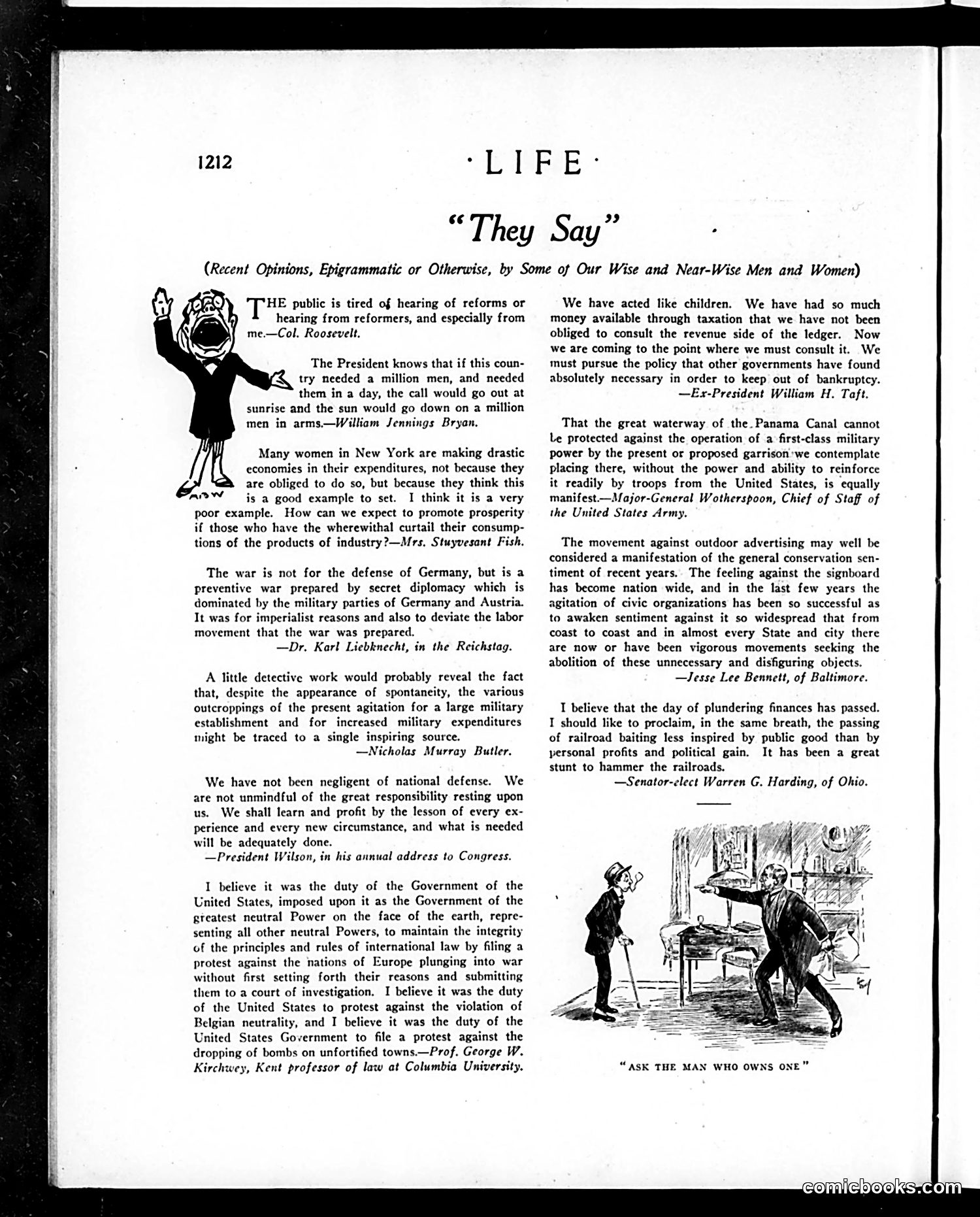
This page collects contemporary political opinions on World War I-era issues, presented as satire through the "They Say" column format. **Key figures and positions:** - **Col. Roosevelt** complains about reform talk - **William Jennings Bryan** expresses confidence in rapid military mobilization - **Mrs. Stuyvesant Fish** (wealthy socialite) argues against wealthy women's "economy" displays, which she sees as harmful to consumer spending and prosperity - **Dr. Karl Liebknecht** (German socialist) characterizes the war as imperialist aggression designed to suppress labor movements - **Nicholas Murray Butler** suggests military expansion agitation is orchestrated propaganda - **President Wilson** offers cautious platitudes about defense - **Ex-President Taft** warns of fiscal irresponsibility - **Prof. Kirchwey** argues the U.S. should have protested war violations **The satire:** By juxtaposing these contradictory statements—from interventionists, pacifists, socialists, capitalists, and politicians—the magazine mocks the confusion and self-interest driving public debate about American military preparedness and WWI involvement.
📄 Transcribed text from this page (OCR, searchable)
Machine-transcribed from the original scan — historical spelling and the odd misread are preserved.
~ [ERE “They Say” (Recent Opinions, Epigrammatic or Otherwise, by Some of Our Wise and Near-Wise Men and Women) TH public is tired of hearing of reforms or hearing from reformers, and especially from me—Col. Roosevelt. The President knows that if this coun- try needed a million men, and needed them in a day, the call would go out at sunrise and the sun would go down on a million men in arms.—William Jennings Bryan. Many women in New York are making drastic economies in their expenditures, not because they are obliged to do so, but because they think this is a good example to set. I think it is a very poor example. How can we expect to promote prosperity if those who have the wherewithal curtail their consump- tions of the products of industry?—Mrs. Stuyvesant Fish. a The war is not for the defense of Germany, but is a Preventive war prepared by secret diplomacy which is dominated by the military parties of Germany and Austria. It was for imperialist reasons and also to deviate the labor movement that the war was prepared. —Dr. Karl Liebknecht, in the Reichstag. A little detective work would probably reveal the fact that, despite the appearance of spontaneity, the various outcroppings of the present agitation for a large military establishment and for increased military expenditures might be traced to a single inspiring source. —Nicholas Murray Butler. We have not been negligent of national defense. We are not unmindful of the great responsibility resting upon us. We shall learn and profit by the lesson of every ex- perience and every new circumstance, and what is needed will be adequately done. —President Wilson, in his annual address to Congress. I believe it was the duty of the Government of the United States, imposed upon it as the Government of the greatest neutral Power on the face of the earth, repre- senting all other neutral Powers, to maintain the integrity of the principles and rules of international law by filing a protest against the nations of Europe plunging into war without first setting forth their reasons and submitting them to a court of investigation. I believe it was the duty of the United States to protest against the violation of Belgian neutrality, and I believe it was the duty of the United States Government to file a protest against the dropping of bombs on unfortified towns.—Prof. George W. Kirchwey, Kent professor of law at Columbia University. We have acted like children. We have had so much money available through taxation that we have not been obliged to consult the revenue side of the ledger. Now we are coming to the point where we must consult it. We must pursue the policy that other governments have found absolutely necessary in order to keep out of bankruptcy. —Ex-President William H. Taft. That the great waterway of the. Panama Canal cannot Le protected against the operation of a first-class military power by the present or proposed garrison we contemplate placing there, without the power and ability to reinforce it readily by troops from the United States, is equally manifest—Major-General Wotherspoon, Chief of Staff of the United States Army. The movement against outdoor advertising may well be considered a manifestation of the general conservation sen- timent of recent years. The feeling against the signboard has become nation wide, and in the last few years the agitation of civic organizations has been so successful as to awaken sentiment against it so widespread that from coast to coast and in almost every State and city there are now or have been vigorous movements secking the abolition of these unnecessary and disfiguring objects. —TJesse Lee Bennett, of Baltimore. I believe that the day of plundering finances has passed. I should like to proclaim, in the same breath, the passing of railroad baiting less inspired by public good than by personal profits and political gain. It has been a great stunt to hammer the railroads. —Senator-elect Warren G. Harding, of Ohio. “ASK THE MAN WHO OWNS ONE”