
Life, 1914-12-31 · page 24 of 41
Life — December 31, 1914 — page 24: what you’re looking at
What you’re looking at
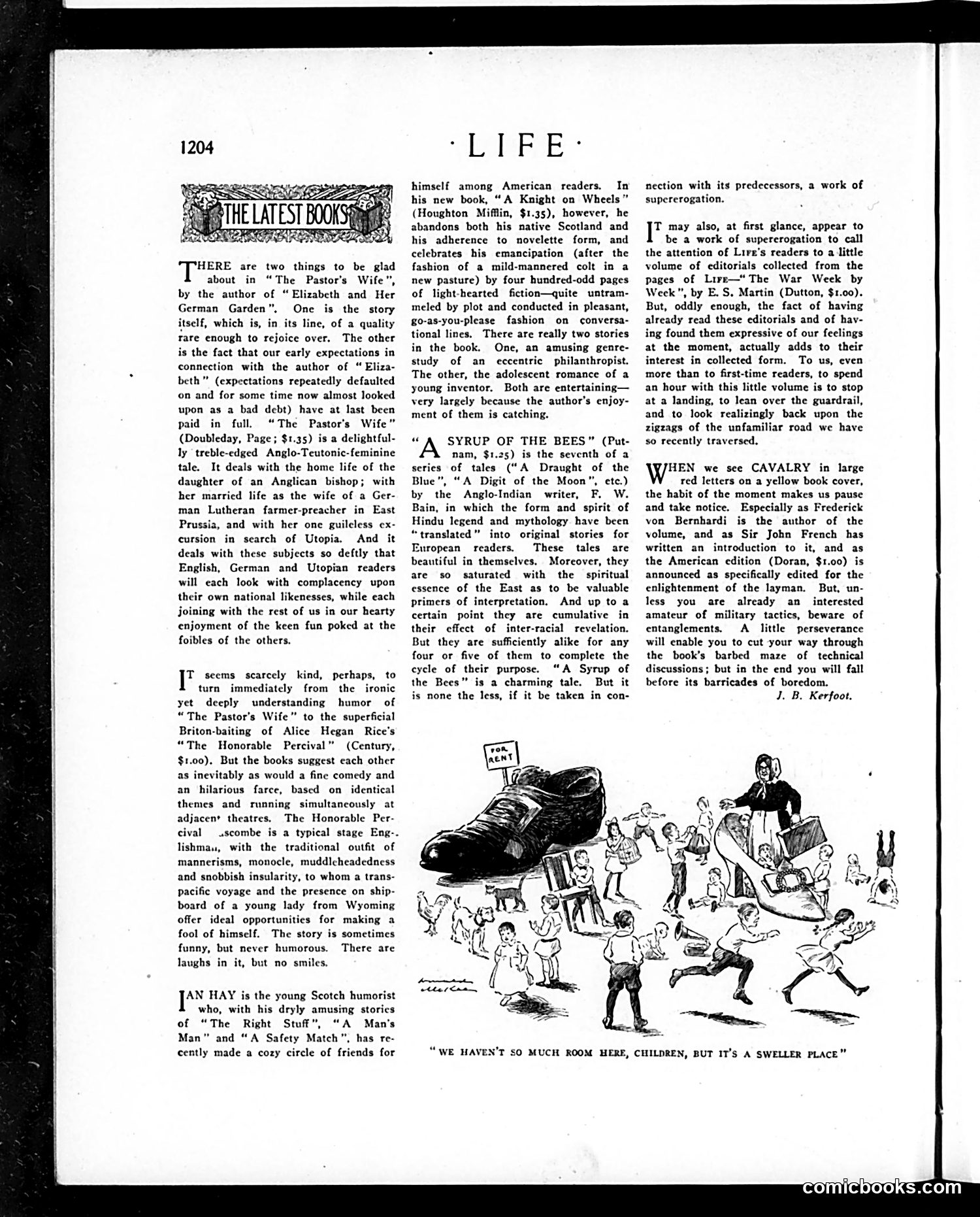
This is a book review page from *Life* magazine featuring literary criticism rather than political satire. The main content discusses contemporary novels, including works by authors now largely forgotten. The single cartoon at the bottom depicts a large shoe with children playing around it—an illustration of the nursery rhyme "There Was an Old Woman Who Lived in a Shoe." The caption reads: "We haven't so much room here, children, but it's a swell place." The cartoon likely comments on overcrowding or housing conditions of the era, using the familiar rhyme as a humorous reference point. The "swell place" suggests ironic acceptance of cramped circumstances—a gentle social observation typical of *Life*'s satirical style. The page itself is primarily a literary review discussing novels by various authors, evaluating their merits and comparing their styles.
📄 Transcribed text from this page (OCR, searchable)
Machine-transcribed from the original scan — historical spelling and the odd misread are preserved.
HERE are two things to be glad about in “The Pastor's Wii by the author of “Elizabeth and Her German Garden”. One is the story itself, which is, in its line, of a quality Tare enough to rejoice over. The other is the fact that our early expectations in connection with the author of “ Eliza- beth” (expectations repeatedly defaulted on and for some time now almost looked upon as a bad debt) have at last been paid in full. “The Pastor's Wife” (Doubleday, Page; $1.35) is a delightful- ly ‘treble-edged Anglo-Teutonic-feminine tale. It deals with the home life of the daughter of an Anglican bishop; with her married life as the wife of a Ger- man Lutheran farmer-preacher in East Prussia, and with her one guileless ex- cursion in search of Utopia. And it deals with these subjects so deftly that English, German and Utopian readers will each look with complacency upon their own national likenesses, while each joining with the rest of us in our hearty enjoyment of the keen fun poked at the foibles of the others. T seems scarcely kind, perhaps, to turn immediately from the ironic yet deeply understanding humor of “The Pastor's Wife” to the superficial Briton-baiting of Alice Hegan Rice's “The Honorable Percival” (Century, $1.00), But the books suggest each other as inevitably as would a fine comedy and an hilarious farce, based on identical themes and running simultancously at adjacen* theatres, The Honorable Per- cival lishmau, with the traditional outfit of mannerisms, monocle, muddlcheadedness and snobbish insularity, to whom a trans- pacific voyage and the presence on ship- board of a young lady from Wyoming offer ideal opportunities for making a fool of himself. The story is sometimes funny, but never humorous. There are laughs in it, but no smiles. AN HAY is the young Scotch humorist who, with his dryly amusing storics of “The Right Stuf”, “A Man's Man” and “A Safety Match”, has re- cently made a cozy circle of friends for ascombe is a typical stage Eng-. VlCaRRE * himself among American readers. In his new book, “A Knight on Wheels” (Houghton Mifflin, $1.35), however, he abandons both his native Scotland and his adherence to novelette form, and celebrates his emancipation (after the fashion of a mild-mannered colt in a new pasture) by four hundred-odd pages of light-hearted fiction—quite untram- meled by plot and conducted in pleasant, go-as-you-please fashion on conversa- tional lines. There are really two stories in the book. One, an amusing genre- study of an eccentric philanthropist. The other, the adolescent romance of a young inventor. Both are entertaining— very largely because the author's enjoy- ment of them is catching. . SYRUP OF THE BEES” (Put- nam, $1.25) is the seventh of a series of tales (“A Draught of the Blue”, “A Digit of the Moon”, etc.) by the Anglo-Indian writer, F. W. Bain, in which the form and spirit of Hindu legend and mythology have been “translated” into original stories for European readers. These tales are beautiful in themselves. Moreover, they are so saturated with the spiritual essence of the East as to be valuable primers of interpretation. And up to a certain point they are cumulative in their effect of inter-racial revelation. But they are sufficiently alike for any four or five of them to complete the cycle of their purpose. “A Syrup of. the Bees” is a charming tale. But it is none the less, if it be taken in con- nection with its predecessors, a work of supererogation. T may also, at first glance, appear to be a work of supererogation to call the attention of Live's readers to a little volume of editorials collected from the pages of Lire—“The War Week by Week”, by E. S. Martin (Dutton, $1.00). But, oddly enough, the fact of having already read these editorials and of hav- ing found them expressive of our feelings at the moment, actually adds to their interest in collected form. To us, even more than to first-time readers, to spend an hour with this little volume is to stop at a landing, to lean over the guardrail, and to look realizingly back upon the zigzags of the unfamiliar road we have so recently traversed, HEN we see CAVALRY in large red letters on a yellow book cover, the habit of the moment makes us pause and take notice. Especially as Frederick von Bernhardi is the author of the volume, and as Sir John French has written an introduction to it, and as the American edition (Doran, $1.00) is announced as specifically edited for the enlightenment of the layman. But, un- less you are already an _ interested amateur of military tactics, beware of entanglements. A little perseverance will enable you to cut your way through the book’s barbed maze of technical discussions; but in the end you will fall before its barricades of boredom. J. B. Kerfoot. ‘T SO MUCH ROOM HERE, CHILDREN, BUT IT’S A SWELLER PLACE”