
Life, 1914-12-31 · page 12 of 41
Life — December 31, 1914 — page 12: what you’re looking at
What you’re looking at
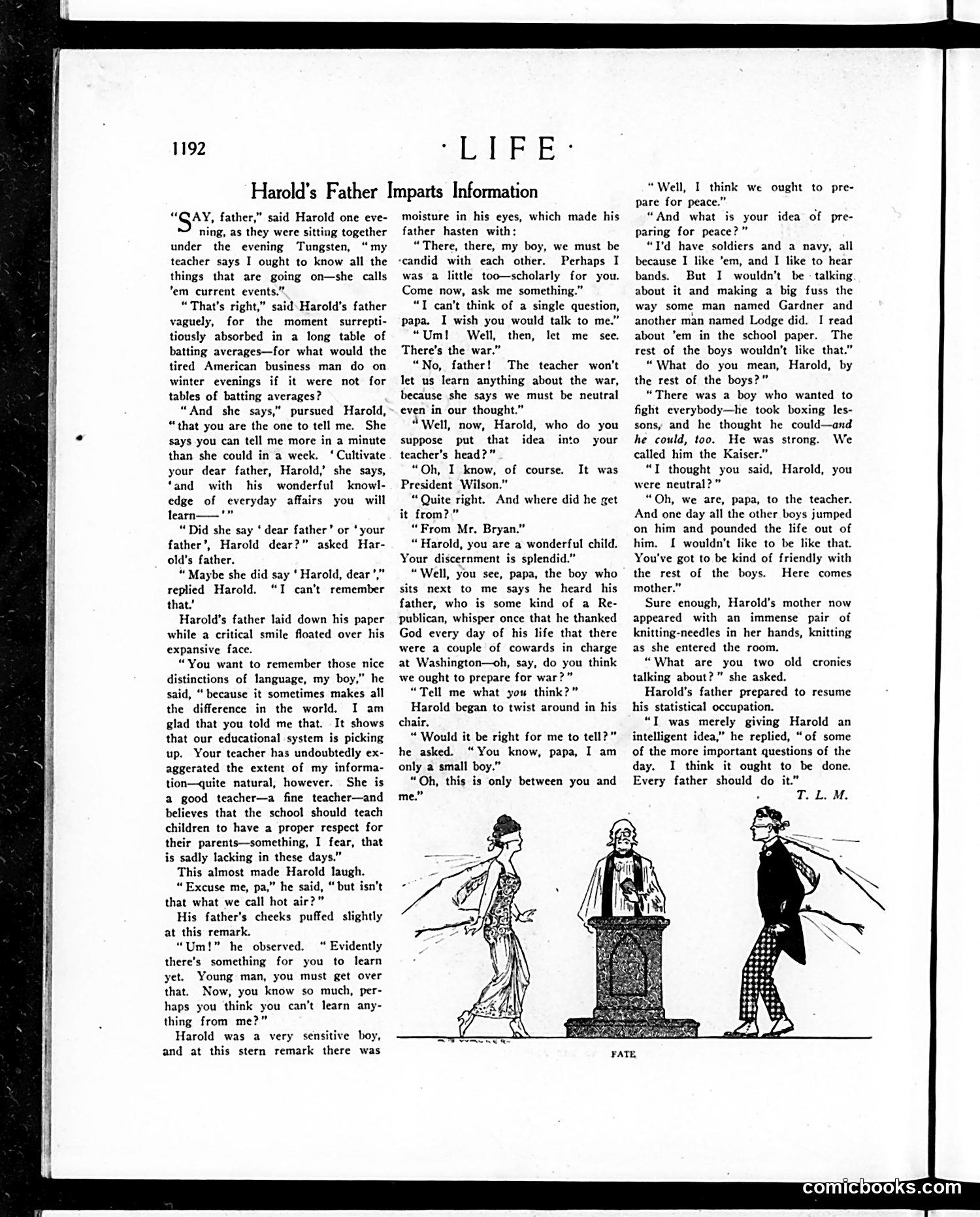
This satirical story critiques how fathers discuss current events with sons. Harold's father insists he should know about "all the things that are going on" and calls them "current events," but when Harold asks specific questions about the war and peace preparation, the father becomes evasive and defensive. The satire targets adult hypocrisy: fathers demand children stay informed while refusing to provide actual information or coherent answers themselves. Harold's teacher wants neutrality on war; his father contradicts this with bellicose rhetoric. The bottom illustration labeled "FATE" appears to show three figures in different poses, likely emphasizing life's uncertainties—thematically connected to the father-son dialogue about an uncertain future. The piece satirizes pre-WWI American confusion about preparedness and neutrality.
📄 Transcribed text from this page (OCR, searchable)
Machine-transcribed from the original scan — historical spelling and the odd misread are preserved.
alee: * Harold's Father Imparts Information “SAY. father,” said Harold one eve- ning, as they were sitting together under the evening Tungsten, “my teacher says I ought to know all the things that are going on—she calls ‘em current events.” “That's right,” said Harold’s father vaguely, for the moment surrepti- tiously absorbed in a long table of batting averages—for what would the tired American business man do on winter evenings if it were not for tables of batting averages? “And she says," pursued Harold, “that you are the one to tell me. She says you can tell me more in a minute than she could in a week. ‘Cultivate your dear father, Harold,’ she says, ‘and with his wonderful knowl- edge of everyday affairs you will learn——'” “ Did she say ‘dear father’ or ‘your father’, Harold dear?” asked Har- old's father. “Maybe she did say ‘ Harold, dear’,” replied Harold. “I can’t remember that.’ Harold’s father laid down his paper while a critical smile floated over his expansive face. “You want to remember those nice distinctions of language, my boy,” he said, “ because it sometimes makes all the difference in the world. I am glad that you told me that. It shows that our educational system is picking up. Your teacher has undoubtedly ex- aggerated the extent of my informa- tion—quite natural, however. She is a good teacher—a fine teacher—and believes that the school should teach children to have a proper respect for their parents—something, I fear, that is sadly lacking in these days.” This almost made Harold laugh. “Excuse me, pa,” he said, “ but isn’t that what we call hot air?” His father’s cheeks puffed slightly at this remark. “Um!” he observed, “ Evidently there’s something for you to learn yet. Young man, you must get over that. Now, you know so much, per- haps you think you can’t learn any- thing from me?” Harold was a very sensitive boy, and at this stern remark there was -candid with each other. moisture in his eyes, which made his father hasten with: “There, there, my boy, we must be Perhaps I was a little too—scholarly for you. Come now, ask me something.” “TI can't think of a single question, papa. I wish you would talk to me.” “Um! Well, then, let me see. There's the war.” “No, father! The teacher won't let us learn anything about the war, because she says we must be neutral even in our thought.” “Well, now, Harold, who do you suppose put that idea into your teacher’s head?” “Oh, I know, of course. President Wilson.” “Quite right. And where did he get it from?” “From Mr. Bryan.” “ Harold, you are a wonderful child. Your discernment is splendid.” “Well, you see, papa, the boy who sits next to me says he heard his father, who is some kind of a Re- publican, whisper once that he thanked God every day of his life that there were a couple of cowards in charge at Washington—oh, say, do you think we ought to prepare for war?” “Tell me what you think?” Harold began to twist around in his chair. “ Would it be right for me to tell?” he asked. “You know, papa, I am only a small boy.” “Oh, this is only between you and me.” It was “Well, I think we ought to pre- pare for peace.” “And what is your idea of pre- paring for peace?” “I'd have soldiers and a navy, all because I like ‘em, and I like to hear bands. But I wouldn't be - talking about it and making a big fuss the way some man named Gardner and another man named Lodge did. I read about ’em in the school paper. The rest of the boys wouldn't like that.” “What do you mean, Harold, by the rest of the boys?” “There was a boy who wanted to fight everybody—he took boxing les- sons, and he thought he could—and he could, too. He was strong. We called him the Kaiser.” “TI thought you said, Harold, you were neutral?” “Oh, we are, papa, to the teacher. And one day all the other boys jumped on him and pounded the life out of him. I wouldn't like to be like that. You've got to be kind of friendly with the rest of the boys. Here comes mother.” Sure enough, Harold's mother now appeared with an immense pair of knitting-needles in her hands, knitting as she entered the room. “What are you two old cronies talking about?” she asked. Harold’s father prepared to resume his statistical occupation. “I was merely giving Harold an intelligent idea,” he replied, “of some of the more important questions of the day. I think it ought to be done. Every father should do it.”